

What Causes Sciatica Nerve Pain and How to Treat It
You bend to pick up a folder, expecting the familiar tug of a stiff lower back. Instead, a hot, electric jolt shoots through your buttock and down the back of your thigh. You shift your weight without thinking, reach for a chair, and wonder why sitting feels easier while standing or coughing makes the pain spike.
That pattern is often called sciatica, a symptom involving radiating pain along the distribution of the sciatic nerve. It isn't one single disease, and the same treatment won't work equally well for every person. The useful question is not only “what causes sciatica nerve pain,” but also which structure is irritated, how long it has been irritated, and what symptoms the nerve is producing.
The map below follows the pain from the spine outward. You'll learn how the sciatic nerve works, why discs and narrowed spinal spaces are common sources, which symptoms need urgent attention, and how care changes between acute, subacute, and chronic stages.
When a Sharp Leg Pain Stops Your Day
By mid-afternoon, the office worker in front of me has stopped pretending the problem is ordinary stiffness. Yesterday, bending over felt uncomfortable but manageable. Today, reaching toward the floor sent pain from the low back into the buttock, down the back of the thigh, and toward the calf. The leg now feels hot and unreliable, and every attempt to stand tall brings another sharp reminder.
That story is common in physical therapy clinics. People often describe burning, shooting, or electric pain rather than a dull muscle ache. They may sit with one hip shifted, avoid stairs, or walk carefully because the leg feels different from the other side. Coughing, sneezing, or straining can briefly intensify symptoms because pressure changes can stress an already irritated nerve root.
The distinction matters. Low back stiffness can stay near the spine, while sciatica travels into the leg along a recognizable nerve distribution. The pain may extend below the knee, and some people also notice tingling, numbness, or weakness.
Practical rule: Pain that travels into the leg deserves a closer look than back soreness that stays local.
Sciatica most often begins where a nerve root leaves the lower spine. A disc may bulge or herniate, bone may narrow the space around the root, or degenerative changes may create intermittent pressure. In older adults, lumbar spinal stenosis becomes an important cause, while spondylolisthesis, a forward slip of one vertebra, can also produce sciatic symptoms. StatPearls' clinical overview of sciatica describes a lifetime incidence ranging from 10% to 40% and an annual incidence of 1% to 5%.
The rest of the explanation starts with the nerve itself. Once you understand its route and the way pressure changes nerve signaling, the different causes become easier to recognize.
The Sciatic Nerve and Why It Acts Up
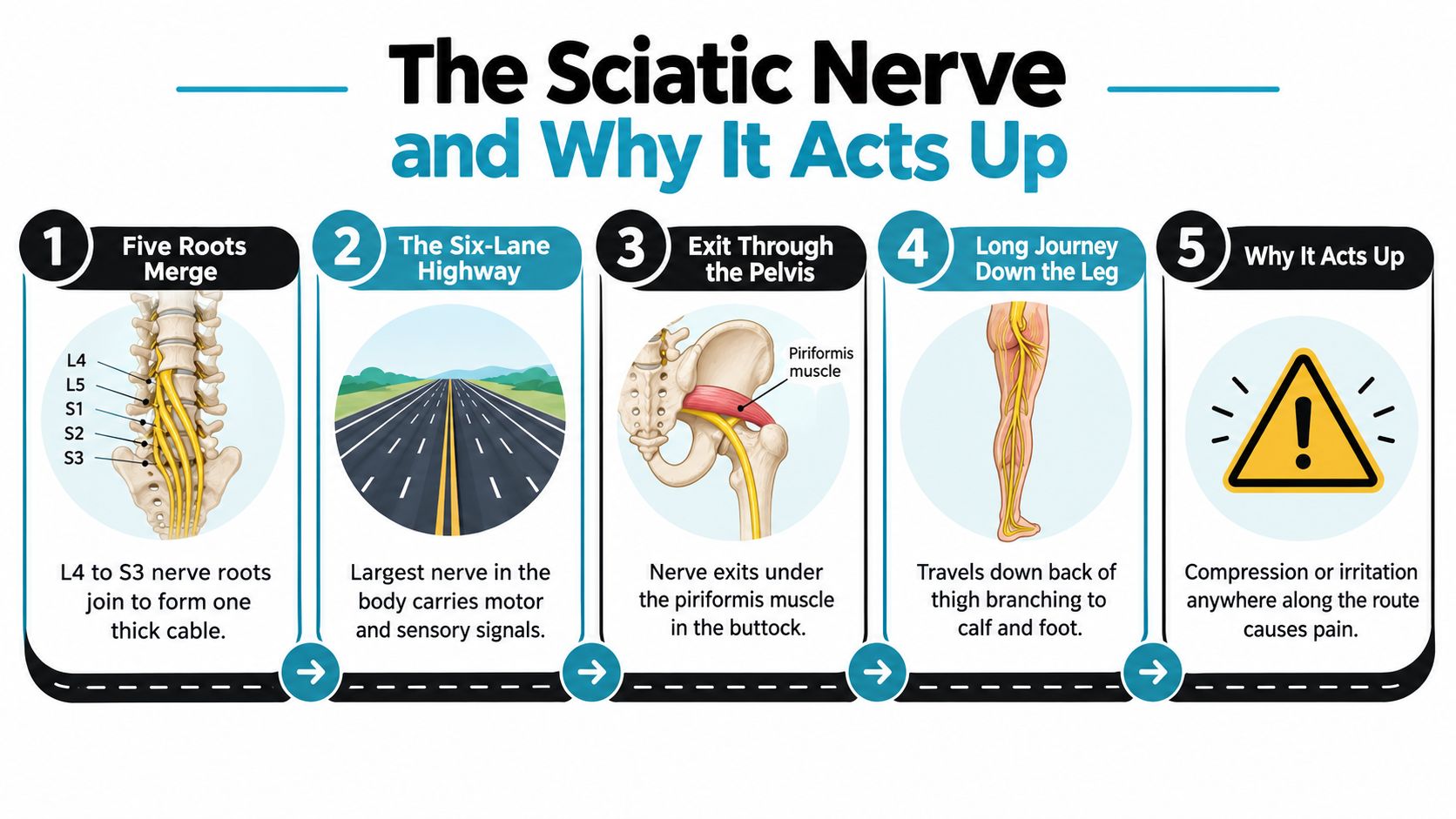
Think of the sciatic nerve as a six-lane communications highway. Several smaller roads leave the lower spine, merge into one large cable, pass through the pelvis and buttock, then travel down the back of the leg before splitting into branches that reach the lower leg and foot.
Five spinal roots, commonly described from L4 through S3, contribute to this cable. The nerve exits the pelvis near the piriformis muscle, crosses the buttock region, and runs down the back of the thigh. Near the knee, it divides into the tibial and common peroneal nerves. Those branches carry signals that help control movement and sensation through much of the lower leg.
What pressure does to the nerve
A nerve root can become painful through mechanical deformation, inflammation, or both. A herniated disc may press against the root while disc material also releases biologically active substances that irritate nearby tissues. Narrowed bone spaces can reduce room for the root and affect its small blood vessels, particularly when the spine moves into positions that further close the available space.
The irritated root may begin sending abnormal signals even when no new injury is occurring. The brain interprets those signals as burning, pins and needles, electrical pain, or numbness. Research summarized in a basic science review describes direct root deformation alongside inflammatory activity, including immune-cell responses around compressed roots. The review of nerve-root pain mechanisms explains why persistent symptoms may involve more than simple physical pinching.
Radicular pain follows a nerve-root pattern. Referred pain behaves differently. A facet joint, muscle, or sacroiliac joint can send discomfort into the buttock or thigh without directly disrupting nerve conduction. Two people can have similar-looking scans but very different symptoms because different nerve fibers, or fascicles, are being affected.
That distinction is why a scan alone can't answer what causes sciatica nerve pain. The clinician has to match the image with the location of pain, sensory changes, strength, reflexes, and movement behavior.
Common and Less Common Causes of Sciatica
The most recognizable cause is a lumbar disc herniation. Discs sit between the vertebrae as load-sharing cushions. If the outer layer develops a tear or the disc bulges into the canal, inner material can irritate or compress a nearby nerve root, often around the lower lumbar levels. Bending, lifting, sitting, coughing, or sneezing may aggravate the leg pain, although symptoms vary.
A major review in the British Journal of Anaesthesia describes disc herniation as the principal pathogenesis-focused explanation for sciatica and cites lifetime incidence estimates of 13% to 40%, with annual incidence of 1% to 5%. The review on sciatica and lumbar disc herniation also notes that population prevalence varies widely because researchers define and measure sciatica differently.
How the major causes differ
- Disc-related irritation: Symptoms may begin after bending, lifting, or an awkward movement. Leg pain often dominates, and coughing or sneezing can increase it. A neurological exam helps identify the affected root.
- Spinal stenosis: Degenerative changes, osteophytes, disc-height loss, or thickened tissues narrow the central canal or the opening where a nerve exits. Standing and walking may worsen symptoms, while sitting or leaning forward may help.
- Spondylolisthesis: One vertebra shifts forward relative to another, potentially narrowing the nerve exit. Imaging helps confirm the alignment change, but symptoms still need to match the affected side and level.
- Piriformis or deep-gluteal irritation: Pain is often centered in the buttock and may worsen with prolonged sitting or positions that load the deep rotator muscles. Tenderness and movement testing can help distinguish it from lumbar radiculopathy.
- Sacroiliac or facet referral: These joints can refer pain into the buttock or thigh without producing a classic nerve-root deficit. A clinician uses a cluster of movement and provocation findings rather than one painful test.
- Pregnancy, trauma, and systemic illness: Pregnancy can alter pelvic loading and ligament tension. Falls or lifting injuries can affect discs, joints, or bones. Tumors, cysts, infection, and diabetes-related neuropathy are less common possibilities that require medical evaluation when the history suggests them.
The phrase “pinched nerve” is useful shorthand, but it can mislead. The nerve may be compressed by disc material, irritated by inflammatory substances, crowded by degenerative bone, or affected by a problem outside the spine.
For readers exploring disc-related rehabilitation, physical therapy for a herniated disc can provide context on how clinicians match exercise and hands-on care to the suspected source.
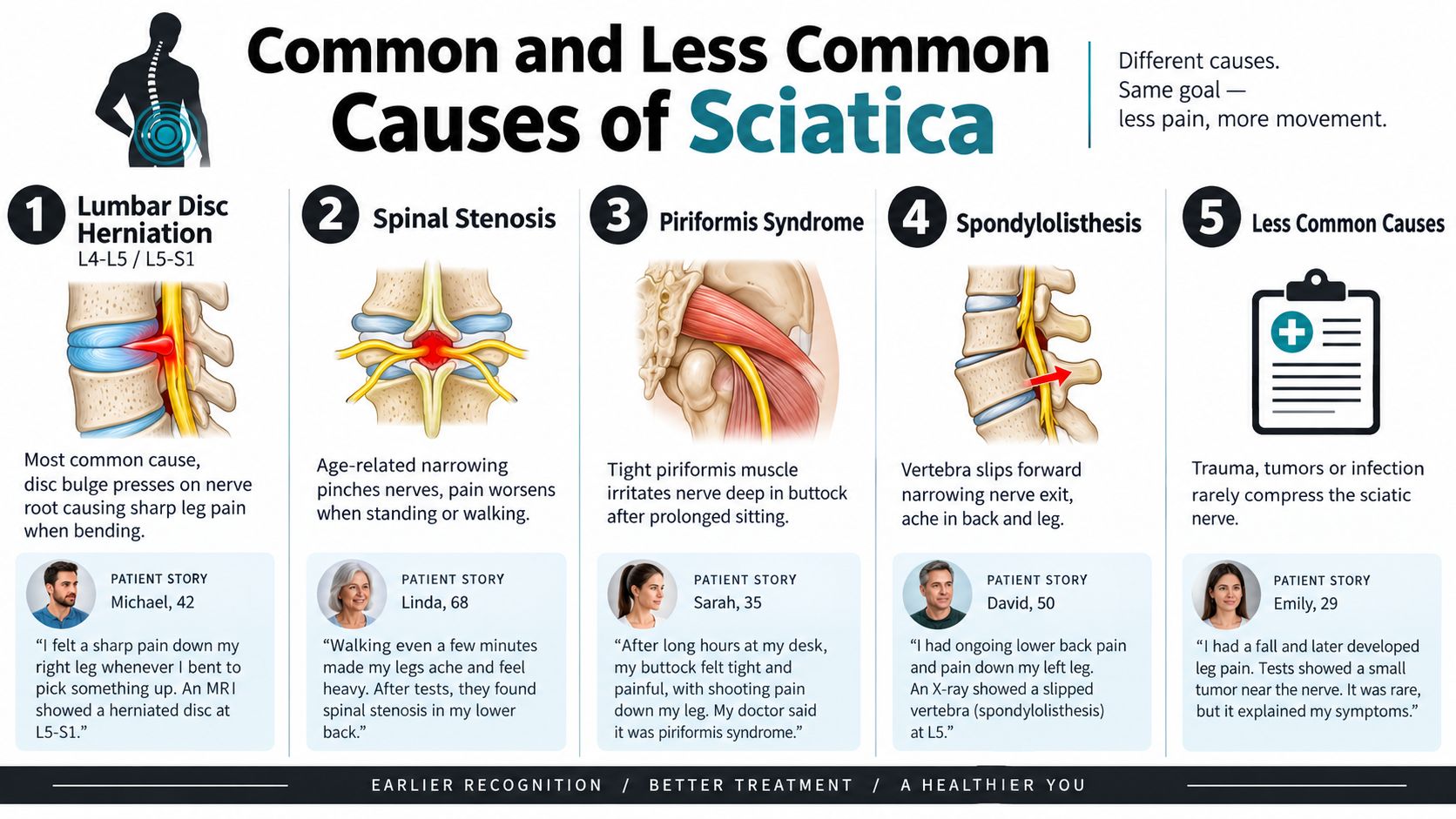
A short visual summary can help separate a disc pattern from stenosis, deep-gluteal pain, vertebral slippage, and uncommon medical causes.
Recognizing the Symptom Pattern and Red Flags
Sciatica usually announces itself through the leg, not just the low back. The exact route depends on which nerve root is involved, but symptoms may include burning, tingling, numbness, or an electric sensation extending through the buttock, thigh, calf, or foot. Pain below the knee is particularly suggestive of nerve-root involvement, though no single location proves the diagnosis.
Sensory symptoms are only one part of the picture. A nerve also carries movement and reflex signals, so a more significant problem may affect strength or coordination.
- Sensation: You may notice altered feeling, prickling, burning, or numbness in a strip of the leg or foot.
- Strength: Difficulty lifting the front of the foot, pushing off, climbing stairs, or rising from a chair can indicate motor involvement.
- Reflexes: A clinician may find a reduced knee or ankle reflex on one side.
- Behavior: Sitting, standing, walking, bending, or coughing may change symptoms in a repeatable way.
When not to wait
Some symptoms require same-day medical evaluation rather than a home exercise experiment. Seek urgent care for new bowel or bladder changes, numbness in the saddle area, or rapidly progressive leg weakness. Severe pain after significant trauma, fever with back pain, unexplained weight loss, and night pain that repeatedly wakes you also deserve prompt assessment.
A sudden change is more concerning when it occurs alongside a history of cancer, osteoporosis, or steroid use. Bilateral symptoms can also signal a broader narrowing problem, especially when they occur with changes in walking or bladder function.
Pain is important, but loss of function is the feature that changes the urgency.
For the next forty-eight hours, record where the pain travels, what movement brings it on, whether it reaches below the knee, and whether strength or sensation changes. That short record won't diagnose the condition, but it gives a clinician a clearer starting point and helps distinguish a changing neurological problem from a stable mechanical pattern.
How Clinicians Diagnose the Real Source
A good evaluation begins before anyone orders a scan. You explain where the pain starts, where it travels, when it began, what makes it worse, and whether you've had similar episodes. The clinician also asks about weakness, numbness, walking changes, trauma, fever, cancer history, and bowel or bladder symptoms.
The physical examination then tests whether the story behaves like nerve-root irritation. The provider may watch you walk on your heels and toes, observe how you rise from a chair, check lumbar movement, and compare one side with the other.
The neurological screen
A straight-leg raise gently tensions the lower nerve pathway. A slump test adds movement through the spine and leg to see whether symptoms respond to neural loading. A femoral stretch test examines a different part of the lumbar nerve system, which can help when pain travels through the front of the thigh rather than the classic back-of-leg route.
Strength testing checks specific muscle actions linked to nerve roots. Sensory testing compares areas of skin, and reflex testing checks whether the knee or ankle response differs. Findings may suggest irritation near the lower lumbar levels, but clinicians still interpret them alongside the entire symptom pattern.
The examination also looks for alternatives. Sacroiliac provocation, hip movement, deep-gluteal tenderness, and vascular signs can point away from a lumbar nerve root. A clean neurological screen makes severe radiculopathy less likely, even if the back remains painful.
When imaging adds value
Imaging becomes more useful when symptoms persist, weakness progresses, trauma raises concern for fracture, or infection or tumor is possible. An X-ray shows bone alignment and some degenerative changes. MRI provides a clearer view of discs, nerve roots, and soft tissues. CT gives detailed information about bone and can help when MRI isn't suitable or when a bony lesion needs closer inspection.
A scan can show a disc bulge or narrowing without proving that it causes the pain. Conversely, pain can persist even when the image doesn't show a dramatic lesion because inflammation, sensitivity, and movement behavior don't always appear clearly on a scan. The diagnosis is strongest when the clinical pattern and imaging point to the same structure.
Conservative Treatments That Actually Help
Treatment should follow the stage and suspected source rather than a fixed recipe. Acute symptoms may require calming irritability and preserving comfortable movement. Subacute symptoms often allow a more active progression. Chronic symptoms may need a broader plan that addresses strength, walking tolerance, sleep, fear of movement, work demands, and any contributing joint or muscle problem.
Comparing the main options
| Therapy | How It Works | Typical Sessions | Best Stage | Key Limitation |
|---|---|---|---|---|
| Physical therapy | Uses examination-guided exercise, nerve mobility work, stabilization, graded walking, and movement retraining | Depends on findings and response | Acute, subacute, or chronic | A generic program may aggravate symptoms if it ignores directional preference |
| Chiropractic care | May use spinal or joint mobilization, manipulation, and movement advice | Depends on response and diagnosis | Selected mechanical presentations | It may not address progressive weakness or substantial nerve compression |
| Acupuncture | Aims to modulate pain and support activity participation | Depends on the treatment plan | Often useful as an adjunct in subacute or chronic care | It doesn't remove a structural compression |
| Shockwave therapy | Targets selected myofascial or deep-gluteal contributors through mechanical stimulation | Depends on tissue response and protocol | Some persistent soft-tissue presentations | Evidence for nerve-root sciatica remains developing |
| Medication and home care | Reduces pain or inflammation enough to support movement and sleep | Short-term use should follow medical guidance | Often acute support | Medication doesn't replace assessment when neurological signs worsen |
Physical therapy may include McKenzie-style directional preference work, gentle nerve glides, trunk stabilization, and a graded walking plan. The right exercise is the one that improves function without driving leg pain farther down the limb. A therapist may reduce or change an exercise if symptoms peripheralize, meaning they travel farther from the spine into the leg.
Chiropractic manipulation can help some people whose symptoms include a mechanical joint restriction, but forceful treatment isn't appropriate for every presentation. Acupuncture may offer a pain-modulation option when symptoms have become persistent, while shockwave treatment is more logically considered when examination identifies a myofascial or deep-gluteal contributor rather than assuming every case comes from a disc.
Heat or ice can make movement more comfortable, but neither corrects the underlying cause. Short courses of anti-inflammatory or neuropathic medication may be considered by a medical professional. If you're reviewing supplements alongside prescribed care, discuss products such as Supplemynts Inc magnesium tablets with a pharmacist or clinician, especially if you take other medicines or have kidney problems.
A coordinated plan often combines education, one or two appropriate hands-on strategies, and progressive exercise. For more information on acupuncture as part of a broader plan, see acupuncture for sciatica pain.
The evidence also supports caution about promising one universal answer. A recent systematic review found no high-quality evidence that one non-surgical treatment consistently outperforms all others for chronic sciatica. A 2025 network meta-analysis reported short-term benefit signals for several interventions in acute or subacute sciatica, including NSAIDs combined with physical therapy modalities, antibiotics, and antidepressants, compared with sham or placebo. The PubMed analysis of acute and subacute sciatica treatments reinforces the need to match treatment to stage and cause.
When to Escalate to a Specialist
Conservative care has limits. Referral becomes more urgent when weakness progresses, foot drop develops, bowel or bladder function changes, saddle numbness appears, or pain remains severe and unremitting, especially at night.
Persistent symptoms also deserve reassessment when they aren't improving with an appropriate plan. The exact timing depends on severity and neurological findings, but weakness that continues beyond four to six weeks should prompt a more focused medical review rather than endless repetition of the same exercises.
A physiatrist may coordinate non-surgical rehabilitation, medication, and targeted injections. A pain specialist may discuss a selective nerve-root block or epidural steroid injection when the suspected root and symptoms align. An orthopedic spine surgeon or neurosurgeon may consider procedures such as microdiscectomy for a focal disc fragment or laminectomy when narrowed bone is compressing the nerve.
Escalation doesn't mean you've failed. It means the expected benefit of continued self-management may be lower than the benefit of clarifying the compression and discussing alternatives.
Before agreeing to a procedure, ask:
- What matches: Does the scan show compression on the same side and level as my symptoms?
- What is the goal: Is the procedure intended to reduce leg pain, improve strength, increase walking, or prevent worsening?
- What are the alternatives: What happens if I continue rehabilitation or choose an injection first?
- What changes urgency: Which new symptoms should send me back immediately?
Your Next Steps and a Simple Action Plan
Use the stage of your symptoms to choose the next practical move.
Acute symptoms
During the first two weeks, focus on comfortable movement rather than strict bed rest. Change positions, take short walks if tolerated, avoid movements that sharply increase leg symptoms, and arrange an evaluation if pain is intense or neurological changes appear.
Subacute symptoms
Between two and six weeks, track function rather than pain alone. Note how long you can sit, how far you can walk, whether the pain is retreating toward the back, and whether strength is improving. A physical therapist can adjust nerve mobility, trunk exercises, and walking progression to your response.
Chronic symptoms
Beyond six weeks, persistent symptoms deserve a fresh assessment of the diagnosis and treatment plan. Chronic sciatica may require coordinated care rather than another isolated modality. Read more about how long sciatica pain can last and use that information as a prompt to review your progress with a qualified provider.
Keep a simple daily record, repeat the neurological check with a clinician when needed, and don't ignore worsening weakness or emergency symptoms. Recovery rarely follows a perfectly straight line, but function should gradually become more reliable.
MedAmerica Rehab Center offers coordinated physical therapy, chiropractic care, acupuncture, and shockwave therapy for sciatica and related movement problems. If your leg pain, numbness, or weakness is limiting work, sleep, or walking, visit MedAmerica Rehab Center to arrange an evaluation and build a treatment plan around the actual source of your symptoms.
MedAmerica Rehab · Deerfield Beach
Talk to a clinician about your pain
Physical therapy, chiropractic, acupuncture and shockwave therapy under one roof, since 1995. Same-day appointments are available.
Mon–Thu 8:00 AM – 6:30 PM · Fri 8:00 AM – 3:00 PM