

Acupuncture for Sciatica Pain: What to Know
A sharp line of pain runs from your lower back through your buttock and down one leg. Sitting through a commute becomes difficult, sleep is interrupted by tingling, and a cough or small twist can trigger an electric jolt. You may have already tried medication, rest, stretching, or a referral for more intensive treatment, and now you're wondering whether acupuncture for sciatica pain can help without becoming another short-lived fix.
The honest answer is encouraging but limited. Recent evidence supports acupuncture for reducing pain and improving function in many people with sciatica, yet researchers still haven't settled how long the benefits last or which patients respond best. Acupuncture can be useful as part of a plan that may also include physical therapy, exercise, medical evaluation, or chiropractic care. It shouldn't be presented as a way to remove a herniated disk or replace urgent assessment when weakness or other warning signs appear.
What Sciatica Really Feels Like and Why People Consider Acupuncture
A sciatica flare rarely feels like ordinary low-back soreness. One day, you may notice a deep ache near the belt line. Soon, the discomfort travels into the buttock, back of the thigh, calf, or foot. Numbness can make part of the leg feel strangely absent, while weakness may show up as trouble lifting the front of the foot, climbing stairs, or standing on one leg.
Patients often describe the pain as burning, stabbing, buzzing, or shock-like. Sitting, driving, bending, and sleeping can all become negotiations. Even when the pain doesn't stay severe all day, the fear of provoking another jolt can lead people to move less, which may leave the back, hip, and leg less tolerant of normal activity.
Why acupuncture enters the conversation
People usually seek acupuncture after conventional options have offered only partial relief. Some want a non-drug approach because medication causes unwanted effects or doesn't provide enough control. Others have been told to wait, restrict activity, continue conservative care, or consider a surgical opinion, and they want something that might make daily movement more manageable during that period.
Referrals commonly come from friends, rehabilitation clinicians, physicians, or other patients who felt that needling reduced their pain enough to walk or exercise more comfortably. That motivation is reasonable, but the treatment still needs a proper clinical frame. The source may be a lumbar disk, narrowing around a nerve, or irritation in the buttock, and those presentations don't always need the same plan.
Practical perspective: Acupuncture may quiet the alarm signal, but it doesn't automatically correct the movement, strength, or structural problem that keeps irritating the nerve.
The useful questions aren't only “Does it work?” They're also “What type of symptoms do I have?”, “How quickly should I judge the response?”, “What happens when treatment stops?”, and “What care should accompany it?” The evidence offers some clear answers, while durability and treatment selection remain less certain.
How Acupuncture May Calm an Irritated Nerve
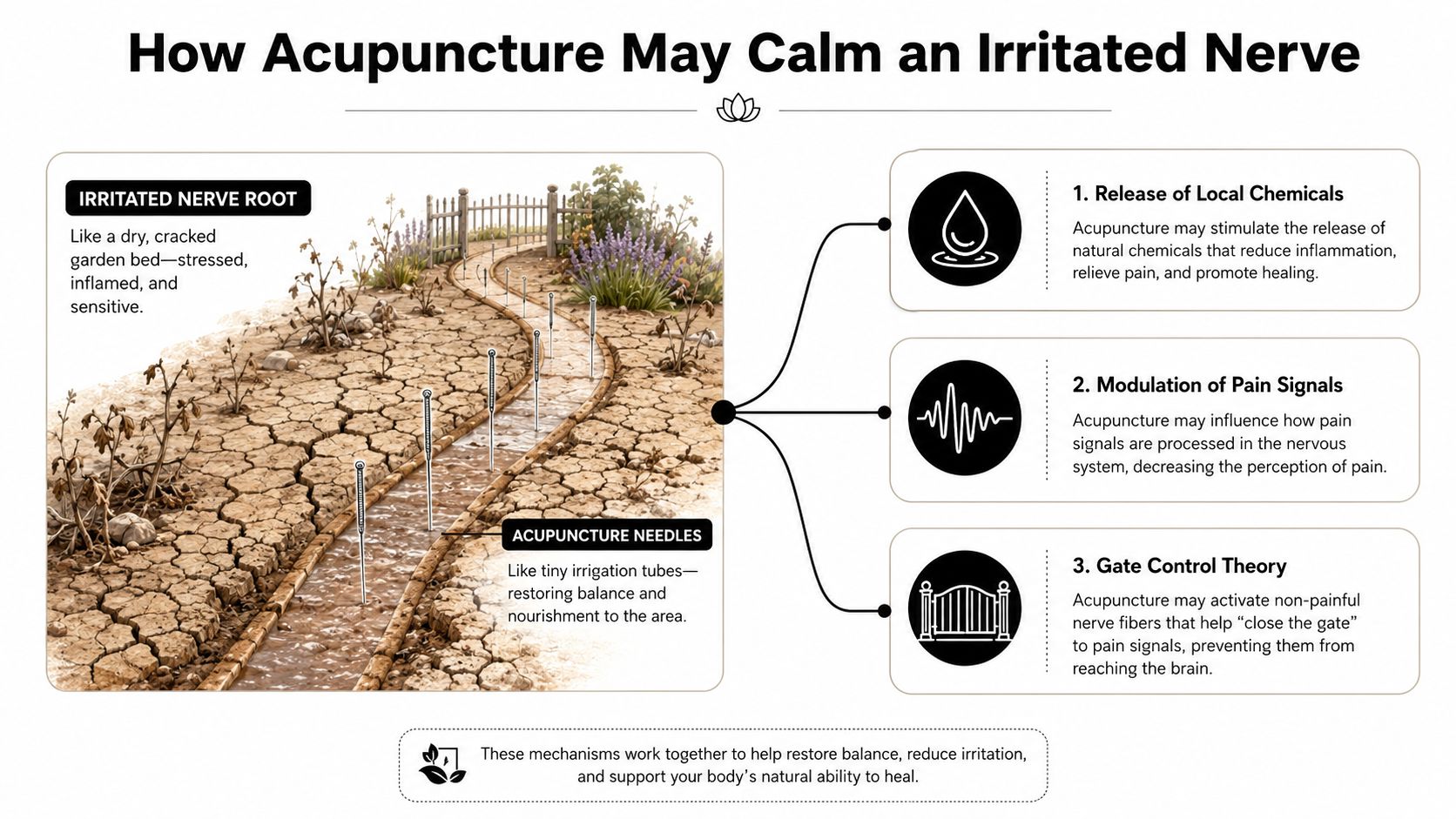
Think of an irritated nerve root as a dry, cracked garden bed. The soil is sensitive, the surrounding tissue is tense, and every small disturbance feels amplified. Acupuncture doesn't rebuild the garden in one visit, but carefully placed stimulation may change how the local tissues and nervous system respond.
Local tissue response
Fine needles placed near the lumbar spine, buttock, hip, or leg create a controlled sensory input. Researchers have proposed that this input encourages the release of local chemicals, including adenosine, and activates the body's own opioid-based pain-modulation systems. Those responses may reduce the intensity of signals coming from irritated muscles and nerve-related tissues.
The treatment isn't necessarily aimed at the exact point where the nerve is compressed. A practitioner may choose local paraspinal areas, gluteal points, or distal points along the leg. The selection depends on the symptom pattern, examination findings, and whether the presentation appears more consistent with lumbar nerve-root irritation or a peripheral source near the hip.
Changing pain traffic
The spinal cord acts less like a passive cable and more like a processing station. Sensory input from needling can compete with or modify incoming pain signals at the spinal segment. This is often described through gate control theory, a model in which non-painful sensory information influences how strongly the nervous system passes pain onward.
Electroacupuncture adds a gentle electrical pulse between selected needles. The predictable stimulation can provide repeated afferent input, meaning signals traveling toward the spinal cord and brain. It isn't automatically better for every patient, and intensity must match the person's sensitivity. A stronger sensation can irritate an already reactive system rather than improve it.
A broader nervous-system effect
Acupuncture may also engage descending pain-inhibition pathways, which help the brain regulate signals arriving from the body. Neurochemical and brain-imaging research supports the idea that needling can produce measurable nervous-system responses, although a biological mechanism doesn't guarantee meaningful relief for every individual.
The practical interpretation is modest. Acupuncture may lower sensitivity around an irritated pathway and create a window in which walking, sleeping, and rehabilitation feel more achievable. It doesn't dissolve a disk herniation, widen a narrowed spinal canal, or replace an examination that identifies progressive nerve damage.
What the Research Shows
Recent pooled evidence supports acupuncture as a possible option for sciatica, although the findings do not apply equally to every cause or treatment method. A 2023 systematic review and meta-analysis pooled 30 randomized controlled trials involving 2,662 participants. It found acupuncture outperformed medicine treatment, with a relative risk of 1.25 for total effective rate and a standardized mean difference of -1.72 for pain-score reduction. The review also reported advantages over medicine or sham acupuncture for clinical efficacy, recurrence reduction, and pain scores. Read the 2023 systematic review and meta-analysis in Frontiers in Neuroscience. For a broader explanation of acupuncture's role in pain care, see this guide on acupuncture for pain relief.
A 2026 meta-analysis examined randomized trials published from 2015.05 to 2025.05, focusing on chronic sciatica. Across the included studies, acupuncture reduced leg pain compared with controls, with an SMD of -1.08. Subgroup findings were -1.05 against sham acupuncture, -1.02 against standard care, and -1.12 against conventional acupuncture. Functional disability also improved, with an ODI SMD of -0.57 across 7 studies involving 621 patients. See the chronic-sciatica meta-analysis indexed by PubMed.
Selected trials and meta-analyses
| Study / Year | Design | Sample | Intervention vs Comparator | Pain Outcome (Effect Size) | Follow-Up |
|---|---|---|---|---|---|
| 2023 systematic review and meta-analysis | Pooled randomized controlled trials | 2,662 participants across 30 trials | Acupuncture vs medicine and sham acupuncture | Relative risk 1.25 for total effective rate, SMD -1.72 for pain reduction | Trial follow-up varied |
| 2026 chronic-sciatica meta-analysis | Pooled randomized trials | 11 RCTs for pain and 7 studies involving 621 patients for ODI | Acupuncture vs sham acupuncture, standard care, and conventional acupuncture | Overall leg pain SMD -1.08, ODI SMD -0.57 | Follow-up varied across studies |
| 2024 randomized clinical trial | Sham-controlled randomized trial | Sample size not stated in the verified data | Real acupuncture vs sham acupuncture for chronic sciatica from herniated disk | Real acupuncture produced less pain and better function | Benefits persisted through week 52 |
The 2024 randomized clinical trial offers useful comparative evidence because it tested real acupuncture against sham acupuncture for chronic sciatica caused by a herniated disk. Real acupuncture produced less pain and better function at week four, with benefits persisting through week 52. Review the trial in JAMA Internal Medicine.
Where the evidence remains incomplete
The research protocols differ in acupuncture points, stimulation methods, visit schedules, and definitions of improvement. Blinding is difficult because experienced patients and practitioners may recognize genuine needling. Some trials are small, and evidence for certain outcomes remains limited or very low quality.
Benefit duration remains uncertain. A 2025 sham-controlled study reported that improvements peaked around week four, while results at weeks 16, 28, and 52 were inconsistent. The 2026 analysis found meaningful pain and disability improvements, yet its studies were still dominated by research from China and did not establish whether relief reliably continues after treatment ends. Read the evidence discussion on benefit durability.
For patients, the practical conclusion is measured: acupuncture may reduce symptoms and make rehabilitation easier, but the evidence does not support using it as a replacement for physical therapy, medical assessment, or other indicated care.
What a Realistic Treatment Course Looks Like
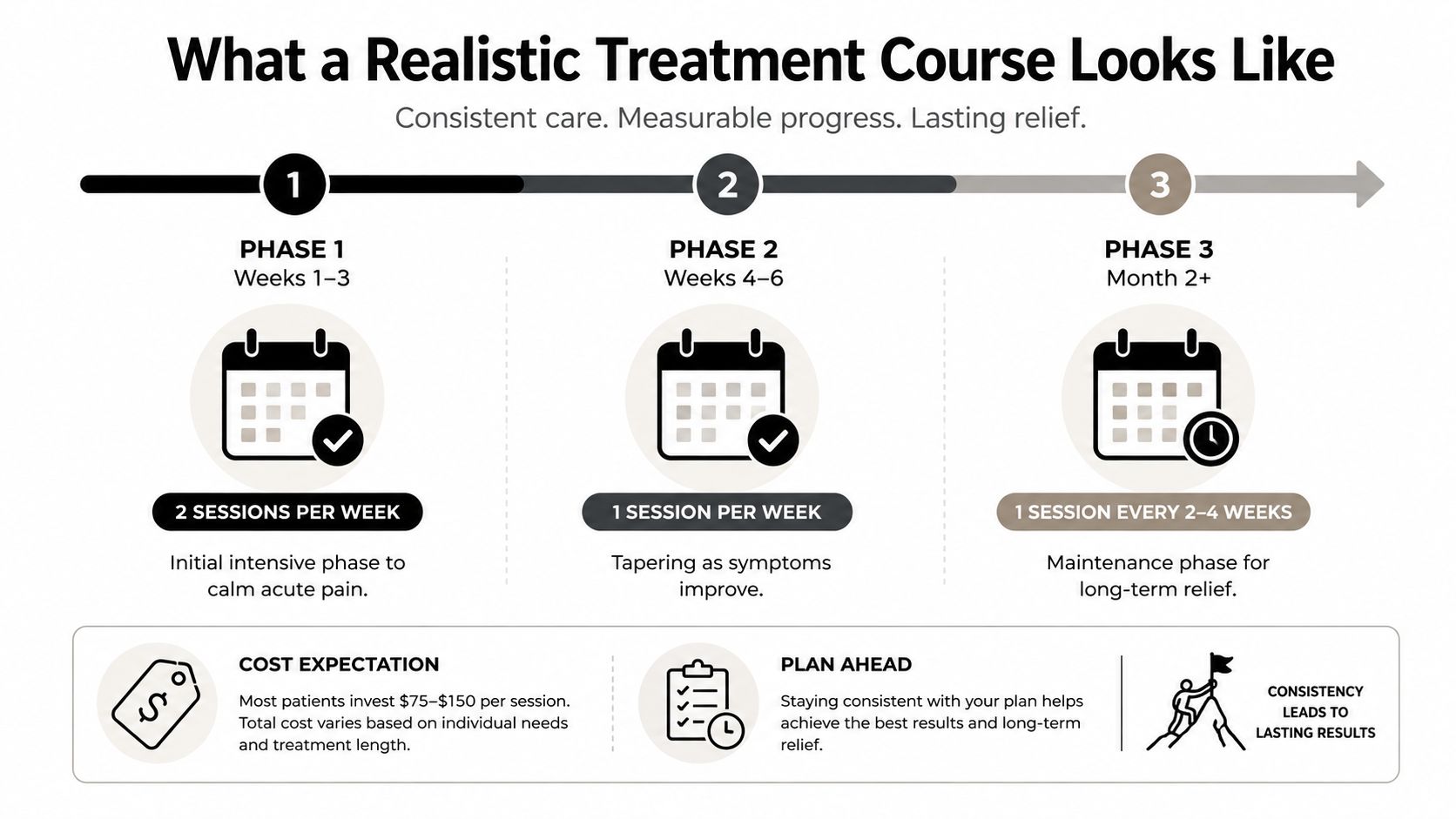
A practical acupuncture plan usually starts with more frequent visits, then tapers as symptoms settle. Many clinics use two sessions per week during the first two to three weeks, followed by weekly care as the patient improves. Meaningful relief often develops between session six and session ten, although some people notice a shift within hours, others need two or three visits, and a smaller group responds minimally.
The first appointment should include more than needle placement. The practitioner reviews symptom changes, checks how pain travels, asks about numbness and weakness, and palpates areas such as the lumbar paraspinals, gluteal muscles, and piriformis region. A typical treatment may use 10 to 20 sterile, single-use needles, retained for 20 to 30 minutes, with gentle manual stimulation or low-intensity electrical stimulation when appropriate.
What you may feel
A dull ache, warmth, heaviness, or mild tingling can occur at the needle site. Practitioners may call this de qi, a response that can feel unfamiliar but shouldn't be sharply painful. Tell the clinician immediately if you feel a sharp, electric, or radiating sensation that resembles your sciatica.
The first few sessions should have a clear purpose. Treatment may aim to lower resting pain so you can sleep, reduce guarding in the hip, or make prescribed exercises easier. If there's no meaningful change after a reasonable trial, continuing indefinitely without reassessing the diagnosis or treatment plan doesn't make sense.
Planning also matters. Ask how the clinic handles missed visits, whether follow-up care can taper, and how acupuncture fits with exercise appointments. The schedule should support work, childcare, transportation, and recovery rather than create a new source of stress.
Acupuncture Alongside Physical Therapy and Chiropractic Care
Acupuncture works best as one tool in a broader nerve-recovery plan when pain is limiting movement. Physical therapy can address strength, tolerance to loading, nerve mobility, trunk control, and the daily positions that provoke symptoms. Chiropractic care may include hands-on treatment, mobility work, and guidance around movement, but the techniques should be selected after screening for neurological changes and structural concerns.
A patient who feels less pain after acupuncture may finally tolerate walking practice, hip strengthening, or graded sitting exposure. That functional progress matters because pain reduction alone doesn't guarantee that the patient can return to work, lift safely, or manage the next flare.
Matching options to patient profiles
| Approach | Best fit for | Coordination notes |
|---|---|---|
| Acupuncture alone | Mild, intermittent symptoms without significant weakness, especially when the patient wants a limited non-drug trial | Reassess if pain persists, spreads, or begins affecting strength |
| Electroacupuncture plus home exercise | Moderate radicular pain, measurable strength loss, or work that requires prolonged sitting | Use stimulation cautiously and pair symptom relief with graded activity |
| Acupuncture plus physical therapy or chiropractic care | Post-acute rehabilitation, movement-related flares, or recovery after surgical clearance | Coordinate goals, examination findings, and progression between providers |
For people seeking a structured rehabilitation plan, sciatica physical therapy services can provide the exercise and movement component that needling can't deliver. Patients recovering after surgery should follow the surgeon's restrictions before adding acupuncture, manual therapy, or more demanding exercise.
Early in care, avoid scheduling aggressive manual treatment and needling on the same day if you don't know how your body responds. Share treatment notes when possible, identify which movements increase leg symptoms, and revisit the plan every four to six weeks. The right combination is the one that improves function without repeatedly provoking the nerve.
Common Misconceptions Worth Clearing Up
More needles don't automatically mean more relief. A thoughtful practitioner chooses points based on the pain distribution, examination findings, tissue sensitivity, and treatment response. Needling every painful area can create unnecessary soreness, and overstimulation may briefly increase symptoms.
Acupuncture isn't an immediate cure. Some patients feel a change quickly, but durable functional improvement generally depends on repeated treatment and movement retraining. The evidence supports symptom and disability improvements, yet it doesn't support promising that a disk herniation has been repaired.
The placebo question requires nuance
Sham-controlled research helps separate the effects of needling from expectation, but sham procedures aren't always physiologically inactive. Touch, pressure, sensory input, treatment attention, and expectation can all influence pain. The pooled findings favoring acupuncture over sham and usual care suggest that the intervention may offer effects beyond expectancy, but the size of that added benefit varies by study and outcome.
That distinction shouldn't become an argument for or against care in the abstract. The useful clinical test is whether your leg pain, sleep, walking, sitting tolerance, and exercise capacity improve enough to justify continuing.
A normal response versus a warning
Mild bruising, a dull ache, or temporary local soreness can occur. Sharp radiating pain during insertion isn't a desirable treatment target, and new or worsening neurological symptoms need medical review. Acupuncture also shouldn't delay evaluation for progressive weakness, bladder or bowel changes, or numbness in the saddle region.
Safety Considerations and When to Pause
Acupuncture is generally low risk when performed by a properly trained practitioner using sterile, single-use needles, but “low risk” doesn't mean “risk-free.” Before treatment, disclose anticoagulants, bleeding disorders, immune compromise, pregnancy, recent procedures, implanted devices, and any active infection near the proposed treatment areas.
Conditions that require caution
Blood thinners such as warfarin or direct oral anticoagulants can increase bruising or bleeding risk. A recent corticosteroid injection may affect how the practitioner schedules treatment, and spinal cord stimulators or pacemakers require discussion before electrical stimulation is used. Active skin infection, severe systemic illness, bleeding disorders, and immune-compromised states also change the risk assessment.
Pregnancy doesn't automatically rule out acupuncture, but certain points and techniques may be restricted. Tell the clinician early rather than assuming a standard sciatica protocol is appropriate.
Symptoms that need urgent medical assessment
Don't use acupuncture as a substitute for urgent evaluation if you develop:
- Progressive weakness: Increasing difficulty lifting the foot, standing, or controlling the leg needs prompt medical attention.
- Saddle anesthesia: Numbness around the inner thighs, groin, or buttocks is a warning sign.
- Bladder or bowel changes: New loss of control or inability to urinate requires urgent assessment.
- Systemic symptoms: Fever with back pain or unexplained weight loss should be medically investigated.
Stop a session early if you become dizzy, feel unwell, develop sharp radiating pain, or notice significant bleeding or a rapidly forming hematoma. Minor soreness can be observed, but a new neurological deficit shouldn't be watched at home.
Choosing a Practitioner and Preparing for Your First Visit
Start with credentials, then assess clinical reasoning. In the United States, ask whether the practitioner holds the relevant state license and whether national certification through the National Certification Commission for Acupuncture and Oriental Medicine, or an equivalent regulatory pathway, applies in your state. Confirm clean-needle training, professional liability coverage, and experience with neuropathic pain, lumbar radiculopathy, and sciatica rather than only general wellness treatments.
A strong intake should connect your symptom pattern to a treatment plan. Bring imaging reports, a current medication and supplement list, prior diagnoses such as disk herniation or spinal stenosis, and a short diary showing when pain travels, what positions worsen it, and whether numbness or weakness changes.
First visit preparation checklist
| Category | What to Prepare | Why It Matters |
|---|---|---|
| Medical history | Imaging reports, diagnoses, injections, surgeries, and relevant specialist notes | Helps distinguish nerve-root irritation from other sources of leg pain |
| Medication safety | Prescription drugs, blood thinners, supplements, and recent injections | Allows the practitioner to plan safely around bleeding and treatment risks |
| Symptom pattern | Pain location, aggravating positions, numbness, weakness, and sleep disruption | Guides point selection and establishes practical outcomes |
| Clinic credentials | State license, relevant certification, sterile-needle procedures, and sciatica experience | Gives you a way to judge professional standards |
| Coverage and logistics | Insurance questions, HSA or FSA eligibility, and self-pay policies | Prevents unexpected billing and helps you plan the course of care |
Ask the clinic to verify acupuncture benefits before your first visit. CPT codes 97810 and 97811 may be relevant to billing, but coverage depends on the insurer and plan. Ask whether authorization is required, whether deductibles apply, and whether the clinic offers a self-pay arrangement when benefits are limited.
Initial assessments commonly include paperwork, informed consent, and a detailed evaluation before treatment. Follow-up visits are usually shorter, but the exact duration and price vary by clinic and location. You can explore local acupuncture services and ask directly how the team coordinates needling with rehabilitation or chiropractic care.
MedAmerica Rehab Center offers acupuncture alongside physical therapy and chiropractic care for pain management, including back and sciatic-related conditions. Visit MedAmerica Rehab Center to request an evaluation, discuss your symptoms with the clinic team, and build a plan that combines pain relief with safe movement-based rehabilitation.
MedAmerica Rehab · Deerfield Beach
Talk to a clinician about your pain
Physical therapy, chiropractic, acupuncture and shockwave therapy under one roof, since 1995. Same-day appointments are available.
Mon–Thu 8:00 AM – 6:30 PM · Fri 8:00 AM – 3:00 PM