

Physical Therapy for Cervical Bulging Disc: 2026 Guide
You wake up with a sharp catch in your neck, turn toward the alarm, and feel the pain travel beneath your shoulder blade. Later, your arm tingles while you're working at a computer, and a scan report uses the words cervical bulging disc. It's understandable to wonder whether the disc is permanently damaged and whether physical therapy can put it back where it belongs.
The honest answer is more useful than a promise of a quick fix. Physical therapy for cervical bulging disc symptoms is primarily aimed at reducing pain, improving movement, restoring strength, and helping you return to daily activities. It may support recovery while the irritated tissues settle, but it isn't a guaranteed method for physically repositioning a disc. The sections below explain what the diagnosis means, what treatment can accomplish, how to exercise safely, and when you need medical assessment before starting or continuing care.
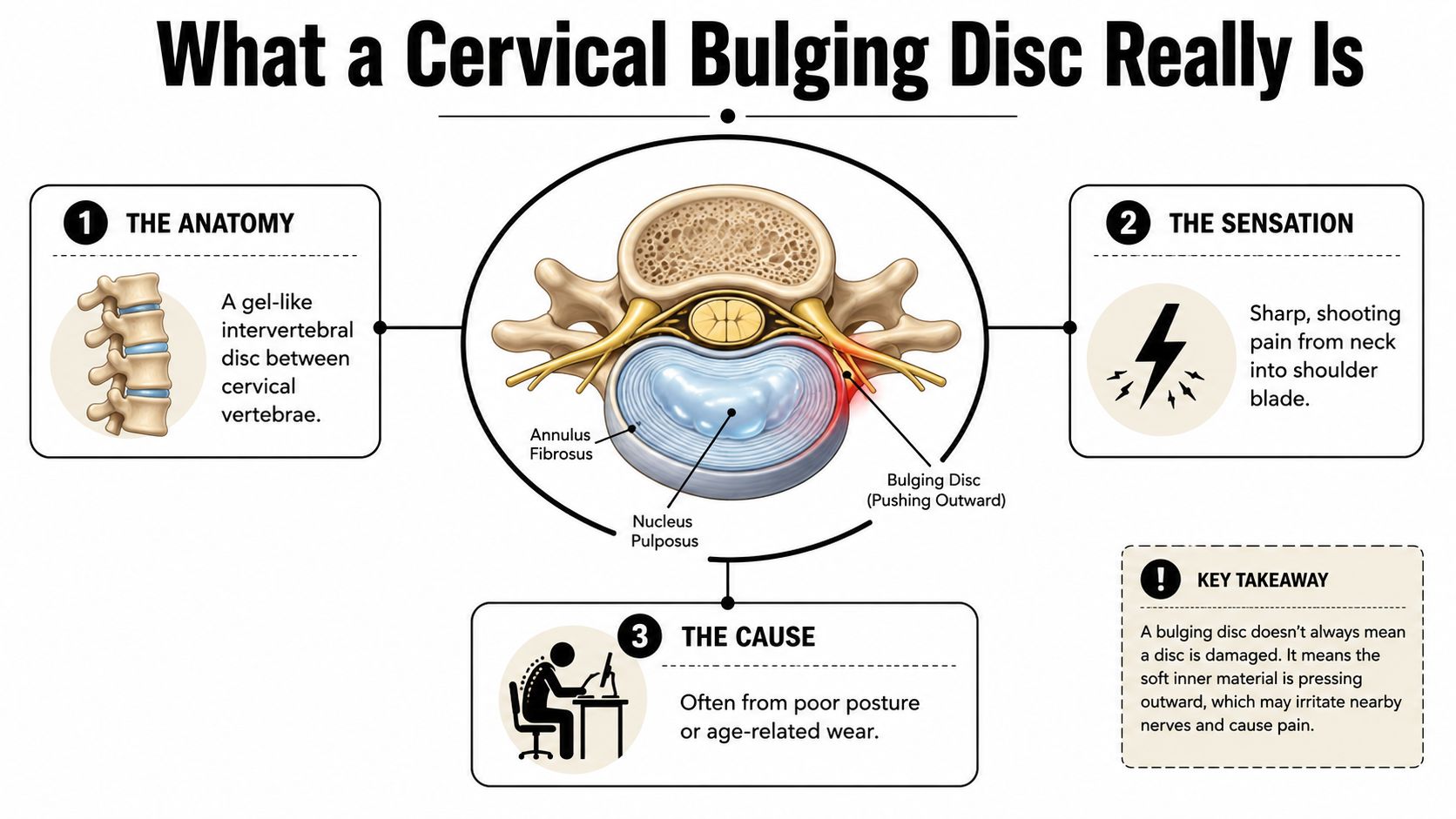
What a Cervical Bulging Disc Really Is
A cervical disc sits between the bones of your neck. It has a softer, gel-like center and a tougher outer ring that helps distribute load as you move. A bulging disc means the outer contour has extended outward or flattened beyond its usual boundary. If the disc or nearby inflammation irritates a nerve root, symptoms can travel from the neck into the shoulder, shoulder blade, arm, or hand.
That traveling pattern is called radicular pain when it follows a nerve-root distribution. It may feel burning, electric, sharp, or tingling rather than like ordinary muscle soreness. A disc can also narrow space around the spinal cord, which is a different and more serious concern that requires appropriate medical screening.
Bulge, herniation, and degeneration
These terms overlap in everyday conversation, but they aren't identical.
- Bulge: The disc's outer edge extends outward over a broader area.
- Herniation: Material from the inner portion pushes through a more focal defect in the outer layer.
- Degenerative change: The disc may lose hydration, height, or flexibility as part of wear-related change.
An MRI can show one or more of these findings even in someone who has no pain. That's why a therapist doesn't treat the scan alone. They compare the image with your symptoms, strength, reflexes, sensation, neck movement, and ability to perform tasks.
The practical goal: Your treatment plan should target the symptoms and movement limitations that affect your life, not chase a perfect-looking image.
Physical therapy has been part of standard nonoperative care for cervical radiculopathy and related bulging-disc symptoms for decades. The 2017 Neck Pain clinical practice guideline emphasizes classifying neck pain by stage and combining active rehabilitation with appropriate hands-on care. For chronic neck pain with radiating symptoms, it supports intermittent mechanical cervical traction alongside stretching, strengthening, and cervical or thoracic mobilization or manipulation.
If your report also mentions wear-related changes, you can review this plain-language explanation of symptoms of degenerative discs in the neck. The important distinction is that an imaging finding can help explain symptoms, but it doesn't determine your prognosis by itself.
Common Causes and Early Warning Signs
A cervical bulging disc can develop gradually, suddenly, or through a combination of both. The disc may become less hydrated with age, while repeated positioning and loading affect how the neck and upper back share work. A sudden lift, a collision, or whiplash can also irritate a disc and the nerve structures around it.
Common contributors
- Age-related wear: Discs can become less resilient over time, making them more sensitive to load.
- Forward-head positioning: Long periods looking down at a phone or toward a low laptop keep the neck working away from its most efficient alignment.
- Sudden force: Lifting, pulling, or a traumatic event can trigger symptoms in tissues that were already vulnerable.
- Repetitive overhead work: Reaching, carrying, and working with the arms raised can increase demand on the neck and shoulder girdle.
Posture rarely explains everything, and you shouldn't blame yourself for developing a disc problem. A forward head position can be one contributing stress, but tissue sensitivity, sleep, workload, general conditioning, and a specific injury may matter just as much.
How symptoms usually feel
Neck pain that stays near the spine is often called axial neck pain. It may cause stiffness after sleep, soreness with turning, or discomfort during desk work. Radicular symptoms extend beyond the neck, such as a burning line under the shoulder blade, tingling into the fingers, numbness in part of the hand, or weakness when gripping or lifting.
The location and behavior of arm symptoms often guide treatment more than the intensity of neck pain. A mild neck ache with increasing hand weakness deserves more attention than severe but steadily improving local soreness. A clinician will want to know whether symptoms move closer to the neck with a position or exercise, spread farther down the arm, change with coughing or straining, or interfere with sleep and work.
Keep a simple symptom record before your appointment. Note the affected side, the path of pain or tingling, activities that worsen it, and whether you're dropping objects or losing endurance. Those details help a physical therapist distinguish a movement-sensitive nerve problem from a condition that needs further medical evaluation.
How Physical Therapy Treats a Cervical Bulging Disc
A well-designed program matches each intervention to a specific problem. A stiff upper back may need mobility work. Guarding may respond to gentle manual therapy. Poor endurance in the deep neck and shoulder-blade muscles calls for graded strengthening. Irritated nerve-root symptoms may justify carefully selected traction or nerve-mobility work.
The strongest practical approach usually combines therapeutic exercise and manual therapy, rather than relying on one passive technique. A review of cervical radiculopathy literature supports this combination for improvements in function, active range of motion, pain, and disability, and discusses thoracic mobilization, thoracic extension, and targeted nerve gliding as possible components of care in appropriate patients. You can also read this broader guide to how physical therapy helps with back and neck pain.
Matching the tool to the problem
Manual therapy may include cervical or thoracic mobilization and soft-tissue techniques. These approaches can reduce protective muscle guarding and make movement easier, but they don't replace active work.
Exercise often targets deep neck-flexor control, scapular stabilizers, thoracic extension, and general upper-body capacity. The purpose isn't to force the disc into position. It's to help the neck and shoulder girdle tolerate normal activities with less irritation.
Mechanical cervical traction is more selective. Evidence supports traction added to exercise over exercise alone for pain and disability outcomes, with benefits reported across short-, middle-, and longer-term follow-up in the relevant review. That supports traction as an adjunct, not as a stand-alone cure.
| Intervention | What It Does | Evidence Strength |
|---|---|---|
| Therapeutic exercise | Builds neck, upper-back, and shoulder control and improves activity tolerance | Strong practical support when individualized and progressed |
| Manual therapy | Addresses guarding and restricted cervical or thoracic movement | Consistent support when combined with exercise |
| Mechanical traction | May reduce nerve-root loading in selected presentations | Moderate-quality support as an addition to exercise, based on the traction review |
| Heat, ice, or TENS | Provides symptom relief that may make movement easier | Symptom-focused, not structural treatment |
| Nerve gliding | Encourages comfortable nerve mobility without aggressive stretching | Useful for selected patients when performed without provoking symptoms |
A therapist may use heat, ice, electrical stimulation, or other modalities for comfort. They can help you participate, but they shouldn't become the entire plan. A 2025 clinical summary notes that commonly used modalities are widely prescribed, yet their superiority to placebo isn't clearly established. That's why the central question remains, “What can you do more comfortably and confidently now?”
What Happens in a PT Session Versus Home Exercise
A clinic visit gives you assessment, supervision, and adjustment. Home exercise gives you repetition between visits. Neither works as well in isolation when symptoms are persistent or movement quality is difficult to judge.
During an initial evaluation, the therapist reviews your history and examines neck movement, arm strength, sensation, reflexes, posture, and functional tasks. They may use gentle cervical or thoracic mobilization, soft-tissue work, or traction if your presentation supports it. They'll also test movements to see which positions calm symptoms and which ones spread them farther down the arm.
The clinic experience
A supervised session may include:
- Hands-on treatment: Gentle mobilization or soft-tissue techniques to reduce guarding and improve movement.
- Movement retraining: Practice of chin tucks, thoracic movement, scapular control, or nerve glides with real-time correction.
- Load planning: Adjustments to lifting, driving, desk work, sleep positions, and other daily demands.
- Progress checks: Reassessment of pain behavior, range of motion, strength, and functional tolerance.
The therapist can change the exercise dose immediately if tingling increases, your symptoms move farther down the arm, or your form breaks down. That feedback matters during the irritable stage.
The home counterpart
At home, you reinforce the changes through brief, consistent practice. Your program may include comfortable neck rotation, gentle chin-tuck work, scapular retraction, thoracic extension, and gradual strengthening. You're not trying to win a stretching contest. The correct dose leaves you moving more freely without creating a lasting increase in arm symptoms.
| Aspect | PT Clinic Session | Home Exercise |
|---|---|---|
| Assessment | Therapist checks neurological and movement findings | You monitor symptom response |
| Hands-on care | Mobilization, soft-tissue techniques, or selected traction | Usually unavailable |
| Form | Immediate correction and progression | Self-guided, ideally with written or video instructions |
| Frequency | Scheduled according to clinical need | Repeated consistently between appointments |
| Main role | Recalibrates movement and addresses stubborn restrictions | Builds capacity and reinforces new habits |
A typical visit includes education, not just treatment on a table. This overview of what a typical physical therapy session looks like can help you know what to expect. The best plan makes the clinic and home settings support the same movement goals.
Home Care and Recovery Timeline
Your home routine should be comfortable, simple, and easy to repeat. Start by reducing avoidable strain rather than trying to correct your posture rigidly all day. Place your monitor at eye level, keep your phone closer to eye height, support your forearms during desk work, and change position regularly.
Sleep setup matters because several uninterrupted hours in a rotated or sharply bent neck position can aggravate morning stiffness. Choose a pillow that keeps your head in line with your spine, whether you sleep on your back or side. If a position increases arm pain or tingling, modify it rather than forcing yourself to tolerate it.
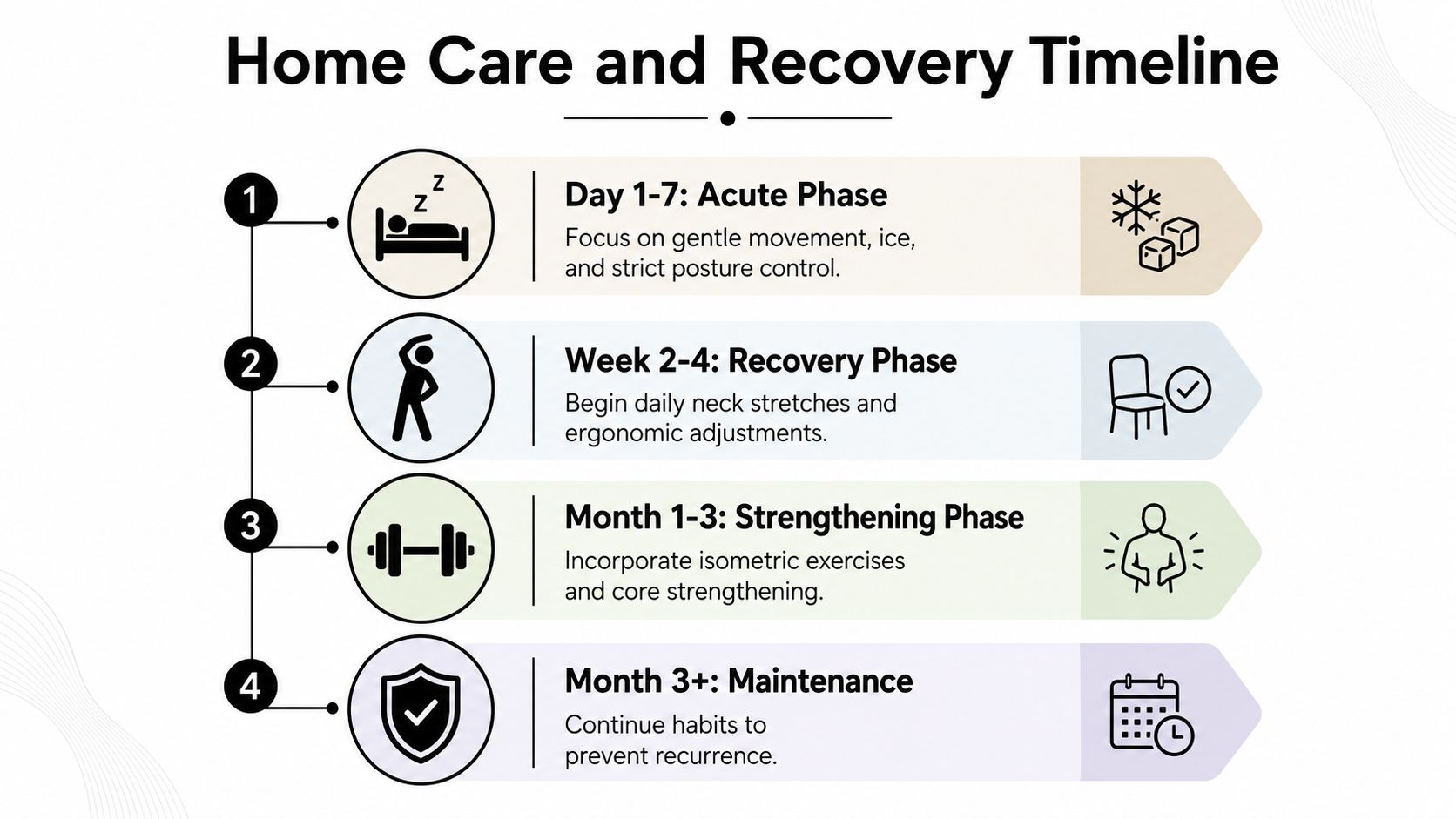
A practical progression
- Early phase: Use gentle neck movement, short walks, comfortable breathing, and position changes. Chin tucks, light scapular retraction, and a mild upper-trapezius stretch may be appropriate if they don't increase arm symptoms.
- Building phase: As pain settles, add deep neck-flexor endurance, mid-back strengthening, and controlled shoulder movements. Your therapist should guide resistance and range.
- Return phase: Practice the tasks that matter to you, such as driving, lifting, reaching, or computer work, with gradual increases in duration and load.
- Maintenance: Keep the mobility and strengthening habits that help you tolerate work and recreation. Prevention is less about perfect posture and more about adaptable strength and regular movement.
Recovery doesn't follow an identical calendar for everyone. The AAFP guidance on cervical radiculopathy describes supervised physical therapy with home exercise as part of conservative care and cites a clinical trial in which supervised therapy twice weekly plus home exercise produced significant improvement during the first six weeks compared with controls. The same source summarizes low-quality but supportive evidence for cervical, shoulder, scapulothoracic, and upper-arm strengthening and stretching during the acute phase.
Use your response as the guide. Mild, temporary muscle effort can be acceptable. Increasing weakness, spreading numbness, or arm pain that remains worse after exercise means you should stop that movement and contact your therapist.
For people working from home, an injury can also raise practical questions about documentation and workplace coverage. This resource on remote work injury coverage in Florida may help you understand what information to gather if symptoms began during work-related activities.
What PT Can and Cannot Fix
Physical therapy doesn't reliably push a bulging disc back into place like a cushion being slid into a slot. That image is appealing, but it sets the wrong expectation. A 2025 clinical summary explains that cervical disc herniations often improve within weeks without invasive treatment, while commonly used PT modalities aren't clearly proven to reverse the disc itself.
This doesn't make therapy pointless. It clarifies what success looks like. Symptoms can improve because inflammation and sensitivity settle, neck movement becomes less guarded, and the muscles around the neck, upper back, and shoulder work more effectively. Those changes can restore function even if a later scan looks similar.
What PT can change
A carefully progressed program can help you:
- Move your neck and upper back with less restriction.
- Improve deep neck-flexor and scapular muscle activation.
- Tolerate desk work, driving, lifting, and sleep positions more comfortably.
- Reduce pain-related fear and regain confidence in normal movement.
- Track neurological symptoms and identify when the plan needs medical review.
What PT can't promise
PT can't guarantee that an MRI will show a normal disc. It can't erase age-related degeneration, and it can't replace surgery or medical intervention when neurological deficits progress or the spinal cord is compromised. It also can't determine the cause of every neck and arm symptom from an image alone.
A useful measure of progress: Can you sleep more comfortably, turn your head farther, use your arm with better control, and complete more of your day?
This distinction matters for people who become anxious after reading about severe spinal injuries. If you're researching legal or medical information after a serious accident, educational material about spinal paralysis injuries in New York is separate from routine rehabilitation guidance and shouldn't replace an urgent clinical assessment.
The most realistic promise is symptom-driven recovery. You may feel and function much better without proving that the disc has changed shape. A therapist should explain that difference before treatment begins, so you can judge progress by meaningful activities rather than by chasing an elusive “normal” scan.
Red Flags and When to Escalate Care
With cervical bulging-disc symptoms, appropriate nonoperative care can typically begin after screening. Self-management is not appropriate, however, when symptoms suggest progressive nerve damage, spinal cord involvement, infection, serious systemic illness, or significant trauma.
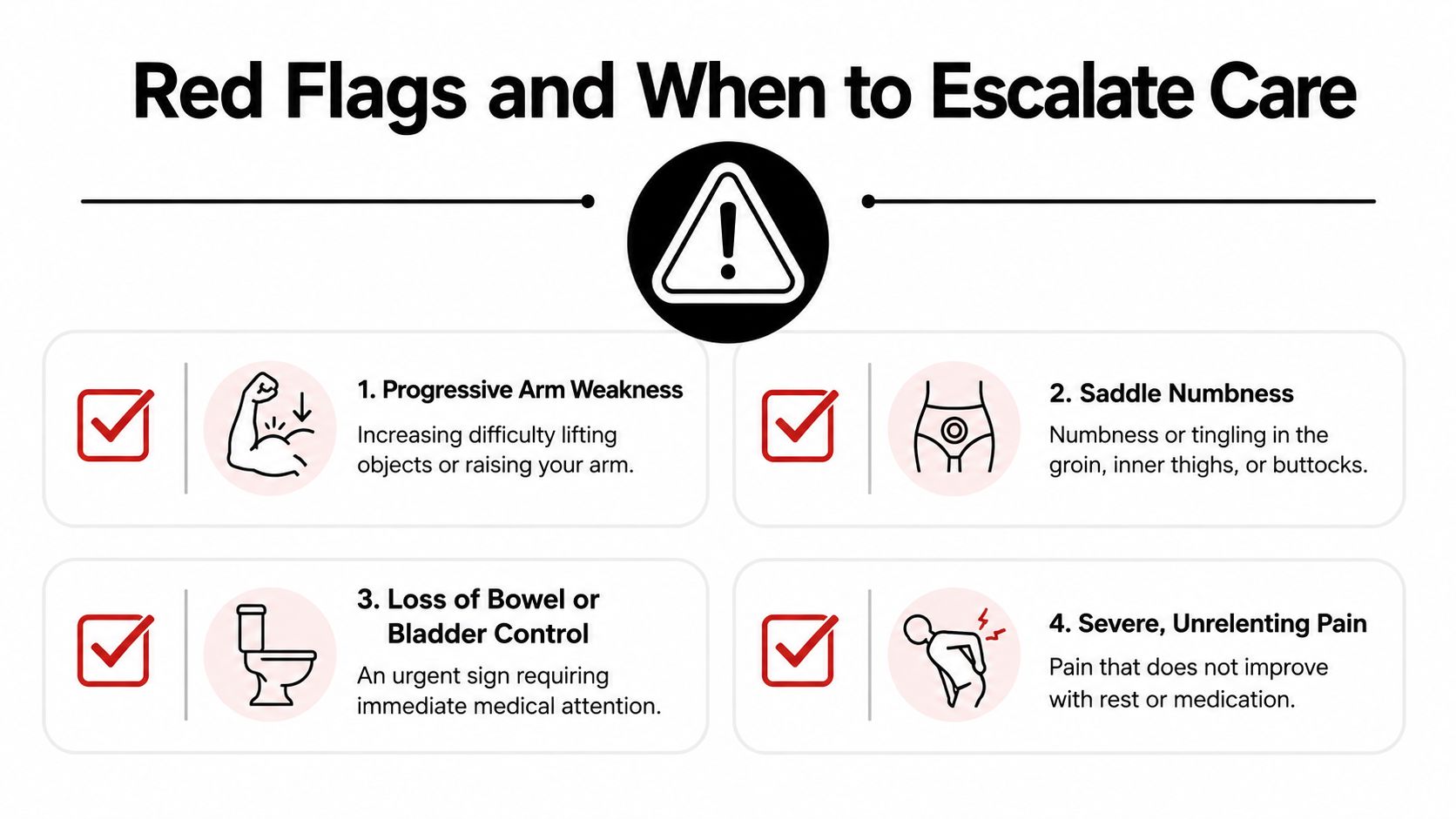
Seek urgent in-person evaluation for:
- Progressive arm or hand weakness: Increasing difficulty lifting, gripping, or controlling the arm may signal worsening nerve involvement.
- Gait or balance changes: Trouble walking, new clumsiness, or loss of hand dexterity can point toward spinal cord involvement.
- Bowel or bladder changes: Loss of control is an emergency warning sign and needs immediate medical attention.
- Saddle-area numbness: Numbness around the groin, inner thighs, or buttocks is not typical for an isolated neck problem and requires urgent assessment.
- Severe, unrelenting pain: Pain that doesn't ease with rest or prescribed medication deserves prompt evaluation, especially when it's unrelated to position.
- Fever or unexplained weight loss: These systemic symptoms can indicate a condition that needs medical investigation rather than routine exercise.
- Symptoms after trauma: A collision, fall, or other significant injury warrants screening before manipulation, traction, or strengthening.
A mild increase in soreness after a new exercise is different from neurological deterioration. Still, you shouldn't wait through worsening weakness, expanding numbness, new balance problems, or unremitting night pain.
Contact your primary care provider, urgent care, or an emergency department based on the severity and speed of the change. Bring your imaging report, medication list, and a short symptom timeline. Once a medical professional clears you for rehabilitation, a physical therapist can coordinate the program around those findings.
MedAmerica Rehab Center provides individualized physical therapy and related rehabilitation care for cervical disc symptoms, with hands-on treatment, targeted exercise, and evidence-based modalities matched to your examination. Visit MedAmerica Rehab Center to request an evaluation in Deerfield Beach and discuss a realistic plan for improving pain, movement, and daily function.
MedAmerica Rehab · Deerfield Beach
Talk to a clinician about your pain
Physical therapy, chiropractic, acupuncture and shockwave therapy under one roof, since 1995. Same-day appointments are available.
Mon–Thu 8:00 AM – 6:30 PM · Fri 8:00 AM – 3:00 PM