
Arthritis Physical Therapy Exercises That Actually Help
You've stopped taking the stairs, avoid longer walks, and brace yourself before standing from a chair because your knee, hip, hands, or back might complain. Rest may feel sensible, but prolonged inactivity often makes movement less comfortable and daily tasks harder. The better approach is specific exercise, carefully dosed, with adjustments for pain, stiffness, strength, and flare days.
The arthritis physical therapy exercises below are designed as a starting framework, not a substitute for an examination. The most important questions aren't only which exercise to choose. They're how hard it should feel, how to progress without provoking a flare, and how to keep going when motivation fades.
Why Exercise Is the Closest Thing to a Cure for Arthritis
A 62-year-old patient once told me she had stopped walking because her knee hurt. Her knee became stiffer, her leg grew weaker, and getting out of a chair began to require more effort. She interpreted that decline as proof that exercise was damaging the joint. In reality, avoiding movement had removed the strength and motion her knee needed for everyday loading.
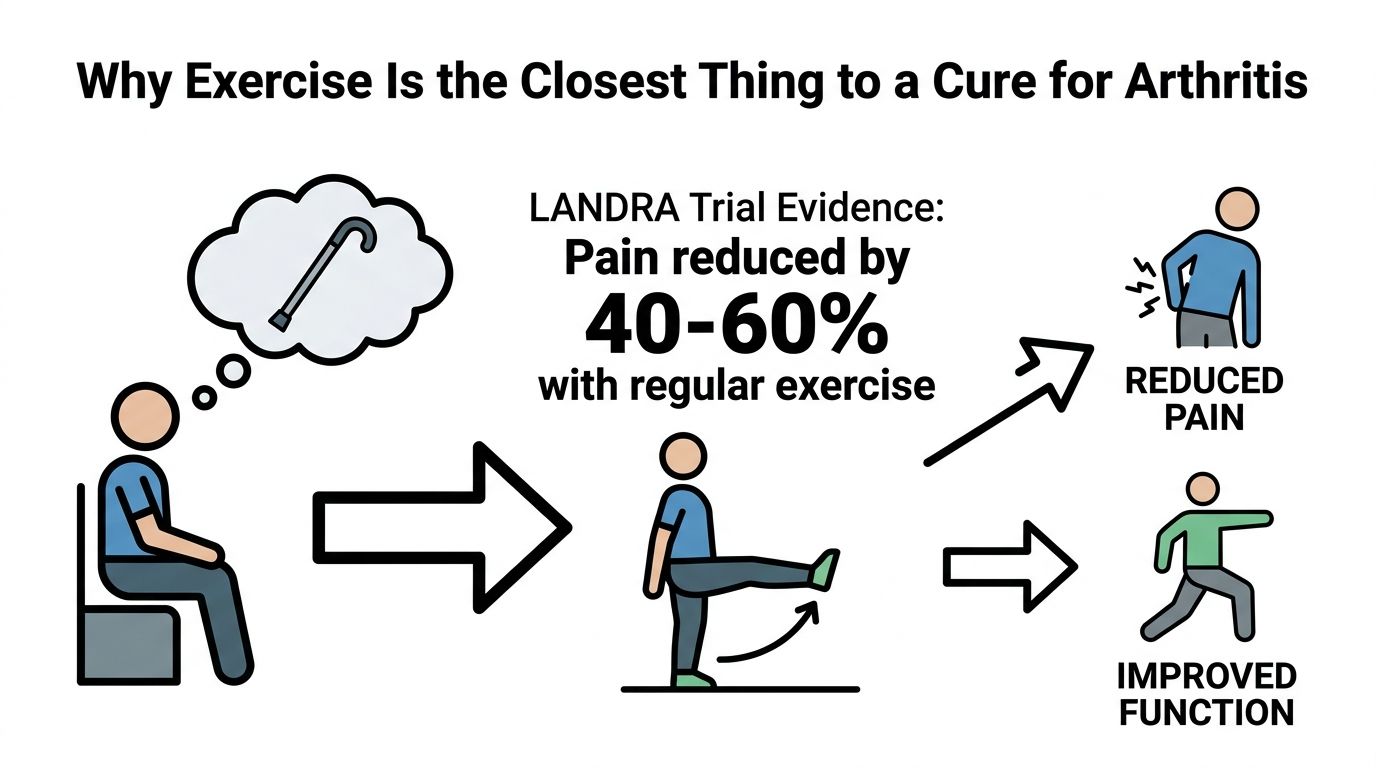
Exercise doesn't restore worn cartilage, and it isn't a cure in the literal sense. It does, however, address several problems at once. It strengthens the muscles that support a joint, preserves usable range of motion, improves confidence with movement, and helps you tolerate daily activities more effectively.
A large systematic review of 77 randomized controlled trials involving 6,472 participants found that exercise therapy produced statistically significant short-term improvements for knee and hip osteoarthritis. At about eight weeks, the reported effect sizes were 0.56 for pain, 0.50 for function, 0.46 for performance, and 0.21 for quality of life (systematic review of exercise therapy for knee and hip osteoarthritis). The benefit peaked around two months and gradually faded, becoming no better than usual care by nine to eighteen months. That pattern makes adherence and progression part of treatment, not an optional extra.
Why controlled loading helps
A joint usually handles controlled, repeated loading better than sudden, unaccustomed stress. Movement also helps circulate synovial fluid and keeps surrounding muscles contributing to joint support. Rest can be useful during an acute flare, but making rest the long-term plan commonly leaves you with less capacity.
Clinical rule: The right exercise dose challenges the joint and muscles without creating a reaction that lasts into the next day.
Exercise therapy has outperformed placebo in the short term, with reported standardized mean differences of -1.1 for pain and -0.8 for function, but the same review found no significant long-term advantage (systematic review of exercise therapy in osteoarthritis). That evidence explains why a beautifully designed program still fails if it's abandoned.
Passive treatments can have a role, especially when pain prevents active participation. They shouldn't replace the exercise dose. In one randomized trial involving hip osteoarthritis, adding manual therapy to exercise didn't improve function or hip range of motion, although patients reported higher satisfaction. If arthritis makes travel difficult, a resource on house call arthritis treatment may help you explore appropriate medical support, while people managing inflammatory disease can review rheumatoid arthritis management alongside their clinician.
Joint-by-Joint Exercise Prescriptions You Can Start This Week
Use these exercises only if you can perform them with controlled movement and without sharp, catching pain. Start with the joint that limits you most, rather than trying to complete every exercise in one session.
Knee
Begin seated or lying down.
- Quad sets: Tighten the thigh by pressing the back of the knee gently toward the bed or floor. Hold for 10 seconds, then relax. Complete 3 sets of 10. You should feel the front thigh working, not cramping behind the knee.
- Straight-leg raises: Lie on your back with one knee bent and the other leg straight. Tighten the thigh, then lift the straight leg slowly. Complete 3 sets of 10. Don't arch your back or swing the leg.
- Seated knee extensions: Sit tall and straighten one knee until comfortable, then lower slowly. Complete 3 sets of 10. Keep the thigh supported and avoid snapping into the end range.
- Mini-squats to a chair: Stand in front of a chair, send your hips back, and lower only as far as you can control. Complete 3 sets of 8. Keep your knees aligned with your second toes.
- Step-ups: Step onto a low step and control the way down. Complete 3 sets of 8 per leg. Use a railing if balance is uncertain.
Hip
Glute bridges and clamshells should create work in the buttocks, not pinching in the front of the hip.
- Glute bridges: Lie on your back with knees bent. Press through your feet, lift your hips, pause, and lower. Complete 3 sets of 10.
- Clamshells: Lie on your side with knees bent. Keep your feet together and lift the top knee without rolling your pelvis backward. Complete 3 sets of 10 per side.
- Standing hip abduction: Hold a counter and move one leg out to the side without leaning. Complete 3 sets of 10.
- Hip flexor stretch: Step one foot back, tuck your pelvis slightly, and shift forward until you feel a stretch at the front of the rear hip. Hold 30 seconds for 3 repetitions.
Hand and thumb
Tendon glides move the fingers through a sequence of open hand, hook fist, full fist, and straight fist positions. Perform the full sequence for 5 repetitions, keeping the movement smooth rather than forcing a stiff joint.
Add 10 thumb-opposition repetitions, touching the thumb to each fingertip. A soft rubber ball squeeze can be performed for 3 sets of 10, provided it doesn't increase joint swelling. Finger walks across a table for 2 minutes can add gentle coordination and mobility. For nutrition and recovery basics, these clean protein recovery tips may be useful, but supplements shouldn't replace an appropriately progressed exercise plan.
Shoulder, neck, and spine
For the shoulder, perform pendulums by leaning on a table and letting the arm hang while making small circles for 1 to 2 minutes. Add scapular retractions, drawing the shoulder blades gently down and back for 3 sets of 10, wall slides for 3 sets of 10, and a doorway chest stretch held 30 seconds for 3 repetitions.
For the cervical and lumbar spine, use chin tucks for 3 sets of 10, thoracic rotations for 3 sets of 10 per side, cat-camel for 3 sets of 10, pelvic tilts for 3 sets of 10, and child's pose held for 30 to 60 seconds. If you need more movement options, this guide to range of motion exercises can supplement your program.
| Joint | Key Exercises | Sets x Reps | Frequency | Progression Cue |
|---|---|---|---|---|
| Knee | Quad sets, straight-leg raises, mini-squats | 3 x 8 to 10 | Regular weekly practice | Add a band, hold, or set after two easy sessions |
| Hip | Bridges, clamshells, abduction | 3 x 10 | Regular weekly practice | Add resistance when pelvic control stays steady |
| Hand | Tendon glides, opposition, ball squeeze | 3 x 5 to 10 | Frequent short practice | Increase hold or gentle resistance |
| Shoulder | Pendulums, retractions, wall slides | 3 x 10 | Regular weekly practice | Increase range before adding resistance |
| Spine | Chin tucks, rotations, pelvic tilts | 3 x 10 | Regular weekly practice | Add a set when symptoms remain settled |
Use an RPE of 4 out of 10 as the progression reference. When two consecutive sessions feel easy at that effort, add a small challenge, such as a resistance band, a longer hold, or one additional set.
Warm-Up, Cool-Down, and How to Read Pain Mid-Exercise
Cold, stiff joints rarely perform well when the first movement is a deep squat, forceful stretch, or heavy resistance exercise. A brief warm-up raises movement confidence and lets you identify whether today is a normal training day or a modification day.
A five-minute preparation
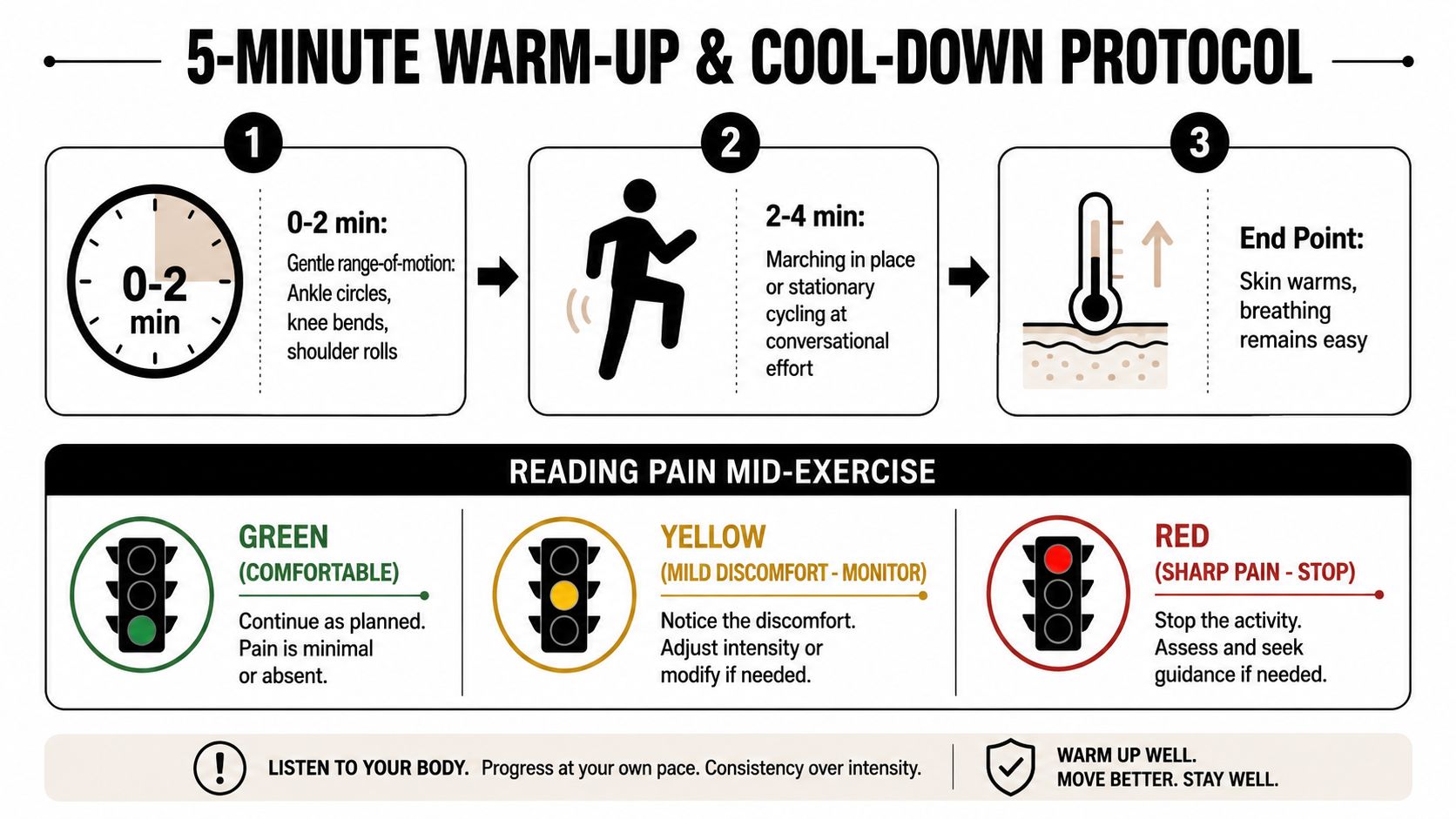
For the first two minutes, move gently through the joints you'll train. Use ankle circles, small knee bends, shoulder rolls, wrist movements, or pelvic tilts. Keep the range comfortable and smooth.
For the next two minutes, march in place or use a stationary bicycle at conversational effort. You should feel warmer and breathe more deeply, but you shouldn't be gasping. Use the final minute to rehearse the first exercise with a smaller range and slower pace.
Cool down with three to five minutes of relaxed static stretching. Hold each stretch at the first point of pull, never bouncing, then spend two minutes breathing into the lower ribs with a slow exhale. This helps reduce unnecessary muscle tension after training.
Use the traffic-light pain rule
Keep exercise discomfort at or below 3 out of 10. Mild muscle fatigue, warmth, or a tolerable ache can be acceptable if it settles during or soon after the session. Mild soreness should resolve within 24 hours.
- Green: Comfortable movement with stable symptoms. Continue.
- Yellow: Mild discomfort or increased stiffness. Reduce the range, slow down, or lower resistance.
- Red: Sharp, catching, sudden, or unstable pain. Stop that movement.
During a flare, replace repeated movement with gentle isometric contractions, such as quad sets or glute squeezes. Heat before exercise may help stiffness, while ice afterward can be useful for a hot, irritated joint. A physical therapy heat-pack guide can help you use heat more thoughtfully, but avoid heat over an acutely swollen or visibly inflamed area unless a clinician has advised it.
Skip the session and seek advice if swelling is rapidly increasing, the joint feels unstable, or symptoms remain worse beyond the next day.
Dose, Intensity, and Progression Without Overdoing It
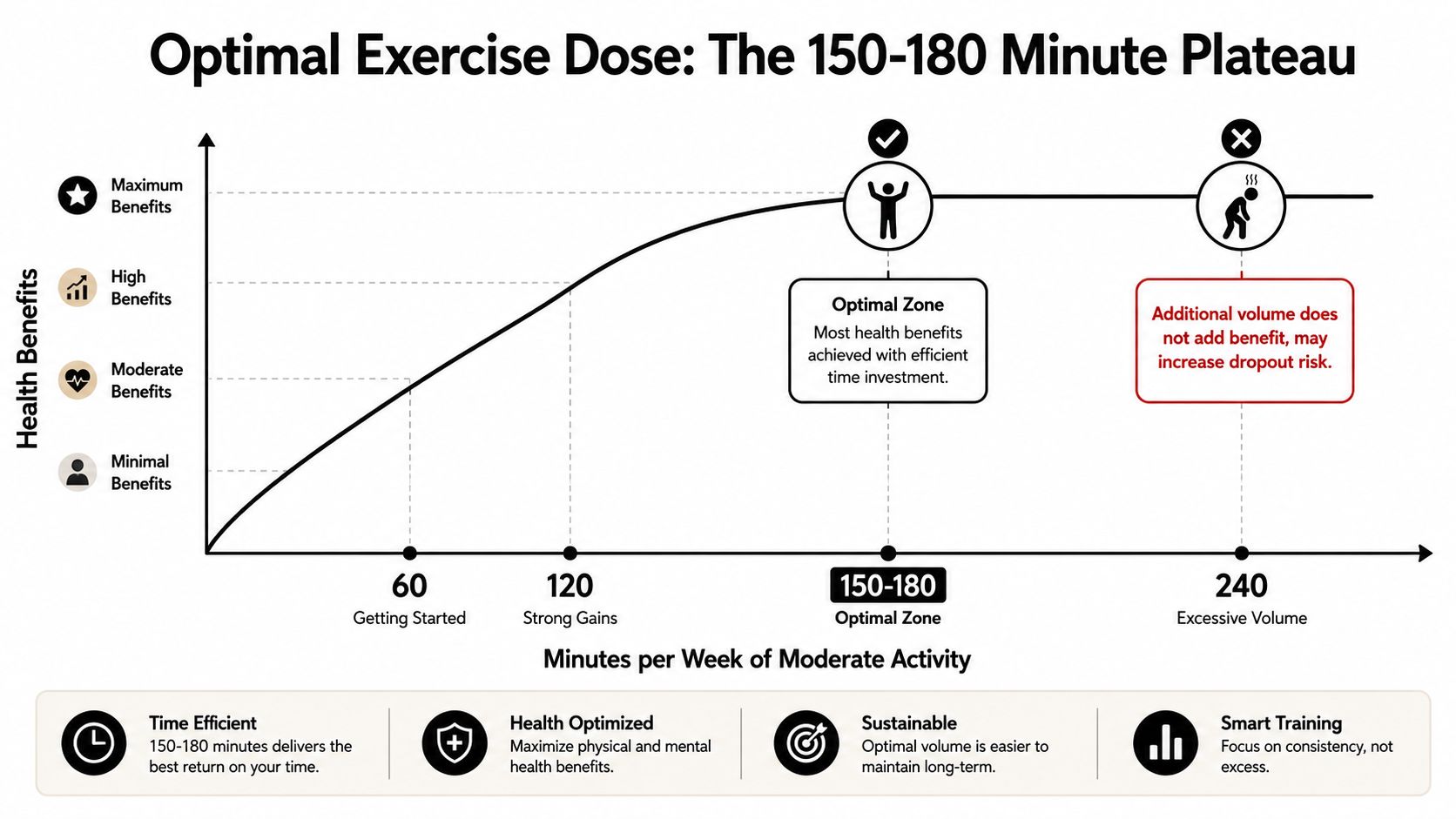
More exercise isn't automatically better. Recent evidence identifies a lack of clarity about the optimal exercise type and dose for osteoarthritis, and a 2025 synthesis found no clear dose-response relationship between exercise and clinical outcomes (2025 synthesis on exercise dose and osteoarthritis). The practical implication is important: choose the smallest dose that produces a useful challenge, then repeat it consistently.
Intensity should be judged by movement quality, the talk test, and perceived exertion rather than heart rate alone. Medications, including beta-blockers, and low conditioning can make heart-rate targets misleading. An effort around 4 out of 10 should feel purposeful but repeatable.
Progress by response, not ambition
Start by adding repetitions or an extra set before reaching for heavier weight. For weight-bearing joints such as the knee and hip, control and alignment matter more than load. For hands and shoulders, a small resistance band or soft ball can create a meaningful challenge without requiring a large external weight.
Use the 24-hour response to judge each session. If your pain and stiffness are back to baseline by the following day, maintain or progress slightly. If symptoms remain high, repeat the previous dose or reduce the range. During a flare that lasts beyond 48 hours, hold progression and return to a tolerable version of the routine.
Progression test: If you can complete every repetition with steady breathing, controlled alignment, and no symptom increase the next day, the exercise may be ready for a small upgrade.
The revised EULAR recommendations emphasize physical-activity promotion as standard care, with attention to dose, adaptations, and technology-based behavior-change approaches, as discussed in the recent evidence synthesis linked above. An app can remind you to exercise, but it can't reliably decide whether your knee needs a smaller range or whether your shoulder is compensating.
The Adherence Problem Nobody Talks About
The exercise plan often fails after the initial enthusiasm disappears. Research on arthritis exercise has frequently focused on selecting exercises rather than on adherence, even though adherence is central to maintaining health in inflammatory arthritis. A recent review identified open questions about how adherence can be improved and whether improved adherence consistently translates into better clinical outcomes (review of adherence in arthritis exercise).
That uncertainty shouldn't be used as an excuse to stop. It should change how the program is designed. A routine that requires a perfect day, uninterrupted time, and constant motivation is fragile.
Build a routine that survives difficult days
Attach the exercises to an existing cue. Do your quad sets after morning coffee, shoulder slides after an evening television program, or tendon glides while waiting for the kettle. Keep the resistance band where you'll see it, put a chair in the exercise area, and schedule the session on the calendar rather than relying on a vague intention.
Flare days need a separate plan. Reduce the number of exercises, shorten the range, and use isometrics or brief movement breaks instead of abandoning all activity. The exact reduction should depend on your symptoms, but the principle is consistent: preserve the habit while lowering the demand.
Track function, not only pain. Every four weeks, repeat a simple task such as standing from a chair, walking to the mailbox, opening a jar, reaching a shelf, or climbing a step. Record how controlled and confident the task feels. Pain varies with sleep, stress, weather, and inflammation, while function gives you another way to recognize progress.
Make the easy choice visible: Put the equipment in the room where the cue occurs, keep the routine short enough to start, and decide your flare-day version before the flare arrives.
A 2024 CDC review found physical activity strongly or conditionally recommended for osteoarthritis, rheumatoid arthritis, and psoriatic arthritis, while real-world counseling and follow-through remain inconsistent. The gap isn't solved by telling someone to “just do the exercises.” It's solved with a routine that fits the person's day.
Sample Routines for Mild, Moderate, and Severe Arthritis
Severity isn't determined only by an imaging report. Your starting plan should reflect what you can tolerate today, how long stiffness lasts, and whether movement improves or aggravates daily function.
The following templates use the exercises described earlier. They're starting points, not fixed prescriptions. A painful flare, recent injury, or inflammatory condition may require a different approach.
| Severity Level | Weekly Time | Sessions/Week | Key Focus | Progression Trigger |
|---|---|---|---|---|
| Mild | Build toward regular moderate activity | Strength on alternating days, aerobic work on other days | Compound strength, walking, balance | Daily tasks remain comfortable and the next-day response is stable |
| Moderate | Short, divided bouts across the week | Frequent short sessions | Range of motion, seated strength, low-impact aerobic work | Activity tolerance improves without a prolonged symptom increase |
| Severe | Very short bouts spread through the day | Multiple brief movement periods | Isometrics, gentle mobility, positioning, symptom control | Measurable function improves, or a clinician confirms progression is appropriate |
Mild
Choose two or three lower-limb strength exercises, such as mini-squats, step-ups, and bridges. Perform the prescribed sets and repetitions on alternating days, then add comfortable walking or cycling on the days between. Include hand, shoulder, or spine exercises if those joints limit your function.
Progress when the routine feels controlled and your symptoms return to baseline by the next day. Increase one variable at a time, such as range, resistance, or an additional set.
Moderate
Split activity into shorter sessions. A morning block might include knee extensions, bridges, and shoulder retractions. Later, use a stationary bicycle, seated marching, or a brief walk, followed by gentle range-of-motion work.
Use a chair, countertop, or railing for support. Your target is consistent exposure, not exhaustion. If a full routine is too much, perform one set of two exercises and repeat the block later.
Severe
Begin with comfortable positioning, breathing, and isometric contractions. Add small-range joint movements several times during the day, stopping before sharp pain or instability. A brief walk inside the home, seated marching, or water-based exercise may be more tolerable than a continuous land routine.
If two weeks of carefully modified exercise produces no measurable improvement, or function continues to decline, arrange an assessment rather than repeatedly changing exercises on your own.
Precautions, Red Flags, and When to Book a Physical Therapy Visit
Exercise is powerful, but some symptoms require diagnosis before you increase activity. Don't exercise through an acutely infected joint, an unhealed fracture, a systemic inflammatory flare with fever, or a recent joint replacement during the period when your surgeon has restricted activity.
Use extra caution with unstable blood pressure, severe osteoporosis, unmanaged cardiac conditions, or a history that makes falls likely. Your medical team may still recommend movement, but the dose, setting, and supervision need to be chosen deliberately.
Stop and seek medical guidance
Contact a physician before continuing if you have:
- Night pain: Pain that doesn't ease when you change position.
- Rapid swelling: A joint that becomes increasingly swollen over a short period.
- Mechanical symptoms: Locking, repeated giving-way, or sudden loss of control.
- Neurological changes: Numbness, new weakness, or foot drop.
- Systemic warning signs: Unexplained weight loss, fever, or feeling acutely unwell.
- Prolonged stiffness: Morning stiffness lasting more than one hour.
Book a physical therapy evaluation if self-management hasn't helped after four weeks, your range of motion is declining, or pain begins appearing in nearby joints because you're compensating. Fear of movement that limits dressing, walking, work, or household tasks is also a clinical problem, not a personal failure.
A therapist can assess strength, gait, balance, joint mobility, movement strategy, and equipment needs. Treatment may include individualized exercise, hands-on techniques when appropriate, aquatic options, education, or custom orthotics. If bathing is difficult because standing increases pain or fall risk, understanding walk-in tub safety features may also help you make the home environment safer.
For a Deerfield Beach visit, bring a list of medications, relevant imaging or surgical information, the activities you want to recover, and a record of what makes symptoms better or worse. The initial assessment should identify the affected joints, establish functional goals, test movement and strength, and give you a clear home plan with instructions for progressing or modifying it.
MedAmerica Rehab Center provides individualized physical therapy, chiropractic care, acupuncture, and shockwave therapy for arthritis and mobility problems, with treatment focused on targeted exercise and restoring daily function. Visit MedAmerica Rehab Center to schedule an evaluation in Deerfield Beach and replace guesswork with a plan you can safely continue.
MedAmerica Rehab · Deerfield Beach
Talk to a clinician about your pain
Physical therapy, chiropractic, acupuncture and shockwave therapy under one roof, since 1995. Same-day appointments are available.
Mon–Thu 8:00 AM – 6:30 PM · Fri 8:00 AM – 3:00 PM