
Fall Risk Assessment Guide to Stay Steady and Safe
You're walking from the bedroom to the kitchen when your foot catches the edge of a rug. You grab the counter, steady yourself, and continue with your morning. Because you didn't hit the floor, you may dismiss the moment. A near-fall, however, can reveal the same balance, strength, vision, medication, or home-safety problems that contribute to a more serious fall.
That's where a fall risk assessment helps. It isn't a pass-or-fail test, and it isn't only for someone who has already been injured. It's a practical check of how you move and what may make moving around less safe. At MedAmerica Rehab Center in Deerfield Beach, this kind of evaluation can help connect a finding, such as difficulty turning, with a useful response, such as gait training or a home-safety change.
The need is widespread. The World Health Organization's falls fact sheet estimates that about 37.3 million falls severe enough to require medical attention occur globally each year. WHO also reports that about 28–35% of adults aged 65 and over fall each year, rising to 32–42% among people over 70. These figures explain why fall assessment became a routine part of geriatric care.
By the end of this guide, you'll understand what clinicians assess, why one score can't tell the whole story, which warning signs deserve attention, and how personalized rehabilitation can support steadier movement and greater confidence.
Introduction Why a Simple Stumble Deserves Attention
A stumble often happens during an ordinary task. You may be carrying laundry, stepping over a pet gate, getting up quickly, or turning toward the bathroom at night. The event can feel too minor to mention, especially if you recovered without pain. Yet that brief loss of balance gives a therapist useful information about how your body responds when the environment or movement changes.
A fall risk assessment looks at those details before they become a bigger problem. The clinician may ask what happened, observe your walking, check how you rise from a chair, and look for factors that could interfere with safe movement. The process is less like taking a single exam and more like inspecting several parts of a home before deciding where a handrail, better lighting, or a repair is needed.
WHO identifies falls as a major public-health issue and notes that fall rates among older adults increase sharply with age, as described in its global falls guidance. Repeated falls are common, but targeted evaluation can uncover changeable contributors involving gait, balance, medications, vision, and the home environment.
Why near-falls belong in the conversation
A near-fall doesn't prove that you'll fall. It does suggest that a specific situation challenged your stability. Was the floor wet? Did your knee buckle? Did you feel lightheaded after standing? Did you misjudge a step because the room was dim? Those answers point toward different actions.
A person with leg weakness may benefit from progressive strengthening. Someone who feels dizzy when standing may need medical review of blood pressure or medications. A person who moves safely in the clinic but struggles in a cluttered home may need environmental changes as well as therapy.
Practical rule: Treat a near-fall as useful information, not as a reason for panic or embarrassment.
The next step isn't to avoid every activity. It's to understand which movements feel uncertain and address the causes with a professional. A thoughtful assessment can help you preserve walking ability, participate more safely in daily routines, and maintain independence.
What a Fall Risk Assessment Really Is
Think of a fall risk assessment as a home inspection for movement. A home inspector doesn't examine only the front door and then declare the entire house safe. The inspector checks the foundation, stairs, lighting, plumbing, and other areas because several small problems can interact. Clinicians use the same logic with balance and mobility.
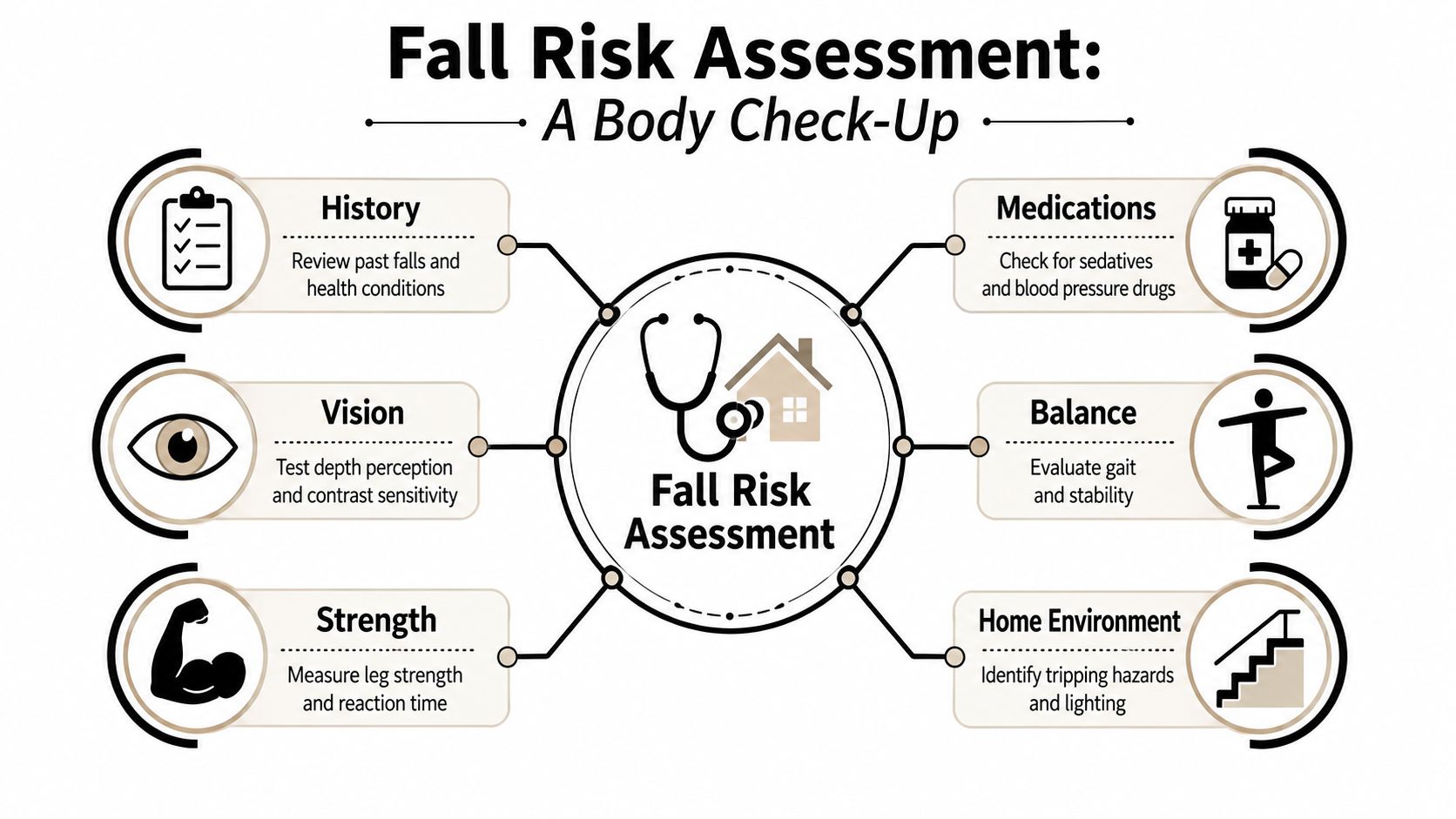
A complete assessment may bring together:
- Fall history: What happened, where it happened, what you were doing, and whether you've had previous falls or near-falls.
- Medication review: Whether medicines may contribute to sleepiness, dizziness, or blood-pressure changes. A therapist doesn't replace a prescriber, but the finding may support a medication conversation with your physician or pharmacist.
- Physical and functional examination: Leg strength, flexibility, coordination, transfers, gait, and the ability to react when balance shifts.
- Sensory review: Vision, hearing, dizziness, and the way your body senses foot position and movement.
- Environmental review: Stairs, rugs, cords, bathroom surfaces, furniture placement, footwear, and lighting.
Screening is the first look
Screening is usually brief. It may involve a few questions and one or more mobility tests to identify who needs a closer evaluation. An assessment goes further by connecting the result to daily life. For example, a person may complete a short walking test adequately but still report repeated difficulty getting up at night because of urgency, poor lighting, and dizziness.
The distinction matters because a score can identify concern without explaining the cause. The cause determines the plan. A therapist may need to evaluate walking mechanics, while a physician reviews medications or a family member improves the path to the bathroom.
Who should consider an assessment
Older adults can benefit, particularly after a fall, near-fall, noticeable change in walking, or growing fear of movement. People recovering from orthopedic surgery, an injury, or a period of inactivity may also need a mobility baseline before returning to normal routines. Dizziness, numbness, joint pain, reduced vision, or difficulty managing stairs are additional reasons to ask for guidance.
A prior fall deserves attention even when the injury seemed minor. The WHO guidance cited above describes previous falls as a strong predictor of future falls and supports routine questioning and formal evaluation when a person has recurrent falls, gait instability, or a recent fall. That history helps the clinician focus the assessment rather than relying on a generic checklist.
Common Screening Tools and Objective Balance Tests
Clinicians often use several tools because each one examines a different slice of movement. One test may show how efficiently you walk and turn. Another may challenge your balance during several everyday tasks. A third may reveal whether a narrow stance becomes difficult before you feel unsafe in ordinary walking.
Timed Up and Go
The Timed Up and Go, often called the TUG, follows a simple sequence. You rise from a chair, walk a short distance, turn, return, and sit down. The clinician observes more than the time. They watch whether you push heavily through your arms, take short steps, lose balance during the turn, or sit without controlling the descent.
The TUG reflects functional mobility because it combines a transfer, walking, turning, and sitting. It may be useful in outpatient therapy, primary care, and follow-up visits when the clinician needs a quick view of how several movements fit together.
Berg Balance Scale
The Berg Balance Scale uses a broader set of tasks involving sitting, standing, reaching, turning, and changing position. It can reveal difficulty with both stillness and movement. A person may stand comfortably with a wide base but struggle when reaching, turning, or placing the feet in a more challenging position.
Because the test includes multiple activities, it can take longer and requires more space and supervision than a brief screening. It's often useful when the clinician wants a detailed picture of balance control and functional limitations.
Four-Stage Balance Test
The Four-Stage Balance Test progresses through increasingly demanding standing positions. The challenge rises as the feet move closer together and the stance becomes less stable. The clinician monitors sway, foot movement, confidence, and the need for support.
No instrument is automatically right for every patient. A person with severe pain may need a modified approach. Someone with neurological symptoms may require more detailed observation. The 2021 systematic review of fall risk scales identified 38 different tools across 115 selected articles, reinforcing that tool selection depends on the setting and patient population (PubMed review).
Comparing Common Fall Risk Assessment Tools
| Tool | What It Measures | Best Use Case | How It Feels for Patients |
|---|---|---|---|
| Timed Up and Go | Transfers, walking, turning, and sitting | Quick functional mobility screen | Short and familiar, similar to getting up and walking at home |
| Berg Balance Scale | Static and dynamic balance across functional tasks | Detailed balance examination | Several manageable tasks, with supervision and adjustments as needed |
| Four-Stage Balance Test | Stability during progressively narrower stances | Focused standing-balance screen | Starts comfortably and becomes more challenging step by step |
A walking observation can add important context to any of these tools. A gait evaluation in physical therapy may examine step length, foot placement, posture, turning, and how pain changes your movement.
How Clinicians Interpret Scores and Combine Results
A score is a signal, not a diagnosis. Clinicians compare the result with your age, health history, symptoms, walking environment, and performance across other tasks. They also consider whether a test reflects the situation that worries you most, such as getting out of bed, stepping into a shower, or walking on uneven ground.
Sensitivity and specificity describe different types of accuracy. Sensitivity asks how well a tool identifies people who have a concern. Specificity asks how well it avoids labeling people who don't have that concern. A tool with a lower threshold may catch more people who need follow-up, while a higher threshold may reduce unnecessary alerts but miss some people.
A 2024 study of the Johns Hopkins Fall Risk Assessment Tool reported an optimal cutoff of 11 for the overall cohort, with 67% sensitivity and 68% specificity. In a low hand-grip-strength subgroup, a cutoff of 12 produced 75% sensitivity and 72% specificity (study details in PubMed). Those figures describe that study's population and context, not a universal rule for every clinic.
The useful question isn't “What score did I get?” It's “What does this result suggest we should examine or change?”
Patterns matter more than isolated results
Suppose your TUG shows hesitation during the turn, while a balance test reveals sway when your feet are closer together. The clinician may then examine hip and ankle strength, foot sensation, vision, footwear, and the route you use at home. If you also report lightheadedness when standing, orthostatic blood-pressure assessment and medical follow-up may become part of the plan.
Combining tools can make the picture clearer. The 2018 systematic review summarized in the WHO materials found that using two assessment tools together better captures the multifactorial nature of falls than relying on one measure. An automated fall-risk system study reported 0.95 sensitivity and 0.97 negative predictive value, compared with 0.68 sensitivity and 0.88 negative predictive value for the nurse-applied Morse Fall Scale in the same context (PubMed study). The important lesson is not that automation replaces clinical judgment. It's that workflow design and tool choice can affect whether high-risk patients receive follow-up.
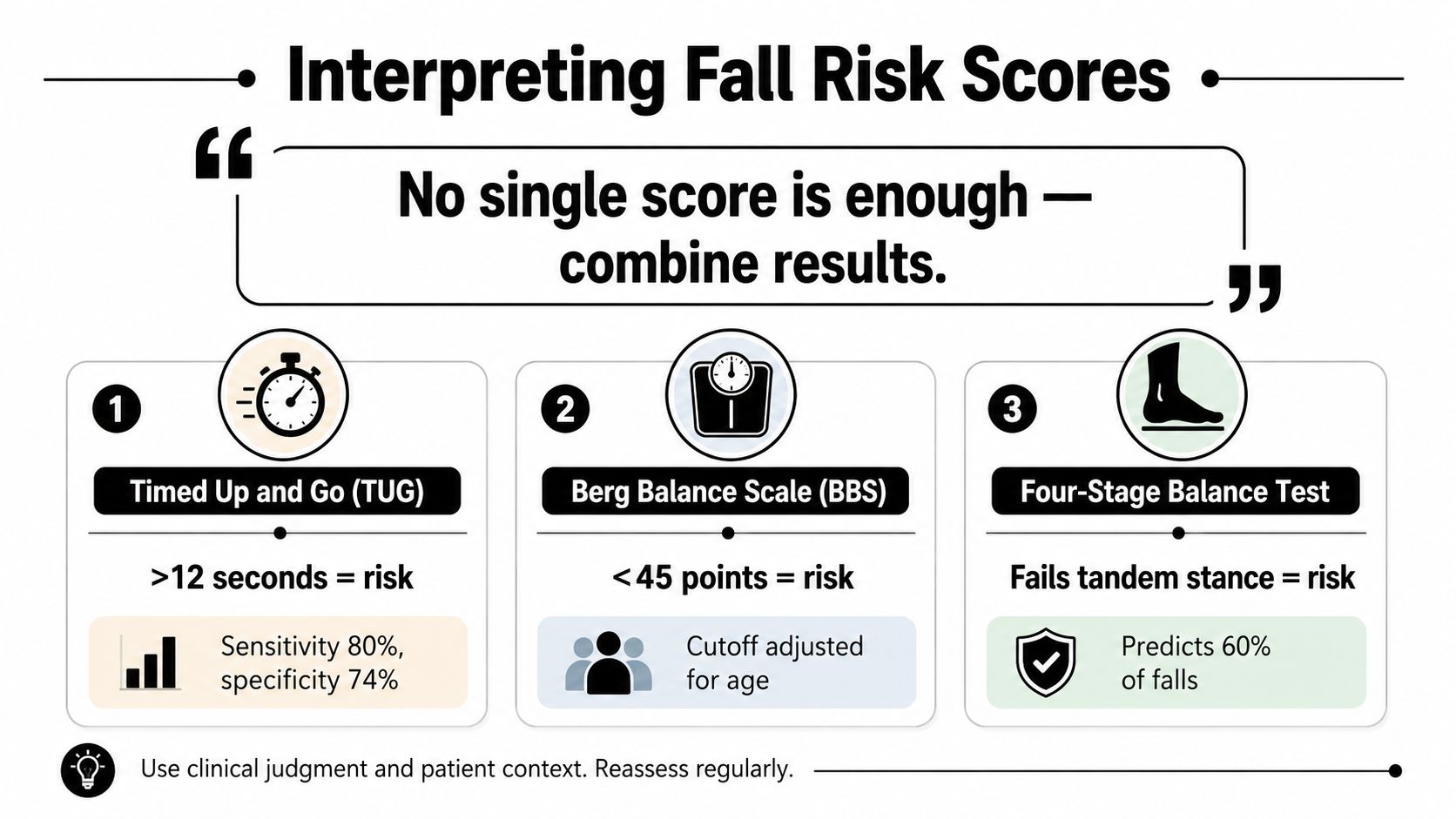
The 2025 systematic review of nine tools reached a cautious conclusion. Although the Mini-BESTest and Berg Balance Scale performed better than some alternatives, no single screening tool had sufficient diagnostic accuracy to be recommended alone (systematic review in PubMed). That's why a responsible interpretation combines test results with medication review, vision, cognition, blood pressure, gait, and environmental findings.
The video below offers another visual explanation of balance and fall-risk assessment concepts.
Common Risk Factors Your Assessment Will Uncover
Fall risk rarely comes from one isolated weakness. A person may have mildly reduced leg strength, slightly poorer vision, and a loose rug near the hallway. Each issue may seem manageable on its own. Together, they can make a routine turn or nighttime walk much less predictable.
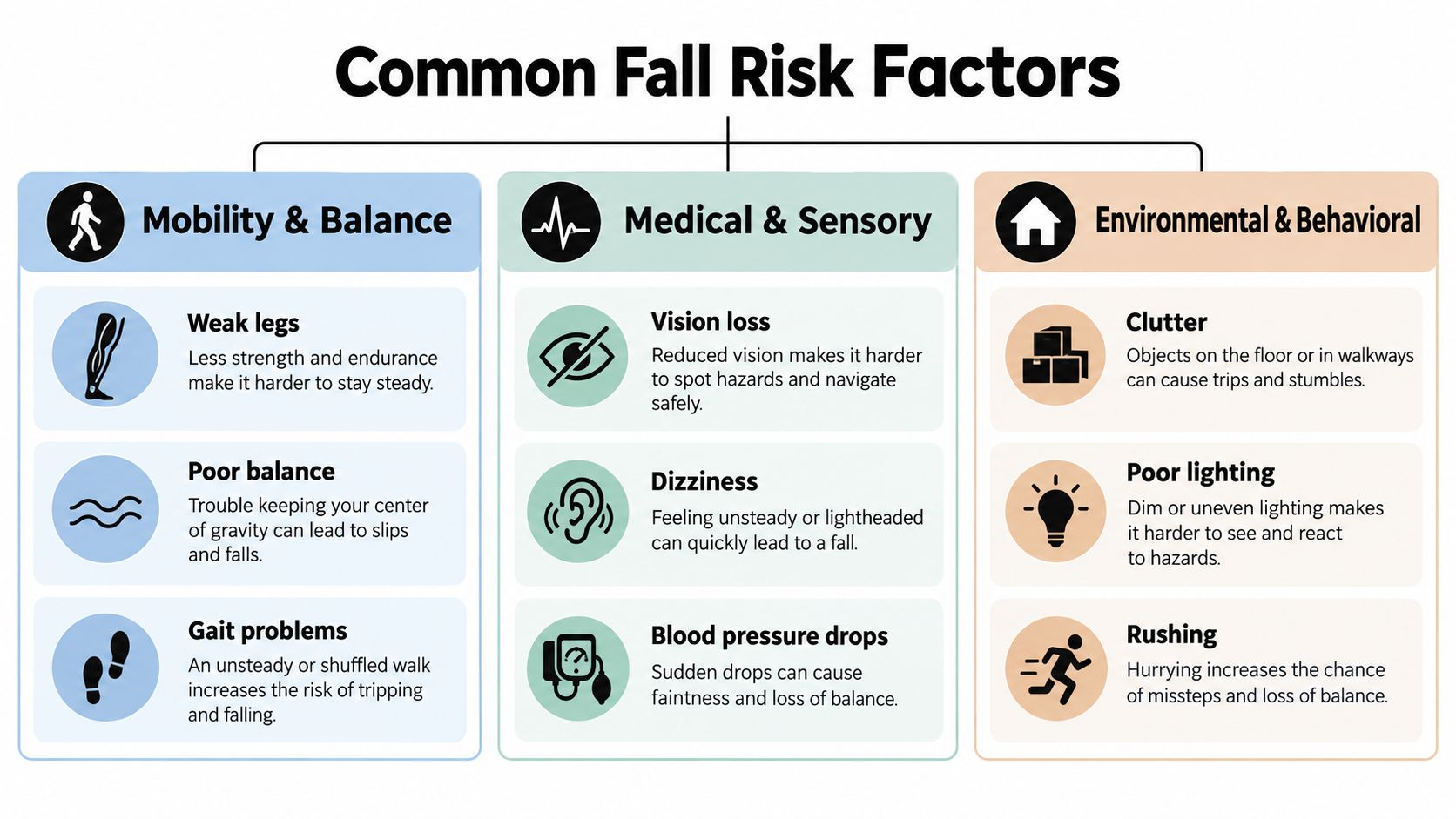
Mobility and balance
Weak hips, knees, or ankles can make it harder to rise from a chair or recover after a misstep. A gait change may appear as shuffling, reduced foot clearance, uneven step timing, or taking a wide path around turns. Pain from arthritis or a recent injury can also cause you to protect one side, shifting the load to the other leg.
Balance isn't only the ability to stand still. It includes adjusting your body while reaching, turning, stepping around an obstacle, or moving from a soft surface to a firm one. A therapist may observe these transitions because they resemble real household tasks more closely than standing in one place.
Medical and sensory contributors
Vision helps you judge steps, edges, contrast, and distance. Dizziness can alter your confidence and make a quick position change feel unsafe. A drop in blood pressure after standing may cause lightheadedness, while medication effects can contribute to drowsiness or unsteadiness.
Tell the clinician about symptoms even if they seem unrelated to balance. Hearing changes may also affect awareness of alarms, approaching people, or environmental cues. For accessible background on the relationship between hearing and cognition, you can review Z Audiology hearing statistics, then discuss personal concerns with an appropriate healthcare professional.
Environmental and behavioral factors
A dark hallway, cluttered walkway, unsecured mat, or slippery bathroom surface can turn a small movement error into a fall. Footwear matters too. Loose slippers, smooth soles, or shoes that don't support the foot may reduce stability.
Behavior can add another layer. Rushing to answer the phone, carrying too many items, walking without prescribed support, or refusing help during a difficult transfer can increase exposure to risk. The purpose of reviewing these behaviors isn't to assign blame. It's to find a safer way to accomplish the same task.
Use this fall prevention guide for older adults as a practical reminder to look at the whole setting, not only your legs or balance score.
Example Fall Risk Assessment Workflow Step by Step
A useful assessment feels organized, but it shouldn't feel rushed. At MedAmerica Rehab Center, the process can begin with a conversation that places the movement concern in context. You may describe a recent stumble, pain that changes your walking, dizziness when standing, or difficulty with stairs.
Step one begins with your history
The clinician asks what happened, where it happened, and what you were doing immediately beforehand. They may ask about previous falls, near-falls, surgery, injuries, medical conditions, assistive devices, and activities you want to resume. Bring a current medication list and, if possible, a short record of situations that feel unstable.
This history helps the therapist choose safe starting points. Someone who falls while turning needs a different emphasis from someone who feels faint after rising from bed.
Step two looks at real movement
You may walk across the treatment area, rise from a chair, turn, reach, and perform selected balance tasks. The clinician observes foot clearance, step symmetry, trunk control, speed, use of the arms, and how you respond to instructions. Strength and flexibility checks help explain why a movement is difficult rather than recording that it is difficult.
The assessment may include the TUG, the Berg Balance Scale, the Four-Stage Balance Test, or modified tasks based on your symptoms. Safety comes first, so the therapist can provide guarding, support, or an appropriate adjustment.
Step three adds sensory and medical context
The clinician reviews vision concerns, dizziness, numbness, footwear, and the effect of symptoms during daily routines. Medication questions may identify a reason to contact your physician or pharmacist. If standing causes lightheadedness, orthostatic blood-pressure evaluation may be appropriate through the relevant medical provider.
Hearing can influence how well someone notices instructions and environmental signals. Families who want broader context may find this overview of hearing loss and cognitive decline helpful, while remembering that online information doesn't replace an individual evaluation.
Step four turns findings into priorities
The final discussion should connect findings to action. Instead of a vague label such as “poor balance,” the record might identify difficulty rising without arm support, instability during turns, or a lighting concern along the nighttime walking route.
The plan then prioritizes manageable changes. It may include supervised strengthening, balance practice, gait training, a home-safety conversation, and communication with other healthcare professionals when medical review is needed. Reassessment helps show whether the chosen strategies are improving the movements that matter to you.
Prevention and Rehabilitation Plans That Restore Confidence
Assessment becomes useful when it changes what you do next. A personalized plan may combine balance training, gait practice, leg strengthening, flexibility work, transfer training, and education about safer movement. The therapist can adjust the challenge so you practice meaningful tasks without being pushed beyond a safe level.
Balance training might begin with supported weight shifts and progress toward controlled reaching, turning, or stepping. Gait training can address foot clearance, pacing, posture, and the safe use of a cane or walker when appropriate. Strength work may focus on the muscles needed to rise from a chair, climb stairs, and recover from a small loss of balance.
Matching the plan to your daily life
Home safety changes can be simple but targeted. Moving a loose rug, improving a dark pathway, keeping commonly used items within reach, choosing stable footwear, and adding support where recommended may reduce avoidable challenges. Families can help by making the safer choice easier, not by treating the person as incapable.
Low-impact activity can support recovery when it matches your condition and clinician's guidance. This resource on low-impact recovery exercises offers ideas to discuss with a rehabilitation professional before adding new movements.
MedAmerica Rehab Center provides balance and gait training, targeted exercise, hands-on physical therapy, and evidence-based modalities for patients in Deerfield Beach, including older adults, people recovering from surgery, and individuals rebuilding mobility after injury. Its family-owned clinic also offers same-day access and can use assessment findings to shape a plan around your goals, comfort, and home routine.
You can explore fall prevention exercises for seniors as a starting point, but stop any activity that causes concerning pain, dizziness, or unsafe loss of balance and ask a qualified professional for guidance. Schedule an assessment if a fall, near-fall, new walking change, dizziness, or fear of movement is limiting your routine. Early attention can help you work on the problem while you're still able to practice the activities you value.
If a stumble, balance change, or recovery concern is affecting your confidence, visit MedAmerica Rehab Center for an individualized fall risk assessment and mobility plan in Deerfield Beach. The team can evaluate gait, balance, strength, and functional movement, then help you build safer strategies for home and daily life.
MedAmerica Rehab · Deerfield Beach
Talk to a clinician about your pain
Physical therapy, chiropractic, acupuncture and shockwave therapy under one roof, since 1995. Same-day appointments are available.
Mon–Thu 8:00 AM – 6:30 PM · Fri 8:00 AM – 3:00 PM