
Carpal Tunnel Syndrome vs Cervical Radiculopathy
You wake up with a tingling hand, shake it until the feeling eases, and assume your wrist is the problem. Later, you notice pain near your shoulder blade or weakness when lifting your arm, and the diagnosis becomes less obvious. A wrist brace may help, but it may also miss the underlying source if an irritated nerve root in your neck is involved.
That's why carpal tunnel syndrome vs cervical radiculopathy isn't a simple either-or question. Both conditions can cause numbness, tingling, pain, and weakness, but they affect different points along the nerve pathway. The most useful approach is to match the pattern, examine the entire arm, and remain open to both conditions occurring together.
Why These Two Diagnoses Get Confused So Often
A patient may spend months wearing a wrist brace because their thumb and fingers tingle, only to discover that neck movement reproduces the arm pain. Another person may have genuine carpal tunnel syndrome but also develop shoulder-blade discomfort from a cervical nerve problem. In both situations, the symptoms are real. The confusion comes from assuming that the place where you feel numbness is the place where the nerve is compressed.
Carpal tunnel syndrome affects the median nerve at the wrist. Cervical radiculopathy affects a nerve root as it leaves the neck. Since the same nerve pathway carries signals toward the hand, irritation at either location can create overlapping sensations downstream. Tingling, burning, reduced grip, and clumsiness don't identify the compression site by themselves.
Shared background factors can muddy the picture further. Desk work may involve sustained wrist positions and prolonged neck posture. Diabetes can affect nerves throughout the body, while prior injury and age-related changes can influence either the wrist or cervical spine. Repetitive gripping and other overuse patterns can also contribute to hand symptoms, as discussed in this guide to repetitive strain injury.
A calm way to sort the possibilities
Start with four questions:
- Where does the symptom begin? Does it start in the hand, or in the neck and shoulder?
- Which fingers are involved? A median-nerve pattern points toward the wrist, while a broader or root-specific pattern may point higher.
- What triggers it? Nighttime hand symptoms suggest a different pattern from pain reproduced by turning or extending the neck.
- What has treatment changed? Failure of a wrist brace doesn't prove a neck diagnosis, but it's useful information to bring to the clinician.
Symptoms involving several body regions can also be difficult to interpret, especially when a person has a functional neurological condition or another overlapping problem. A plain-language guide for FND patients may help explain why symptom patterns sometimes require careful clinical assessment rather than a single label.
Practical rule: Treat the symptom map as a clue, not a verdict. A clinician should compare sensation, strength, reflexes, neck movement, and wrist findings before deciding where the problem lives.
What Each Condition Is
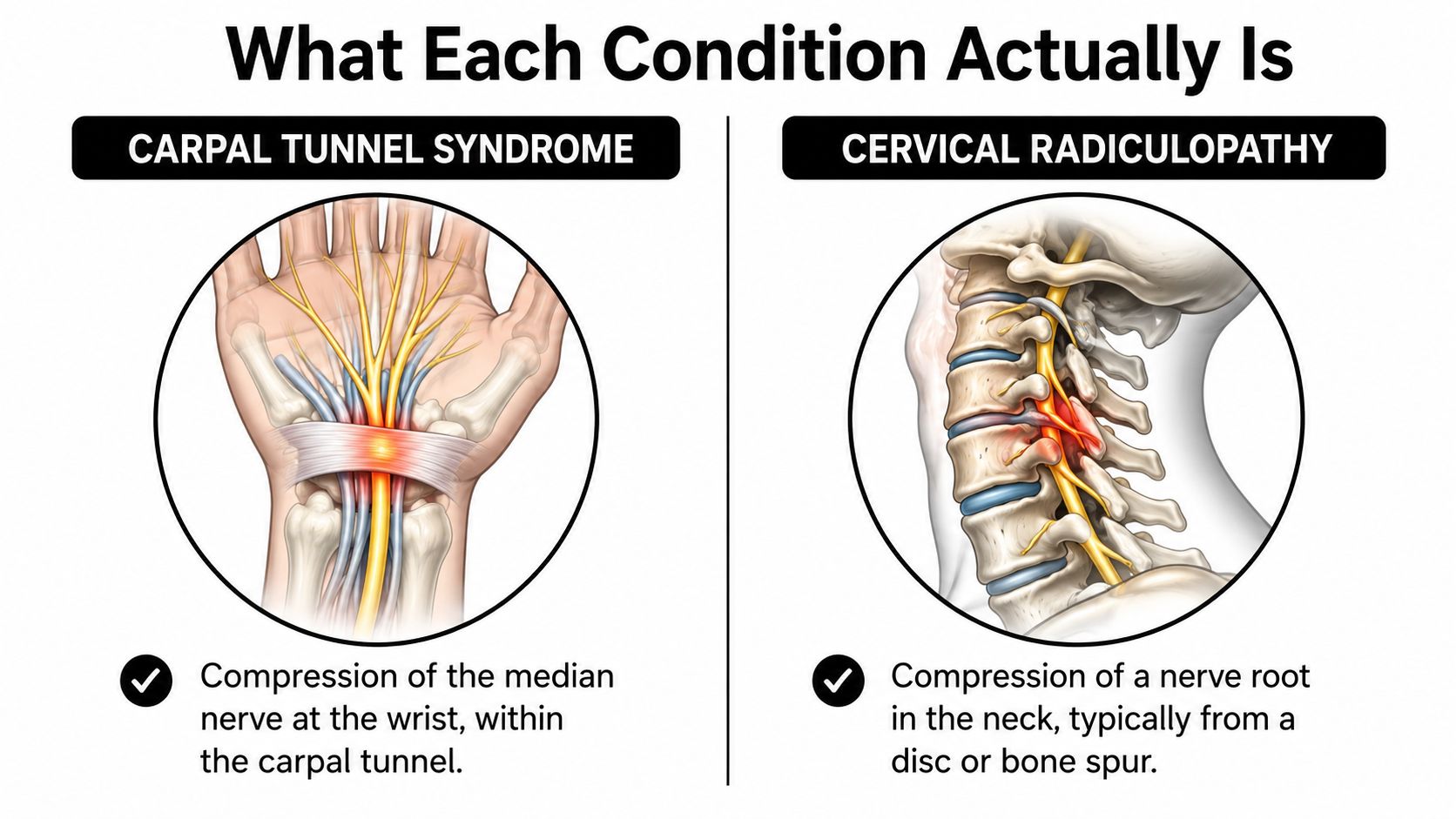
The same hand symptom can begin in two different places. Carpal tunnel syndrome, or CTS, is compression of the median nerve at the wrist. The nerve travels through the carpal tunnel, a narrow passage beneath the transverse carpal ligament, alongside nine flexor tendons. Repetitive gripping, pregnancy-related fluid retention, rheumatoid inflammation, wrist injury, and limited space from natural anatomy can raise pressure there.
The median nerve carries sensation from the thumb, index finger, middle finger, and part of the ring finger. It also activates muscles used for thumb opposition and precise pinching. Pressure at the wrist therefore tends to affect those areas first, although symptoms can vary.
Cervical radiculopathy begins in the neck. A nerve root becomes irritated or compressed as it leaves the cervical spine. A herniated disc or a bone spur can narrow the opening, called the foramen. The involved root may be near the C6 or C7 levels, but the pattern depends on the specific nerve and the person.
Anatomy provides the clearest starting point. CTS is a distal problem at the wrist, while cervical radiculopathy is a proximal problem at the neck. Because the nerve pathway is continuous, a neck problem can be felt in the hand, and a wrist problem can be felt in the fingers. The two diagnoses can also coexist, so location alone does not settle the question.
For a broader overview of hand numbness and pain solutions, remember that online information cannot show whether the neck is contributing.
Symptom Patterns Side by Side
Symptoms become more useful when you evaluate location, timing, quality, and aggravating movements together. No single sensation can reliably separate CTS from cervical radiculopathy. A 2025 review of diagnostic literature concluded that clinicians need to interpret patterns across multiple data points rather than rely on one definitive feature, as summarized in this clinical discussion of overlapping presentations.
With CTS, numbness commonly affects the thumb, index, middle, and thumb-side half of the ring finger. Many people notice symptoms while sleeping, driving, holding a phone, or keeping the wrist bent. Shaking the hand may temporarily ease the sensation, and prolonged compression can weaken pinch or grip.
Cervical radiculopathy often feels more like a line or pathway from the neck into the shoulder, shoulder blade, upper arm, forearm, or hand. The exact route depends on the involved root. Neck movement may worsen symptoms, and the person may describe burning, electric pain, or weakness above the wrist.
| Feature | Carpal Tunnel Syndrome | Cervical Radiculopathy |
|---|---|---|
| Main location | Wrist and hand | Neck, shoulder girdle, arm, and possibly hand |
| Typical sensory area | Thumb, index, middle, and part of the ring finger | A root-related region that may extend along the arm |
| Night pattern | Frequently wakes the person or causes hand tingling during sleep | May occur, but neck position and daily movement are often more prominent triggers |
| Pain quality | Tingling, buzzing, burning, or aching in the hand | Radiating, burning, sharp, or electric pain from the neck or shoulder |
| Weakness pattern | Pinch, thumb opposition, or grip may decline | Weakness may involve the shoulder, elbow, wrist, or hand, depending on the root |
| Neck involvement | Usually absent or secondary | Common, with restricted or painful neck movement |
| Distribution clue | Usually stays at or below the wrist | Often travels above the wrist into the arm or shoulder |
| Mixed pattern | Hand symptoms plus unexplained proximal complaints | Neck and arm symptoms plus a clear median-nerve hand pattern |
How to map your own symptoms
A thumb and index-finger pattern that is worse at night and improves when you reposition the wrist leans toward CTS. Neck pain that sends symptoms through the shoulder blade and down the arm leans toward cervical radiculopathy.
Whole-hand numbness deserves caution because it crosses the classic median-nerve territory. Weakness that affects several regions, such as grip plus elbow extension or shoulder elevation, also deserves a broader evaluation. These clues don't establish double-crush syndrome, but they make a wrist-only explanation less satisfying.
How a Clinician Examines You at the Bedside
A careful examination usually starts with your story, then checks both possible compression sites. The clinician may ask when symptoms began, whether they wake you, which fingers feel numb, whether neck movement changes the pain, and whether you've noticed dropping objects or losing strength.
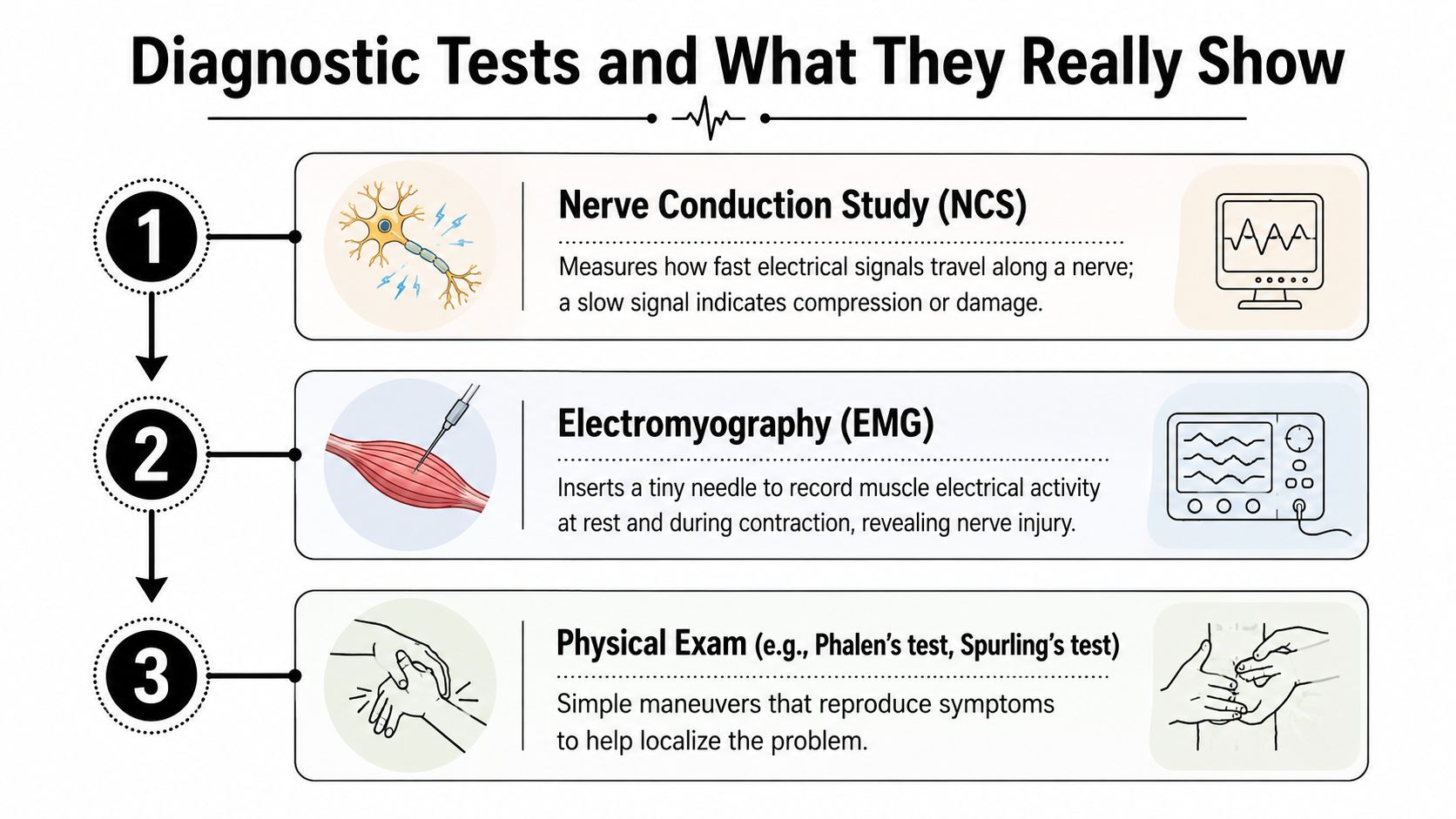
For suspected CTS, the examiner may tap over the carpal tunnel, known as Tinel's test, to see whether tingling travels into the median-nerve fingers. Phalen's test holds the wrists in flexion for a period of time to stress the tunnel. These maneuvers can reproduce symptoms, but a positive or negative result shouldn't stand alone.
The clinician may inspect the thenar muscles at the base of the thumb for wasting. Sensory testing can compare the thumb, index, and middle fingers using light touch, a monofilament, or two-point discrimination. The examiner may also compare pinch and grip with the opposite hand.
What changes when the neck is suspected
For cervical radiculopathy, the clinician checks neck range of motion and may perform Spurling's test, which combines neck positioning with gentle foraminal compression. Reproduction of the familiar radiating arm symptom can support a cervical source, although a negative maneuver doesn't exclude it.
Strength testing follows a myotomal pattern. The deltoid can help assess C5 function, wrist extension can provide information about C6, the triceps relates to C7, and grip testing contributes to the C8 assessment. Reflexes, sensation along the arm, and shoulder-blade pain add context.
| Test or Sign | Carpal Tunnel Syndrome | Cervical Radiculopathy |
|---|---|---|
| Tinel's test | Tapping at the wrist may reproduce median-nerve tingling | Not expected to reproduce the primary symptoms |
| Phalen's test | Wrist flexion may provoke hand symptoms | Usually does not recreate a root pattern |
| Thenar inspection | Wasting may indicate advanced median-nerve involvement | Thenar changes alone don't localize the neck |
| Neck motion | Usually doesn't change isolated CTS symptoms | Turning or extending the neck may reproduce arm pain |
| Spurling's test | Typically negative for a wrist-only problem | A familiar radiating symptom supports root irritation |
| Myotome testing | May show localized hand weakness | Can reveal weakness at the shoulder, wrist, elbow, or hand |
| Dermatome mapping | Follows a median-nerve distribution | May follow a cervical-root distribution |
The purpose isn't to collect positive tests. It's to determine whether the findings agree at one location, conflict, or suggest irritation at both.
Diagnostic Tests and What They Really Show
When the examination doesn't provide a clear answer, electrodiagnostic testing can help. Nerve conduction studies, or NCS, measure how electrical signals travel along a peripheral nerve. For CTS, the examiner compares median-nerve timing across the wrist with nearby sensory pathways. A delayed signal can support compression at the carpal tunnel.
The performance depends on the metric selected. One 2024 study reported 85.9% sensitivity and 82.5% specificity, with an AUC of 0.935, for a relative latency cutoff, while another median-nerve measure reached 94.8% sensitivity and 60.0% specificity. These findings show the tradeoff clearly: a test designed to catch more possible cases may also identify more people who don't have confirmed entrapment. See the 2024 electrodiagnostic comparison for the source data.
Electromyography, or EMG, uses a fine needle to record electrical activity in selected muscles. In cervical radiculopathy, the examiner looks for denervation patterns in muscles supplied by a particular root, often sampling several limb muscles and paraspinals. Expert guidance describes needle EMG as moderately sensitive but highly specific, with sensitivity around 50% to 71% in cervical radiculopathy, as reported by AAPM&R's electrodiagnosis guidance.
A negative EMG doesn't rule out radiculopathy, especially when the problem is primarily sensory or early. A positive pattern can strongly support motor axon involvement when it matches the history and examination.
Imaging has a different job
A cervical MRI can show a disc herniation, foraminal narrowing, or other structural changes around the nerve roots. It doesn't automatically prove that the visible finding causes your symptoms, because imaging abnormalities and clinical complaints must match.
Wrist ultrasound can assess the median nerve and its cross-sectional area at the carpal tunnel. Imaging is most useful when it answers a specific clinical question. A guide to MRI and X-ray decisions can help explain why clinicians choose one form of imaging over another.
Seek faster medical evaluation for progressive weakness, frequent dropping of objects, new coordination problems, gait change, or symptoms suggesting spinal cord involvement. Foot drop or bladder and bowel changes are not typical wrist-only complaints and shouldn't be managed with watchful waiting.
When Both Conditions Show Up Together
Some people have compression at the wrist and irritation at the neck. Clinicians often call this double-crush syndrome, referring to the possibility that a nerve affected at one point becomes more vulnerable to compression farther along its route. The idea matters because treating only the wrist may leave a neck-driven component untouched.
The overlap is clinically meaningful, not merely theoretical. In a surgically treated cohort, cervical radiculopathy appeared in 2.86% of carpal tunnel cases, while another study reported 9.98% CTS among cervical radiculopathy patients and 1.84% with both CTS and peripheral ulnar compression. A separate electrodiagnostic series found 5.6% double-crush syndrome and 15.9% isolated cervical radiculopathy among symptomatic limbs. These figures come from different populations and methods, so they shouldn't be treated as a universal rate. They do show why an either-or diagnosis can miss part of the picture. The detailed surgical-outcome evidence is available in this double-crush study.
Clues that deserve a two-site evaluation
| Clue | Why It Suggests Double-Crush | Next Step |
|---|---|---|
| Symptoms persist after carpal tunnel release | Wrist decompression may have addressed only one source | Reassess the neck, arm strength, reflexes, and sensory pattern |
| Numbness extends above the wrist | Proximal symptoms are difficult to explain with isolated CTS | Perform a cervical examination and consider EMG |
| Neck pain reaches the shoulder blade | This pattern supports cervical involvement alongside hand symptoms | Map neck movement, myotomes, and dermatomes |
| Weakness crosses expected territories | Several affected regions may not fit one distal nerve | Compare root, peripheral nerve, and muscle findings |
| Median-nerve hand symptoms plus radiating arm pain | The wrist and neck patterns may both be genuine | Evaluate both sites rather than choosing one prematurely |
The workup may include electrodiagnostic testing that examines the median nerve and muscles supplied by cervical roots. A cervical MRI may be considered alongside wrist ultrasound when each location has supporting findings.
Treatment order depends on which problem is driving disability, weakness, or progression. If radiculopathy is dominant, the neck may need attention first. In other cases, staged or simultaneous treatment can be discussed, and the surgical literature suggests outcomes aren't always straightforward.
Treatment Paths and Practical Next Steps
Treatment should follow the pattern and severity of the nerve problem, not the most familiar label. Intermittent symptoms with preserved strength often justify a period of rehabilitation-based care, while progressive weakness or constant sensory loss calls for faster medical assessment.
For CTS, a night splint that keeps the wrist near neutral can reduce prolonged bending during sleep. Activity modification, tendon and nerve gliding exercises, ergonomic changes, and clinician-guided strengthening may help reduce irritation. A corticosteroid injection can provide short-term relief and sometimes adds diagnostic information, but persistent thenar weakness, muscle wasting, or constant numbness may require surgical evaluation for carpal tunnel release.
Cervical radiculopathy may respond to mechanical traction, directional-preference exercises such as McKenzie-style movements when appropriate, nerve glides, and correction of sustained postures. A therapist may add targeted strengthening for the scapular and deep neck stabilizers. Selective transforaminal epidural steroid injections can be considered in suitable cases, while anterior cervical discectomy and fusion or artificial disc replacement may enter the discussion for progressive motor loss or refractory radicular pain.
Options arranged by treatment tier
| Treatment tier | Carpal Tunnel Syndrome | Cervical Radiculopathy |
|---|---|---|
| First-line care | Neutral night splinting, activity changes, ergonomic adjustments, and guided exercises | Postural correction, graded activity, traction when appropriate, and targeted rehabilitation |
| Focused rehabilitation | Median-nerve mobility, tendon gliding, grip modification, and functional retraining | Nerve glides, directional-preference exercises, scapular control, and deep neck stabilization |
| Procedural care | Corticosteroid injection when clinically appropriate | Selective transforaminal epidural steroid injection when clinically appropriate |
| Surgical discussion | Carpal tunnel release for failed conservative care or advanced nerve dysfunction | Cervical decompression, fusion, or artificial disc replacement for selected progressive or refractory cases |
| Combined presentation | Treat wrist findings without ignoring proximal symptoms | Prioritize the dominant driver and coordinate care across both regions |
Don't use an exercise or traction program to push through worsening weakness. If you develop constant numbness, thenar wasting, foot drop, gait disturbance, or loss of coordination, seek prompt evaluation rather than waiting for routine self-care to work.
For people exploring nonoperative options, this resource on carpal tunnel treatment without surgery offers practical context. Gentle movement and clinician-guided care may also be useful for neck symptoms, including this resource on gentle neck pain treatment. If hand symptoms dominate, start with a clinician who can assess the wrist and order electrodiagnostic testing when needed. If neck pain, shoulder-blade pain, or arm weakness dominates, begin with a provider experienced in cervical evaluation, and ask that the wrist be checked too.
MedAmerica Rehab Center offers individualized physical therapy and related rehabilitation services for neck pain, cervical nerve symptoms, and carpal tunnel concerns, with evaluation focused on function, strength, mobility, and symptom location. Visit MedAmerica Rehab Center to request an assessment in Deerfield Beach and discuss whether your symptoms point to the wrist, the neck, or both.
MedAmerica Rehab · Deerfield Beach
Talk to a clinician about your pain
Physical therapy, chiropractic, acupuncture and shockwave therapy under one roof, since 1995. Same-day appointments are available.
Mon–Thu 8:00 AM – 6:30 PM · Fri 8:00 AM – 3:00 PM