
Herniated Disc Physical Therapy Your Guide to Healing
You may be reading this while shifting in a chair, trying to find the one position that hurts a little less. Maybe your leg burns when you sit. Maybe your foot feels oddly numb. Maybe getting out of bed has turned into a careful, breath-holding routine.
That kind of pain can make life feel smaller very quickly. Work becomes harder. Sleep gets broken up. Even simple things like driving, walking the grocery store, or bending to tie a shoe can start to feel loaded with risk.
The good news is that a herniated disc diagnosis doesn't mean you're broken, and it doesn't mean your only option is to wait in fear. In many cases, a thoughtful physical therapy plan helps people move with less pain, rebuild confidence, and return to daily life step by step. The key is understanding what's happening, what recovery usually looks like, and what you can do right now to help your body calm down and heal.
The Pain That Changes Everything
It often starts with one moment you remember clearly, or one you barely noticed at all.
You bend to pick up a laundry basket. You stand after a long drive. You twist while unloading groceries. Then something feels wrong. At first it may seem like a pulled muscle. Later, the pain shifts. It shoots down the leg, settles into the buttock, creeps into the calf, or makes the foot tingle in a way that feels strange and unsettling.
That's the part that throws people. Back pain is one thing. Nerve pain feels different. It can be sharp, electric, hot, or deep and aching. It may flare when you sit, cough, sneeze, or try to sleep. Some people say the hardest part isn't just the pain itself. It's not knowing what movement will set it off next.
What daily life starts to look like
A herniated disc can turn routine activities into a series of decisions.
- Sitting becomes a problem because pressure builds and symptoms may travel farther down the leg.
- Walking can feel unpredictable because one minute you're fine and the next your calf tightens or your foot feels weak.
- Sleeping gets frustrating because rolling over or finding a comfortable position takes effort.
- Work and family tasks pile up because you're spending so much energy just getting through the day.
If your symptoms began after a crash, it can help to read Lawyer in Martin County's back pain guide because it explains how back pain can show up after an accident and why it shouldn't be brushed off.
You don't need to understand every medical term on day one. You just need a clear next step.
Why physical therapy matters early
Physical therapy gives structure to a situation that often feels chaotic. Instead of guessing whether to rest, stretch, walk, or avoid movement completely, you get a plan based on your symptoms, your movements, and your goals.
That plan usually starts with two simple questions. What calms your symptoms down? And what brings them on? Once those patterns are clear, treatment becomes much less mysterious. Recovery stops feeling like luck and starts feeling like a process you can participate in.
Understanding Your Herniated Disc
The term herniated disc sounds dramatic, so let's make it simple.
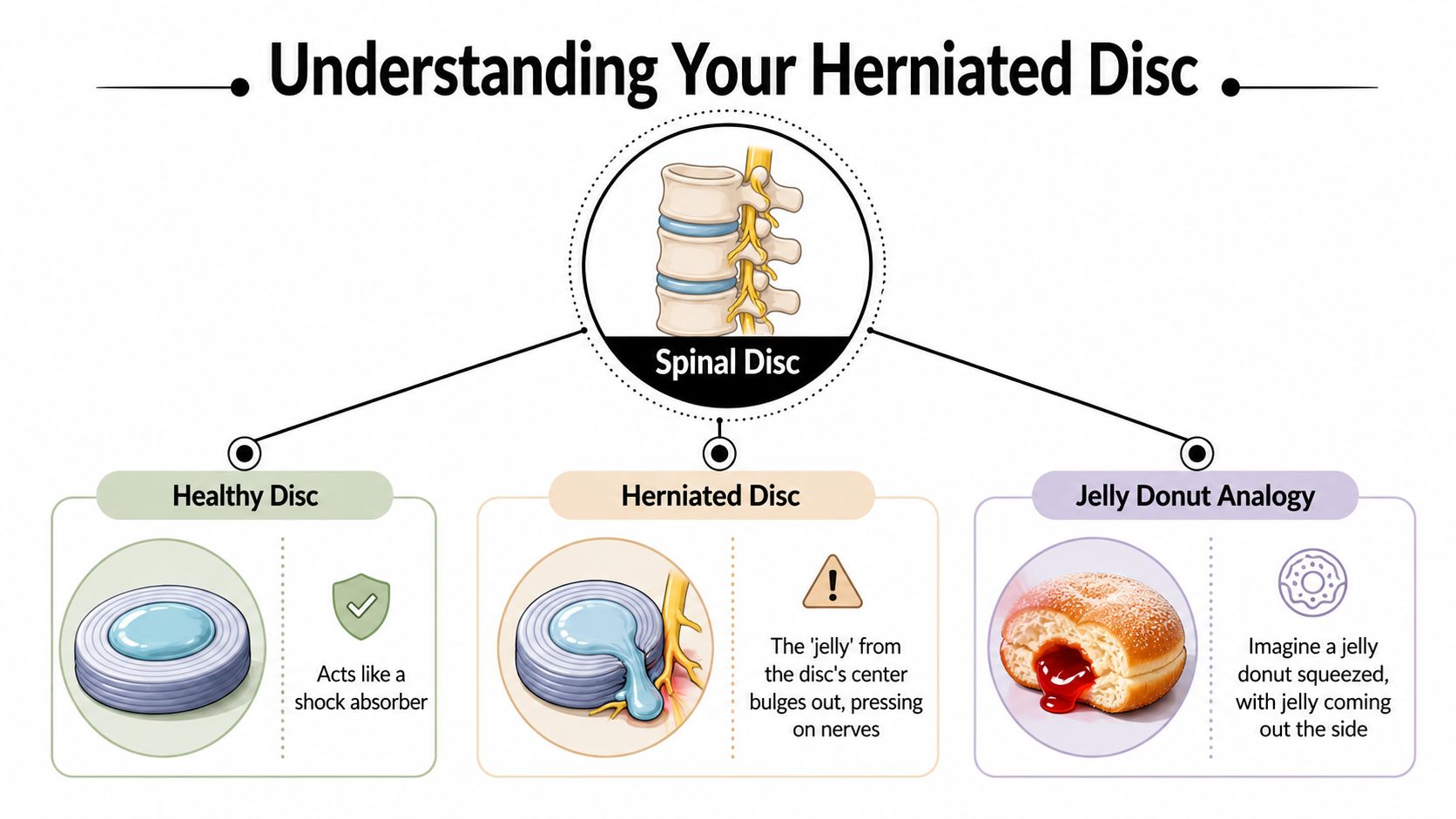
Between the bones of your spine are discs. They act like cushions and shock absorbers. A useful way to picture a disc is a jelly donut. The outside is tougher and more fibrous. The inside is softer, like jelly. If the outer layer gets irritated or weak and the inner material pushes outward, that's a herniated disc.
Here's a visual that makes the idea easier to grasp:
Why it can hurt in the back and somewhere else
Many people mistakenly believe the problem will stay in the back. But discs live close to spinal nerves. If disc material bulges or irritates a nearby nerve, symptoms can travel along that nerve's path.
That's why a lower back disc can create pain in the buttock, thigh, calf, or foot. It can also cause tingling, numbness, or a feeling that part of the leg just isn't working normally. The source may be in the spine, but the symptom can show up farther away.
What a diagnosis does and doesn't mean
A diagnosis tells you where the irritation may be coming from. It does not tell you that every movement is dangerous. It also doesn't mean the disc is constantly slipping in and out.
A better way to think about it is this:
- The disc is irritated
- The nerve may be sensitive
- Certain positions load the area more than others
- Specific movements can often calm it down
That's why one person feels worse sitting but better walking, while another prefers lying down first and then gradually moving more.
Later in care, it helps to see movement in action as well as in diagrams. This short video gives a useful overview of how symptoms can develop and why treatment often focuses on reducing nerve irritation and restoring motion.
Practical rule: Pain that travels farther down the leg usually deserves attention. Pain that starts to retreat closer to the back during treatment is often a helpful sign.
The Pillars of Physical Therapy Treatment
Good herniated disc physical therapy isn't one exercise sheet and a heating pad. It works best when several parts of treatment support each other. I think of it as a three-part system. Your therapist helps calm the irritated area, teaches your body to move better, and shows you how to protect your back in everyday life.
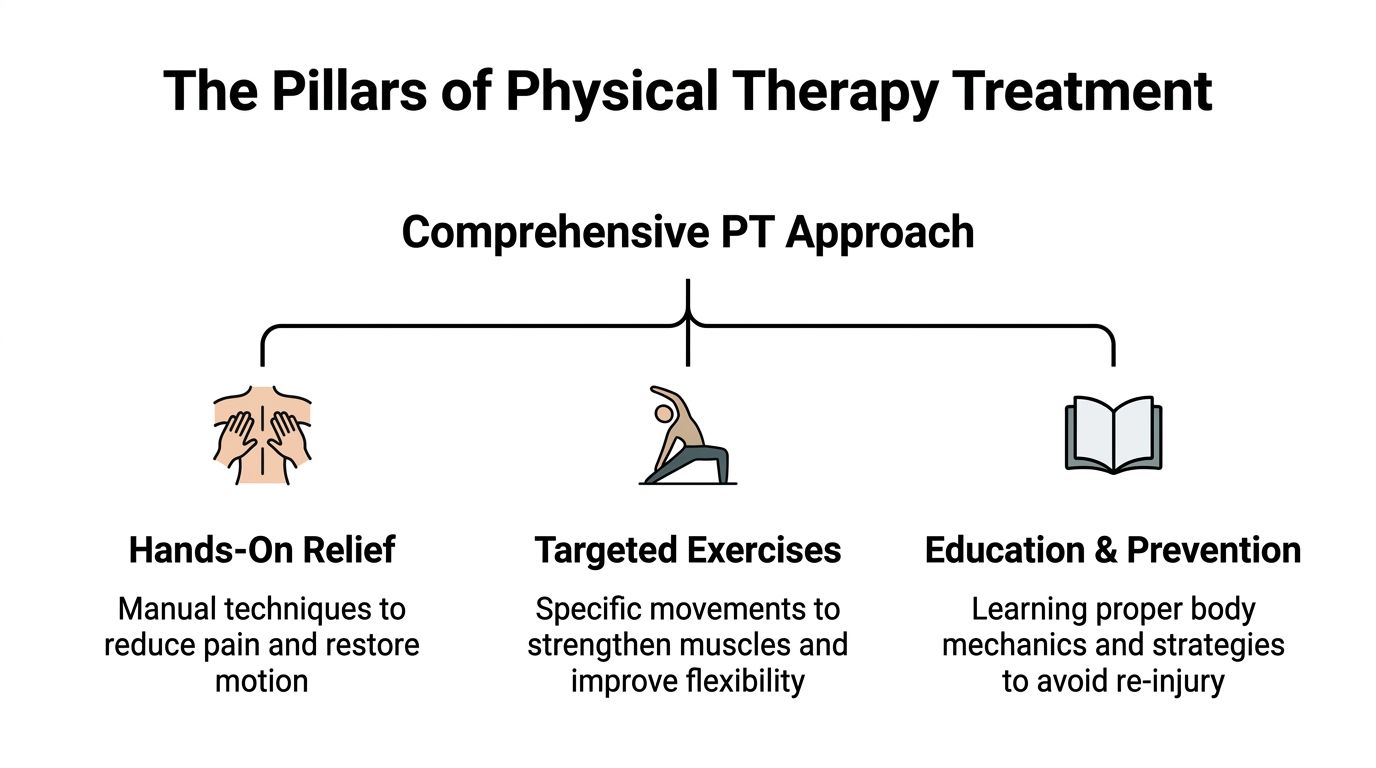
If you want a broader overview of conservative care for spine pain, this guide to how physical therapy helps with back and neck pain connects many of the same principles.
Hands-on relief
At the beginning, pain often makes everything tighten up. Muscles guard. Joints stiffen. You move less, and then moving less creates even more stiffness. Hands-on treatment can help interrupt that cycle.
This part of care may include:
- Soft tissue work to reduce guarding in the low back, hip, and glute muscles
- Joint mobilization to improve motion in areas that have become stiff
- Positioning strategies to help you find less painful ways to lie down, sit, or stand
- Gentle symptom-guided movement to reduce pressure on irritated structures
This isn't about forcing the spine into place. It's about helping the body settle enough so you can move with less fear and less resistance.
A simple example is a patient who can't stand upright after a flare. Once surrounding tissues relax and the body stops bracing so hard, walking becomes smoother and less threatening. That change matters because motion is part of recovery.
Active recovery
This is the heart of treatment. The right exercises are chosen for your presentation, not copied from a generic back pain list.
Some people need extension-based movements. Others need gentle flexion, hip mobility, nerve glides, or trunk stabilization. The point isn't to collect exercises. The point is to find movements that improve your symptoms and build support around the spine.
Common categories include:
- Directional exercises that help reduce or centralize symptoms
- Core stabilization to improve control through the trunk and pelvis
- Hip and glute strengthening because weak support muscles often leave the back doing too much work
- Nerve mobility work when the nerve itself is irritated and sensitive
- Walking or graded activity to rebuild tolerance for everyday movement
Education and prevention
This pillar often gets underestimated, but it's what helps relief last.
You need to know why sitting one way bothers you, why repeated bending may flare symptoms, and how to move through the day without becoming stiff or guarded again. Education turns treatment into something you can use outside the clinic.
That usually includes:
| Focus area | What you learn | Why it helps |
|---|---|---|
| Sitting posture | How to reduce prolonged strain | Less irritation during desk work or driving |
| Body mechanics | How to bend, lift, and transition safely | Fewer symptom spikes during chores |
| Activity pacing | How to do enough, but not too much | Prevents boom-and-bust setbacks |
| Home exercise plan | What to do between visits | Keeps progress moving forward |
Relief is helpful. Understanding why you got relief is what gives you control.
When these three pillars work together, physical therapy becomes more than symptom management. It becomes a way to rebuild trust in your body.
Your Recovery Journey Step by Step
Many individuals feel less anxious once they know what truly happens in treatment. The process is usually more straightforward and collaborative than they expect. You won't be dropped into a room and told to fend for yourself with random stretches.
The first visit
Your first session is about listening, observing, and testing patterns.
A physical therapist will usually ask where the pain travels, what positions make it worse, what eases it, how you're sleeping, and whether you've noticed numbness or weakness. Then comes a movement exam. You may bend, lean backward, walk, sit, stand, and perform simple strength or sensation tests.
The purpose is to answer practical questions:
- Is the nerve irritated?
- Which movements increase symptoms?
- Which positions reduce them?
- Are there signs that you need medical follow-up beyond therapy?
- What matters most to you right now, sitting at work, sleeping, walking, or lifting?
That last point is important. Recovery goals should match real life. Some patients want to get through a workday. Others want to pick up a child without fear. Others want to sleep through the night again.
The active treatment phase
Once your symptom pattern is clear, treatment becomes more targeted. A session may start with hands-on care or guided movements to calm the area. Then you'll practice a small number of exercises chosen for your body, not a huge routine you'll never keep up with.
A typical progression might look like this:
| Phase | Primary Goal | Typical Activities |
|---|---|---|
| Early care | Calm pain and reduce nerve irritation | Positioning, gentle repeated movements, manual therapy, short walks |
| Mid recovery | Restore motion and improve tolerance | Mobility work, core control, nerve glides, activity modification |
| Later recovery | Build strength and confidence | Progressive strengthening, lifting practice, balance, functional drills |
| Independence | Maintain gains and prevent flare-ups | Home program, pacing strategies, return-to-work or return-to-hobby guidance |
What patients often misunderstand
People often assume every session should leave them exhausted. That's not the goal. The best visit is often the one that gives your body a clear, useful signal without stirring everything up.
Here's what tends to work better:
- Specific over intense because the right movement beats the hardest movement
- Consistent over occasional because your body responds to repeated practice
- Progressive over aggressive because irritated tissue usually hates being rushed
A good session should teach you something. Maybe it shows you which movement eases leg pain, or how to get out of bed with less strain, or how much walking your back tolerates today.
The transition to independence
As symptoms calm and strength improves, the focus shifts. Therapy becomes less about hands-on symptom control and more about self-management. You practice returning to tasks that matter, carrying groceries, sitting longer, climbing stairs, or lifting from the floor with better mechanics.
This part can feel surprisingly emotional. Many people are physically better before they fully trust that they're better. A strong discharge plan helps close that gap. You leave knowing what to keep doing, what warning signs to watch, and what to change quickly if a flare begins.
That confidence is a major part of recovery. The goal isn't to make you dependent on treatment. The goal is to help you leave with skills.
How Long Does Recovery From a Herniated Disc Take
This is the question almost everyone asks first, and the honest answer is that recovery has a range. Some people notice early relief once they start moving in better directions and stop aggravating the nerve. Others improve more gradually and need time to rebuild strength, motion, and confidence.
What matters most is understanding that feeling better and being fully recovered aren't always the same thing. Pain may ease before your body is ready for long car rides, repeated lifting, or a full return to demanding activity. That's normal. Healing tends to happen in layers.
What influences your timeline
Several factors can shape how recovery unfolds:
- Symptom irritability matters. A highly sensitive nerve can take longer to settle than a milder flare.
- Location of symptoms matters. Pain that shoots far down the leg often behaves differently than pain that stays mostly in the back.
- Daily habits matter. Repeated bending, prolonged sitting, poor sleep, and inconsistent activity can slow progress.
- Consistency with therapy matters a lot. The home plan is part of treatment, not extra credit.
- Overall health matters. Your body heals best when stress, sleep, and general movement are addressed too.
What progress usually looks like
Recovery is rarely a straight line. You may have a good stretch, then a sore day after overdoing yard work or sitting too long. That doesn't automatically mean you've re-injured yourself. Often it means the tissue or nerve is still sensitive and your tolerance is still building.
A more useful way to judge progress is to ask:
- Are symptoms less intense than before?
- Do flare-ups settle faster?
- Can you do more before pain starts?
- Is the pain traveling less far down the leg?
- Are sleep and daily routines improving?
For people recovering after an accident, legal and medical timelines can create extra confusion. This overview of MMI guidance for accident victims can help you understand the idea of maximum medical improvement in plain language. For symptom-specific expectations, this article on how long sciatica pain lasts is also helpful.
The mindset that helps most
Patience doesn't mean passivity. It means sticking with the plan long enough for the plan to work.
If you only judge recovery by whether you feel perfect today, you'll get discouraged. If you judge it by trends in function, symptom behavior, and confidence, you'll see more clearly how far you've come.
When to Seek Immediate Medical Attention
Most herniated disc cases can be managed conservatively, but some symptoms need urgent medical evaluation. This is one area where I want to be direct.
If you notice new or worsening weakness in the leg or foot, don't wait it out. If your foot starts slapping the ground, you can't lift the front of the foot well, or standing on the leg suddenly feels much harder, contact a physician promptly.
Red flags you shouldn't ignore
Seek immediate medical attention if you have any of the following:
- Loss of bladder or bowel control
- Numbness in the saddle area, meaning the inner thighs, groin, or area that would touch a bicycle seat
- Rapidly progressing leg weakness
- Severe pain with fever, unexplained illness, or other concerning systemic symptoms
- Major trauma followed by severe back pain and neurological changes
These symptoms can point to a more serious problem that needs urgent medical care, not routine outpatient therapy.
This is not a "see how it feels tomorrow" situation. If bladder, bowel, saddle numbness, or fast-moving weakness appears, get medical help right away.
Why this matters
Physical therapy is powerful, but it has limits. Responsible care means knowing when conservative treatment is appropriate and when faster medical intervention matters more. A good therapist takes those warning signs seriously and acts quickly when they appear.
Start Your Healing Journey in Deerfield Beach
If you've been dealing with nerve pain, stiffness, or sciatica symptoms, the hardest part is often the beginning. You want relief, but you also want a plan that makes sense. You want someone to examine how you're moving, explain what they see in plain language, and help you build momentum without making things worse.
That kind of care is what many people are looking for when they search for herniated disc physical therapy in Deerfield Beach. They don't just need a diagnosis repeated back to them. They need guidance, reassurance, and treatment that changes what they can do day to day.
What patient-centered care should feel like
A strong rehab experience should feel organized and personal.
- You're heard clearly instead of being rushed through a generic checklist
- Your treatment matches your symptoms instead of following the same routine given to everyone
- You leave each visit with a clear next step so you're not guessing what to do at home
- Your progress is measured by function such as sitting, walking, sleeping, lifting, and returning to normal tasks
For many patients, choosing the right clinic starts with knowing what questions to ask. This guide on how to choose a physical therapist is a practical place to start.
Why local support matters
When you're hurting, convenience matters more than people realize. Easy scheduling, help understanding insurance, and a team that can adjust care as your symptoms change all make it easier to stay consistent. And consistency is what gives treatment the best chance to work.
In Deerfield Beach, patients also benefit from a setting that can address more than one piece of the problem. Some need hands-on physical therapy. Some benefit from a broader rehab approach that includes other non-surgical services under one roof. What matters is having a team that keeps the focus on function, comfort, and steady progress.
If you're ready to take the first step, MedAmerica Rehab Center offers patient-centered care in Deerfield Beach with a hands-on, practical approach to back pain, sciatica, and movement recovery. Their multidisciplinary team has served the community since 1995, and they make getting started easier with same-day appointments, insurance-friendly support, and individualized treatment plans built around your goals.
MedAmerica Rehab · Deerfield Beach
Talk to a clinician about your pain
Physical therapy, chiropractic, acupuncture and shockwave therapy under one roof, since 1995. Same-day appointments are available.
Mon–Thu 8:00 AM – 6:30 PM · Fri 8:00 AM – 3:00 PM