

Gait Evaluation Physical Therapy: A Complete Guide
A woman in her late sixties begins shuffling after knee replacement. She knows the hallway at home by heart, yet she hesitates before going outside because each uneven surface feels unpredictable. Her question is familiar: “Will someone watch me walk, or will the evaluation explain why walking has changed?”
A gait evaluation in physical therapy should answer that question with more than a quick visual impression. It examines how you stand, step, turn, balance, and respond to movement demands, then connects those findings to pain, weakness, stiffness, coordination, and safety. The right assessment helps a therapist choose treatment that fits your actual movement pattern instead of handing you a generic exercise sheet.
What Gait Evaluation in Physical Therapy Really Means
Gait is the clinical word for the way you walk. A gait evaluation is a structured physical therapy assessment of walking quality, balance, movement control, and functional mobility. Your therapist may watch you walk at your usual pace, ask you to change speed, observe a turn, test your ability to step over an obstacle, and examine what your joints and muscles are doing during those tasks.
That work goes well beyond watching someone cross a hallway. A therapist looks for step length, cadence, symmetry, foot clearance, trunk position, arm movement, heel contact, push-off, joint motion, and the way your body controls its center of gravity. The clinician also considers whether pain, fear, reduced attention, poor proprioception, or a vestibular problem changes your walking.
Practical rule: A gait evaluation should connect what your therapist sees with a measurable functional question, such as whether you can walk faster, turn safely, or tolerate a longer distance.
Why the therapist asks for specific tasks
Every task creates a different demand. Walking in a straight line may reveal a short step or a painful loading pattern. Turning can expose reduced balance reactions or difficulty shifting weight. Walking while talking may show that your movement becomes less automatic when your attention is divided.
The history matters just as much as the movement screen. Your therapist may ask about falls, near-falls, footwear, medications, home layout, pain, recent surgery, and the activities you want to resume. A person who wants to walk safely to the mailbox has different priorities from an athlete returning to cutting and running.
Clinical gait analysis developed into a structured discipline that combines qualitative observation and quantitative measurement. Rehabilitation literature describes its uses as documenting gait patterns, comparing them with typical gait, identifying causes of functional disorders, evaluating assistive devices, and measuring intervention effects in this rehabilitation review of gait analysis.
You can also read a practical explanation of how gait work fits into rehabilitation in this guide to gait training in physical therapy. The central idea is simple: the evaluation establishes what needs to change, why it matters, and how progress will be judged.
How Modern Gait Evaluation Came to Be
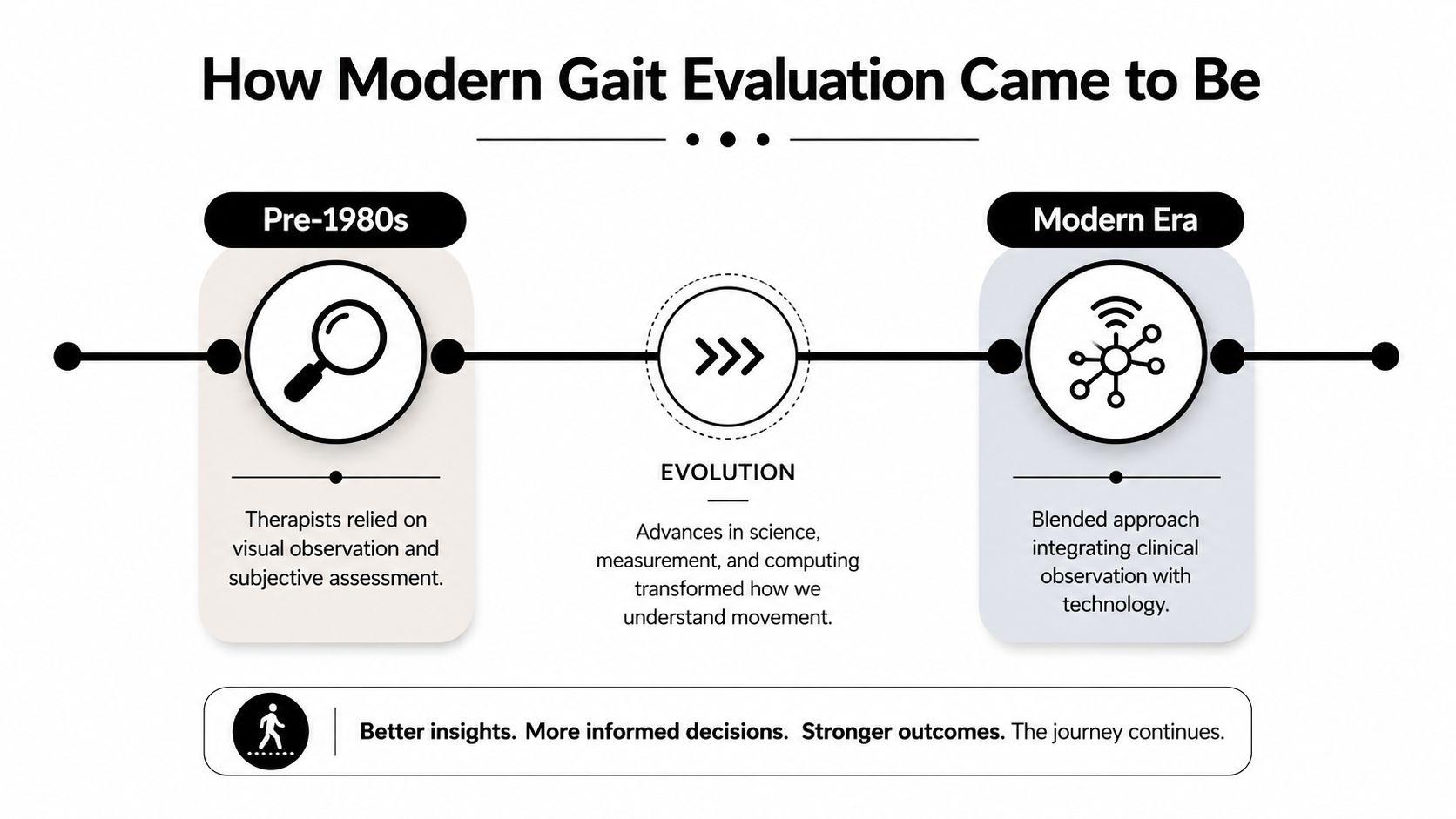
Before computerized measurement became practical, physical therapists depended heavily on skilled visual observation and descriptive notes. That approach remains useful, but two clinicians can notice different details or describe the same movement differently, especially when a deviation is subtle.
Modern clinical gait analysis traces a major milestone to the early 1980s, when specialized laboratories began opening in locations including Newington, Connecticut, and later Boston, Glasgow, and Dundee, with equipment from Oxford Dynamics. The arrival of modern computers eventually made instrumented gait analysis practical for routine clinical care, shifting gait assessment from purely observational examination toward a combination of observation and measurement. The historical development is documented in the clinical gait analysis literature.
What changed in clinical practice
Early gait laboratories could measure movement, ground reaction forces, pressure distribution, and muscle activity, but they required specialized equipment and trained staff. Most community clinics continued using observation, physical examination, and standardized functional tests because those tools were more accessible and directly connected to everyday mobility.
Today, technology can be more portable. Three-dimensional motion capture, force plates, instrumented treadmills, pressure systems, and wearable sensors can quantify speed, cadence, asymmetry, and joint movement. A smartphone video or wearable device may also help a therapist compare movement across visits or monitor walking outside the clinic, although the usefulness of any tool depends on validation, consistent setup, and clinical interpretation.
The most useful modern approach is therefore a blend, not a contest between the therapist's eyes and a sensor. Observation explains how movement looks and feels. Functional tests show whether a person can complete meaningful tasks. Instrumented measurement adds detail when the clinical question is too complex for basic tools.
That history explains why a good evaluation may look low-tech at first. A stopwatch, marked walkway, examination table, and careful questioning can produce highly relevant information. Technology earns its place when it clarifies a decision that simpler assessment can't answer.
The Four Building Blocks of a Clinical Gait Assessment
A physical therapist usually builds the assessment in layers. Each layer adds context to the one before it, so the final plan reflects both the movement pattern and the person living with it.
History gives the movement a reason
The appointment often begins with questions rather than walking. Your therapist may ask when the change started, whether pain limits weight-bearing, whether you've fallen, what shoes you wear, which surfaces feel unsafe, and what you need to do at home or work.
Medical history, neurological conditions, joint replacement, medications, vision changes, and home hazards can all affect the clinical question. A shuffling pattern in a person with pain requires a different investigation from shuffling associated with reduced initiation or balance control.
Observation shows the pattern in context
The therapist may watch you from the front, side, and rear at a comfortable pace, then ask for a faster walk or a change in direction. Common observations include:
- Alignment: Trunk position, pelvic control, knee position, and foot orientation.
- Foot mechanics: Heel contact, toe clearance, pronation, and push-off.
- Symmetry: Differences in step length, stance time, arm swing, or loading.
- Transitions: Starting, stopping, turning, and moving from sitting to standing.
A movement assessment can also be useful outside a medical appointment when it helps organize attention around alignment, control, and task performance. Cartwright Fitness movement assessment offers related context on observing movement quality.
Functional tests make performance repeatable
A therapist selects tests according to your condition and goals. Common options include the Timed Up and Go, 10-Meter Walk Test, 6-Minute Walk Test, Five Times Sit-to-Stand, tandem stance, and the Functional Gait Assessment. Each test stresses a different part of mobility, including speed, endurance, transfers, balance, turning, or walking under changing conditions.
Instrumentation answers narrower questions
When needed, the therapist may use motion capture, force plates, pressure mats, surface electromyography, instrumented treadmills, or wearable inertial sensors. These systems can examine joint motion, loading, timing, and muscle activation with greater detail than visual observation alone.
The layers aren't interchangeable. A sensor can quantify an asymmetry, but it doesn't replace questions about pain or home safety. Conversely, observation may identify a clinically important problem without explaining its exact joint mechanics. The clinician chooses the least complicated assessment that answers the question well.
Common Tests and What Abnormal Findings Reveal
Standardized tests do not label your body as passing or failing. They give the therapist repeatable ways to describe function, identify priorities, and check whether treatment is producing a meaningful change. The score matters, but the movement pattern behind it often matters more.
The 10-Meter Walk Test measures walking speed across a measured distance. A slower result can occur with weakness, pain, fear of falling, reduced motor control, or limited endurance. The therapist watches how that speed is produced. Shorter steps, less time spent on one leg, or weak push-off can point toward different treatment priorities.
The Timed Up and Go combines rising from a chair, walking, turning, and sitting down. Trouble during the turn may suggest limited balance reactions, reduced proprioception, or vestibular involvement. A therapist also observes whether you hesitate before standing, pivot unsafely, or lose control while returning to the chair. The elapsed time is one piece of the examination, not a diagnosis by itself.
Tests that challenge balance and endurance
The 6-Minute Walk Test examines endurance and the ability to sustain walking. Early fatigue, a shortened stride, or increasing reliance on support can show that mobility becomes less efficient over time. The Dynamic Gait Index adds tasks such as changing speed, turning the head, stepping around or over obstacles, and using stairs. These demands can reveal difficulty that a quiet, straight hallway walk does not expose.
The Berg Balance Scale examines several controlled balance tasks. The Functional Gait Assessment focuses on postural stability during walking tasks. The American Physical Therapy Association lists the FGA as a clinical tool for conditions including Parkinson disease, spinal cord injury, stroke, and vestibular disorders, and cites guideline support for adults with neurologic conditions whose goals include improving walking balance in its Functional Gait Assessment resource.
Tests that expose strength and movement strategy
The Five Times Sit-to-Stand test provides information about lower-extremity strength, power, coordination, and the mechanics of rising from a chair. A person may lean far forward, push with the hands, shift weight away from one leg, or drop into the seat. Those observations help the therapist choose strengthening exercises and transfer practice that match the actual problem.
| Test | What it measures | Abnormal finding or clinical signal |
|---|---|---|
| 10-Meter Walk Test | Walking speed and functional mobility | Short steps, cautious pacing, pain-related slowing, or reduced propulsion |
| Timed Up and Go | Standing, walking, turning, and sitting | Difficulty initiating, pivoting, or controlling the return to the chair |
| 6-Minute Walk Test | Walking endurance | Early fatigue, reduced distance tolerance, or an inefficient gait pattern |
| Dynamic Gait Index | Walking adaptability and balance | Trouble changing speed, turning the head, avoiding obstacles, or using stairs |
| Berg Balance Scale | Controlled postural balance | Instability during reaching, transfers, or changing the base of support |
| Five Times Sit-to-Stand | Leg strength and transfer mechanics | Asymmetrical loading, hand support, forward collapse, or poor control |
| Functional Gait Assessment | Balance during challenging walking tasks | Reduced stability with head movement, narrow walking, or speed changes |
Observational scales, including the Wisconsin Gait Scale and Tinetti gait subscale, add structure to the therapist's visual examination. A sound clinical assessment combines those qualitative observations with quantified measures, as described in guidance on gait abnormality assessment.
When Simple Observation Is Enough and When You Need More
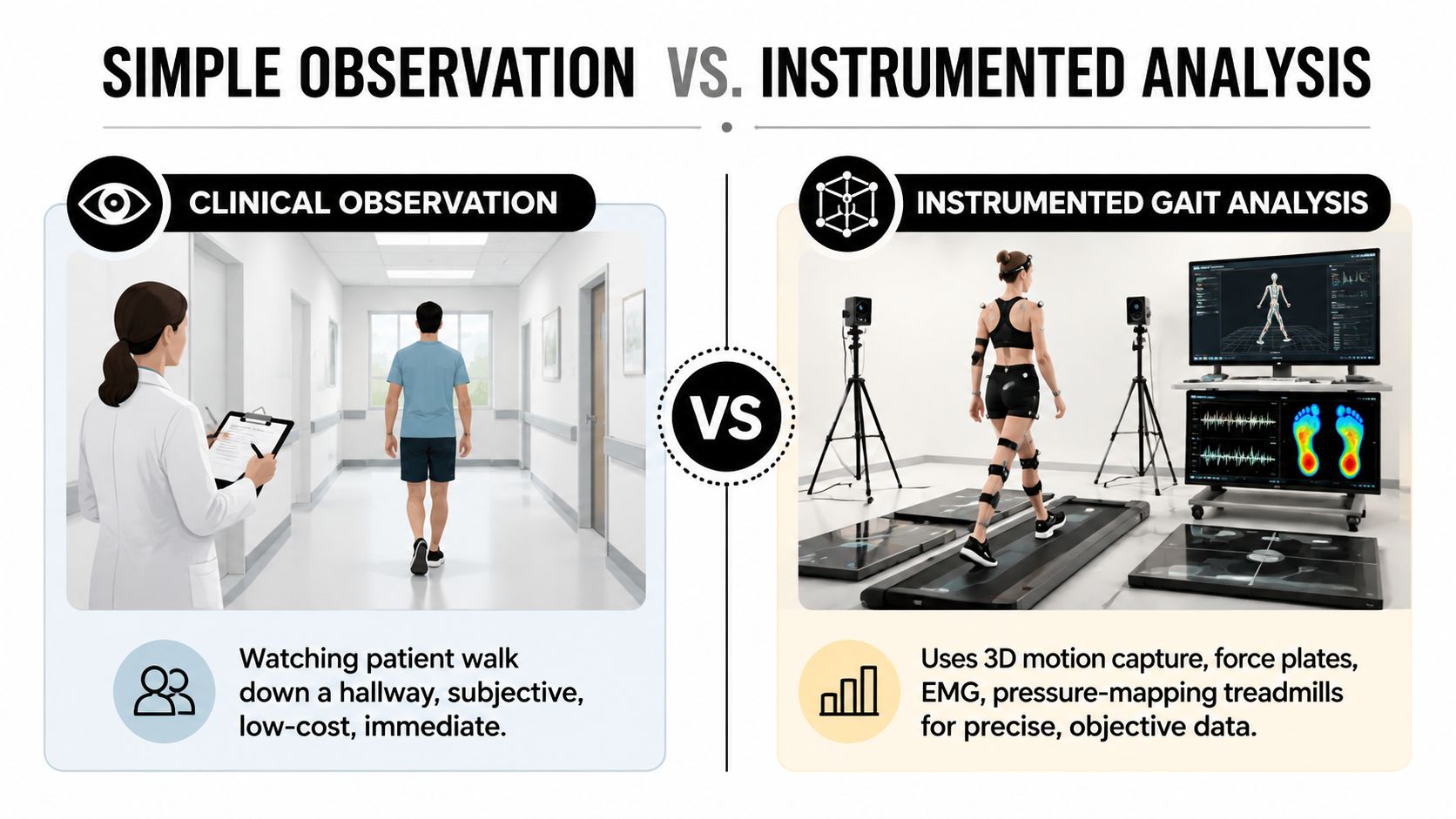
A therapist watching you walk can identify many clinically important findings. A painful limp, reduced foot clearance, trunk lean, short step, or unsafe turn often becomes obvious when the clinician observes several trials and compares walking with related tasks.
For many straightforward orthopedic and neurological presentations, skilled observation plus validated functional tests is enough to guide treatment. A stopwatch, a measured walkway, a chair, and a balance assessment can show whether your mobility is improving without requiring a motion laboratory.
When instrumentation adds useful detail
Instrumented gait analysis becomes more valuable when the therapist needs to answer a narrow, difficult question. Examples include subtle deviations after stroke, pre-surgical planning for spasticity or deformity, persistent pain without a clear mechanical explanation, prosthetic alignment concerns, or detailed documentation for complex rehabilitation.
Three-dimensional motion capture can quantify joint angles. Force plates can show how and when you load each limb. Pressure-mapping systems can display where the foot contacts the ground, while surface EMG can help examine muscle activation timing. Wearable inertial sensors can capture walking outside a laboratory, but their clinical value still depends on reliable interpretation and standardization.
Decision rule: If basic observation and functional tests answer the clinical question, more technology may add complexity without changing care. If they don't explain why progress has stalled, instrumentation may be justified.
Wearables and smartphone-based tools occupy a middle ground. They can help compare walking across settings or document changes between visits, but a larger volume of data isn't automatically better. Recent reviews describe growing use of computerized systems, including motion capture, force plates, instrumented treadmills, and wearable sensors, while also emphasizing the importance of meaningful clinical interpretation in this review of technology in gait assessment.
Turning Results Into a Personalized Treatment and Fall-Prevention Plan
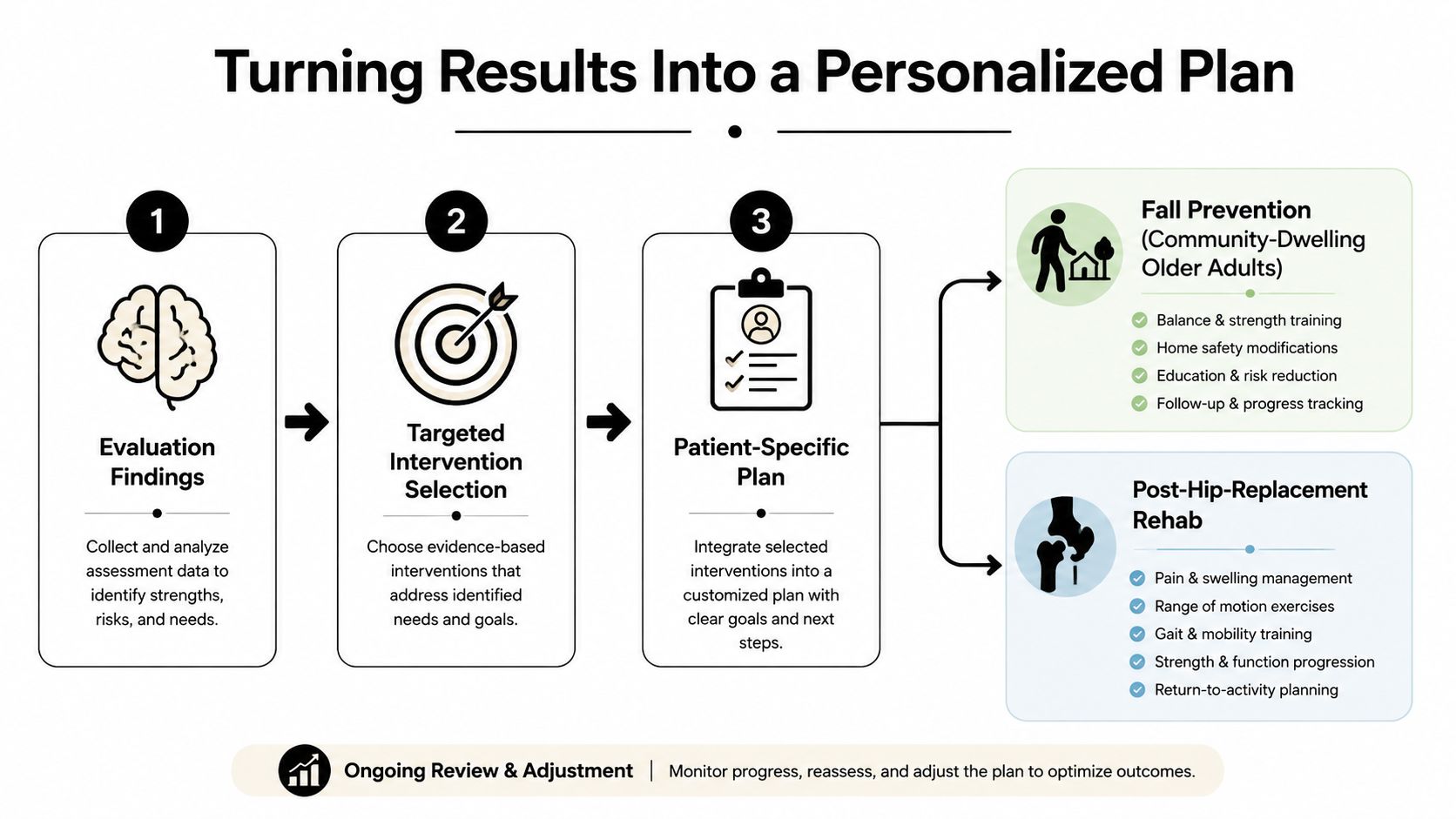
An evaluation becomes useful when each finding changes the treatment plan. Suppose a patient takes short steps and leans the trunk over the stance leg. The therapist may first examine hip strength and control, then combine strengthening with cueing for a more upright position and balance practice during walking. If the patient walks steadily on a straight path but loses balance while turning, the priority shifts to weight transfer, controlled turns, and dynamic balance.
The same walking pattern can have different meanings in different people. An older adult who feels unsafe outside may need lower-extremity strengthening, balance-reaction practice, walking strategies for divided attention, and safer ways to manage community settings. After hip replacement, treatment may focus on even weight bearing, hip control, step length, transfers, stairs, and confidence.
Matching the intervention to the finding
- Short steps or reduced cadence: Practice larger, controlled steps, use suitable cues, and build walking tolerance while monitoring pain and fatigue.
- Trunk lean or pelvic instability: Strengthen the hip stabilizers, then practice keeping that control during standing and stair tasks.
- Postural sway: Progress from stable standing to reaching, stepping, dynamic surfaces, and carefully selected balance challenges.
- Unsafe turning: Break turns into controlled parts, improve weight transfer, and add direction changes as control improves.
- Reduced endurance: Use graded walking intervals and observe whether fatigue changes step length, posture, or foot clearance.
The Functional Gait Assessment, walking tests, and balance measures can establish a baseline and show whether the plan is working. Home exercises may include balance practice, walking logs, footwear review, or environmental changes. Instructions should match the person's safety level. A drill that requires support should not be assigned for unsupervised practice.
Reassessment keeps the plan responsive
A rehabilitation plan changes as walking changes. The therapist may adjust exercise difficulty, walking speed, assistive-device use, or balance demands when control improves, symptoms shift, or testing exposes a limitation that was not clear at the first visit.
Fall prevention needs direct attention because gait, balance, mobility, and muscle weakness all affect fall risk assessment in older adults. Patients seeking structured support can review MedAmerica's fall-prevention program and discuss which assessment and training approach fits their situation.
What to Expect at Your MedAmerica Rehab Center Appointment
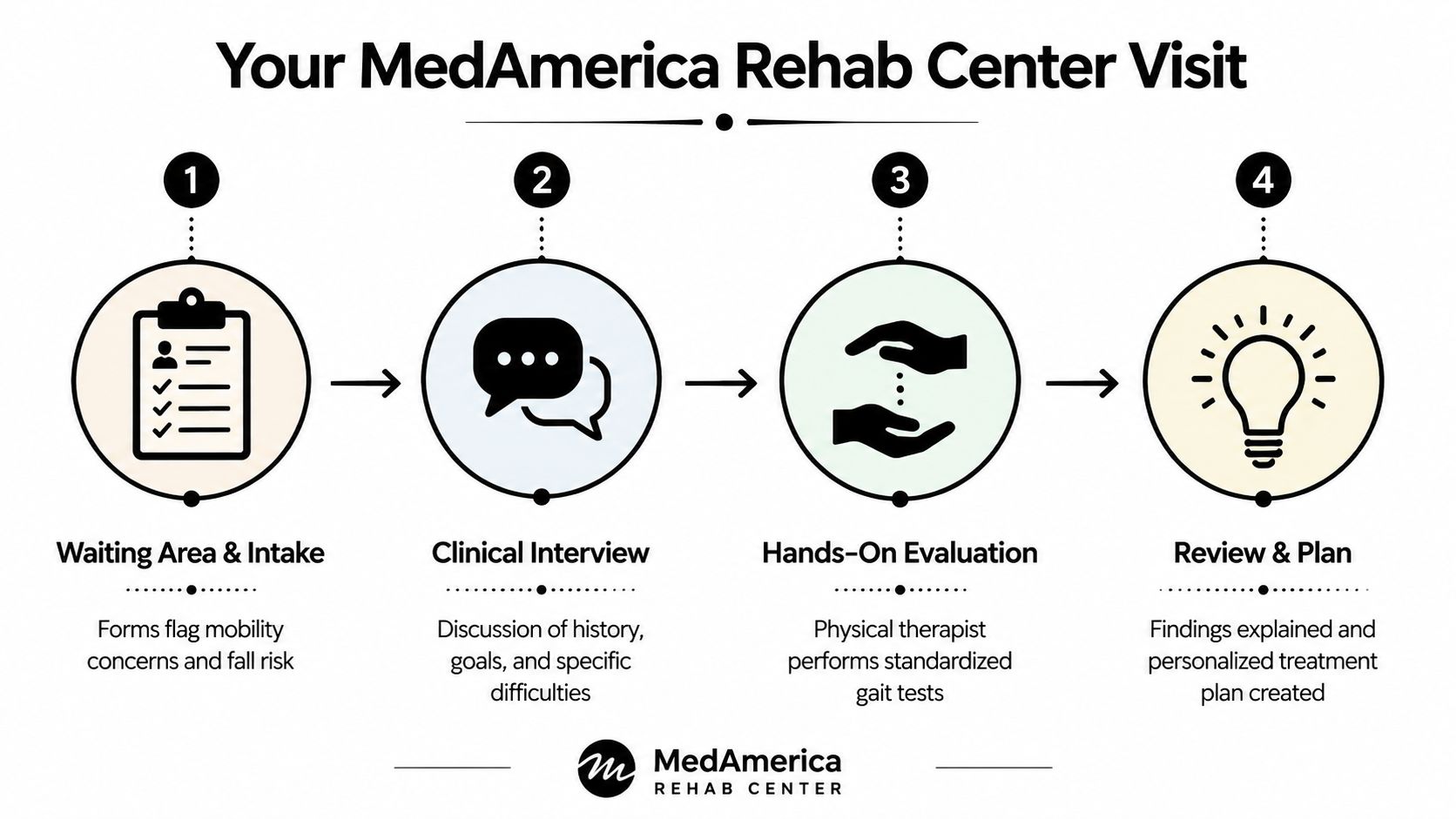
You may begin with intake forms that ask about mobility concerns, falls, pain, prior surgery, and daily activities. Those questions help the therapist identify safety issues before testing begins. Wear comfortable clothing and bring any walking aid you use regularly, along with information about relevant medical conditions and medications.
During the interview, the therapist listens to what walking feels like, when symptoms appear, and what you want to regain. You may then walk along a hallway while the clinician watches from different angles. The therapist may ask you to change pace, turn, rise from a chair, or negotiate a balance challenge.
The hands-on portion connects symptoms to movement
At the mat table, the therapist may examine joint range of motion, leg strength, flexibility, posture, and balance reactions. Standardized walking tests can establish a starting point, while additional measurement is considered if your presentation remains unclear or requires more detailed movement information.
The findings should be explained in ordinary language. You should understand whether pain, weakness, stiffness, balance, coordination, or another factor is affecting your gait, what the therapist plans to address first, and how progress will be checked. Treatment may include hands-on therapy, targeted strengthening, balance training, gait retraining, and a home program.
For a community-dwelling older adult, one pathway may focus on balance and strengthening with gradual practice for turning, transfers, and safe walking. For a person after ACL reconstruction, another pathway may progress from restoring a controlled walking pattern to strengthening, dynamic control, and eventually running mechanics when clinically appropriate. Visit frequency and milestones depend on the examination, surgical guidance, symptoms, and goals.
A general overview of the patient experience is available in this explanation of a typical physical therapy session. You can also preview the conversational nature of a rehabilitation visit below.
MedAmerica Rehab Center provides physical therapy that includes walking assessment, gait and mobility training, balance work, and fall-prevention care. The clinic's multidisciplinary services also include chiropractic care, acupuncture, and shockwave therapy, with treatment selected according to the patient's evaluation and goals.
Why a Thorough Gait Evaluation Changes Everything
Generic exercises can improve general strength while leaving the underlying walking problem untouched. If a stiff ankle limits forward movement, a weak hip causes pelvic instability, or a balance system struggles during turns, the treatment needs to address that specific limitation.
A thorough assessment also identifies compensations. A person may shorten one step to protect a painful knee, lean the trunk to reduce demand on a weak hip, or lift the leg excessively to clear a foot. These strategies may help temporarily, but they can also shift stress to another joint or make walking less efficient.
Objective measures give both patient and therapist a shared reference point. Instead of relying only on whether walking “feels better,” you can track changes in speed, endurance, balance performance, step symmetry, or task control. That information supports treatment adjustments, discharge planning, assistive-device decisions, and fall-prevention strategies.
The older woman who began shuffling after knee replacement doesn't need to be told to walk more. She needs an evaluation that determines whether pain, limited motion, weakness, fear, or balance control is driving the change, followed by practice that restores safe movement in situations she faces.
Gait evaluation isn't a formality. It's the foundation for efficient rehabilitation, greater confidence, and safer participation in daily life. If walking has changed, an assessment is the practical first step toward understanding why.
MedAmerica Rehab Center offers individualized physical therapy, gait and mobility training, balance rehabilitation, and fall-prevention support for patients in Deerfield Beach and nearby communities. Visit MedAmerica Rehab Center to request an evaluation and discuss a treatment plan built around your walking goals.
MedAmerica Rehab · Deerfield Beach
Talk to a clinician about your pain
Physical therapy, chiropractic, acupuncture and shockwave therapy under one roof, since 1995. Same-day appointments are available.
Mon–Thu 8:00 AM – 6:30 PM · Fri 8:00 AM – 3:00 PM