
Balance Training for Seniors: A Step-by-Step Guide
If you've started reaching for the wall when you walk down the hallway, or you hesitate before stepping off a curb, you're not overreacting. Those small moments matter. They often show up before a fall, and they can slowly shrink your world if you let them.
I see this pattern often in older adults. At first, it looks like caution. Then it turns into avoiding stairs, skipping outings, or keeping one hand on furniture at home. The good news is that balance isn't fixed. Like strength and flexibility, it responds to practice when the program matches the reason you're unsteady.
Regaining Your Footing and Your Confidence
Balance problems are frustrating because they don't just affect walking. They change how you move through an entire day. Getting up to use the bathroom at night feels different. Turning in the kitchen feels different. A busy grocery aisle can suddenly feel like too much.
That loss of confidence is real. So is the opportunity to improve it.
Targeted fall-prevention exercise isn't just "nice to have." A Harvard summary of research reports that exercise programs lowered falls causing injuries by 37%, falls leading to serious injuries by 43%, and broken bones by 61% among older adults, as described in Harvard Health's summary of fall-prevention research.
Why generic advice often falls short
A lot of balance training for seniors starts and ends with "stand on one leg." That's not wrong, but it isn't enough for many people.
Some people are unsteady because their legs are weak. Others feel a spinning or floating sensation when they turn their head. Others have numb feet and can't feel the floor well. Those are different problems, and they shouldn't all get the same home program.
Practical rule: Balance training works best when it matches the cause of the imbalance, not just the symptom.
What usually works better
A useful program does three things at once:
- Builds a base with simple supported standing drills
- Improves movement control during walking, turning, and reaching
- Prepares for real life with stepping and recovery practice, not just still poses
It also respects fear. If you're nervous about falling, you won't commit to a program that feels risky. That's why a safe setup matters as much as the exercise choice.
For many seniors in Deerfield Beach and nearby communities, the goal isn't to become athletic. It's to get back to ordinary things without second-guessing every step. Walking to the mailbox. Turning to answer the phone. Getting out of a chair without that brief flash of panic.
That's the standard I use when I think about progress. Not whether an exercise looks impressive, but whether it gives you more freedom in daily life.
How to Assess Your Starting Balance at Home
Before you start any routine, get a baseline. You don't need a fancy clinic setup for a simple screen. A sturdy chair, a stopwatch or phone timer, and a clear walkway are enough to learn a lot.
Experts recommend screening first with functional tests like the Timed Up and Go, and lower-body weakness is a major risk factor because it can increase the odds of falling fourfold, as noted in NASM's fall-prevention guidance.
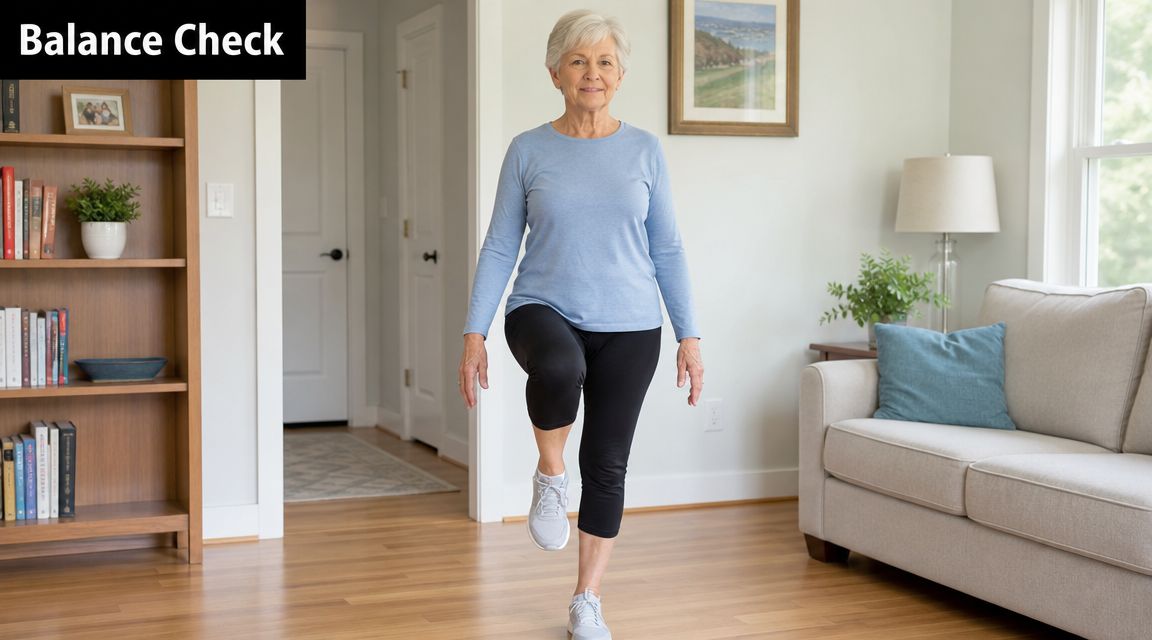
Try the chair-to-walk screen
Set a chair against a wall so it won't slide. Mark a short walking distance in your home, such as a path to a point you can clearly identify and safely return from.
Then do this:
- Sit tall in the chair. Keep your back against the chair and your feet flat.
- Start the timer as you stand up.
- Walk at your normal pace to your marked point.
- Turn carefully without rushing.
- Walk back and sit down with control.
- Stop the timer once you're seated.
Don't obsess over the number. What matters most at home is how it feels. Were you steady when standing? Did the turn feel awkward? Did you need to grab the chair when sitting down? Those details help identify where the problem starts.
If you want a more complete next step, MedAmerica has a page on fall risk assessment for elderly adults that outlines what a fuller screening looks like.
Ask what kind of unsteadiness you have
This is the part most home guides skip.
Not all balance loss feels the same, and your description matters:
- Weakness pattern. Your legs feel heavy, rising from a chair is hard, stairs are difficult, and you feel less steady as you get tired.
- Dizziness pattern. You feel spinning, lightheadedness, floating, or increased sway with quick head turns or position changes.
- Numbness pattern. Your feet feel less connected to the floor, especially in dim light or on uneven ground.
If your main complaint is dizziness, don't jump into harder balance drills. The wrong exercise can make you feel worse before it makes you feel better.
Two quick observations that help
Use these simple home checks to guide your starting point:
| What you notice | What it may suggest |
|---|---|
| Trouble standing up from a chair without using your hands | Lower-body weakness and reduced functional control |
| More sway when turning your head | Vestibular or dizziness-related involvement |
| Worse balance in socks, at night, or on soft surfaces | Reduced foot sensation or proprioceptive loss |
These aren't diagnoses. They're clues.
If your symptoms are mostly weakness, a standard strength-plus-balance routine often makes sense. If dizziness, numbness, or medication-related unsteadiness is the main issue, the program needs more modification and a slower progression.
Building Your Foundation with Static Balance Exercises
Static balance means holding your body steady without stepping. It sounds basic, but it enables many seniors to rebuild trust in their legs and feet. If you can't control stillness, moving safely gets much harder.
For this stage, support should always be close. A kitchen counter works well. So does the back of a heavy chair placed on a non-slip surface.
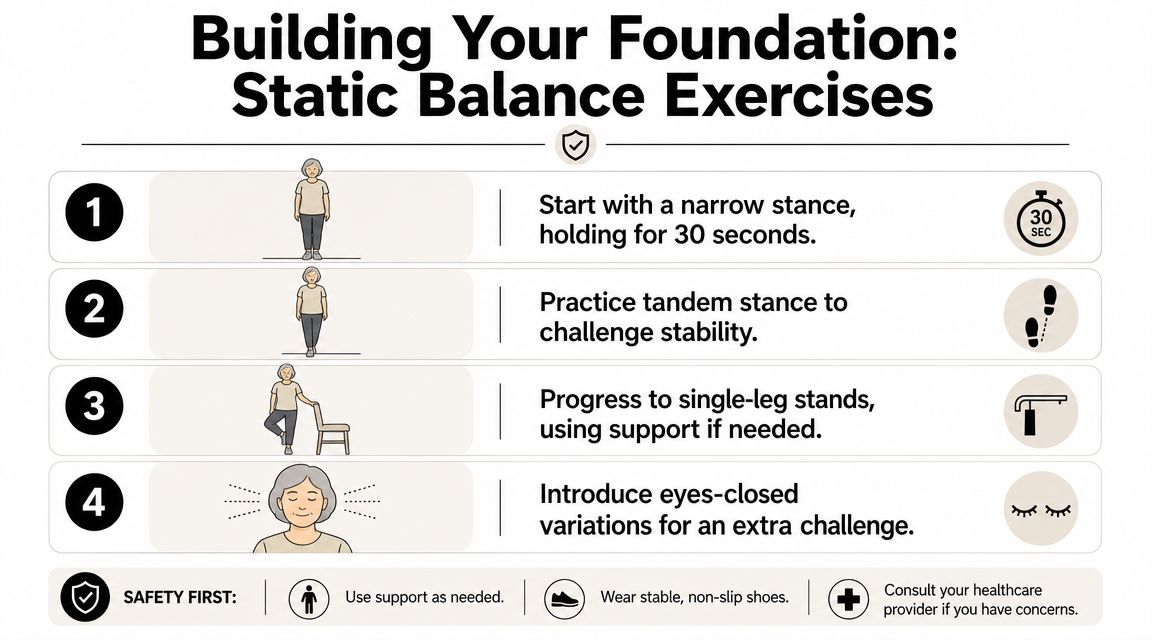
Setup cues that make these work
Before the individual drills, use the same form each time:
- Stand tall. Keep your chest up instead of leaning forward.
- Look ahead. Pick a fixed point on the wall rather than staring at your feet.
- Keep your hands ready. Hover over the counter or chair if you're not yet safe hands-free.
- Breathe steadily. Many people hold their breath when they feel wobbly, which makes them stiff.
Three starting exercises
1. Feet-together stand
Stand with your feet close together while lightly touching the counter.
- Hold the position with easy breathing.
- If you sway, widen your feet slightly.
- If this feels easy, reduce hand pressure rather than removing support completely.
This drill narrows your base of support and teaches your ankles and hips to make small corrections.
2. Tandem stance
Place one foot in front of the other, heel near toe, like you're standing on a line.
- Start with a small gap between the feet if full heel-to-toe is too much.
- Hold the counter with one or two hands as needed.
- Repeat with the other foot in front.
This starts to challenge side-to-side control, which is often where falls happen.
3. Single-leg hold with support
Shift your weight onto one leg and lift the other foot only a little.
- Keep one or both hands near support.
- Don't hike your hip or lean your trunk.
- Lower the foot as soon as form breaks down.
This drill matters because walking is a series of brief single-leg stands.
Your goal isn't to "tough it out." Your goal is to stay upright with good form and calm breathing.
How to progress without getting reckless
Progression should be boring. That's usually a good sign.
Change only one thing at a time:
- Less hand support before you increase time
- Narrower stance before you close your eyes
- Longer hold before you try a harder surface
For some seniors, tools like a foam pad or an inflatable balance disc can add challenge later, but only after flat-ground control is solid. If flat standing is still shaky, unstable surfaces are too much too soon.
What not to do yet
Skip these mistakes early on:
- No rushing into eyes-closed drills if you're already very unsteady
- No balancing far from support
- No multitasking while you're still learning the positions
- No slippery socks
A supported static program is often the right entry point, especially if your sway increases quickly. Once you can hold these positions calmly and recover small wobbles without panic, you're ready to make the exercises look more like real life.
Progressing to Dynamic and Real-World Movements
Daily life doesn't happen in a still stance. You turn, reach, back up, step sideways, and recover when something catches you off guard. That's why balance training for seniors has to move beyond holds.
Many seniors can perform controlled exercises well and still struggle when balance is suddenly disrupted. That gap matters. Reactive balance training, including quick stepping and obstacle recovery practice, is discussed in this NIH-hosted article on balance training and real-world function.
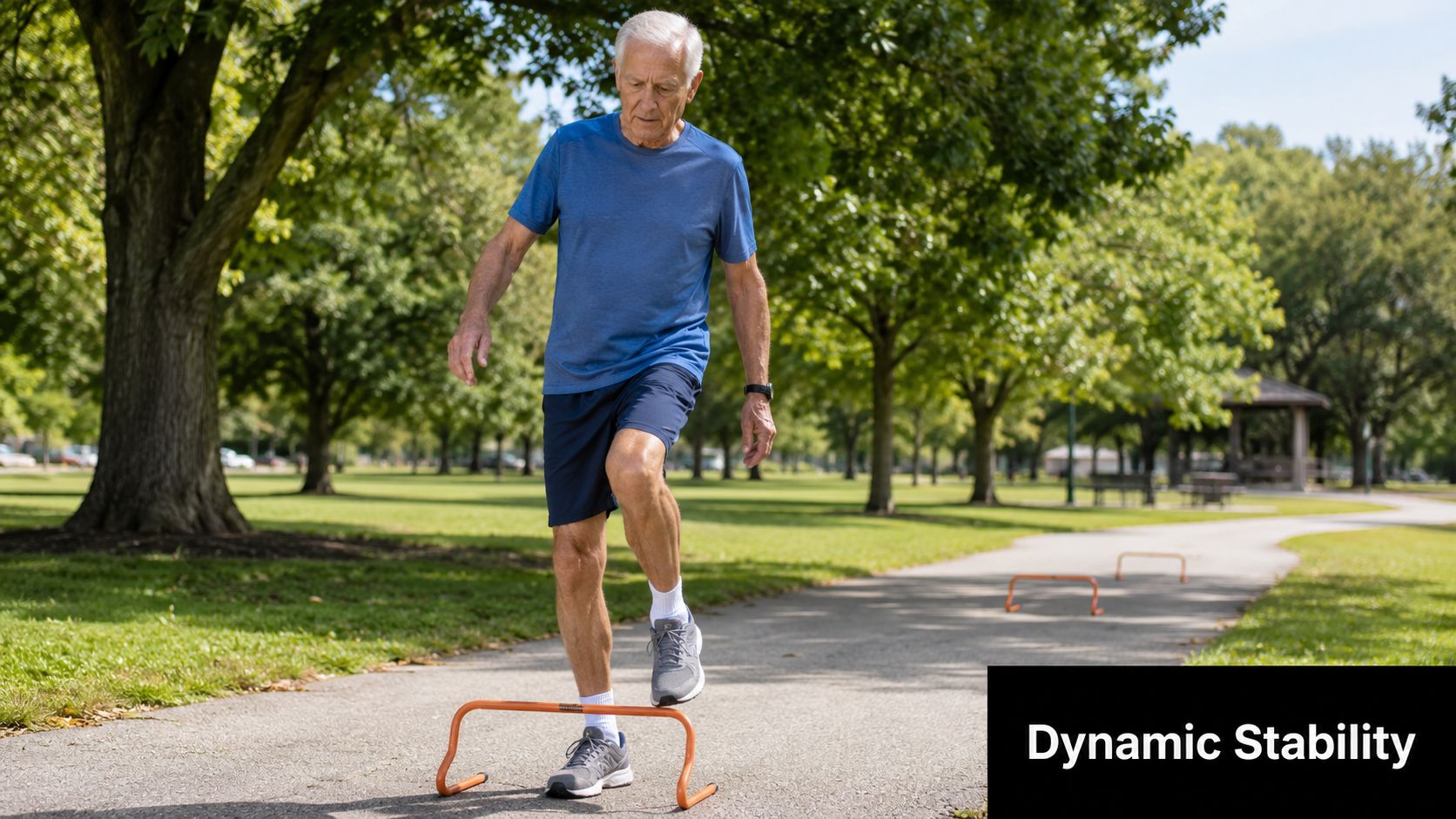
Start with controlled motion
Begin next to a counter or in a hallway with a wall nearby. These drills should feel deliberate, not fast.
Try this short sequence:
- Side-to-side weight shifts. Move your weight onto one leg, then the other, without letting your trunk collapse.
- Front-to-back shifts. Gently shift toward your toes, then toward your heels without lifting either.
- Standing march. Lift one knee, set it down, then switch sides with control.
- Leg swings with support. Hold the counter and swing one leg gently forward and back.
These drills teach your body to manage a moving center of mass. That's the primary job of balance during walking.
Add walking tasks that resemble normal life
Once those feel steady, use a hallway or open room for gait-based practice.
A few good choices:
- Heel-to-toe walking along a counter or wall
- Walking with head turns left and right, only if head motion doesn't provoke dizziness
- Walking while carrying a light object so your arms aren't doing all the balancing
- Practice turning in place slowly, then walking out of the turn
One practical rule matters here. If adding a head turn makes you drift or stop, that's useful information. It often means your system isn't ready for that layer yet.
Here's a simple visual example of balance-focused movement practice:
Train your recovery, not just your pose
Many home programs fall short in a key area. A real stumble doesn't ask you to hold still. It asks you to react.
You can start that safely at home with mild stepping drills:
- Quick step and return. Step one foot forward and back. Then sideways and back.
- Reach and recover. Reach slightly outside your base of support, then return upright without grabbing.
- Obstacle awareness practice. Step around a shoe box or small visible object in a clear area.
A good dynamic drill teaches you how to save a step, not just how to look steady while standing.
These movements don't need to be dramatic. In fact, smaller and cleaner is better. The goal is to teach your body to notice a balance error early and fix it with a controlled step.
If you're someone who says, "I don't usually fall, but I have a lot of near-falls," this dynamic stage is often where the biggest change happens.
A Sample Weekly Balance Training Program
A lot of people do better when the plan is already built. For healthy older adults, a major systematic review found the most effective balance-training dose was 3 sessions per week for 11 to 12 weeks, with sessions lasting 31 to 45 minutes, and the strongest weekly dose fell between 91 and 120 minutes of training, according to this systematic review of balance training dose in older adults.
That doesn't mean every session has to be intense. It means consistency matters, and three nonconsecutive days is a practical structure.
Sample 3-Day Weekly Balance Plan
| Day 1 Monday | Day 2 Wednesday | Day 3 Friday | |
|---|---|---|---|
| Warm-up | Seated ankle pumps, gentle marching in place, sit-to-stand practice | Seated ankle pumps, posture reset at counter, easy marching | Seated ankle pumps, standing weight shifts, chair rises |
| Static work | Feet-together stand, tandem stance | Tandem stance, supported single-leg hold | Feet-together stand, supported single-leg hold |
| Dynamic work | Side-to-side weight shifts, short hallway walk | Front-to-back shifts, heel-to-toe walk near support | Marching, turning practice, walking with light object |
| Reactive practice | Step forward and back | Side step and return | Reach and recover |
| Cool-down | Slow breathing, calf stretch, seated rest | Slow breathing, ankle circles, seated rest | Slow breathing, gentle hip motion, seated rest |
How to use the plan
Keep each session in the 31 to 45 minute range. Move slowly enough that you can correct your posture and breathing while you practice.
A simple progression approach works well:
- Week to week, add time first. Make holds a bit longer or extend walking distance.
- Then reduce support. Move from full hand contact to fingertip contact.
- Then add complexity. Use turns, reaching, or mild dual-task challenges only after the basics are stable.
One detail matters more than people expect. Space your sessions out. Monday, Wednesday, and Friday usually works better than doing everything on back-to-back days, especially if fatigue makes you sloppier.
What success should look like
A useful program shouldn't leave you feeling beaten up. It should leave you feeling worked, alert, and a little more in control.
Look for signs like these:
- Standing from a chair feels smoother
- Turns feel less hesitant
- You grab furniture less often
- Walking in busy places feels more manageable
If one category keeps breaking down, don't just push harder. Adjust the plan. Better balance comes from good repetition, not random difficulty.
Safety, Modifications, and When to Call a Physical Therapist
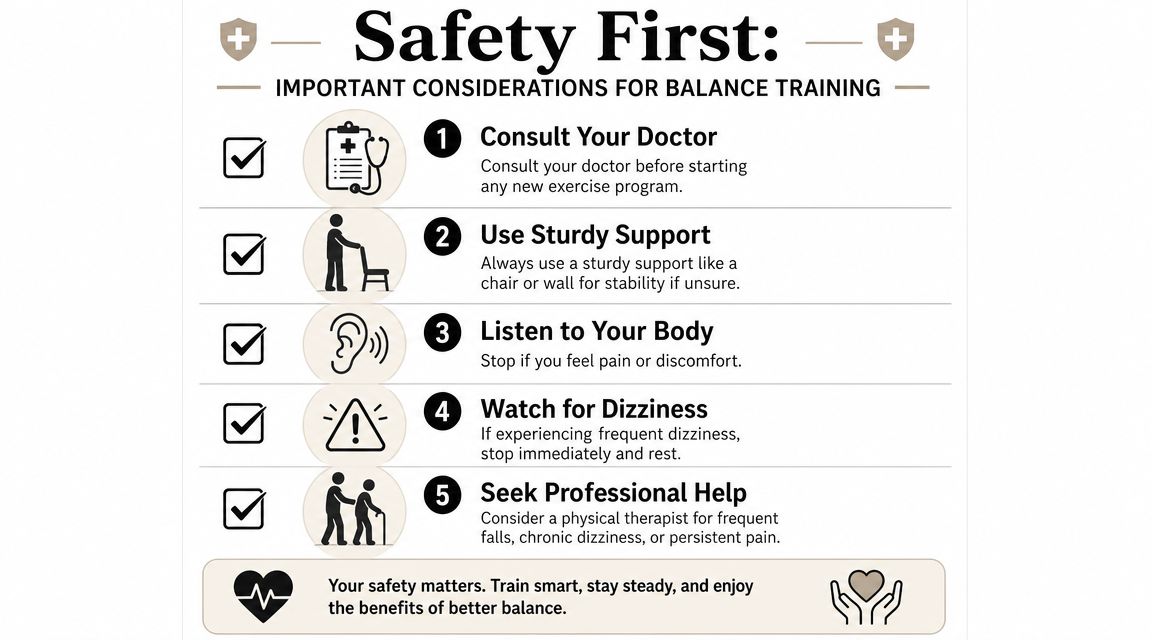
Safety isn't the fine print of a home program. It's the main rule. The right exercise is only helpful if you can do it without putting yourself in danger.
Many balance articles miss a critical issue. Balance problems caused by dizziness, neuropathy, or medication side effects need a different starting point than plain deconditioning. Johns Hopkins recommends beginning with supported static drills and progressing only when swaying is minimal, which reinforces that balance work should be individualized, as described in Johns Hopkins guidance on fall-prevention exercises.
Set up your space the right way
Before any session, make the environment boring and predictable.
- Clear the area. Move rugs, cords, pet bowls, and clutter.
- Use sturdy support. A heavy chair, kitchen counter, or wall is safer than something that rolls or slides.
- Turn on good lighting. Dim spaces make foot placement harder.
- Wear secure shoes. Skip slick socks and backless slippers.
If you already use a device for walking, don't treat that as failure. It's a tool. For some people, an adjustable aluminum cane can add enough support to make walking practice safer while strength and balance improve.
Modify for the reason you're unsteady
Practical judgment matters.
If weakness is your main issue, focus on chair rises, supported standing, and controlled weight shifts. If dizziness is the driver, keep movements slower, reduce head motion, and stop before symptoms build. If numbness in the feet is the problem, use bright lighting, keep visual focus forward, and stay close to support.
A few common modifications help:
| Situation | Better starting option |
|---|---|
| Arthritis flare-up | Shorter sessions, smaller ranges of motion, more chair-supported work |
| Neuropathy | Wider stance, slower transitions, stronger reliance on visual cues |
| Medication-related lightheadedness | Pause after standing, avoid quick position changes, train near support |
Know the red flags
Stop the session and seek medical advice if you have:
- Sudden or severe dizziness
- Chest pain
- A fall with injury
- Rapid worsening of balance
- New numbness or weakness
- Pain that increases during the exercises instead of settling after
If your balance is getting worse despite consistent practice, that's not a sign to be tougher. It's a sign to get evaluated.
If you or your family are noticing a broader change in daily safety, it can also help to review common indicators for home care services. Sometimes the issue isn't just exercise selection. It's whether extra support at home is needed while mobility is being addressed.
When a physical therapist is the right next step
Home programs are useful, but they have limits. A physical therapist is the right call if you keep having near-falls, if you feel dizzy when you turn, if your feet feel numb and unreliable, or if fear of falling is making you avoid normal activities.
MedAmerica Rehab Center offers physical therapy services that include balance and gait training, fall-prevention programming, and individualized exercise progressions for older adults. In practice, that means a clinician can sort out whether your main problem is weakness, vestibular symptoms, pain, joint stiffness, sensory loss, or a mix of several issues.
The main advantage of PT isn't just supervision. It's accuracy. The better the match between the cause and the exercise, the better your odds of getting steady again.
If balance problems are changing how you walk, move, or live at home, MedAmerica Rehab Center can help you figure out why and build a safer plan. A physical therapy evaluation can identify whether weakness, dizziness, pain, or sensory changes are driving the problem, then turn that into a practical program you can follow.
MedAmerica Rehab · Deerfield Beach
Talk to a clinician about your pain
Physical therapy, chiropractic, acupuncture and shockwave therapy under one roof, since 1995. Same-day appointments are available.
Mon–Thu 8:00 AM – 6:30 PM · Fri 8:00 AM – 3:00 PM