
Your Guide to Neurological Rehabilitation Therapy
When your nervous system is injured, it can feel like the fundamental connection between your mind and your body has been broken. A stroke, a brain injury, or a progressive condition like Parkinson's or MS can change everything, disrupting your ability to move, think, speak, and live the way you used to. The path forward can seem uncertain, but this is exactly where neurological rehabilitation comes in.
It’s an active, guided process focused on one powerful truth: your brain can change and adapt. This remarkable ability is called neuroplasticity, and it's the engine that drives recovery.
Rewiring Your Brain for Recovery
Think of your brain and nervous system as the body's intricate wiring. A neurological event is like a power surge that damages some of the circuits, interrupting the signals that control movement, balance, or speech. Neurological rehab is the process of working with a team of skilled specialists to reroute and repair these connections.
This isn't a passive fix. It's a partnership. Through carefully chosen, repetitive exercises, you and your therapy team are actively teaching your brain to form new pathways and find clever workarounds to accomplish familiar tasks.
Who Benefits from Neurological Rehabilitation?
This specialized therapy is a cornerstone of recovery for a surprisingly wide range of conditions. We see people who are navigating the challenges of:
- Stroke: Working to regain the ability to walk, talk, and handle daily activities.
- Traumatic Brain Injury (TBI): Rebuilding skills related to memory, concentration, and physical coordination.
- Spinal Cord Injury (SCI): Focusing on maximizing mobility and building strength.
- Parkinson's Disease: Improving balance, managing motor symptoms, and maintaining a confident stride. We cover many of these techniques in our guide to gait training in physical therapy.
- Multiple Sclerosis (MS): Developing strategies to manage fatigue and preserve independence.
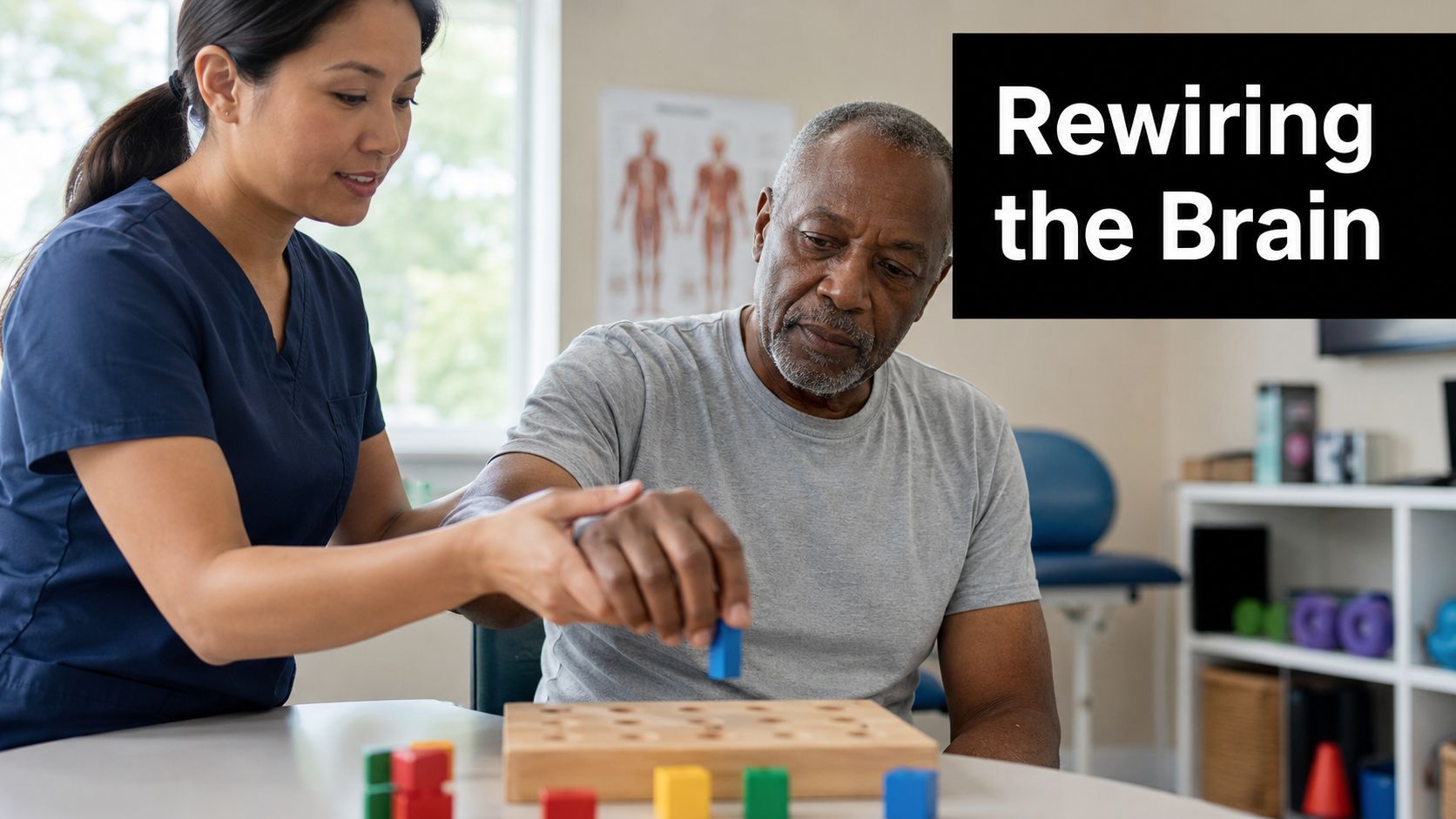
The ultimate goal of neurological rehabilitation is to help you reclaim as much independence as possible. It's about empowering you to get back to your life, whether that means returning to work, enjoying hobbies, or simply managing daily tasks with confidence.
Because every injury is unique, every rehab program must be, too. The process often involves specific interventions for improving cognitive health alongside physical exercises, all tailored to what matters most to you.
The Building Blocks of Your Recovery
When you begin neurological rehabilitation therapy, you're starting a process designed to rebuild the connections between your brain, spinal cord, and muscles. This isn't about generic exercises; it's a very intentional approach to restore function and help you regain confidence.
Think of it like this: if your nervous system is a busy highway with a major bridge out, therapy is how we carefully rebuild that bridge. We don’t just hope for the best; we actively retrain the pathways to get traffic moving smoothly again. This work is built on several key components that will form the core of your personal recovery program.
Neuro-Reeducation: Reconnecting Your Brain and Body
At the very heart of your recovery is neuro-reeducation. This is the hands-on process of retraining the specific brain-to-muscle pathways that have been disrupted. Your therapist will use repetitive movements and physical cues to help your brain find the "on switch" for a muscle or remember how to coordinate a movement pattern.
It’s a bit like helping someone recall a language they've forgotten. At first, the words feel foreign, but with guided practice, the connections start to fire again. This is why your therapist might guide your arm through the motion of reaching for a glass over and over, re-teaching your brain the exact sequence for that one simple task. You can learn more about this in our detailed guide on what neuromuscular reeducation is and how it works.
Key Insight: Neuro-reeducation isn't just about building raw muscle strength. It’s about improving the quality and control of the signal coming from your brain, making your movements smoother, more efficient, and eventually, more automatic.
Building a Foundation with Gait and Balance Training
For so many of our patients, being able to stand up and walk with confidence is a top priority. Gait and balance training is all about rebuilding this foundation, piece by piece. We'll analyze every part of your walking pattern to spot weaknesses or instability.
Your exercises might include:
- Weight-Shifting Drills: Simply practicing how to shift your weight from one leg to the other to improve your stability.
- Obstacle Navigation: Learning to safely step over small objects to train your brain to react to uneven ground.
- Tandem Walking: Carefully walking heel-to-toe to challenge and sharpen your balance control.
This is much more than learning to walk again. It's about building the confidence you need to move safely around your home and community, which goes a long way in reducing the fear of falling.
Functional Practice and Advanced Tools
Ultimately, we measure success by your ability to get back to real-world activities. Functional task practice means we break down daily actions—like buttoning a shirt, using a fork, or getting up from a chair—and practice them until they feel manageable again.
To help you get there, we often use modalities, which are specialized tools that can enhance your progress.
- Electrical Stimulation (E-Stim): We can use gentle electrical currents to help "wake up" and strengthen weakened muscles.
- Aquatic Therapy: The natural buoyancy of water makes it easier and less painful to move, allowing you to perform exercises you might not be able to do on land.
Every single part of your plan, from targeted neuro-reeducation to practicing daily tasks, works together. Each exercise and tool is a building block, carefully placed to help you construct a stronger, more capable you.
Setting Realistic Expectations for Your Recovery Timeline
"How long will this take?" and "How much better can I expect to get?"
These are the first two questions nearly everyone asks, and they are the right ones to ask. The honest answer is that recovery after a neurological event is a deeply personal journey. There’s no fixed finish line.
Progress often shows up in small, gradual steps, not giant leaps. Think of it less like a sprint and more like a long hike. Some parts will be steep and challenging, other parts will feel flat, and then you’ll reach a peak with an incredible view you worked hard to earn. The key is to just keep taking that next step.
The Commitment Required for Meaningful Results
The intensity and length of neurological rehabilitation therapy really depend on the complexity of your condition. It’s a significant time investment because we are asking the brain to literally heal and rewire itself.
For example, research shows that someone recovering from a chronic stroke might benefit from an average of 155.1 hours of therapy in a year. In contrast, a person with a very mild traumatic brain injury might only need around 4.9 hours. That’s a huge difference, and it paints a realistic picture of the dedication needed to drive real change.
This isn’t meant to overwhelm you. It’s to show that your commitment to showing up and doing the work is the most powerful tool you have.
Redefining Success on Your Own Terms
We always hope for a full recovery, but it's crucial to understand that "success" in neurological rehab means many different things. It’s about celebrating every single victory, no matter how small it might seem to an outsider.
Success isn't a single destination. It's every moment of progress—being able to button your own shirt, feeling confident enough to walk to the mailbox, or having the strength to hold a loved one’s hand again.
A great therapy program targets different areas at once to help you reach these milestones. This chart gives a good idea of how the different components of your therapy plan work together.
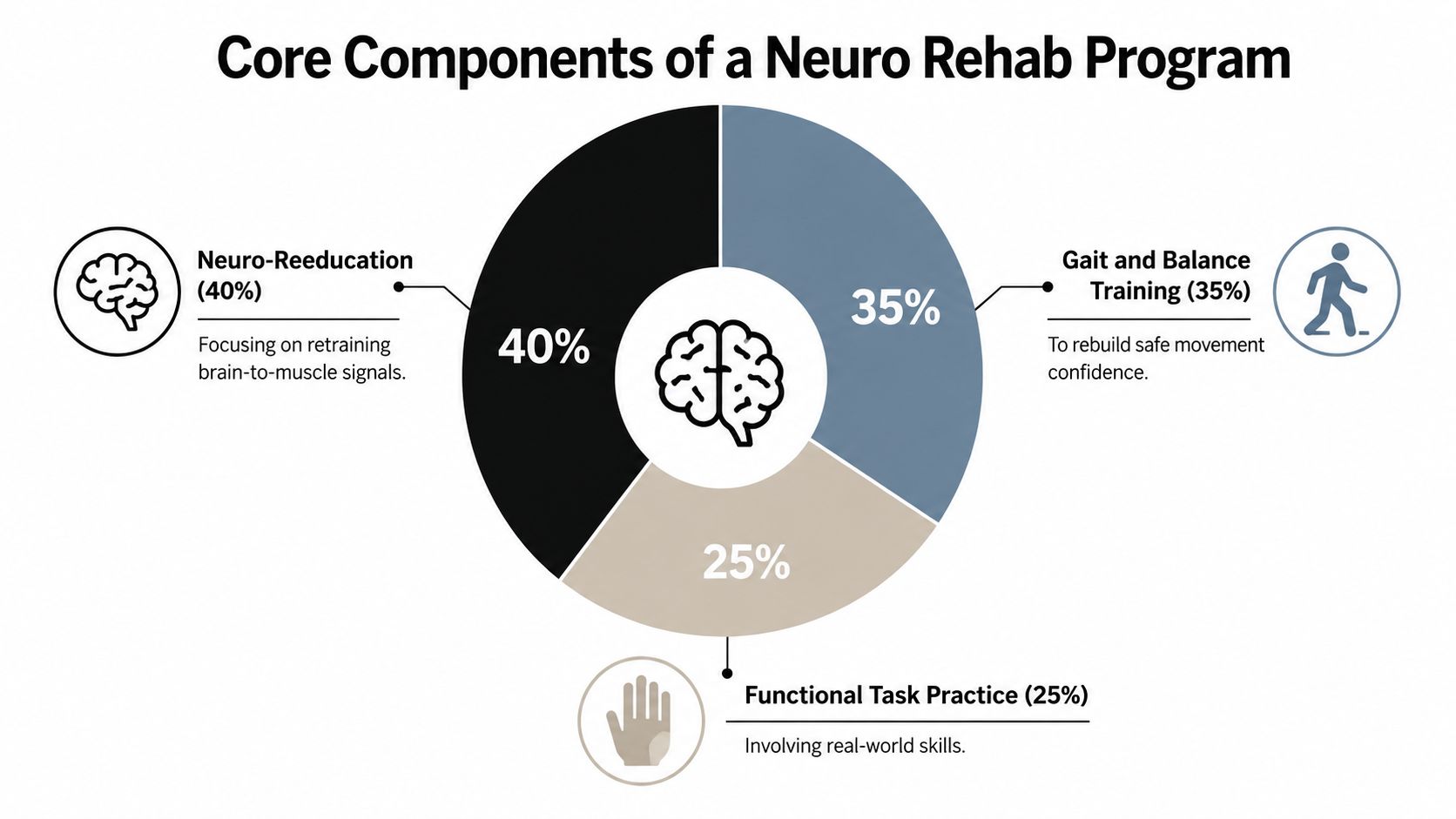
As you can see, a balanced plan combines retraining the brain-to-muscle connection with practicing real-world skills. By focusing on both the fundamental rewiring and your ability to navigate daily life, your therapy is designed to create meaningful, lasting gains in your function and independence. Each small victory becomes a building block for the next one.
How Consistent Therapy Can Save Lives
Of course, the main goal of neurological rehabilitation therapy is to help you regain movement and restore function. But the benefits go much deeper than that—in many cases, this therapy can be a literal life-saver. The link between how consistently you attend therapy and your long-term health is incredibly strong, especially if you're recovering from a major event like a stroke.
We call this a dose-response relationship. Think of it just like a prescription you'd get from your doctor. A small dose of a medication might not do much, but the full, prescribed dose is designed to get the best possible result. Therapy works the same way. More consistent, focused sessions almost always lead to more significant, life-sustaining outcomes.
The Life-Saving Impact of Consistent Rehab
This isn’t just a theory; it's a truth backed by powerful evidence. For people who have had a stroke, the frequency of their rehabilitation is a huge factor not just in their recovery, but in their very survival.
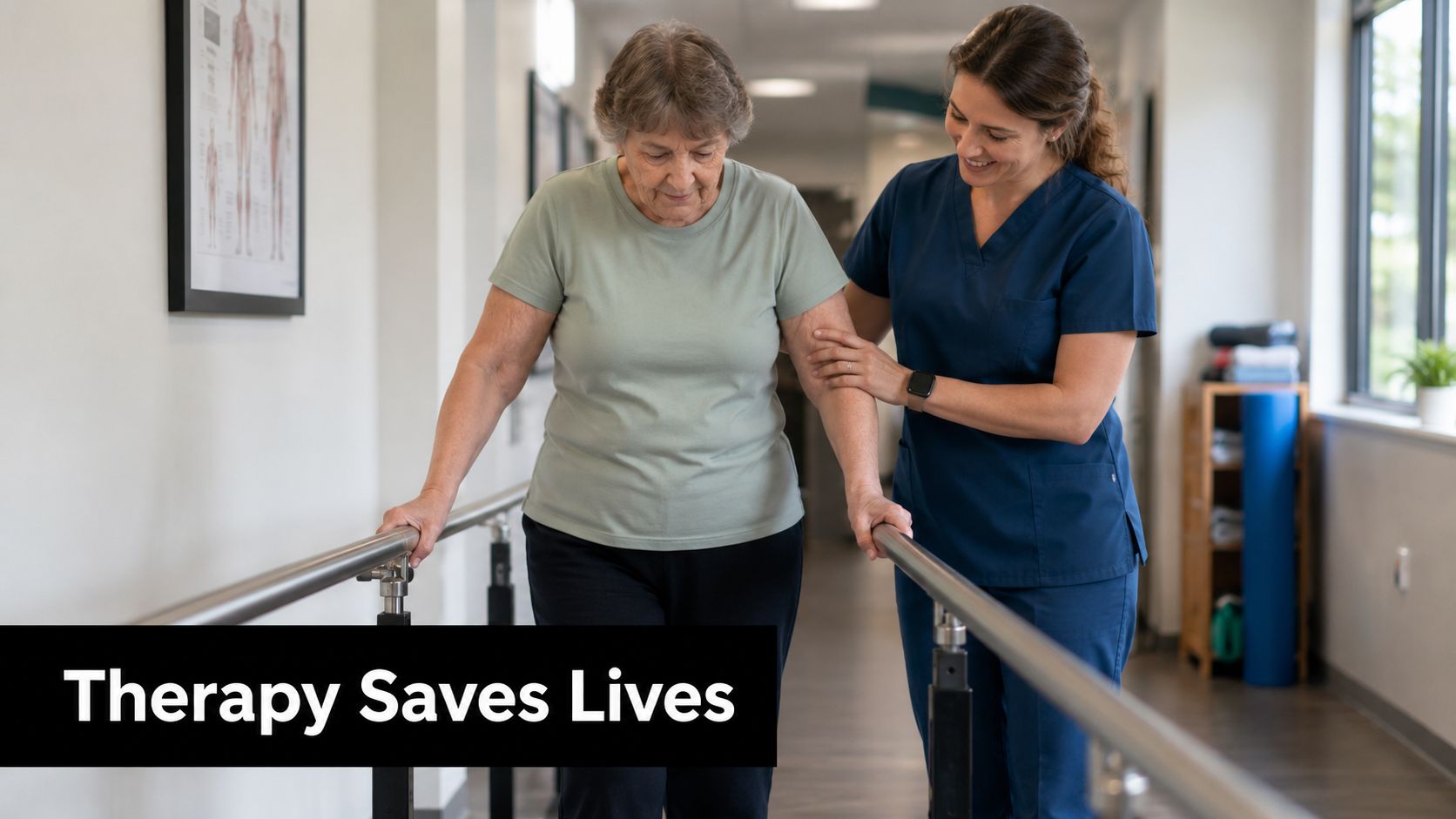
Groundbreaking research has shown that getting a high frequency of rehabilitation can be a life-saving intervention. Patients who received more therapy sessions within the first six months after a stroke saw a 25% reduction in mortality compared to those who received no therapy at all.
Why More Therapy Matters for Severe Conditions
These life-saving benefits are most obvious for those dealing with the most severe disabilities. A huge analysis involving over 15,000 patients confirmed this crucial link. It showed that as the frequency of therapy went up, the risk of death for severely disabled stroke survivors dropped significantly.
This powerful evidence proves that for our most vulnerable patients, rehab isn't just "supportive care." It is an essential treatment that directly reduces the risk of mortality. You can read more about the study on post-stroke survival rates to see the data for yourself.
Understanding this connection is incredibly empowering. It changes the way you see your therapy schedule—it's no longer just another appointment, but one of the most important investments you can make in your own future. Every single session is a step toward not just a more functional life, but a longer one.
Exploring New Tools in Neuro Rehab
The world of neurological rehabilitation therapy is always evolving, and some of the most exciting changes are happening with technology. These new tools aren't meant to replace the hands-on care of a therapist. Instead, they give us powerful ways to make your recovery more engaging and, in many cases, more convenient.
One of the biggest helpers has been tele-rehabilitation. We know that getting to a clinic for every appointment can be a real challenge, especially when you're managing fatigue or mobility issues. Modern telehealth lets our therapists guide you through your program right from your home, removing a major barrier to consistent care.
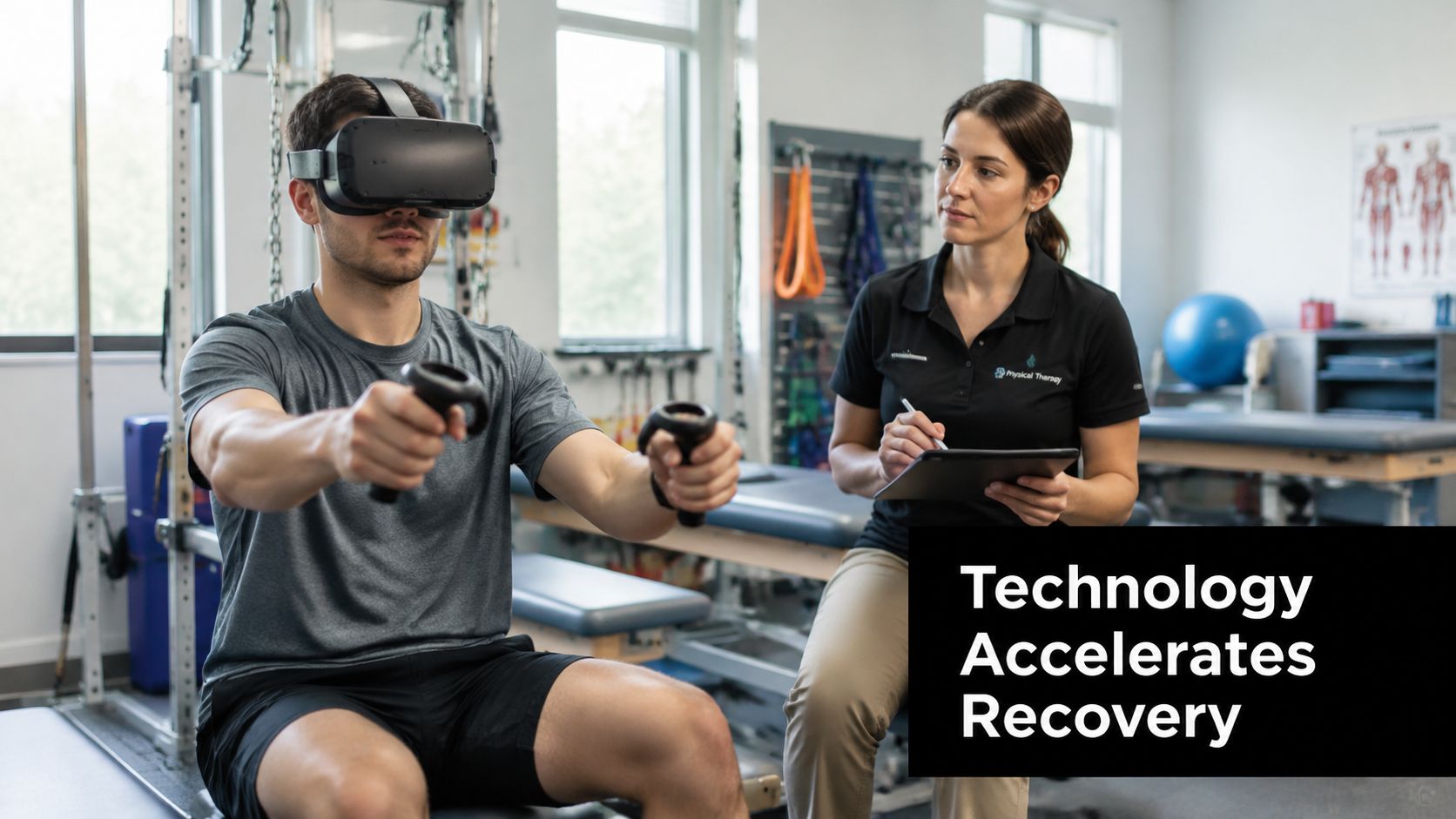
And this isn't just about convenience. For patients with conditions like a traumatic brain injury (TBI), studies show that remote therapy can achieve results that are just as good as in-person care. It's become a reliable way to keep your recovery on track. You can read the research on tele-rehab and VR here to see the data for yourself.
Virtual Reality and Making Rehab Fun
Maybe the most interesting new tool in our clinic is virtual reality (VR). It might sound like a video game, but VR is a serious, science-backed tool that turns what can be repetitive exercises into motivating and fun challenges.
Think about practicing your reach by "picking" virtual apples from a tree, or working on your balance by walking a simulated path along a beautiful coastline. These immersive worlds do more than just pass the time; they require your full attention and encourage your brain to find new ways to solve problems.
This kind of focused, multi-sensory environment is fantastic for encouraging neuroplasticity—your brain's ability to rewire itself. In fact, studies show that adding VR to a therapy plan can lead to 20–30% greater improvements in attention and executive function compared to standard therapy alone.
Speeding Up Your Cognitive and Physical Recovery
Beyond VR, other technologies are also making a real difference. We use specialized computer programs for cognitive rehabilitation, designed to sharpen specific mental skills that might have been affected by an injury or condition.
These tools provide very targeted benefits:
- Faster Thinking: TBI patients who use this type of training have seen their processing speed on timed tasks improve by 15–20%.
- Better Working Memory: The exercises adapt to your level, constantly challenging and strengthening your ability to hold and work with information.
- Stronger Focus: By asking you to maintain concentration to finish a task, these tools help rebuild the "muscle" of your attention span.
At MedAmerica Rehab Center, our philosophy is to blend the best of both worlds. We combine our proven, hands-on techniques with these powerful new technologies. This integrated approach lets us build a truly personalized plan to help you move better, think more clearly, and get back to your life, faster.
How to Get Started on Your Recovery Journey
Taking that first step toward recovery can feel like the hardest part. We get it. That’s why we’ve made the process of starting neurological rehabilitation therapy at MedAmerica Rehab Center as simple and supportive as possible, right from day one.
Your journey back begins with a single phone call.
Our friendly patient coordinators will help you schedule your first appointment and walk you through any initial questions you might have about insurance or what to expect. We work with a wide range of insurance providers and will gladly help you verify your benefits so there are no surprises.
What to Expect on Your First Visit
Your first visit is all about creating a partnership. It’s our chance to listen, to understand your story, and to see firsthand how your condition affects your daily life. This initial consultation is a comprehensive, one-on-one evaluation with a licensed therapist who specializes in neurological conditions.
During this session, we will:
- Discuss Your History: We’ll talk about your medical background, your specific diagnosis, and the unique challenges you’re facing.
- Perform a Physical Assessment: Your therapist will carefully assess your strength, balance, coordination, and functional mobility. This gives us a clear, honest baseline to build from.
- Set Your Personal Goals: This is the most important part. We want to know what matters to you. Is it walking to the mailbox? Getting back to a favorite hobby? Or simply feeling more steady and confident at home?
Your goals become our goals. We believe the most effective treatment plans are built together, blending our clinical expertise with your personal hopes. This ensures every single exercise and activity we do is meaningful and moves you closer to where you want to be.
Based on this in-depth evaluation, we’ll design a personalized treatment plan just for you. Think of this plan as your roadmap to recovery, outlining the specific therapies and exercises we’ll use to help you move better, feel stronger, and reclaim your independence.
We'll walk you through every step of the plan, making sure you feel confident and empowered from the very beginning. To learn more about our specific services, check out our guide on neuro physical therapy.
Frequently Asked Questions About Neuro Rehab
Thinking about neurological rehabilitation therapy is a big step, and it’s completely normal to have questions. Getting clear, honest answers can make all the difference as you prepare for your recovery.
Here are a few of the most common questions we hear from patients and their families.
How Is This Different from Regular Physical Therapy?
This is a great question. While both types of therapy aim to get you moving better, neurological rehab goes a step further. Instead of just working on a specific muscle, we’re focused on rebuilding the connection between your brain and that muscle.
Think of it as repairing the body’s electrical wiring. We’re targeting the nervous system itself to help your brain and body communicate effectively again. It's a much deeper level of work designed for conditions that affect the brain, spinal cord, or nerves.
Will Neurological Rehabilitation Therapy Be Painful?
Many people worry that therapy will hurt, and that’s a valid concern. Our therapists are experts at finding the right balance. The goal is to challenge your body and brain enough to make progress, but never to cause you pain.
We’re not big believers in the old "no pain, no gain" approach. Your comfort and safety come first. We’ll constantly check in with you and adjust the intensity of each session so that it feels productive but always manageable.
At MedAmerica Rehab Center, open communication is everything. We partner with you to create a plan that pushes you toward your goals without ever pushing you into pain.
How Much Work Is Required Outside of Therapy?
Your home exercise program is where the magic really happens. This is probably the most critical piece of the puzzle for a successful recovery.
Your therapy sessions are where we guide you, teach you the correct movements, and make sure you’re on the right track. But the consistent practice you do at home is what truly helps your brain lock in those new pathways we’re building together. Following your home program is the single most powerful thing you can do to speed up your recovery and make sure your results stick for the long haul.
Ready to get answers to your personal questions? The team at MedAmerica Rehab Center is here to help you navigate your recovery with a clear, personalized plan. Schedule your comprehensive evaluation with us today.
MedAmerica Rehab · Deerfield Beach
Talk to a clinician about your pain
Physical therapy, chiropractic, acupuncture and shockwave therapy under one roof, since 1995. Same-day appointments are available.
Mon–Thu 8:00 AM – 6:30 PM · Fri 8:00 AM – 3:00 PM