
The Adjustable Aluminum Cane: Your Guide to Safe Mobility
The first time many people think about using a cane, they aren’t thinking about equipment. They’re thinking about something much more personal. Getting from the bed to the bathroom without grabbing the wall. Walking across the parking lot after an auto accident without feeling wobbly. Taking pressure off a painful leg when sciatica, arthritis, or surgery recovery turns every step into work.
That’s where an adjustable aluminum cane can help. Not as a symbol of limitation, but as a practical rehab tool. Used the right way, it can steady your balance, reduce strain on an irritated leg, and help you move with more confidence while your body heals.
A lot of people also worry that using a cane means they’ve “given in.” I’d encourage you to think of it differently. In physical therapy, we use tools to make movement safer and more efficient. A cane is one of those tools. Like a seatbelt, a brace, or a handrail, it supports you while you rebuild strength and control.
Regaining Your Stride with the Right Support
Maria had been avoiding walks to her mailbox. Her back and leg pain flared every few steps, and after one close call on a curb, she started moving more slowly and holding onto furniture at home. She didn’t want “a walking stick.” She wanted to feel normal again.
What helped her wasn’t just any cane. It was a properly fitted adjustable aluminum cane that matched her height, gave her a steady point of contact with the ground, and let her unload some pressure from the painful side. Once she learned how to use it correctly, the cane stopped feeling like a burden and started feeling like a bridge back to independence.

That experience is common. In the United States, 10% of adults older than 65 years, approximately 5.7 million individuals, rely on assistive canes to redistribute weight, enhance stability, and provide ground feedback for better balance, according to assistive cane use data summarized here. If you need one, you’re in very good company.
Why a cane helps more than people expect
A cane does three simple things well:
- It shares the load: If one leg hurts or feels weak, the cane helps your arms and trunk take part of the effort.
- It improves balance: That extra point of contact works like adding one more leg to a table. The base gets steadier.
- It gives feedback: The tip touches the floor before your full body weight shifts, which helps you judge uneven ground.
A cane doesn’t just help you walk. It helps you trust walking again.
For older adults, balance training and safer mobility often go hand in hand. If that’s your goal, this guide to physical therapy for Deerfield Beach seniors offers helpful context on improving stability and confidence.
Who often benefits from an adjustable aluminum cane
You might be a good candidate if you’re dealing with:
- Pain with walking: Arthritis, sciatica, or post-injury soreness that makes one side feel unreliable
- Mild balance loss: You can walk, but you feel safer with support
- Recovery after a setback: Surgery, an auto accident, or a flare-up that changed your gait
The key word is adjustable. Rehab changes over time. Your support should be able to change with it.
Understanding Your Cane Anatomy and Key Benefits
A good cane is simple, but every part matters. I often describe it as a customizable third leg. It’s there to support you, but only if the parts work together and the fit matches your body.
The main parts of an adjustable aluminum cane
Start at the top.
- Handle: This is where your hand rests and where pressure gets transferred through the cane. Some handles are straighter, while others are more ergonomic or offset to spread pressure more comfortably across the palm.
- Shaft: This is the long body of the cane. On an adjustable model, the shaft changes length so the cane can match your height.
- Locking mechanism: Many canes use a push-button system. Some also have a locking ring for added security.
- Rubber tip: This is the part that grips the floor. If the tip is worn smooth, the whole cane becomes less reliable.
Why aluminum changed cane design
Older wooden canes could work, but they had a big limitation. They were often fixed length. That meant the cane had to fit the person, or the person had to adapt to the cane. That’s backward in rehab.
The introduction of aluminum in the 20th century made canes significantly lighter, often under 1 pound, and stronger than many wooden predecessors. Its corrosion resistance and affordability also helped shift canes from fashion items to practical medical aids for arthritis and post-surgical recovery, as described in this history of canes overview.
That matters in daily life. A lighter cane is easier to lift, place, and carry. A corrosion-resistant cane also makes sense in a humid place like Florida, where metal equipment has to hold up to regular use.
Clinical view: The best cane is the one you’ll use correctly, consistently, and without fighting it.
What each feature does for your body
Think of the cane as a chain. If one link is wrong, the whole setup feels off.
Here’s how the parts affect comfort and safety:
| Cane part | Why it matters | What users often notice |
|---|---|---|
| Handle | Changes how pressure spreads through the hand and wrist | Less palm soreness, better grip |
| Adjustable shaft | Matches cane height to your body | Better posture, less shoulder shrugging |
| Locking system | Keeps the cane from slipping shorter during use | More confidence with weight-bearing |
| Rubber tip | Creates traction with the floor | Less slipping on smooth surfaces |
People often assume a cane is “just a cane.” In therapy, we know better. A handle that irritates your hand, a shaft that’s too short, or a tip that’s worn out can change your walking pattern quickly. Small equipment details can create big differences in how safe you feel.
How to Choose the Right Adjustable Cane Model
Shopping for a cane can feel oddly overwhelming. Shoppers often look at a few models online, see similar pictures, and assume they’re basically the same. They’re not. The right model depends on how much support you need, how your hand tolerates pressure, and how you plan to use it day to day.
Start with function, not color
Pick a cane the same way you’d pick shoes after an injury. Don’t start with style. Start with fit and purpose.
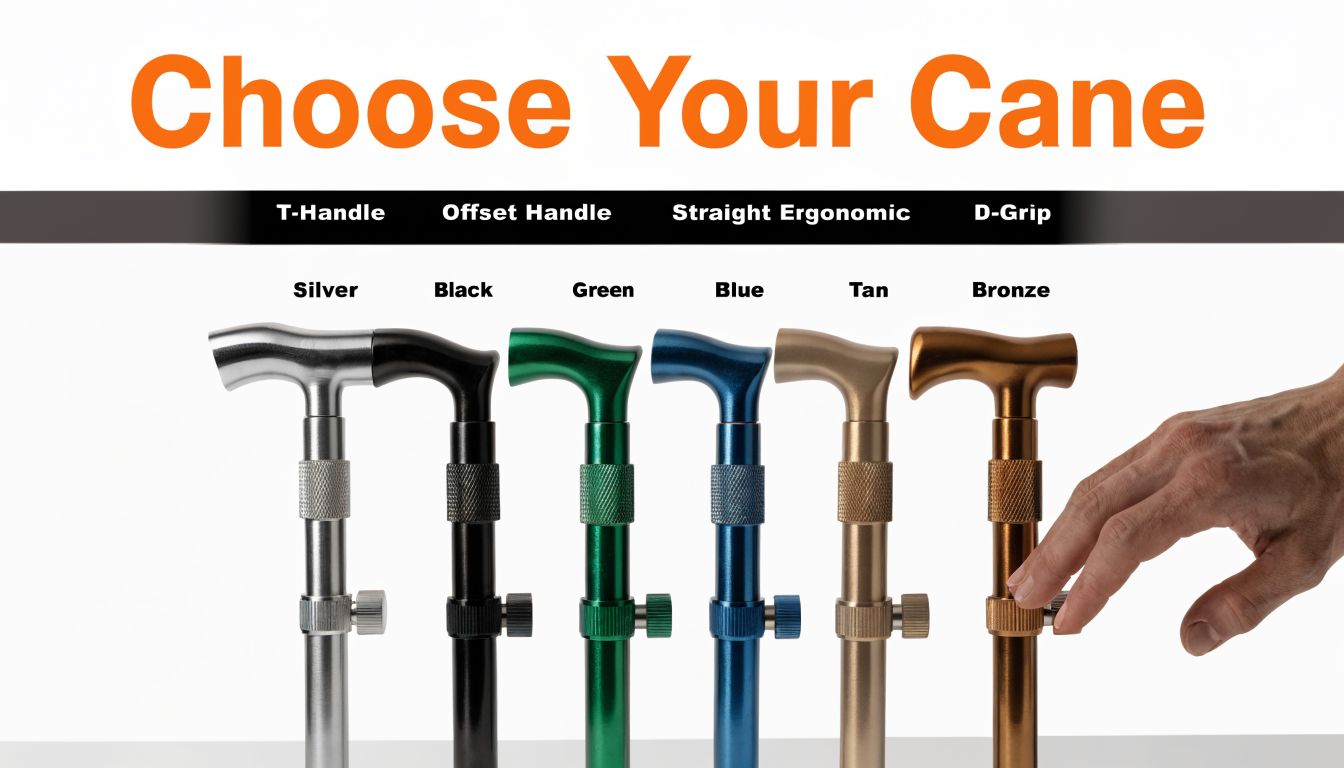
According to these adjustable cane specifications, adjustable aluminum canes typically support 300 lb while weighing under 1 lb, with adjustment ranges from 28.75 to 37.75 inches to accommodate users from 4'10" to 6'1". Those details matter because they tell you whether the cane can safely match your body and your daily use.
Features worth paying attention to
- Handle shape: If you have arthritis, hand pain, or wrist irritation, a more ergonomic or offset handle usually feels better than a narrow, hard grip.
- Base style: A standard single-tip cane is lighter and easier to move. A small quad base may help if you need more stability and don’t mind a bulkier feel.
- Adjustment system: A push-button system is common and easy to use. It should click cleanly into place.
- Tip quality: The best cane body won’t help much if the tip slips on smooth flooring.
Match the cane to your situation
A few simple examples help.
If you’re recovering from a minor flare-up of back or leg pain and mostly need occasional support, a single-point adjustable aluminum cane is often enough. It’s lighter, quicker, and easier to use in tight spaces.
If your balance feels more uncertain, or you find yourself reaching for counters and walls, you may do better with a broader base. That doesn’t automatically mean a walker. It may just mean your body wants more contact with the ground than a standard tip provides.
If you have to grip the cane hard to feel safe, the issue may not be your strength. The issue may be the cane choice or the fit.
A short decision checklist
Before buying, ask yourself:
- Do I need balance help, pain relief, or both?
- Does my hand tolerate pressure well, or do I need a softer handle?
- Will I use this mostly indoors, outdoors, or both?
- Can I adjust it easily and confirm that it locks securely?
A cane should feel like support, not like a puzzle. If the model makes walking more awkward, heavier, or more stressful, it’s not the right match.
Perfecting Your Fit Measuring and Adjusting Your Cane
A well-made cane can still cause problems if it’s the wrong height. This is one of the most common mistakes I see. People borrow a cane from a relative, buy one online, or set it at a random hole and start walking. Then their shoulder aches, their wrist gets sore, or they lean sideways without realizing it.
The fix is usually straightforward. The cane has to match your body while you’re standing in your usual shoes, with your arm relaxed.
The simplest way to measure cane height
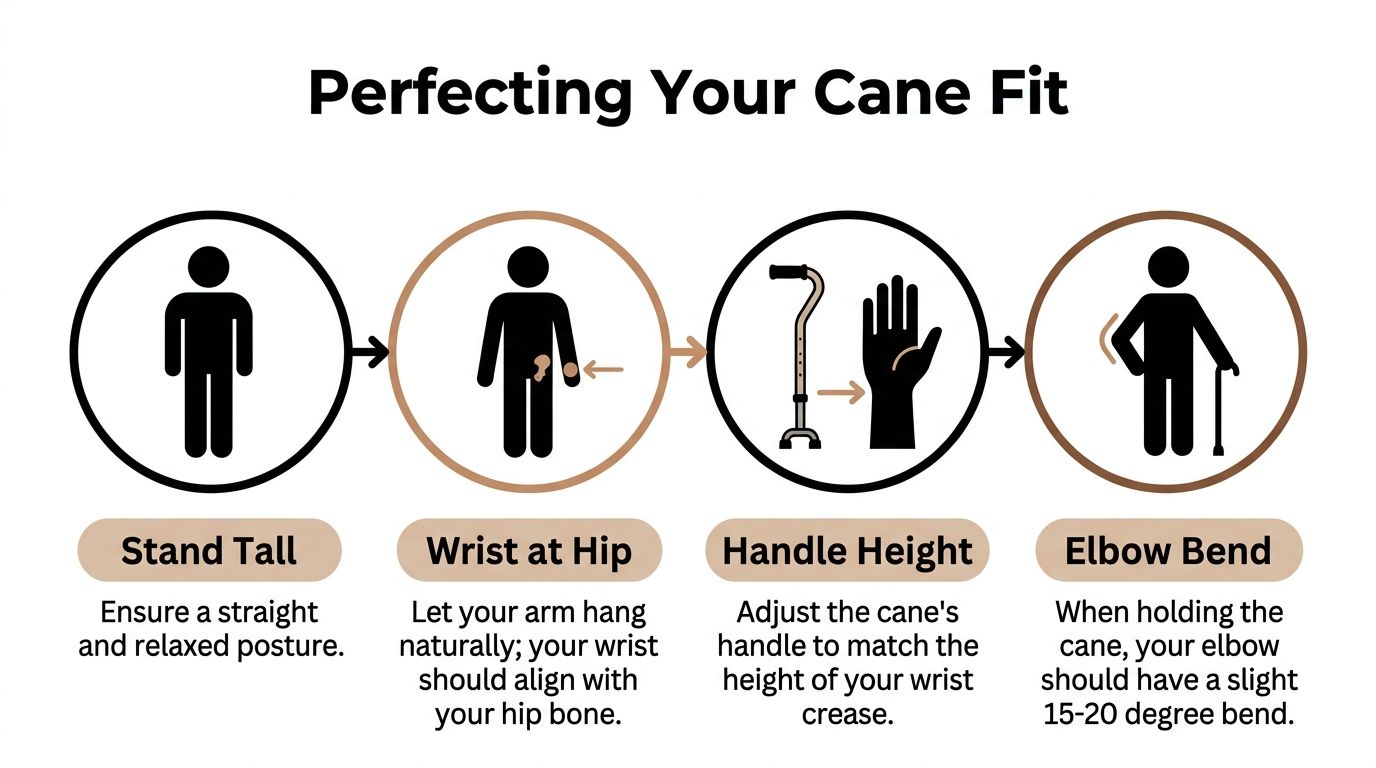
Use these steps:
- Stand tall in your usual walking shoes. Don’t measure in bare feet if you normally wear sneakers or supportive shoes outdoors.
- Let your arm hang naturally at your side. Keep your shoulders relaxed.
- Line up the top of the cane handle with your wrist crease. That’s the usual starting point for a safe fit.
- Hold the cane and check your elbow. You want a slight bend, not a locked arm and not a deep bend.
That slight bend matters. It helps your arm absorb force smoothly instead of jamming pressure upward into the wrist, elbow, or shoulder.
Why the elbow bend matters
When the cane height is right, holding it should feel natural. You shouldn’t have to hike one shoulder up, lean hard over the handle, or stoop to reach it.
This visual walkthrough can help if you want to see the setup in motion.
A good fit usually creates a slight 15 to 20 degree elbow bend, which is the position commonly used in cane fitting because it supports efficient hand placement and reduces strain during walking. If the elbow is too straight, the cane may feel far away and stiff. If the elbow is too bent, you’ll tend to hunch or overload the upper body.
How to adjust the cane safely
Most adjustable canes use a simple push-button mechanism. The process is easy, but it needs care.
- Press the button fully: Don’t force the cane sections apart while the button is only half depressed.
- Slide to the desired hole: Move slowly until the button snaps cleanly into place.
- Listen and feel for the click: You should hear or feel the button seat itself.
- Test before walking: Press down lightly on the handle while the cane is planted on the floor.
Practical rule: If the cane wobbles, shifts, or makes you question it, don’t walk on it yet. Recheck the lock.
Common fitting mistakes
People often get confused in the same few places:
- Using the cane too high: This can make the shoulder lift and the wrist work harder.
- Using it too low: This often causes forward bending and poor posture.
- Measuring while slouched: A slumped setup creates a bad starting point.
- Ignoring shoe changes: Sandals, sneakers, and orthopedic shoes can all change your effective height.
Here’s the simple analogy I use in the clinic. A cane is like a crutch for timing as much as support. If it’s too long or too short, your body has to improvise every step. Good rehab tries to remove improvisation.
Mastering Safe Walking Techniques and Gait Patterns
Fit comes first. Then technique.
Many cane users make one common mistake right away. They hold the cane on the same side as the painful leg. That feels logical at first, but it usually makes walking less efficient. Typically, the cane belongs in the hand opposite the weaker or more painful leg.
The basic walking pattern
Try this standard sequence for everyday walking:
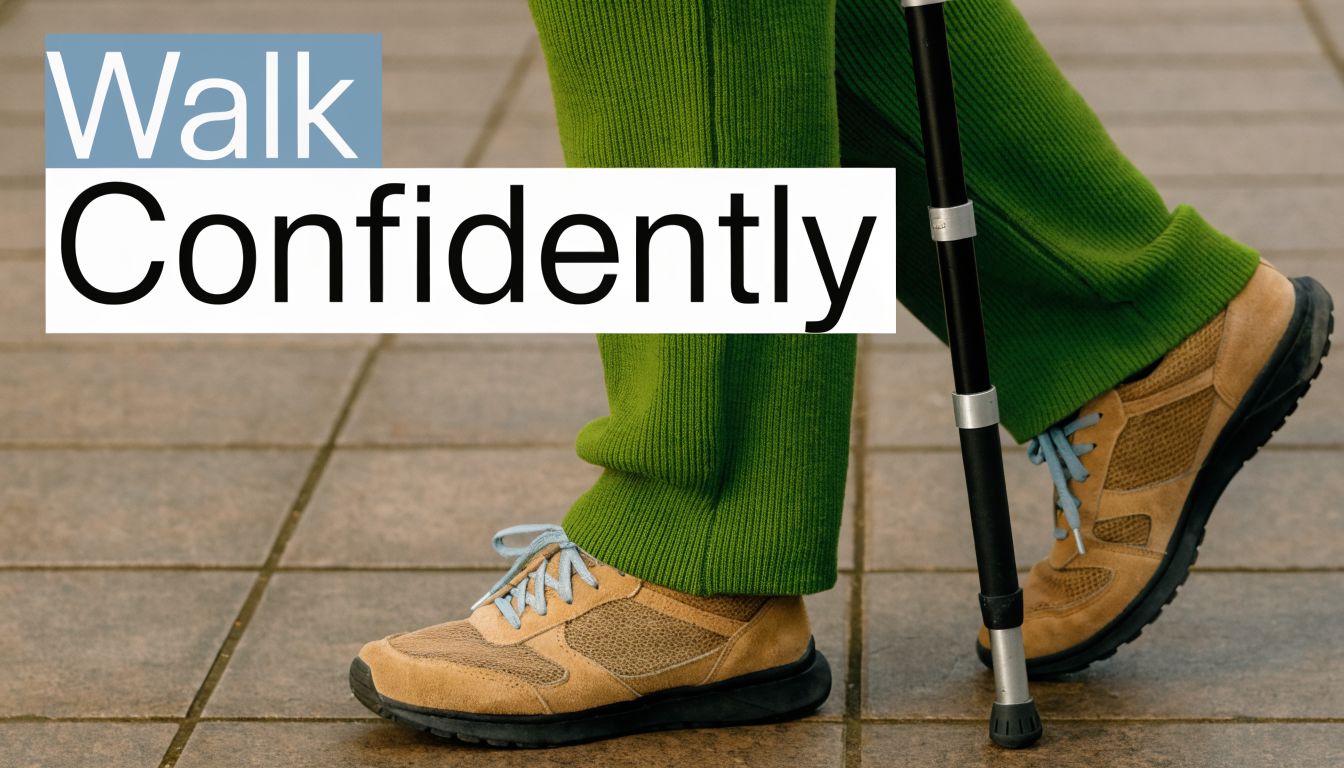
- Place the cane forward at the same time as the weaker leg.
- Shift some weight into the cane as needed.
- Step through with the stronger leg.
That pattern helps the cane and the affected side work as a team. It often reduces limping and makes your movement look smoother.
The rule for stairs and curbs
People remember this best with a short phrase:
Up with the good. Down with the bad.
That means:
- Going up: stronger leg first, then weaker leg and cane
- Going down: cane first, then weaker leg, then stronger leg
If there’s a handrail, use it. A handrail plus a cane usually gives better control than a cane alone.
Safety cues that make a real difference
Keep these habits in mind:
- Look ahead, not straight down: Glancing at the floor is fine, but staring down can throw off posture and balance.
- Plant the cane fully: Don’t tap it lightly and rush past it.
- Shorten your step on uneven ground: Slower is safer on grass, gravel, and cracked sidewalks.
- Turn in small steps: Pivoting quickly can make the cane lag behind your body.
For people rebuilding leg strength, these walking mechanics pair well with targeted exercise. This guide on four exercises to strengthen your legs is a useful companion if your goal is to rely less on support over time.
What to do in tight or awkward spaces
Doorways, bathrooms, and busy sidewalks can make a cane feel clumsy at first. The key is to avoid rushing.
If you’re opening a heavy door, stop, plant the cane, then manage the door. If you’re stepping onto a curb, get your footing first and keep the cane close enough that it supports you without reaching. The cane should move with your body, not get dragged behind it.
Walking well with a cane isn’t about looking graceful. It’s about building a repeatable pattern your body can trust.
Exploring Alternatives and Upgrades
A single-point adjustable aluminum cane is a great option for many people, but it isn’t the right answer for everyone. The best mobility aid is the one that matches your current level of support need.
If you’re comparing options, this overview of mobility aids for elderly gives a broad, practical look at where canes, walkers, and similar devices fit into daily life.
Mobility Aid Comparison
| Mobility Aid | Level of Support | Best For | Limitations |
|---|---|---|---|
| Single-point cane | Light support | Mild balance loss, pain relief on one side, early return to walking | Gives less support than broader-base devices |
| Quad cane | Moderate support | People who want more contact with the floor and slower, steadier walking | Heavier, bulkier, can feel awkward in tight spaces |
| Walker | Highest support of these three | Significant weakness, poor balance, or when a cane doesn’t feel safe enough | Slower movement, more cumbersome for stairs and travel |
Upgrades that may suit your routine
A few add-ons or variations can make a cane more practical:
- Folding models: Helpful for travel, errands, or keeping a backup cane nearby
- Different handle styles: Worth considering if hand comfort is your limiting factor
- Specialized tips: Some users prefer tips designed for wet or slick surfaces
The goal isn’t to “graduate” to a certain device as fast as possible. The goal is to use the least amount of support that still lets you move safely and confidently.
When to Consult MedAmerica Rehab Center for a Perfect Fit
General cane advice is helpful, but rehab rarely follows a generic script. That’s especially true after surgery, an auto accident, or a work injury. In those cases, the question usually isn’t just “Which cane should I buy?” It’s “How much support do I need right now, and when should that change?”
That’s where many online articles fall short. Most online guides lack evidence-based frameworks for how cane use should progress during rehabilitation, while a physical therapist connects product details to real clinical goals for post-surgical, auto accident, and workers’ compensation recovery, as noted in this discussion of cane guidance gaps.
When professional fitting matters most
You shouldn’t guess your way through cane use if you have:
- Recent orthopedic surgery: Your weight-bearing status and walking pattern may change over time
- Auto accident injuries: Pain, dizziness, guarding, and asymmetry can all affect safe cane use
- Workers’ compensation injuries: Return-to-function planning often requires more structured progression
- Balance problems with multiple causes: If strength, sensation, and coordination are all involved, simple self-fitting may miss important risks
Why a rehab plan is different from a product guide
A product page can tell you the cane adjusts. It can’t tell you whether you should still be using one next week, whether your gait is protecting the wrong side, or whether your pain is changing because of poor mechanics.
Some patients also need support after a hospital discharge or a major medical event. In those situations, reading about transitional care management can help you understand the broader coordination side of recovery while your rehab team handles movement safety and progression.
Good cane use is never just about the cane. It’s about timing, progression, strength, balance, and the reason you need support in the first place.
If you’re wondering how an evaluation works, this page on what to expect at your first visit gives a clear picture of the process.
If you’re dealing with pain, balance problems, or recovery after surgery or an accident, MedAmerica Rehab Center can help you get fitted properly, walk more safely, and build a plan that supports real progress. A well-chosen adjustable aluminum cane is a useful tool. Expert guidance helps you use it at the right time, in the right way, for the right reason.
MedAmerica Rehab · Deerfield Beach
Talk to a clinician about your pain
Physical therapy, chiropractic, acupuncture and shockwave therapy under one roof, since 1995. Same-day appointments are available.
Mon–Thu 8:00 AM – 6:30 PM · Fri 8:00 AM – 3:00 PM