

Neck Pain and Headache Relief: Fast, Lasting Solutions
You're on the couch in the evening, rubbing the base of your skull because the ache started in your neck again. It may have begun as stiffness after computer work, a long drive, or sleeping in a bad position. A few hours later, the pain has crept upward into your head, behind an eye, or across your temple.
That pattern is common. It's also frustrating because many people treat only the headache and ignore the neck that set it off. Real neck pain and headache relief usually starts when you stop separating the two.
Understanding the Link Between Your Neck and Headaches
A lot of people describe the same sequence. Their neck feels tight first. Turning the head feels limited. Then the headache arrives and stays longer than it should.
That's one reason cervicogenic headache matters. The term means a headache that comes from the neck. Joints, muscles, and irritated tissues in the upper neck can refer pain into the head. The pain is real, and it doesn't have to start with a dramatic injury.
Why this pattern deserves attention
The neck-head connection isn't a niche issue. Neck pain is highly prevalent among individuals with primary headache disorders, showing a one-year prevalence of 85.7% in those with primary headaches compared to 56.7% in those without according to this prevalence review on neck pain in headache disorders. That's a strong reminder that chasing headache relief without looking at the neck often misses a major piece of the problem.
Some people also clench the jaw when their neck gets tight, or they hold tension through the jaw, temples, and upper shoulders at the same time. If that sounds familiar, this guide on relief for jaw pain can help you sort out whether TMJ tension may be adding to the cycle.
Neck pain and headache relief gets easier when you identify where the pain starts, not just where you feel it most.
What cervicogenic pain often feels like
Common signs include:
- Pain that begins in the neck and moves upward into the back of the head, temple, forehead, or around the eye
- Stiffness with turning your head or looking up
- Worsening pain after static posture, especially desk work or screen time
- Tender muscles at the base of the skull or along the top of the shoulders
That doesn't mean every headache comes from the neck. Migraine, tension-type headache, sinus issues, jaw dysfunction, and other conditions can overlap. But when the neck starts the cascade, treating the neck directly usually changes the whole picture.
Immediate Relief Strategies for When It Hurts Now
When pain is active, the goal isn't to force a stretch or “fix” posture in one session. The goal is to calm irritated tissue, lower guarding, and keep the neck from stiffening further.
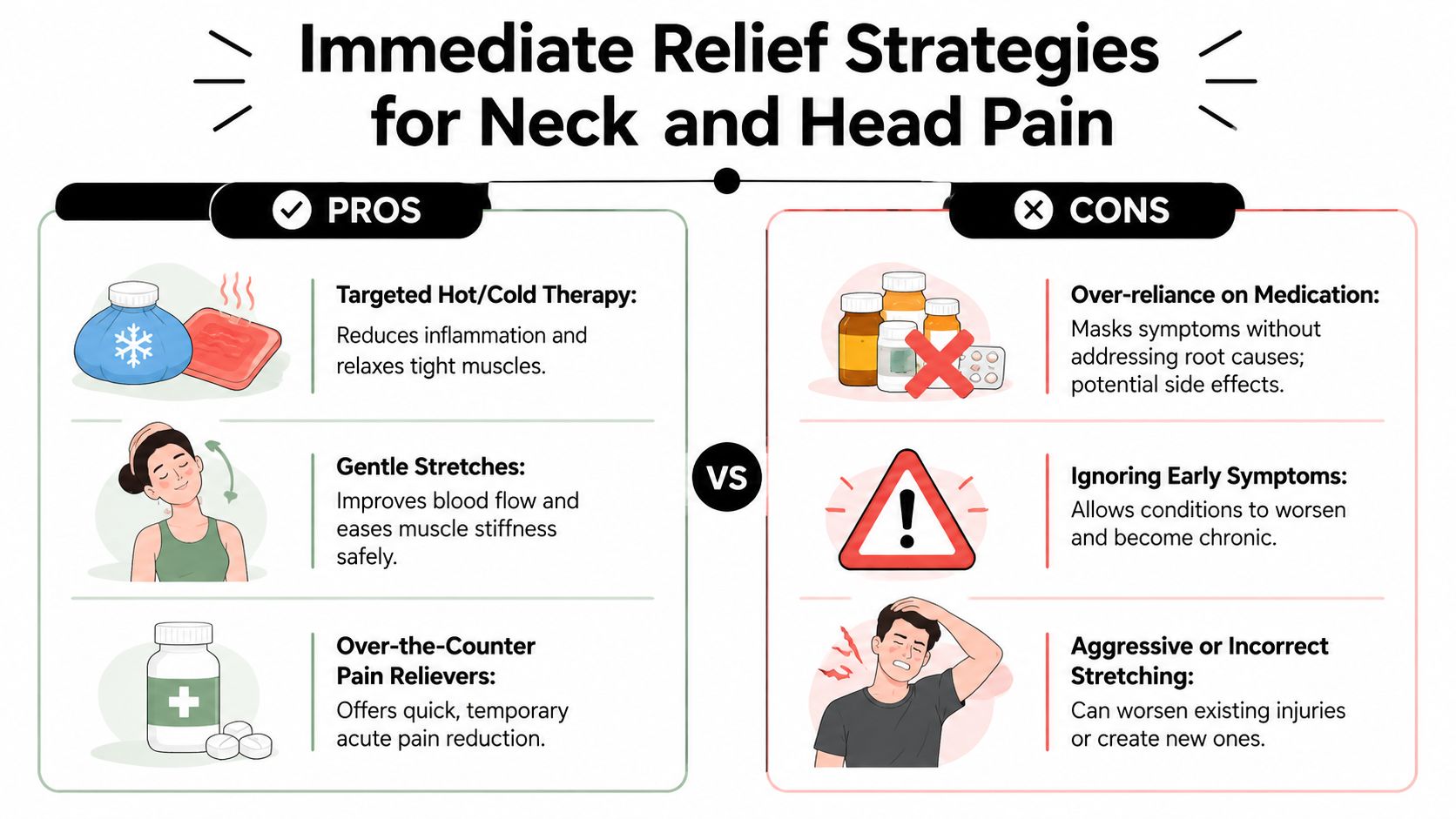
Use heat or ice for the right reason
Pick the tool based on what the neck feels like right now.
- Choose heat for tightness: If your neck feels knotted, stiff, or guarded, heat can help relax muscle tone and make gentle motion easier.
- Choose ice for a hot flare: If the area feels inflamed, freshly irritated, or worse after sudden strain, ice may settle it down.
- Keep it brief: Use either one for a short session, then reassess. If it leaves you stiffer or more aggravated, switch approaches.
If you want practical guidance on when each one makes sense, this overview of using an ice pack in physical therapy is a useful reference.
Try one gentle reset, not an aggressive stretch
When people are hurting, they often crank the neck side to side or pull hard on the head. That usually backfires. Start smaller.
Breathing reset
- Sit back and let your shoulders drop.
- Inhale through your nose slowly.
- Exhale longer than you inhale.
- As you exhale, unclench your jaw and let the shoulder blades feel heavy.
This helps because neck tension often rises with stress, breath holding, and shoulder shrugging. You're giving the nervous system a reason to stop bracing.
Basic chin tuck
- Sit tall without lifting your chin.
- Glide your head straight back, as if making a double chin.
- Hold briefly, then relax.
- Keep the movement small and smooth.
This can reduce the forward-head position that overloads the upper neck. You should feel a mild deep effort, not a pinch.
Practical rule: If a movement increases your headache during the set, stop. Relief work should feel calming or neutral first, strengthening second.
What to avoid during a flare
A few habits make a painful day worse fast:
- Long phone posture: Looking down for extended periods keeps the upper neck compressed.
- Fast neck circles: These can irritate sensitive joints and dizzy some people.
- Endless medication-only management: It may help short term, but it won't correct the trigger.
- Deep self-massage over a highly sensitive area: Too much pressure can increase guarding.
If the pain is active right now, aim for brief heat or ice, controlled breathing, one gentle movement, and less screen strain for the next few hours. Simple usually works better than intense.
Foundational Stretches and Exercises for Lasting Relief
Lasting improvement usually comes from a basic principle. Stretch what's overworking. Strengthen what isn't doing its job. Individuals experiencing recurring neck-driven headaches often require both.
Start with mobility in the right places
Tight muscles around the neck and shoulder girdle can keep pulling on the upper cervical area. That tension often feeds headaches.
Two useful mobility drills are:
- Upper trapezius stretch: Sit tall. Hold the chair with one hand. Tilt your opposite ear toward your shoulder until you feel a mild stretch along the side of the neck. Keep your nose forward. Don't yank.
- Levator scapulae stretch: Turn your head slightly toward your armpit, then nod downward gently. This often reaches the back-corner of the neck where people feel stubborn tightness.
Hold each gently and breathe. A stretch should reduce resistance over time. It shouldn't produce sharp pain, tingling, or a throbbing headache.
For a more structured home sequence, these neck pain relief stretches can help you build a safer routine.
Then train support muscles
Mobility without control doesn't last. If the deep neck stabilizers and shoulder blade muscles stay weak, tight tissues readily take over again.
Focus on:
Deep neck flexor activation
Use the same small chin tuck from the previous section. The goal is endurance and control, not force. These muscles help support your head so the upper neck doesn't work overtime.Scapular setting
Gently draw the shoulder blades back and down without arching your lower back. This gives your neck a better base to work from.Wall slides or low-load rows
These help coordinate the mid-back and shoulder girdle. When the upper back moves better, the neck often stops compensating.
Better neck pain and headache relief usually comes from consistency with low-load movement, not occasional hard stretching sessions.
A simple way to organize your week
Use a progression instead of random exercises.
| Focus | What to do | Why it helps |
|---|---|---|
| Tight tissues | Gentle side-neck and back-corner stretches | Reduces muscle pull on the upper neck |
| Joint motion | Small, controlled neck mobility | Restores movement without flaring symptoms |
| Support | Chin tucks and scapular control drills | Improves stability and posture tolerance |
| Function | Practice during desk work and daily tasks | Makes the changes stick in real life |
Common mistakes
These are the ones I see most often in practice:
- Stretching too hard: More intensity doesn't mean more benefit.
- Skipping strengthening: Temporary relief fades when the support system stays weak.
- Training only the neck: The upper back and shoulder blades matter.
- Doing exercises only when pain spikes: Preventive work is what changes the pattern.
The best home program feels manageable enough that you'll consistently repeat it. That matters more than a long list of drills you abandon after three days.
Your Daily Habits The True Source of Neck Pain
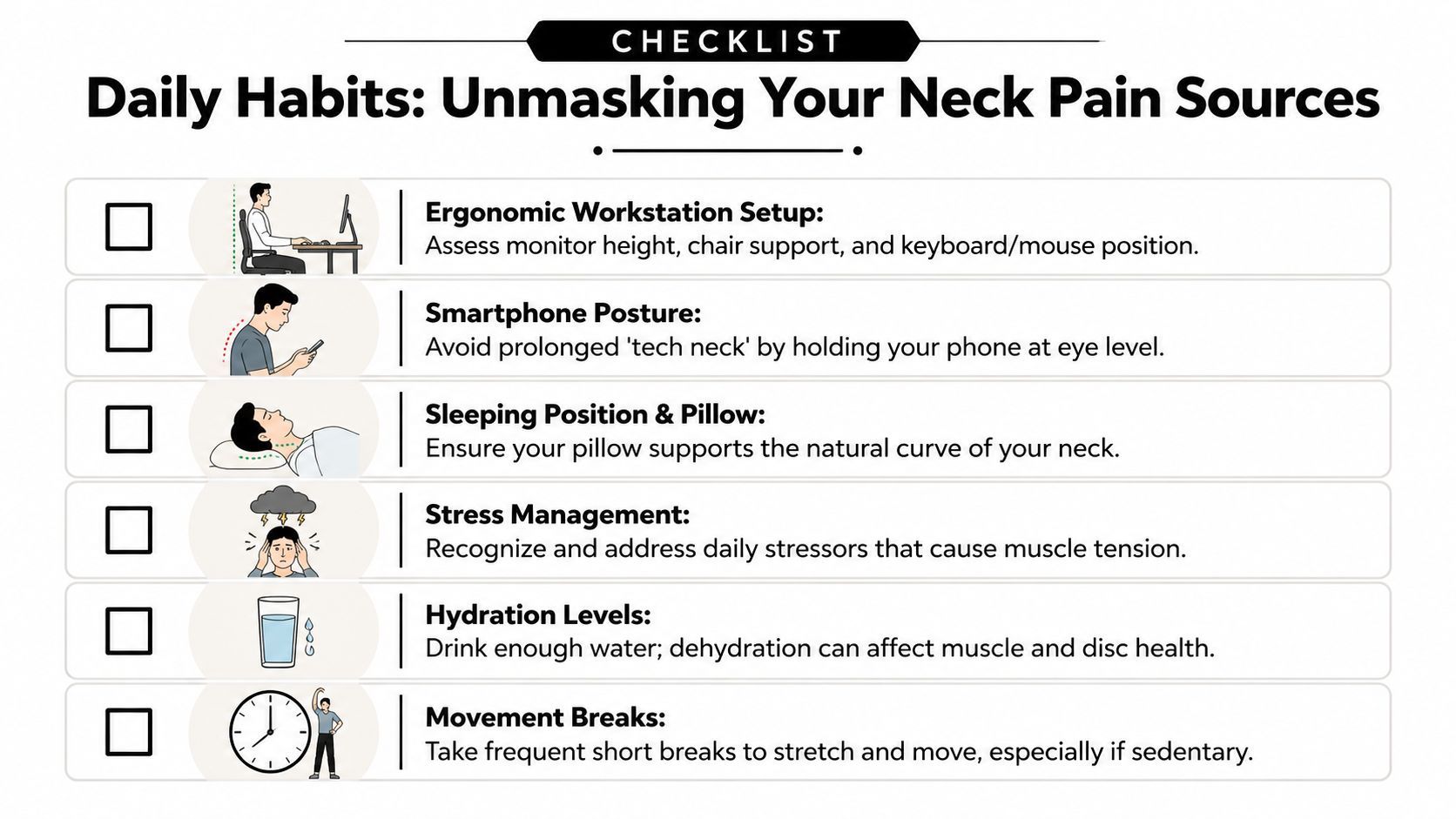
Many recurring headaches don't start with a workout injury. They start with ordinary repetition. A low monitor, a phone in your lap, a bad pillow, and hours without movement can keep your neck mildly irritated all week.
That's one reason neck pain keeps spreading across so many populations. By 2020, the number of people affected by neck pain globally rose to 203 million, a 77.3% increase from 1990, and projections indicate this will reach 269 million by 2050, according to this global burden analysis in Frontiers in Neurology. Modern routines clearly matter.
The desk problem most people miss
The issue usually isn't one dramatic posture mistake. It's time. If you sit with your head drifting forward for hours, the upper neck muscles have to hold that load all day.
Three fixes give the biggest return:
- Raise the screen: Your eyes should land comfortably on the monitor without dropping your chin.
- Bring work closer: Reaching forward for the keyboard or mouse pulls the shoulders and head with it.
- Change position often: Even a good setup becomes a bad setup if you never move.
If you want practical posture ideas to fix your desk slump, that resource pairs well with daily mobility and strengthening work.
A quick visual can help if you're trying to clean up your setup and movement habits:
Phone use and sleep matter more than people think
Phone posture creates a similar problem. If you spend long stretches looking down, you keep the neck in a loaded position with no recovery.
Sleep can undo your progress too. A pillow that leaves your head tipped too far up or too far down can keep joints and muscles irritated for hours at a time.
Your neck doesn't care whether the strain came from a laptop, a couch, or a pillow. It only responds to the position it has to tolerate.
A better daily audit
Run through this short checklist:
- At work: Can you look straight ahead instead of down?
- On your phone: Can you bring the screen higher and shorten the session?
- At night: Does your pillow keep your neck neutral, not bent?
- During the day: Do you stand up and reset before stiffness builds?
Small corrections done repeatedly beat perfect posture done once.
When to See a Professional Recognizing the Red Flags
Self-care is appropriate for many mild, position-related flares. It is not the right plan for every headache or every neck problem.
Get medical attention right away if you notice these signs
| Symptom | What It Could Mean |
|---|---|
| Sudden, severe headache unlike your usual pattern | A medical emergency that needs immediate evaluation |
| Fever with headache and neck pain | Infection or another urgent condition |
| Progressive arm weakness or worsening numbness | Nerve involvement that needs prompt assessment |
| Loss of balance, fainting, confusion, or trouble speaking | Neurological issue requiring urgent care |
| Headache after significant trauma | Injury that should be medically evaluated |
| Unexplained weight loss with ongoing pain | A broader medical problem that needs investigation |
| New bowel or bladder changes with neck or spine symptoms | Serious neurological involvement |
Persistent pain deserves a real exam too
Not every non-emergency problem should be handled alone. If your pain keeps returning, if headaches consistently start from neck stiffness, or if home strategies only help for a few hours, you need a clearer diagnosis.
A good professional evaluation looks at movement, joint mechanics, muscle guarding, work setup, sleep position, and symptom pattern. It should also sort out whether the pain behaves more like a neck-driven headache, migraine overlap, jaw involvement, or nerve irritation.
If your symptoms keep circling back to the same trigger, the missing piece usually isn't more willpower. It's better assessment.
The earlier you address a repeating pattern, the easier it is to stop it from becoming part of your normal week.
How Professional Treatment Delivers Targeted Relief
Home care works best when the problem is mild and the cause is obvious. Professional care becomes more valuable when symptoms are persistent, mixed, or stubborn. The advantage isn't just more treatment. It's more precision.
Why combined treatment often works better
A neck-driven headache rarely has one single cause. One person may have stiff upper cervical joints, weak deep neck flexors, guarded suboccipital muscles, and poor desk mechanics at the same time. That's why layered care often outperforms one isolated technique.
Multimodal non-pharmacological treatment, specifically combining manual therapy like chiropractic care with targeted exercise, demonstrates a 65-70% reduction in headache frequency and intensity in meta-analyses, as summarized in this review of cervicogenic headache treatments. In practice, that makes sense. Exercise improves support. Manual care improves motion. Neither one fully replaces the other.
What each treatment type adds
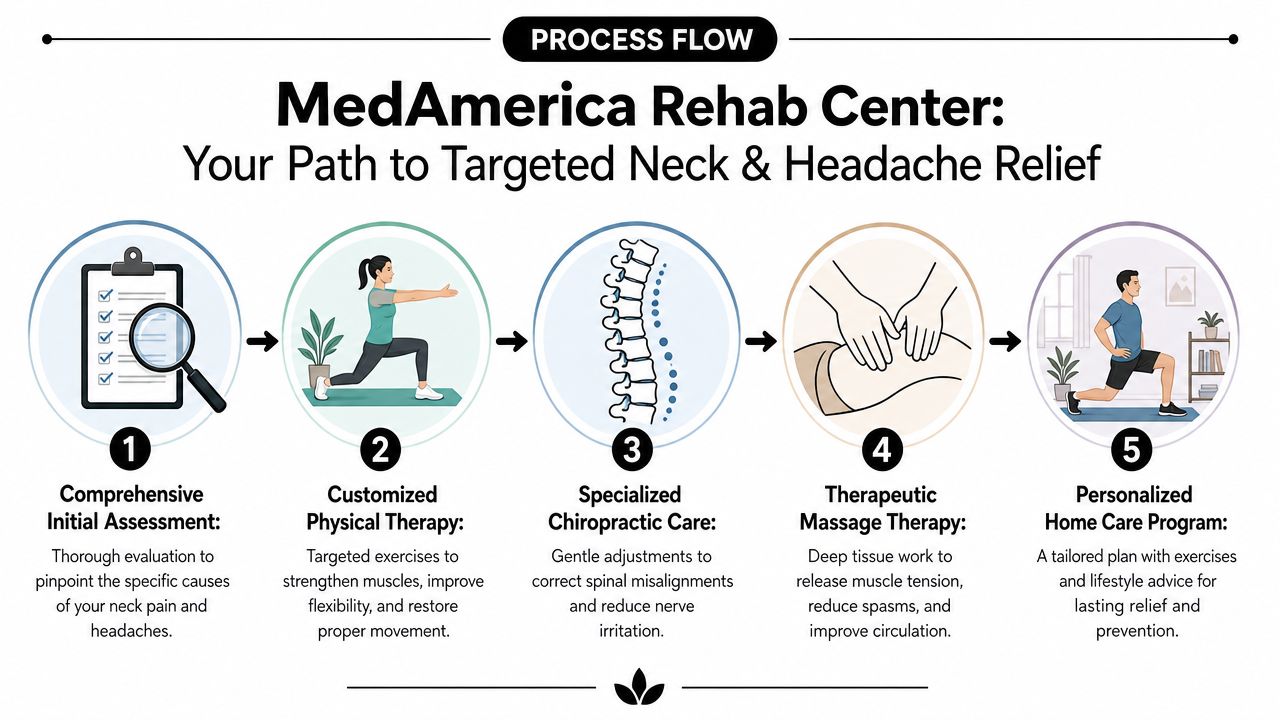
A complete plan may include several tools, each with a different job:
- Physical therapy: Builds a personalized movement plan, improves neck and upper-back control, and retrains habits that keep symptoms coming back. This guide on physical therapy for headaches outlines how targeted rehab can address headache patterns linked to neck dysfunction.
- Chiropractic care: Can help restore joint motion when specific segments are restricted and contributing to referred pain.
- Acupuncture: Often helps reduce muscle tension and settle pain sensitivity, especially when stress and guarding are part of the picture.
- Soft tissue treatment: Useful when trigger points, upper trapezius tension, or suboccipital tightness are driving symptoms.
- Shockwave therapy: Sometimes considered for chronic, stubborn soft tissue problems when simpler approaches haven't changed the pattern.
Matching the treatment to the driver
Professional care matters most. A person with clear jaw tension and headache overlap may also need coordinated TMJ input, such as the education discussed in Dental Professionals of Fair Lawn TMJ care. Someone else may respond better to manual therapy plus exercise because the neck is the main trigger.
At a clinic that offers physical therapy, chiropractic care, acupuncture, and advanced rehab options in one setting, such as MedAmerica Rehab Center, the value is coordination. The treatment plan can follow the actual pattern of your pain instead of forcing every patient into the same protocol.
The right plan should make daily life easier. You should turn your head with less guarding, sit longer without paying for it later, and feel fewer headaches that start at the base of the skull and climb forward.
If your neck pain keeps feeding your headaches, getting the right evaluation can save you weeks of guessing. MedAmerica Rehab Center provides non-surgical care that may include physical therapy, chiropractic treatment, acupuncture, and guided home exercise based on how your symptoms behave.
MedAmerica Rehab · Deerfield Beach
Talk to a clinician about your pain
Physical therapy, chiropractic, acupuncture and shockwave therapy under one roof, since 1995. Same-day appointments are available.
Mon–Thu 8:00 AM – 6:30 PM · Fri 8:00 AM – 3:00 PM