
Physical Therapy for Headaches: Lasting Relief 2026
You wake up with that familiar pressure behind your eyes. By lunch, it settles into your temple. By evening, you're shorter with your family, less focused at work, and already thinking about what medication to take next. For a lot of people, headaches become a routine instead of a warning sign.
That pattern is exhausting because pills can help with the pain, but they don't always answer the bigger question. Why does this keep happening? In many cases, the problem isn't only in the head. It's connected to the neck, jaw, upper back, posture, and the way your body handles stress and movement all day long.
That's where physical therapy for headaches can make a real difference. A physical therapist doesn't just ask where it hurts. We look at how your joints move, where your muscles are overloaded, which positions trigger symptoms, and whether your headache pattern points to a mechanical issue that can be treated.
Beyond the Pill Bottle Understanding Your Headaches
A common story goes like this. Someone gets headaches a few times a week, usually after computer work, driving, poor sleep, or a stressful day. They take something for relief, feel better for a while, then the headache comes back. After a few months, they start planning their day around pain instead of around life.
That cycle creates confusion because all headaches feel like "head pain," but they don't all come from the same place. Some are driven by migraine mechanisms. Some are strongly tied to muscle tension and posture. Some begin in the neck and refer pain upward into the head, forehead, or behind the eye.
Why the source matters
Think of a headache like a fire alarm. The sound is in the hallway, but the smoke may be coming from the kitchen. If you only silence the alarm, you haven't solved the problem. Physical therapy works the same way. We look for the source of the signal.
For people with a strong neck component, headaches can be a movement problem as much as a pain problem. Stiff upper neck joints, overworked shoulder muscles, poor sitting posture, and weak postural support can all increase strain. That's why some people notice that turning their head, sitting too long, or working on a laptop makes symptoms worse.
If you're trying to sort out whether your headaches sound more like migraine, this guide on Relief on migraine causes gives useful background on common patterns and triggers. If neck pain seems to travel upward into your head, this article on constant headaches from neck pain can help you recognize that connection.
Physical therapy isn't about chasing every headache with the same exercise. It's about identifying whether your pain has a treatable musculoskeletal driver.
What physical therapy changes
A good PT plan doesn't just try to reduce pain for a day or two. It aims to improve the mechanics underneath the pain. That may include restoring neck motion, reducing muscle guarding, improving upper-back support, changing workstation habits, or teaching you how to stop feeding the problem with daily posture.
For the right person, that's the shift that matters. You're not just asking, "How do I get through this headache?" You're asking, "What keeps setting this off, and how do I change it?"
Is Physical Therapy Right for Your Type of Headache
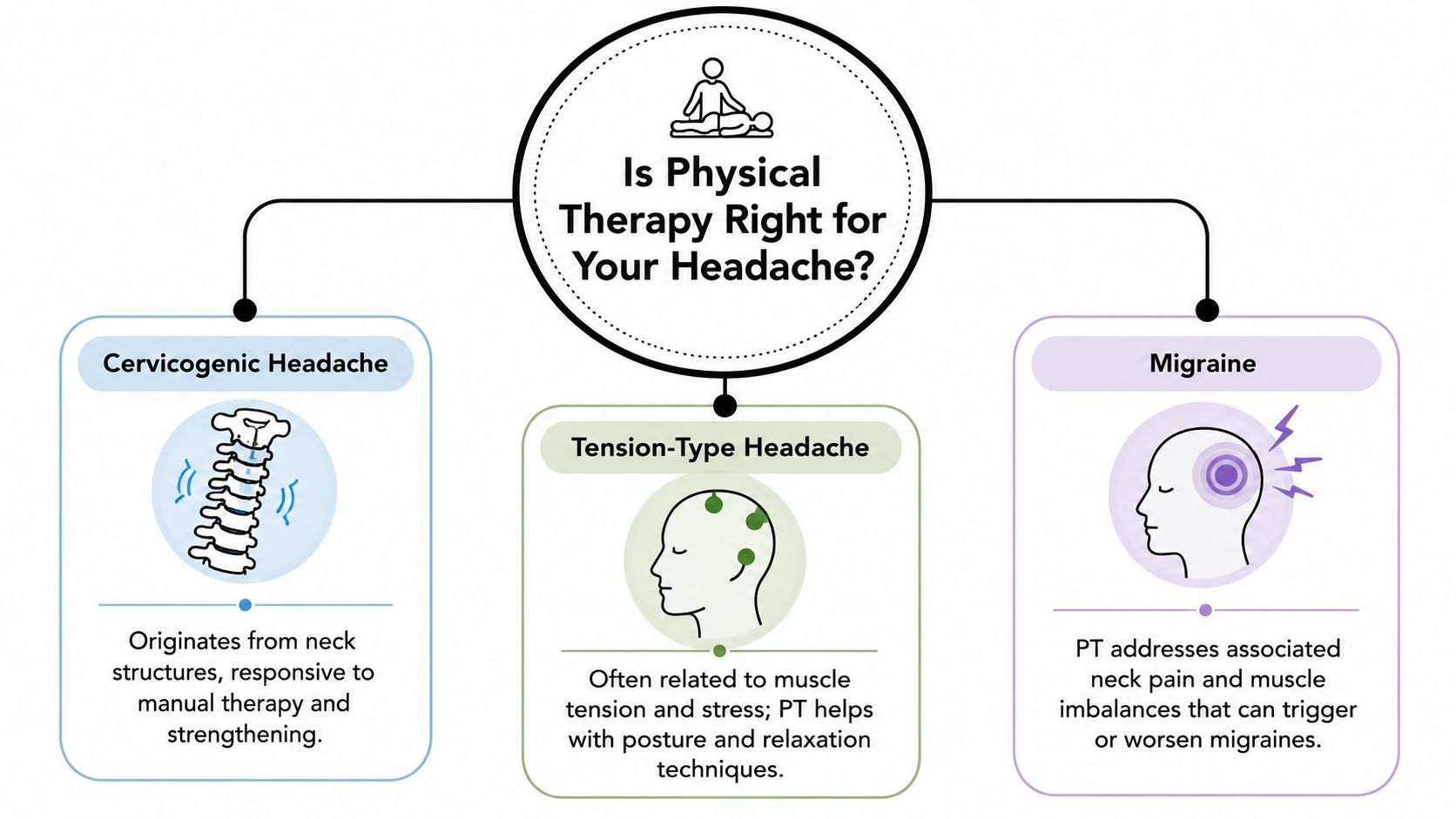
Not every headache should go straight to physical therapy. That's one of the most important points people rarely hear. PT is most relevant when headaches have a musculoskeletal contributor, especially with cervicogenic headache, tension-type headache, and some post-concussion headaches, while migraine care is often adjunctive rather than stand-alone, as noted by ChoosePT's headache guidance.
Cervicogenic headache
This type usually starts with the neck. People often describe pain that begins at the base of the skull or upper neck and then travels into the head. It may stay more on one side, and neck movement or sustained positions often aggravate it.
Clues that point in this direction include:
- Pain linked to neck motion: Turning your head, looking up, or holding one position too long brings symptoms on.
- Neck stiffness: Your neck doesn't feel free or easy to move.
- Pain that starts low and moves upward: The headache seems to climb from the neck rather than appear out of nowhere.
These patients are often strong candidates for PT because the source is frequently mechanical.
Tension-type headache
This is the headache many people call a "stress headache." It often feels like a band of pressure around the forehead, temples, or back of the head. The muscles in the neck, shoulders, and upper back are commonly part of the picture.
Patterns that fit include:
- A dull, steady ache: Less throbbing, more pressure or tightness.
- Tender neck and shoulder muscles: You can often feel the tension.
- Posture and stress effects: Long desk days, jaw clenching, or fatigue seem to ramp it up.
Physical therapy often helps here because the treatment can target posture, muscle overload, breathing habits, and cervical mobility.
Migraine with a neck component
Migraines are more complex. PT doesn't replace medical care for migraine, but it can help when neck tension, posture, or jaw dysfunction act as triggers or amplifiers.
You may fit this group if:
- You have classic migraine features: Throbbing pain, light or sound sensitivity, nausea, or aura.
- Your neck gets tight before or during attacks: The neck isn't the whole story, but it's part of it.
- Certain positions or muscle tension seem to worsen episodes: Long sitting, clenching, or upper-neck stiffness show up repeatedly.
Practical rule: If your headache pattern clearly changes with posture, neck movement, muscle tension, or jaw clenching, a PT evaluation makes sense.
When you need medical evaluation first
Some headache patterns need a physician before a PT. Seek prompt medical care if you have a sudden severe headache unlike your usual pattern, headache after head trauma, new neurological symptoms, fever with neck stiffness, confusion, fainting, new vision loss, or a major change in your typical headache pattern.
PT helps best when the question is mechanical. Medical care comes first when the question is safety.
Your First Headache Assessment What to Expect
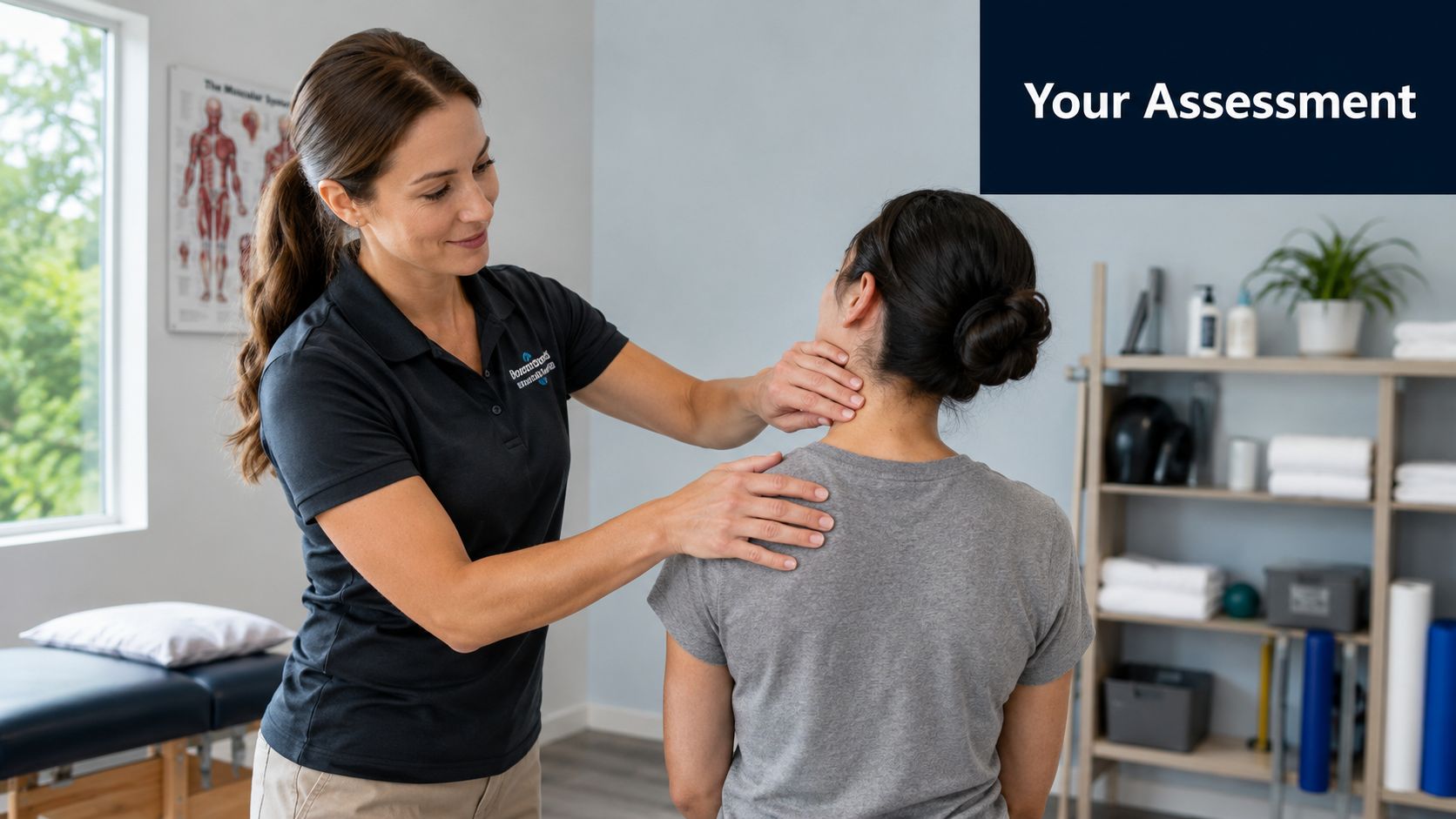
Patients are often relieved after a headache evaluation because it feels far more specific than they expected. It isn't just, "Touch your toes and rate your pain." A good assessment is a structured conversation plus a movement exam designed to answer one question. Is your headache being driven, worsened, or maintained by something we can treat physically?
The conversation comes first
The first part is your story. A therapist will want details that matter, such as where the pain starts, whether it spreads, what time of day it's worst, which activities trigger it, and whether neck motion changes it.
Expect questions like these:
- Where does the headache begin? Back of the skull, temple, forehead, behind the eye, or diffuse pressure.
- What makes it worse? Computer work, reading, driving, poor sleep, stress, chewing, or exercise.
- What makes it better? Rest, heat, movement, darkness, medication, or changing position.
That history often gives the first major clue. If symptoms repeatedly build after posture-related tasks, that's very different from a headache that appears with no mechanical pattern.
Then comes the movement exam
Next, the therapist looks at how you move. This often includes your neck range of motion, upper-back mobility, shoulder position, and how your head sits over your trunk. The body works like a chain. If one link gets stiff or weak, another area often pays for it.
A therapist may check:
- Neck motion: Rotation, looking up, looking down, and side bending.
- Upper-back mobility: A stiff thoracic spine can increase neck strain.
- Muscle tone and tenderness: Tight suboccipitals, upper trapezius, jaw muscles, and shoulder girdle muscles often matter.
- Postural control: Can you hold a good position without bracing or collapsing?
If you're curious about the broader flow of rehab visits, this overview of what a typical physical therapy session looks like helps make the process feel less mysterious.
Hands-on testing matters
A headache assessment is often partly hands-on because movement quality and tissue irritability can't be judged from a checklist alone. Your therapist may gently test joint mobility in the neck and upper back, press on muscles that can refer pain into the head, and see whether certain positions reproduce your familiar symptoms.
That matters because it helps separate "my head hurts" from "this exact neck structure is feeding the pain pattern."
A short visual overview can make this easier to picture:
A thorough headache PT evaluation should leave you with more clarity, not more confusion. You should understand what seems mechanical, what doesn't, and what the next step should be.
What you should leave with
By the end of the visit, you should have a working explanation. Not every case is simple, but you should hear something more useful than "your muscles are tight." You should know whether your symptoms fit a PT-responsive pattern, what body regions are involved, and what kind of treatment approach makes sense.
That clarity is part of the treatment. People do better when they understand the problem they're solving.
Core Physical Therapy Techniques for Headache Treatment
The strongest approach isn't one magic technique. For tension-type headache, migraine, and cervicogenic headache, the best-supported PT care is multimodal, combining spinal joint manipulation or mobilization, soft-tissue treatment, exercise, and other therapies, with the literature noting that these combined programs tend to be more effective than single-technique care in the review indexed on PubMed.
Manual therapy restores motion
When a neck segment gets stiff, nearby muscles often tighten to protect it. That can create a loop. The joint doesn't move well, muscles guard, pain rises, and movement becomes even more restricted.
Manual therapy helps interrupt that loop. Depending on the person, that may include joint mobilization, soft-tissue work, myofascial techniques, or targeted hands-on treatment around the upper cervical region and upper back. The goal isn't just temporary relaxation. It's to improve how the area moves and how sensitive it is.
If you want a better sense of the hands-on side of care, this guide to manual physical therapy techniques explains how therapists use touch to reduce pain and restore movement.
Exercise gives the relief staying power
Manual therapy can open the door. Exercise helps keep it open.
For headache patients, exercises usually focus less on heavy strength training and more on support, endurance, and control. That often means:
- Deep neck flexor training: Helps support the head without overusing superficial neck muscles.
- Scapular and upper-back work: Better shoulder blade support reduces strain traveling into the neck.
- Mobility drills: Keeps the thoracic spine and shoulders from forcing the neck to compensate.
This is the difference between loosening a knot and fixing why the knot keeps returning.
Posture isn't about sitting like a statue
Many people hear "posture correction" and imagine being told to sit ramrod straight all day. That's not the point. Good postural rehab means reducing unnecessary load and giving your body more options.
A therapist may help you adjust:
| Daily situation | Common problem | PT focus |
|---|---|---|
| Laptop work | Head drifts forward, shoulders round | Head and ribcage position, screen setup, movement breaks |
| Driving | Prolonged neck tension | Seat support, headrest position, gentle resets |
| Phone use | Repeated neck flexion | Hand position, arm support, screen height |
Jaw and surrounding tension can matter
Some headaches aren't only about the neck. Jaw clenching and TMJ irritation can feed temple pain, facial pain, and upper-neck tension. When that pattern is present, treatment may include jaw awareness, relaxation training, and coordination work alongside neck care.
If jaw symptoms are part of your pattern, these TMJ physical therapy exercises can help you understand what targeted jaw work may look like.
The best headache rehab plans don't chase one tissue. They connect the neck, jaw, upper back, breathing, and daily habits into one coherent plan.
The Evidence Behind PT for Headache Relief
A lot of readers want one reasonable question answered before they commit to treatment. Does this work? For the right headache types, the answer is yes, and the research is most convincing when symptoms have a musculoskeletal component.
What the research shows for migraine
A 2023 systematic review in the Journal of Integrative Neuroscience found that physical therapy and rehabilitation approaches for chronic migraine showed measurable benefits in multiple randomized controlled trials. In that review, manual therapy or aerobic exercise combined with medication significantly reduced headache intensity, and manual therapy or aerobic exercise combined with medication also significantly reduced headache days per month. The review also described structured protocols lasting 5 to 8 weeks for manual therapy and 12 weeks for amitriptyline plus aerobic exercise, which supports the idea that headache-focused PT is usually delivered as a planned program rather than a one-time visit, as reported in the Journal of Integrative Neuroscience review.
That timeline matters. People often expect either instant relief or no relief. Headache rehab usually works more like training than like flipping a switch.
What the research shows for tension-type headache
For tension-type headache, a 2023 systematic review found that several PT approaches improved outcomes in the short to medium term. One program that combined cervical and thoracic mobilization with postural re-education significantly improved headache intensity at 8 weeks (p = 0.003) and headache frequency at 8 weeks (p < 0.001). The same review also noted that some studies reported a response rate of more than 90%, and that direct or indirect myofascial release significantly decreased headache frequency at 3 months (p < 0.001), according to the systematic review on tension-type headache treatment.
That doesn't mean every person gets the same result. It does mean targeted musculoskeletal care can produce meaningful change.
Physical therapy outcomes for headaches at a glance
| Headache Type | PT Intervention | Key Outcome |
|---|---|---|
| Chronic migraine | Manual therapy or aerobic exercise combined with medication | Significant reduction in headache intensity and headache days per month |
| Chronic migraine | Structured PT-based program | Protocols in the review ranged from 5 to 8 weeks for manual therapy and 12 weeks for amitriptyline plus aerobic exercise |
| Tension-type headache | Cervical and thoracic mobilization plus postural re-education | Significant improvement in headache intensity and frequency at 8 weeks |
| Tension-type headache | Direct or indirect myofascial release | Significant decrease in headache frequency at 3 months |
Research supports PT best when treatment matches the headache pattern. That's why accurate triage matters as much as the treatment itself.
Home Strategies to Maintain and Enhance Your Progress
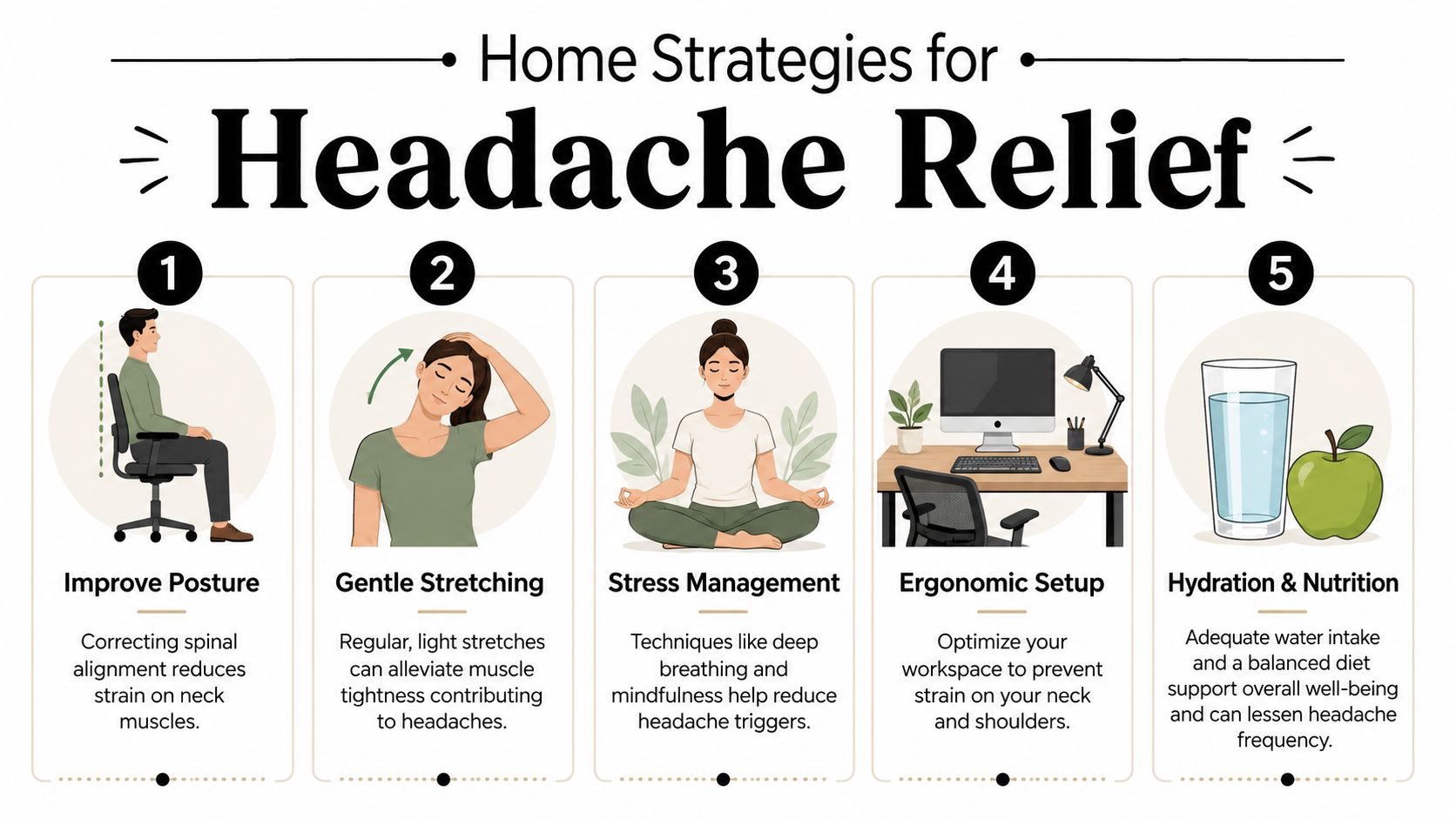
Clinic treatment helps, but home habits decide whether your neck settles down or gets irritated again tomorrow. That's especially true because a major target in headache rehab is the cervical mechanism. Poor posture, neck and upper-back tightness, and reduced neck motion are common contributors, so effective programs typically combine manual therapy with postural and upper-back strengthening to reduce cervical load and help prevent recurrence, as described by Henry Ford Health's headache physical therapy overview.
Three simple resets you can do at home
These should feel gentle, not aggressive. If an exercise clearly worsens symptoms, stop and get personalized guidance.
- Chin tuck reset: Sit tall and slide your chin straight back without tipping your head up or down. Hold briefly, then relax. This can reduce the forward-head position that loads the upper neck.
- Shoulder blade set: Gently draw the shoulder blades back and slightly down. Don't force a military posture. Think "broad collarbones" rather than "chest up."
- Upper trapezius stretch: Sit on one hand, tilt your head away, and hold a light stretch along the side of the neck. Easy pressure is enough.
Your workstation matters more than you think
A lot of headaches are fed by low-level strain repeated all day. Small changes often help more than heroic weekend stretching.
Try this checklist:
- Raise the screen: Keep it closer to eye level so your head isn't falling forward.
- Support the forearms: Arm support reduces neck and shoulder gripping.
- Use movement breaks: Stand up, walk, or reset posture regularly instead of waiting until you hurt.
- Switch positions: The best posture is the one you can vary.
Use heat, breathing, and awareness wisely
Heat can calm guarded muscles around the neck and shoulders. Slow breathing can reduce the tendency to clench through the jaw and upper traps. Awareness matters too. Many people don't realize they're shrugging their shoulders or pressing their tongue against the roof of the mouth all day until someone points it out.
Home exercise isn't extra credit. It's how you teach your body to keep the gains from treatment.
Keep your plan realistic
The best home program is the one you will do. A few focused minutes done consistently beats an ambitious routine that gets abandoned after three days. Start small. Build the habit. Let consistency do the heavy lifting.
Begin Your Journey to Relief at MedAmerica Rehab Center
Headaches can make life feel smaller. You cancel plans, work through brain fog, and brace for the next episode. When the primary driver is mechanical, continuing to chase symptoms alone can keep you stuck in the same cycle.
Physical therapy for headaches offers a different path. It looks at whether your pain is being fueled by the neck, posture, muscle tension, jaw mechanics, or movement habits you can change. It also respects the limits of PT. If your symptoms point somewhere else, the right next step may be medical evaluation first.
That combination matters. It gives you both hope and honesty.

If you're in Deerfield Beach and you're tired of guessing whether your headaches are coming from your neck, your posture, or something else, a skilled evaluation can give you direction. You don't have to figure it out alone, and you don't have to settle for temporary relief as the only option.
If you're ready to get clear answers and a treatment plan built around the underlying source of your pain, MedAmerica Rehab Center offers patient-centered care in Deerfield Beach with a multidisciplinary team, same-day appointments, and an insurance-friendly process that makes it easier to start.
MedAmerica Rehab · Deerfield Beach
Talk to a clinician about your pain
Physical therapy, chiropractic, acupuncture and shockwave therapy under one roof, since 1995. Same-day appointments are available.
Mon–Thu 8:00 AM – 6:30 PM · Fri 8:00 AM – 3:00 PM