
Chiropractor Tamarac FL: Your Guide to Lasting Relief
You wake up stiff, turn your head to check traffic, and feel that familiar pull from your neck into your shoulder. Or maybe it hits later, halfway through the workday, when standing up from your desk feels harder than it should. For a lot of people in Broward County, pain doesn't arrive as one dramatic moment. It builds through commutes, screen time, lifting, yard work, workouts, and old injuries that never fully settled down.
That usually leads to the same search. You type in Chiropractor Tamarac FL and start comparing websites that all seem to promise relief. The hard part isn't finding a provider. It's figuring out which kind of care will help you feel better and keep moving well after the first burst of pain relief wears off.
Living with Pain in Tamarac? Here's How Chiropractic Care Can Help
A common Tamarac story goes like this. Someone spends too much time sitting, pushes through a few weeks of tightness, then reaches for something simple and suddenly the back locks up. Another person gets rear-ended at a stoplight, feels "mostly fine" that day, then wakes up two mornings later with headaches and a neck that won't turn normally.
That's often when chiropractic enters the conversation. Not as a miracle fix, but as a practical next step when the body isn't moving the way it should.

In simple terms, chiropractic care focuses on joint motion, spinal mechanics, nerve irritation, and the way your muscles respond to stress or injury. When the spine or surrounding joints stop moving well, the body compensates. One area stiffens, another overworks, and the result can be pain, guarding, tingling, or a constant sense that your body is "off."
Tamarac residents have plenty of options. In fact, 406 licensed chiropractic specialists practice within a 10-mile radius of Tamarac, according to the Tamarac chiropractic directory on Healthgrades. That tells you two things. First, people in this area actively seek chiropractic care. Second, choosing the right clinic takes more than picking the first name on a map.
When pain starts affecting normal life
You don't have to be in severe pain to benefit from an evaluation. Good reasons to consider care include:
- Morning stiffness: You loosen up only after a hot shower or moving around for a while.
- Pain with sitting or driving: Your low back, neck, or shoulder gets worse the longer you stay in one position.
- Reduced motion: Looking over your shoulder, bending forward, or standing upright feels restricted.
- After an accident or strain: Even minor collisions and lifting injuries can leave lingering problems.
Practical insight: The longer your body compensates around pain, the more those compensation patterns start to feel normal.
If your pain began after a car crash or slip and fall, medical care should come first. Legal questions often follow close behind, and a plain-English Florida personal injury lawyer guide can help you understand what that process usually involves while you focus on recovery.
What a Chiropractor Actually Does for Your Body
While it's commonly known that chiropractors "adjust the spine," that phrase doesn't explain much. A better way to think about it is this. Your spine is part support structure, part motion system, and part protective casing for the nerves that help coordinate movement throughout your body.
When spinal joints are moving well, muscles tend to share work more evenly. When those joints get restricted, the body often responds with tension, inflammation, guarding, and altered movement. That can show up as back pain, neck pain, headaches, or pain that seems to travel into the arm or leg.
To see the basic idea at a glance:
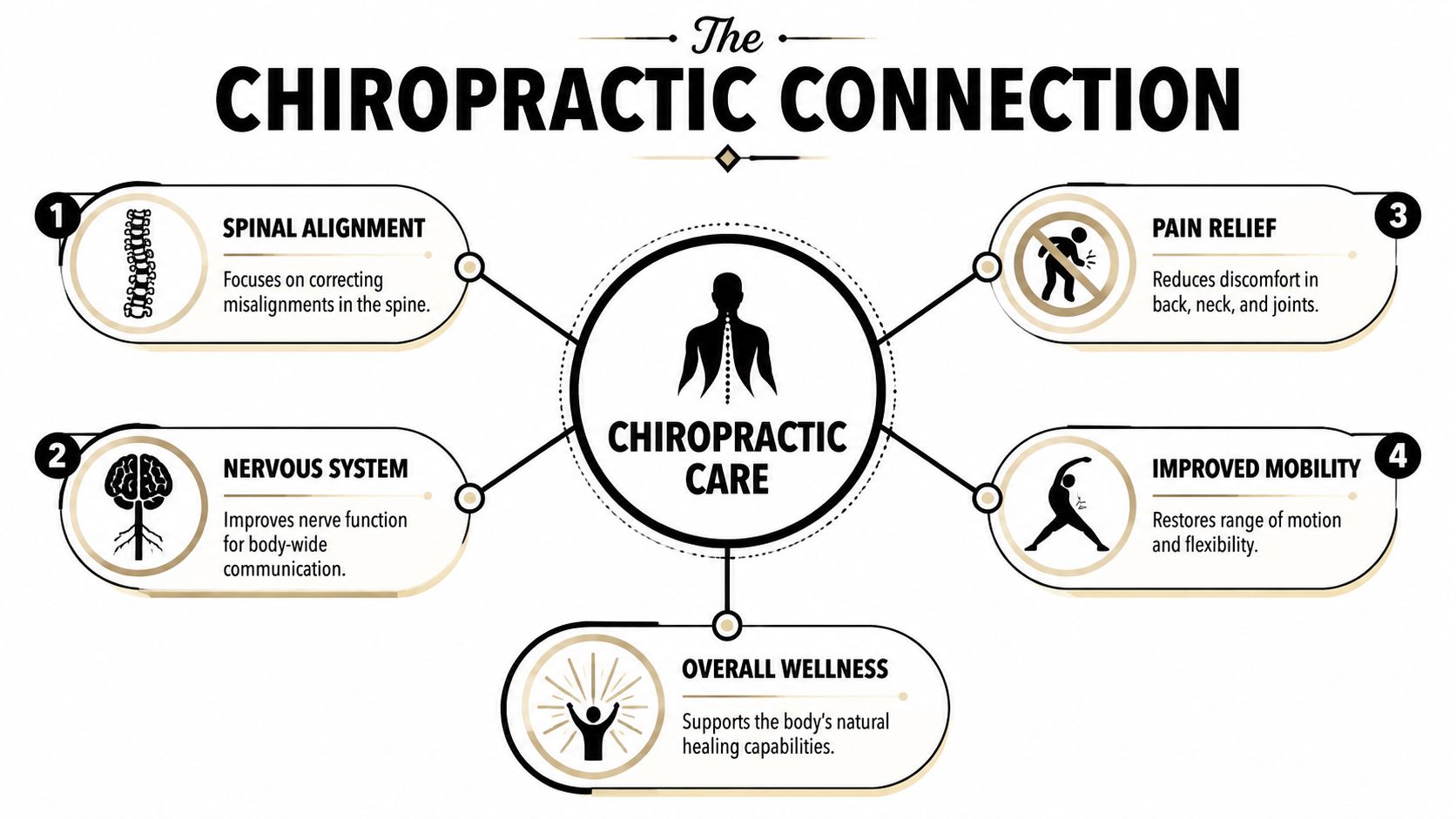
Think of your nervous system like electrical wiring
If the body's wiring is sending a clear signal, movement feels efficient. If there's irritation, restriction, or too much muscular "noise," that signal gets messy. Patients experience that as pain, tightness, weakness, or motion that feels hesitant and unsteady.
A chiropractic adjustment is a hands-on technique meant to improve joint motion. It doesn't rebuild a weak muscle by itself, and it doesn't erase every cause of pain. What it can do is reduce mechanical restriction so the body can move with less resistance.
For a broader overview, this guide on what a chiropractor does breaks down the role in patient-friendly terms.
What happens during treatment
A chiropractor typically evaluates several things at once:
- Joint motion: Which areas move too little, too much, or painfully.
- Muscle tone: Where the body is guarding, spasming, or overcompensating.
- Posture and mechanics: How you stand, sit, bend, and rotate.
- Nerve-related symptoms: Whether pain is local or travels into another area.
Treatment may include spinal or extremity adjustments, soft tissue work, mobility drills, postural coaching, and advice about activity modification. The adjustment is often the most recognized part, but it isn't the whole visit in a well-run office.
More people use chiropractic care than many assume. More than 35 million Americans visit a chiropractor each year, and 77% describe the care as very effective for musculoskeletal conditions, according to national chiropractic industry statistics summarized by ClinicMind.
Later in the visit, many patients want to see the process in action. This short video helps make the hands-on side feel less mysterious.
Treatment works best when the adjustment opens the door, and the rest of the plan teaches your body how to keep that door open.
Is Chiropractic Care Right for Your Condition?
Chiropractic is most useful when the problem involves movement, loading, joint irritation, muscular imbalance, or recovery after strain. It isn't the answer to everything. But for many common complaints, it can be a smart part of care.
Pain from daily life
These are the problems that creep in without one dramatic injury.
| Condition | How chiropractic may help |
|---|---|
| Low back pain | Improves joint mobility, reduces stiffness, and helps normalize movement patterns that have become guarded or uneven |
| Neck pain | Addresses restriction from desk posture, driving, sleep position, and stress-related muscle tension |
| Tension-related headaches | Helps when headache symptoms are tied to neck stiffness, upper back tension, or limited cervical motion |
| Mid-back tightness | Useful for people who feel stuck between the shoulder blades after long sitting or repetitive reaching |
If your pain changes with posture, movement, lifting, or sitting time, that usually points toward a mechanical issue. Mechanical issues often respond well to hands-on care plus movement-based rehab.
Nerve-related symptoms and radiating pain
Some patients don't describe pain as "pain." They say their leg burns, their arm tingles, or their foot feels oddly weak. Those symptoms may involve nerve irritation, especially when they travel away from the spine.
Common examples include:
- Sciatica-type symptoms: Pain, tingling, or heaviness running from the low back into the buttock or leg
- Cervical referral patterns: Neck problems that contribute to pain into the shoulder blade, arm, or hand
- Post-injury nerve sensitivity: Symptoms that start after a crash, sports injury, or abrupt twist
A useful rule is this. If a symptom travels, changes with position, or worsens when one area gets stiff, the source may be higher up the chain than where you feel it.
Injury recovery and overuse problems
Chiropractic can also help after a specific event or with repetitive strain. That includes auto accident injuries, sports-related flare-ups, lifting injuries, shoulder irritation from overhead activity, and joint pain made worse by compensation.
Good candidates often notice one or more of these patterns:
- You improved, then plateaued: The sharp pain calmed down, but normal movement never fully returned.
- You keep re-aggravating the same spot: The problem settles, then comes back with ordinary activity.
- One area improved while another got worse: This usually means the body shifted the workload elsewhere.
What doesn't work well is relying on passive treatment alone for months while strength, balance, and control are ignored. Relief matters, but function is what lets you stay active.
What Happens at Your First Chiropractic Appointment
The first visit should feel organized, not rushed. A good appointment isn't just about getting adjusted quickly. It's about figuring out what's driving the problem, what needs treatment now, and what can wait.
Step one is the conversation
You'll usually start with intake forms and a health history. Expect questions about where the pain is, when it started, what makes it worse, what makes it ease up, whether it travels, and whether you've had similar episodes before.
This part matters more than many patients realize. The pattern tells the story. Pain with sitting suggests one thing. Pain with walking, turning, coughing, sleeping, or lifting may suggest something else.
For a patient-friendly preview, this page on what to expect at a first chiropractic visit covers the basics clearly.
Step two is the physical exam
The exam usually includes posture, range of motion, orthopedic testing, palpation, strength checks, and basic neurologic screening when needed. The chiropractor is looking for a few key findings:
- Where motion is limited
- Which movements reproduce symptoms
- Whether a nerve seems irritated
- How muscles are compensating
- Whether the presentation fits chiropractic care at all
Sometimes the most useful result of the first visit is learning what the pain is not. If your symptoms suggest a condition that needs imaging, a specialist, or a different level of care, a responsible clinician should say so.
Clinical priority: The first appointment is not a sales meeting. It should end with a working diagnosis, a rationale for treatment, and clear next steps.
Step three is the plan
If treatment is appropriate, your chiropractor should explain the plan in plain language. You should understand what they're treating, what techniques they'll use, how you'll know whether it's working, and what you need to do between visits.
A thoughtful plan often includes these pieces:
- Immediate symptom relief through hands-on treatment and activity guidance
- Movement restoration so the painful area can function more normally
- Home strategies such as position changes, ice or heat guidance, and simple exercises
- Progress checks based on function, not just whether today's pain is lower
You should leave knowing more about your body than when you walked in.
Why Choose a Chiropractor Near Tamarac Who Offers More
Many patients say the same thing after trying care elsewhere: "It helped, but the pain came back." That doesn't mean chiropractic failed. It usually means the treatment plan stopped at symptom relief.
An adjustment can restore motion to a restricted joint. But if weak hips, poor trunk control, limited shoulder mechanics, balance deficits, or deconditioned postural muscles are still in place, the body often falls back into the same pattern. The pain may quiet down for a while, then return under the next load.
Relief and recovery are not the same
This is the gap many local searches miss. People look for a chiropractor near Tamarac because they want pain relief now. That's reasonable. But the better question is whether the care plan also improves function, because function is what protects you when life gets busy again.
That distinction matters even more in recurring cases. According to this discussion of chiropractic care and integrated treatment options, 68% of patients see pain recur within 6 months without adjunctive strength training, and 74% of patients with conditions like diabetic neuropathy report significant improvement when chiropractic is integrated with modalities like shockwave therapy.

What integrated care changes
The strongest plans usually combine several tools, each doing a different job.
- Chiropractic adjustments help restore motion and reduce joint-related irritation.
- Physical therapy exercises build the strength and control needed to hold those gains.
- Soft tissue treatment helps calm guarded muscles that keep pulling you back into the same pattern.
- Shockwave or other modalities may support healing in selected chronic conditions and stubborn tissue problems.
- Patient education teaches you how to sit, lift, walk, train, and recover without reloading the same weak link.
The point isn't to pile on treatments. It's to match the tool to the problem.
A patient with recurring low back pain may need hip strength and trunk stability. Someone with shoulder pain may need thoracic mobility and scapular control. A senior with unsteady walking may need balance retraining as much as spinal treatment. These aren't separate from chiropractic goals. They complete them.
For readers comparing approaches, this article on the benefits of chiropractic and physical therapy together gives a useful overview of why the combination often produces more durable results.
If your treatment plan never progresses beyond "come in when it hurts," you may get temporary relief without ever changing the reason the pain keeps returning.
Why Tamarac Residents Choose MedAmerica Rehab Center
When patients search for Chiropractor Tamarac FL, they usually want three things at once. They want someone who can calm pain, explain what's going on in plain English, and help them stay active without bouncing from one flare-up to the next.
That's why an integrated clinic stands out. MedAmerica Rehab Center has served South Florida since 1995, with chiropractic care, physical therapy, acupuncture, and shockwave therapy available under one roof. For patients, that means the care plan doesn't have to stop at the adjustment. It can move into strength work, mobility training, balance support, and guided recovery for more complex cases.
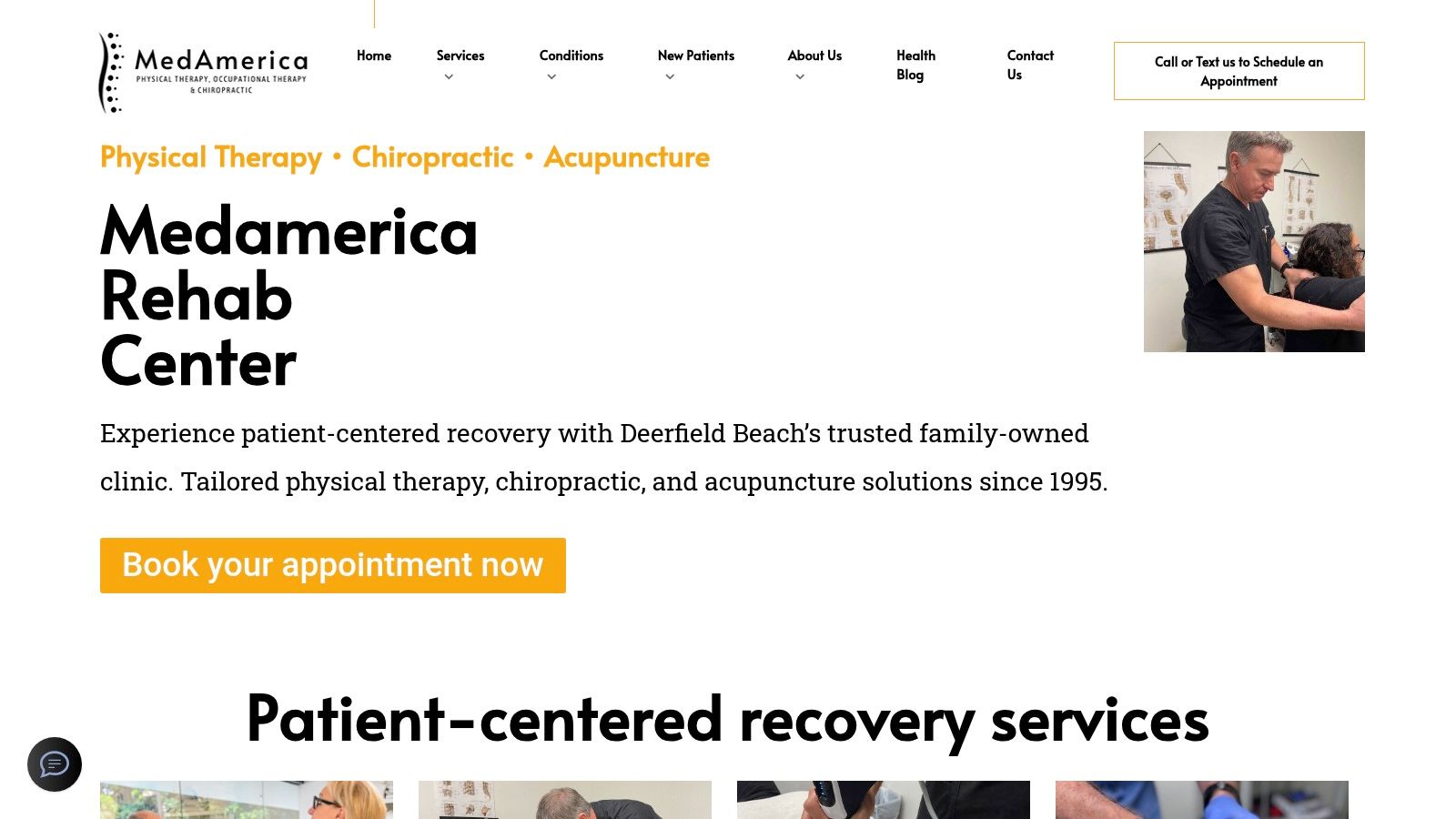
A few practical details matter too:
- Family-owned care: Patients often value consistency, familiarity, and a clinic culture that feels attentive rather than transactional.
- Multidisciplinary treatment: Back pain, neck pain, sciatica, arthritis, auto injuries, and postsurgical recovery don't all need the same tools.
- Same-day appointments: When pain spikes, waiting too long often makes movement harder and anxiety worse.
- Insurance-friendly processes: Clear front-desk guidance removes one of the biggest barriers to getting started.
The bigger reason people choose this kind of clinic is simple. They don't just want to feel better for a day or two. They want to walk better, lift better, sleep better, drive without guarding, and trust their body again.
If you're looking for care that goes beyond quick symptom relief, MedAmerica Rehab Center offers a practical path forward. The team combines chiropractic, physical therapy, acupuncture, and advanced shockwave therapy to help patients reduce pain, rebuild function, and return to daily life with more confidence.
MedAmerica Rehab · Deerfield Beach
Talk to a clinician about your pain
Physical therapy, chiropractic, acupuncture and shockwave therapy under one roof, since 1995. Same-day appointments are available.
Mon–Thu 8:00 AM – 6:30 PM · Fri 8:00 AM – 3:00 PM