

How to Prevent Sports Injuries: A Deerfield Beach Guide
Saturday morning in Deerfield Beach has a rhythm to it. Runners head down A1A before the heat climbs, beach volleyball courts fill up, and local athletes squeeze in training before the rest of the day starts. Individuals don't step onto the sand or pavement expecting to get hurt. They're thinking about pace, performance, or just enjoying the workout.
Then the common mistakes show up. A runner adds too much mileage after taking time off. A weekend basketball player skips the warm-up and tries to move at game speed on the first possession. A high school athlete plays through tightness all week, then feels a pull on Friday night. In clinic, that pattern is familiar. The injury often starts before the painful moment. It starts with preparation, workload, and ignored warning signs.
Staying in the Game Without the Pain
In Deerfield Beach, sports injuries don't just happen to elite athletes. They happen to the adult who joins a rec league after a busy work season. They happen to the teen who practices hard, plays hard, and never really recovers. They happen to the runner who feels great for two weeks and decides to double down.
That matters because the problem is bigger than most athletes think. The CDC reports an annual average of 8.6 million sports-related injuries in the U.S., and more than 775,000 children under 14 are treated in emergency rooms each year for these incidents according to this sports injury statistics summary. Those numbers don't mean you should avoid activity. They mean injury prevention belongs in the routine from day one.
For younger athletes, especially in football, soccer, and other contact sports, the stakes are even clearer. A lot of injuries come from basic breakdowns in timing, control, and load. Adults aren't immune either. I see plenty of avoidable strains and flare-ups from people who are active only on weekends, then ask their bodies to perform like they've trained consistently all month.
The best prevention plan is rarely fancy. It's the plan you'll actually follow before, during, and after your sport.
If you play soccer or football and want a practical checklist that covers smart habits, gear, and preparation, SoccerWares' guide for safer play is a useful starting point. The key is not reading advice once. The key is using it every week.
A good prevention plan doesn't make you cautious. It makes you available. That's the difference. The athlete who stays in the game is usually the one who trains with some restraint, respects recovery, and treats small problems early.
Build Your Injury-Proof Foundation
Most athletes think injury prevention starts with stretching. It usually starts earlier than that. It starts with knowing how your body moves before speed, fatigue, and competition expose weak links.
Research confirms that 50% to 60% of sports injuries can be prevented through modifiable measures like proper conditioning and technique, based on prevention models summarized in PubMed Central. That's why a movement baseline matters. If you want to learn how to prevent sports injuries, don't begin by copying a random workout from social media. Begin by figuring out what your body does well and where it compensates.

What a real screening should catch
A basic sports physical has value, but it doesn't tell you much about movement quality. A useful pre-participation screening looks at how you squat, hinge, rotate, balance, and absorb force. It should also look at side-to-side differences.
Here's what often shows up:
- Stiff ankles: Limited ankle motion often shifts stress upward into the knee, especially during running, cutting, and landing.
- Weak hips or glutes: When the hip doesn't control the leg well, the knee tends to drift into poor positions under load.
- Restricted thoracic rotation: Tennis players, golfers, swimmers, and even runners can compensate elsewhere when upper back mobility is poor.
- Core control deficits: If the trunk can't stabilize well, the limbs usually have to work harder than they should.
A lot of recurring “knee pain” is not really a knee problem. It's a load-distribution problem. The knee becomes the complaint because the ankle, hip, or trunk isn't doing its share.
What to do with the findings
The point of screening isn't to label you as broken. It's to direct training. If your left hip is less stable than your right, your plan should reflect that. If your calves are overloaded from beach running, your week should account for that surface demand.
A good foundation usually includes:
Mobility where you're restricted
Think ankles, hips, and upper back, not random stretching everywhere.Strength where you're underpowered
Single-leg control, posterior chain strength, and trunk stability matter more than mirror-muscle training.Movement practice under control
Squats, step-downs, lunges, and landing drills tell you a lot about how you'll move when speed increases.
For athletes who need a better base of trunk stability, these core exercises from MedAmerica Rehab Center are a practical place to start. The right core work should improve control, not just create fatigue.
Practical rule: Don't build speed on top of dysfunction. Clean up the pattern first, then add intensity.
That approach feels slower at first. In practice, it usually keeps people training longer and missing less time.
Master Your Warm-Up and Conditioning
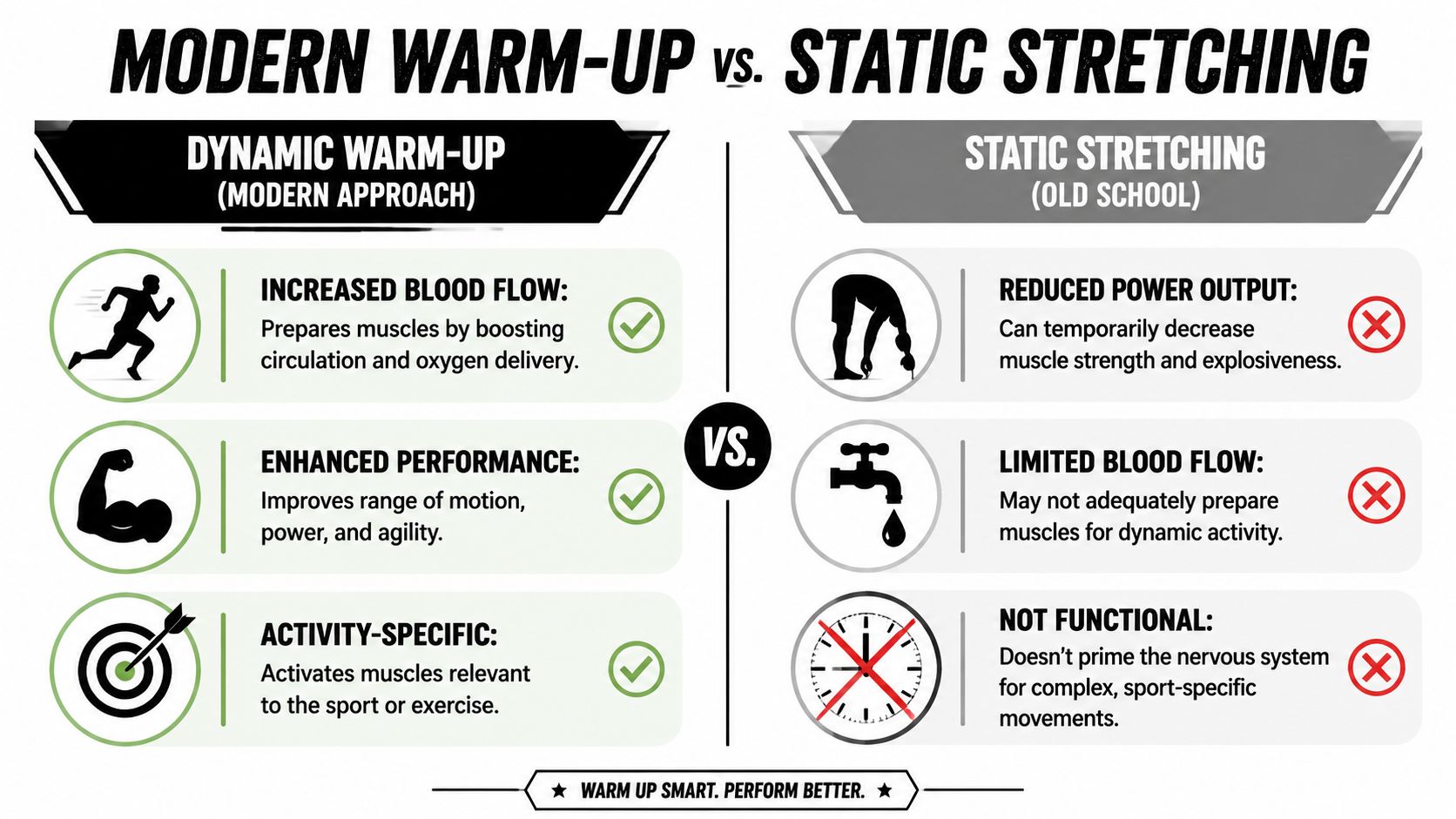
The old routine still shows up everywhere. Athletes jog a little, hold a hamstring stretch, grab a quad stretch, maybe sit in a calf stretch, then jump right into sprints or full-speed play. That's not a great setup for performance or for tissue readiness.
A modern warm-up should raise body temperature, increase blood flow, wake up the nervous system, and rehearse the movement patterns your sport demands. A runner on A1A doesn't need the same prep as a high school tennis player or a beach volleyball athlete. The idea is the same, though. Move first. Stretch strategically later.
What a warm-up should look like
Before activity, use movements that gradually build toward the demands ahead. That usually means a sequence like this:
- Start with easy motion: brisk walking, light jogging, or easy bike work
- Add mobility through movement: leg swings, walking lunges, hip openers, ankle rocks
- Activate key muscle groups: glute bridges, mini-band steps, calf raises, dead bugs
- Finish with sport-specific rehearsal: strides for runners, shuffle and cut drills for court athletes, approach jumps for volleyball players
If you're preparing for a road race, this guide on how to properly warm up for a 5K gives a simple structure you can adapt even if you're not racing.
Why static stretching isn't enough
Static stretching has a place. It's just usually not the main event before explosive activity. Long holds don't train timing, force absorption, or coordination. Your sport asks for those qualities whether you're accelerating, landing, changing direction, or rotating.
What works better before training is a warm-up that matches the task. For a Deerfield Beach runner, that may mean calf prep, glute activation, and a few controlled strides. For a basketball or soccer player, it may mean deceleration drills, lateral movement, and trunk control.
This short demo can help athletes who want a visual routine to follow before activity.
Conditioning should be specific, not generic
General fitness helps, but targeted strength work prevents more problems than random conditioning circuits. Hamstrings are a good example. Sprinting sports, cutting sports, and stop-start field sports all ask a lot from them, especially when athletes are tired.
Including the Nordic hamstring exercise in a prevention program has been shown to cut the rate of hamstring injuries by about 50% across multiple sports, according to a JOSPT review on hamstring injury prevention. That doesn't make Nordic curls the only answer. It does show how powerful specific loading can be when the exercise matches the injury pattern.
A smart conditioning plan usually blends a few categories:
| Focus area | Practical examples |
|---|---|
| Posterior chain strength | Nordic hamstring exercise, Romanian deadlifts, hip thrusts |
| Single-leg control | Split squats, step-downs, single-leg RDLs |
| Elastic prep | Pogos, skips, controlled hops |
| Sport carryover | Acceleration drills, shuffle work, cutting mechanics |
The mistake isn't that athletes train too little variety. It's that they often train the wrong qualities for their sport. If your game requires sprinting, decelerating, and rotating, your prep should too.
Smart Training and Progressive Load Management
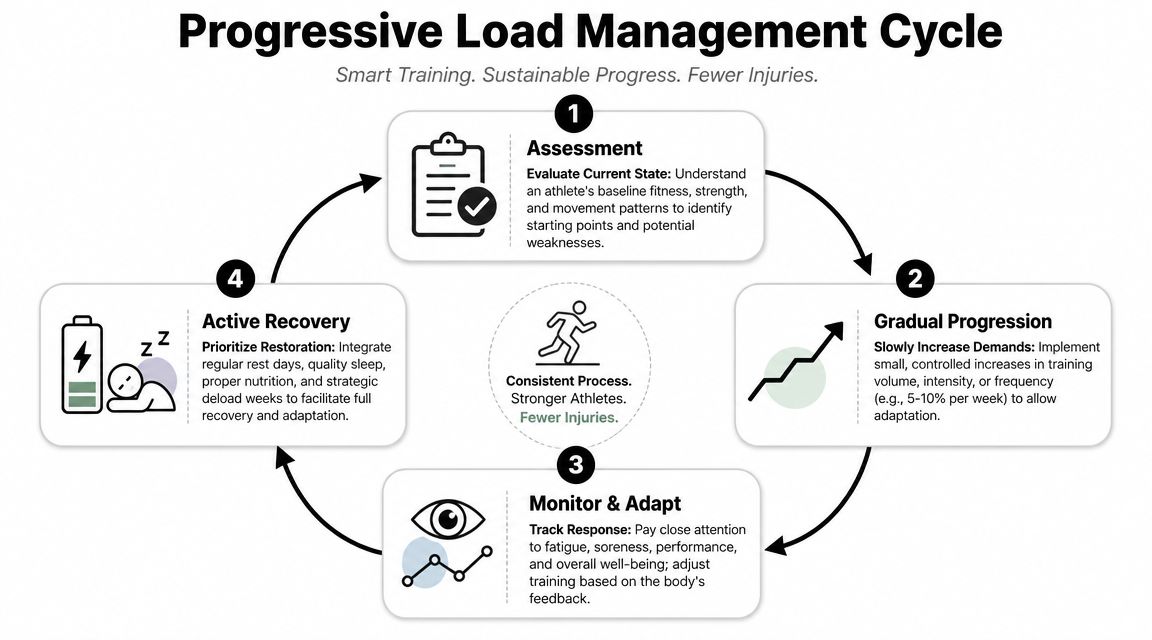
Most overuse injuries don't come from one bad step. They come from a mismatch between what your tissues can currently handle and what your schedule demands. That's why so many Deerfield Beach athletes get into trouble after a layoff, at the start of a season, or when motivation suddenly spikes.
If you're trying to learn how to prevent sports injuries, this is the part people skip. They focus on shoes, sleeves, tape, and gadgets while ignoring the biggest driver of many preventable problems. Load. More specifically, load spikes.
The 10 percent rule is simple for a reason
Cedars-Sinai and the University of Chicago Medicine advise athletes not to increase training volume or intensity by more than 10% per week in order to let tissues adapt and reduce repetitive strain, as summarized in Cedars-Sinai's sports injury prevention guidance. It's not magic. It's a brake pedal.
That rule is especially useful for:
- Runners returning after time off
- Adults joining weekend leagues
- Students ramping up before tryouts
- Gym members who restart with high enthusiasm after inactivity
The body likes consistency more than heroics. Tendons, muscles, and joints adapt, but they don't adapt instantly.
What load spikes look like in real life
This is where athletes miss the point. A load spike isn't just “I ran too much.” It can be:
- Going from two easy runs to a long run plus speed work in the same week
- Playing in two rec games after doing little training during the week
- Adding hill sprints, beach runs, and leg day all at once
- Practicing daily after a school break without adjusting total volume
In Deerfield Beach, surface and climate matter too. Running on the beach adds a different stress than running on flat pavement. Heat and humidity increase fatigue, and fatigue changes mechanics. The same planned workout can become a bigger load than expected because the environment makes every rep more expensive.
If your breathing, pace, or soreness changes sharply after a schedule jump, your body is telling you the progression was too aggressive.
Train in a way your body can repeat
A better training week isn't always a harder one. It's one you can recover from and repeat. That means building around rhythm.
Try this framework:
Keep one variable stable
If you increase distance, don't also increase intensity and frequency.Use hard and easy days on purpose
Don't stack demanding sessions back to back unless your sport schedule forces it.Cross-train when impact is the problem
If your knees or shins are getting irritated, you may need aerobic work with less pounding. For athletes looking at lower-impact options, BionicGym for knee-friendly exercise offers ideas that can help maintain conditioning without constant joint aggravation.Watch delayed soreness, not just workout-day soreness
A lot of overload problems show up the next morning, not during the session.
Technique and gear still matter
Technique and equipment don't replace load management, but they support it. Poor running form, bad landing mechanics, worn-out shoes, and the wrong surface can all make a tolerable workload feel excessive. Good gear doesn't make you invincible. It just reduces unnecessary stress.
That's why the smartest athletes don't ask, “How much can I survive this week?” They ask, “What can I progress and still feel good doing again next week?” That question keeps more people active than any motivational speech ever will.
The Recovery Playbook for Peak Performance
Training is only half the job. The adaptation you want happens after the session, when your body repairs tissue, restores energy, and recalibrates for the next load. Athletes who ignore recovery often think they need a tougher program. In many cases, they need a better one outside the gym.
That matters even more in South Florida. A run in Deerfield Beach can leave you more depleted than expected because heat, humidity, and sun exposure push hydration and recovery needs higher. If you finish a workout and spend the rest of the day dragging, cramping, or feeling unusually flat, your recovery system is probably underbuilt.
Start with the basics that actually move the needle
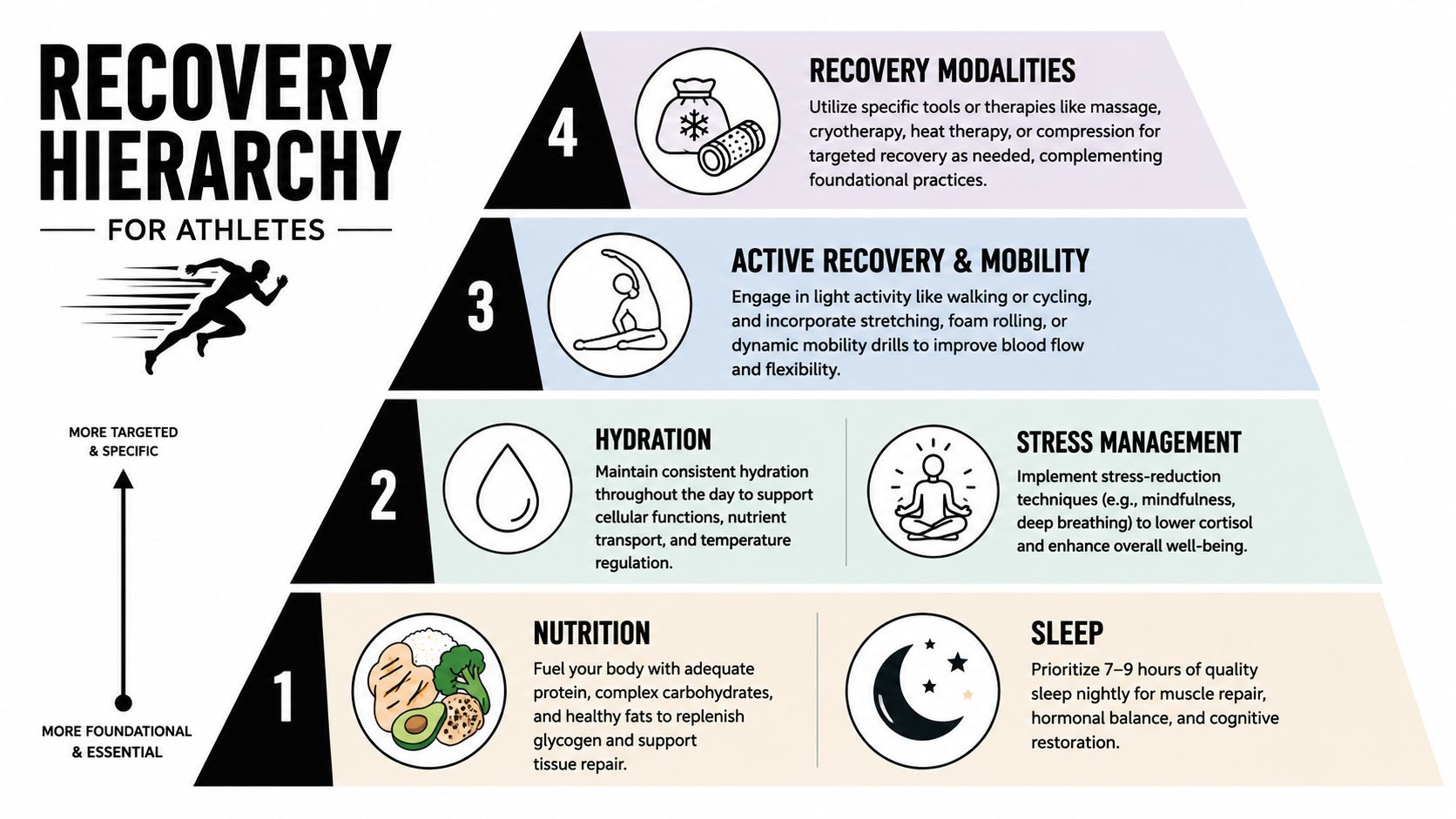
Recovery tools get a lot of attention. Sleep, hydration, and food do more of the heavy lifting.
Use this order of priority:
- Sleep first: If sleep is poor, tissue repair, energy, and focus all suffer.
- Hydrate consistently: Don't try to make up for a whole day of underhydration with one big bottle after practice.
- Refuel after training: Give your body enough nutrition to recover from what you did.
- Use mobility and light movement wisely: These can help, but they don't replace the basics.
For athletes trying to understand how sleep supports repair, SleepHabits guide to muscle repair offers useful context around recovery habits and what is effective.
A practical Deerfield Beach recovery routine
You don't need an elaborate protocol. You need consistency.
After a hard run, field session, or game, a simple plan works well:
| When | What to do |
|---|---|
| Right after | Walk until breathing settles, begin fluids, avoid dropping straight into a chair or car seat |
| Within the next meal window | Eat a balanced meal that includes protein and carbohydrates |
| Later that day | Keep fluids steady, especially if you trained in heat |
| That evening | Light mobility or an easy walk if you feel stiff, then protect sleep |
For beach athletes, rinse and reset matters too. Sand, heat, and long sun exposure can increase total fatigue even when the workout itself doesn't seem extreme.
Active recovery versus complete rest
Both have value. The mistake is treating every sore day the same way.
Choose active recovery when you feel generally tired, stiff, or heavy, but not acutely painful. Easy cycling, walking, gentle mobility, or low-intensity swimming can help you feel better without adding much strain.
Choose more complete rest when pain is sharp, mechanics are altered, or fatigue feels systemic. If your stride is off, your jump feels unstable, or your shoulder catches when you lift your arm, forcing an “active recovery” session can become another training session in disguise.
Recovery isn't what you do only after a hard week. It's part of what makes a hard week possible.
The athletes who stay available usually protect boring habits. They drink enough. They eat enough. They sleep enough. Then they add the extra tools if needed.
When to Listen to Your Body and Get Help
Soreness after a tough session is normal. Pain that changes how you move is not. That's the distinction athletes need to get comfortable making.
Good soreness usually feels broad, symmetrical, and predictable. It improves as you warm up and fades over time. Warning-sign pain is different. It tends to be sharper, more localized, or tied to one specific movement. It may make you limp, guard, or avoid loading one side.
Red flags that deserve attention
Don't keep guessing if you notice any of these:
- Pain that gets worse during activity: Not just discomfort at the start, but a clear upward trend as you continue.
- Swelling or joint fullness: Especially after a twist, impact, or repeated overload.
- Instability: A knee that feels like it may buckle, an ankle that doesn't feel trustworthy, or a shoulder that feels loose.
- Pain that lingers for several days: Especially if rest helps only a little and the same pain returns quickly.
- Night pain or pain at rest: That usually deserves a closer look.
- Visible loss of motion or strength: If you can't squat, raise your arm, push off, or rotate normally, don't brush it off.
What athletes get wrong
A lot of people wait too long because the injury is still “playable.” They can still jog, still practice, still work out. But they're compensating. They shorten stride length, avoid one side, or change mechanics enough to spread the problem elsewhere.
That's how a mild calf issue becomes Achilles irritation. It's how hip tightness turns into knee pain. It's how a shoulder pinch becomes a bigger throwing problem.
A smart response looks more like this:
- Reduce the aggravating load
- Check whether pain changes your mechanics
- Use a short observation window
- Get assessed if the pattern isn't improving
When an evaluation saves time
You don't need to wait for a major injury to get help. An early movement assessment can tell you whether you're dealing with overload, irritation, a technique issue, or something that needs referral. For athletes dealing with strains, sprains, running pain, or field-sport injuries, physical therapy for sports injuries can help clarify the problem and guide a safe return to activity.
In Deerfield Beach, this matters for both student athletes and adults trying to stay active around work and family schedules. The earlier you understand the problem, the less likely you are to lose weeks trying random fixes.
Pain is useful information. It becomes a bigger problem when you treat it like background noise.
The goal isn't to panic every time something feels off. The goal is to respond early, adjust intelligently, and avoid turning a manageable issue into a longer layoff.
If pain is starting to limit your training, games, or recovery, MedAmerica Rehab Center in Deerfield Beach offers physical therapy, chiropractic care, acupuncture, and shockwave therapy with individualized plans built around mobility, strength, and return-to-sport function. Whether you're a beach runner, a high school athlete, or a weekend league player, getting the right assessment early can help you train with less guesswork and get back to the activities you enjoy.
MedAmerica Rehab · Deerfield Beach
Talk to a clinician about your pain
Physical therapy, chiropractic, acupuncture and shockwave therapy under one roof, since 1995. Same-day appointments are available.
Mon–Thu 8:00 AM – 6:30 PM · Fri 8:00 AM – 3:00 PM