
Meniscus Tear Recovery Timeline: A Phase-by-Phase Guide
A lot of people arrive at this question the same way. You twisted, pivoted, squatted, or stood up from a low seat, felt a pop in the knee, and then spent the next hour wondering whether this is a minor setback or the start of a long recovery.
By the time you search online, the advice usually gets more confusing, not less. One page says you'll be fine in a few weeks. Another makes it sound like every meniscus tear needs surgery. Neither is very helpful when your knee is swollen, stairs hurt, and you're trying to figure out whether to rest, walk, brace, or call an orthopedist.
There isn't one meniscus tear recovery timeline. There are different timelines based on where the tear is, whether it can heal, and which treatment path you're on. If you understand those three factors, the whole picture gets much clearer.
That First Pop and the Road to Recovery
One patient story repeats itself in different forms. A weekend pickleball match. A deep squat while gardening. A quick pivot getting out of the car. The details change, but the first questions are always familiar: “Did I tear something?” “Should I keep walking on it?” “How long is this going to take?”
The hardest part early on isn't just the pain. It's the uncertainty. Meniscus injuries don't all behave the same way, so generic timelines often create the wrong expectations.
Why the internet often gets this wrong
Most articles flatten everything into one average recovery window. That misses the detail that matters most. Tear location changes healing potential. According to Orthobethesda's overview of torn meniscus healing time, tears in the vascular red-red zone may heal in 4 to 8 weeks with conservative care, while tears in the white-white zone often don't heal without surgery.
That difference matters in the clinic. Two people can both say, “I tore my meniscus,” and still have completely different treatment options and recovery timelines.
Practical rule: Don't compare your knee to a friend's recovery unless the tear location and treatment choice were similar.
What usually helps in the first few days
Early on, the right goal isn't to “push through.” It's to calm the joint down and get a clear diagnosis. That usually means paying attention to swelling, locking, catching, painful twisting, and whether you can walk without a limp.
A realistic meniscus tear recovery timeline starts with a few grounded questions:
- How severe are your symptoms? Mild swelling and tolerable walking suggest a different path than a knee that locks or buckles.
- Where is the tear? Blood supply often decides whether healing is possible.
- What's the plan? Rest and rehab, surgical repair, and meniscectomy all lead to different recovery calendars.
If you're reading this while your knee still feels unstable, you don't need vague reassurance. You need a roadmap that fits the actual injury. That's what the rest of this guide is for.
Understanding Your Tear and Treatment Options
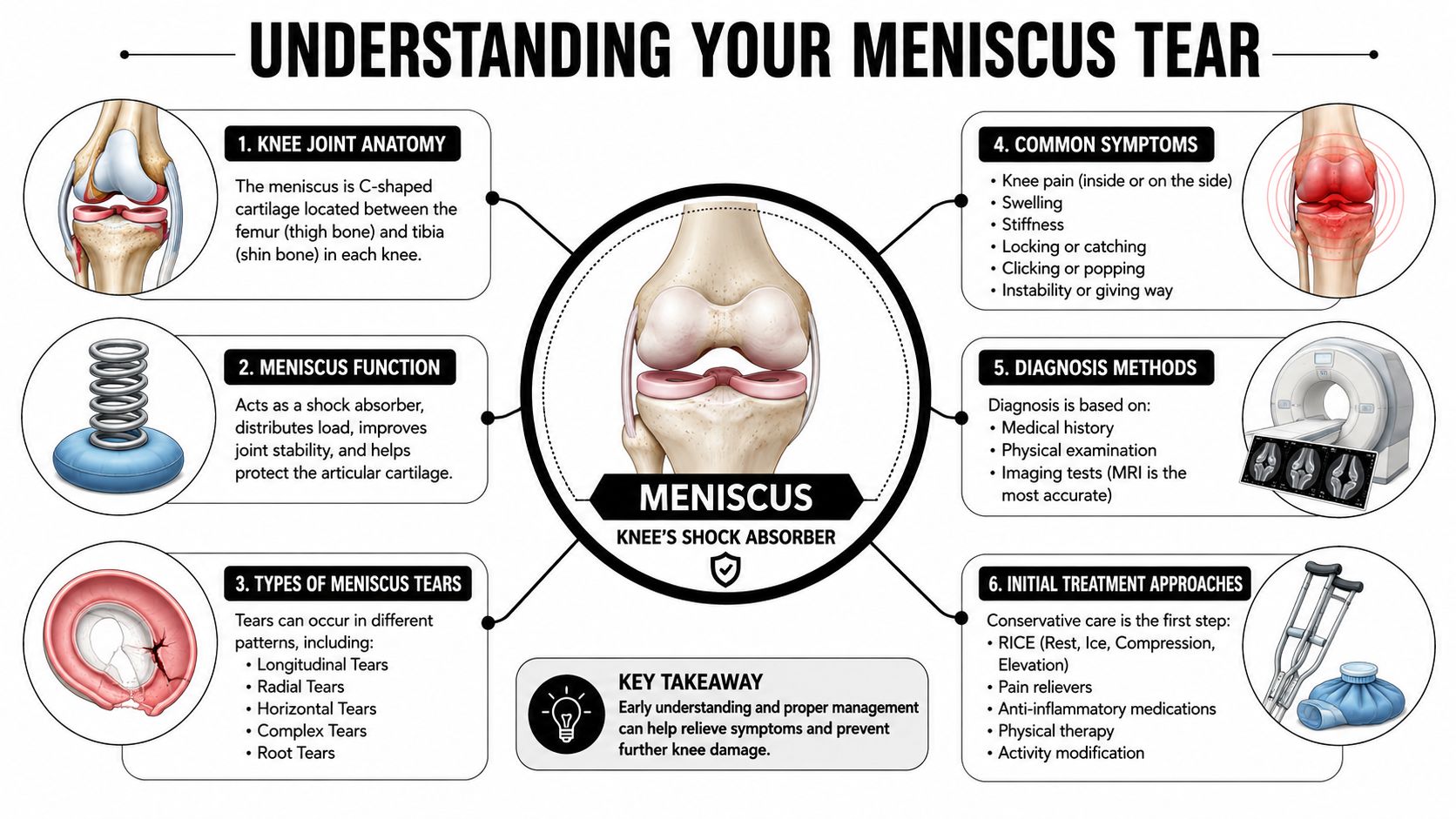
The meniscus is the knee's shock absorber. Each knee has two menisci, pieces of cartilage that help distribute force, improve stability, and reduce stress inside the joint. When one tears, the knee can become painful, swollen, stiff, or mechanically irritable.
The part most patients aren't told clearly
The key detail is blood supply. Some parts of the meniscus get enough circulation to support healing. Other parts don't. That's why one tear may improve with physical therapy while another keeps flaring up no matter how carefully someone rests.
ColumbiaDoctors explains meniscus surgery recovery this way: the recovery timeline is dictated by blood supply. The white-white zone is avascular, so a meniscus repair requires 3 to 6 months for tissue healing, while a partial meniscectomy has a 4 to 6 week recovery because it removes tissue rather than waiting for it to heal.
That biological difference drives treatment decisions.
The three recovery paths
Here's a simple way to look at it:
| Treatment path | Main goal | Typical recovery pattern |
|---|---|---|
| Conservative care | Reduce pain, restore motion, build strength, and let a healable tear settle | Best suited to smaller or more stable tears and some degenerative tears |
| Meniscus repair | Stitch the torn tissue and preserve the meniscus | Slower rehab because the tissue has to heal |
| Partial meniscectomy | Trim the damaged fragment that's causing symptoms | Faster rehab because healing the removed piece isn't the goal |
What each option is really trying to do
Conservative care works when the knee can calm down and function improves with protected loading, exercise, and activity changes. This is often the first step when the tear looks stable or symptoms are manageable.
Meniscus repair tries to preserve tissue. That matters because the meniscus does important long-term work for the knee. The trade-off is patience. Protecting the repair is vital.
Partial meniscectomy tends to move faster because the surgeon trims unstable tissue rather than stitching it. Patients often feel relief sooner, but this path removes part of the meniscus instead of preserving it.
The best treatment isn't the fastest one. It's the one that fits the tear pattern, the knee, and your long-term demands.
When people understand this early, they stop asking, “What's the average?” and start asking the better question: “Which recovery path am I on?”
The Non-Surgical Recovery Timeline
If your provider recommends conservative care, the timeline usually depends on symptom severity, tear stability, and how well you follow the rehab plan. For small or partial tears, non-surgical recovery typically spans 6 to 8 weeks, and for Grade 1 tears, recovery can be as fast as 2 to 6 weeks with proper rehab, based on this recovery timeline overview from DME-Direct.
That doesn't mean every day feels better in a straight line. Meniscus rehab is usually more of a gradual staircase than a clean upward slope.
Early phase and calming the knee
The first goal is simple. Settle the joint enough that you can move without repeatedly irritating it.
In this phase, we usually focus on:
- Reducing swelling: Ice, compression, elevation, and avoiding repeated twisting or deep bending.
- Protecting your gait: If you're limping, your knee isn't ready for normal loading.
- Restoring basic motion: Gentle bending and straightening matter early, but forcing painful range rarely helps.
A common mistake is doing too much too soon because the pain improves before the knee is ready. Swelling often lingers longer than people expect, and a knee that still feels “full” or catches with motion usually needs more control, not more intensity.
Middle phase and rebuilding control
Once pain settles and walking improves, rehab shifts toward motion, muscle activation, and tolerance for daily tasks. At this stage, physical therapy earns its value. The exercises are rarely flashy. They're targeted.
Common building blocks include:
- Quad sets and straight-leg raises: To wake the thigh back up
- Heel slides: To improve knee flexion comfortably
- Hip and glute work: To reduce extra stress at the knee
- Controlled sit-to-stand and step work: To rebuild confidence under load
If you want examples of knee-friendly home exercise progressions, this guide on exercises to strengthen your knees is a useful place to start.
A quieter knee is not the same as a strong knee. Pain reduction is only the first checkpoint.
Later phase and return to activity
The last phase is where people often rush. They can walk, so they assume they're done. But the true test is whether the knee tolerates normal movement patterns without swelling afterward.
Good signs you're moving in the right direction include:
- Walking without a limp
- Using stairs with better control
- Tolerating longer periods on your feet
- Returning to low-impact activity such as biking or steady walking
If pain spikes after every workout, the load is probably too high. If the knee stays calm and function keeps improving, the timeline is usually on track. A successful non-surgical meniscus tear recovery timeline isn't just about waiting a set number of weeks. It's about progressing only when the knee earns it.
Surgical Timelines Meniscectomy vs Meniscus Repair
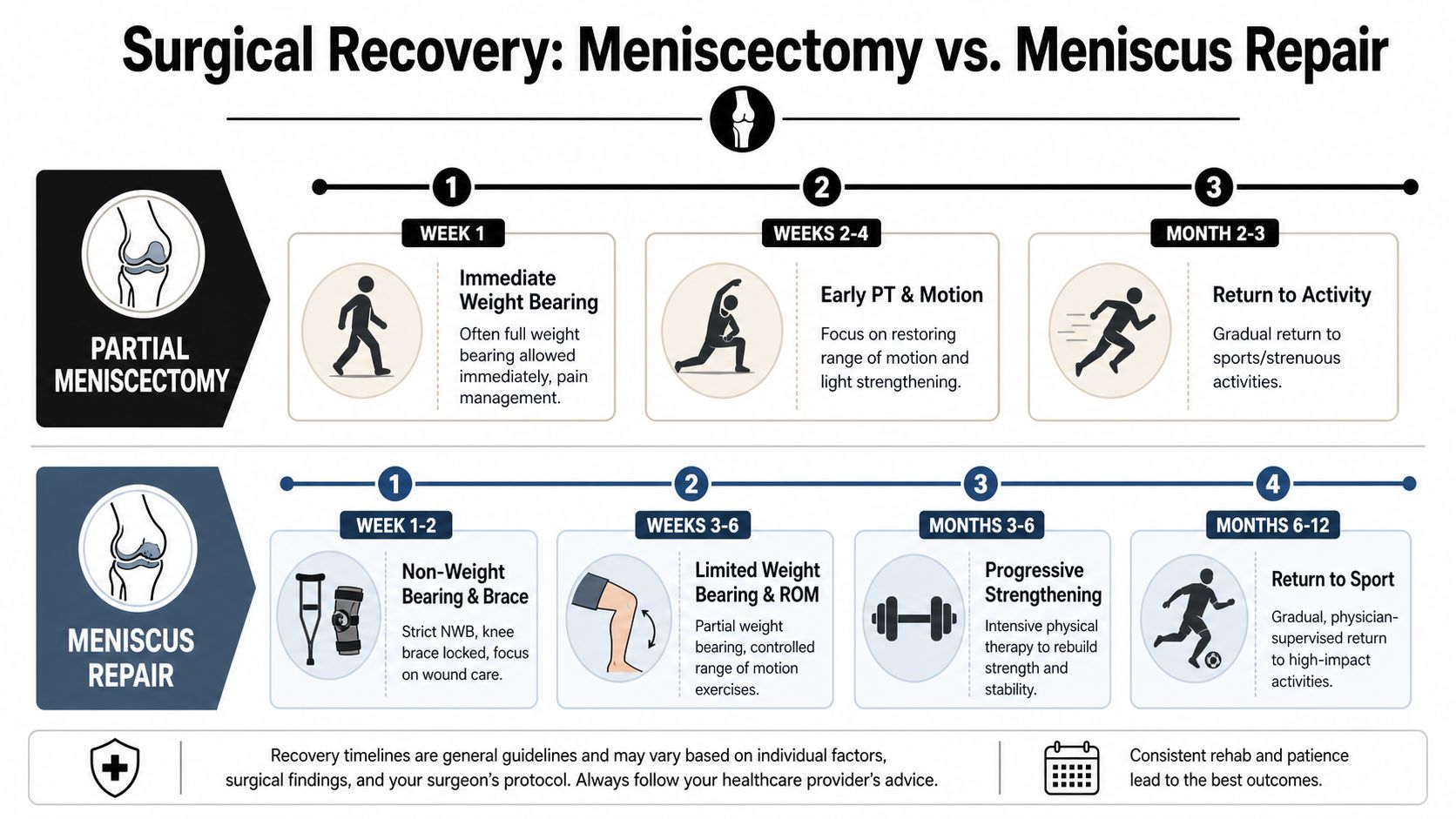
If surgery enters the picture, the biggest source of confusion is this: not all meniscus surgeries recover the same way. A meniscectomy and a meniscus repair may both be called “meniscus surgery,” but from a rehab standpoint they are very different experiences.
Partial meniscectomy and the faster track
In a partial meniscectomy, the damaged portion is trimmed away. Because the procedure removes unstable tissue instead of asking it to biologically heal, recovery is usually much quicker.
According to WebMD's meniscus tear surgery overview, patients often bear weight almost immediately after an uncomplicated meniscectomy and may return to sports within 4 to 6 weeks.
What that looks like in practice:
- Early days: Walking resumes quickly, though swelling and soreness still need management.
- Early rehab: Range of motion returns relatively fast.
- Functional recovery: Strength, balance, and confidence still need work, especially for stairs, squatting, and athletic movement.
The upside is speed. The limitation is that tissue has been removed, not preserved.
Meniscus repair and the slower track
A meniscus repair stitches the torn tissue so it can heal. That's often the more joint-preserving option, but it demands more discipline. The repair has to be protected while the tissue heals.
WebMD notes that return to high-impact sports takes 6 to 9 months after repair, and the early protocol usually requires 0 to 6 weeks of protected weight-bearing with crutches.
That longer timeline is why repair patients often feel frustrated in the first several weeks. They may feel capable of doing more before the tissue is ready for more.
Here's a side-by-side view:
| Milestone | Partial meniscectomy | Meniscus repair |
|---|---|---|
| Weight-bearing | Often immediate | Protected early with crutches |
| Early motion | Usually progresses faster | Progresses more cautiously |
| Return to sport | Often much sooner | Delayed to protect healing tissue |
| Main trade-off | Faster recovery | Better tissue preservation |
A strong post-op plan matters on both tracks. If you're preparing for surgery or already recovering, this overview of physical therapy after knee surgery can help you understand what structured rehab should include.
Here's a visual explanation of the recovery split between procedures:
What works and what backfires
What works after meniscectomy is steady progression. People usually do well when they control swelling, restore motion early, and rebuild strength instead of assuming the surgery alone solved everything.
What works after repair is restraint. The most common setback is acting on how good the knee feels rather than following the protocol. A repair can feel better before it is biologically secure.
If your surgeon says protect the repair, that instruction outranks your confidence, your calendar, and your impatience.
The trade-off is straightforward. Meniscectomy often gives you a faster recovery. Repair often gives the meniscus a better chance to remain part of the knee. The right choice depends on the tear, not on which timeline sounds more appealing.
Factors That Influence Your Personal Timeline
Standard recovery windows are useful, but they're only a starting point. In the clinic, personal timelines shift because knees don't heal in a vacuum. Age, arthritis, tear pattern, swelling response, strength, and consistency with rehab all shape what happens next.

Age and joint health matter more than people expect
A younger athlete with a relatively healthy knee often tolerates rehab differently than an older adult with stiffness, arthritis, and a long history of knee irritation. That's one reason two people with similar MRI wording can have very different recoveries.
The group that needs especially realistic expectations is adults with arthritis. The AAOS plain-language summary on meniscus tears notes that for patients with moderate-to-severe osteoarthritis, symptoms often persist beyond 8 weeks despite conservative treatment, and surgery may offer no significant long-term benefit over physical therapy alone.
That changes the conversation. If arthritis is part of the picture, the goal may be symptom management and function rather than chasing a quick, clean timeline.
The habits that speed recovery up or slow it down
Some factors are hard to change. Others are entirely in your hands.
These usually help:
- Following load guidelines: If your knee swells after activity, that feedback matters.
- Doing the home program consistently: A few focused exercises done regularly beat random hard workouts.
- Improving sleep and recovery habits: Tissue healing and pain tolerance both suffer when recovery basics are poor.
- Keeping the rest of the body strong: Hips, calves, and core all help reduce stress at the knee.
These often slow people down:
- Testing the knee too often: Repeated squats, pivots, or long walks “just to see” can keep the joint inflamed.
- Skipping strength work once pain drops: That usually leads to a plateau.
- Comparing your pace to someone else's: Their tear, age, and knee history may be completely different.
Some patients also ask about recovery support outside rehab, especially around sleep, nutrition, and training tolerance. If that's you, this 2026 guide to recovery supplements is a helpful general resource to review alongside your physician or therapist's guidance.
Safe home work that usually supports progress
Most home programs start with simple movements that protect the knee while restoring control:
- Quad sets: Tighten the thigh with the knee supported straight
- Heel slides: Bend and straighten within a comfortable range
- Straight-leg raises: Build front-thigh control without deep knee loading
- Glute bridges: Improve hip support
- Calf raises: Rebuild lower-leg strength and tolerance for walking
The key is response. If the knee gets more swollen, more irritable, or more unstable after home exercise, the program needs adjusting. A good meniscus tear recovery timeline isn't just about how much you do. It's about whether the knee keeps tolerating what you do.
Your Path Forward with MedAmerica Rehab Center
The safest recoveries start with knowing when a meniscus problem is routine and when it needs urgent attention. If your knee becomes severely swollen, you can't bear weight, the joint locks and won't move, you develop calf pain with unusual swelling, or you have fever or signs of infection after surgery, contact your medical team right away.
When recovery needs closer supervision
Some patients can follow a straightforward rehab path. Others need closer monitoring because pain patterns change, swelling keeps returning, or progress stalls when activity increases.
That's where guided care makes a difference. A good rehab plan doesn't just hand you exercises. It tracks how your knee responds, adjusts loading at the right time, and helps you avoid the two common mistakes: doing too little for too long, or doing too much too soon.
For patients who like structured tracking, tools such as digital patient monitoring tools show how remote follow-up can support communication, adherence, and symptom tracking between visits.

Why local, hands-on rehab matters
With knee injuries, details matter. How you walk matters. How you climb stairs matters. Whether swelling returns the day after activity matters. Those details are easy to miss when people try to self-manage entirely from internet advice.
If you're dealing with persistent knee pain, instability, or a frustrating recovery after injury or surgery, it helps to work from a plan built around your actual symptoms and goals. Patients looking for focused support can learn more about knee injury pain relief and rehab.
The goal isn't to get through a timeline on paper. The goal is to get your real knee working again.
Frequently Asked Questions About Meniscus Recovery
Can I drive with a meniscus tear or after surgery
Driving depends on which leg is injured, how quickly you can move safely, and whether you're taking medication that impairs alertness. If the right knee is affected, braking speed becomes a real concern. If you still have pain with weight transfer, limited motion, or delayed reactions, you're not ready.
A simple rule helps. Don't drive until you can get in and out of the car comfortably, move your foot quickly and confidently, and your surgeon or provider has cleared you if you've had surgery.
How should I sleep with a painful meniscus tear
Individuals often find comfort lying on their back or on the opposite side with the knee supported by pillows. The goal is comfort without twisting the joint into an irritated position.
Avoid sleeping with the knee sharply bent for long periods if that position triggers stiffness or locking in the morning. If swelling is active, light elevation can also help overnight comfort.
Is walking good or bad for a torn meniscus
Walking is helpful when the knee tolerates it. Walking is unhelpful when it increases limping, swelling, or sharp catching pain. That's why the answer changes from person to person.
Use symptom response as your guide. A short, controlled walk that leaves the knee unchanged is usually acceptable. A walk that causes increased swelling later in the day means the dose was too high.
What happens if I delay treatment
Sometimes symptoms settle with time and rehab. Sometimes they don't. Delaying care can mean living longer with pain, stiffness, weakness, or recurring swelling. In some cases, people also keep compensating and irritate other areas, especially the hip or the opposite knee.
The bigger risk is delay without clarity. If you don't know whether the knee is improving, stalling, or mechanically unstable, it's hard to make good decisions.
How do I know if recovery is on track
Look for trends, not perfect days. You want less swelling, better walking, easier stairs, better confidence with daily movement, and fewer symptom flares after activity.
If progress keeps stalling, the knee keeps locking, or every increase in activity causes a setback, it's time to get the plan reassessed.
If your knee pain has you guessing about the next step, MedAmerica Rehab Center can help you move from uncertainty to a clear plan. Our team works with patients recovering from meniscus injuries, knee surgery, arthritis flare-ups, and stubborn mobility problems every day. If you're in Deerfield Beach or a nearby community, schedule a consultation and get a recovery plan built around your knee, your symptoms, and your goals.
MedAmerica Rehab · Deerfield Beach
Talk to a clinician about your pain
Physical therapy, chiropractic, acupuncture and shockwave therapy under one roof, since 1995. Same-day appointments are available.
Mon–Thu 8:00 AM – 6:30 PM · Fri 8:00 AM – 3:00 PM