

Acupuncture in Deerfield Beach: What to Expect
A dull neck ache can turn an ordinary Deerfield Beach morning into a series of small negotiations. You may shorten your walk on the Boardwalk, tilt your head before checking traffic, or skip pickleball at Pioneer Park because one quick movement could start another flare-up. After rest, over-the-counter medication, massage, or physical therapy hasn't solved the problem, acupuncture can begin to look less unusual and more like a reasonable next step.
That doesn't mean acupuncture is a cure for every painful condition. It means the treatment deserves a careful, practical conversation about which problems it may help, what a first visit feels like, how safety is handled, and how it can fit with physical therapy or chiropractic care. The national picture helps explain why local interest has grown. Adult acupuncture use in the United States rose from 1.0% in 2002 to 2.2% in 2022, representing roughly 7.4 million adults in 2022, according to national acupuncture use data from the National Center for Complementary and Integrative Health.
When the Ache Won't Quit and You're Open to Something New
A dental hygienist from The Cove has spent months working around neck pain between patients. She ices the area after work, takes ibuprofen when necessary, and asks a massage therapist to focus on the tight band near her shoulder. Her morning walks on the Deerfield Beach Boardwalk are shorter because turning her head feels difficult. When a neighbor suggests acupuncture, her reaction is understandable: needles seem like an odd answer to a muscular problem.
Her real question is practical: what might help her move without creating another problem? Persistent pain can affect sleep, work posture, driving, exercise, and mood before it becomes severe enough to require emergency care. That makes the goal more specific than reducing a pain score. The useful question is whether treatment helps someone return to ordinary activities.
Acupuncture has become a recognized option for pain care rather than a last resort. National survey findings indicate that 72.8% of acupuncture users in 2022 received it for pain, including complaints involving the back, neck, joints, and head, according to the NCCIH summary of national survey findings. For a Deerfield Beach patient, that supports evaluating acupuncture within a broader plan, with realistic expectations about what it can and cannot do.
A useful starting point: acupuncture should be judged by whether it helps you sleep, move, work, or participate in rehabilitation more comfortably.
Before scheduling, patients often want clear answers. Could treatment fit neck pain, sciatica, arthritis, or headaches? Will the clinician assess the likely source instead of treating only the sorest spot? Can acupuncture be coordinated with exercises, manual therapy, physical therapy, or chiropractic care? This overview of acupuncture for pain relief explains how it may fit into a wider recovery plan.
The right starting point depends on the person and the problem. Someone who dislikes needles may tolerate acupuncture once the expected sensations are explained. Another patient may prefer exercise-based care first and add acupuncture if pain limits progress. At MedAmerica Rehab, that conversation can include how acupuncture fits with rehabilitation services under one roof. The aim is to match the treatment with the condition and the outcome you want.
How Acupuncture Actually Works Without the Mystery
Think of the nervous system as a busy Deerfield Beach intersection during a holiday weekend. Cars arrive from every direction, drivers react to small changes, and one blocked lane can create congestion far beyond the original problem. Persistent pain can behave similarly. A sensitive nerve, guarded muscle, or irritated joint may keep sending warning signals even after the initial injury has changed.
Acupuncture uses very thin needles at specific points to provide a controlled signal to the nervous system. You can think of each needle as a traffic controller, not a wrench inserted into a damaged part. The aim is to help the body regulate how it processes pain, muscle tension, and local irritation.

What the signal may change
The treatment can influence pain signaling between the body and brain. It may encourage the release of natural pain-regulating chemicals such as endorphins, affect serotonin activity, calm overactive muscles, and support circulation around an irritated area. Those effects don't mean the needle repairs a torn ligament or reverses arthritis. They may, however, reduce the protective alarm enough for a person to move more normally.
Researchers have also examined physiological mechanisms such as adenosine release, autonomic nervous system activity, and changes in brain responses to painful stimulation. You don't need to understand every pathway to evaluate the practical result. If a patient can turn the head, walk, sleep, or perform prescribed exercises with less guarding, the nervous system has become less disruptive to daily function.
Why the treatment can feel different from a massage
Massage applies pressure and movement directly to muscles and soft tissue. Acupuncture uses stimulation at selected points, which can create sensations away from the exact place that hurts. A patient with neck pain might feel warmth, heaviness, or relaxation in the shoulder while the needles are placed at several points chosen during the assessment.
The experience varies from person to person. Some patients notice a brief prick, followed by a dull ache or gentle pressure. Others barely feel the needles once they're positioned. The clinician should explain what they're doing and invite you to report discomfort rather than asking you to tolerate unexplained sensations.
Acupuncture makes the most sense when it supports an active goal. Calming pain so you can complete mobility work is more useful than chasing a temporary sensation of relaxation without addressing the movement pattern that keeps provoking symptoms.
What Acupuncture Is Best Known to Help
The strongest practical case for acupuncture in Deerfield Beach involves pain, especially when symptoms have become persistent and are interfering with movement. A review summarized by the National Center for Complementary and Integrative Health found acupuncture more effective than no treatment for back or neck pain across 12 studies involving 8,003 participants, and more effective than sham acupuncture across 10 studies involving 1,963 participants. The same summary reports that pain relief was comparable to NSAIDs and notes that the American College of Physicians includes acupuncture among first-line nondrug options for chronic low-back pain.
That evidence supports a measured conclusion. Acupuncture may reduce symptoms, but the benefit is often modest and depends on the condition, the person, and the rest of the care plan. It isn't a replacement for evaluating weakness, progressive numbness, structural injury, or other signs that require medical attention.
Matching common complaints to realistic goals
| Condition | Evidence strength | Typical benefit | Best used with |
|---|---|---|---|
| Low-back and neck pain | Relatively well studied | Less pain and easier movement, with results varying by person | Exercise-based physical therapy and activity changes |
| Headaches and migraines | Supported for some patients | Fewer or less disruptive symptoms for certain headache patterns | Medical headache evaluation and trigger management |
| Joint pain and arthritis | Useful as a symptom-management option | Improved comfort during walking or exercise, without reversing joint changes | Strengthening, mobility work, and load management |
| Sciatica and nerve-related pain | Condition-dependent | Reduced surrounding muscle guarding or pain sensitivity | Assessment of nerve function, targeted rehabilitation, and medical follow-up when needed |
Patients researching acupuncture for sciatica pain should ask what is causing the leg symptoms. Acupuncture may help a person tolerate movement, but it shouldn't be used to ignore worsening weakness or significant changes in sensation.
Conditions outside the main pain conversation
Acupuncture is also studied for postoperative dental pain, chemotherapy-related nausea, seasonal allergies, and perimenopausal hot flashes. Evidence is less settled for some other uses, including fertility outcomes and certain complex chronic pain conditions. A responsible clinician should separate established uses from emerging or uncertain ones instead of presenting every symptom as equally treatable.
The best candidates often have a clear functional target. “I want less pain” is a useful beginning, but “I want to sit through a workday,” “I want to return to walking,” or “I want to complete my exercises without a flare-up” gives the treatment plan something measurable to address.
The realistic promise is functional: acupuncture may help lower the barrier that pain creates around movement and rehabilitation.
Why a Rehab Clinic Can Treat You Differently Than a Solo Practice
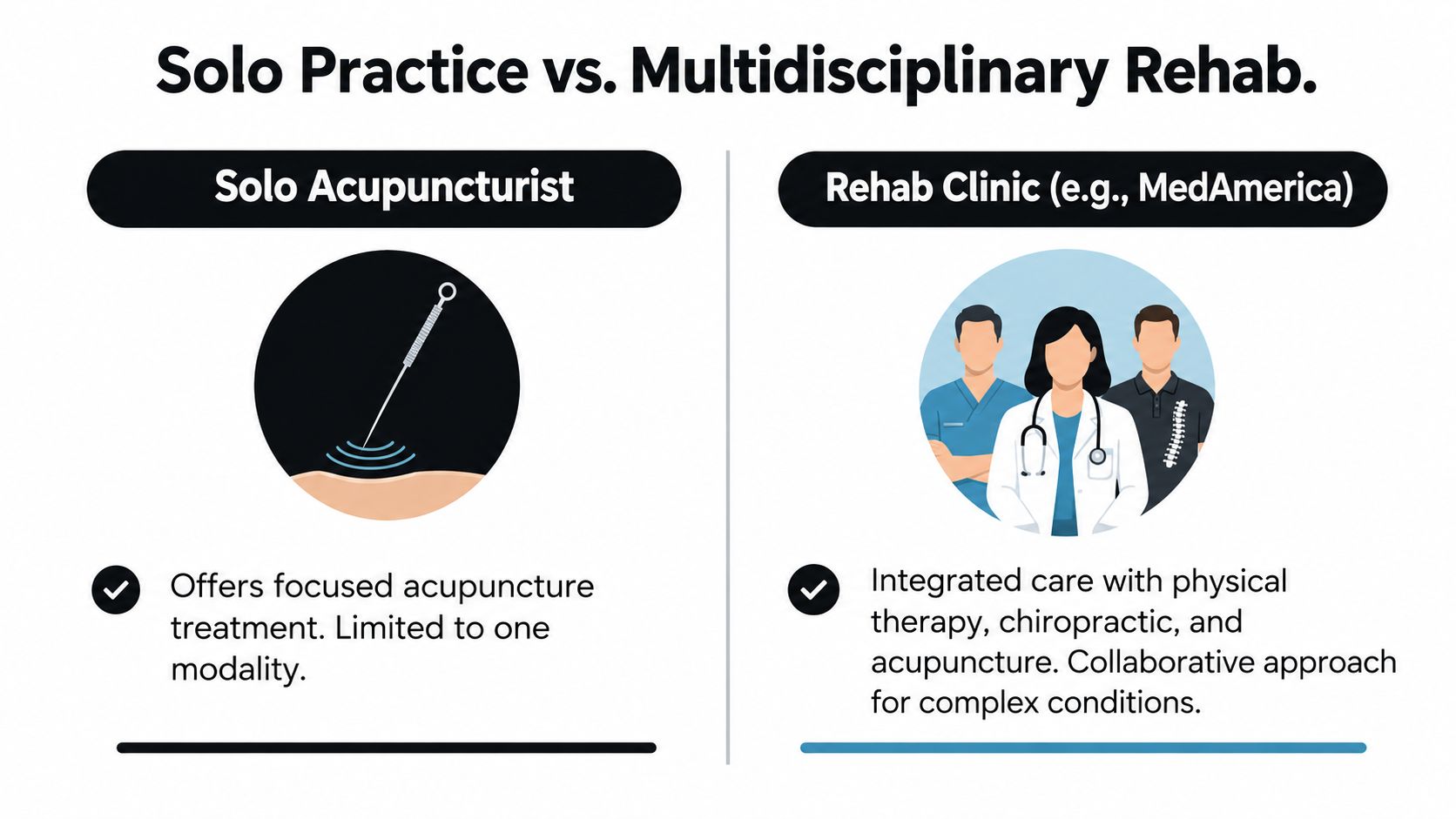
A solo acupuncture office and a multidisciplinary rehabilitation clinic can both provide acupuncture, but the surrounding care may look different. In a solo practice, the visit usually centers on acupuncture as the primary modality. That focused approach may suit someone who wants acupuncture alone and already has a separate plan for strength, mobility, or injury recovery.
A rehabilitation clinic can add other tools when the assessment shows that needles aren't enough. Someone with neck pain may need acupuncture for symptom relief, physical therapy for posture and endurance, and manual treatment for restricted movement. Someone with knee arthritis may need a combination of symptom management, strengthening, balance work, and advice about gradually increasing activity.
What coordination changes
When providers work in the same setting, they can align treatment goals more easily. The acupuncturist can understand which exercises a physical therapist is introducing, while the rehabilitation team can consider how the patient responds after acupuncture. That communication helps avoid treating pain in isolation from movement, strength, balance, or joint mechanics.
At MedAmerica Rehab Center, acupuncture is offered alongside physical therapy and chiropractic services. Patients considering coordinated care providers can ask whether a combined plan is appropriate for their diagnosis and goals.
A practical example is a patient with low-back pain who can't tolerate strengthening because every exercise increases muscle guarding. Acupuncture may help reduce that guarding temporarily. The physical therapist can then use the improved tolerance to work on mobility and trunk strength. The needle treatment doesn't replace rehabilitation. It can make rehabilitation more achievable.
The trade-off to understand
Integrated care isn't automatically better for every person. It may involve more than one type of treatment, and patients should know what each component is intended to do. A clear plan might identify acupuncture as a way to manage symptoms, physical therapy as the route to improved capacity, and chiropractic care as one option for addressing joint or movement restrictions.
Ask who will review your progress, how the providers communicate, and what happens if acupuncture isn't producing a useful change. Those questions help you choose care based on coordination and clinical reasoning rather than the number of services listed on a website.
Walking Through Your First Visit at MedAmerica Rehab
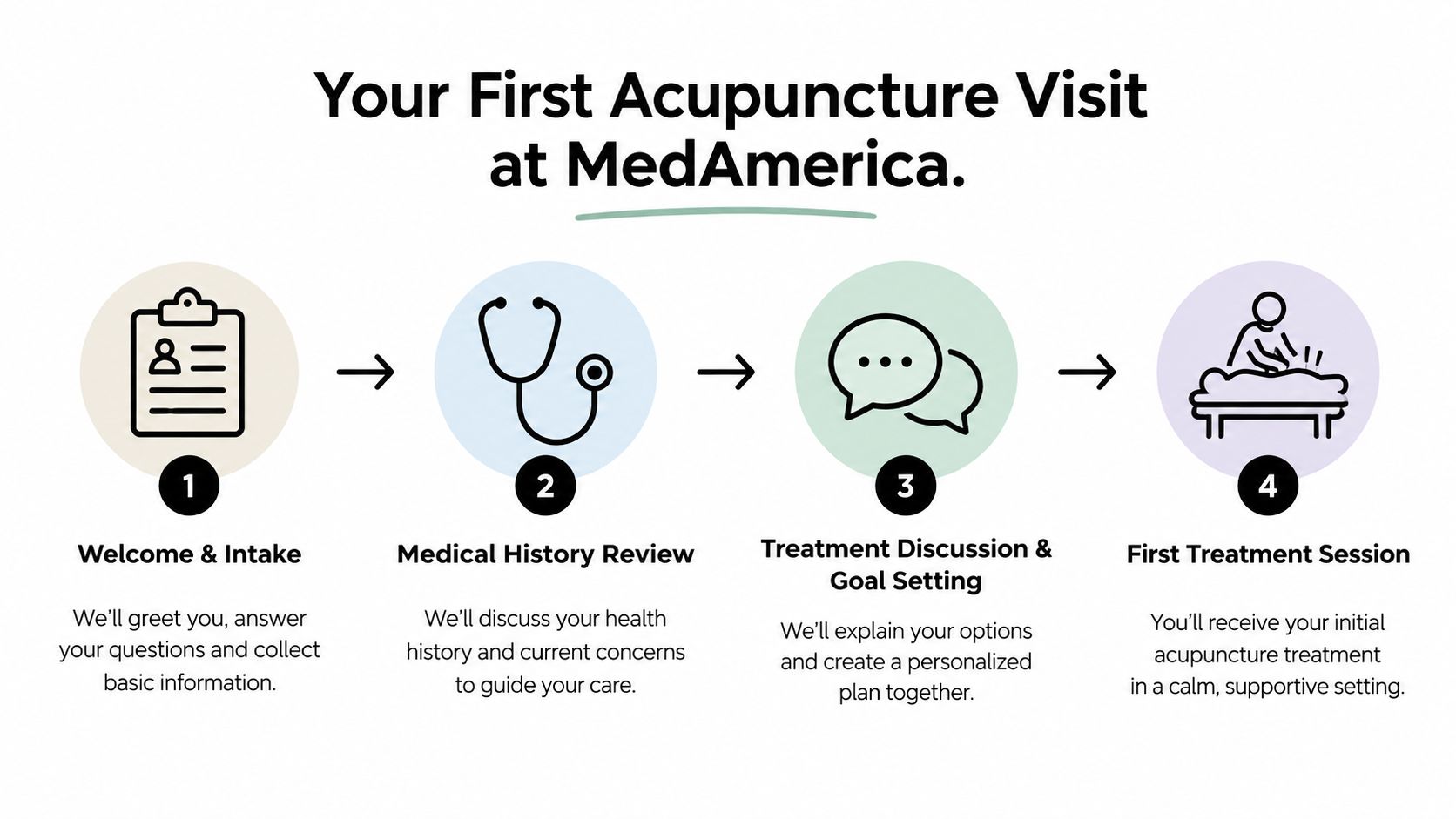
A first acupuncture visit should answer three questions before treatment begins: what is likely driving the symptoms, what does the clinician plan to treat, and how will you know whether the plan is helping? You won't need to arrive with a diagnosis in perfect medical language. Bring a clear description of what hurts, what aggravates it, and what you want to do more comfortably.
The conversation and assessment
The visit begins with intake and a review of your medical history. Tell the provider about medications, previous injuries, operations, relevant diagnoses, and treatments you've already tried. Mention changes in strength, sensation, balance, bladder or bowel function, fever, or unexplained illness, because those details may change whether acupuncture is appropriate.
The clinician will ask about the main complaint and may perform an orthopedic-style assessment. For neck pain, that could include observing how you turn your head, checking movement, and identifying areas of muscle guarding. For hip or back pain, the assessment may look at walking, bending, strength, and how symptoms travel into the leg.
Choosing points and preparing for treatment
After the assessment, the clinician should explain the treatment approach in plain language. They may describe which points they'll use, what sensations are normal, and how acupuncture relates to your functional goal. Clothing usually stays on when it allows access to the treatment areas. If a larger area needs to be reached, the clinic should provide appropriate draping or a gown and protect your privacy.
Treatment takes place on a comfortable table with sterile, single-use needles. Many patients feel a quick prick, then mild dullness, heaviness, warmth, or relaxation. A typical retention period is 15 to 30 minutes, although the exact timing depends on the plan and the patient's response.
Leaving with a plan
After the needles are removed, report how you feel before standing. Lightheadedness can occur, particularly if you've eaten very little or feel anxious around needles. The clinician may recommend hydration, ordinary activity, and avoiding an unusually demanding workout until you know how your body responds.
The follow-up plan should connect symptoms to function. Rather than promising a fixed outcome, the provider can discuss what change would justify continuing, whether acupuncture should be paired with exercises, and when the plan needs to be reassessed.
Safety, Side Effects, and When to Be Cautious
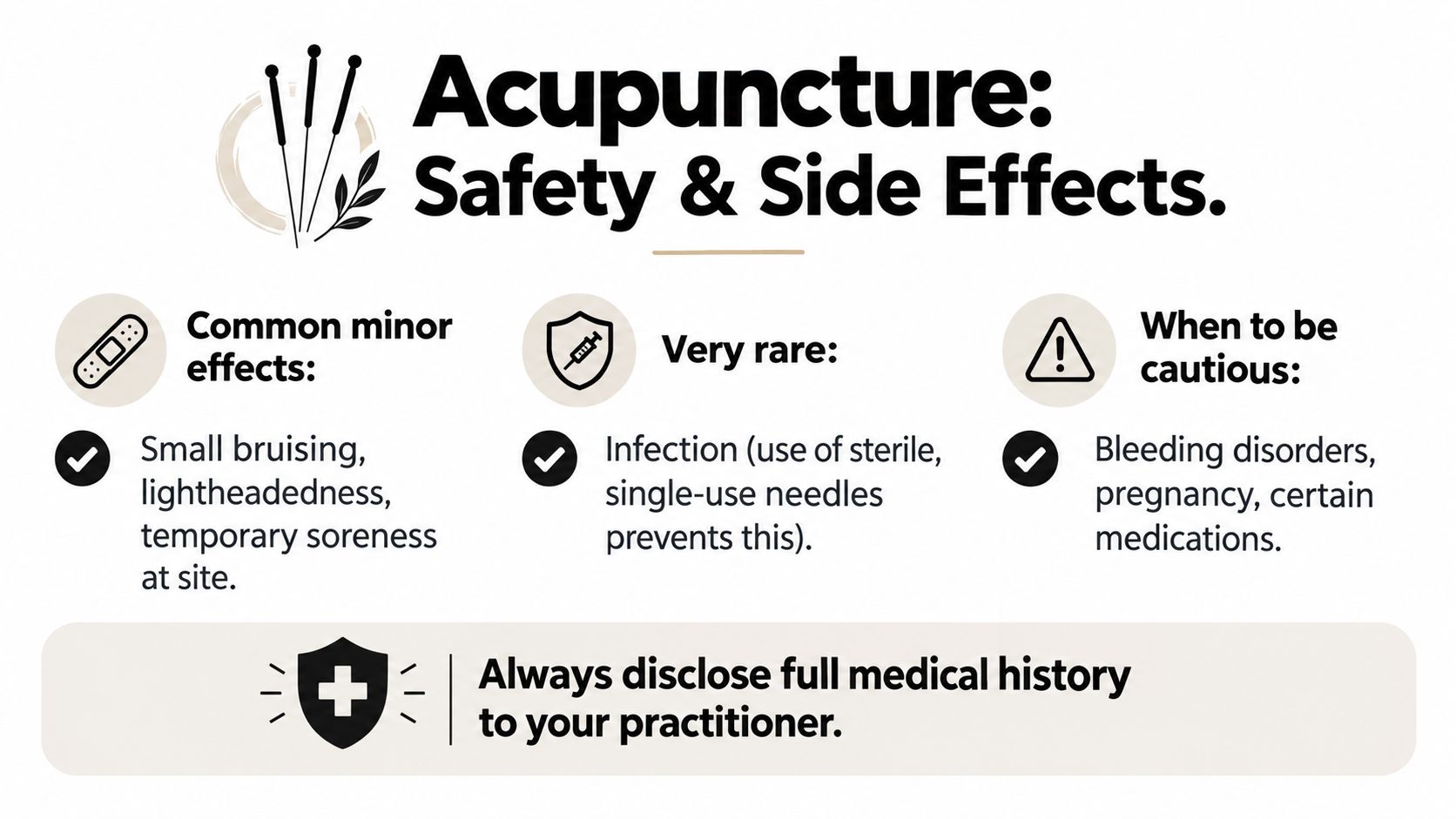
Acupuncture is generally considered low risk when performed appropriately, but low risk isn't the same as no risk. A systematic review estimated approximately 1.01 serious adverse events per 10,000 patients in an acupuncture series and 7.98 serious adverse events per one million treatments, while minor effects occurred more often, as described in the systematic safety review published in the National Library of Medicine.
Minor reactions can include a small bruise, temporary soreness at a needle site, mild bleeding, fatigue, or lightheadedness. These effects are usually short-lived, but you should tell the clinician if a reaction is severe, persistent, or unlike what you were told to expect.
Who should disclose extra information
Your health history helps the provider choose safer points and techniques. Speak up before treatment if you:
- Take blood thinners or have a bleeding disorder: You may bruise or bleed more easily, so the clinician needs to evaluate the risk.
- Are pregnant or could be pregnant: Some points and techniques may need to be avoided or modified.
- Have a weakened immune system: Infection prevention and treatment timing deserve special attention.
- Use a pacemaker or other implanted device: Certain electrical stimulation techniques may not be appropriate near the device.
- Have an open wound, rash, or skin infection: Needles shouldn't pass through compromised skin.
- Recently had surgery or suffered a significant injury: The treatment plan should respect healing restrictions and medical instructions.
Serious complications can include infection, fainting, or injury to deeper structures, although they are uncommon. Single-use disposable needles and appropriate clinical technique reduce preventable hazards. They don't remove the need for a proper assessment.
Before the first needle, disclose the full picture. Medication lists, pregnancy status, implanted devices, recent procedures, and skin problems can all affect treatment choices.
Seek prompt medical advice for symptoms such as sudden weakness, severe breathing difficulty, chest pain, or rapidly worsening neurological changes. Acupuncture shouldn't delay evaluation of an emergency or a condition that needs a different form of care.
Insurance, Booking, and the Deerfield Beach Advantage
The practical questions are often simpler than the coverage rules. Before scheduling, ask your insurer whether acupuncture is covered for your diagnosis, whether prior authorization is required, and whether the plan limits visits or applies a specific copay. Coverage can differ for regular health insurance, auto-related injuries, workers' compensation, and personal injury cases.
A short call can clarify the basics
Have your insurance card, referral information if you have one, and accident or workers' compensation details available. Ask the clinic whether it verifies benefits, what documentation it needs, and how billing works if your plan doesn't cover the service. Don't assume that a directory listing or a general benefit statement guarantees payment for your particular treatment.
Local listings can also create confusion. Healthgrades' Deerfield Beach acupuncture directory reports 145 acupuncture specialists within 10 miles, but a directory generally won't tell you which providers coordinate with rehabilitation, accept your insurance, or have an appointment that fits your schedule. Availability and treatment fit matter more than the size of a search result.
What makes local access useful
A nearby multidisciplinary clinic can reduce travel between appointments and make communication easier when more than one provider is involved. Patients in Deerfield Beach, Boca Raton, Lighthouse Point, and Pompano Beach can ask about scheduling acupuncture on the same day as physical therapy or chiropractic care, parking, language support, and appointment timing.
Same-day or next-day availability may be especially useful during an acute flare, but it should never replace appropriate screening. Describe the main problem when you call, ask whether an evaluation is needed first, and confirm what will happen at the initial visit.
Deciding Whether Acupuncture Fits Your Recovery Plan
Acupuncture may be worth discussing if pain has persisted, medication hasn't provided a satisfactory solution, or symptoms are preventing you from participating in rehabilitation. It can also appeal to active adults recovering from soft-tissue injuries, older adults managing arthritis symptoms, and people who want to explore non-drug options. The deciding factor isn't whether acupuncture sounds interesting. It's whether the treatment has a sensible role in your recovery.
Use these questions to prepare for a conversation with a clinician:
- Duration: How long have the symptoms been present, and are they improving, stable, or worsening?
- Function: Which activity has changed most, such as walking, sleeping, lifting, driving, or working?
- Previous care: What have you tried, and what helped even temporarily?
- Warning signs: Do you have new weakness, progressive numbness, fever, severe unexplained pain, or another symptom that needs medical evaluation?
- Treatment preference: Are you comfortable trying needles, and would you prefer acupuncture as an add-on rather than a stand-alone treatment?
- Goal: What specific change would make the treatment worthwhile for you?
A patient with chronic neck pain who can't tolerate strengthening may benefit from acupuncture as a bridge into physical therapy. A person with arthritis may use it to make walking and exercise more comfortable. Someone with worsening weakness or unexplained neurological symptoms needs assessment for the underlying problem before focusing on symptom relief.
The most useful plan assigns each treatment a job. Acupuncture may help regulate pain and muscle guarding. Physical therapy can build strength, mobility, balance, and confidence. Chiropractic care may be considered when joint or movement restrictions are part of the presentation. Combining services should be based on the evaluation, not on the assumption that more treatment is always better.
Call the clinic, describe your main complaint, and ask whether a combined physical therapy and acupuncture plan would be reasonable. That conversation gives you a low-pressure way to understand your options before committing to a course of care.
MedAmerica Rehab Center offers acupuncture alongside physical therapy and chiropractic care for Deerfield Beach patients managing pain and mobility limitations. Visit MedAmerica Rehab Center to learn about the clinic and request an appointment, then ask how acupuncture could fit your specific recovery goals.
MedAmerica Rehab · Deerfield Beach
Talk to a clinician about your pain
Physical therapy, chiropractic, acupuncture and shockwave therapy under one roof, since 1995. Same-day appointments are available.
Mon–Thu 8:00 AM – 6:30 PM · Fri 8:00 AM – 3:00 PM