
Total Knee Replacement Rehab Timeline: Milestones by Week
A search for a total knee replacement rehab timeline returns a tidy ladder of weeks, each rung labelled with what you should be able to do by then. Which raises the question those charts almost never answer. What are you supposed to do in the week your knee hasn't caught up?
The ladder is the wrong shape. Recovery from knee replacement runs as overlapping phases, and the useful milestones are ranges with a tolerance check attached, not deadlines. Once you accept that, six weeks becomes a checkpoint rather than a finish line, three months becomes the point where the work shifts from bending the knee to loading it, and six months becomes the point where most measures are back to where they were before surgery, with strength still climbing long after.
Read your own progress month to month. Read the numbers below as ranges. And keep one question in your pocket for every stage: is this slow, or is this a problem?
Total Knee Replacement Rehab Timeline at a Glance
The short version is that total knee replacement recovery is a six month curve inside a two year story. Most of the visible change lands in the first six months. Strength, balance and confidence keep filling in afterwards, sometimes for far longer than patients expect. None of that is slow. It's how healing tissue behaves.
Use the table below as your single lookup. Find your stage, read across, and note which milestones you've already met.
Total knee replacement recovery phases and milestones
| Stage | Typical timing | Milestone to check | What to expect |
|---|---|---|---|
| Hospital stay and first days | Day 0 to day 3 | Starts within hours of surgery; safe transfers and short walks with a walker or crutches | Pain and swelling are highest |
| Early recovery | Weeks 1 to 2 | Full knee extension and about 90 degrees of flexion | Outpatient physiotherapy often starts 1 to 2 weeks after discharge |
| Walking checkpoint | About 6 weeks | Two walking aids reduced to one; unaided walking may be attempted | Driving usually deferred at least 6 weeks |
| Structured rehab | Up to about 11 weeks | Strength, balance and weight-bearing functional exercises | Supervised programs often run two to three times a week |
| Return to work | 6 to 12 weeks | Ability to meet job physical demands | Depends on occupation |
| Low-impact activity | About 3 months | Cycling, swimming, walking or golf considered with clearance | High-impact running, jumping and pivoting need more caution |
| Plateau and consolidation | 3 to 6 months | Most measures back to preoperative level by 6 months, except knee flexion | Range of motion gains slow between 3 and 6 months |
| Strength and endurance | 6 months to 2 years | Muscle strength and proprioception continue improving | Individual variation with age, health and preoperative function |
How to read a ranges-based timeline
Three anchors do most of the work. Around six weeks, walking support usually drops and strength becomes the main thing your therapist measures. Around three months, low-impact activity such as cycling or swimming comes back into reach, with clearance. Around six months, most measured outcomes return to their preoperative level, with knee flexion the stubborn exception.
Between those anchors, progress looks lumpy. A strong week follows a flat one. A longer walk on Saturday can make Monday feel worse than Friday did.
Practical rule: judge yourself against a two week window, not a two day window. If the trend line is heading the right way, the timeline is doing its job.
What to do before your first appointment
Open the table on your phone and mark three things: the stage you think you're in, the milestones you've already hit, and the one that's lagging. That list turns your first appointment into a targeted conversation instead of a general once-over.
Keep one more expectation in mind from day one. A supervised program often runs two to three sessions a week through roughly eleven weeks, and many people keep a home program going well beyond that. Plan for the calendar to bend around swelling, work and sleep, not the other way around.
The First Six Weeks After Knee Replacement Surgery
Rehabilitation doesn't begin at your first outpatient visit. It begins within hours of surgery, once sensation and movement return to the leg, and the timing is deliberate. Moving early protects your independence and lowers the risk that comes from lying still. The Royal Orthopaedic Hospital's total knee replacement guidance places early mobilization at the front of the pathway, alongside swelling control and progressive knee range of motion.
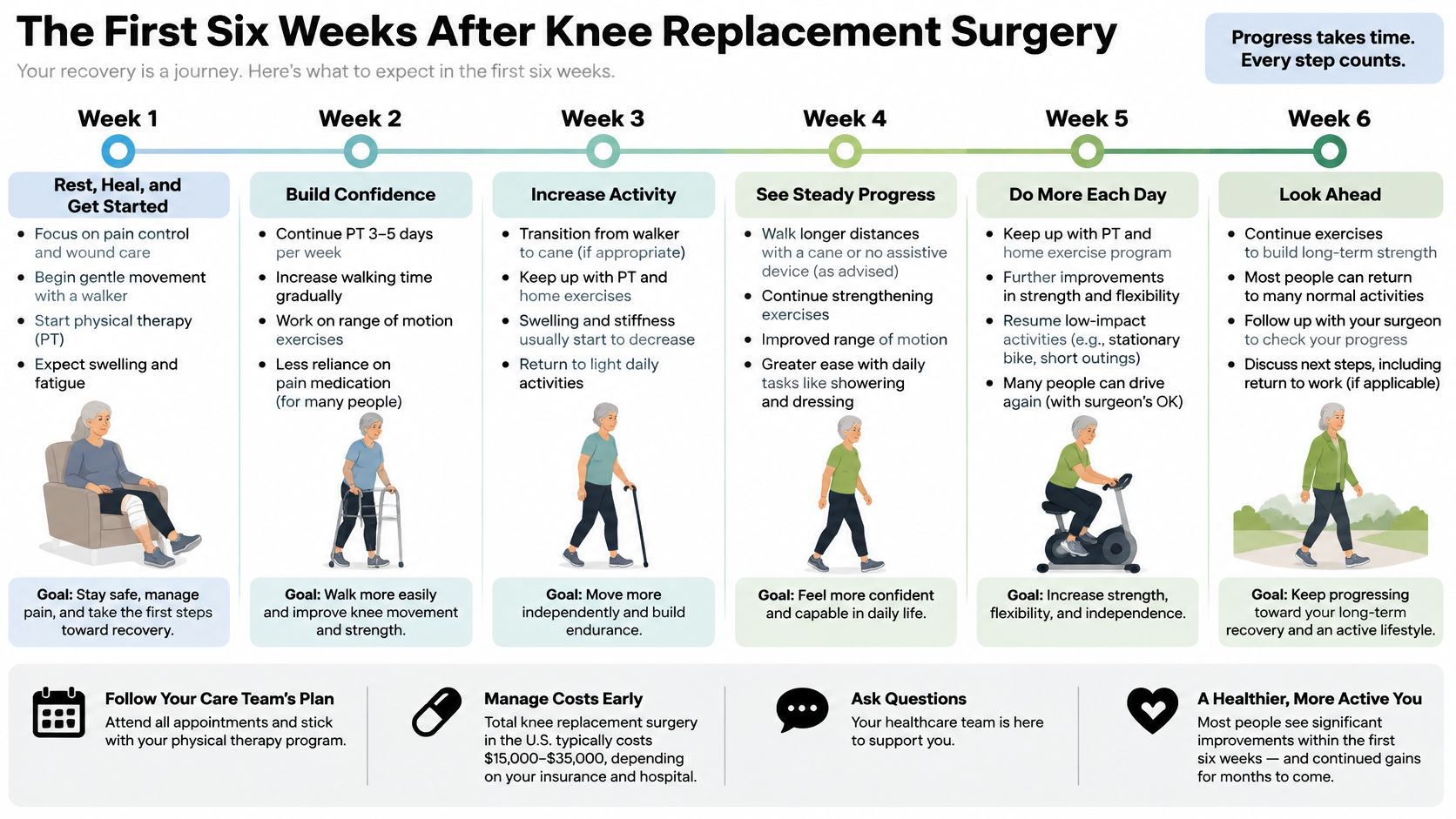
The infographic below maps that first stretch week by week.
The first three days, as a sequence of small wins
- Bed mobility first: rolling to the edge, sitting up, and standing with a frame before you take a single step.
- Transfers next: bed to chair, chair to commode, taught with the walker positioned so you aren't twisting the new knee.
- Walking third: short distances on crutches or a walker, heel landing first, the knee straightening as you pass through.
- Stairs when you're ready: up leading with the unoperated leg, down leading with the operated one.
- Quadriceps activation daily: quad sets and straight-leg raises, pressing the back of the knee down into the bed to wake the muscle that holds the knee straight.
Swelling control deserves its own routine rather than an afterthought. Ice through a thin barrier, raise the whole leg instead of wedging a pillow under the knee, and use whichever cold device you'll keep reaching for, such as a freeze sleeve for post-operative knee swelling, a commercial cold cuff, or a bag of peas wrapped in a towel.
The week two benchmark that matters most
By around the second postoperative week, the target is a fully straight knee and roughly 90 degrees of bend, provided you had comparable motion before surgery. The same hospital guidance is direct about what to do when that isn't happening: get clinically reassessed rather than pushing harder. A knee that won't bend usually has a reason, whether that's swelling, pain guarding, or a technique that needs changing rather than more repetitions.
Walking support typically steps down rather than disappearing. The move from two aids to one is common, and many attempt unaided walking at about six weeks.
Gait quality decides that step, not the date. If you're limping, hitching, or swinging the leg through, you're not ready, even if the calendar says otherwise.
Here's a short walkthrough of the early exercises that carry you through this phase.
What to confirm at the first outpatient evaluation
Your first visit is a working session, and at MedAmerica Rehab Center an initial physical therapy evaluation typically runs 60 to 75 minutes, so bring the list. Ask for your extension and flexion numbers in degrees rather than a general verdict. Ask someone to watch you walk and tell you what your gait looks like.
Confirm the swelling plan, the exercise dose, and whether you're cleared to drive. Get the answers written down, because the next six weeks are built on them.
Week Six to Week Twelve Strength and Return to Daily Life
Six weeks changes the question. It stops being can I walk and becomes how well am I walking, how far, and for how long. That's why this stretch is where therapy gets more demanding rather than less.
The photo below shows the kind of loaded work that starts showing up in programs around now, scaled to your knee's response.

Three questions that define your week six
Answer these and you'll know where you stand before anyone measures you.
- Can you straighten the knee fully, actively, without help? A knee that hangs a few degrees short alters your stride and loads the hip.
- Can you walk without an aid using a heel-to-toe pattern? If you're still reaching for furniture, gait work comes before distance.
- Can you stand from a low chair without pushing off with your hands? That single test reflects quadriceps strength better than most gym numbers.
Clinicians in a randomized trial of total knee arthroplasty patients tracked exactly these kinds of early achievements, including a straight-leg raise, progression from a Zimmer frame to two sticks, and independent stair climbing, then reassessed everyone at 6 weeks, 3 months and 6 months. One surgical approach produced straight-leg-raise achievement an average of 1.3 days earlier than the comparison approach, a reminder that your operating technique, not just your effort, shapes the early pace. The trial measured knee-extensor strength specifically at six weeks, which tells you what therapists consider the headline number at that checkpoint.
What structured rehab looks like from here
A rehabilitation-protocol review summarized in that same paper described an 11-week supervised program combining strengthening, weight-bearing functional exercises, balance work and agility activities two to three times weekly. Comparison protocols ran the same 11 weeks but progressed more cautiously, which is the useful part for patients: the length of the program is similar, the steepness of the ramp is what varies.
Hitting the six week checkpoint doesn't mean you're done. Endurance, strength, balance and confidence commonly keep improving through three to six months.
Two jobs, same week, different readiness
Say two people both reach week eight with the same knee. One works at a desk and can return as soon as sitting is comfortable and the commute is safe. The other works in a warehouse, a kitchen or a landscaping crew, on their feet, lifting, crouching, on concrete for eight hours. Return to work commonly falls somewhere between 6 and 12 weeks, and the deciding variable is the physical demand of the job rather than the date on the certificate.
Driving follows the same logic. It's usually deferred for at least six weeks and then requires medical clearance, adequate control of the pedals, and the ability to perform an emergency stop safely. A right knee tends to take longer than a left for obvious reasons.
What to ask before you book a return date
Bring your therapist the actual demands of your week, not a summary. Ask which activities are cleared now and which need a further review. If your walking pattern is the sticking point, ask specifically about gait training in physical therapy, because a normalized stride protects the rest of the chain when you go back to full days on your feet.
Then set a review date and leave with it written down.
Months Three to Six and Long-Term Loading
This is the stretch where patients get discouraged for no good reason. The rapid, visible gains of the first three months level off, and it can feel like the knee has stopped cooperating. It hasn't. It has changed jobs.
A longitudinal study of total knee arthroplasty patients tested people before surgery and then after, with average testing dates of 25.6, 92.2 and 186.8 days postoperatively. At one month, scores had dropped significantly from preoperative levels across every measured outcome, which is exactly what surgery, pain, swelling and reduced mobility produce. By six months, patients had recovered to their preoperative levels on all measured outcomes except knee-flexion range of motion.
What the plateau actually means
The same study found recovery wasn't uniform at all. Between three and six months, active knee flexion didn't improve significantly. Active extension, timed-up-and-go performance, stair climbing, six-minute walking distance and single-leg stance all reached a plateau during that window.
Read that as a change of assignment rather than a stall. The first month is about restoring movement and basic function. The first three months capture the major functional gains. What's left after that is strength, endurance, balance and the specific activities you want back, and those respond to loading rather than to more stretching.
The reframe that helps most: a plateau in motion is your cue to move the goalposts, not evidence that you've plateaued everywhere.
The loading rules that prevent flare-ups
Soft tissue healing inside the knee takes time, and loading it too fast has a predictable cost. NHS guidance on recovery after knee replacement describes healing within the knee as taking at least three months, notes that surrounding muscle strength can require as long as two years to normalize, and reports that most recovery happens in the first six months with continued improvement potentially lasting two years. The mechanism is straightforward: pushing walking distance and resistance up too quickly aggravates swelling, and swelling inhibits the quadriceps from firing.
What that looks like in practice:
- Start with short household walks and increase gradually after the first week rather than doubling distance because you feel good.
- Keep a prescribed home program for at least 12 weeks. Strength development typically needs three to six months of consistent exercise, not a heroic fortnight.
- Add load in small steps and check the knee the next morning. Swelling that's still up 24 hours later means the step was too big.
The activity ladder
Low-impact activity such as cycling, swimming, walking, golf or bowls is often considered around the three month mark, subject to your surgeon's and therapist's assessment. High-impact work, including running, jumping and pivoting sports, needs substantially more caution because it imposes much larger loads on the joint and the soft tissue around it.
Climb the ladder one rung at a time. Stationary bike before road bike. Pool before open water. Nine holes with a cart before eighteen on foot. Each rung gets a week of next-day checking before the next one.
What a session actually contains
Depending on the service, a visit can include manual therapy, strengthening exercises, hot or cold packs, electrical stimulation, stretching or an adjustment, and this phase usually leans hardest on the strengthening and balance side. If you want the exercise progressions laid out by phase, our guide to knee surgery recovery exercises follows the same immediate, early and strengthening structure used here.
Variables that change your pace
Age, general health, preoperative function, surgical factors and how consistently you take part in rehab all shift the curve. Two patients with identical operations can be three months apart in function and both be doing fine.
Close this phase with concrete steps. Record your measurable numbers so you can compare months rather than days. Ask your therapist for specific strength and balance goals instead of a general keep going. Write a weekly home plan on paper. Track how the knee responds the day after activity. And get surgeon clearance before adding any sport, so the decision is made on your knee rather than your patience.
Normal Variation and Warning Signs to Report
Here's the assumption worth dismantling: that total knee replacement rehab follows a fixed week-by-week schedule, and that being behind it means something has gone wrong. Recovery speed varies with age, medical conditions, preoperative function and early postoperative pain.
That variation is wide and documented. Research on variation in knee replacement rehabilitation notes that basic transfers, assisted walking and stair negotiation may return within one to two weeks, that range of motion can keep improving for three to six months, and that overall recovery may progress for roughly a year. Those are three different clocks running at once.
Where the fixed schedule breaks down
Anyone with arthritis elsewhere, obesity, diabetes, limited mobility before surgery, or a complicated early recovery will often move on a different curve. Generic timelines tend to make those patients anxious about falling behind and unrealistic about what next week should hold.
A better approach ties each milestone to a tolerance measure you can observe: pain, swelling, range of motion, how much medication you're using, and whether function is changing. Those five readings tell you more about your trajectory than any chart.
| Finding | Usually normal | Call your surgeon or therapist |
|---|---|---|
| Pain | Eases steadily over weeks and is controlled with prescribed medication | Pain that is getting worse, or spikes after activity and does not settle |
| Swelling | Fluctuates, often worse at the end of the day | Swelling that keeps increasing, or the knee is hot and red |
| Calf | Mild soreness during early walking | Calf pain, warmth or swelling in one leg |
| Range of motion | Gains slow after 3 months | Sudden loss of motion you previously had |
| Stability | Some unease on stairs in the early weeks | Knee giving way or feeling unstable |
| Fever or wound | A little warmth and pinkness at the incision edges that fades over days | Fever, or wound drainage or spreading redness |
Why more intensity isn't automatically better
Patients often assume the aggressive route buys a faster knee. The evidence complicates that. The same analysis of rehabilitation intensity found similar 12-month knee-flexion results between high-intensity and low-intensity programs, which supports pain-guided, individualized progression over a hard push for every patient.
That's liberating if you've been white-knuckling it. It's also a warning against treating soreness as a scoreboard.
When you're deciding whether to call or wait, ask one question. Is the pain and swelling trending better over days, and does that trend match what your team told you to expect? A trend that moves the right way earns patience. A trend that breaks the pattern earns a phone call, and calf pain, fever, wound drainage, spreading redness or a knee that gives way earns one the same day.
Confirm Your Rehab Timeline With Your Surgeon and Therapist
Bring the phase table to your next appointment. Mark your current week, the milestones you've met, and how pain and swelling have trended over the last fortnight. That single page turns a vague check-up into a real review.
Then work through four questions.
- Which activities are cleared right now, and which need a further review before you try them.
- When can I drive and when can I return to work, based on my specific knee and job rather than an average.
- Is this knee on track for its current phase, or does something need reassessing.
- When is the next formal review, so progress has a date attached to it.
Expect the team to estimate how many sessions you'll need after the initial evaluation, and expect sessions to land at one to three times per week. MedAmerica Rehab Center supports pre- and post-surgical recovery, balance and gait training and fall prevention, so ask about a program matched to the phase you're in. Ask for the plan, the home exercises and the next review date to be written down, so you leave with a dated checklist instead of a general impression.
Three things to carry out of here. Recovery runs in overlapping phases, not fixed weeks. The milestones are ranges, and being at the slow end of a range is not the same as failing. And the warning signs worth a same-day call are the ones that break your trend rather than the ones that merely annoy you.
MedAmerica Rehab Center builds post-surgical programs around your knee's current phase, with hands-on therapy, progressive strengthening, balance and gait training, and fall prevention for people recovering from joint replacement. Our team treats recovery as a progression rather than a fixed calendar, and we'll set milestones against what your knee tolerates this week. Visit MedAmerica Rehab Center to schedule your evaluation and start with a plan that matches your stage.
MedAmerica Rehab · Deerfield Beach
Talk to a clinician about your pain
Physical therapy, chiropractic, acupuncture and shockwave therapy under one roof, since 1995. Same-day appointments are available.
Mon–Thu 8:00 AM – 6:30 PM · Fri 8:00 AM – 3:00 PM