
30 Second Chair Stand Test: Scores and How to Run It
If someone finishes 12 stands, is that a strong result, a weak one, or just a number that depends on the chair? A single count from the 30 second chair stand test only means something when the setup stays the same. Age, sex, seat height, arm use, and pain can all move the score without any real change in leg strength.
What the 30 Second Chair Stand Test Measures
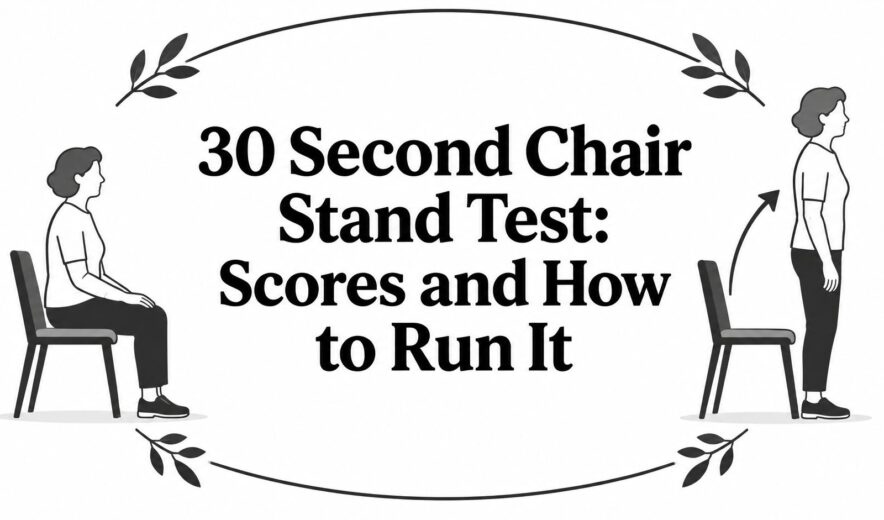
Picture a sturdy chair, a stopwatch, and a person who stands all the way up, then sits all the way down, again and again until 30 seconds run out. The score is not how fast the first stand looks. It is how many full sit-to-stand repetitions that person can finish before the clock stops. That makes it a test of repeated lower-body strength under time pressure, not a simple walking-speed check.
Older chair-rise tests timed how long it took to complete 5 or 10 stands. Jones and colleagues, writing in 1999, introduced the 30-second count as a practical alternative. Those shorter tests could create a floor effect: an adult with substantial lower-limb weakness might not finish the required stands, so the test could not separate one low score from another. Counting as many stands as possible in a fixed half-minute still gives that person a number.
That early validation work reported reliability coefficients from 0.84 to 0.92, and correlations of about 0.71 to 0.78 with laboratory measures of lower-extremity strength. You need almost nothing beyond a firm chair and a timer. Clinics use it in rehabilitation, geriatric assessment, and fall-prevention screening because it captures repeated transitional movement on a fixed clock. When the same chair, the same arm rule, and the same instructions are used again, a later change in the count can carry meaning. The useful next questions are which scores sit below average, how to run the test, what typical counts look like, when a change is real, and what can distort the result.
How to Run the Test Step by Step
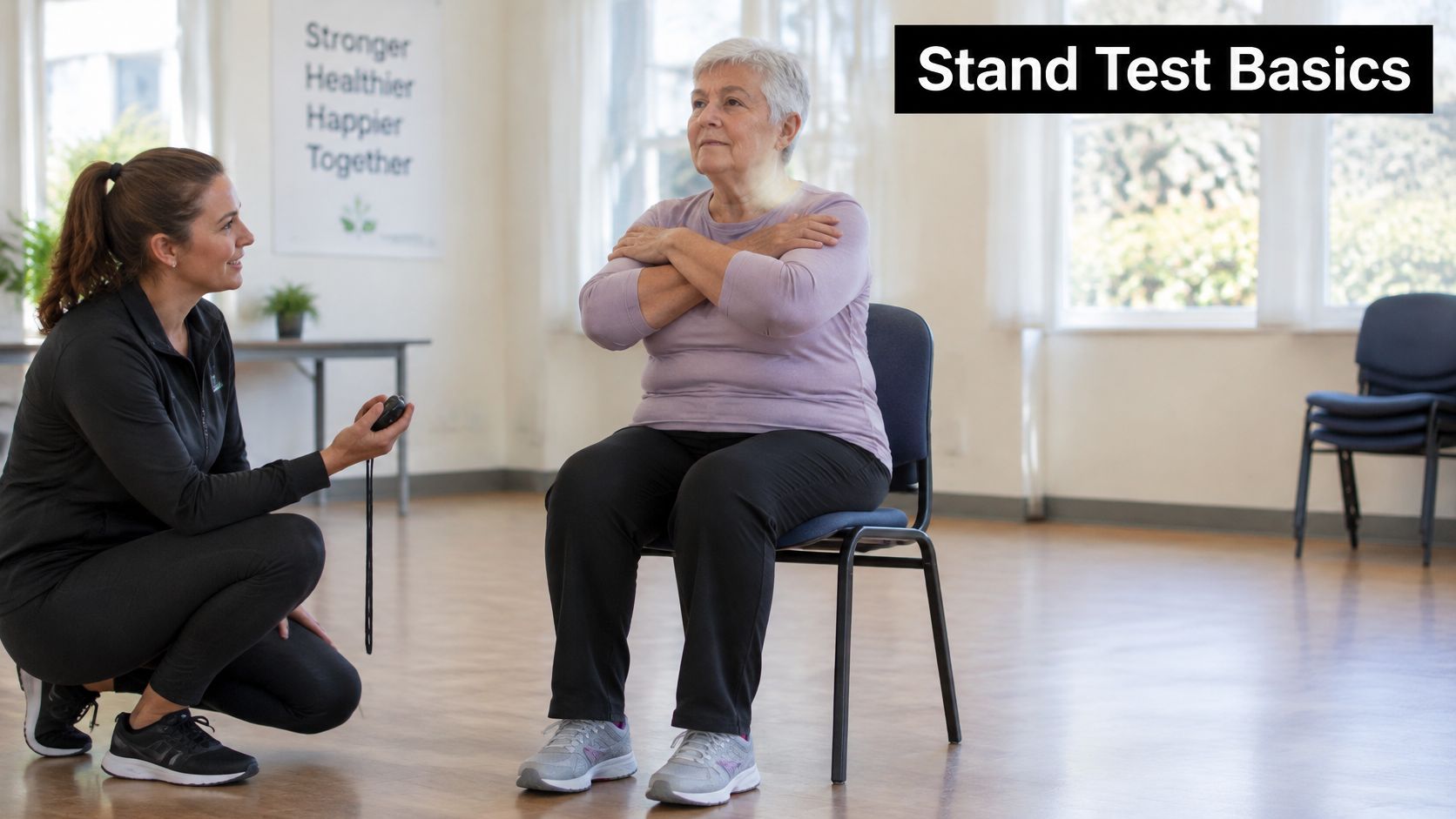
The NIH common data element form for the 30-second chair stand treats this as a standardized lower-extremity functional-power assessment. The adult sits mid-seat, back straight, feet flat, arms crossed over the chest, then rises to full standing and returns to sitting for 30 seconds. A repetition counts if the person is more than halfway upright when time expires. If they cannot stand without using the arms, stop and record zero.
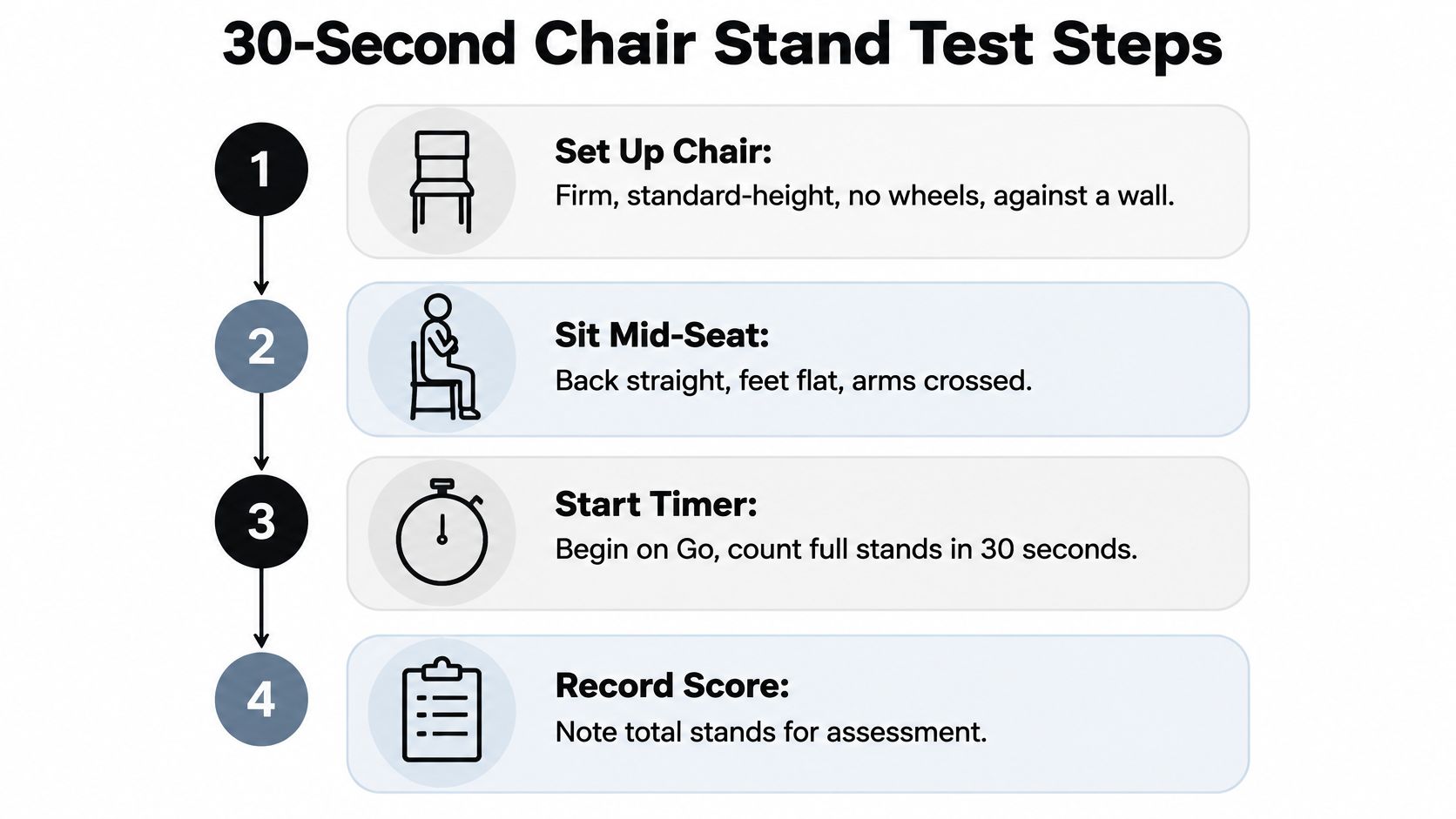
- Set the chair so it cannot move. Use a firm chair of standard height with no wheels, and place it against a wall. A sliding or tilting seat changes the effort and can turn a strength test into a balance scare.
- Seat the person in the middle. Back straight, feet flat, arms crossed over the chest. Crossing the arms keeps the legs doing the work. Pushing off the thighs or armrests makes the stand easier and breaks the comparison.
- Guard without helping. A clinician stands close enough to catch a loss of balance, because a fall is the main safety risk. Helping on the way up turns the score into a two-person lift.
- Start on "go" and count full cycles. Start the timer with the command, and count each full stand plus the return to sitting. Partial rocking at the start does not earn a point.
- Apply the halfway rule at the buzzer. If the person is more than halfway upright when 30 seconds end, count that stand. If they are still low in the seat, leave it out.
- Stop and score zero if the arms are required. Inability to stand without the arms is both a safety stop and a sign of impaired functional strength. Do not "let them finish" with a hand on the knee and then compare that count with an arms-free score.
- Write down the setup, then repeat it. Note chair height, arm use, pain, balance loss, and any rocking or momentum. A later test only reflects rehabilitation when those conditions match.
Before you start, press on the seat and nudge the chair. If it tips, sinks, or rolls, pick another one. Footwear should be the shoes the person walks in, not socks on a slick floor.
A short demonstration helps more than a long speech. Show one stand, then let the person practice a single rise if they are steady enough to do it safely. Say the rules out loud: full stand, full sit, arms stay crossed, stop if you feel sharp pain, dizziness, or like you might fall.
Watching the timing once is often clearer than reading it. This clip shows the pace and the full stand clinicians are counting.
Practical rule: Same chair, same arm rule, same shoes. If any of those change, you are not comparing two scores. You are comparing two tests.
Below-Average Cut-Offs for Adults 60 to 94
A 67-year-old man who finishes 11 stands and a 67-year-old woman who finishes the same 11 stands do not get the same reading. He is below average. She is not.
For community-dwelling adults, a score is flagged as below average only when it falls under the number in that person's age-and-sex row. A score equal to the number is not flagged. The bands run from 60–64 through 90–94. Those thresholds come from the community-dwelling norms reported by Jones and colleagues in 1999.
| Age band | Men: below average if fewer than | Women: below average if fewer than |
|---|---|---|
| 60–64 | 14 | 12 |
| 65–69 | 12 | 11 |
| 70–74 | 12 | 10 |
| 75–79 | 11 | 10 |
| 80–84 | 10 | 9 |
| 85–89 | 8 | 8 |
| 90–94 | 7 | 4 |
He sits in the 65–69 row, where men are below average under 12, so 11 is flagged. She meets the women's line of 11, so she is not flagged. Sex is part of the reference. That is why one count splits into two readings.
Why the row matters more than a round number
The lines fall with age. By 90–94, the below-average mark is under 7 stands for men and under 4 for women. A single "12" works like one shoe size handed to every person in a waiting room. A 62-year-old man at 13 stands is under his row. A 92-year-old man at 8 stands is not under his.
These figures describe community-dwelling adults tested in a standard setup, not someone at the bedside or in the first days after surgery. A lower chair makes each rise harder, so a count that looks fine against the table can be a weaker performance, and a higher chair can inflate it. Pain, a new joint, and hospital fatigue pull the number down the same way. Hold age, sex, chair height, and pain constant, or the cutoff is answering a different question than the one you asked. A low result is a prompt to look at strength, gait, balance, and symptoms next to the score. The score alone does not prove a diagnosis.
Typical Scores by Frailty Status and Age
Averages are reference points, not targets. The ± figure is the standard deviation, a measure of how spread out scores are around the average. A wider spread means people in that group can score quite differently.
| Group | Participants | Average repetitions ± SD |
|---|---|---|
| Healthy older adults | Not reported | 22 ± 7 |
| Pre-frail older adults | Not reported | 15 ± 5 |
| Frail older adults | Not reported | 6 ± 1 |
| Men aged 20–59 | 200 | 24.2 ± 6.3 |
| Women aged 20–59 | 200 | 22.6 ± 6.2 |
| Men aged 60 and older | 150 | 18.3 ± 6.0 |
| Women aged 60 and older | 150 | 15.9 ± 5.1 |
Frailty groups sit far apart
A study of older adults summarized in work indexed by PubMed Central reported averages of 22 ± 7 repetitions for healthy participants, 15 ± 5 for pre-frail participants, and 6 ± 1 for frail participants. The differences between groups were statistically significant at p ≤ 0.001. Participant counts for these categories are not reported in the summary, so use the figures as group averages, not as expected scores for every person.
The overlap matters: with a healthy-group average of 22 and a spread of 7, a score of 15 can still occur in that group. A score near the frail-group average of 6 may prompt a closer look at functional reserve, but the chair stand count alone cannot assign someone a frailty label.
Age and sex shift the middle
A normative study of healthy adults aged 20–59 reported averages of 24.2 ± 6.3 for men and 22.6 ± 6.2 for women, with 200 participants of each sex. In a separate older-adult reference group, the averages were 18.3 ± 6.0 for men and 15.9 ± 5.1 for women aged 60 and older, with 150 participants of each sex. These figures come from different reference groups, so they should not be treated as a direct comparison of the same people as they age.
The setup also shapes what a score means. Chair height, arm use, pain, balance, joint limits, and instructions can change the count. For a goal of completing more stands, leg-strengthening exercises for seniors may support practice, while repeated scores are most useful when the test conditions stay consistent.
Knowing When a Change Is Real
For one person, an improvement of about three stands is the point where clinicians can trust that the gain beat measurement noise. Smaller bumps can be a good sign. They are not yet a confirmed change.
A reliability study covered by the Annals of Geriatric Medicine and Research found intraclass correlation coefficients above 0.90, which is excellent test–retest reliability. The individual minimal detectable change was about 2.5 stands. Group-level change could be as small as 0.3 to 0.4 stands. Across a treatment cohort, a tiny average shift can still matter. For the person in front of you, you generally want about three more repetitions before you call the progress larger than noise.
Ordinary aging is not a sudden crash
Norms also fall with age, and they differ by population. Greenland data in that same report put means at 15.1 repetitions for men and 12.7 for women aged 55–64, then 10.7 and 9.2 at ages 75–84. A loss of a few stands across a decade can be ordinary aging in that reference group. It is not, by itself, proof of a sharp new decline. Age- and sex-referenced reading beats one cutoff for every adult.
A simple retest routine
- Baseline first: Record the first score with symptoms and the functional goal, such as getting off the toilet without a push.
- Match the conditions: Same chair, same arm rule, same footwear at follow-up.
- Read the gap: A gain under about three stands is possible progress. It is not yet a change you can separate from noise.
- Don't stop at the number: A score under the age-and-sex line should trigger a wider look at strength, gait, balance, pain, and medication risk. Gait speed and fall risk often belongs in that same visit. The chair count is not a stand-alone diagnosis.
About three more stands, on the same setup, is the individual change you can trust. Less than that may still be heading the right way.
What Skews a Score Before You Read It
Would the same legs produce the same count on a different chair? Often no. Seat height, armrests, footwear, supervision, and whether momentum is allowed all change the work. Keep that setup fixed, or you are not reading one fact.
Reference testing in healthy young adults did not adjust chair height for body height or leg length, even though seat height is already known to influence performance. A lower chair or a higher one can move the score with no real change in leg strength. A soft sofa cushion one week and a firm clinic chair the next can manufacture a "gain" or a "loss."
Scoring cut-offs also vary between populations and clinical settings, so a single universal cutoff can oversimplify risk. Age, sex, chair height, and pain each change the count. Ignore those, and one cutoff can mislabel risk.
Write down the deviations before you judge the number: chair, arms, shoes, momentum, pain. After surgery, injury, or a hospital stay, compare the person with their own earlier score on the same setup. Generic online norms are the weaker comparison.
Where the Test Falls Short
Does one stand count equal leg strength? Only when the setup stays the same. A kitchen scale reads differently on a soft mat than on a hard counter, even when the flour has not changed. Age, sex, chair height, and pain shift this test the same way. One cutoff that ignores those four can mark a capable person as weak, or wave through someone who is struggling.
Calling it a pure lower-body strength test oversells it. In adults with severe mental disorders, correlation with an objective lower-limb strength reference was only moderate, r = 0.56 and ICC = 0.54, according to a PubMed Central report on that group. The authors cautioned that results from stable outpatients may not generalize to acute psychiatric or older groups. A moderate link means balance, effort, and the words you used are still inside the number.
On a hospital ward, a modified version has followed in-hospital function more closely than hand-grip strength, and it has lined up more closely with later mortality. That came from a selected group who could be tested, so it does not describe every ward. A fixed five-stand test can be impossible when someone is acutely ill, which is part of why a timed count exists. The 30-second format can still bottom out. A zero from needing the arms means the standard test was too hard. It does not say how many assisted stands that person might manage.
What a low or higher score does not prove
A low score is not automatic proof of isolated quadriceps weakness. A higher score does not prove fall risk is gone. Pain, balance, cognition, fatigue, fear of falling, chair mechanics, and coaching all pull on the result. Pair the count with gait, balance, symptoms, and daily tasks. How much of the body is muscle is a separate question. Telomyx Manchester looks at body composition, not at this stand count.
Stop the repeated stands when they are unsafe:
- Pain: Sharp or rising joint pain, not ordinary effort.
- Dizziness: Light-headedness or a sense the room is moving.
- Instability: A grab, a side step, or a near fall.
Switch to an adapted protocol, or stop, instead of pushing for a prettier number.
Decide Whether to Get a Professional Assessment
Consider a professional assessment if repeated tests fall below the cut-off for your age and sex, you cannot stand without using your arms, or pain, dizziness, or unsteadiness occurs during the test. It may also help while recovering from surgery, an injury, or a hospital stay. One low score is less informative than a pattern.
Bring your dated scores and note the chair height, footwear, whether you used your arms, and any pain. These details help a clinician compare results on the same setup rather than relying on memory. At MedAmerica Rehab Center, a clinician can repeat the test and assess balance and gait. The fall risk assessment for older adults can add a broader view when the chair count is only one part of the picture. Same-day appointments are available. After the initial evaluation, the team may be able to estimate how many sessions will be needed.
Chair fitness is one snapshot of how you move, not a complete measure of aging. For a broader perspective on that topic, see the REVETIX guide to biological age. Wear comfortable clothes and shoes, such as gym clothes and shoes, to your appointment.
A useful assessment starts with a fair repeat and considers what else may affect the score. MedAmerica Rehab Center in Deerfield Beach includes the 30 second chair stand test in fall-prevention, balance, and post-surgical care. If your scores are dropping, painful, or hard to compare because the setup changes, bring them in for assessment. Visit MedAmerica Rehab Center to learn more.
MedAmerica Rehab · Deerfield Beach
Talk to a clinician about your pain
Physical therapy, chiropractic, acupuncture and shockwave therapy under one roof, since 1995. Same-day appointments are available.
Mon–Thu 8:00 AM – 6:30 PM · Fri 8:00 AM – 3:00 PM