

Coordinated Care Providers: A Guide to Better Healing
You wake up already behind. There's a follow-up with the orthopedist, a physical therapy visit later in the day, and a question about whether the medication you started last week is supposed to make you this tired. One office tells you to rest. Another says keep moving. A third asks you to bring records you assumed had already been sent.
If you're recovering from a back injury, surgery, arthritis flare, or car accident, this kind of confusion can drain as much energy as the condition itself. Many people aren't just trying to heal. They're also trying to act as the scheduler, messenger, historian, and problem-solver for their own care.
That's where coordinated care providers come in. When care is coordinated, your treatment stops feeling like separate conversations happening in separate buildings. It starts feeling like one plan, guided by a team that knows what the others are doing and why.
The Problem with Disconnected Healthcare
A lot of patients describe the same feeling in different words. “I'm tired of repeating myself.” “Why am I getting different advice?” “Who's in charge?” Those questions usually show up when care is fragmented.
Say you hurt your neck in a car accident. You see one doctor for imaging, another provider for pain, and a therapist for movement. Each visit may be helpful on its own. But if those providers don't communicate well, you can end up carrying the whole system on your back.
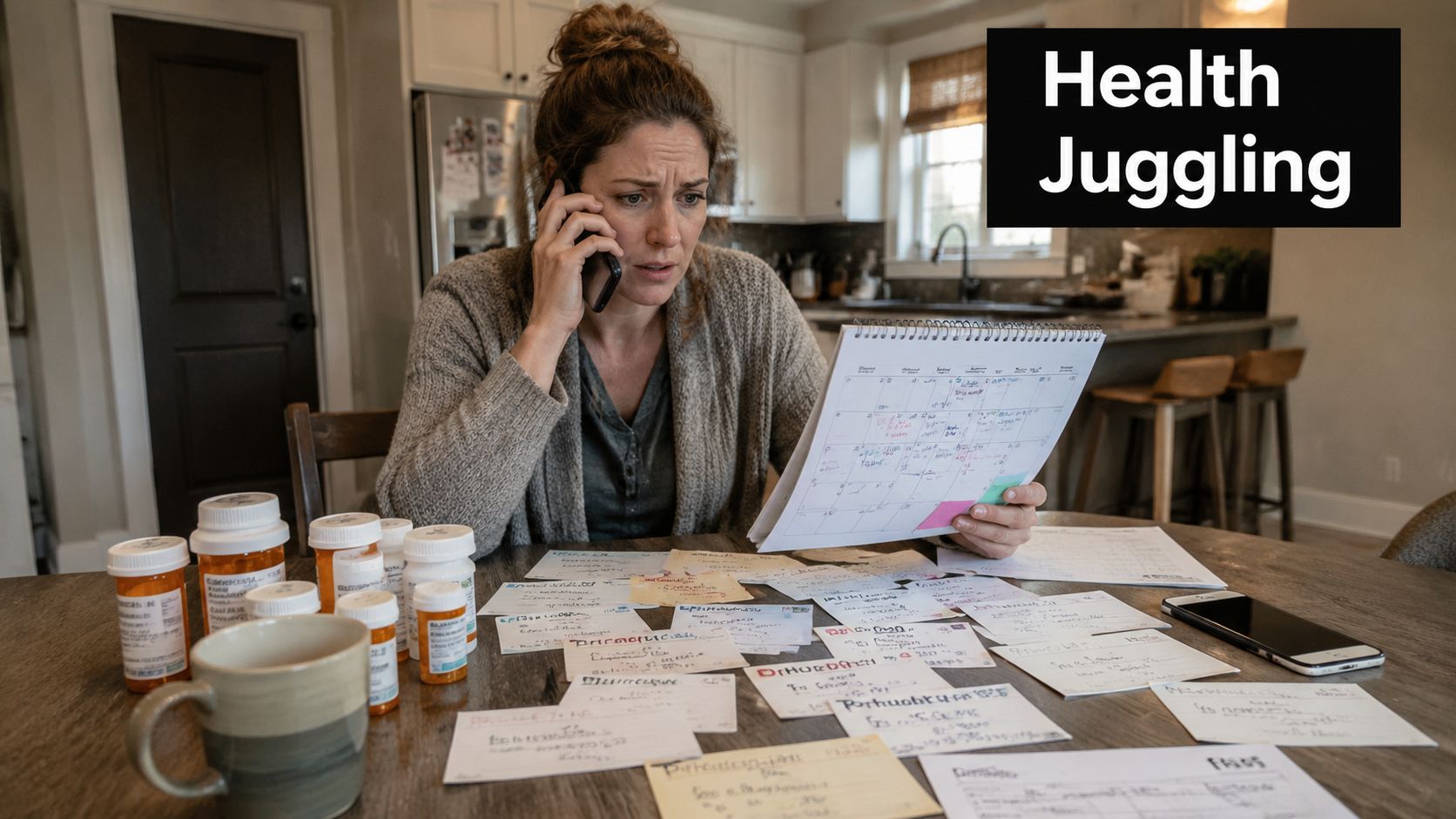
What fragmentation feels like to a patient
In real life, disconnected care often looks like this:
- You retell your story every visit: The same injury timeline, the same symptoms, the same list of medications.
- You get mixed instructions: One provider says avoid activity. Another wants aggressive rehab. You're stuck trying to sort it out.
- You waste time on admin: Calling offices, requesting notes, checking referrals, and chasing paperwork.
- Your recovery feels less clear: You know you're getting treatment, but you don't know how the pieces fit together.
When patients have to coordinate their own care, treatment can feel less safe and less predictable. That matters even more if pain is affecting sleep, work, driving, or basic daily tasks.
Patients often don't need more appointments. They need the appointments they already have to connect.
Why this matters for healing
Recovery usually works best when each provider builds on what the last one learned. If that handoff doesn't happen, you get delays, duplicated effort, and more uncertainty than you need.
For a rehab patient in Deerfield Beach, this can be the difference between feeling supported and feeling stranded. The concept of coordinated care isn't abstract when you're the one trying to decide which advice to follow before your next visit. It's personal, practical, and tied to whether your day feels manageable.
What Are Coordinated Care Providers
Coordinated care providers are healthcare professionals who work as a connected team instead of as separate silos. They share information, align treatment goals, and help the patient move through care with less confusion.
A simple analogy helps. Think of a home renovation. You might need an electrician, plumber, tile installer, and painter. If each one shows up without speaking to the others, the project gets messy fast. A general contractor keeps everyone on the same plan, in the right order, with the same end goal.
Healthcare works the same way.
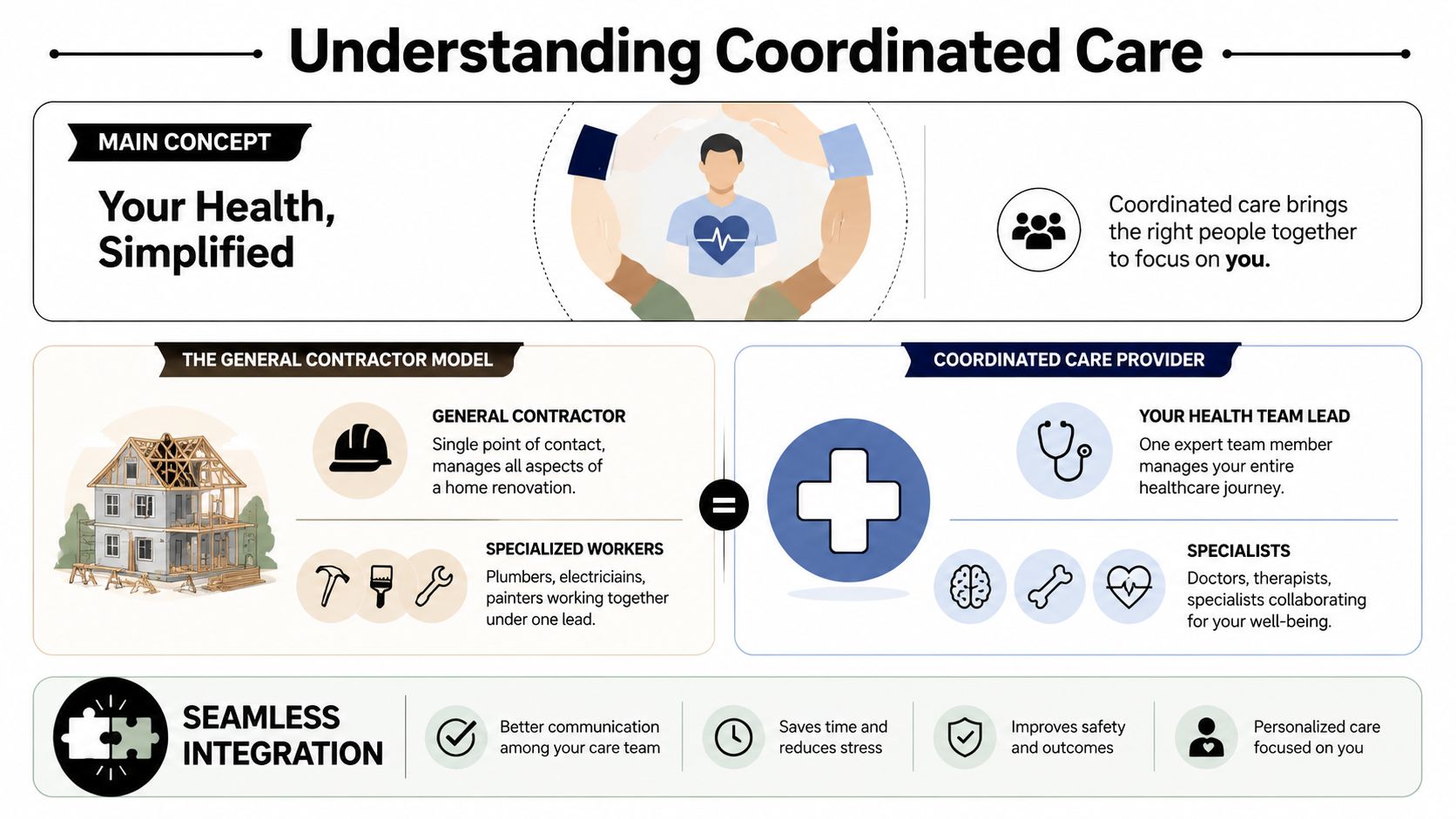
The health version of a general contractor
In coordinated care, one team helps organize the moving parts of your treatment. That may include your physician, physical therapist, chiropractor, specialist, and support staff. Instead of each person working from a partial picture, they work from a shared understanding of what's happening.
This model matters because many patients aren't dealing with just one simple issue. A Consensus Health review of care coordination best practices reports that 23% of patients with a chronic illness saw four or more doctors in the prior year, and 46% took four or more prescriptions regularly. The same review explains that patients with multiple clinicians and medications face higher risk of duplicated tests and conflicting treatment plans unless one team actively organizes information across settings.
That's why coordinated care isn't a luxury. For many patients, it's the difference between a plan that makes sense and a pile of instructions that don't.
What patients usually get wrong about the term
Many people hear “coordinated care” and assume it just means a referral network. It's more than that. A referral is one handoff. Coordination is what happens before, during, and after the handoff.
A coordinated team often does things like:
- Share updates across visits: So your treatment doesn't restart from zero each time.
- Compare recommendations: So your exercise plan, pain plan, and daily activity guidance work together.
- Track follow-through: So missed steps don't derail progress unnoticed.
- Support communication outside the exam room: Good outreach matters too. Thoughtful systems like those discussed in Call Loop's guide on patient engagement can help patients remember appointments, understand next steps, and stay connected between visits.
A short explainer can help make the model easier to picture:
Practical rule: If the patient is the one connecting all the dots, care probably isn't coordinated enough.
How Multidisciplinary Coordination Works in Practice
On the ground, coordinated rehab is less about buzzwords and more about workflow. The team gathers the same story, builds one working plan, and updates it as your body responds.
For example, a physical therapist may focus on movement quality, strength, walking tolerance, balance, and how pain changes during activity. A chiropractor may focus on joint motion, spinal mechanics, and how alignment issues affect movement and nerve irritation. An acupuncturist may focus on pain modulation, inflammation, and helping a patient calm down an overreactive pain cycle. These roles are different, but they shouldn't compete.
One evaluation, one direction
A well-coordinated setup usually starts with a broad evaluation instead of isolated opinions. The point isn't just to identify what hurts. It's to understand how the pain affects sleep, driving, work tasks, lifting, stairs, and confidence with movement.
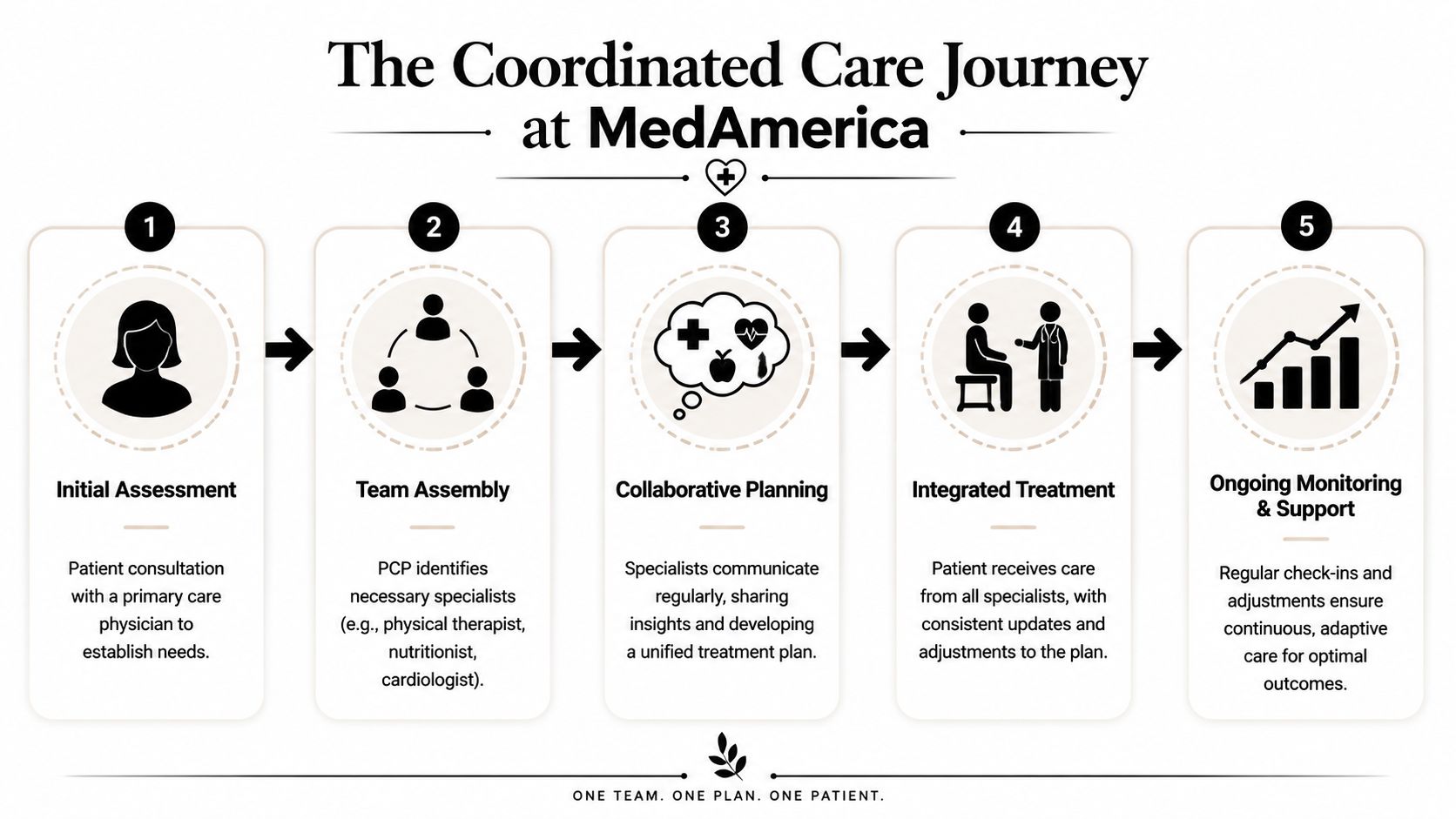
From there, the team can shape a unified treatment plan. That plan may include hands-on therapy, guided exercise, activity modification, pain-relief strategies, and clear home instructions. If one part changes, the others should know.
Here's what that often looks like in practice:
- Initial assessment: Someone gathers the full story, not just the symptom of the day.
- Shared treatment goals: The team agrees on what matters most, such as walking without limping or returning to work safely.
- Role clarity: Each provider knows where they add value.
- Progress reviews: The plan changes when your response changes.
The technology piece patients don't always see
Good coordination depends on communication, but it also depends on systems. The U.S. Office of the National Coordinator for Health Information Technology explains how health IT supports care coordination. Its guidance notes that shared electronic health records help reduce care fragmentation by allowing authorized providers to access the same current patient data, update care plans in one place, improve information sharing, and support proactive patient management.
That matters because it cuts down on guesswork. A provider doesn't have to rely only on what the patient remembers from the last office. They can review current notes, medication lists, testing, and plan changes.
When every provider sees the same current plan, the patient doesn't have to play telephone.
Coordination also includes practical support
Not every obstacle is clinical. Some patients miss progress because getting to visits is hard, arranging rides is stressful, or family members can't always help. In those situations, support services can make a real difference. For people who need extra help getting to and from care, appointment escorting services from Carevo Home Health Care show the kind of practical coordination that can keep treatment on track.
When multiple hands-on disciplines work together, patients often get a broader plan with less friction. If you're curious how two rehab disciplines can complement each other, this overview of chiropractic and physical therapy working together gives a useful example of that collaborative approach.
The Real-World Benefits of a Coordinated Team
Patients usually ask the same honest question. “Does this help me heal better, or is it just a nicer way to organize care?” Fair question.
The strongest answer is that coordinated care is linked to better quality performance, not just a smoother experience. In a national study of Medicare Advantage beneficiaries and care coordination, patients who reported better coordination had better clinical quality scores for 9 of 13 HEDIS measures, and the gaps between excellent and poor coordination exceeded 5 percentage points for 7 measures. The positively associated measures included cancer screenings, several diabetes care measures, osteoporosis management, and rheumatoid arthritis therapy.
That study wasn't about rehab alone, but it does reinforce an important point. When care is organized well, better follow-through and better quality often follow.
Better outcomes feel personal
For patients, “better quality” usually shows up in practical ways:
- A clearer recovery path: You know what the plan is, what the goals are, and who to ask when something changes.
- Fewer crossed wires: Your providers are less likely to send you in opposite directions.
- More useful visits: Each appointment builds on the last one instead of rehashing basic details.
- Stronger long-term management: This matters if your pain sits alongside arthritis, diabetes, balance concerns, or post-surgical recovery.
Less wasted motion
Coordinated care can also make treatment more efficient. Not every patient can take half a day off for every appointment or spend extra time tracking records and clarifying instructions.
A connected team can reduce the common friction points that wear patients down:
| Benefit area | What fragmented care feels like | What coordinated care feels like |
|---|---|---|
| Communication | You carry messages between offices | Providers share updates directly |
| Planning | Each visit feels separate | Visits connect to one treatment plan |
| Time | Repetition eats up appointments | More time goes to care itself |
| Confidence | You're never sure who to follow | You know the team is aligned |
Feeling supported changes behavior
People stick with care more consistently when the path feels understandable. That's one reason clinic communication matters so much. If you want to see what better messaging and smoother operations can look like from the patient side, this piece on improving clinic communication and workflow highlights the kinds of systems that can reduce friction.
For rehab specifically, coordinated care tends to work best when the plan is designed for the individual, not pulled from a template. A good example of that principle is the emphasis on individualized treatment plans, where the care path reflects the patient's goals, limitations, and response to treatment.
Good rehab doesn't just ask, “What's the diagnosis?” It asks, “What does this person need to do again, and what's blocking that?”
What to Look For in Coordinated Care in Deerfield Beach
If you're comparing clinics or provider groups in Deerfield Beach, don't stop at “Do you offer physical therapy?” That tells you what services exist. It doesn't tell you whether those services work together.
The better questions are about process. You want to know how the clinic communicates, who updates the plan, and what happens when recovery doesn't go in a straight line.
Questions worth asking before you start
Use questions like these when you call:
- How do your providers coordinate patient plans? Listen for a real workflow, not a vague promise.
- Do different providers review progress together? A team that talks regularly will usually say so clearly.
- Can providers see the same treatment notes? Shared records reduce mixed messages.
- What happens if my symptoms change between visits? You want a process for adjustments, not a shrug.
- Do you help with scheduling, referrals, or insurance questions? Practical support is part of care.
- If transportation or logistics are a problem, what support do you offer? This question matters more than many patients realize.
That last point is important. A review of Medicaid care-coordination and social service integration models shows that coordinated care often addresses nonclinical barriers such as transportation assistance and benefits enrollment. In plain language, treatment only works if patients can get to care and follow through on the plan.
Fragmented care vs coordinated care
| Aspect | Fragmented Care (Typical Experience) | Coordinated Care (The Better Way) |
|---|---|---|
| Communication | You repeat your story to each office | Providers already know the basics and build from there |
| Treatment plan | Advice may conflict | One shared direction guides care |
| Scheduling | You manage most of the moving parts | Staff helps reduce confusion and bottlenecks |
| Problem-solving | Delays happen when no one owns the issue | A team responds and adjusts the plan |
| Real-life barriers | Transportation, paperwork, and benefits issues are treated as separate problems | Practical barriers are acknowledged as part of whether care succeeds |
Signs a clinic takes coordination seriously
Some clues are subtle, but they matter:
- They ask about your full routine: Work, sleep, driving, caregiving, stairs, exercise tolerance.
- They explain how disciplines complement each other: Not just what each one does separately.
- They can describe the patient journey clearly: Evaluation, plan, updates, reassessment.
- They don't rush past obstacles outside the treatment room: Scheduling problems, insurance confusion, and missed visits all affect results.
If you're weighing local options, a guide on how to choose a physical therapist can help you ask sharper questions and spot the difference between a basic service list and a thoughtful care model.
Your Next Step Toward Coordinated Healing
Most patients don't need healthcare to become more complicated. They need it to become more connected.
That's the heart of coordinated care. You have a team that shares information, aligns treatment, and helps you move forward without making you carry the full burden of communication. For someone dealing with back pain, neck pain, arthritis, post-surgical stiffness, or injury recovery, that kind of structure can make healing feel less chaotic and more doable.
In Deerfield Beach, a clinic built around that model gives patients something valuable. Not just multiple services under one roof, but a treatment experience where physical therapists, chiropractors, and acupuncturists can work in the same direction. That's especially helpful when pain affects more than one part of life at once, such as walking, sleeping, working, and confidence with movement.
MedAmerica Rehab Center has provided multidisciplinary care in Deerfield Beach since 1995. Its family-owned team includes physical therapists, chiropractors, and acupuncturists who build treatment around the patient, not around isolated appointments. For many people, that means a more understandable plan, less stress between visits, and a better sense that someone is connecting the dots.
If you've been trying to manage too many moving parts on your own, a coordinated approach may be the reset you need. You don't have to commit to a complicated process just to ask questions. Start with a conversation, explain what's been going on, and find out whether a connected rehab team fits your situation.
If you want a more connected path to recovery, MedAmerica Rehab Center offers coordinated physical therapy, chiropractic care, acupuncture, and rehab support for patients in Deerfield Beach. A consultation can help you understand your options and decide whether a team-based approach is the right next step for your healing.
MedAmerica Rehab · Deerfield Beach
Talk to a clinician about your pain
Physical therapy, chiropractic, acupuncture and shockwave therapy under one roof, since 1995. Same-day appointments are available.
Mon–Thu 8:00 AM – 6:30 PM · Fri 8:00 AM – 3:00 PM