
Shockwave Therapy for Tennis Elbow: What to Expect
Your outer elbow started complaining months ago. Maybe it was a weekend of painting, a Saturday doubles match, or a new job that runs on grip and lift. Now the same spot aches when you pick up a coffee mug, twist a jar lid, or carry a grocery bag in one hand, and rest helped for about a week before the gripping brought it back.
By now you know the vocabulary. Lateral epicondylitis, tennis elbow, sometimes lateral elbow tendinopathy. What you want is a straight answer about shockwave therapy for tennis elbow: does the machine work, how many visits, and will your grip come back.
The honest version runs like this. Shockwave helps some people a lot, helps others barely at all, and works best as one part of the loading program you do between visits. Here's how to read the evidence, the visit, and your own progress without being sold a miracle.
Does Shockwave Therapy Help Tennis Elbow
You lift the kettle and the outer elbow aches again. Rest may have eased it briefly, but the pain returned with gripping. Shockwave therapy may help, though study averages and individual responses are not the same thing.
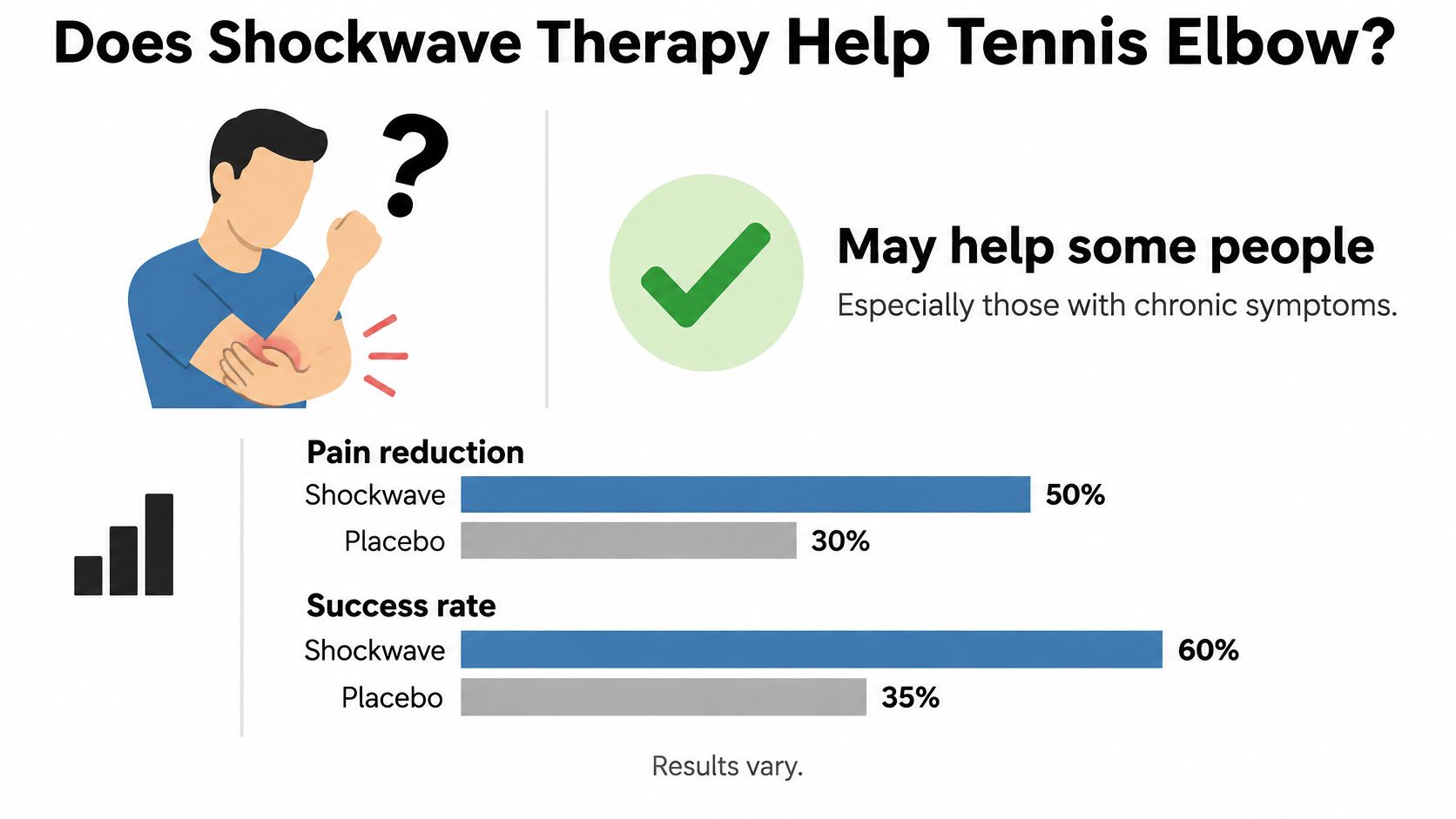
Across studies, the average pain benefit is modest and uncertain. Some patients report a meaningful reduction, while others notice little change. The evidence also varies because studies use different treatment protocols and comparisons.
| Evidence snapshot | Comparison | Pain result | Function or responders |
|---|---|---|---|
| 2020 systematic review, 9 studies, 715 patients | Placebo, sham, ultrasound, laser, or other doses | Mean difference -4.23 points, interval -8.78 to 0.32, not clearly better | At least 50% pain drop more often, estimate 1.38 (1.09 to 1.75) |
| Cochrane review, 9 placebo trials, 1,006 people | Shockwave versus placebo | No clear average pain benefit at 4 to 6 weeks | Little or no clear average function benefit |
| 2025 meta-analysis, 9 trials, 654 people | Shockwave versus ultrasound | Pain mean difference about -0.90 points | PRTEE function not statistically better |
| Umbrella review | Shockwave versus placebo | A modest pain signal, with results varying between studies | No single protocol established |
Why an average score hides the people who improved
An average pain score is like averaging the temperatures in a room: it can hide how different the readings are. Some people may report a substantial pain drop, while others feel little change. The group average can therefore look modest even when a portion of patients improves noticeably.
The 2020 review found that a higher share of patients receiving shockwave had at least a 50% pain reduction, even though its average pain result was not clearly better. Those measures answer different questions: one describes the group's overall change, the other counts people who crossed a response threshold.
What this means for you: A meaningful pain reduction is possible, but it is not guaranteed. Track whether pain changes and whether gripping, lifting, work, or sport becomes easier.
Where the evidence is thinnest
Pain results are more encouraging than results for practical function. Reviews report less certainty about grip, lifting, and everyday tasks. In the 2025 comparison with ultrasound, pain favored shockwave, but the difference in PRTEE function was not statistically clear. Earlier placebo-controlled findings also showed little clear average benefit.
Shockwave protocols differ, so “shockwave” does not describe one identical treatment. The comparison with ultrasound is about two treatment approaches, not a contest between shockwave machines. Read more about extracorporeal shock wave therapy compared with ultrasound to understand that distinction. Pairing treatment with appropriate exercise can help address strength and function; pain relief alone does not show that grip or sport performance has returned.
How Shockwaves Reach a Sore Elbow Tendon
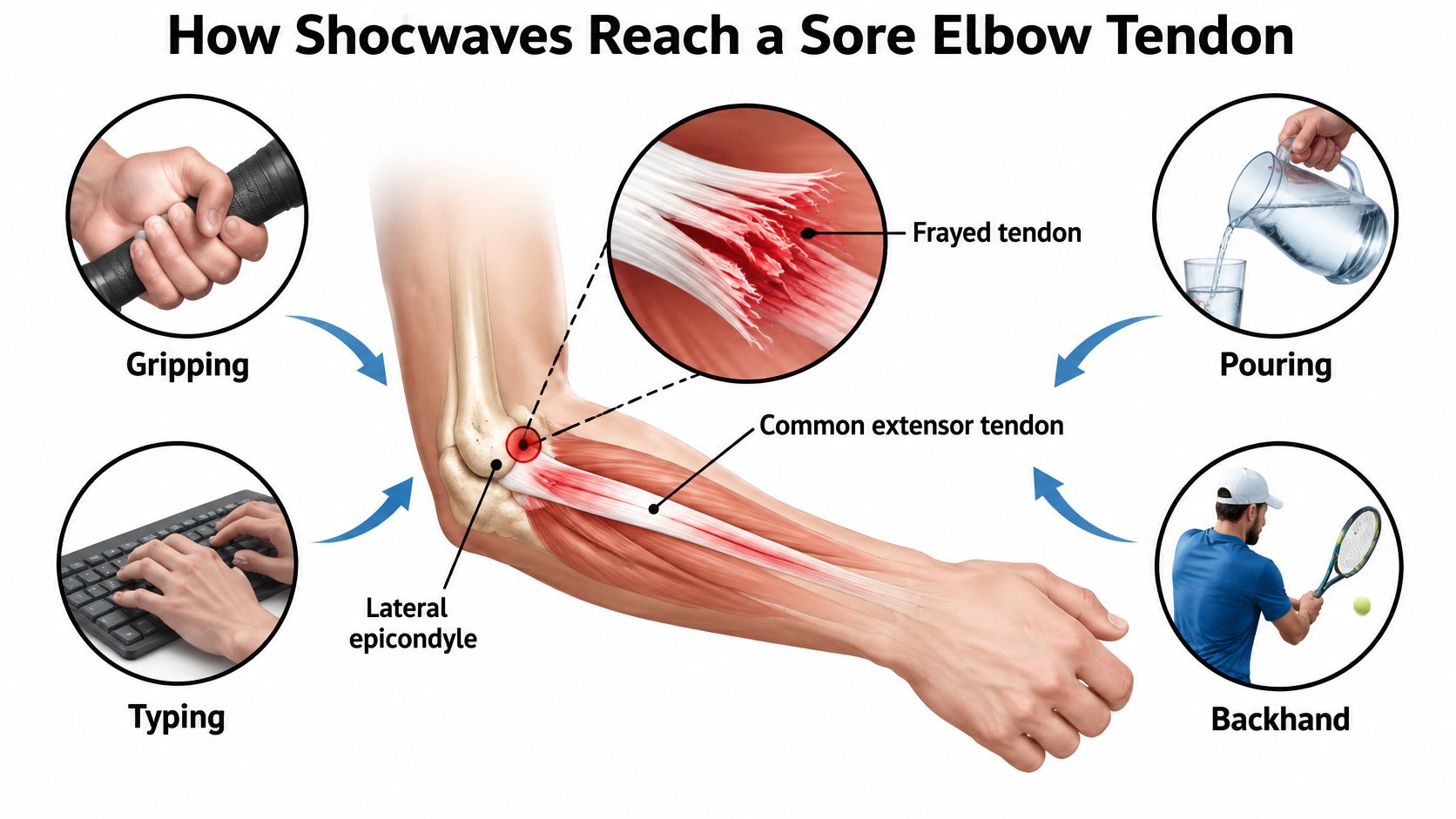
Think of the common extensor tendon as a rope. It runs from the bony bump on the outside of your elbow, the lateral epicondyle, down toward the back of your wrist. Every grip pulls that rope: a kettle handle, a mouse, a jar lid, a paint roller, a backhand. Pull it hard and often enough without letting it rebuild, and the fibers near the bony anchor start to fray. The tissue thickens, loses its tidy alignment, and complains when loaded. That frayed region is what clinicians call lateral epicondylitis or lateral elbow tendinopathy.
What the machine actually does
Shockwave therapy doesn't cut the rope or dissolve a knot. A handheld applicator with coupling gel sends short acoustic pulses through the skin into the sore tendon origin. Think of it as precise, rhythmic tapping at a depth you can't reach with your thumb: firm enough to stir a local tissue response and to turn down pain sensitivity around the anchor, brief enough that you walk out and drive home.
The target is narrow. One spot at the tendon origin, not the whole forearm, not the elbow joint itself. That's why the clinician spends time finding the exact painful point before the first pulse.
Radial and focused waves in plain words
Two wave types do this job. Radial waves spread outward from where the applicator touches your skin, covering a broader, more superficial area. Focused waves concentrate energy into a smaller zone at a chosen depth. Both can reach a structure as superficial as the common extensor origin, which is why the same clinic may stock one device and another clinic may stock the other.
Your own clues point to whether this tissue is even the right target: pain with a handshake, pain lifting a pitcher palm down, pain when you push your wrist upward against resistance. If the pain arrives with numbness, follows a pop or a fall, or tracks up into your neck, the tendon isn't the whole story and the exam needs to go wider.
A short video overview sits below.
One session of pulses is a stimulus, not a finished repair. The numbers that decide whether the stimulus is well aimed are the shock count, the energy setting, and how the visits are spaced.
What One Course of Shockwave Treatment Involves
"Shockwave" isn't one setting. Two clinics can advertise shockwave therapy for tennis elbow and deliver quite different doses: different energy, different pulse counts, different spacing, different wave type. A review of published shockwave protocols for lateral elbow tendinopathy lays out the ranges clinicians use, and the spread is wide.
| Protocol piece | Typical published range | A common study example | Why it is recorded |
|---|---|---|---|
| Shocks per session | About 1,000 to 2,000 | 2,000 | Sets how much the tendon is loaded |
| Energy-flux density | About 0.02 to 0.60 mJ/mm² | 0.07 to 0.09 mJ/mm² | Low, medium, or high changes tissue stress |
| Energy bands | Low under 0.08, medium under 0.28, high up to 0.60 mJ/mm² | Low-energy regimen | Stops all shockwave being treated as identical |
| Schedule | Weekly for three sessions | Three visits | Gives a course rather than a single tap |
| Wave type | Radial or focused | Either, chosen for the goal | Spread versus concentrated energy |
| Target | Painful common extensor origin | Sometimes ultrasound-guided | Keeps pulses on the tendon origin |
Because pulse count, energy density, frequency, applicator type and wave type all shift how much load the tendon receives, results from different studies and different clinics are hard to compare. "I had shockwave" tells you almost nothing on its own.
What a session looks like, step by step
- Confirm the diagnosis and screen elsewhere first. The clinician reproduces your pain with resisted wrist extension and palpation of the lateral epicondyle, and checks for a suspected tear, nerve involvement, or pain referred from the neck. Shockwave on the wrong tissue wastes your money and your weeks.
- Mark the common extensor origin. Some protocols use ultrasound to locate the painful attachment before the first pulse, which keeps the energy on the tendon rather than the joint line or the muscle belly.
- Apply gel and deliver the planned shocks. You'll feel a rapid stinging or tapping over the sore point. It should be uncomfortable but conversational. If you can't speak through it, the energy is too high for that session.
- Check the skin and note the soreness. Redness at the contact point is common and settles. A mild increase in ache later the same day is a known reaction, not a sign that something tore.
- Write the settings down. Device type, energy, shock count, interval, target and your tolerance belong in your record, so the next visit continues a protocol instead of restarting a guess.
- Keep loading the tendon between visits. Gentle, progressive wrist-extensor and grip work continues through the course. Complete rest between sessions leaves the tendon exactly where it started.
Practical rule: ask for the dose in numbers, not in adjectives. "Two thousand shocks at a low energy setting, weekly for three weeks" is a plan you can repeat, compare, and adjust.
A typical published course is three weekly visits, not an open-ended series of appointments. If your elbow hasn't shifted after a defined block and a loading program, the useful question is whether the diagnosis or the plan needs changing rather than whether you need a fourth month of the same thing.
Who Should Consider Shockwave and Who Should Wait
The person who tends to do well with this treatment has a recognizable story. Outer-elbow pain that has outlasted the first few weeks, pain reproduced by resisted wrist extension, a grip that feels weaker than it did, and little lasting change from rest, a counterforce strap, or a short bout of exercise. Warehouse workers, racket-sport players, and adults trying to avoid another steroid injection or a surgery conversation all fit that profile.
A reasonable candidate looks like this
- Symptoms with some mileage on them. Weeks to months, not days. Brand-new pain still sits inside the window where the tendon often settles on its own.
- A tendon-shaped exam. Point tenderness at the lateral epicondyle, pain with gripping and resisted wrist extension, no numbness or tingling.
- A plateau despite sensible care. Activity changes and a loading program have been tried, and progress has stalled rather than reversed.
- A willingness to keep loading. The people who get the most from shockwave are usually the ones who keep strengthening the forearm through and after the course.
Reasons to wait or get screened first
A suspected tendon tear, skin infection or open wound at the contact point, pregnancy, a bleeding disorder, or a pacemaker in the treatment field all change the decision, and a clinician makes that call after examining you rather than after reading a webpage. Our shockwave therapy contraindications guide covers the screening questions in more detail.
A review of shockwave for lateral elbow tendinopathy found improvements in pain and grip-related limitation with a favorable safety profile, while noting that the trial base was limited in quality and number. The same review summarized short-term local reactions from one randomized trial, and those numbers are honest consent material rather than warnings about damage:
| Reaction | Shockwave group | Sham group |
|---|---|---|
| Transient pain | 11% | 4% |
| Skin reddening | 31% | 8% |
| Swelling | 7% | 6% |
Consent point: these are short-lived local reactions at the treatment site. They aren't evidence the tendon was harmed, and they're the reason we tell you to expect a warm, sore patch for a day.
Shockwave works best inside a plan that includes progressive tendon loading, activity modification and functional rehab, not as a substitute for diagnosis or for the exercise that rebuilds capacity. Measure progress with pain, a disability score, and pain-free grip rather than stopping at the first comfortable morning.
Pain Relief Compared with Grip and Daily Tasks
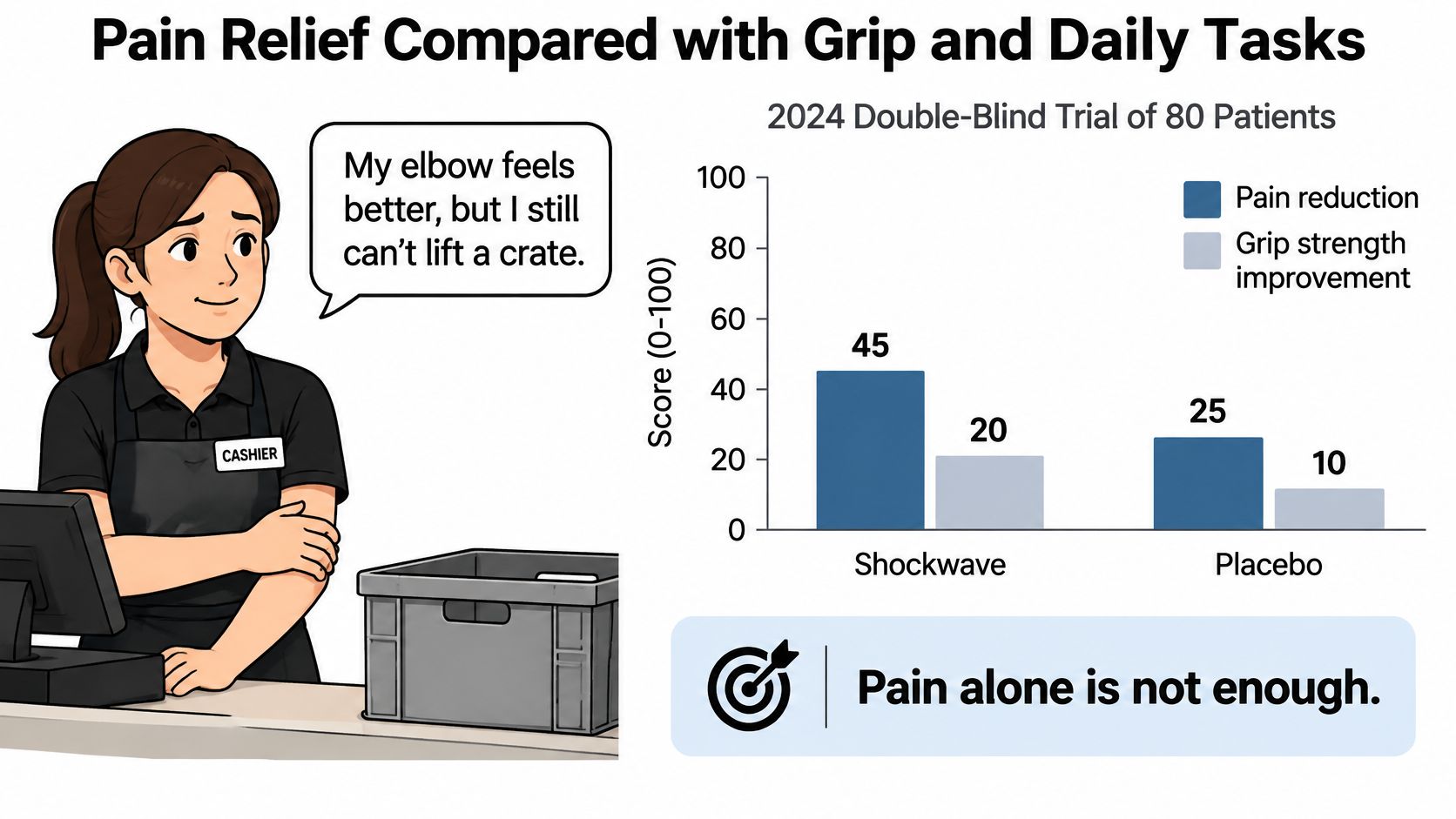
A cashier may notice that an elbow ache has eased after treatment, yet still struggle to lift a crate of milk onto a shelf. Pain relief matters, but it does not automatically mean the arm is ready for work, sport, or heavier gripping.
The Patient-Rated Tennis Elbow Evaluation, or PRTEE, tracks both pain and difficulty with tasks such as lifting, gripping, and carrying. A lower score means less reported pain and disability. It is useful, but it cannot show by itself whether a person can manage a full work shift or return to a racket.
What a strong individual result looks like
Shockwave therapy is not one fixed protocol. Studies can differ in how treatment is delivered and what else patients do alongside it, so a large improvement in one trial is not a forecast for every patient. The 2024 trial and 2025 randomized trial cited in earlier versions of this section do not provide a reliable basis here for quoting specific score changes.
Average scores also do not describe every response. One person may feel a meaningful drop in pain, while another sees a smaller change. In either case, grip and task ability need their own check.
Three checks that tell you more than a pain score
- The kettle test. Use a familiar, manageable kettle and notice whether pouring feels easier. Repeat the same task over time rather than increasing the load to test the elbow.
- A pain-free grip. Squeeze a rolled towel gently and note when discomfort begins. A grip dynamometer can make that check more measurable if one is available.
- Your one task. Choose a specific work or sport movement, such as carrying grocery bags or practicing a controlled backhand. Track whether it becomes easier to do, not just whether pain settles afterward.
Progress can be gradual: typing with less discomfort, carrying a bag more comfortably, then building toward heavier work or racket practice. Exercise helps develop the tendon's capacity alongside treatment. A physical therapy plan for sports injuries can support that process with strengthening and task-specific progression.
Radial Versus Focused Waves During Recovery
At the treatment table, the device may deliver radial or focused shockwaves. Neither type is a universal winner for tennis elbow. The choice is better understood as a set of protocols, with results that can differ by treatment settings, the outcome measured, and when it is measured.
A 2026 systematic review and network meta-analysis of shockwave settings for lateral elbow tendinopathy found no clear overall superiority of radial or focused therapy for pain or function. The evidence was low or very low in certainty, and a possible radial advantage for wrist-extensor strength relied on few studies. Rankings also varied by clinical goal and follow-up time.
| Clinical goal | Setting that ranked better | Evidence caution |
|---|---|---|
| Pain at about one month | Medium-intensity radial | Network ranking, not a guarantee |
| Longer-term pain | Low-intensity focused | Better rank at later follow-up |
| Overall profile | Low-energy treatment | Most favorable profile in that analysis |
| Wrist-extensor strength | Possible radial advantage | Based on very few studies |
| Pain or function overall | No clear radial or focused winner | Low or very low certainty |
The rankings answer different questions. A setting ranked higher for pain at about one month may not rank highest at a later follow-up. A network ranking estimates the chance of a setting ranking first; it does not predict an individual result.
How much discomfort is acceptable
Treatment can feel like a sharp sting over the sore tendon. You should still be able to speak and ask the clinician to lower the energy. If you find yourself bracing against the table, ask for an adjustment. A brief soreness flare over the next day or two can happen.
Keep same-day activity easy. Walking, typing at your usual pace, and light daily tasks are reasonable; heavy gripping, crate lifting, or a full practice session can wait until soreness settles, usually a day or two. Then resume progressive loading where you left off. Agree on activity limits before leaving, and compare compression and infrared elbow sleeves if you are considering support while rebuilding grip.
Shared decision in one sentence: name your goal, the time frame that matters, the device available, and a review date to assess progress.
Book Care if Pain Still Limits Daily Tasks
If elbow pain continues to limit gripping, lifting, typing, work, or sport after several weeks of rest and simple exercise, an in-person evaluation can help clarify the next steps. Seek care sooner if pain comes with numbness, follows a fall, or involves swelling and warmth.
Before your visit, note when the pain began, which tasks hurt most, any previous injections or imaging, and the activity you most want to return to. Bring your medication list and mention any history of bleeding disorders, a pacemaker, pregnancy, or skin problems near the elbow.
At MedAmerica Rehab Center, shockwave therapy is a non-invasive option that can help reduce pain, improve healing, and restore function, even after one visit. It can be paired with progressive exercises to rebuild tendon strength. Initial physical and occupational therapy evaluations typically last 60 to 75 minutes; chiropractic initial evaluations usually take about 30 minutes.
MedAmerica Rehab Center has provided physical therapy, chiropractic care, acupuncture, and shockwave therapy in Deerfield Beach since 1995, and the team treats tennis elbow. The evaluation and care plan depend on the service you choose. Visit MedAmerica Rehab Center to arrange an evaluation and discuss whether shockwave therapy may suit your recovery.
MedAmerica Rehab · Deerfield Beach
Talk to a clinician about your pain
Physical therapy, chiropractic, acupuncture and shockwave therapy under one roof, since 1995. Same-day appointments are available.
Mon–Thu 8:00 AM – 6:30 PM · Fri 8:00 AM – 3:00 PM