
Personalized Wellness Coaching Programs
You show up to physical therapy. You listen carefully. You leave with a clear home program and every intention of following it.
Then real life steps in.
By Tuesday, work runs late. By Wednesday, your knee feels a little sore and you're not sure whether to push through or scale back. By Friday, the exercise handout is sitting on the kitchen counter, and you're feeling that familiar frustration. Not because you don't care, but because recovery at home is harder than it looks inside the clinic.
That's where wellness coaching programs can make a real difference. Not by replacing your physical therapist, and not by turning recovery into another full-time job. A good coach helps you stay connected to the plan when structure falls away. They help you turn “I know what I'm supposed to do” into “I'm doing it.”
If you've been looking into broader comprehensive therapy solutions for recovery, mental well-being, or long-term habit change, wellness coaching fits into that same practical idea. Healing rarely depends on one appointment alone. It depends on what happens between appointments.
Your Partner in Recovery Beyond the Clinic
A lot of people think the hard part of rehab is getting the diagnosis. Often, that's only the beginning.
Consider a common situation. A patient starts therapy for back pain after weeks of stiffness, poor sleep, and trouble sitting through a workday. The treatment plan makes sense. Mobility work in the morning. Core exercises every other day. Walking breaks. Better pacing instead of doing too much on good days and crashing on bad ones. In the clinic, it feels manageable.
At home, it gets messy.
The patient misses two exercise days, then worries they've ruined their progress. They try to “make up for it” by doing too much at once. Pain flares. Confidence drops. Soon the problem isn't just the back anymore. It's uncertainty, inconsistency, and the feeling that recovery keeps slipping out of reach.
Where support usually breaks down
Physical therapists are trained to evaluate movement, identify impairments, guide treatment, and adjust the rehab plan. But most recovery happens outside the appointment. That's the gap many people feel.
A wellness coach steps into that day-to-day space. They help with questions like:
- How do I fit my exercises into a crowded schedule?
- What should I do when motivation drops?
- How can I keep going without overdoing it?
- What routines make pain management easier at home?
Those questions sound simple, but they often decide whether a plan works.
Recovery doesn't usually fail because the plan was bad. It often stalls because the plan never became part of daily life.
What this partnership feels like
It feels less like being told what to do and more like having someone help you carry out what already matters to you.
For a post-surgical patient, that may mean building a steady routine around swelling control, walking, and home exercises. For someone with neck pain, it may mean changing how they break up desk time. For a senior working on balance, it may mean turning a few prescribed movements into a safe, repeatable habit.
The value is practical. You still have your clinical care. The coach helps you stay engaged with it.
What Exactly Is a Wellness Coaching Program
The simplest way to understand a wellness coaching program is this: if your physical therapist designs the recovery blueprint, the coach helps you follow it in daily life.
That doesn't mean the coach is treating your injury or changing your medical plan. Coaching is a collaborative, behavior-focused service. It helps you work through barriers, build routines, and stay accountable to goals that matter to you.
A plain-language definition
A wellness coach helps you connect health goals to everyday actions.
In rehabilitation, that might include:
- Exercise follow-through after a therapy session
- Sleep habits that support healing
- Stress management when pain spikes
- Activity pacing so you don't swing between inactivity and overdoing it
- Appointment follow-through and routine check-ins
The tone is different from medical treatment. A coach doesn't diagnose. A coach doesn't prescribe rehab protocols. A coach helps you make consistent choices around the plan already set by your licensed providers.
Why this model has grown
More people want structured support, not just information. A market summary reported that the U.S. health coaching market was estimated at $7.1 billion in 2020, and the workforce of health educators and community health workers grew from 99,400 in 2012 to a projected 144,100 by 2029, with 60% of U.S. adults saying they want to improve their physical fitness, according to this U.S. market analysis on health coaching demand.
That matters because most patients don't struggle from lack of instructions. They struggle with execution.
What coaching is and isn't
A quick comparison helps clear up common confusion.
| Focus | Physical therapy | Wellness coaching |
|---|---|---|
| Primary role | Evaluate, treat, and guide rehabilitation | Support behavior change and follow-through |
| Works on | Pain, mobility, strength, function | Routines, habits, motivation, consistency |
| Clinical decisions | Yes | No |
| Typical questions | What exercise is appropriate now? | How will I actually do this three times this week? |
Practical rule: If the issue is diagnosis, pain mechanism, surgical precautions, or treatment progression, that belongs with the clinician. If the issue is consistency, habits, planning, or accountability, coaching can help.
A good wellness coaching program gives shape to the part of recovery that often feels unstructured. That's why many patients find it easier to stay steady once they have both the treatment plan and support around the plan.
The Core Components of Effective Coaching
Not all wellness coaching programs feel the same. The strongest ones aren't just friendly conversations. They follow a structure that helps people move from intention to action.
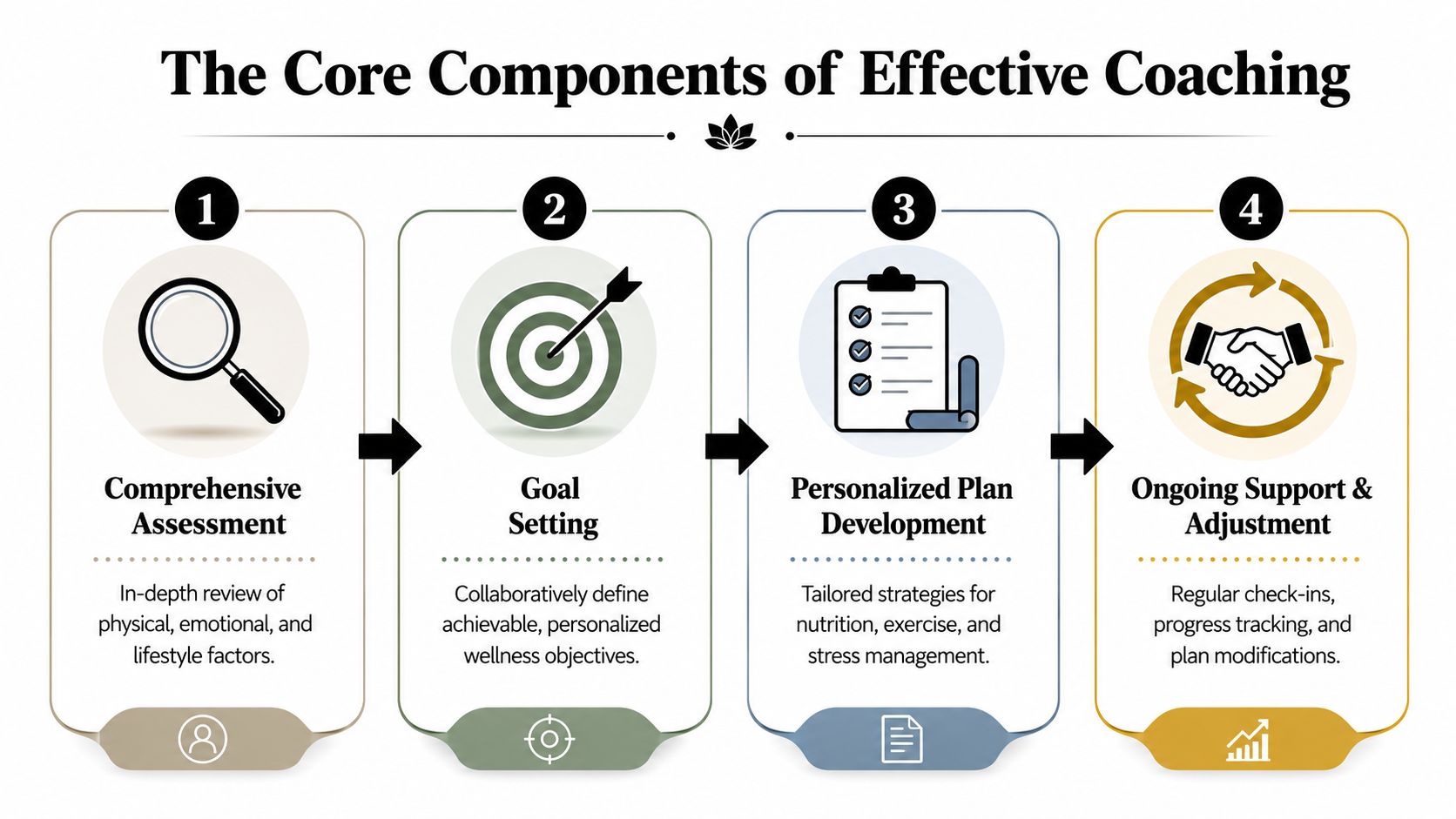
Comprehensive assessment
A useful coaching relationship starts by looking beyond symptoms.
If a patient says, “I'm not doing my home program,” that sentence can hide several different problems. Maybe they don't understand the exercises. Maybe evenings are chaotic. Maybe they're afraid of making pain worse. Maybe poor sleep is draining their energy.
A coach explores the context around the behavior:
- Daily schedule
- Stress level
- Confidence with the plan
- Past habits that helped or failed
- Environmental barriers at home or work
For someone recovering from shoulder surgery, this might reveal that exercise adherence drops on days with long commutes and childcare demands. That changes the conversation. The problem isn't laziness. The plan may need better timing and simpler cues.
Collaborative goal setting
People stay more engaged when the goal feels personal and realistic.
A coach doesn't stop at “do your exercises more.” They help shape goals that are specific enough to act on. A patient with knee pain may choose a near-term target such as completing the home routine after breakfast on three set days. A person with chronic back pain may focus on walking consistently without triggering a flare.
The best goals usually connect function to meaning.
| Recovery challenge | Coaching goal |
|---|---|
| Post-op stiffness | Build a morning routine that supports mobility before work |
| Pain flare-ups | Use pacing strategies instead of waiting until pain becomes severe |
| Low exercise consistency | Link exercises to an existing habit, such as after coffee or before a shower |
Personalized planning and behavior change
Coaching becomes practical when the coach helps turn broad goals into repeatable actions.
That can include:
- Breaking a task down into smaller steps
- Choosing a cue that reminds you to act
- Planning around obstacles before they happen
- Using reflective questions that strengthen motivation instead of relying on guilt
For example, if a patient says, “I never have time,” the coach may help them test a shorter version of the routine on busy days rather than skipping it entirely.
Ongoing support and adjustment
Recovery rarely moves in a straight line. Pain changes. Energy changes. Workweeks change.
A coach helps patients review what worked, what didn't, and what needs to change. That's different from criticism. It's a process of adjustment.
Small adjustments made consistently usually beat perfect plans that collapse after one difficult week.
When people understand these four parts, coaching stops sounding vague. It becomes what it is: a structured support system for behavior change.
Who Benefits Most from Wellness Coaching
Some people hear “wellness coaching” and assume it's only for general health goals, like eating better or getting more steps. It can help there, but in rehabilitation it has a much more specific role. It supports people who need to carry a treatment plan into everyday life.
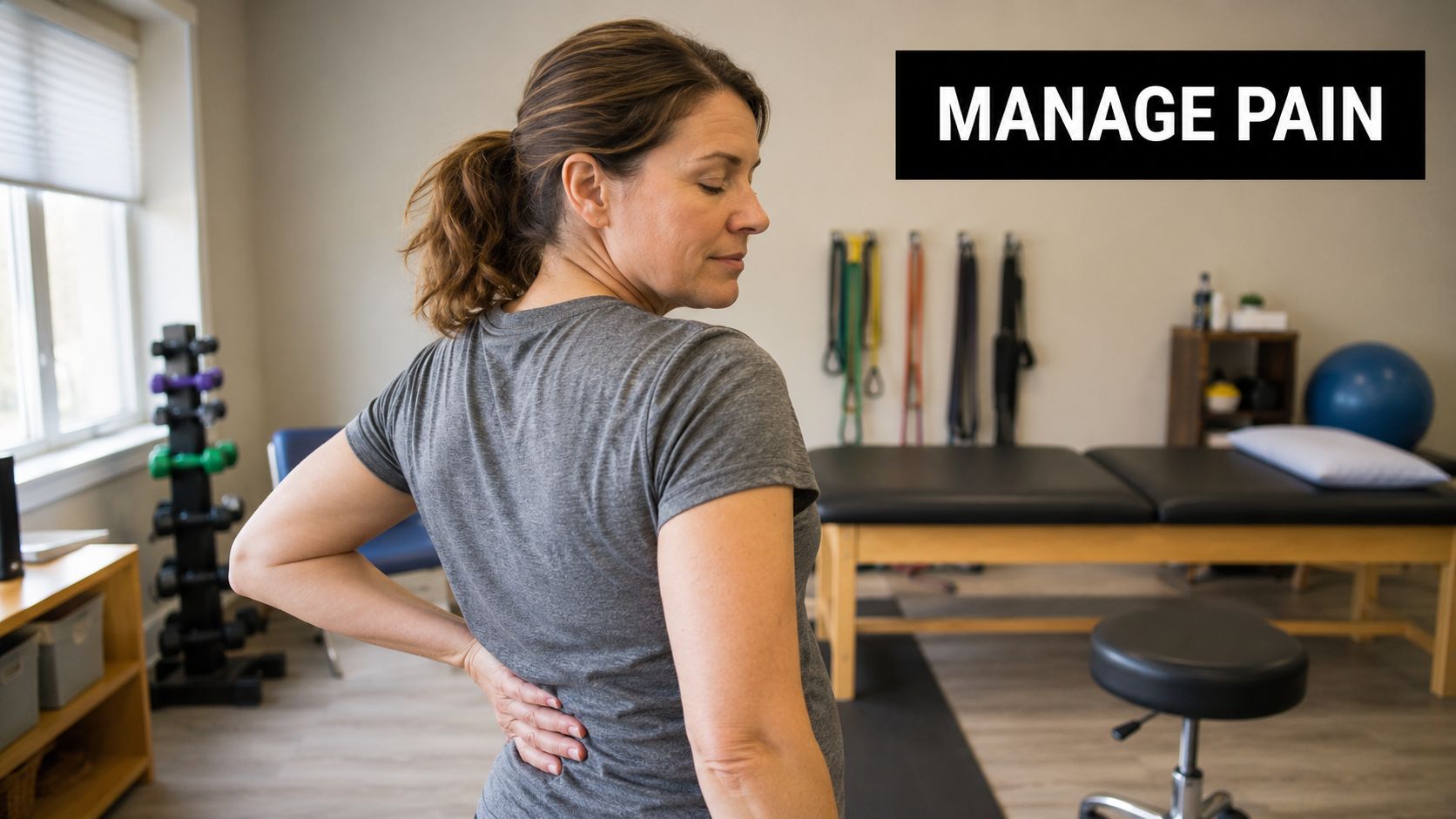
A 2024 review of 28 wellness coaching studies found that 91.67% of studies with follow-ups under 6 months and 87.5% of studies with follow-ups of 6 months or longer showed participants sustained or improved outcomes after coaching ended. That's one reason coaching is especially relevant in rehab, where lasting follow-through matters as much as early progress.
People managing ongoing pain
Pain management often depends on more than the right exercises. Many patients need help with pacing, flare-up planning, stress regulation, and realistic daily activity.
A coach can help someone with low back pain notice patterns such as:
- doing too much on low-pain days
- skipping movement when discomfort rises
- losing routine after one setback
Instead of chasing perfect pain-free days, coaching helps patients build steadier habits. That often makes progress feel less fragile.
Patients recovering after surgery
Post-surgical recovery comes with structure, but also a lot of uncertainty. Patients may wonder if stiffness is normal, how to stay consistent when tired, or how to manage frustration when improvement feels slower than expected.
A coach can help by reinforcing routines around:
- home exercise completion
- walking progression
- swelling-management habits
- rest and recovery routines
- confidence-building after setbacks
The coach isn't deciding the protocol. The coach is helping the patient live it.
Seniors working on balance and fall prevention
Fall-prevention plans often sound simple on paper. In practice, consistency can be difficult. Balance drills may feel repetitive. Home safety changes may get postponed. Fear of falling can lead to less movement, which then lowers confidence further.
A coach can support a senior by helping create:
- a repeatable exercise schedule
- reminders tied to daily habits
- a safer home setup
- a plan for staying active without feeling rushed or unsteady
People living with chronic musculoskeletal conditions
Arthritis, sciatica, recurrent neck pain, and similar conditions often require long-term self-management. These patients usually know that movement helps. The challenge is staying engaged when symptoms come and go.
Good coaching doesn't promise a perfect recovery experience. It helps people keep moving forward when recovery feels uneven.
For these groups, the biggest benefit isn't hype. It's sustainability. Coaching supports the habits that keep rehab gains from fading once the initial burst of motivation wears off.
How Coaching Integrates with Physical Therapy at MedAmerica
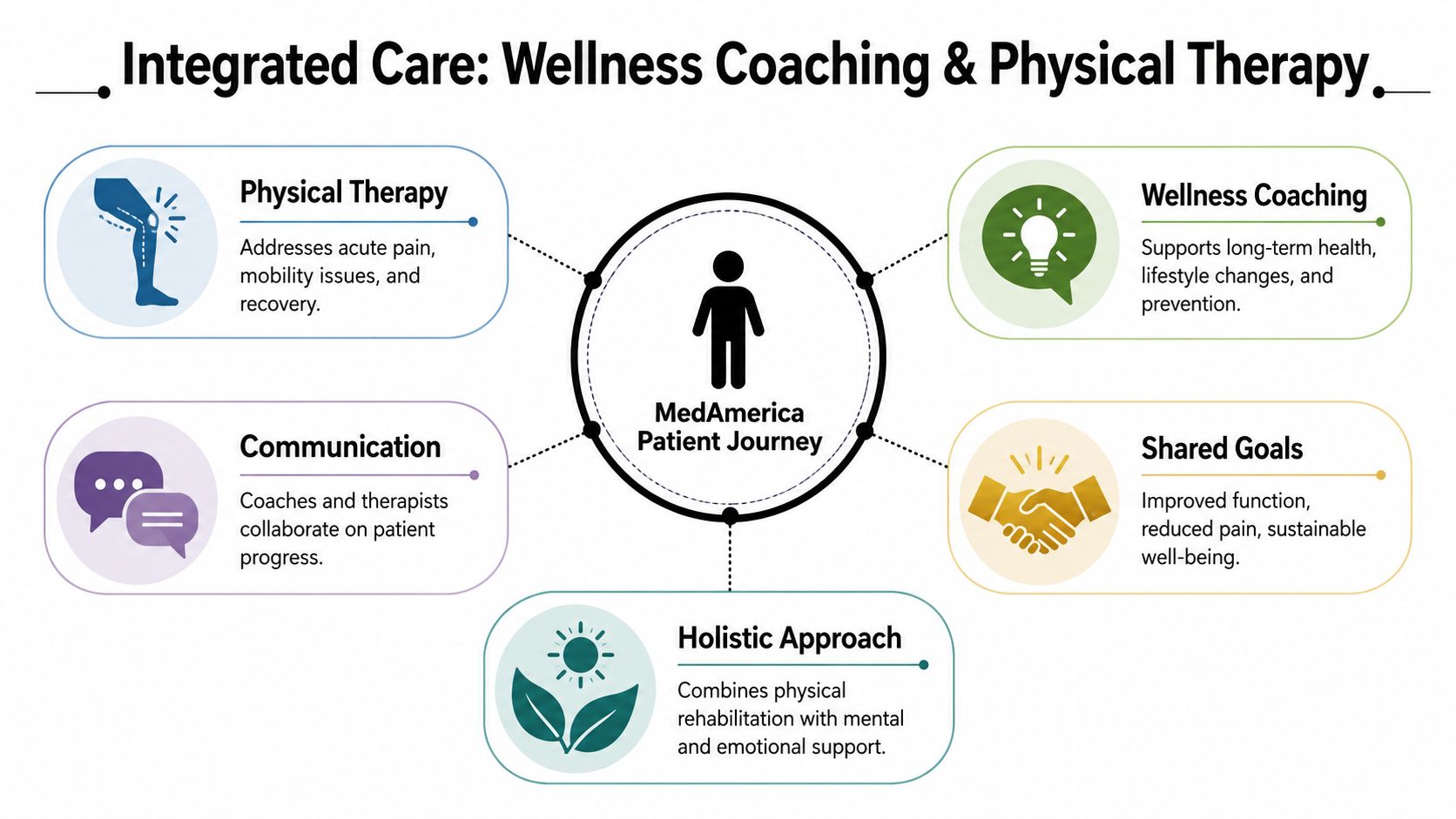
The most useful way to think about coaching in a rehab setting is not as an extra service sitting off to the side. It works best as part of an integrated care process.
Physical therapy addresses the clinical side of recovery. The therapist evaluates movement, identifies impairments, sets treatment priorities, and progresses care. Wellness coaching supports the daily follow-through that determines whether those recommendations become lived habits.
Different roles, shared purpose
A structured coaching model is designed as a non-clinical layer that expands care capacity. California's Certified Wellness Coach framework describes coaches as supporting wellness promotion, education, coordination, support, and referral, while licensed clinicians retain diagnosis and treatment responsibilities, as outlined in this Certified Wellness Coach workforce model.
That division matters in physical rehabilitation.
| Task | Physical therapist | Wellness coach |
|---|---|---|
| Diagnose and evaluate | Yes | No |
| Prescribe and progress treatment | Yes | No |
| Reinforce routines and adherence | Supports | Yes |
| Help troubleshoot daily barriers | Sometimes, within visit limits | Yes |
| Escalate concerns back to clinician | Yes | Yes, by communication pathway |
The common failure point in musculoskeletal care often isn't knowing what exercise to do. It's maintaining the behavior long enough for it to help.
What integration looks like in real life
Suppose a patient receives one of the clinic's individualized treatment plans for sciatica. The therapist may prescribe mobility work, gradual strengthening, walking, and activity modification. The coach then helps the patient fit that plan into a workweek, identify times of day when symptoms are most manageable, and prepare for predictable barriers like long car rides or missed mornings.
A coach might ask:
- Which part of the routine feels easiest to keep?
- When are you most likely to skip it?
- What can you do on your hardest days instead of doing nothing?
- What warning signs should be reported back to your therapist?
That last point is important. Coaching should strengthen communication, not replace it.
Why this combination works so well
A therapist can create an excellent rehab plan. But if a patient feels overwhelmed, forgets key steps, or gets discouraged after a flare-up, progress slows. Coaching creates a support layer around that reality.
This integrated model can improve the patient experience in several ways:
- Better adherence because expectations are reviewed in plain language
- More consistent routines because obstacles are addressed before they derail the week
- Stronger confidence because patients learn how to recover from a missed day or symptom spike
- Clearer escalation because coaches know when concerns belong back with the clinician
The result is a more supported recovery path. Patients don't just receive instructions. They get help using them.
Choosing a Quality Wellness Coaching Program
If you're considering wellness coaching, quality matters. The term sounds friendly and broad, which can make it hard to tell the difference between a well-trained professional and someone offering general encouragement without a clear method.
A reliable program should have structure, boundaries, and a visible training standard.
What to look for first
The National Board for Health & Wellness Coaching identifies approved training programs that meet published standards, and Mayo Clinic's coach training is structured as a 12-week program, which reflects the move toward defined, competency-based preparation in the field. You can review that benchmark through the NBHWC approved training program standards.
That doesn't mean every good coach has the same background. It does mean you should expect more than informal experience.
Ask practical questions such as:
- What training did the coach complete?
- Was the curriculum competency-based and supervised?
- Does the coach understand role boundaries?
- How do they handle issues that require a clinician rather than a coach?
Signs of a stronger program
A quality program usually has several features working together.
- Defined structure: You should know how sessions are organized, how progress is reviewed, and what kind of support is offered between visits.
- Clear scope: The coach should never blur into psychotherapy, diagnosis, or medical advice.
- Behavior-change methods: The conversation should go beyond cheerleading and include goal setting, barrier planning, and accountability.
- Care-team awareness: In a rehab setting, the coach should understand how to support a physical therapy plan rather than compete with it.
If you're also comparing broader support options, resources that offer expert guidance for symptom management can help you understand how different coaching models are described and where their boundaries should sit.
Questions worth asking before you commit
A short checklist can help you evaluate fit.
| Question | Why it matters |
|---|---|
| How are goals set and reviewed? | Shows whether the program is structured |
| What happens if symptoms change? | Reveals whether the coach respects clinical boundaries |
| How do you coordinate with other providers? | Important for rehab continuity |
| What should I expect in the first few sessions? | Helps you judge clarity and professionalism |
You can also compare the coaching philosophy with the decision factors used when evaluating providers in guides about how to choose a physical therapist. The same common sense applies. Look for training, communication, a clear process, and respect for patient safety.
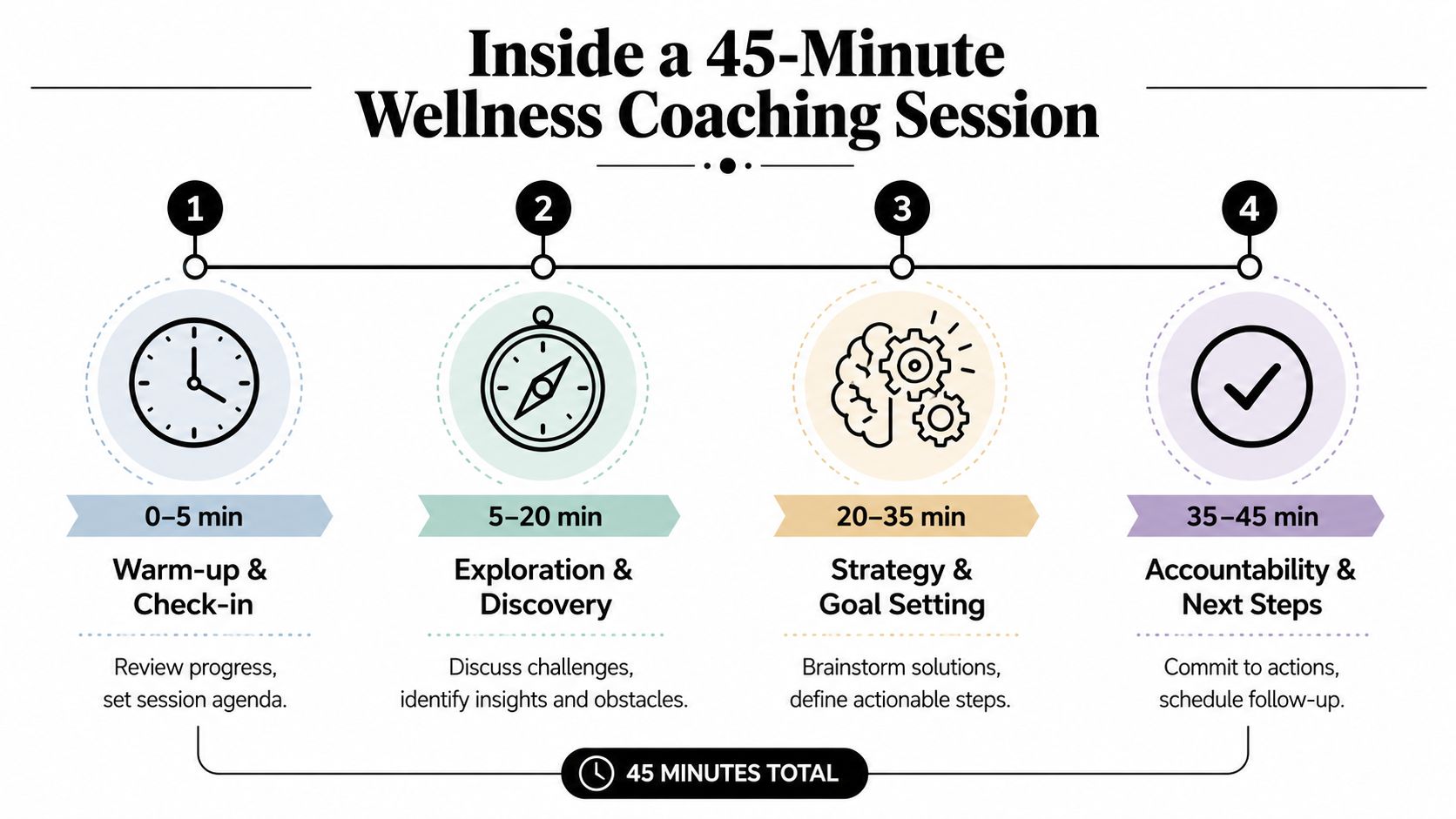
A Look Inside a Typical Coaching Session
A lot of patients feel comfortable with physical therapy because they know what to expect. Coaching can feel less familiar until you see how concrete it is.
A typical session is focused, conversational, and built around your real week, not an idealized version of it.
To make that easier to picture, here's a visual overview.
The first few minutes
The session usually starts with a brief check-in. How did the week go? What felt easier? What got in the way? If you were working on a home exercise routine after therapy, you'd then discuss what transpired.
That honesty matters. A productive session is not about impressing anyone. It's about finding out why a plan did or didn't work in real life.
The middle of the conversation
After the check-in, the coach helps you explore the sticking point.
Maybe you say, “I didn't have time.” A good coach won't stop there. They may ask whether the issue was timing, fatigue, uncertainty, pain anxiety, or lack of a routine cue. If you're recovering from a knee injury, they may help you identify that evenings are too unpredictable, but mornings after coffee are more realistic.
For a useful comparison, many patients like to understand the rhythm of both services side by side. This overview of what a typical physical therapy session looks like can help show how coaching complements, rather than duplicates, treatment visits.
This short video gives another sense of the coaching style and pace.
How the session ends
The final portion is about action, not theory.
You might leave with one or two small commitments:
- Do the shorter version of your home routine on busy days
- Set out your resistance band the night before
- Walk for a planned interval after lunch on workdays
- Write down flare-up triggers so you can discuss patterns with your therapist
A useful mindset: Success in coaching is rarely “I was perfect all week.” It's “I learned what made the plan easier to follow.”
By the end, you should feel clearer, not overloaded. The best sessions leave you with a practical next step you can implement.
Frequently Asked Questions About Wellness Coaching
Is wellness coaching the same as counseling or psychotherapy
No. They can both be supportive, but they serve different purposes.
Wellness coaching focuses on behavior change, routines, goal follow-through, and accountability. In a rehab setting, that may mean helping you stay consistent with home exercises, improve pacing, build sleep habits, or troubleshoot barriers that affect recovery.
Psychotherapy addresses mental health diagnosis, emotional processing, trauma, mood disorders, and other concerns that require licensed mental health care. A coach should understand those boundaries and refer out when needed. If strong anxiety, depression, trauma symptoms, or major emotional distress are affecting your recovery, a licensed mental health professional is the right person to involve.
Will insurance cover wellness coaching
Coverage varies, so it's best to ask the clinic and your insurer directly.
In some settings, coaching may be packaged within a broader program. In others, it may be offered as a separate self-pay service or as part of a care bundle. The important question is not only “Is it covered?” but also “What support is included, how often, and how does it connect with my rehab plan?”
When you call, ask:
- How is the service billed?
- Is it part of another treatment program or separate?
- Are there package options or visit-based fees?
- Does a prescription or referral affect eligibility?
How long does a wellness coaching program usually last
The answer depends on your goals, your recovery timeline, and how much support you need.
Some people benefit from short-term coaching during a focused stage of rehab, such as the first phase after surgery. Others do better with ongoing support while building long-term habits around pain management, balance, or activity pacing.
A better way to think about duration is this: coaching should last long enough for you to build a repeatable process, not just have one good week. Early on, sessions may be more frequent. Later, they may spread out as you become more confident and independent.
Do I need a referral to get started
That depends on the clinic's process and your insurance arrangement.
Some programs allow direct access or self-referral. Others may coordinate coaching through your existing rehabilitation plan. If you're already receiving physical therapy, it's reasonable to ask whether coaching can be added as a support layer around your current goals.
How do I know if I'm a good candidate
You're likely a good fit if you keep thinking one of these things:
- I know what I should do, but I'm not doing it consistently
- I start strong and then lose momentum
- I get discouraged when symptoms flare
- I want support between appointments without needing more medical treatment
That doesn't mean you've failed. It means you may benefit from more structure around the part of recovery that happens at home.
If you want help turning rehab instructions into daily habits that support pain relief, mobility, and long-term recovery, MedAmerica Rehab Center can help you understand your options and find the right next step for your care.
MedAmerica Rehab · Deerfield Beach
Talk to a clinician about your pain
Physical therapy, chiropractic, acupuncture and shockwave therapy under one roof, since 1995. Same-day appointments are available.
Mon–Thu 8:00 AM – 6:30 PM · Fri 8:00 AM – 3:00 PM