

How to Choose a Physical Therapist: A Deerfield Beach Guide
A lot of people start looking for physical therapy at the exact moment they have the least patience for research.
Your low back has gone from annoying to sharp. Your neck is stiff after a car accident. Your knee still doesn’t feel right weeks after surgery. You type “how to choose a physical therapist” or “physical therapist Deerfield Beach” into your phone, and suddenly every clinic sounds excellent.
That’s the hard part. Pain makes everything urgent, but choosing well still matters.
In Deerfield Beach, I’ve seen the same pattern again and again. People usually aren’t confused about whether they need help. They’re confused about who should guide that recovery, what questions to ask, and how to avoid wasting time in the wrong setting. If you’re trying to get back to walking the beach comfortably, lifting groceries without a jolt down your leg, returning to golf, or sleeping through the night without shoulder pain, the right therapist can change the whole experience.
Finding Relief from Pain Starts with Finding the Right Partner
One common scenario goes like this. Someone wakes up with back pain that now shoots into the leg. They try heat, rest, and a few stretches they found online. Nothing really settles it down. A friend says to try physical therapy. Their doctor says the same thing. Then the search begins, and the options blur together.

Not every clinic delivers care the same way. Some therapists spend time listening, examining movement, and building a plan that fits your life. Others move patients through quickly and lean on generic routines. If you’ve never been to PT before, it can be hard to tell the difference from a website alone.
What matters most at the start
When people ask me what to look for first, I keep it simple.
- Match the therapist to the problem: Back pain, sciatica, arthritis, balance issues, sports injuries, and post-surgical rehab don’t all need the same skill set.
- Look past marketing language: “Personalized care” is easy to write on a homepage. It means more when the clinic can explain exactly how they evaluate and treat your condition.
- Think beyond the first visit: Physical therapy usually works best as a series of visits, not a one-time fix. Scheduling, insurance, travel time, and communication all matter.
Practical rule: Choose a therapist the same way you’d choose a specialist for any other health problem. Start with fit and expertise, not just whoever is closest.
A better way to choose
Good physical therapy is a partnership. You need someone who can assess the underlying cause of the problem, explain it clearly, adjust treatment as your body responds, and keep the plan realistic. That’s especially important in Deerfield Beach, where many patients want to stay active, recover from auto injuries, or manage chronic pain without surgery or unnecessary medication.
The rest of the decision gets much easier once you focus on a few essentials. Credentials come first. Logistics come second. The consultation tells you whether the clinic is a fit.
The Foundation Verifying Credentials and Specializations
Before you compare clinic hours or parking, check qualifications. This is the part many people skip, and it’s one of the biggest mistakes I see.
A physical therapist should have the education and licensure required to practice. In practical terms, you’ll usually see DPT after the therapist’s name, which stands for Doctor of Physical Therapy. You may also see older credentials such as MPT. Either way, state licensure matters, and so does knowing whether that therapist has advanced specialization in the condition you’re trying to fix.
What the letters actually mean
The most useful credentials for patients are the ones tied to real training and testing.
- DPT: This tells you the therapist completed doctoral-level physical therapy education.
- State licensure: This confirms the therapist is licensed to practice.
- Board certification: For this certification, specialization becomes important.
If you’re dealing with back pain, arthritis, sciatica, shoulder pain, knee pain, or recovery after orthopedic surgery, look closely for orthopedic specialization. According to physical therapy statistics on orthopedic demand and specialization, 59% of all physical therapy services focus on orthopedic rehabilitation, yet fewer than 10% of physical therapists nationally achieve board certification in orthopedics or sports. That gap matters because orthopedic problems make up such a large share of what PT clinics treat.
Why specialization matters in real life
A therapist with orthopedic specialization has gone deeper into musculoskeletal care. That doesn’t mean a general PT can’t help. It means a specialist has invested extra training into the kinds of problems many Deerfield Beach patients bring through the door.
That’s especially helpful when the case isn’t straightforward. A basic ankle sprain is one thing. Ongoing sciatica, post-surgical stiffness, recurring shoulder pain, and arthritis-related limitations often need sharper evaluation and more precise progression.
Here’s a simple filter to use when you review a clinic team page like this therapist profile page:
- Confirm licensure and degree
- Check for specialty credentials
- See whether the therapist regularly treats your exact condition
- Notice whether the clinic explains its treatment approach clearly
A good therapist should be able to tell you, in plain English, why your pain is happening and what the first phase of care will focus on.
Conditions should drive the choice
Choose based on the problem you need solved.
For example:
- Back pain or sciatica: Prioritize orthopedic experience and hands-on assessment.
- Post-surgical rehab: Look for someone who routinely handles surgical protocols and progression.
- Sports injury: Ask whether the therapist treats active adults and return-to-sport cases regularly.
- Balance or fall prevention: Look for experience with gait training and stability work.
People often assume all PT is interchangeable. It isn’t. Credentials don’t guarantee a perfect fit, but they’re the strongest place to begin.
Decoding the Logistics Insurance Location and Scheduling
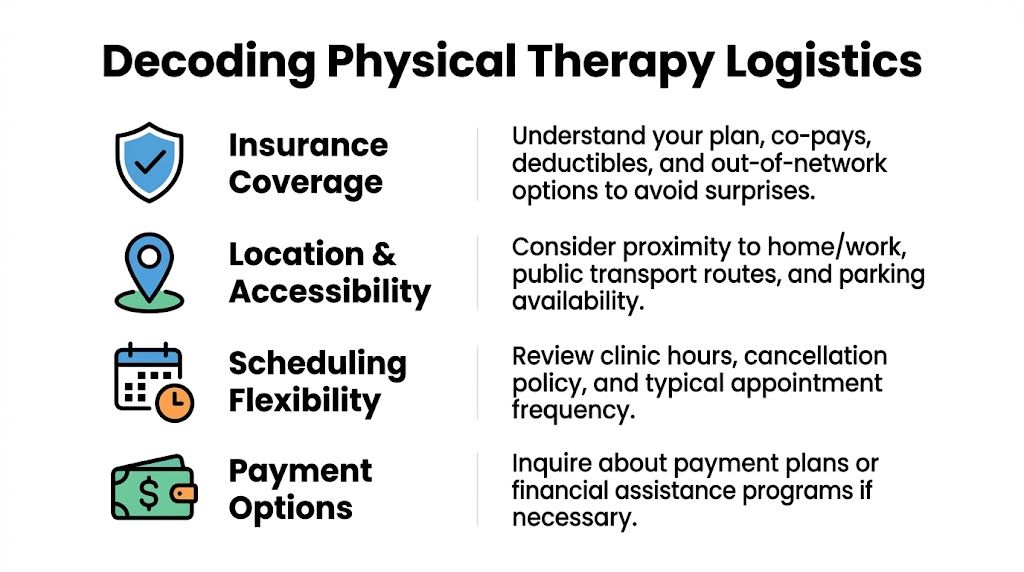
A therapist can be highly qualified and still be the wrong choice if the practical side of care is messy. Many patients are often surprised by these practical aspects.
A good recovery plan has to work on your calendar, in your budget, and with your insurance. If it doesn’t, even strong treatment can get interrupted.
Start with the insurance questions most people forget
Insurance isn’t the most exciting part of choosing care, but it’s one of the most important. A frequently overlooked issue in PT selection is insurance compatibility, workers’ comp handling, and auto accident billing expertise, as highlighted in this discussion of high standards to expect when finding a physical therapist.
Call the clinic and ask direct questions:
- Are you in network with my plan: Use the exact name on your insurance card.
- What will I likely owe per visit: Ask about co-pays, deductibles, and any evaluation charges.
- Do you verify benefits before my first appointment: That helps avoid guesswork.
- If you’re out of network, what are my options: Some clinics can explain self-pay clearly. Others stay vague. Vagueness is not a good sign.
Florida auto accident cases need a different conversation
Deerfield Beach patients dealing with car accidents should ask about Florida PIP, which stands for Personal Injury Protection. Clinics that regularly work with accident cases usually understand the paperwork, the documentation requirements, and the communication needed with attorneys or insurers when applicable.
Ask these questions:
- Do you routinely handle Florida PIP claims
- What documents do you need from me before treatment starts
- Who manages billing if there’s an issue
- Have you worked with auto accident patients with my type of injury
Workers’ compensation cases are similar. The care itself may be straightforward, but the billing and authorization process often isn’t. A clinic that fumbles authorizations can delay treatment before your body has a fair chance to improve.
Convenience affects consistency
A clinic doesn’t need to be next door, but it should be realistic for repeat visits.
Think about:
- Drive time: If traffic makes every visit stressful, adherence usually slips.
- Parking and accessibility: This matters more when you’re limping, dizzy, or recovering from surgery.
- Hours: Early morning, later evening, and same-day options can make a big difference.
- Responsiveness: A front desk that returns calls promptly usually reflects a better overall system.
If you want to test scheduling ease, try using a clinic’s online booking page, such as this appointment request option, and notice whether the process feels clear or confusing.
Ask about treatment tools, not just availability
If your condition may benefit from a more advanced approach, ask whether the clinic offers specific services such as shockwave therapy, manual therapy, structured therapeutic exercise, or balance training. The key question isn’t whether they own equipment. It’s whether they can explain why a modality fits your diagnosis.
A good clinic makes logistics feel organized. A disorganized one turns recovery into another source of stress.
The Consultation Questions to Ask and Red Flags to Watch
Your first conversation with a clinic tells you a lot, revealing whether its polished marketing holds up or falls apart.
One issue patients often miss is the care model itself. A major gap in most online advice is session structure, especially the difference between one-on-one treatment and high-volume care, which is why this guidance on what to look for when picking a physical therapist is so useful.
The biggest question to ask first
Ask this early: Will I be treated one-on-one by a licensed physical therapist?
That question cuts through a lot of noise.
Some clinics run on a high-volume model. The therapist evaluates you, then hands much of the session to an aide or splits attention across several patients at once. That setup may be common, but it’s rarely what patients think they’re signing up for.
One-on-one care is especially important for:
- Back and neck pain: Small movement adjustments matter.
- Post-surgical rehab: Progression needs close monitoring.
- Balance problems: Safety and cueing are essential.
- Persistent pain cases: These usually require more nuanced coaching.
Therapist interview checklist
| Question | Green Flag Answer | Red Flag Answer |
|---|---|---|
| Will I see the same therapist consistently? | “We try to keep you with the same therapist so your plan stays consistent.” | “Whoever is free will work with you.” |
| Will my sessions be one-on-one? | “Yes, your care is directly supervised by a licensed PT.” | “The therapist oversees the room while staff help everyone.” |
| How do you treat my condition? | “We combine hands-on care, exercise progression, and reassessment.” | “We usually start everyone on the same routine.” |
| Do you treat this problem often? | “Yes, we regularly see patients with that issue.” | “We treat a little bit of everything.” |
| What happens if I’m not improving? | “We re-evaluate, adjust the plan, and communicate clearly about next steps.” | “Just give it more time.” |
| What will a typical visit look like? | “We’ll explain each phase and what we’re tracking.” | “It depends,” with no real explanation. |
If you want a clearer picture of how a visit should flow, this page on what a typical physical therapy session looks like gives a useful benchmark.
Ask how they think, not just what they offer
A good consultation should reveal the therapist’s reasoning.
Try questions like these:
- What do you think is driving my pain or limitation
- What would you expect me to improve first
- What would make you change the plan
- How much of recovery depends on home exercises versus in-clinic work
- Do you use manual therapy, strengthening, mobility work, or modalities such as shockwave therapy for cases like mine
You’re listening for specificity. A strong therapist doesn’t need to promise miracles. They should sound thoughtful, clear, and comfortable explaining trade-offs.
If a therapist can’t explain the plan simply, there’s a good chance the plan isn’t specific enough.
Red flags that should make you pause
Some warning signs are subtle. Others are obvious.
- No real evaluation: If the first visit skips a detailed history and movement exam, that’s a problem.
- Heavy reliance on passive treatment: Heat, electrical stimulation, and massage can have a place, but they shouldn’t be the whole program.
- Generic exercise sheets: Your body isn’t generic, and your plan shouldn’t be either.
- Pressure without explanation: You should never feel rushed into a package or treatment path you don’t understand.
- Poor rapport: If you don’t feel heard early on, that usually doesn’t improve later.
A good consultation leaves you feeling informed. A weak one leaves you uncertain and still confused.
Making Your Choice and Preparing for Your First Visit
At some point, the research has to turn into a decision. By then, one already knows more than they think.
If one clinic gave clear answers, respected your questions, and sounded organized, that matters. If another felt vague or rushed, that matters too. The right choice is rarely about a flashy website. It’s about whether the therapist seems capable of guiding your recovery from where you are now to where you want to be.

Use a simple decision filter
A practical method for how to choose a physical therapist is to move through five checkpoints: identify your needs, verify credentials, assess experience, seek referrals and reviews, and then schedule an initial consultation. That step-by-step framework is outlined in this guide on how to choose the right physical therapist for you.
When you’re deciding between two or three clinics, ask yourself:
- Did they treat my condition like a specific problem, not a template?
- Did they answer insurance and scheduling questions clearly?
- Did I feel comfortable with their communication style?
- Can I realistically attend the plan they’re recommending?
That last point matters more than people realize. The “best” clinic on paper won’t help much if getting there becomes a weekly struggle.
What to bring to the first visit
Being prepared makes the evaluation smoother and more useful.
Bring these with you:
- Insurance card and photo ID
- Prescription or referral if you have one
- Imaging reports or surgical paperwork
- Medication list
- A short timeline of your symptoms: When they started, what makes them worse, and what has helped at all
Wear clothing that makes the affected area easy to assess. For knee pain, shorts help. For shoulder or neck issues, a loose top is better than a stiff button-down.
What a strong first appointment should include
The first visit should feel more like an investigation than a workout.
Expect the therapist to:
- Ask detailed questions: Not just where it hurts, but how it behaves.
- Watch how you move: Walking, bending, reaching, getting up from a chair, or balancing.
- Test strength and mobility: This helps pinpoint what’s limited and what’s compensating.
- Explain findings clearly: You should understand the problem in plain language.
- Set goals with you: Pain relief, better walking, safer balance, return to sport, or post-op milestones.
A well-run visit also gives you a roadmap. You should leave knowing what the clinic is treating, what your role is at home, and what progress they’ll be watching for.
Here’s a helpful visual overview before that first appointment:
The first visit shouldn’t feel mysterious. You should leave with more clarity than when you walked in.
Take Control of Your Recovery Journey
Choosing a physical therapist is a health decision, not just an errand. It affects how quickly you start, how confident you feel in the plan, and whether you stick with care long enough to make real progress.
The strongest choices usually come from a few basics. Verify training. Match specialization to the problem. Ask how sessions are structured. Make sure the logistics won’t get in the way. Then pay attention to whether the therapist listens and explains things well.
What works and what doesn’t
Some approaches consistently help patients choose better.
- What works: Clear credentials, condition-specific experience, direct answers, and individualized treatment.
- What doesn’t: Generic promises, rushed evaluations, confusing billing, and clinic models that make you feel like one more person in the room.
Your role matters too
Even the best therapist can’t recover for you. Good results usually come from partnership. That includes showing up, asking questions, doing the home program as instructed, and avoiding movements that keep irritating the problem.
That last point is often overlooked. If you’re dealing with a spinal condition or posture-related issue, it helps to understand exercises to avoid based on your condition so you don’t accidentally work against your recovery between visits.
Deerfield Beach patients often want the same thing. Less pain, more confidence, and a safe path back to normal activity. That’s realistic when you choose carefully. The right therapist won’t just give you exercises. They’ll help you understand your body, reduce fear around movement, and build momentum toward lasting relief.
Frequently Asked Questions About Physical Therapy
A few practical questions come up in almost every first phone call. Here are straightforward answers.
Do I need a referral to start physical therapy in Florida
In many cases, people can start by contacting a clinic directly, but referral needs can depend on your insurance plan and the details of your case. Auto accident and workers’ compensation claims can involve extra paperwork or authorization steps. The safest move is to ask both your insurer and the clinic before the first visit.
How do I know if a therapist has enough experience
Ask what kinds of cases they treat most often and how they measure progress. Experience matters, especially with musculoskeletal conditions. According to benchmark data on choosing the right physical therapist, experienced therapists with 10+ years achieve 85-95% functional improvement rates for musculoskeletal conditions, compared with 70-80% for less specialized providers.
That doesn’t mean every newer therapist is a poor choice. It means complex cases often benefit from a clinician who has seen more variations of the same problem.
What’s the difference between physical therapy and chiropractic or massage care
Physical therapy focuses on evaluating movement, restoring function, reducing pain, and progressing you through exercise and activity safely. Chiropractic care may focus more on spinal and joint manipulation. Massage care centers on soft tissue work. In some clinics, these services work well together, but they aren’t interchangeable.
Should I choose the closest clinic
Not automatically. Convenience matters, but not more than fit. A nearby clinic with rushed care can slow your progress. A slightly longer drive may be worth it if the therapist is a better match and the care model is stronger.
What if I’m nervous about the first session
That’s normal. Most first visits are assessment-heavy and not as intense as people fear. A good therapist will explain what they’re doing, adjust to your pain level, and avoid throwing you into exercises that don’t fit your condition.
Where can I find answers to equipment or recovery basics at home
If you’re sorting through practical issues outside the clinic, such as support items or common home-use questions, this list of general frequently asked questions can be a helpful supplement.
If you’re looking for patient-centered care in Deerfield Beach, MedAmerica Rehab Center offers physical therapy, chiropractic, acupuncture, and advanced shockwave therapy in one location. Their team focuses on one-on-one attention, clear treatment plans, and practical support for everyday cases like back pain, sciatica, arthritis, post-surgical rehab, auto accident injuries, and workers’ compensation recovery. If you’re ready to take the next step, reach out and schedule a visit.
MedAmerica Rehab · Deerfield Beach
Talk to a clinician about your pain
Physical therapy, chiropractic, acupuncture and shockwave therapy under one roof, since 1995. Same-day appointments are available.
Mon–Thu 8:00 AM – 6:30 PM · Fri 8:00 AM – 3:00 PM