

How to Treat Sciatica Naturally: A Complete Relief Guide
You wake up, swing your legs out of bed, and feel an electric bolt travel from your lower back through your buttock and down your thigh. The instinct is usually to freeze, stretch aggressively, or stay in bed until the pain disappears. None of those reactions is consistently helpful.
Natural sciatica care works best as a staged process. First, calm the irritated area without becoming completely inactive. Then restore comfortable movement, build strength, and change the daily habits that keep provoking symptoms. The right plan depends on whether your pain is mild and settling, persistent but manageable, or worsening with neurological changes.
Immediate At-Home Relief Strategies for Sciatica Pain
During the first hours of a flare, reduce irritation before trying to restore flexibility. Choose a position that eases leg symptoms, move within a tolerable range, and match cold or heat to how the flare feels. A staged response prevents you from applying every remedy at once.
What to do during the first 48 hours
Start with support. Lie on your back with your lower legs on a sofa or chair, keeping your hips and knees comfortably bent in the 90/90 position. If lying on your side feels better, place a pillow between your knees and let your spine relax. These positions can reduce the muscular effort needed to support your pelvis and lower back.
Strict bed rest is rarely helpful. Harvard Health's sciatica self-care guidance recommends returning to activity as soon as possible. It also describes ice packs for 15 to 20 minutes at a time, with breaks between applications, followed by heat after the first few days. Mayo Clinic guidance recommends cold packs for up to 20 minutes several times a day, then heat after 2 to 3 days, with stretches held for at least 30 seconds. Use cold packs only when they feel soothing, and protect your skin with a cloth barrier.
During the first six hours, a wrapped cold pack may help when the flare feels fresh, hot, sharp, or reactive. After that initial phase, heat may feel better when muscle guarding and stiffness dominate.
Practical rule: Choose the position or treatment that keeps pain from traveling farther down the leg. A mild ache near the back or buttock may be tolerable. Increasing tingling, numbness, or leg pain means stop and change the approach.
Over-the-counter anti-inflammatory medication does not suit everyone. Follow the product label and ask a pharmacist or clinician about interactions, especially with a history of stomach ulcers, kidney disease, bleeding problems, cardiovascular disease, pregnancy, or medication sensitivities. Avoid combining products that contain overlapping ingredients.
Gentle nerve movement can be more appropriate than a forceful stretch. While lying comfortably, slowly straighten your knee until you notice light tension, then bend it again. Keep the ankle relaxed at first. A nerve glide should feel easy, not like a hamstring stretch, and it should never reproduce a strong electrical sensation.
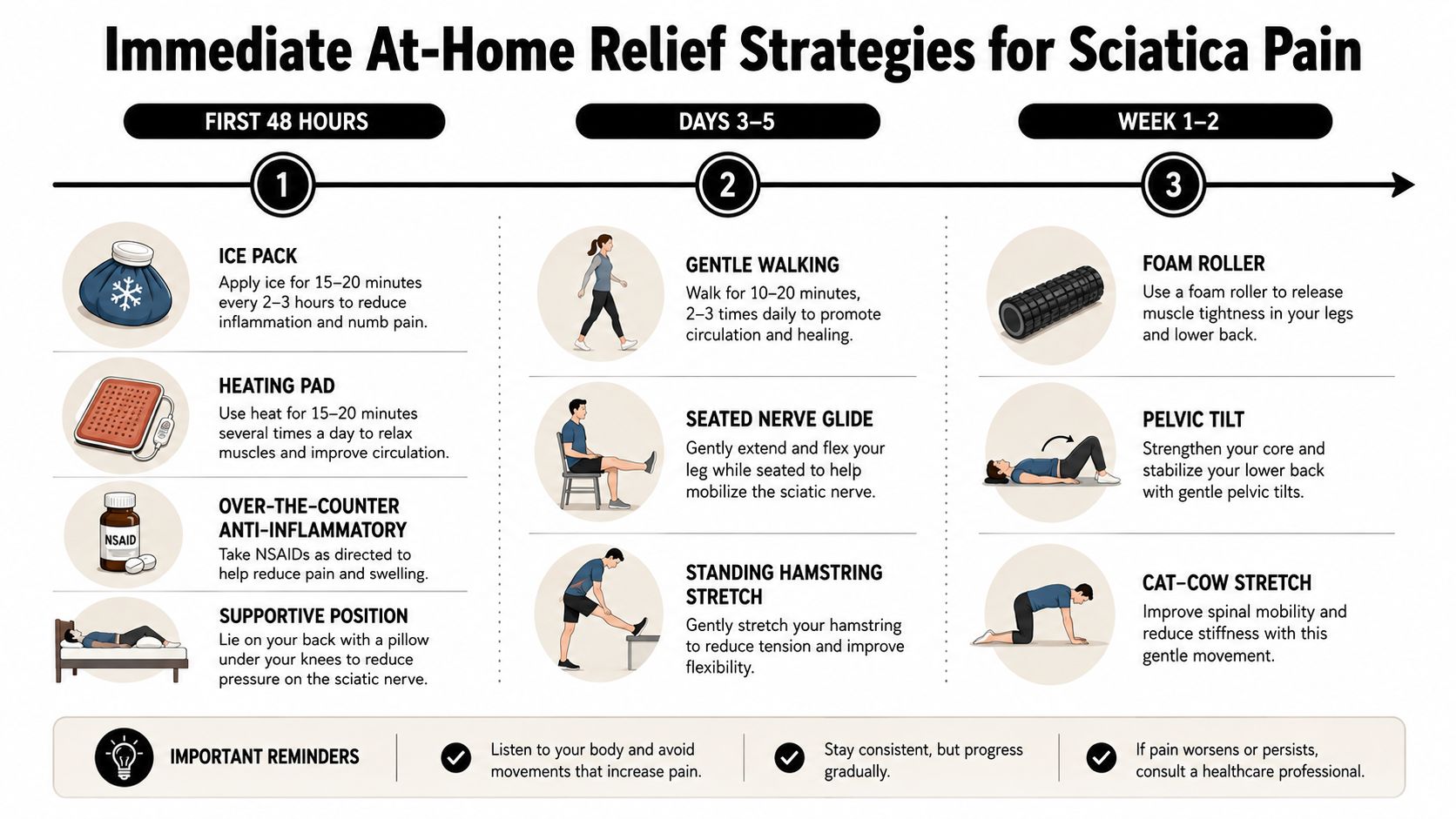
On day one and day two, take brief walks around your home if walking does not increase leg symptoms. Avoid repeated bending, heavy lifting, forceful twisting, and prolonged sitting. For further practical ideas, see this guide to relieving sciatica pain quickly. Apply any home strategy only when symptoms remain stable or improve.
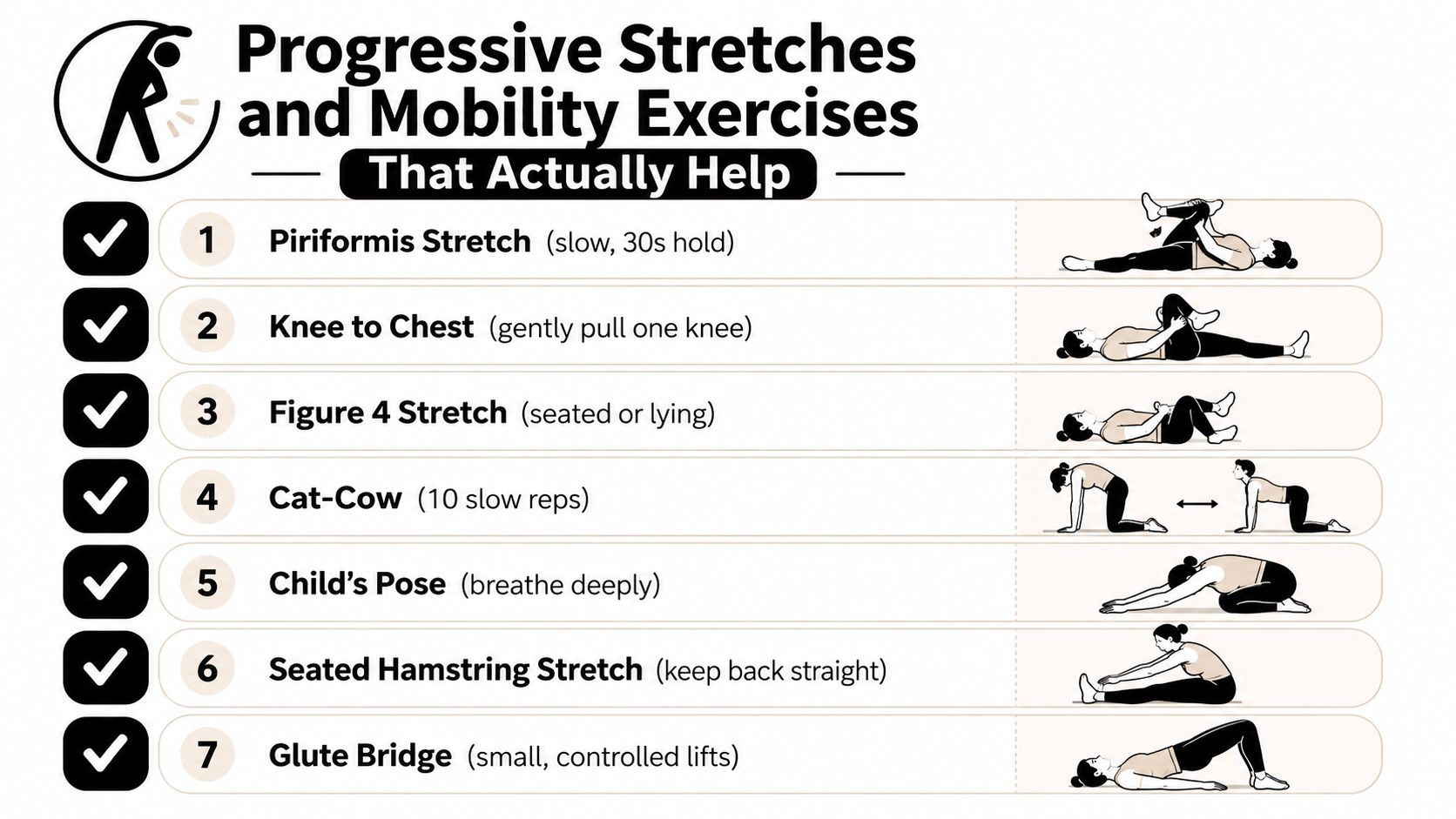
Progressive Stretches and Mobility Exercises That Help
Once the sharpest symptoms have settled, movement can support recovery. The right choice depends on how the nerve responds, not on how popular an exercise is. Forceful hamstring stretches, deep forward folds, and repeated movements that send pain farther down the leg can irritate a sensitive nerve.
A 2015 systematic review and meta-analysis found that exercise produced a statistically significant short-term reduction in leg pain compared with advice to stay active, with a weighted mean difference of 11.43 points on a 0 to 100 scale across five trials. It did not improve disability, and long-term differences were not meaningful (2015 sciatica exercise review). Exercise is useful self-management, but it is not a guaranteed cure.
Use symptom response to choose direction
Test one movement at a time and monitor what happens. If gentle extension, such as lying on your stomach and propping on your elbows, reduces leg pain or draws it closer to your back, extension may suit your current symptoms. Stop repeating it if pain increases or travels farther down the leg. Some people tolerate a supported forward position better, especially when standing and walking are aggravating.
Start with a small range. Reassess later that day and again the next day before adding another movement.
- Prone press-up: Lie on your stomach with your hands under your shoulders. Press your chest upward while keeping your pelvis heavy on the surface. Stop before your hips lift. A reduction in leg symptoms is encouraging. Use a smaller range or omit the exercise if pain moves farther down the leg.
- Supine piriformis stretch: Lie on your back, cross one ankle over the opposite thigh, and draw the supporting leg toward you. The stretch should remain in the buttock, without a sharp line of pain down the leg. Hold for at least 30 seconds, following the stretching guidance described by Mayo Clinic, only while the position stays comfortable.
- Seated sciatic nerve glide: Sit upright. Slowly straighten the symptomatic knee while lifting your chin, then bend the knee as you gently look down. Move the head and knee in opposite directions. Keep the repetitions fluid instead of holding the nerve under tension.
- Standing hip flexor stretch: Step one foot back, soften both knees, and gently tuck the pelvis. Shift forward until you feel the stretch at the front of the back hip. Keep the lower back from arching to create more range.
- Cat-cow mobilization: On your hands and knees, slowly round and extend the spine within a comfortable range. Breathe steadily and stay controlled. Reduce the range if either direction increases leg pain.
Choose one or two suitable movements rather than completing the entire list in one session. Use a 48-hour response rule. If symptoms are calmer or stable afterward and the following day, the movement may be appropriate. If leg pain intensifies, spreads farther, or leaves you more irritable, reduce the range, lower the volume, or stop that exercise.
A systematic review of 18 studies involving 2,699 people with clinically diagnosed sciatica found that physiotherapy interventions were better than minimal intervention for long-term pain reduction. They were not superior to more substantial interventions for short- and medium-term pain and disability (systematic review of physiotherapy interventions). Progress should therefore match symptom severity. Mild, stable symptoms may tolerate mobility work, while spreading leg pain calls for a simpler program and professional assessment rather than more exercises.
If limited hip, ankle, or spinal motion may be influencing symptoms, a structured mobility self-assessment NexiHerb LLC can provide observations to discuss with a qualified professional. A foam roller may ease surrounding muscle discomfort, but use it gently and never directly over the spine or painful nerve symptoms. This guide to a foam roller for physical therapy offers setup ideas.
Daily Habits and Ergonomic Changes That Reduce Nerve Pressure
Exercise may take only a small part of the day. Your chair, car seat, sleep position, and lifting technique can determine whether irritated tissues have time to settle. Match the adjustment to your symptoms rather than changing everything at once.
Start with sitting. A rounded pelvis and prolonged hip flexion can keep symptoms active, while a wallet or phone in the back pocket creates an uneven seat surface. Use a supportive chair, keep both feet grounded, and change position before leg symptoms build. A rigidly perfect posture is less useful than regular, comfortable movement.
For remote work, place the monitor directly in front of you. Keep the keyboard close enough for your shoulders to relax, and add a small lumbar roll if the chair lacks lower-back support. A sit-stand desk can provide another position, but standing still for long periods is not a cure. Alternate sitting and standing, then take short walking breaks. These functional home office tips can help arrange a workspace that makes movement easier.
Driving requires similar choices. Move the seat close enough that you do not reach for the pedals, keep the backrest supportive, and use a thin lumbar cushion if the seat encourages slumping. On a long commute, stop when practical to stand and walk instead of waiting until symptoms become severe.
| Daily Habit | Why It Aggravates Sciatica | Ergonomic Swap |
|---|---|---|
| Slouching in a deep chair | Keeps the lower back rounded and increases sustained tissue stress | Use lumbar support and sit with hips slightly higher than knees |
| Wallet in the back pocket | Tilts the pelvis and loads one side unevenly | Remove it before sitting or driving |
| Repeated bending from the waist | Combines spinal flexion with load | Move closer, bend through the hips and knees, and keep the object near you |
| Sleeping twisted on the stomach | Holds the pelvis and spine in rotation | Try side-lying with a pillow between the knees or supported back-lying |
| Sitting through a workday | Prevents symptom-guided movement and reinforces stiffness | Alternate sitting, standing, and brief walks |
| Lifting a child or laundry basket with straight legs | Places the load far from the body and increases strain on the lower back | Use a hip hinge, keep the load close, and turn with your feet |
The aim is not to eliminate every comfortable position. Reduce the time spent in positions that steadily increase leg symptoms, then adjust again as your tolerance improves.
Alternative Therapies Worth Considering for Stubborn Sciatica
Alternative care can be useful when symptoms persist, but it should complement a reasoned exercise and activity plan. It shouldn't replace neurological screening or become an expensive sequence of treatments chosen without a working diagnosis.
Acupuncture has the most relevant evidence among the options listed for a specific subgroup. Recent guidance describes benefit in chronic sciatica, including a randomized trial in which pain and function improvements persisted to 52 weeks, but the finding mainly applies to chronic herniated-disc sciatica rather than every person with radiating leg pain (clinical guidance on chronic sciatica and acupuncture). That makes acupuncture reasonable to discuss when symptoms are chronic and a clinician has assessed the likely cause.
Chiropractic adjustments may help selected patients when joint restriction or movement-related back pain contributes to the presentation. They can't be assumed to remove a disc-related nerve compression after one visit. A responsible provider should review symptoms, test strength and sensation, explain alternatives, and combine manual care with movement rather than selling adjustments as a standalone solution.
Shockwave therapy and soft-tissue techniques such as dry needling or cupping may be considered when muscle guarding or local soft-tissue pain is prominent. Evidence and patient response vary, and these approaches shouldn't be applied directly to a highly irritable nerve or used to push through worsening symptoms. Dry needling is best understood as one physical therapy tool, not a diagnosis or a cure. This explanation of dry needling in physical therapy may help you understand where it fits.
| Therapy | Best For | Sessions Needed | Evidence Strength |
|---|---|---|---|
| Acupuncture | Selected chronic cases after assessment | Depends on response and clinical plan | Promising for specific chronic subgroups |
| Chiropractic care | Movement-related pain or suspected joint contribution | Individualized, with reassessment | Mixed and diagnosis-dependent |
| Shockwave therapy | Selected persistent soft-tissue problems | Individualized | Mixed for sciatica itself |
| Dry needling | Muscle guarding alongside exercise | Individualized | Adjunctive and variable |
| Cupping | Short-term muscular comfort for some patients | Individualized | Limited and variable |
| Physical therapy | Graded movement, strength, function, and education | Progressed according to goals | Supports staged, individualized care |
Be cautious with any clinic that promises immediate nerve decompression, guarantees a fixed result, or recommends a large package before examining you.
Red Flags That Mean You Need Professional Care Right Away
Not every shooting leg pain episode is routine sciatica. Radiating pain can occur with nerve irritation, but certain changes indicate that self-care is no longer an appropriate first step.
Go to an emergency department immediately for new loss of bladder or bowel control, numbness in the groin or saddle region, or rapidly worsening weakness in one or both legs. These symptoms can signal severe nerve compression, including cauda equina syndrome, where delays may increase the risk of permanent neurological damage.
Progressive foot drop, an inability to stand on your toes, or weakness that is clearly getting worse also requires urgent assessment. Bilateral symptoms appearing together deserve prompt medical attention, particularly when they develop rapidly.
Other warning signs
Pain after a significant fall or accident should be assessed rather than treated solely at home. Back pain with fever, systemic illness, or unexplained weight loss can point to infection or another serious condition and needs clinician review.
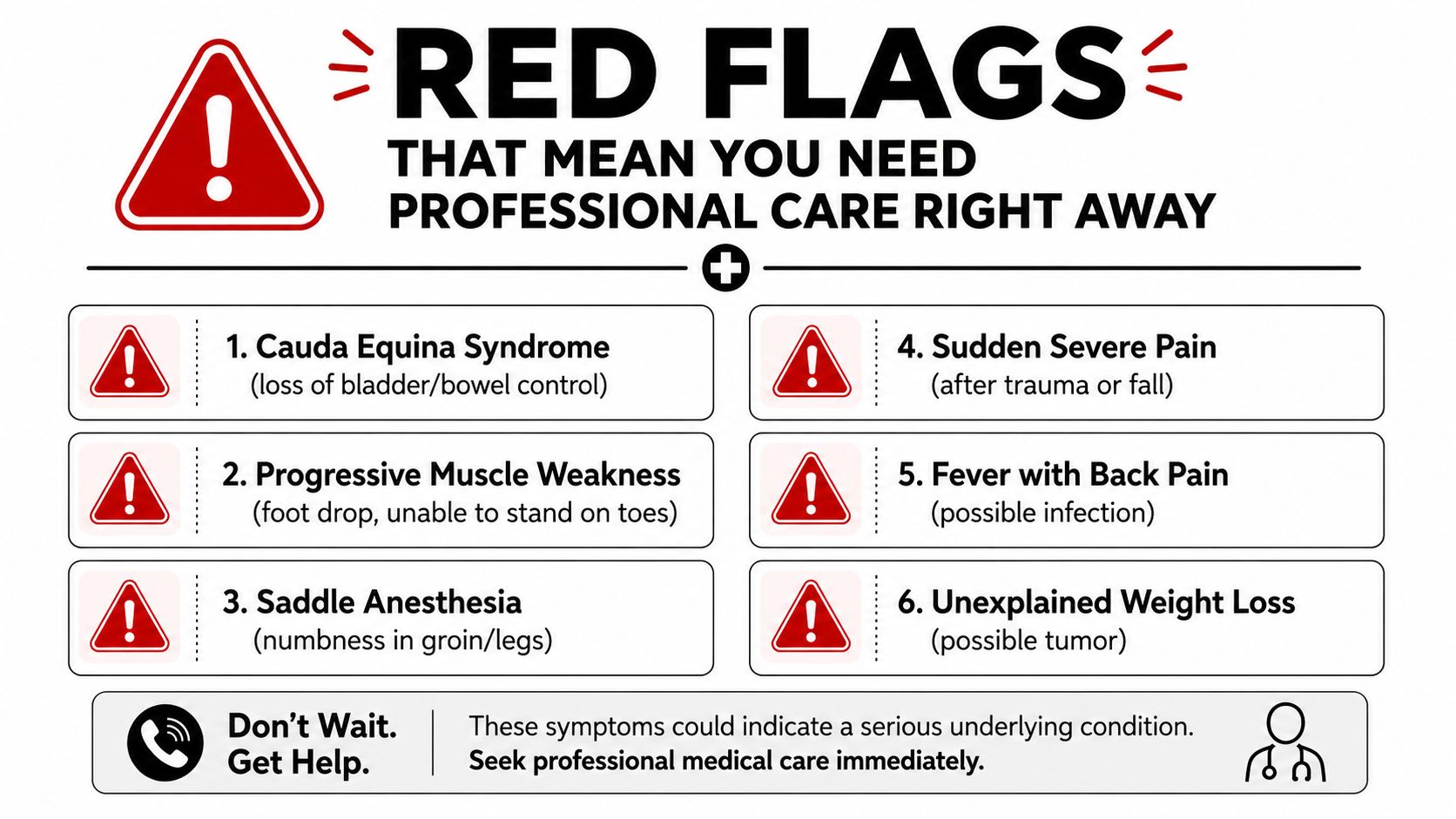
Use an emergency department for bladder or bowel changes, saddle anesthesia, severe trauma, or rapidly progressing weakness. Contact urgent care or your primary clinician promptly for fever, unexplained weight loss, new significant numbness, or pain that is escalating. A scheduled physical therapy or specialist assessment may be suitable for persistent symptoms that remain stable but aren't improving.
Natural treatment is appropriate only after serious causes and significant neurological compromise have been considered and ruled out by a qualified clinician.
Imaging isn't automatically needed for every new episode. It becomes more relevant when symptoms persist, worsen, follow trauma, or include neurological findings that require clarification.
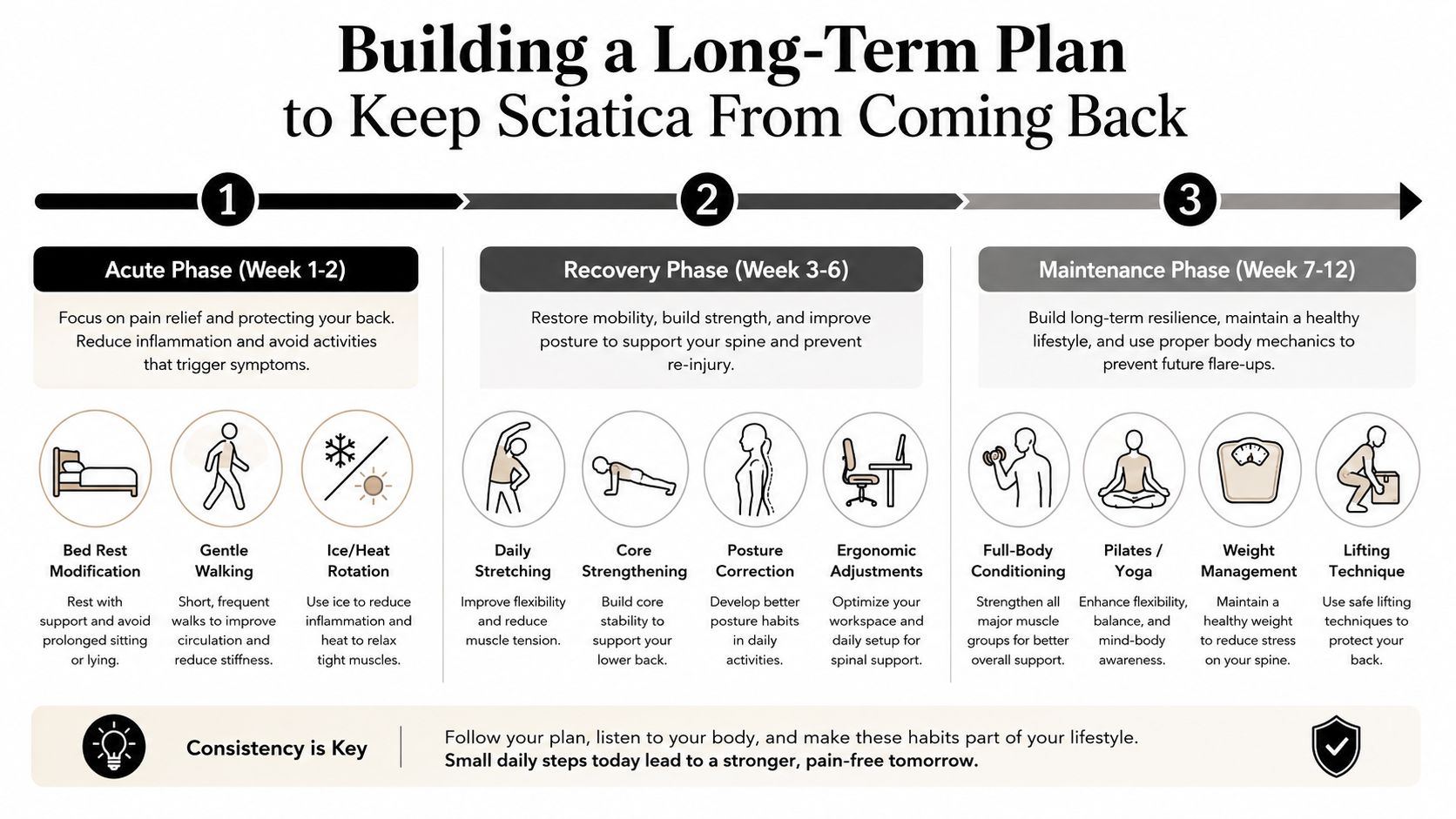
Building a Long-Term Plan to Keep Sciatica From Coming Back
Recovery should be judged by function, not by waiting for every sensation to vanish. A useful plan matches treatment intensity to your symptoms. As walking, sitting, bending, and daily tasks become easier without pain traveling farther down the leg, progress gradually.
A staged recovery timeline
Days 1 to 7: Remove positions that aggravate symptoms, rest with support, and avoid spending the entire day in bed. Take brief walks as tolerated. Use only movements that calm symptoms or bring them closer to the back. Cold may help early, while heat can be useful when stiffness and muscle guarding become the main problem.
Weeks 2 to 4: Extend walking and reintroduce mobility exercises that produced a calm response over the following 48 hours. Keep the range controlled. Stop a movement if numbness, weakness, or radiating pain increases. Consistency matters more than force.
Weeks 5 to 8: If symptoms are stable, add small controlled bridges, abdominal bracing, and hip-hinge practice. Change one variable at a time, such as repetitions, walking duration, or resistance. A worsening leg symptom means the program needs adjustment, regardless of the calendar.
Weeks 9 to 12 and beyond: Build regular full-body conditioning, mobility, and lifting practice. Pilates, yoga, swimming, and resistance training may fit, depending on your symptoms and ability. The right activity is one you can repeat without repeatedly provoking a flare.
For Deerfield Beach residents, prevention must fit everyday routines. Break up prolonged sitting during I-95 commutes, warm up before beach activities, and avoid pairing a long inactive day with sudden heavy lifting, paddleboarding, or other water sports. Afterward, walk gently and check whether symptoms stay local or begin traveling farther down the leg.
Keep a simple maintenance checklist:
- Walk or perform comfortable low-impact activity.
- Practice one mobility movement suited to your directional preference.
- Strengthen when symptoms are stable.
- Use a hip hinge for lifting and keep loads close.
- Change sitting and standing positions throughout the day.
- Arrange an assessment if weakness, numbness, or radiating pain progresses.
The best natural plan is usually the smallest one you can follow reliably. Exercise may improve pain in the short term, but it does not guarantee better function or prevent every recurrence. Reassess if progress stalls rather than adding more remedies at once.
MedAmerica Rehab Center provides individualized physical therapy, chiropractic care, acupuncture, and shockwave therapy for sciatica and related back pain. If symptoms persist, restrict daily activity, or need a safer progression, visit MedAmerica Rehab Center to arrange an assessment in Deerfield Beach.
MedAmerica Rehab · Deerfield Beach
Talk to a clinician about your pain
Physical therapy, chiropractic, acupuncture and shockwave therapy under one roof, since 1995. Same-day appointments are available.
Mon–Thu 8:00 AM – 6:30 PM · Fri 8:00 AM – 3:00 PM