
Individualized Treatment Plans: Faster Recovery Awaits
You wake up stiff, try a few stretches you found online, sit through work, then realize the pain is back by lunch. A friend says to rest. Another says to push through it. A video tells you to strengthen your core. A different one says your hips are the problem. After a while, the advice starts to blur together, and none of it feels like it was meant for your body, your job, or your day.
That's where many people get stuck. The problem isn't always lack of effort. It's that generic advice treats recovery like everyone is dealing with the same injury in the same life.
A good rehab plan doesn't work that way. It starts with what hurts, but it doesn't stop there. It asks what makes your symptoms worse, what you need to get back to, what you can realistically do each week, and what signs show the plan is working. That's what individualized treatment plans are for. Not as a buzzword, but as a working blueprint that changes as you do.
Beyond One-Size-Fits-All Your Recovery Deserves a Custom Plan
A lot of patients come in after doing everything they were told should help. They bought the brace. They tried the stretch routine. They rested for a few days, then overdid it on a “good” day and ended up right back where they started.
That cycle is common with back pain, neck pain, sciatica, arthritis flare-ups, and post-injury stiffness. It's frustrating because the advice isn't always wrong. It's just incomplete. The same exercise that helps one person can irritate another if the driver is different, the timing is wrong, or the dose is too much.

Why generic plans fall apart
Two people can both say, “My lower back hurts,” and need very different care.
One may have pain mostly after sitting, with weak trunk control and poor desk setup. Another may feel worse with standing and walking, with hip stiffness and limited tolerance for loading. If both get handed the same printout, one might improve and the other might feel discouraged.
That's why individualized treatment plans matter. They're built for one person, not for a diagnosis label alone.
Generic rehab often fails for a simple reason. It treats the body part but ignores the person attached to it.
What a custom plan changes
Instead of asking, “What do people with this condition usually do?” a therapist asks better questions:
- What is your real goal: Do you want to sleep without shoulder pain, walk the grocery store without stopping, return to pickleball, or get through a work shift without your back tightening up?
- What are your barriers: Is your schedule packed, your commute long, your home full of stairs, or your energy low by the end of the day?
- What pattern do your symptoms follow: Morning stiffness, pain with lifting, numbness after driving, swelling after activity, or fear of movement after surgery all point care in different directions.
The result is more useful than a standard list of exercises. It becomes a plan you can follow, with a reason behind each step.
That's the part people often feel relief about first. Not that everything is fixed on day one, but that the plan finally makes sense.
What Makes a Treatment Plan Truly Individualized
An off-the-rack suit can look decent from a distance. A custom-fit suit fits your shoulders, sleeve length, waist, and how you move. Rehab works the same way. A basic program may check a box, but an individualized plan fits your symptoms, goals, limits, and progress.
A real plan starts with a structured assessment and gets turned into SMART goals, meaning specific, measurable, achievable, relevant, and time-bound. It also assigns interventions, frequency, and review dates so progress can be documented and adjusted, rather than relying on vague “feel better” goals, as described in this guidance on SMART treatment planning in behavioral health.
The parts that actually matter
A diagnosis is only one piece. A useful plan also includes:
- Your functional goal: “Walk my dog for twenty minutes” is more actionable than “improve mobility.”
- Your starting point: Pain pattern, movement limits, balance, strength, tolerance for activity, and daily triggers.
- Your real schedule: A home routine that takes too long usually doesn't get done.
- Your response to care: What calms symptoms, what aggravates them, and how long any flare lasts.
If you've ever felt like rehab was happening to you instead of with you, this is the difference.
Generic plan vs individualized plan
| Feature | Generic Rehab Plan | Individualized Treatment Plan |
|---|---|---|
| Starting point | Based mostly on diagnosis | Based on assessment findings, goals, and daily demands |
| Goals | Broad goals like pain relief | SMART goals tied to real activities |
| Exercises | Same set for many patients | Selected for your movement pattern and tolerance |
| Schedule | Fixed expectations | Adjusted to your work, recovery, and consistency |
| Progress review | Informal or occasional | Planned check-ins with clear review points |
| Changes over time | Often slow to change | Updated based on response and function |
What collaboration looks like
An individualized plan is not just customized by the clinician. It's also shaped by the patient. If getting on the floor matters because you want to play with your grandkids, that belongs in the plan. If your shoulder only hurts when reaching into the back seat, that matters too.
For many patients, one-to-one therapy sessions make this process easier because there's room to fine-tune technique, pacing, and progression without rushing past the details.
Practical rule: If a treatment plan can't explain what you're working toward, how progress will be checked, and when it will be revised, it isn't individualized enough.
Your Rehab Journey From First Visit to Final Goal
Starting rehab feels easier when you know what will happen. Many people expect one quick exam and a sheet of exercises. Good care is more structured than that.
There's a long clinical history behind written treatment planning. Formal Individual Treatment Plans, or ITPs, developed as part of a shift toward care that specifies goals, service type, service intensity, and progress monitoring, moving treatment from generic to person-specific, as outlined by the Minnesota Department of Human Services on Individual Treatment Plans.
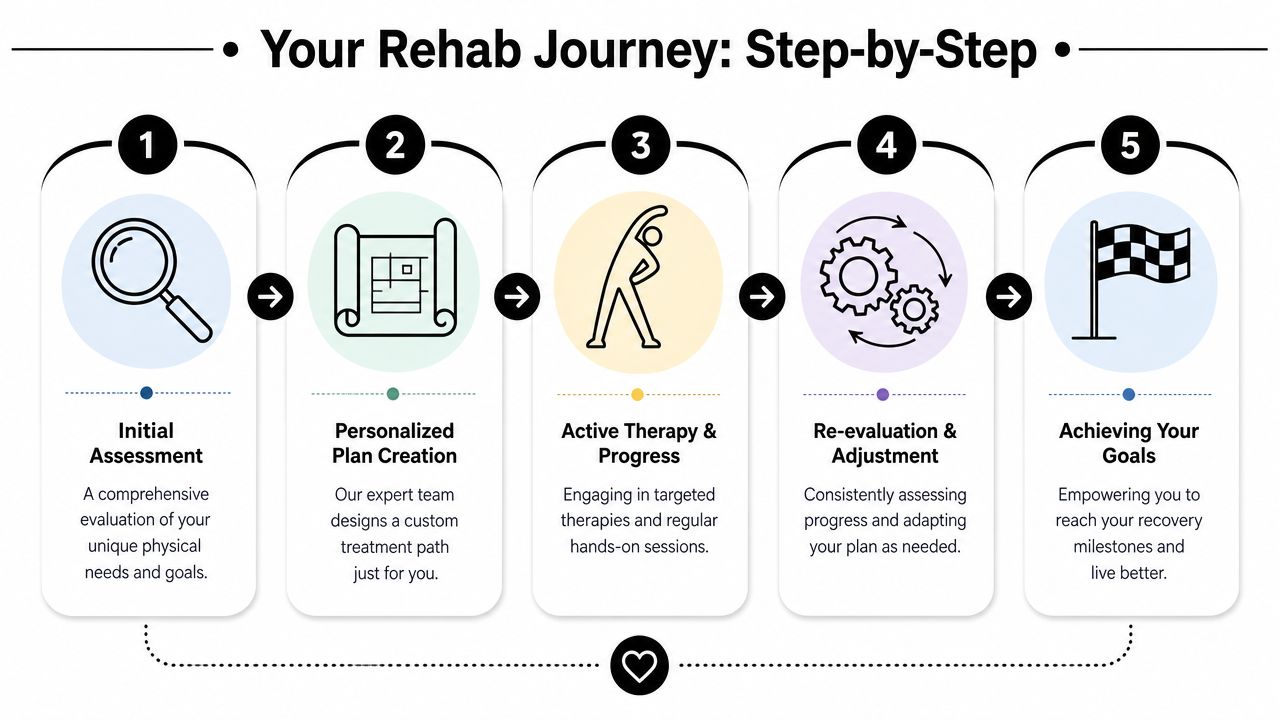
Step one begins with your story
The first visit isn't just about where it hurts. It's about how the problem behaves.
A therapist looks at movement, strength, stiffness, balance, symptom triggers, and what your day asks of you. Sitting all day at a desk creates one set of problems. Repeated lifting, driving, caregiving, or recovering after surgery creates another.
Important details often include:
- What started it: Was it gradual, sudden, post-surgical, or after an accident?
- What sets it off: Sitting, stairs, lifting, sleep position, turning your head, or long walks.
- What you need back: Work duties, exercise, housework, golf, driving, or confidence walking without fear of falling.
The plan takes shape together
Once the assessment is done, treatment decisions get more practical. The question becomes, “What should we target first?”
That may mean calming pain before building strength. It may mean restoring motion before loading a joint. It may mean improving walking tolerance before adding more advanced exercise. This is also where real-life constraints matter. If someone can only commit to a certain schedule, the plan has to be built around what's sustainable.
If you're new to rehab and want a clearer sense of the day-to-day process, this overview of what a typical physical therapy session looks like gives a useful picture of what patients can expect.
The best plan on paper still fails if it doesn't fit your week, your energy, and your responsibilities.
Progress review is part of treatment, not an extra
Once therapy starts, the plan should keep evolving. If mobility improves but walking still flares your pain, something needs to change. If strength is coming back but swelling increases after each session, the dosage may be wrong. If pain decreases but function hasn't improved, the treatment may be helping symptoms without solving the main limitation.
That review process is one reason coordinated care matters across healthcare settings. Practices trying to attract new medical patients often focus on access and communication because patients don't just want treatment. They want a system that tracks progress and responds when reality doesn't match the original plan.
The finish line is functional
Discharge shouldn't mean “you completed visits.” It should mean you reached the goals that matter for your life, or you've progressed enough to manage independently with confidence.
For one person, that's picking up a grandchild safely. For another, it's returning to work duties, getting through a tennis match, or walking through the house without feeling unsteady. The destination changes. The point is that it's yours.
Individualized Plans in Action Three Patient Stories
The easiest way to understand individualized treatment plans is to see how differently they work from one person to the next. Same clinic. Same broad goal of getting better. Very different paths.
High-quality plans are collaborative and adaptive. They include the patient's goals, history, strengths, barriers, and response to care, then update the treatment mix as symptoms, side effects, or functional status change, as explained in this overview of collaborative and adaptive treatment planning.
The desk worker with stubborn back pain
A patient comes in with lower back pain that has dragged on for months. He's already tried rest, random stretches, and a few strength videos online. Some days he feels looser. Then one long day at the computer wipes out the progress.
A generic plan might focus only on “back exercises.” An individualized one asks a different question. Why does the pain spike after sitting, and what happens when he stands up, bends, drives, or lifts?
His treatment may need several moving parts:
- Movement correction: Exercises aimed at the pattern that reproduces and relieves symptoms.
- Workday strategy: Changes to sitting setup, break timing, and how often he resets posture or stands.
- Load tolerance: Gradual strengthening that matches what his back can handle now, not what it handled years ago.
The goal isn't to turn him into a different person. It's to help his back handle his actual work life.
The knee replacement patient who needs progression, not guesswork
A post-operative patient often starts with pain, swelling, stiffness, and uncertainty. Early care may emphasize gentle motion, walking quality, quad activation, and confidence with transfers or stairs.
But that early phase shouldn't last forever. Once healing milestones and function improve, the plan needs to evolve. The focus may shift toward strength, endurance, balance, and returning to normal daily tasks.
What doesn't work is staying stuck in the same low-level routine just because it feels safe. What also doesn't work is jumping ahead too quickly and irritating the joint. Good progression lives in the middle.
A changing plan doesn't mean the first plan failed. It usually means the clinician is paying attention.
The older adult working on balance and fall prevention
Balance training gets called “general” care too often. It shouldn't be.
One older patient may be unsteady mainly in low light. Another may struggle when turning quickly. Another may move well in the clinic but lose confidence around rugs, stairs, or carrying laundry at home. Vision issues, medication effects, leg weakness, arthritis, and fear of falling all change the plan.
An individualized balance program might include:
- Targeted balance tasks: Standing, turning, stepping, and reaching based on the exact situations that feel unsafe.
- Strength and gait work: Training legs and walking mechanics to support stability.
- Environmental problem-solving: Looking at footwear, home setup, and daily routines that increase fall risk.
That's why “fall prevention exercises” by themselves aren't enough. The plan has to match where the risk shows up.
Your Treatment Experience at MedAmerica Rehab Center
You come in expecting treatment for one problem, then the first conversation brings out the complete situation. Your back hurts, but the harder issue is sitting through a commute. Your shoulder is healing, but sleep is poor and work still needs to get done. That is usually how rehab starts in practice.
At MedAmerica Rehab Center, the treatment experience is built around those details. The first plan is a starting point, not a script to repeat for six weeks. Clinicians look at what is limiting you most right now, what is improving, and what is getting in the way at home, at work, or during daily routines. Then the plan changes on purpose.
A big part of good care is setting priorities when several needs compete. Pain may need attention first if it is disrupting sleep and making every exercise harder. In another case, restoring motion comes first because walking, reaching, or turning is still too restricted to build strength well. Sometimes the limiting factor is not tissue healing at all. It is fear of reinjury, poor tolerance for activity, or a work demand that keeps flaring symptoms.
That is why a clinic that offers physical therapy, chiropractic care, acupuncture, and other rehab services can be useful in complex cases. The goal is not to stack on more visits. The goal is to choose the approach that fits the current barrier, then change course when your response shows another need has moved to the top of the list.
Patients usually notice this in practical ways.
- The plan fits real life: Home exercises match your schedule, space, and energy instead of reading like an ideal week that never happens.
- Progressions have a reason: We do not push harder just because time passed. We progress when pain irritability, movement quality, and task tolerance support the next step.
- Rechecks shape the next visit: If stairs are improving but standing at work still causes trouble, treatment shifts toward the demand that is still limiting you.
- Work goals are handled directly: If your recovery affects job duties, tools such as a functional capacity evaluation for work-related planning can help define safe limits and next steps.
That last point matters. Patients often have goals that pull against each other. You may want faster pain relief, but you also need enough activity to rebuild strength. You may want to return to work quickly, but not at a level that causes a setback. Good rehab means sorting out those trade-offs with you, not pretending they do not exist.
What patients tend to remember is simple. Someone listened, explained the plan in plain language, and adjusted it when their real-world response called for a change. That is what individualized care should feel like.
How We Measure Success and Adapt Your Plan
Patients often ask a fair question. “How will we know this is working?” The right answer is more specific than “Let's give it time.”
Modern treatment planning is moving toward more explicit, measurable goals and multi-disciplinary planning, with attention to what data should trigger a change, such as pain scores, function, adherence, mobility gains, or return-to-work progress, as outlined in this discussion of measurable goals and treatment plan revision.
The signals clinicians watch
A plan may need revision when the data and your lived experience stop lining up. In rehab, that usually includes a mix of objective and subjective markers.
Common examples include:
- Pain pattern: Not just pain level, but whether it's becoming less frequent, less intense, or easier to calm down.
- Function: Can you walk farther, get out of a chair more easily, lift with less hesitation, or tolerate a longer workday?
- Mobility and movement quality: Are you moving more freely, or still guarding the same motions?
- Adherence: Are you able to follow the program as written, or is the plan too demanding for your week?
For patients with job-related limitations, return-to-work questions can overlap with broader performance testing. In those cases, learning about a functional capacity evaluation can help clarify how work ability may be assessed.
When change is the right call
If a patient is consistent but not progressing, the answer may be to change the exercise dose, shift the treatment focus, modify the home plan, or reassess what barrier is most important. If symptoms are improving but function isn't, the next phase may need more task-specific work. If function is improving but recovery is too slow for a major life demand, the team may need to tighten priorities.
A treatment plan should be stable enough to give your body time to respond, but flexible enough to change when the evidence says it should.
That's not guesswork. That's the whole point of individualized care.
Frequently Asked Questions About Your Treatment
Will insurance cover treatment?
Coverage depends on your plan, referral rules, and the type of rehab you need. Front desk staff can usually verify benefits before your first visit, and that helps prevent surprises about copays, visit limits, or authorization requirements.
How long are appointments and how often will I come in?
That depends on what you are working on and how your body responds in the first few visits. A patient with recent surgery may need closer supervision early on, while someone with a mild overuse problem may do well with fewer visits and a stronger home program. If progress is steady, visits often spread out over time. If pain flares, exercise tolerance drops, or a return-to-work deadline gets closer, the schedule may need to change.
What should I wear to the first visit?
Wear comfortable clothes that let your therapist see the area being treated and watch how you move. Shorts are useful for knee, hip, or ankle problems. A tank top or loose T-shirt helps with shoulder or neck care. Supportive shoes are a good idea if walking, balance, or exercise testing may be part of the visit.
What should I bring?
Bring your ID, insurance card, referral or prescription if your plan requires one, and any imaging reports or past therapy notes you already have.
It also helps to bring a simple list of what makes symptoms worse, what time of day is hardest, and what you need to get back to doing. That information often shapes the plan faster than people expect.
What questions should I ask my therapist?
Good questions make treatment more useful. They also help you understand why the plan may change over time instead of staying fixed from day one.
- What are we treating first? Pain control, joint motion, strength, balance, stamina, or a specific daily task?
- How will you know if this is working? What signs are you watching in the clinic and at home?
- What change should happen first? Less pain after activity, easier walking, better sleep, more confidence, or improved strength?
- What would make you change the plan? A symptom flare, missed milestones, poor exercise tolerance, or a new work or family demand?
- If my goals compete, what gets priority first? For example, pain relief versus strength building, or faster progress versus avoiding a setback?
- What should I do at home if my week gets busy? Which one or two exercises matter most?
What if my progress is slower than I expected?
That does not automatically mean treatment is failing. Recovery rarely moves in a straight line. Sometimes pain improves before strength does. Sometimes strength returns, but bending, reaching, or endurance still lag behind. In practice, we look at the pattern, not one rough day.
A slower course usually leads to a plan adjustment, not a dead end. The therapist may reduce exercise volume, change the order of priorities, add more hands-on treatment, simplify the home program, or spend more time on a task that matches your real day, such as stairs, lifting, or getting through a work shift.
If you are ready for care that reflects your actual progress, setbacks, schedule, and goals, MedAmerica Rehab Center can help. Treatment plans are built to change for a reason. They should match what your body is doing now, not what it was doing on evaluation day. Call to schedule your first visit, and we will help you start with a plan that fits your life and can be adjusted as your recovery unfolds.
MedAmerica Rehab · Deerfield Beach
Talk to a clinician about your pain
Physical therapy, chiropractic, acupuncture and shockwave therapy under one roof, since 1995. Same-day appointments are available.
Mon–Thu 8:00 AM – 6:30 PM · Fri 8:00 AM – 3:00 PM