
Suspension Training Equipment: A Rehab Guide for Pain Relief
A 42-year-old desk worker arrives with the same complaint many patients bring: recurring lower back pain, several rounds of stretching, and core classes that helped briefly but never changed how the back felt during a workday. The natural question is whether suspension training equipment can provide something different, or whether unstable straps will add another challenge to an already irritated body.
Suspension training can be useful, but it isn't a universal answer. The equipment gives a therapist a practical way to adjust bodyweight resistance through body angle, strap length, foot position, and hand support. That makes it less like a generic fitness gadget and more like a clinician-tuned loading tool. The right setup can make an exercise accessible, while a poorly chosen angle can turn a manageable movement into an unnecessary provocation.
What Suspension Training Equipment Does in a Rehab Plan
Suspension training equipment consists of anchored straps with handles or foot cradles. The user supports part of their bodyweight through the straps while the feet or hands remain connected to the floor, creating a closed-chain exercise that can be modified without adding plates or dumbbells.
For the desk worker with recurring back pain, a therapist might begin with an upright supported squat, a gentle standing row, or a shallow chest press. The straps provide balance and feedback, while the therapist adjusts the lean so the patient can practice controlled movement without exceeding current tolerance. As strength and confidence improve, the patient can gradually move into a more demanding angle.
Why clinicians use straps
Machines can isolate movement effectively, but their fixed paths don't always match a patient's needs. Floor exercises can be valuable, but getting down and up may be uncomfortable for someone with back, knee, or hip symptoms. Straps sit between those options. They offer support, movement freedom, and a way to change loading from session to session.
Biomechanical research on suspended push-ups found that changing body inclination and strap length shifts load distribution between the upper and lower extremities. That matters in rehabilitation because the therapist can alter the demand without abandoning the movement altogether. A patient who can't tolerate a deep chest press may still practice the pattern from a more upright position.
Suspension work also creates an unstable environment. That instability can increase the demand on trunk and shoulder stabilizers, but more activation isn't automatically better. It must serve a specific goal, such as improving scapular control, trunk endurance, or dynamic balance.
Clinical perspective: Straps work best when they solve a loading problem. They shouldn't be added merely because an exercise looks more advanced.
Patients comparing suspension systems with other home or clinic tools may also benefit from a broader guide on how to choose recovery gear. The important question isn't which product looks most versatile. It's whether the equipment can be anchored safely and adjusted precisely enough for the person's current condition. A therapist may also compare straps with a standard exercise machine when a more stable or guided movement is appropriate.
Understanding Suspension Training Equipment and Its Main Types
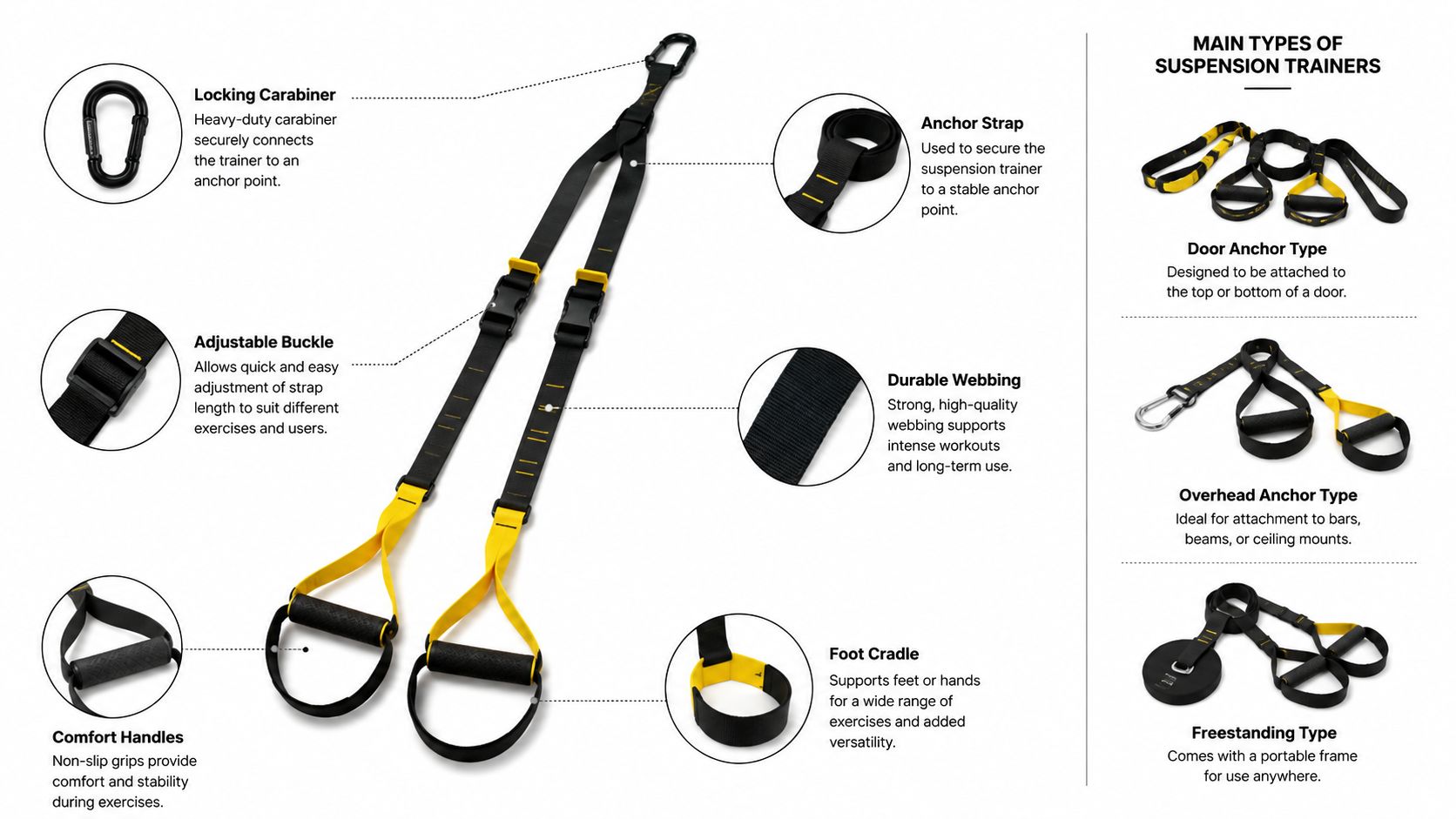
In plain terms, a suspension trainer is a pair of adjustable straps connected to an anchor. The straps may end in rigid handles for the hands, foot cradles for the feet, or both. Most systems attach overhead to a door anchor, wall mount, ceiling point, beam, rack, or other structure designed to tolerate the expected load.
The main equipment categories
A single-anchor home system is compact and generally uses one attachment point. It suits basic rows, supported squats, standing presses, and similar drills. A commercial TRX-style system usually has rigid handles, adjustable webbing, and foot cradles designed for frequent use in a gym or clinic.
Doorway models often use a foam or fabric anchor that sits over the top of a closed door. They're convenient, but the door, frame, hinge direction, and anchor placement all matter. A hollow-core door or weak frame shouldn't be treated as a structural anchor just because the strap fits over it.
Clinic-grade rigs may offer multiple anchor points and more room to adjust height. That flexibility helps a therapist position a patient for supported balance work, upper-limb loading, or a controlled progression without repeatedly moving the entire setup.
Parts that deserve attention
- Adjustment buckles: These should lock firmly and release predictably. Uneven strap lengths can change the exercise and create unwanted rotation.
- Length markers: Markings help the patient reproduce the prescribed setup rather than guessing at each session.
- Handle orientation: Neutral, angled, or rotating handles can affect wrist comfort, especially when gripping irritates the hand or forearm.
- Foot cradles: The loop should support the foot without forcing the ankle into an uncomfortable position.
- Anchor rating: Use a mount or attachment designed for bodyweight loading. A decorative hook isn't a substitute for a rated anchor.
- Webbing and padding: Nylon and polyester webbing can both be durable when properly manufactured, while padded handles may be more comfortable for arthritic hands or long clinic sessions.
Most home units are sufficient for beginner rehabilitation drills if the anchor point has been verified and a clinician has selected appropriate movements. Facilities choosing equipment should also consider durability, cleaning, adjustment speed, and how the setup can boost member retention with the right gear. For patients who dislike gripping textured handles, a latex-free resistance band may be a better starting tool for certain exercises.
How Body Angle and Strap Length Change the Load
The central programming principle is simple: your body angle changes how much of your bodyweight the working muscles must control. In a standing row, a nearly upright position leaves more weight supported through the feet. Walking the feet forward and leaning farther back increases the portion of bodyweight handled by the arms and trunk.
The same idea works in a chest press. Standing closer to upright makes the movement easier. A more horizontal lean increases the demand on the pressing muscles and the stabilizers that keep the ribs, pelvis, and shoulders aligned. The therapist can therefore progress the exercise without immediately adding external resistance.
This isn't a precise percentage calculation for everyday treatment. It is a practical loading continuum. The angle should be selected according to symptoms, movement quality, and the patient's ability to repeat the motion without compensation.
Strap length changes more than difficulty
Strap length influences the range of motion and how freely the body can move beneath the anchor. Longer straps may allow a deeper body angle or a larger movement arc, while shorter straps can constrain the position and make an early-stage drill easier to control. The exact effect depends on the exercise and anchor height, so length should be recorded rather than changed casually.
A biomechanical analysis of suspended push-ups found that body inclination and strap length alter load distribution between the upper and lower limbs in the published analysis. That principle supports graded exposure for people rebuilding low-back, shoulder, or upper-limb capacity. The clinician can change one variable while keeping the rest of the exercise familiar.
Practical rule: Progress one control at a time. Change the body angle first, or adjust strap length first, but don't increase lean, narrow the stance, and add instability in the same session.
For rehabilitation, this adjustability is more important than the equipment's ability to produce an impressive-looking movement. The aim is a tolerable stimulus that can be repeated, monitored, and progressed when the patient's form and symptoms justify it.
Rehab Benefits for Common Back, Neck, and Joint Conditions
Suspension straps earn a place in rehabilitation when they help a patient practice a useful movement with a better balance of support and challenge. Their value varies by diagnosis, irritability, supervision, and the outcome being measured.
Low back pain
For nonspecific low back pain, supported squats, rows, hip hinges, and carefully scaled planks can build trunk and hip endurance while the patient learns to control the pelvis and ribcage. The straps may make standing exercise feel more secure than unsupported bodyweight work. They can also provide feedback when the patient loses alignment.
The evidence is more persuasive for improvements in strength, function, dynamic control, and exercise capacity than for suspension training as a direct pain cure. A review identified 26 eligible studies, including 22 experimental studies and 4 reviews, with participants ranging from approximately 13.2 ± 1.9 years to 80 years old in the indexed review. That breadth shows an expanding research base, but it doesn't mean every back-pain patient will respond in the same way.
Neck pain and cervical strain
Straps shouldn't be used as a way to load the cervical spine directly. A better application is scapular and thoracic training, such as a shallow chest press, supported row, or controlled Y-pattern selected by a clinician. These movements can encourage the patient to coordinate the shoulder blades and upper back without shrugging or bracing the neck excessively.
Electromyography research found greater upper trapezius activation with suspension equipment than with stable surfaces, with a pooled effect size of ES = 2.92, and reported greater serratus anterior activation when the feet were suspended rather than the arms in the meta-analysis. That finding supports careful programming, not automatic use. A patient with an irritable neck may need less upper-trapezius demand, not more.
Sciatica and radicular symptoms
Lumbar radiculopathy requires a more cautious approach. A neutral-spine position, shallow angle, and symptom monitoring may be appropriate once the patient has been assessed. Sustained flexion, aggressive hamstring loading, deep single-leg work, or any movement that increases radiating symptoms should be avoided until the clinician understands the neurological presentation.
For patients looking for a broader explanation of treatment options, this guide to physical therapy for back and neck pain provides useful context. Straps may complement the plan, but they don't replace neurological assessment.
Arthritis and post-operative recovery
Hip and knee arthritis may respond well to supported squats, sit-to-stand patterns, gentle weight shifting, and controlled mobility. The handles can reduce fear and provide balance while the joints experience a manageable amount of loading.
Post-operative shoulder or knee rehabilitation is phase-dependent. Suspension work may be useful later, but it isn't automatically suitable during the early protection period. The surgical protocol, tissue healing, range-of-motion restrictions, and surgeon's instructions take priority.
Safety Rules and Contraindications You Should Not Skip
A suspension trainer is only as safe as its anchor, setup, and prescription. The assumption that bodyweight equipment is automatically low-risk is wrong. A strap failure, door movement, uncontrolled swing, or poorly selected angle can create a fall or overload a healing joint.
Before every session, check the following:
- Anchor integrity: Confirm that the door, beam, wall mount, or rig is solid and intended for bodyweight loading.
- Hardware condition: Inspect webbing, loops, carabiners, buckles, handles, and foot cradles for fraying, cracking, or looseness.
- Door direction: If using a door anchor, position yourself so your pull reinforces the closed door and frame rather than pulling it open.
- Strap symmetry: Make sure both sides are adjusted to the intended length.
- Clear floor space: Remove obstacles and keep the feet positioned beneath the anchor when the exercise requires a centered stance.
- Symptom response: Stop if the movement produces sharp joint pain, increasing radiating pain, new numbness, or sudden weakness.
Who needs clinical clearance
Speak with a qualified clinician before using straps if you have an acute disc herniation with progressive neurological deficits, an unstable fracture, severe osteoporosis, uncontrolled hypertension, significant vertigo, pregnancy-related movement restrictions, or a recent joint replacement that remains within the surgeon's protected phase. These conditions don't all prohibit exercise, but they make unsupervised loading a poor choice.
Bowel or bladder changes, sudden weakness, and radiating leg pain with numbness require medical evaluation before strap work. Those symptoms call for assessment, not an improvised plank progression.
Novices should also avoid inverted positions, single-leg variations, deep suspended lunges, and advanced foot-cradle movements until a therapist has established adequate control. Suspended push-ups can increase torso stabilizer recruitment in the external oblique, internal oblique, and rectus abdominis without necessarily increasing prime-mover activation in the anterior deltoid, pectoralis major, or serratus anterior compared with standard push-ups in the controlled study. That makes them a core-stability progression, not a harmless upgrade to every upper-body exercise.
A therapist should demonstrate the first movements and watch the patient repeat them before adding instability or a steeper angle. The goal is controlled exposure, not testing how much instability the patient can tolerate.
Therapist-Led Exercises and Clear Progressions
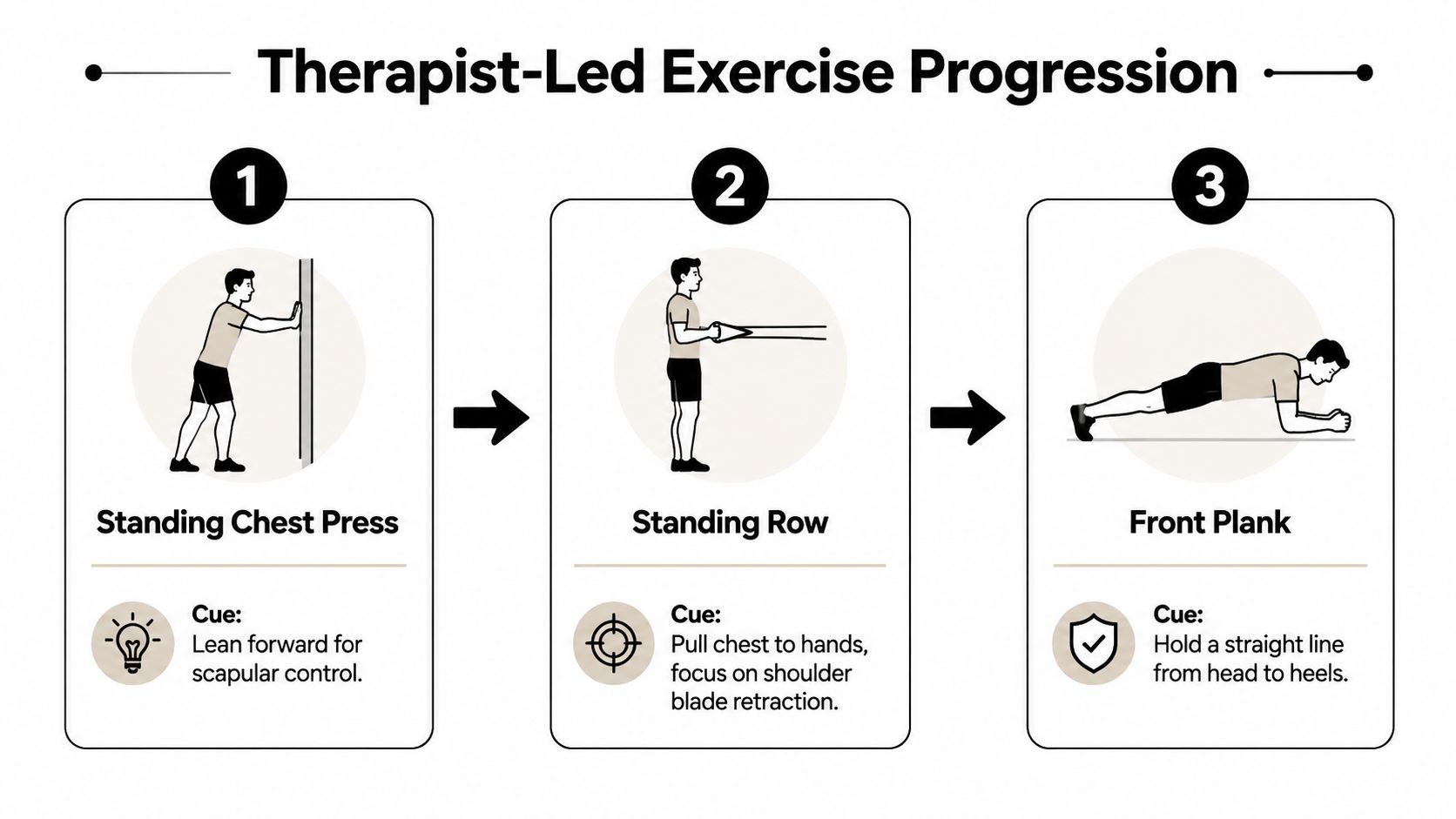
A sensible starting program uses familiar patterns and keeps the setup easy to reproduce. The therapist should select the angle, strap length, stance, and range of motion based on the person's diagnosis rather than copying a general workout.
Standing chest press
Face away from the anchor with the handles near chest height. Start in a fairly upright lean, keep the ribs stacked over the pelvis, and lower only as far as the shoulders remain controlled. This is useful for scapular control and upper-body loading in some neck and shoulder programs.
Progress by moving the feet closer to the anchor or increasing the lean. Regress by stepping back and becoming more upright. The patient shouldn't shrug, flare the ribs, or let the hips fall forward.
Standing row
Face the anchor with the straps shortened enough that the handles sit comfortably in the hands. Begin almost upright, keep the feet stable, and pull the chest toward the handles while allowing the shoulder blades to move without forcing them aggressively together.
A more horizontal body position increases the demand. This variation can support postural endurance and mid-back conditioning, but patients with shoulder irritation may need a neutral grip and a reduced range.
Supported squat
Hold the straps lightly and face the anchor. Use them as balance assistance rather than pulling the body upward, keep the feet stable, and squat only to a depth that doesn't provoke hip or knee symptoms.
For an arthritic joint, the handles can reduce fear during weight shifting. Progress by relying less on the straps, increasing the range, or adding a controlled pause. Don't progress all three variables at once.
Plank progression
A clinician may begin with hands on the floor and the straps used only for support, then introduce a kneeling plank or foot-cradle variation. Feet in the cradles increase the stability demand, so the patient should first demonstrate the ability to maintain a straight line without sagging or piking.
Use 20 to 30 second holds when that duration matches the person's capacity, or choose shorter holds if form changes earlier. These hold ranges are practical programming examples, not mandatory targets.
Hip extension and posterior-chain work
Prone or supported hip-extension drills can train the gluteal muscles without requiring heavy external loading. The therapist should watch for lumbar hinging, pelvic rotation, and hamstring dominance. A small range with clean pelvic control is more useful than a large range that reproduces back symptoms.
For many beginner exercises, 8 to 12 repetitions is a reasonable starting range when the patient can complete it without compensation. Advance only when form remains consistent, symptoms don't flare during or after the session, and the patient can finish the set without holding their breath or shifting into a protective pattern.
Choosing Supervised Sessions or Home Practice
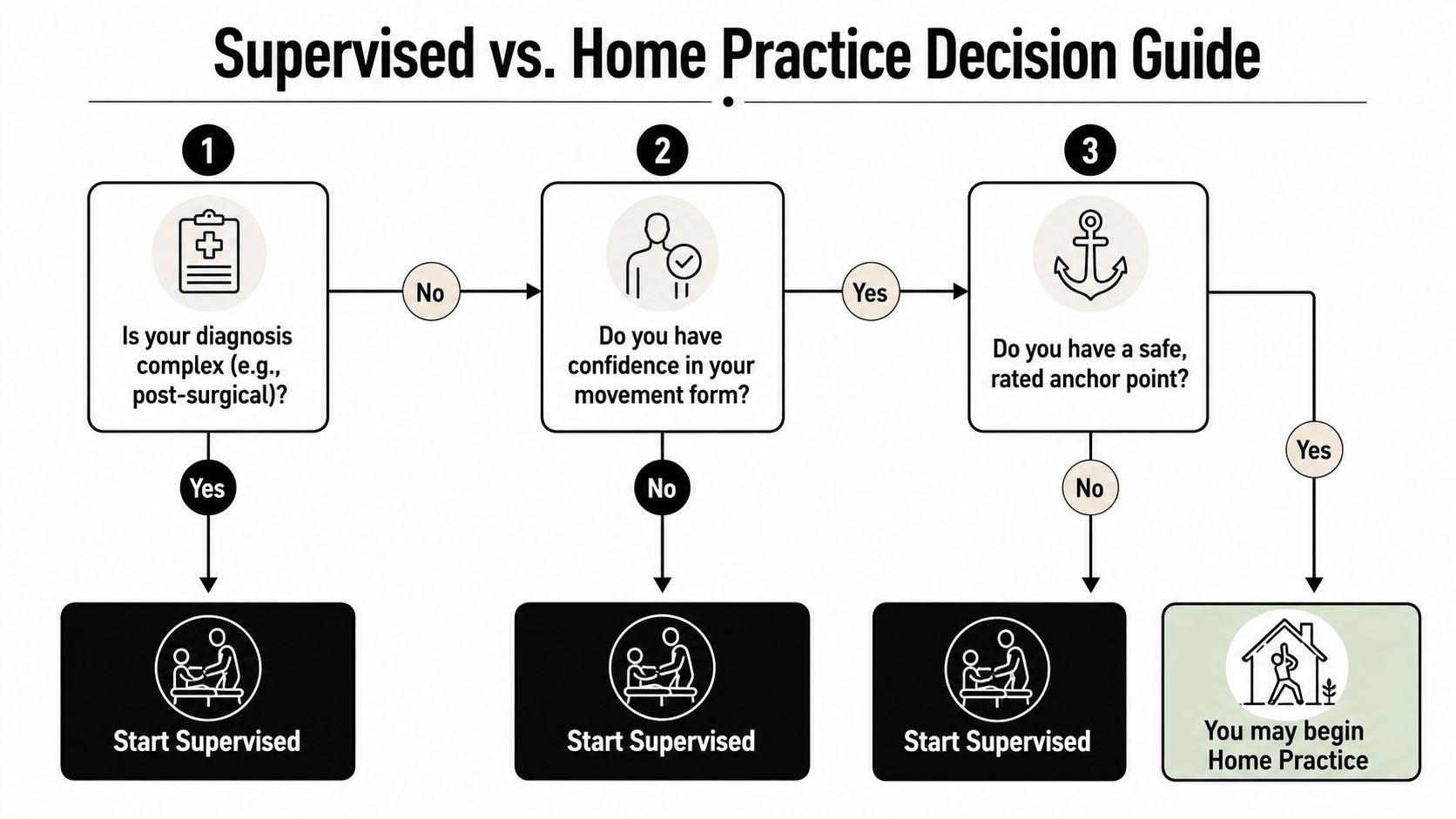
The choice between a clinic and home practice comes down to diagnosis complexity, movement confidence, and anchor quality. A person with a straightforward conditioning goal and reliable equipment may learn the basics quickly. Someone recovering from surgery, dealing with neurological symptoms, or experiencing an irritable pain episode needs more direct oversight.
Post-surgical patients should follow the surgeon's and therapist's phase-specific instructions. People in the first 6 weeks of a new back or neck episode and those with numbness, weakness, or radiating symptoms should start with professional assessment rather than experimenting with steep angles at home.
Home practice is earned through consistency
Independent practice becomes more reasonable once the patient can perform 2 to 3 prescribed movements with reliable form, understands how to change the angle, and has been cleared for home repetitions. The anchor must be appropriate for bodyweight loading, and the user should be able to inspect the straps and reproduce the exact setup taught in treatment.
A solid door frame is preferable to a hollow-core door. The door should close securely, the anchor should sit correctly over the top, and the user should test the connection before placing full weight into the straps. Stop immediately if the buckle slips, the anchor shifts, or a movement reproduces radicular pain or sharp joint symptoms.
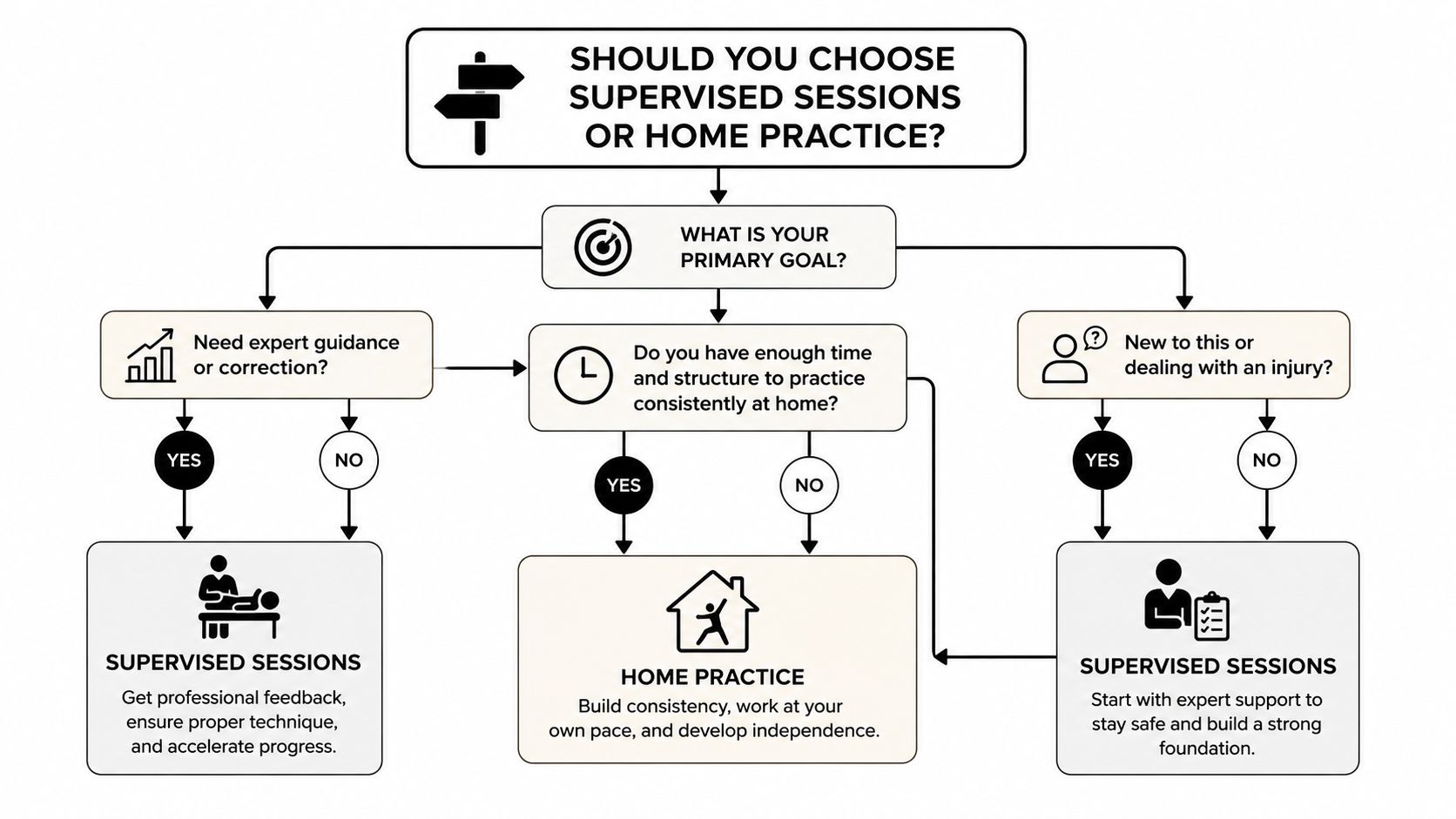
A first supervised session should identify the diagnosis, screen for red flags, assess movement tolerance, verify the anchor and handle setup, and establish a small home program. The therapist can then document the strap length, stance, angle, and symptom response so home practice becomes repeatable rather than improvised.
A Realistic Takeaway and When to Book a Visit
Suspension training equipment can deliver three useful rehabilitation features: adjustable bodyweight loading, supported closed-chain movement, and a graded neuromuscular challenge. Those features may help with trunk endurance, scapular coordination, dynamic balance, supported lower-limb work, and progressive return to activity.
The equipment can't resolve an acute disc herniation, replace a post-operative protocol, or substitute for hands-on care when restricted joint mobility is the main limitation. It also shouldn't be sold as a universal solution for pain or fall risk. Research in healthy untrained adults has found improvements in dynamic balance and functional performance but not static balance, while a TRX-based program after traumatic brain injury improved coordination without a statistically significant change in balance or quality of life in the clinical study. These findings support targeted use, not blanket promises.
For adults in Deerfield Beach and surrounding Broward County who have ongoing back pain, post-surgical stiffness, sciatica, or recurring joint flare-ups, book an evaluation before adding suspension work to your routine. A licensed therapist can determine whether straps fit your current phase of recovery and select a safer starting load.
MedAmerica Rehab Center offers individualized physical therapy, chiropractic care, acupuncture, shockwave therapy, balance training, and post-surgical rehabilitation in Deerfield Beach. Visit MedAmerica Rehab Center to schedule an evaluation and find out whether suspension-based exercise belongs in your recovery plan.
MedAmerica Rehab · Deerfield Beach
Talk to a clinician about your pain
Physical therapy, chiropractic, acupuncture and shockwave therapy under one roof, since 1995. Same-day appointments are available.
Mon–Thu 8:00 AM – 6:30 PM · Fri 8:00 AM – 3:00 PM