
Freeze Sleeve Knee Guide: How Cryotherapy Sleeves Work
You've probably been there. The knee starts throbbing after a long walk, a pickup game, or a day of yard work, and the first move is usually the freezer. A bag of peas, a gel pack, or a homemade wrap gets tossed on top of the joint, then you sit still and hope the ache settles down. A freeze sleeve knee changes that experience because it stays on, spreads cold more evenly, and lets you keep moving a little while you treat the knee, which matters when you're trying to get through a workday or stick with rehab. If you're also sorting through other ways to calm knee pain, the guide to MEDISTIK topical pain relief is a useful companion read for understanding how topical options fit into pain care. For a clinic-based perspective on combining cold with therapy, the team approach described at MedAmerica Rehab Center's ice pack physical therapy page shows how home care and supervised rehab can work together.
Why a Knee That Aches Deserves More Than a Bag of Ice
A sore knee rarely shows up at a convenient time. One person notices swelling after a weekend hike, another feels a sharp ache after a few hours of standing, and someone else realizes the knee is stiff the moment they try to climb stairs. The usual response is to grab a frozen pack and sit still, but that setup is awkward, uneven, and easy to abandon after a few minutes.
A freeze sleeve knee offers a different kind of cold therapy. Instead of balancing a slippery ice bag on top of the joint, the sleeve wraps around the knee and holds the cold where it is needed. That makes it feel less like a chore and more like part of the day, which is one reason people keep using it.
That practical difference matters because comfort is easier to maintain when the cold stays in place while you move a little. Traditional cold packs often force you into one position, while a sleeve can fit into a short break, a rehab exercise session, or the time between errands. If you want to see how cold fits into a broader recovery plan, MedAmerica's discussion of ice-pack physical therapy explains how clinics use cold alongside therapy instead of treating it as a stand-alone fix.
A knee that aches also deserves more than a quick chill because pain relief is only one piece of the problem. The core question is whether the knee can settle enough to let you keep doing the work that helps it recover, such as walking with better control, climbing stairs with less hesitation, or tolerating therapy exercises. A sleeve can help with that short window of comfort, but it does not replace the rehab steps that build lasting change.
If you are comparing options and wondering what pairs well with sleeves, the overview of MEDISTIK topical pain relief can help you think through the broader picture without assuming every ache needs the same fix.
A good way to think about it is this, a bag of ice is like holding a cold drink against one spot with your hand, while a sleeve is more like putting on a fitted cooling layer that stays put. That simple change in contact is why many people find sleeves easier to use consistently.
What a Freeze Sleeve Knee Actually Is
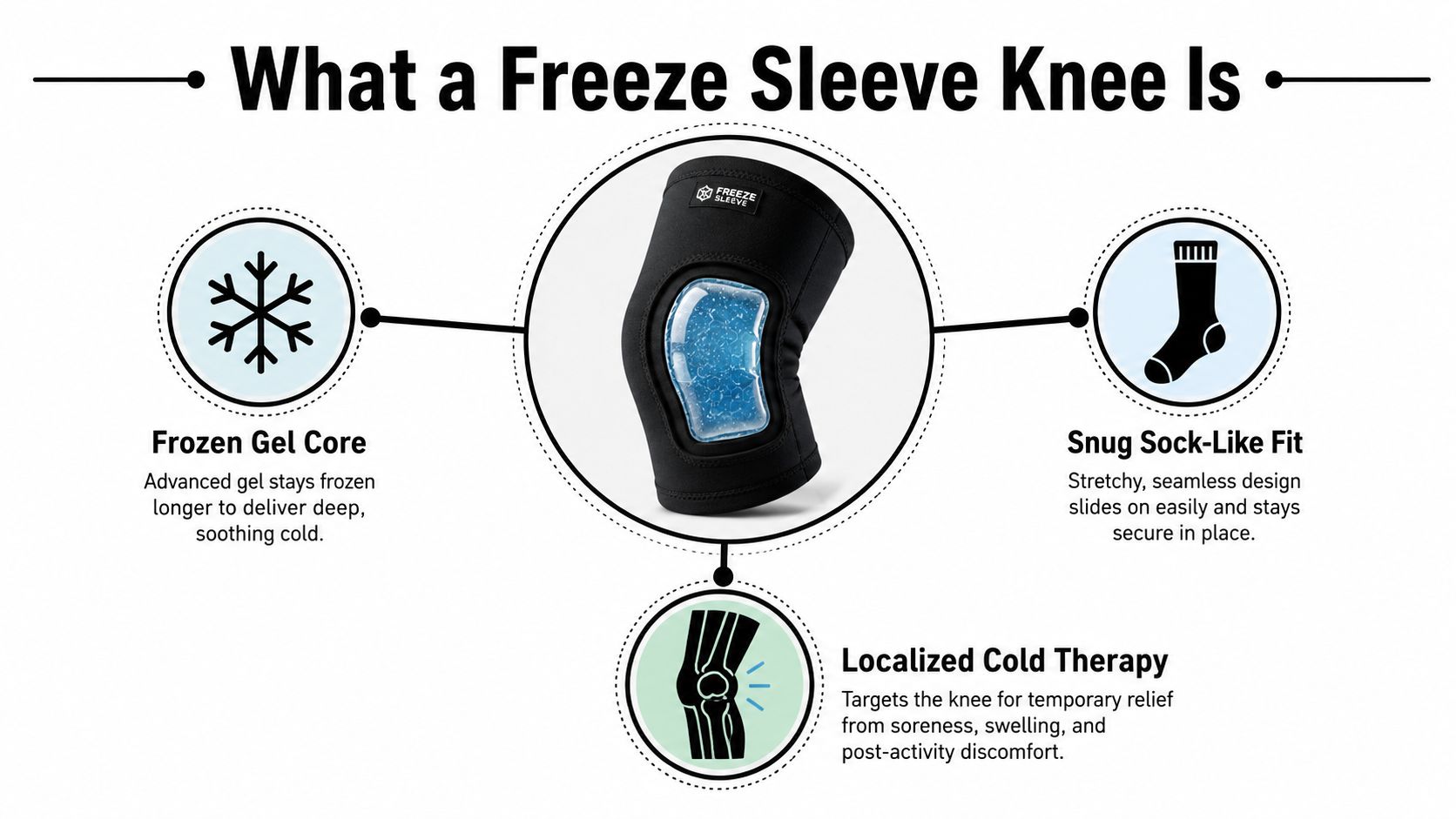
A freeze sleeve knee is a fitted sleeve with a cold-retaining gel layer inside. You keep it in the freezer, then pull it over the knee like a snug sock. The sleeve is usually made from neoprene or a similar fabric, so it hugs the joint instead of hanging loosely.
The basic mechanics
The cold comes from the frozen gel core, which slowly transfers temperature into the tissue. Because the sleeve wraps around the knee, you get 360° even cold/heat coverage rather than a flat strip of cold on one side only, and the design is intended for a targeted 20-minute treatment duration (Freeze Sleeve). That matters because short, controlled cold exposure is easier to fit into daily life than a messy ice setup.
A cold towel shaped for a single task. A towel can cool skin, but it shifts, dries out, and leaves gaps. A sleeve keeps the cold layer in position and spreads contact around the joint.
Sizing matters too. For a freeze sleeve knee, the fit is based on the circumference just above the knee, not on the kneecap itself. The sizing guide recommends measuring with the knee bent to about 30 degrees and placing the tape 3 inches above the kneecap crease so the sleeve is snug enough to do its job without cutting off comfort (RockTape sizing guide).
Some versions can also be warmed for heat therapy, which gives them a second use when stiffness matters more than swelling. If you have used an arm sleeve before, the same logic applies to the knee, and this MedAmerica arm-sleeve page shows how the shape and fit of these tools are meant to stay close to the body rather than float above it.
A freeze sleeve is a short-duration sensory tool, not a long-term fix. It can make the knee feel calmer for exercise, walking, or a therapy session, much like turning down a loud radio enough to hear the instructions clearly. That quieting effect is useful only if it helps you keep moving through a clinician-led rehab plan, because the primary change comes from the work that follows the relief.
A knee sleeve for cold therapy also differs from broader recovery tools such as the ice baths for athletes guide, which looks at whole-body cold exposure rather than a single joint. The freeze sleeve is narrower in purpose. It is meant to sit on one area, stay put, and give you a controlled window of comfort.
Practical rule: a sleeve should feel snug, cool, and steady, not painfully tight or icy in one small patch.
What the Evidence Actually Says
A freeze sleeve knee can help some people, but the research does not show the same result for everyone. A 2017 systematic review examined 20 studies and found that 12 reported significant improvements, while 8 found no significant effect. That split is useful because it matches what patients often feel in clinic, one person gets clear short-term relief, another notices only a small change.
Why the results are uneven
The strongest reported benefits showed up in proprioception for healthy knees, gait and balance for osteoarthritic knees, and functional improvement for injured knees in the systematic review. The authors also said the evidence was limited by heterogeneity and a lack of rigor, which means the sleeve designs, study methods, and outcome measures were not consistent enough to produce one clean answer.
Older research points in the same direction. A prospective study in 395 army recruits with overuse patellofemoral pain compared a simple elastic knee sleeve, an elastic sleeve with a silicone patellar ring, and no treatment. By the end of training, the simple elastic sleeve had a statistically significant better comfort score, and more recruits reported pain resolution than in the other groups. The same study also found that the simple sleeve was no more effective than no treatment at all for overall pain reduction.
That combination matters. A sleeve can change how a knee feels during activity without changing the underlying cause of the pain. In practice, that often means the sleeve is useful as a short window of symptom relief, especially if it helps someone keep moving through rehab instead of shutting down activity altogether.
The ACL-reconstruction study makes the point even more clearly. The sleeve increased knee flexion angles right away during a hop task, but after six weeks of at least one hour per day, there were no significant differences in knee flexion angles or external knee flexion moments versus controls, and only stance duration decreased. The immediate response and the longer-term response were not the same, which is exactly why a sleeve should be treated as a support tool, not a stand-alone treatment.
A sleeve may help the knee behave better in the moment, but that does not automatically mean the joint is healing faster.
For a patient, the practical lesson is straightforward. A sleeve can be part of care, especially when it calms symptoms enough to make exercise or walking more tolerable, but it does not replace the rest of the plan. MedAmerica's cold-pack therapy page reflects that idea by treating cryotherapy as one piece of recovery, not the whole answer.
How a Freeze Sleeve Compares with Other Cold Therapies
Different cold tools solve different problems. A freeze sleeve knee shines when you want coverage and movement at the same time. A flat ice pack works fine for a quick rest session, but it doesn't stay evenly wrapped around the joint. Ice baths cover more of the body, which is why athletes use them after harder training, but they're not practical for everyday knee flare-ups at home.
| Cold Therapy Options for the Knee | Coverage | Hands-Free | Best For |
|---|---|---|---|
| Freeze sleeve | Wraps around the knee with broad contact | Yes | Home rehab, repeat use, staying mobile |
| Bagged ice or gel pack | Localized and uneven if it shifts | No | Short flare-up relief, simple home use |
| Ice bath | Whole lower-body exposure | No | Athletic recovery or broader cooling needs |
| Clinic cold compression | More controlled, often more intense | Sometimes, depending on device | Supervised post-surgical or higher-support care |
The question is not which option is universally best. It's which tool fits the task in front of you. If your knee is hot and irritated after a workout, a sleeve can be convenient because you can put it on, settle down, and still answer email or do light stretching. If the knee is acutely swollen after surgery, a clinician may prefer a more structured cold-compression setup.
Coverage also changes the feel of treatment. With a sleeve, the cold comes from all sides, so there's less of that “one frozen square on one sore spot” sensation. That can make the experience more tolerable, especially for people who don't like direct ice packs.
A sleeve is also repeatable. You can freeze it, use it, store it again, and bring it back out without much setup. That matters for rehab, where the best tool is often the one a person will use.
How to Choose, Apply, and Use a Freeze Sleeve Safely
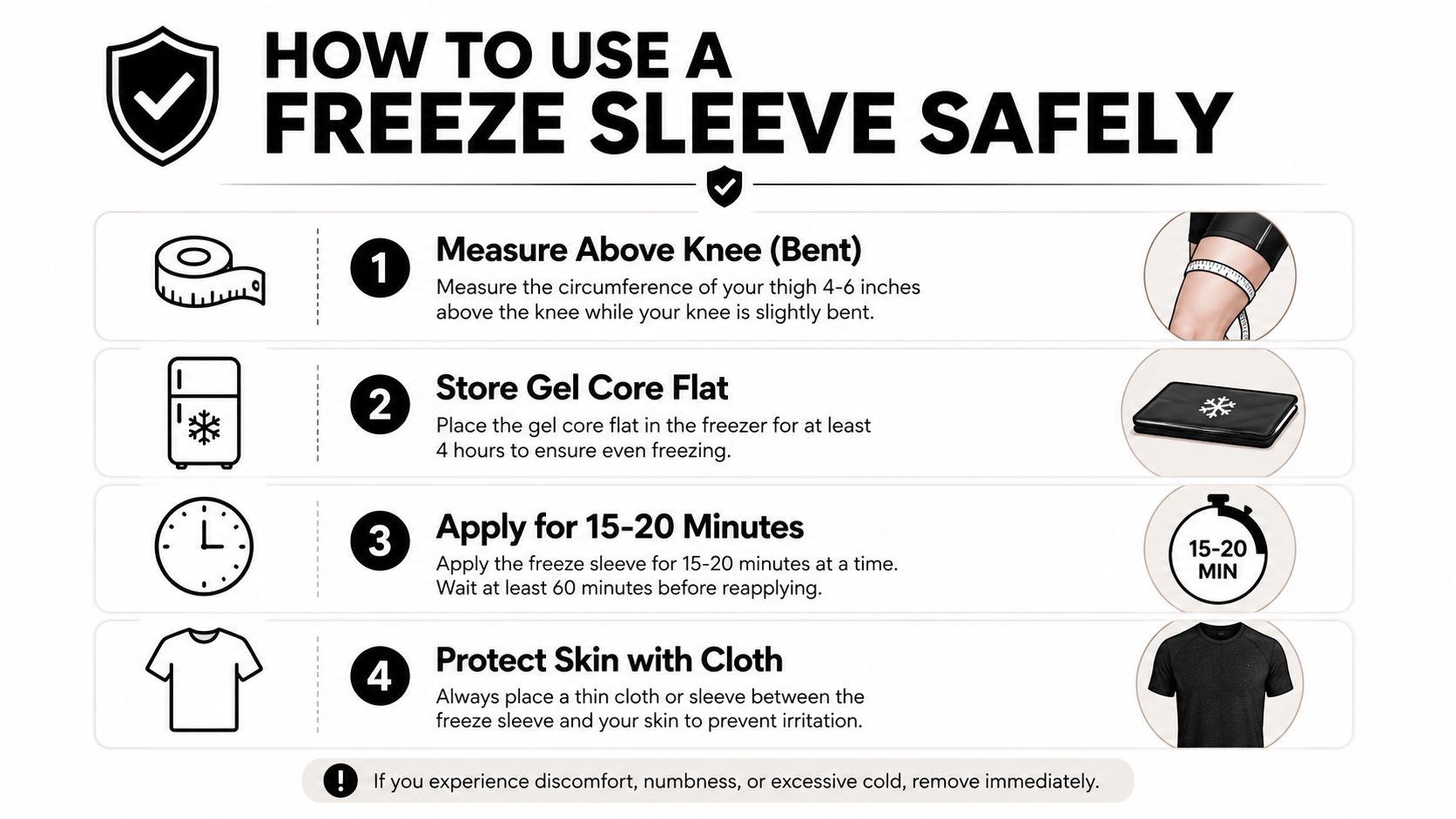
Fit comes first. Measure the circumference just above the knee with the knee bent to about 30 degrees, and place the tape 3 inches above the kneecap crease so the sleeve sits snugly where it should (RockTape sizing guide). A sleeve that's too loose won't stay in contact, and one that's too tight can feel harsh instead of therapeutic.
Use it like a short treatment, not a long session
The freezer part is only one step. The product is designed for a targeted 20-minute treatment duration and 360° even cold/heat coverage (Freeze Sleeve). That short window matters because cold therapy is meant to calm symptoms without making the knee feel numb for too long.
A thin cloth barrier is a smart habit if your skin is sensitive. After the session, check for redness that lingers, numbness, or an uncomfortable burning sensation. If the knee feels very numb or irritated, the next session should be shorter or skipped until you've talked with a clinician.
Practical rule: if the skin looks angry or feels detached from normal sensation, stop and reassess.
Common uses and reasons to avoid it
People often use a sleeve for post-exercise soreness, mild swelling, or an arthritis flare-up. Those are the situations where a short, repeatable cold intervention can be easiest to fit into daily life.
Avoid cold sleeves over open wounds, and don't use them if you have impaired sensation, cold hypersensitivity, or Raynaud's disease. Those conditions make it harder to judge whether the skin is tolerating cold safely.
A simple checklist helps:
- Do measure for a snug fit before you buy.
- Do limit sessions to the recommended window.
- Do protect the skin with a thin layer if needed.
- Don't fall asleep with the sleeve on.
- Don't use it on skin you can't feel well.
- Don't assume more cold means more healing.
If you need a broader cold-therapy reference for clinic and home use, MedAmerica's physical therapy cold-pack page gives useful context for how professionals think about timing and safety.
From Short-Term Relief to Real Recovery
The biggest misunderstanding about a freeze sleeve is that it should “fix” the knee. That's not how it works. The ACL study is a good example, because the sleeve changed movement right away during a hop task, but after six weeks of at least one hour per day there were no significant differences in the main biomechanics compared with controls (PMC study). In plain language, the sleeve seemed to affect how the knee performed in the moment more than how it recovered over time.
Why that matters in rehab
That short-term effect can still be useful. If a knee feels less threatening, a person may bend it more, walk more normally, or tolerate a rehab drill they would otherwise avoid. That gives a clinician a window to work on the deeper problem, such as weakness, stiffness, poor control, or altered gait.
A good rehab plan uses that window. A physical therapist may pair cold therapy with targeted exercise, hands-on treatment, and movement retraining. The point is not to keep the knee cold forever. The point is to help the person move well enough to rebuild strength and confidence.
MedAmerica Rehab Center in Deerfield Beach uses that kind of multidisciplinary approach, with physical therapy, chiropractic care, acupuncture, and shockwave therapy available in one setting. For someone with a stubborn knee, that means a freeze sleeve routine can sit alongside supervised exercise instead of replacing it.
Cold can open the door. Rehab has to walk the patient through it.
That's also where expectations stay realistic. If the knee pain comes from arthritis, sports injury, post-surgical recovery, or another mechanical issue, a sleeve may ease symptoms, but durable recovery usually comes from a plan that changes load, motion, and strength over time. The sleeve helps the session start better. The rehab plan helps it end better.
When to See a Clinician and How MedAmerica Can Help
A freeze sleeve is not the right answer if the knee is locking, giving way, or swollen in a way that doesn't settle within 48 to 72 hours. Pain that wakes you at night, or pain after a fall or accident, also deserves a professional look. Those signs can point to something more than simple inflammation.
At a first visit, MedAmerica Rehab Center can evaluate the knee from a broader angle, then build an individualized treatment plan that matches the cause of the pain. That may include home cryotherapy, supervised exercise, and other in-clinic care for arthritis, post-surgical recovery, sports injuries, or auto and workers' compensation cases.
If you're in Deerfield Beach or a nearby community and the knee pain keeps circling back, don't wait for it to become a bigger problem. Call MedAmerica Rehab Center, ask about same-day appointments, and get a plan that uses cold therapy the right way, as one part of evidence-based, drug-free care.
A CTA for MedAmerica Rehab Center.
MedAmerica Rehab · Deerfield Beach
Talk to a clinician about your pain
Physical therapy, chiropractic, acupuncture and shockwave therapy under one roof, since 1995. Same-day appointments are available.
Mon–Thu 8:00 AM – 6:30 PM · Fri 8:00 AM – 3:00 PM