

Neck Pain on Left Side: Causes, Red Flags and Treatment
If your neck hurts only on the left, does that tell you what's wrong, or just where you're feeling it? The side is a clue, not a diagnosis. An ache after sleeping awkwardly needs a different response from neck pain accompanied by arm weakness, chest pressure, or a sudden severe headache.
The most useful questions concern how the pain started, what movements change it, and what other symptoms you have. Those details help you decide whether gentle home care is reasonable, a clinic appointment makes sense, or you need urgent medical attention.
Common Causes Behind Left-Sided Neck Pain
Pain on one side of the neck is a familiar clinical pattern, but it isn't a separate disease. The Global Burden of Disease Study estimated that 203 million people worldwide had neck pain in 2020, according to the analysis published in The Lancet Rheumatology00321-1/fulltext). That estimate covers neck pain overall, not left-sided symptoms specifically.
Your neck contains muscles, small joints, discs, and nerves packed into a relatively small space. Irritation in any of these structures can produce overlapping symptoms, so a painful spot alone can't reliably identify the source.
Common causes of left-sided neck pain
| Cause | Typical pattern | What it suggests |
|---|---|---|
| Muscle strain involving the trapezius or levator scapulae | Ache along the left neck and shoulder blade after awkward sleep or prolonged screen use | A muscular pattern that may respond to gentle activity and self-care |
| Facet joint irritation | Localized ache that catches when turning left, sometimes with morning stiffness | Joint sensitivity, which may flare after holding one position |
| Cervical radiculopathy | Pain into the left shoulder or arm, with tingling, numbness, or weakness | Possible nerve root irritation requiring clinical assessment |
| Whiplash or acute injury | Pain after a fall, car crash, or sports impact | Injury history changes the assessment; check warning signs before self-treating |
| Sustained posture load | Dull ache that builds during desk work or phone use | A mechanical pattern that may improve with movement breaks and workstation changes |
| Referred pain from elsewhere | Left neck pain with chest pressure, jaw pain, or breathlessness | A possible nonmuscular emergency requiring immediate evaluation |
Read the pattern, not just the location
The trapezius and levator scapulae connect the neck with the shoulder region. Holding a phone between your ear and shoulder, for example, can load these tissues without an obvious injury.
Facet joints are the small joints at the back of the spine. Pain that catches during a particular turn can suggest joint involvement, but muscles can also tighten protectively and make that movement uncomfortable.
Sustained posture load doesn't mean you have a permanently “bad” posture. A workstation that keeps you looking left, or a task that holds your head still, may demand more endurance than your neck currently tolerates.
Useful distinction: A symptom pattern helps guide an assessment. It doesn't prove which tissue is responsible.
Start by answering these questions:
- Onset: Did the pain begin suddenly or build gradually?
- Injury: Was there a fall, collision, forceful movement, or sports impact?
- Spread: Does the discomfort stay near your neck, or travel into your shoulder, arm, or hand?
When Left Neck Pain Needs Urgent Care
Act on the highest urgency level that matches any symptom you have. A mild neck ache doesn't make accompanying chest pressure or new weakness less important.
A primary-care review of neck pain warning signs identifies neurological changes, significant trauma, fever or chills, unexplained weight loss, cancer history, immunosuppression, and ripping or tearing pain as reasons for heightened concern. These combinations can indicate conditions that need urgent investigation rather than stretching or massage.
Left neck pain triage by urgency
| Urgency | Symptoms that place you here | Action |
|---|---|---|
| Emergency now | Sudden severe headache, facial droop, slurred speech, chest pressure spreading to the arm or jaw, sudden tearing neck pain, or trouble breathing or swallowing | Call emergency services now |
| Same day | New arm weakness, new balance or walking difficulty, bladder or bowel changes, fever with a stiff neck, or pain after significant trauma | Obtain urgent medical assessment today; use emergency care for sudden, severe, or worsening symptoms |
| Soon | Persistent night pain, unexplained weight loss, stable arm tingling or numbness, or pain that isn't improving | Arrange a prompt clinician appointment rather than continuing self-treatment indefinitely |
| Monitor | Mild ache after sleep or desk work that eases with movement, without other symptoms | Try gentle self-care and monitor for improvement or new symptoms |
Use this visual as a reminder, not as a substitute for assessment when symptoms are changing.
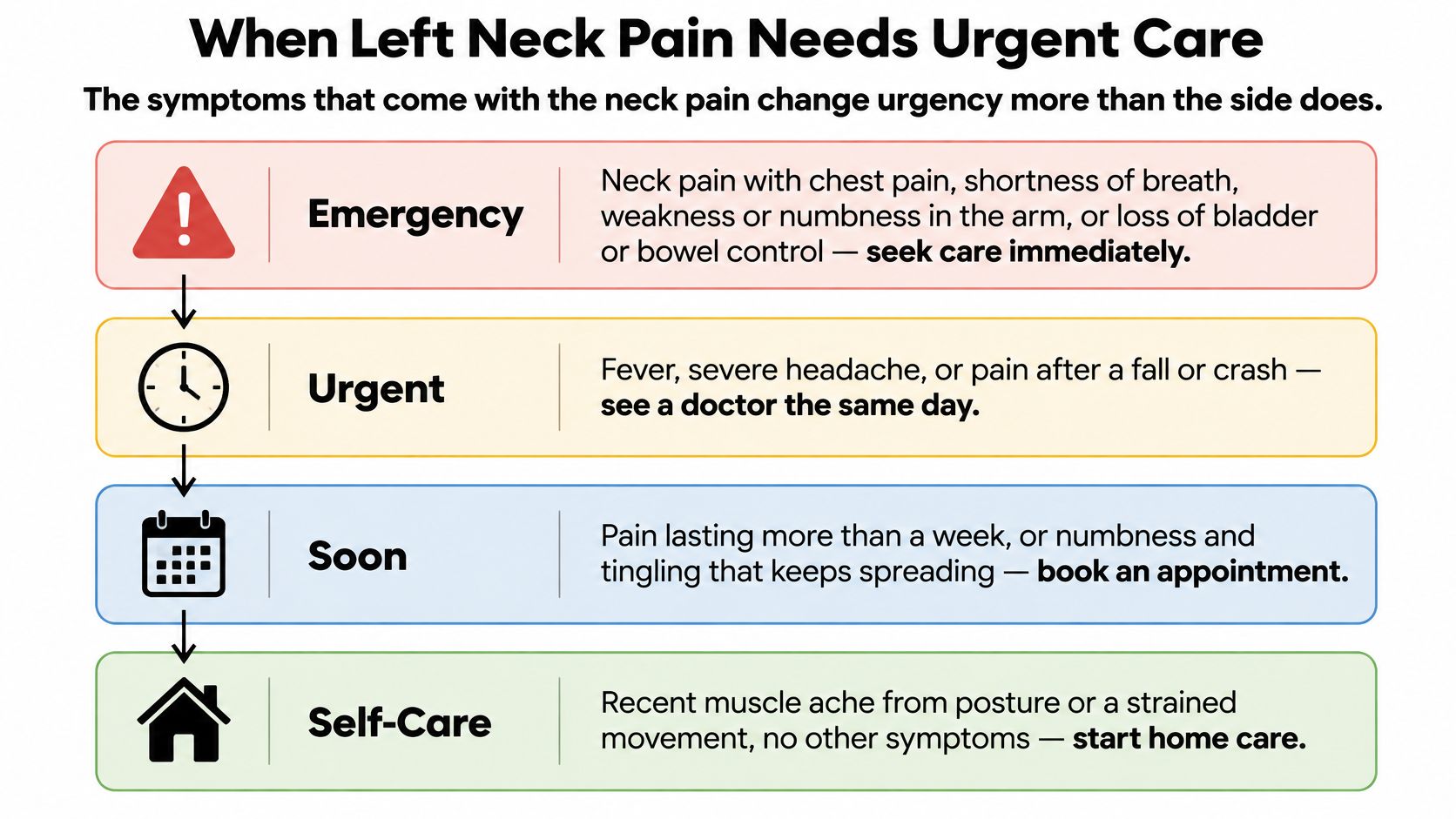
Know when to move up a level
Sudden arm weakness, particularly with facial changes or speech difficulty, belongs in the emergency category. New bladder or bowel dysfunction accompanied by limb symptoms or walking difficulty also warrants emergency evaluation, not a routine appointment.
Night discomfort needs context. Pain when rolling onto a sore muscle isn't the same pattern as severe, unrelenting pain that repeatedly wakes you, especially with fever, weight loss, or a cancer history.
Likewise, a brief tingling sensation after leaning on an arm differs from numbness that persists, spreads, or accompanies weakness. If you're unsure whether a symptom is progressing, contact a medical professional rather than repeatedly testing it yourself.
You don't need to fear every unusual sensation. You do need to respond when the symptom combination changes.
Don't drive yourself if you have possible stroke symptoms, significant breathing difficulty, or severe chest discomfort. Call your local emergency service and describe the associated symptoms, not just the neck pain.
Telling Muscle Pain From Nerve Pain
Before trying stretches, notice whether pain travels beyond your elbow, whether your fingers feel different, and whether everyday gripping or lifting feels unexpectedly difficult. These observations are useful to report, but they aren't a home diagnostic test.
Muscular discomfort tends to remain around the neck and shoulder blade. Nerve root irritation can send sharp or electric pain into the shoulder or arm, sometimes with altered sensation or weakness, as described in the StatPearls clinical review of cervical radiculopathy.
Muscle pain versus nerve root pain
| Feature | Muscle strain | Nerve root irritation |
|---|---|---|
| Pain location | Mainly neck and shoulder blade | Shoulder or arm, sometimes reaching the fingers |
| Pain quality | Often dull or aching | May feel sharp, shooting, or electric |
| Tingling or numbness | Usually absent | May follow a particular arm or finger distribution |
| Grip or lifting | Usually preserved, although pain can limit effort | May reveal actual weakness |
| Effect of movement | Gentle movement may feel relieving | Looking upward, turning toward the painful side, or overhead work may aggravate symptoms |
| Both sides or leg symptoms | Not typical of an isolated strain | Requires prompt medical review for possible spinal-cord involvement |
What a nerve root problem means
A cervical nerve root is a nerve branch leaving the spinal cord in the neck. Disc material or narrowing around that nerve can irritate it, producing symptoms farther down the limb.
Say your neck aches after computer work, but your hand feels normal and ordinary tasks remain comfortable. That pattern differs from neck pain accompanied by an electric sensation down the arm and difficulty holding a mug, although neither example establishes a diagnosis.
Hand symptoms can also originate outside the neck. The distinction between carpal tunnel syndrome and cervical radiculopathy helps explain why clinicians examine more than the painful area.
Clinicians compare strength, sensation, and reflexes with the symptom distribution. They may use Spurling testing or an upper-limb tension test to assess whether positioning reproduces a compatible nerve pattern.
Don't have someone press down on your head or force your arm into a testing position. Symptoms affecting both sides, changes in your legs or walking, and progressive weakness are where self-checking stops and urgent medical assessment begins.
How Doctors Confirm the Cause
A clinician starts with your story, not a scan. The timing, injury history, aggravating movements, and associated symptoms help determine which examination findings matter.
Be specific about function. “It hurts when I check my blind spot” gives different information from “my fingers go numb while I work overhead,” even if both problems begin near the same place.
A clinical examination looks beyond the sore spot to assess movement and neurological function.
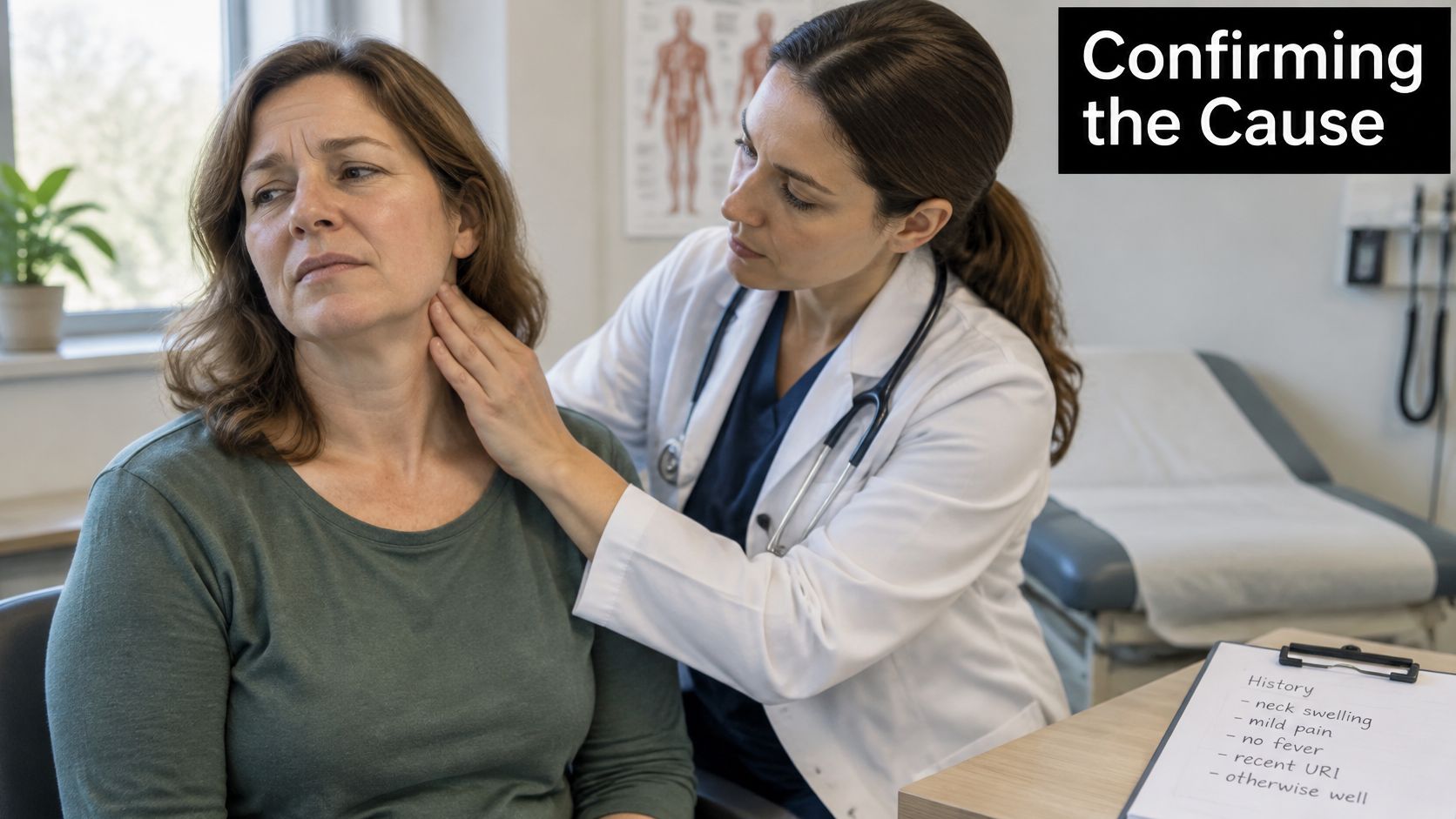
History and examination come first
Expect questions about previous episodes, sleep disruption, medications, medical conditions, and what you've already tried. Mention symptoms that seem unrelated, including changes in balance or hand coordination.
The examination may include:
- Movement: Which directions are comfortable, restricted, or painful.
- Strength: Whether specific arm or hand muscles show weakness.
- Sensation and reflexes: Whether findings fit a particular nerve distribution.
- Provocation testing: Whether controlled positioning reproduces your familiar symptoms.
These findings are interpreted together. A sore muscle, restricted turn, or positive test doesn't carry the same meaning in every patient.
Imaging answers a specific clinical question
Immediate advanced imaging isn't automatic for uncomplicated, nontraumatic neck pain. Age-related findings can appear on scans without explaining the current symptoms, so an image must match the examination.
The American Academy of Family Physicians review supports MRI when infection, cancer, spinal-cord involvement, or objective neurological compromise is suspected, and consideration of MRI for moderate-to-severe pain persisting beyond approximately six weeks despite standard treatment. That is a reassessment point, not a requirement to wait when concerning findings are present.
MRI and X-rays also answer different questions. Understanding when an MRI or an X-ray is needed can help you discuss why a particular test would change your care.
Bring these questions to your appointment:
- Meaning: Which findings best explain my symptoms?
- Testing: Would imaging change treatment now?
- Progress: What improvement should we expect, and what would trigger reassessment?
Home Self-Care for the First Two Weeks
Home care is appropriate for a mild, muscle-type ache without warning signs. Improvement matters more than completing a fixed waiting period, and pain after a significant injury needs assessment before exercises.
Use the following visual as a general reminder of comfort measures and activity adjustments.
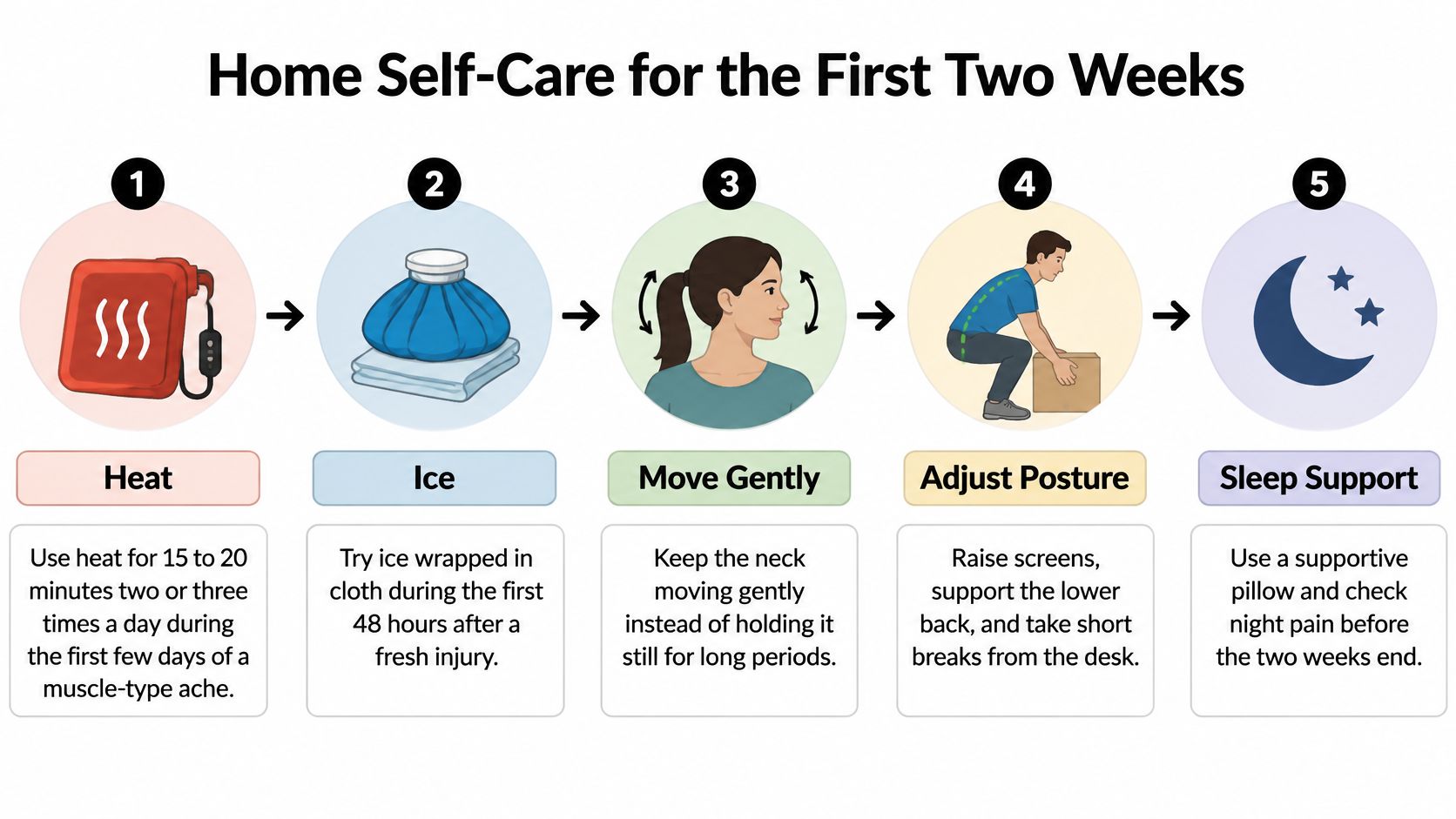
Try comfortable warmth. Use a warm pack with a protective cloth barrier, checking your skin regularly. Don't sleep on a heating pad or apply heat where sensation is reduced.
Use cold if it feels better after a minor strain. Wrap the cold pack in cloth rather than placing it directly on your skin. Stop if your skin becomes painful, unusually pale, or numb.
Keep movement gentle. Try small chin nods, relaxed shoulder rolls, and comfortable head turns without forcing the end of the movement. Don't pull your head into a stretch.
Change your work setup. Center your monitor, keep frequently used items within easy reach, and support your forearms. Use a headset instead of trapping a phone against your shoulder.
Support your head during sleep. On your back or side, choose a pillow height that keeps your neck comfortably aligned with your trunk. More pillows aren't necessarily more supportive.
Interrupt long periods of stillness. Change position between tasks, stand up, and walk briefly. You don't need to hold a rigid “perfect” posture.
Reduce provocative loads. Temporarily modify heavy carrying, overhead work, sudden twisting, and forceful stretches. Continue comfortable daily activities rather than avoiding all movement.
Keep a simple symptom log. Record where the pain travels, what triggers it, how you sleep, and which activities are becoming easier.
For movement examples, review these neck pain relief stretches and choose only those that remain comfortable. A video can demonstrate movement, but it can't determine whether an exercise suits your symptoms.
Stop-and-reassess rule: Stop any exercise that sends pain or tingling down your arm. Arrange clinical review if symptoms worsen, new symptoms appear, or you aren't making clear progress.
Treatment Options Compared
Conservative treatments for left-sided neck pain
| Option | Best suited for | Typical course | Evidence to weigh |
|---|---|---|---|
| Physical therapy | Muscle-related pain, movement limitations, recovery after injury, or nerve symptoms suitable for rehabilitation | Individualized supervised care with a home exercise plan | Look for an active programme with measurable functional goals |
| Chiropractic care | Selected mechanical neck pain with stiffness after appropriate screening | A monitored trial with reassessment | Distinguish gentle mobilization and exercise from forceful manipulation; discuss risks and alternatives |
| Acupuncture | An optional adjunct for pain or tension | Continued only if there is a meaningful response | Symptom relief should be judged alongside function, not treated as proof of recovery |
| Shockwave therapy | Selected persistent soft-tissue complaints after diagnosis | A condition-specific trial rather than a preset package | Neck-specific benefit and protocols need careful evaluation; it isn't a default treatment |
| Short-term medication | Symptom control when medically appropriate | As directed by a clinician or pharmacist | Pain relief doesn't establish or correct the underlying cause |
Match the treatment to the limitation
Physical therapy can address the tasks you're struggling with, such as turning while driving, tolerating computer work, or returning to lifting. A suitable plan may combine movement practice, strengthening, activity adjustments, and hands-on care rather than relying on passive treatment alone.
For suspected nerve irritation, exercise selection should account for the examination. A movement that helps a local muscle ache may aggravate radiating symptoms, so more stretching isn't automatically better.
Chiropractic care describes a range of approaches, not a single procedure. Discuss whether the proposed care involves soft-tissue treatment, gentle joint mobilization, exercise, or high-velocity manipulation, and what alternatives are available.
Forceful neck treatment is inappropriate when vascular injury, instability, spinal-cord involvement, or another serious cause is suspected. Screening matters before treatment, not after an unexpected response.
Judge add-on care by useful change
Acupuncture may be considered as an adjunct when the aim is symptom relief. It shouldn't replace investigation of unexplained neurological symptoms or a plan to restore comfortable activity.
Shockwave therapy requires a clear soft-tissue target and a reason for choosing it. Persistent pain alone doesn't establish that shockwave is appropriate, and a provider should explain what outcome would justify continuing.
Medication decisions depend on your health history and other medicines. Anti-inflammatory medicines, for example, aren't suitable for everyone, and sedating medicines can affect driving and balance; a pharmacist or prescribing clinician can check these issues.
The comparison isn't about finding the strongest-sounding treatment. It's about choosing care that matches the diagnosis and produces useful gains without unnecessary risk or expense.
Before agreeing to a course of care, ask:
- Target: What finding or limitation are we treating?
- Plan: What will I practise independently, and how will supervised care help?
- Review: When will we decide whether to continue, modify, or stop?
- Measurement: Will progress include sleep, comfortable movement, work tolerance, or another goal that matters to me?
Book a Clinic Assessment for Left Neck Pain
Choose the type of appointment according to your symptoms, not how much pain you can tolerate. Emergency symptoms need emergency services, while new neurological changes or a significant injury need urgent medical evaluation rather than a routine rehabilitation booking.
For stable symptoms that interfere with sleep, driving, work, or exercise, a clinic assessment can help you move beyond repeatedly trying different remedies. Even a relatively mild ache deserves attention when it keeps returning or prevents normal activity.
Bring details that help guide the visit
Write down the date the symptoms began and whether anything unusual happened beforehand. Include a collision, fall, new exercise, workstation change, or prolonged task, even if you weren't immediately sore.
Bring a concise record of:
- Symptoms: Where the pain starts, where it travels, and any altered sensation.
- Daily demands: Your work setup, lifting tasks, driving, and usual exercise.
- Sleep: Your typical position and how symptoms affect rest.
- Previous care: Exercises, medicines, or treatments you've tried and their effects.
- Priorities: The activities you most want to resume comfortably.
A useful assessment combines your history with movement and neurological screening, then explains what the findings mean. You should leave knowing what to do at home, what to avoid temporarily, and which changes should prompt medical reassessment.
MedAmerica Rehab Center in Deerfield Beach is an option for assessment and physical therapy for neck pain, including rehabilitation needs related to whiplash, sports injuries, auto accidents, and workers' compensation injuries. Our clinician can determine which care fits the findings and whether medical referral is needed before rehabilitation proceeds.
Bring your symptom log rather than trying to remember every fluctuation during the appointment. Clear examples of what you can and can't do help turn a general complaint into practical treatment goals.
MedAmerica Rehab Center offers individualized care for neck pain and related movement limitations, with treatment selected after assessment. Visit MedAmerica Rehab Center to book an assessment, and bring your symptom log so we can discuss your symptoms, daily demands, and recovery goals.
MedAmerica Rehab · Deerfield Beach
Talk to a clinician about your pain
Physical therapy, chiropractic, acupuncture and shockwave therapy under one roof, since 1995. Same-day appointments are available.
Mon–Thu 8:00 AM – 6:30 PM · Fri 8:00 AM – 3:00 PM