
Sports Medicine and Rehab: Conditions, Care and Recovery
About 1.71 billion people worldwide live with a musculoskeletal condition, according to the World Health Organization analysis of Global Burden of Disease 2019 data. Those conditions account for roughly 149 million years lived with disability, about 17% of the global total. Low back pain affects about 570 million people and is the leading cause of disability in 160 countries. Osteoarthritis affects an estimated 528 million, fractures about 440 million, and neck pain about 222 million.
Sports medicine and rehab is the work of diagnosing, treating, and restoring movement after injury or illness. It isn't reserved for elite athletes. The same clinical logic serves a weekend runner, an office worker, and an older adult who wants to trust the stairs. Readiness is judged across criteria, timing, and confidence, not one passed test.
Conditions Treated and Which Discipline Handles Them
Match the problem to the discipline that usually starts care. The lead discipline is the first door, not the whole plan.
| Condition | Lead Discipline | Typical Approach |
|---|---|---|
| ACL injury after surgery | Physical therapy | Staged strength, hop testing, and sport-specific loading |
| Low back pain | Chiropractic and physical therapy | Manual therapy, exercise, and load management |
| Sciatica | Chiropractic and physical therapy | Spinal manipulation, nerve mobility work, and core strengthening |
| Neck pain and whiplash | Chiropractic and physical therapy | Manual therapy and posture-focused exercise |
| Hamstring strain | Physical therapy | Progressive tissue loading, then running and sprint progression |
| Rotator cuff or shoulder injury | Physical therapy | Strength and range-of-motion restoration, with a throwing progression for overhead athletes |
| Tennis elbow | Physical therapy and shockwave therapy | Loading exercise, with shockwave for persistent cases |
| Plantar heel pain | Physical therapy and shockwave therapy | Calf and foot loading, with shockwave for persistent cases |
| Carpal tunnel syndrome | Occupational therapy and physical therapy | Nerve gliding, wrist ergonomics, and splinting |
| Balance and fall risk | Physical therapy | Balance and gait training |
| Post-surgical knee or hip | Physical therapy and occupational therapy | Range of motion first, then function and daily tasks |
Most rows share the work. A hamstring strain is led by physical therapy, yet a stiff lumbar spine can still need chiropractic care so the hip can load cleanly. Tennis elbow starts with tendon loading. If pain is still limiting grip after a fair trial of exercise, shockwave is added rather than swapping the whole plan.
Sports medicine and rehab is the work of diagnosing, treating, and restoring movement after injury or illness, for athletes and for everyday active adults.
Practical rule: Find your row, then ask for that lead discipline first. Tell the clinician the other problems on the list, such as balance trouble after a knee surgery, so the plan isn't built around one body part.
Say you sit at a desk and your heel hurts on the first steps of the morning. That pattern points to physical therapy, with shockwave held for cases that stay stubborn. A wrist that tingles at the keyboard points to occupational therapy alongside physical therapy, because the job is nerve motion, splinting, and how you type.
How Physical Therapy, Chiropractic and Shockwave Work Together
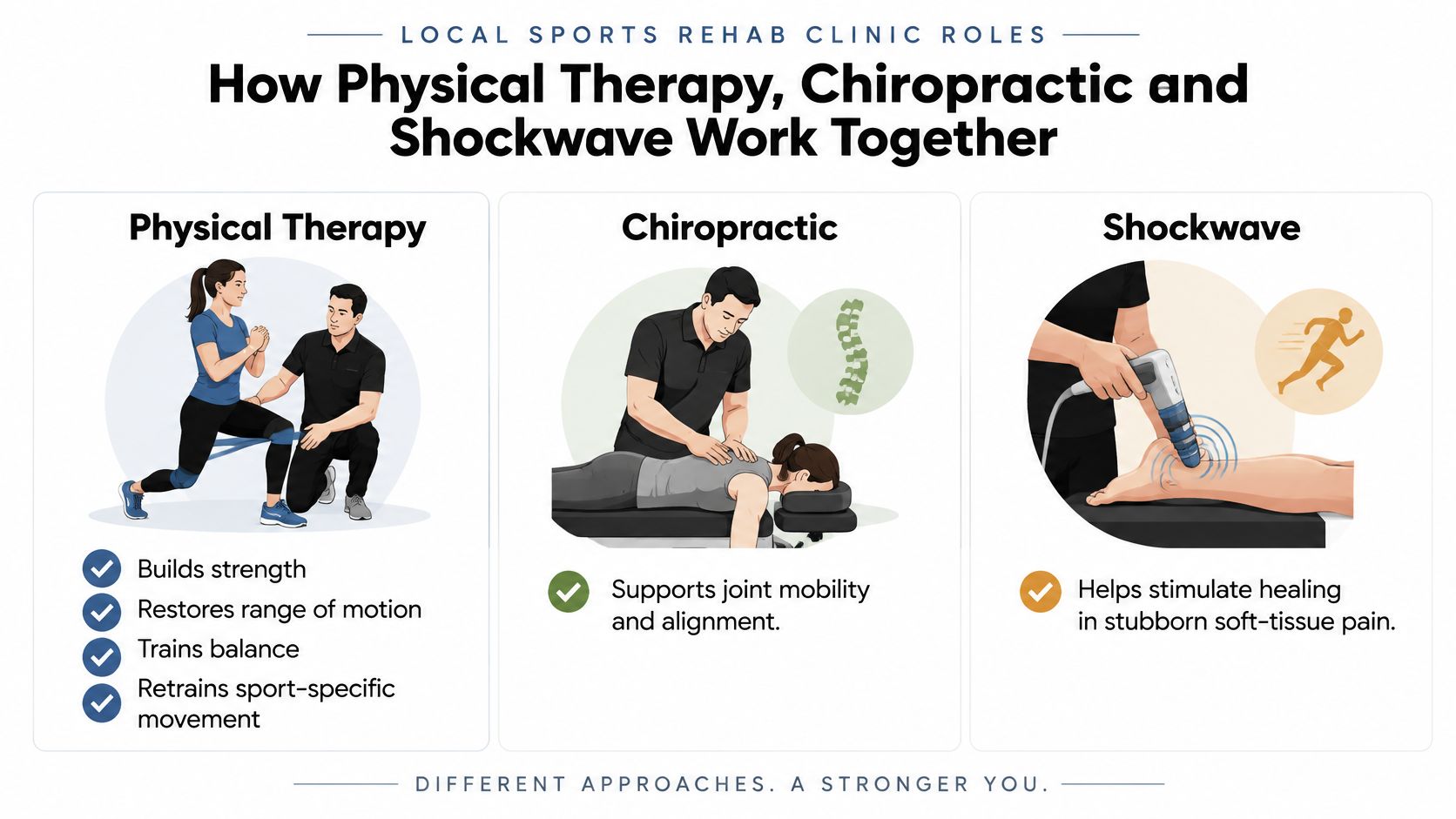
In a local sports rehab clinic, each discipline has a job. They aren't interchangeable labels for the same session.
Physical therapy is the core. It builds strength, restores range of motion, trains balance, and retrains the movement the sport or the job uses. A referral makes sense when pain has limited walking, lifting, running, or a return to practice.
Chiropractic care addresses spinal and joint mechanics. Manual therapy and adjustments aim to reduce pain and let the limb move through a useful range. It fits neck pain, low back pain, whiplash, and the stiff joints that show up after a car crash or a hard season.
Acupuncture is an adjunct for pain, used alongside the exercise plan rather than instead of it. Occupational therapy handles the hand and the tasks of daily life, including carpal tunnel and the dressing, reaching, and work skills that follow surgery.
Shockwave therapy is a non-invasive option for stubborn tendon and heel pain that hasn't settled after a real trial of loading. Shockwave therapy is the add-on for those persistent cases, not the first exercise session.
What a visit actually contains
Depending on the service, a visit can include manual therapy, strengthening exercises, hot or cold packs, electrical stimulation, stretching, and/or an adjustment. A shoulder visit might open with hands-on joint work, move to rotator-cuff strengthening, and finish with a short throwing pattern. A back visit might pair an adjustment with hip and trunk exercise so the relief doesn't vanish by the next morning.
A good team writes one plan, one shared goal, and a review date. Ask two questions before you agree to a stack of treatments. In what order will these be used? What result will trigger a change of approach? If pain drops but you still can't single-leg balance, the plan should shift toward strength and control, not more of the same modality.
Why Rehab Reaches Far Beyond Elite Athletes
Musculoskeletal conditions are a major driver of the worldwide need for rehabilitation, according to the World Health Organization. The same rehabilitation skills serve people who will never compete in a stadium: individualized therapy, exercise-based recovery, balance training, and injury prevention can support movement and daily activities at every age.
Four people, four goals
Weekend runners and gym-goers may develop calf strains, heel pain, or sore knees after increasing their mileage. Their goal is a gradual return to activity the body can tolerate. A sudden restart after resting can bring symptoms back.
Office workers may seek help for neck pain, wrist symptoms, or low back pain after long periods in one posture. Relief needs to carry over into the workday, so a plan can address how the desk, mouse, and lifting habits affect movement.
Older adults may be more concerned about falling than returning to a sport. The aim is greater confidence on stairs, curbs, and uneven sidewalks. Balance and gait practice work alongside leg strengthening, helping the body manage everyday changes in footing.
People recovering from surgery or a car accident may need to restore movement, rebuild walking ability, and resume work tasks in stages. The goal is a safe return to work, driving, and daily life, guided by healing and function rather than an arbitrary calendar.
The same clinical logic applies across these groups: assess what a person can do, build capacity progressively, and reduce the chance of another injury. The criteria and pace vary with the person and the task. A return to a 5K, a warehouse shift, or a flight of stairs calls for different goals, but each requires readiness across more than one measure, including physical ability and confidence.
Sports Injury Patterns by Activity and Age
A CDC analysis of the National Hospital Ambulatory Medical Care Survey found about 2.7 million annual sports-injury emergency-department visits among people aged 5 to 24 during 2010 to 2016. The activity associated with an injury and a person's age both help explain what parts of the body may need attention.
| Category | Measure | Share |
|---|---|---|
| Football | Share of sports-injury ED visits | 14.1% |
| Basketball | Share of sports-injury ED visits | 12.5% |
| Pedal cycling | Share of sports-injury ED visits | 9.9% |
| Soccer | Share of sports-injury ED visits | 7.1% |
| Ice or roller skating or skateboarding | Share of sports-injury ED visits | 6.9% |
| Upper-extremity injuries, ages 5-9 | Share of visits | 37.1% |
| Upper-extremity injuries, ages 20-24 | Share of visits | 27.4% |
| Lower-extremity injuries, ages 5-9 | Share of visits | 16.2% |
| Lower-extremity injuries, ages 20-24 | Share of visits | 41.0% |
Football accounted for the largest share of visits in this group, followed by basketball, pedal cycling, soccer, and ice or roller skating or skateboarding. Court and paddle sports can also involve quick turns and abrupt stops. In pickleball injuries, for example, sudden direction changes on a small court can lead to ankle, knee, or shoulder complaints, including among adults who do not play football.
Why age changes the plan
The pattern shifts across age groups. Upper-extremity injuries made up 37.1% of visits among children aged 5 to 9, compared with 27.4% among people aged 20 to 24. Lower-extremity injuries accounted for 16.2% of visits among the younger group and 41.0% among the older group. A young child may need care for a wrist or elbow, while a young adult may need a progression that addresses a knee, ankle, or hamstring used for sprinting and cutting.
Many emergency visits involve imaging or pain medication. That immediate care addresses urgent concerns, while restoring strength, range of motion, balance, coordination, and sport-specific function takes further rehabilitation.
The activity and age provide useful context, not a complete recovery plan. A 7-year-old with a wrist injury and a 22-year-old with a knee injury need progressions matched to their injuries and abilities. The same step-by-step rehab logic can guide athletes and active adults, with the demands adjusted to the activity they hope to resume.
Return-to-Sport Readiness Beyond a Passed Test
Clinicians should clear you based on criteria, not a calendar date. Expert consensus on return to sport combines symptom response, strength, motion, workload, sprinting, movement quality, and psychological readiness. Many proposed thresholds lack uniform validation. A sound progression asks whether you can tolerate the mechanical and metabolic demands of your sport, not whether the ache has faded.
| Criterion | What It Shows | How It Is Used |
|---|---|---|
| Symptom response | Pain and swelling after activity | Confirm symptoms settle after each loading session |
| Limb strength symmetry | Strength difference between sides | Compare injured and uninjured limb under the same test |
| Range of motion | Joint movement compared with the other side | Confirm full, pain-free motion before high loads |
| Sport-specific workload | Tolerance to real sport demands | Build training volume in measured steps |
| Sprint and agility progression | Acceleration, top speed, and deceleration | Move from straight running to change-of-direction work |
| Movement quality | Control during cuts and landings | Observe mechanics on video or in person |
| Psychological readiness | Confidence and fear of reinjury | Use a questionnaire and an open conversation |
A hamstring, walked forward
Hamstring rehab restores tissue length and load tolerance, builds neuromuscular control early, then advances from running to agility and pain-free high-speed sprinting before unrestricted play. The notes that matter are sprint exposure, deceleration control, reactive agility, and confidence under sport movement. A single strength score or a lower pain number doesn't carry that decision.
Falling pain is not readiness. You can feel better on a Tuesday jog and still fail a hard deceleration on Saturday.
Fear is part of the test
A 2025 qualitative study of people recovering from ACL injury found rehab disrupted by fear of reinjury, uncertainty about surgery versus conservative care, fluctuating motivation, competing responsibilities, socioeconomic barriers, and inconsistent protocols. Passing a strength or hop test doesn't mean you're ready to play safely or confidently. People ask, "Why am I strong enough but still afraid?" and "How do I increase activity without reinjury?"
Name the fear out loud. Then use graded exposure. Return to training is not return to competition. A runner restarts intervals at a lower volume. A basketball player starts with noncontact drills before live defense. Track a simple confidence rating, how the session felt the next day, sleep, and mood next to the strength numbers. Swelling, a limp, or dread before the next session means that step was too big.
ACL Recovery Timing and Strength Symmetry
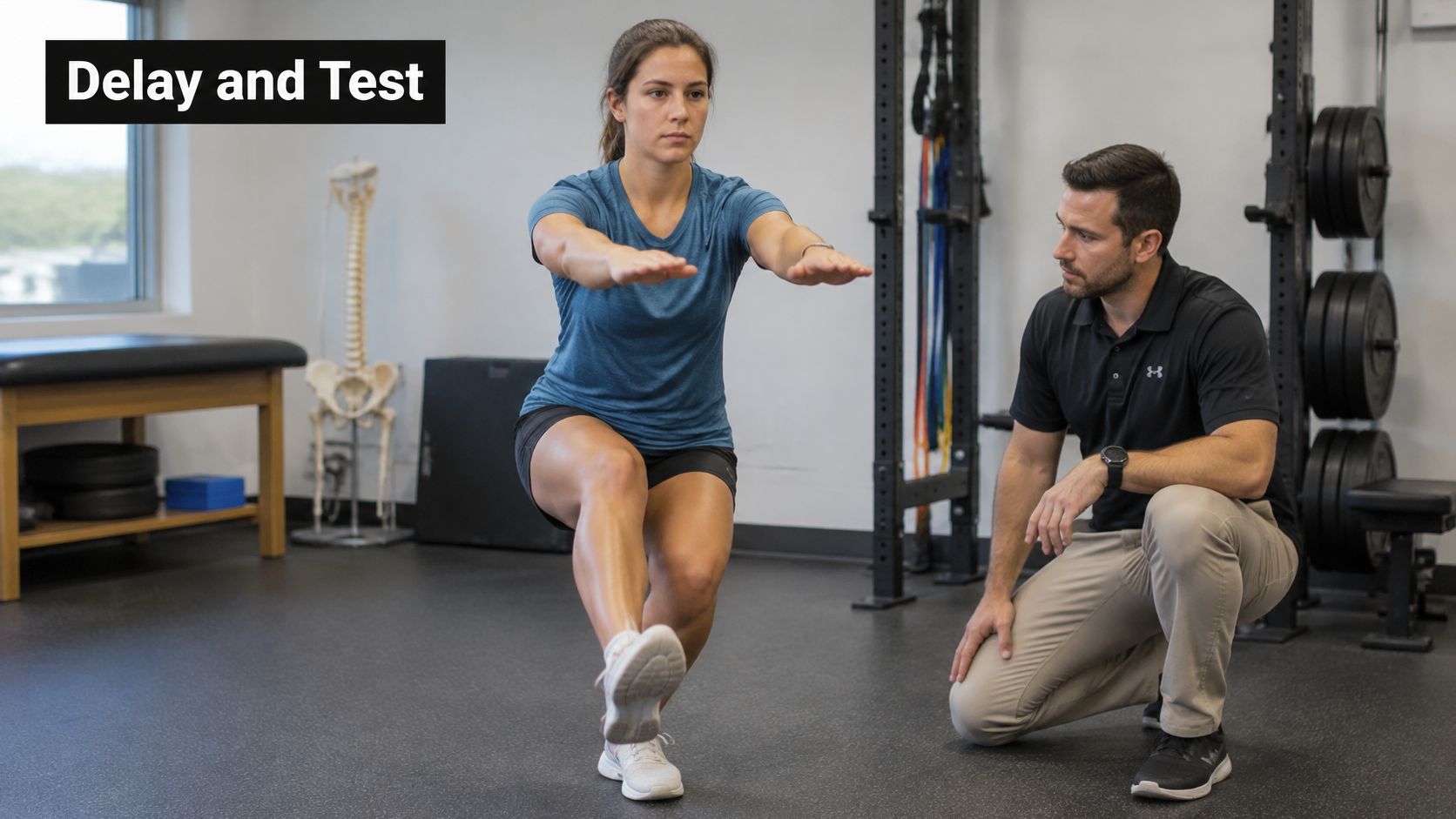
After ACL reconstruction, waiting until the knee is biologically and functionally ready can cut reinjury risk in a measurable way. In the Delaware-Oslo cohort, the reinjury rate decreased by 51% for each additional month that return was delayed, up to 9 months after surgery. Beyond 9 months, delay alone added no further reduction.
Time is not a substitute for a test. The same research tied quadriceps strength symmetry to risk. Every 1-percentage-point improvement in strength symmetry before return was associated with about a 3% lower knee reinjury rate. A single-leg squat, watched for knee control, is one way that symmetry shows up in the room, not only on a machine printout.
A commonly used minimum is at least 90% quadriceps symmetry. Treat that number as a floor, not a guarantee. Clearance should also include single-leg hop performance, movement-quality analysis, and progressive sport-specific loading. Landing mechanics, how the knee behaves when you're tired, psychological readiness, and the sport itself still sit on the table. Pivoting in soccer asks more of the graft than steady running in a distance event.
Ask for the actual symmetry percentage and the names of the tests. "You look strong" is not a result you can track.
The video walks through how a clinic session ties strength work to the way the knee has to move later in sport. Pair what you see with your own numbers. If hop distance or landing control lags the strength score, you aren't finished, even if the month on the calendar looks right.
What Good Recovery Outcomes Look Like
Set the finish line before the first exercise. Useful outcomes are a return to the activity you named, limb symmetry, pain and function scores, a return to work or daily tasks, and confidence on the movements that matter to you. If the goal is "play rec soccer," a painless walk around the block is progress, not success.
Newer tools don't replace that agreement. A 2025 review of 43 studies reported mixed efficacy for wearables and artificial intelligence. Telerehabilitation worked best when it was paired with community integration, and that review reported 89% adherence in a community-integrated telerehabilitation context. That figure is a signal from one kind of program, not a promise for every home app. Pain intensity also doesn't always match what you can do, so a wearable pain log can't stand in for a strength or hop test.
How the check actually runs
- Record a baseline before treatment, using the same tests you'll repeat.
- Repeat those tests at set review points, not only when someone feels motivated.
- Compare the results with the return criteria you agreed on.
- Write down whether the goal was reached and what changed, including missed sessions.
Clinics that use standardized outcome measures can show you the score trend instead of a vague "you're improving." Adherence is itself an outcome. Missed visits and a chaotic week change the result as much as the exercise list does.
Choosing a Local Clinic and Your Next Step
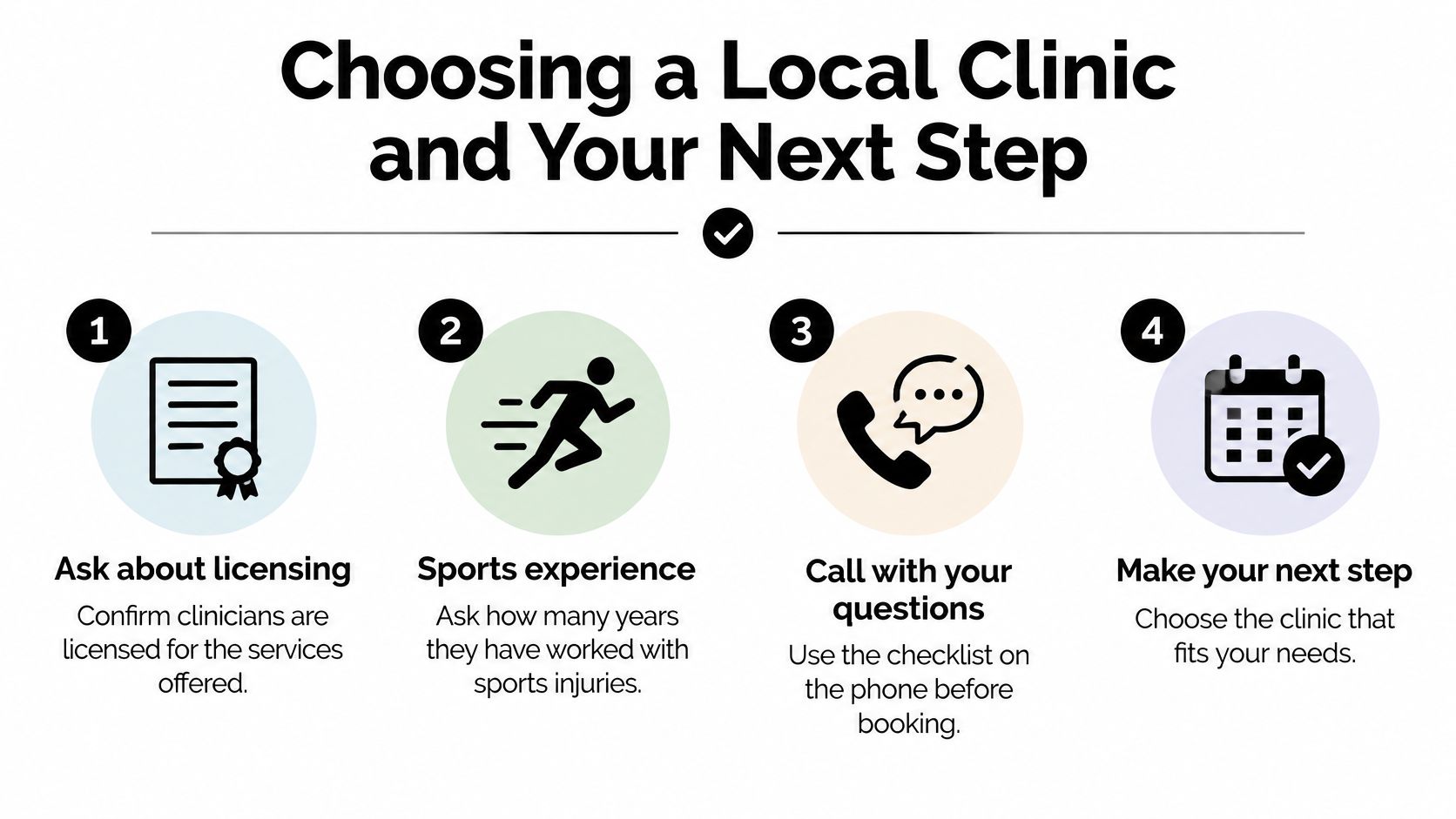
Use this on the phone before you book.
- Licensing. Our doctors and therapists are licensed and experienced. Ask how long the clinician has worked with sports injuries and with active adults who aren't on a team.
- The first look. Ask whether the evaluation covers gait, balance, and movement, not only the sore spot. A knee plan that never watches you walk will miss the limp that keeps the pain going.
- How progress is judged. Ask which return criteria they'll measure and how often the plan is reviewed. You want a date, not "we'll see how you feel."
- Your claim and your coverage. We accept most major insurance plans, plus auto accident claims and workers' compensation claims. Check with us before the appointment so billing isn't a surprise.
The first visit
Physical therapy and occupational therapy initial evaluations, on the first visit, typically last 60 to 75 minutes. Follow-up treatments are 60 minutes. Wear gym clothes and supportive shoes. Bring your injury history, imaging reports, a current medication list, and the activity you want back.
Book the evaluation with one clear goal, pick one measurable benchmark to track, and put a review date on the calendar before you leave.
MedAmerica Rehab Center in Deerfield Beach provides physical therapy, chiropractic care, acupuncture, occupational therapy, and shockwave therapy for sports injuries, everyday pain, and recovery after surgery or an accident. If you want a plan that judges readiness by strength, movement, and confidence, visit MedAmerica Rehab Center and book an evaluation with the goal you want to get back to.
MedAmerica Rehab · Deerfield Beach
Talk to a clinician about your pain
Physical therapy, chiropractic, acupuncture and shockwave therapy under one roof, since 1995. Same-day appointments are available.
Mon–Thu 8:00 AM – 6:30 PM · Fri 8:00 AM – 3:00 PM