

Physical Therapy for Low Back Pain Relief: What Works
About 1 in 13 people worldwide lives with low back pain, yet physical therapy for low back pain relief is often described as if it were one standard treatment. It isn't. One person may need help calming a recent flare-up so they can sit, walk and sleep. Another may need months of graded strengthening because bending still feels risky long after tissues have healed.
That's why the details matter. Which exercises are chosen, how quickly they're progressed, how fear and poor sleep are handled, and how progress is measured can change the result as much as the exercises themselves. A good plan treats function as the goal, not pain relief alone. You should leave understanding what each part of care does, what it can't do, and what questions to ask before you commit to weeks of visits.
Why Physical Therapy Works for Low Back Pain
Say you're marking a calendar. The World Health Organization guideline reported approximately 619 million people experienced low back pain in 2020, about 1 in 13 people worldwide, and identifies structured exercise therapy as an option for adults, including older adults, with chronic primary low back pain. That scale helps explain why care focuses on accessible, nonsurgical strategies rather than rest alone.
Three Patterns You May Recognize
- Acute episode: Pain starts suddenly, often after lifting or twisting, and settles within weeks as movement returns.
- Recurrent flare-ups: Pain eases, then returns with bending, prolonged sitting or a heavier lift.
- Chronic pain: Pain lasts beyond three months and begins to limit work, walking, lifting and sleep.
Picture your spine as a stack of blocks. Deep trunk, hip and gluteal muscles act like guy wires holding that stack steady while you move. When pain makes those muscles switch off or weaken, the stack feels less supported, so ordinary tasks seem risky and you move less. Moving less weakens the wires further.
Physical therapy interrupts that cycle. A therapist combines strengthening, mobility, aerobic conditioning, movement control and self-management, matched to your age, capacity, symptoms and goals. Passive treatment may help you feel comfortable enough to start, but it doesn't rebuild the wires by itself.
Clear documentation helps that progression stay focused, which is why tools that turn therapy consultations into clinical notes can support continuity between visits. Before your first appointment, note which pattern fits you, how long pain has lasted, and which activities it limits most. Those three answers shape the starting dose more than a pain score alone.
Red Flags and Whether Telehealth Fits Your Case
Some symptoms call for urgent medical assessment before starting exercise or routine physical therapy. New bladder or bowel problems, numbness around the groin or inner thighs, or worsening leg weakness can signal a serious problem. Seek urgent care if any of these occur.
Other warning signs include fever with back pain, unexplained weight loss, pain after significant trauma, or new unexplained back pain with a history of cancer. Trouble lifting the front of your foot also deserves prompt assessment.
If leg pain, tingling or numbness is your main concern, learning about symptoms that may point to a herniated disk can help you describe what you feel. A clinician can assess strength, reflexes and sensation when nerve symptoms are present.
Where Digital Care Fits and Where It Doesn't
Digital care may help people follow an exercise program after safety screening. In a 2025 matched cohort study published in the Journal of Medical Internet Research, 4,190 people with spinal or musculoskeletal pain who participated in a digital program had a 58% lower relative risk of surgery at 12 months than those who started in-person physical therapy. The study found an association, not proof that the digital program prevented surgery. Participants who chose and continued an app may have differed from clinic patients in motivation, access or symptom severity.
Remote coaching can support adherence between visits, but it cannot assess every concern. In-person care is a better starting point when red flags, neurological symptoms, severe weakness or complex post-surgical needs are present, or when technology access is unreliable.
A hybrid approach can combine clinic visits with remote check-ins. The clinician can assess your movement and adjust your plan, while check-ins help you stay engaged between appointments. Fear of movement and low mood can also make it harder to keep up with exercise, so tell your care team if either is getting in the way.
Physical Therapy Techniques and What Each Does
People often ask what a therapist does to a back. The short answer is that physical therapy for low back pain relief combines active rebuilding with short-term comfort measures. The table below separates those roles, because confusing them leads to disappointment. A session that feels good for an hour isn't the same as a program that helps you lift, walk and work with confidence in three months.
Physical therapy techniques for low back pain
| Technique | What happens in the session | Best used for | Strength of support |
|---|---|---|---|
| Manual therapy | Joint mobilisation, spinal manipulation or soft-tissue work | Easing stiffness so movement can start | Recommended only as part of a package that includes exercise |
| Targeted exercise | Strengthening, aerobic and mobility work tailored to the patient | Chronic and recurrent pain, and rebuilding function | Moderate-certainty reduction in pain versus no treatment or usual care |
| Spinal stabilisation | Activation of deep trunk and gluteal muscles with movement-control drills | Pain that returns with bending, lifting or prolonged sitting | Used within active programmes; direct trial data still growing |
| Stretching | Guided stretches for hips, hamstrings and lower back | Stiffness and limited range of motion | Helpful for comfort, not a standalone fix |
| Heat or cold packs | Superficial heat or ice applied for 15 to 20 minutes | Short-term comfort during a flare-up | Short-term relief only, no lasting change |
| Electrical stimulation | Low-level electrical current delivered through pads | Brief pain relief to help a patient move | Adjunct only; short-term effect |
How to Read This Table
- No single technique cures back pain: Each row does a different job, and a plan built around one tool usually leaves gaps.
- Active rows carry long-term outcomes: Targeted exercise and stabilisation rebuild strength, tolerance and control.
- Passive rows buy comfort: Heat, cold and electrical stimulation may open a window for movement, but they don't create lasting capacity.
- Manual therapy needs context: Hands-on care belongs inside a package with exercise, not instead of it.
Think of hands-on care as a jump-start. Joint mobilisation or soft-tissue work can reduce stiffness and pain enough that you can practise a hip hinge, walk longer or begin a glute bridge without guarding every movement. Exercise is the drive that follows. Without that drive, you'll likely need the same jump-start again because nothing underneath has changed.
That distinction helps you judge quality. If you're reviewing manual physical therapy techniques, look for a clear link between each hands-on method and the active exercise it's meant to support. A therapist should be able to say, for example, that soft-tissue work around tight hip muscles is being used this week so you can practise sit-to-stand movements with better form.
Three Questions That Test Any Clinic Plan
- Which hands-on techniques are planned, and why those? The answer should connect to your assessment findings, not a routine package.
- How long will each technique be used? Passive care should have a purpose and a review point, not run indefinitely.
- When will hands-on care taper off? As you get stronger, session time should shift toward progressive exercise and self-management.
At MedAmerica Rehab Center, depending on the service, a visit can include manual therapy, strengthening exercises, hot or cold packs, electrical stimulation, stretching and/or an adjustment. That combination only makes sense if the proportions change over time. Early on, comfort measures may take more room. Later, most of your effort should go into loading the back and hips safely.
A useful test is simple. Each week you should be doing slightly more, not simply receiving slightly more treatment.
Watch for warning signs in a plan. You're told every visit will be identical for months. Exercises never get harder. No one measures walking tolerance, lifting capacity or disability scores. You're discouraged from moving between appointments. Those patterns suggest passive care is driving the schedule.
By contrast, a sound plan names the target, such as sitting for your workday, carrying groceries, gardening or returning to sport. It then works backward, choosing techniques that build toward that target and dropping techniques that no longer help.
Exercise Plans That Reduce Pain and Rebuild Movement
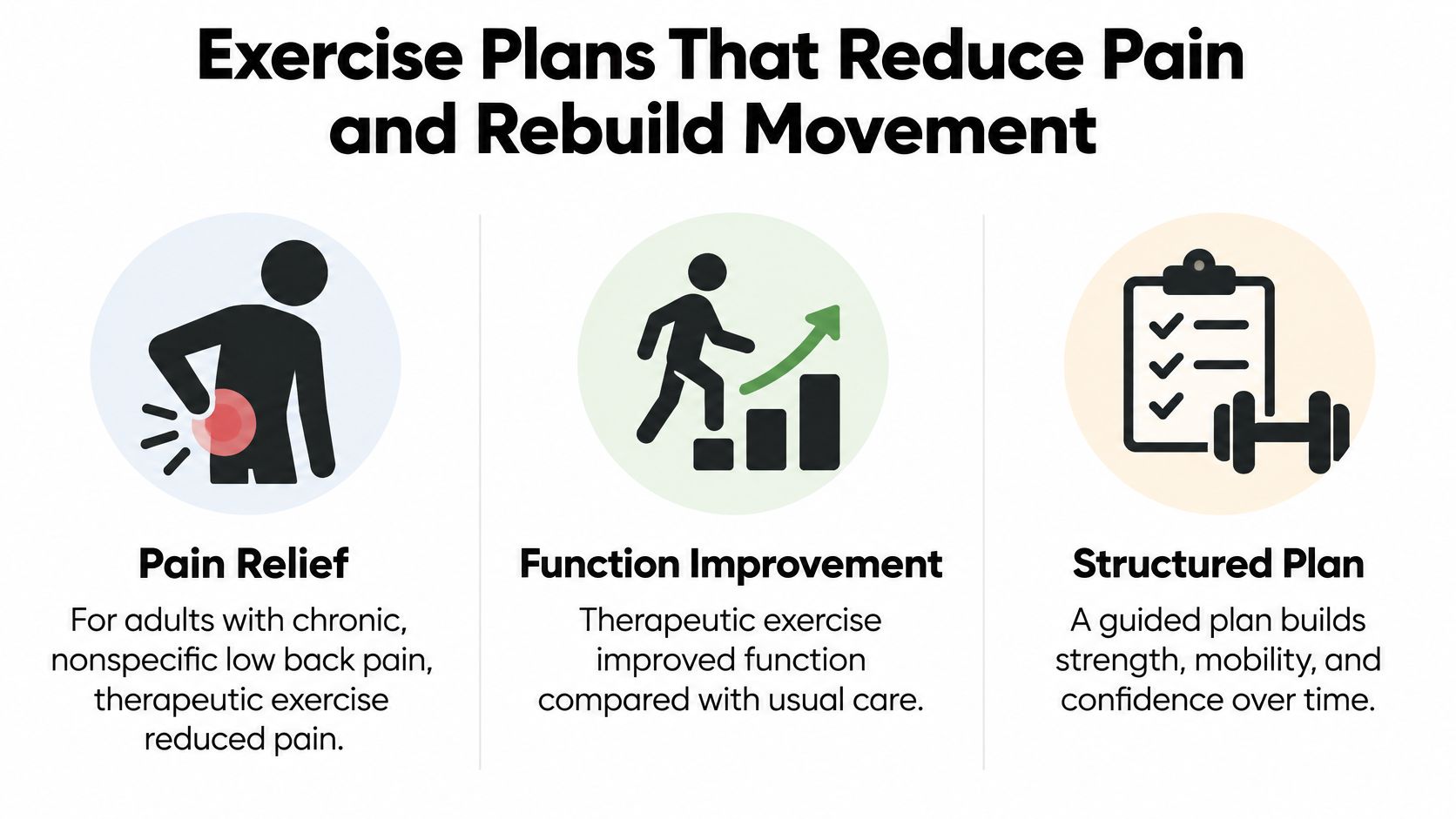
Exercise helps pain more clearly than it restores every activity at once, and that difference matters for expectations. The Cochrane review found that for adults with chronic, nonspecific low back pain, therapeutic exercise produced a moderate-certainty pooled improvement of 15.2 points on a 0 to 100 pain scale compared with no treatment, usual care or placebo, across 35 studies involving 2,746 participants. Functional improvement was smaller at 6.8 points on a 0 to 100 disability scale across 38 studies and 2,942 participants.
In plain terms, you may notice pain easing before you can confidently lift, bend or sit through a full workday. That's not failure. Pain and disability don't always move at the same speed, so both need tracking.
What a Structured Plan Includes
- Strengthening: Hip, gluteal and trunk work, such as bridges, sit-to-stands, carries and progressive resistance.
- Mobility: Controlled spinal and hip movement to restore range without forcing painful end positions.
- Aerobic conditioning: Walking, cycling or similar activity to rebuild general tolerance and reduce sensitivity to daily load.
- Movement control: Drills that practise bending, lifting and turning with the trunk and hips sharing work.
Your therapist chooses the mix based on irritability. If pain flares for a day after light activity, you'll start lower and progress more slowly. If symptoms settle quickly, load can rise sooner.
Dosing Without Guesswork
Start below the level that sharply provokes symptoms. Add small steps, such as one extra set, slightly more resistance or a few more walking minutes, when the previous level settles well. The next morning matters. Mild muscle effort is expected, but a clear flare that lingers suggests the step was too large.
This is the guy-wire idea in practice. Exercise rebuilds support gradually, which is slower than a single hands-on session but more durable. Reassessment after approximately 6 to 12 weeks should compare pain and disability scores, not rely only on how one session felt.
Ask two questions at your first visit. How will progress be measured? What should the plan look like by week six if you're responding well? Clear answers show that exercise is being prescribed, not just suggested.
Treatment Timeline From First Visit to Recovery
Recovery usually builds in phases, not in a straight line. The table below gives one measured example, then places it beside what clinics typically focus on at each stage.
Oswestry improvement across a 12-week exercise and manual therapy programme
| Checkpoint | ODI improvement in one study | Typical clinic focus |
|---|---|---|
| 3 weeks | 54.71% | Pain control, gentle movement and graded activity |
| 6 weeks | 63.16% | Strength, movement control and progressing loads |
| 12 weeks | 87.70% | Return to work, lifting, daily tasks and self-management |
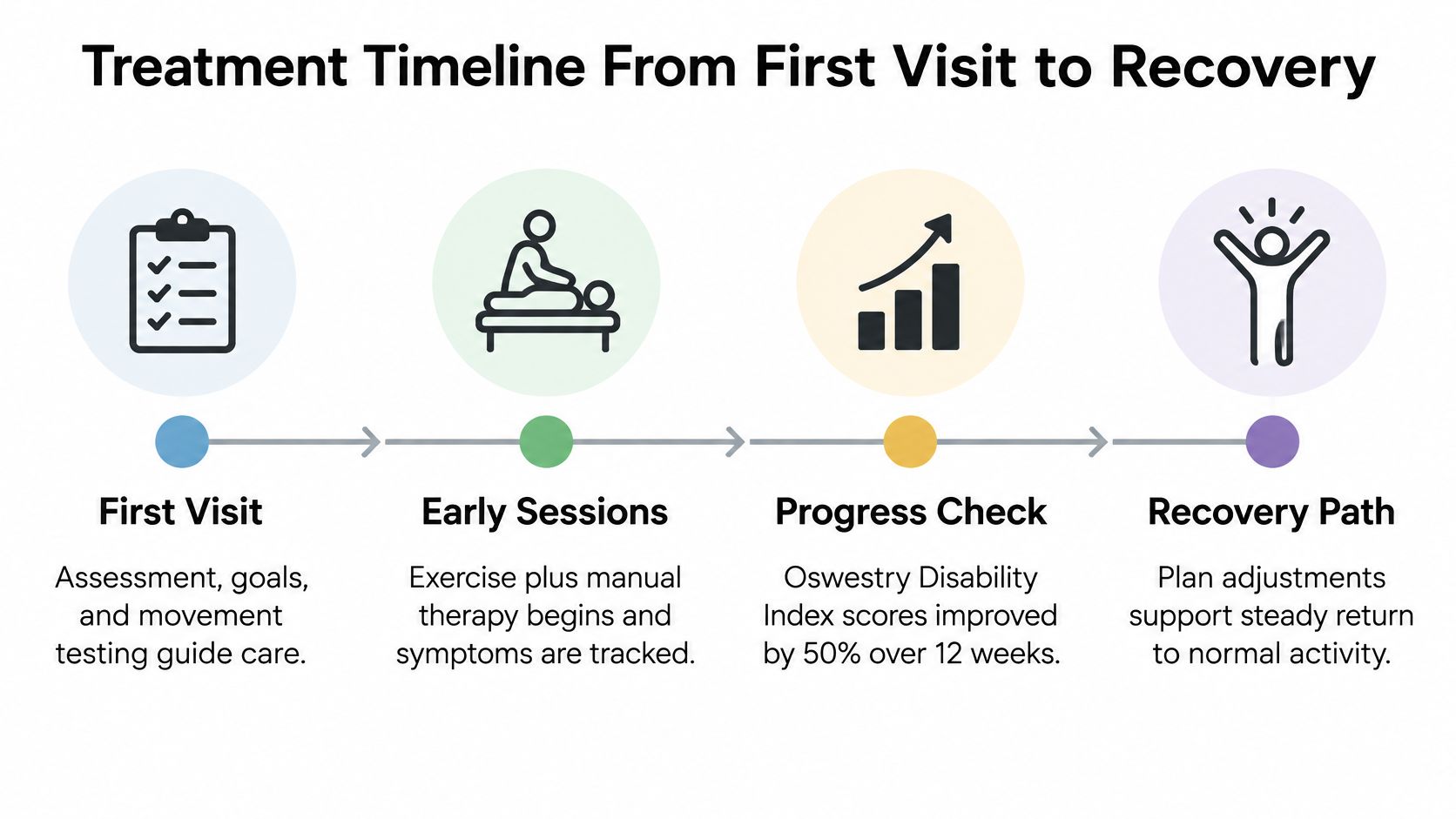
Those figures come from the Scientific Reports trial, a 2024 randomized controlled trial of 55 adults with chronic low back pain that found exercise plus manual therapy improved Oswestry Disability Index scores by 54.71% after 3 weeks, 63.16% after 6 weeks, and 87.70% after 12 weeks. With only 55 participants, treat this as one encouraging example, not a promise for your case.
What Each Phase Usually Looks Like
First visit. Our physical therapy and occupational therapy initial evaluations typically last 60 to 75 minutes and cover your history, a movement screen and goal setting. Follow-up physical therapy and occupational therapy treatments are 60 minutes.
Early weeks. The aim is calming symptoms while keeping you moving. You'll practise gentle mobility, short walks and basic activation work, and learn positions that ease flare-ups.
Middle weeks. Load increases. Strength exercises get heavier, movement-control drills become more demanding, and home practice should feel more like training than stretching alone.
Later weeks. Care shifts toward real-life targets, such as lifting at work, playing with grandchildren, gardening or sport. You'll also build a self-management routine you can continue after discharge.
Plateaus are normal. A week where scores barely move doesn't mean the program has stopped working, especially if walking tolerance or confidence is still improving. What matters is the trend across several weeks and whether your therapist adjusts load when progress stalls.
Set two measurable goals early, for example walking 20 minutes without stopping or carrying groceries from the car. Track them weekly. Then ask how many visits per week are planned and how that schedule changes as you meet those goals, so the timeline stays tied to function rather than habit.
When Mood, Fear and Sleep Slow Your Recovery
More exercise doesn't always fix a stalled recovery. If pain is disrupting your sleep, mood, confidence or willingness to move, exercise alone may not be enough unless those barriers are addressed too.
In the Physiotherapy Theory and Practice study, outpatient therapists' awareness of low back pain guidelines was 78.3% and agreement reached 85%, but actual adherence was only 10%, and adherence was 26% lower for cases involving an affective disorder. Knowing the guideline and delivering guideline-concordant care are different things. That gap matters most for people whose pain comes with depression, anxiety or fear of movement.
How Fear Narrows Your World
Fear of movement often starts sensibly. Bending hurt once, so you avoid it. Lifting hurt, so someone else carries everything. Within weeks, you move less, lose strength and trust your back even less. Avoidance then protects pain instead of you.
A thorough assessment asks about sleep, mood, stress at work and confidence with specific movements, alongside pain intensity. Approaches such as pain neuroscience education can help explain why a sensitive back isn't always a damaged back, which makes graded activity feel safer.
Graded activity starts with a small, agreed target, such as a short walk or practising a supported bend, then increases weekly. Shared goals matter because confidence grows when you choose the target and see yourself meet it. When low mood or anxiety persists, coordinated referral to a behavioral health professional should sit alongside therapy, not replace it.
Sleep deserves the same attention. Practical steps to build a restorative bedtime routine may support recovery when nighttime pain and next-day sensitivity feed each other.
Ask directly how fear avoidance, mood, sleep and daily function will be tracked alongside your pain score.
Book a Clinical Assessment Before Starting Any Program
Book an in-person assessment before committing to a long home program, especially if pain has lasted more than six weeks, spreads into a leg or keeps returning. That visit determines whether physical therapy for low back pain relief is appropriate, what needs medical review first, and how hard you can safely train.
The photo below shows the kind of one-to-one consultation that starts that process.

Steps Before Your First Visit
- Check for red flags: Seek urgent medical care first if bladder, bowel, weakness or fever symptoms are present.
- List what hurts: Write down movements, positions and activities that provoke or ease symptoms.
- Gather your context: Bring current medications, previous imaging if you have it, and notes about the physical demands of your work.
- Name two goals: Choose measurable targets, such as walking tolerance, sitting time or lifting a specific household load.
- Prepare questions: Ask how progress will be measured and what the first six weeks should look like.
At MedAmerica Rehab Center, our initial physical therapy evaluation typically lasts 60 to 75 minutes and covers history, a movement screen and goal setting. We treat back pain, sciatica, neck pain, headaches, arthritis, knee pain, shoulder pain, and foot and ankle pain, and we serve patients in Deerfield Beach, Florida and nearby communities. Our care aims to relieve pain, restore mobility and improve quality of life without surgery or unnecessary medication.
Wear comfortable clothing, such as gym clothes and shoes, so your therapist can watch you bend, walk, squat and lift safely. Loose clothing also makes hands-on assessment easier and more accurate.
The short video below gives a sense of how a clinical conversation can turn your history and goals into a treatment plan.
Use this final checklist today. Confirm no red flags are present, write down two measurable goals, book the assessment, and bring questions about measurement, visit frequency and home exercise. You'll get more from care when you arrive knowing what success should look like.
If back pain or sciatica is limiting your work, sleep or daily movement in Deerfield Beach or a nearby community, book an initial evaluation so we can examine how you move, set measurable goals and build an individualized plan without surgery or unnecessary medication. Visit MedAmerica Rehab Center to request your assessment and take the first structured step toward steadier, more confident movement.
MedAmerica Rehab · Deerfield Beach
Talk to a clinician about your pain
Physical therapy, chiropractic, acupuncture and shockwave therapy under one roof, since 1995. Same-day appointments are available.
Mon–Thu 8:00 AM – 6:30 PM · Fri 8:00 AM – 3:00 PM