
Sports Injury Recovery Time: Real Timelines by Injury Type
Most sports injuries resolve within a few weeks, while severe injuries such as ACL tears often require nine to twelve months before a safe return to sport. Your timeline depends more on tissue healing, symptoms, strength, and functional testing than on a fixed calendar date.
You've probably searched “how long will this take?” after a painful landing, awkward twist, sudden sprint, or collision. The honest answer is that sports injury recovery time is a range, not a promise. A mild muscle injury may settle quickly, while a ligament rupture or surgically repaired tendon demands months of carefully increased loading.
The useful question isn't only, “How many weeks has it been?” It's also, “What can I do safely now?” Clinicians track swelling, mobility, strength, balance, movement quality, confidence, and tolerance to the demands of your sport. Two people with apparently similar injuries can progress differently because the tissue damage, treatment, health history, and response to rehabilitation aren't identical.
A milestone-based plan gives you something better than an arbitrary return date. It shows what must improve before you move from walking to jogging, from jogging to practice, and from practice to competition. An individualized treatment plan helps match those milestones to your injury, activity level, and daily demands.
What Affects Your Sports Injury Recovery Time
The injured tissue sets the first boundary. Muscle, tendon, ligament, bone, cartilage, and joint capsules each heal differently, and surgery can add another layer of protection and rehabilitation. A small strain and a complete tear may occur in the same body region but require very different decisions.
Severity matters just as much. Pain and swelling can decrease before the tissue has regained enough strength to handle sprinting, jumping, lifting, or rapid changes of direction. Feeling better is encouraging, but it doesn't automatically mean the injured structure is ready for full load.
Why the calendar can mislead
A calendar is useful for organizing care, but it shouldn't make the clearance decision by itself. Early rehabilitation may focus on controlling symptoms and restoring safe movement. Later stages require progressive resistance, coordination, balance, and sport-specific exposure.
Your age, previous injuries, general health, sleep, nutrition, stress, and consistency with treatment can all influence how you respond. A recreational athlete also faces different demands from a professional player, even when the diagnosis sounds similar.
Practical rule: Use time as a guide for biological healing, then use objective performance and symptom response to decide whether loading can advance.
The trade-off is straightforward. Progress too cautiously and you may lose strength, confidence, and conditioning. Progress too quickly and you may provoke swelling, compensate with another body part, or return before the tissue can tolerate the sport. Good rehabilitation manages both risks through staged progression rather than a race to the first pain-free day.
Recovery Time Benchmarks From Large Injury Studies
A professional footballer may miss a week, several weeks, or months depending on the injury and the progress of rehabilitation. The UEFA Elite Club Injury Study reviewed 22,942 injuries across 494 team-seasons over 16 years, offering a substantial benchmark for time lost before medical clearance (British Journal of Sports Medicine).
Shorter absences made up most of the dataset. Forty-two percent of cases, totaling 6,440 injuries, were mild, with a median absence of 7 days or less. Another 56%, representing 8,518 injuries, were moderate, with a median absence of 7 to 28 days. Two percent, or 311 cases, were severe, keeping players away from play for more than 28 days.
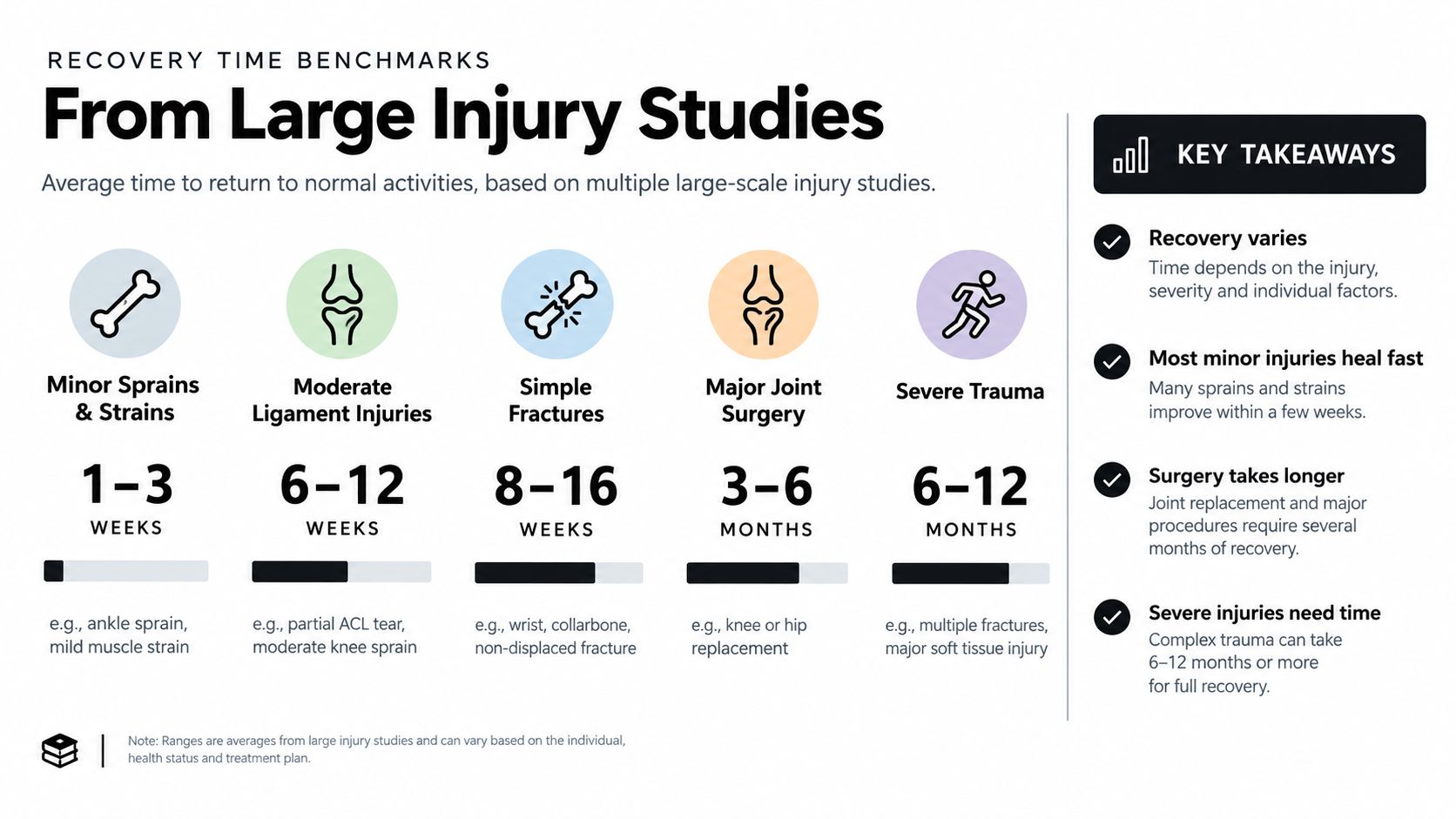
The practical message is encouraging: most injuries in this professional dataset were measured in days or weeks rather than months. Calendar time still cannot determine readiness. An athlete may reach the end of a typical absence while lacking the strength, control, or sport-specific tolerance needed for full participation.
The study also found that most total injury-related time loss came from injuries with an individual absence of up to four weeks. A smaller group of severe injuries produced much longer interruptions. That trade-off matters for recreational athletes, who should use these figures to set a broad expectation, then progress through functional milestones rather than chase a fixed return date.
| Injury classification | Reported benchmark | What it means |
|---|---|---|
| Mild | 7 days or less median absence | Symptoms may settle quickly, but function still needs checking |
| Moderate | 7 to 28 days median absence | Progressive loading usually matters more than rest alone |
| Severe | More than 28 days away from play | Months of rehabilitation may be appropriate when major tissue damage or surgery is involved |
Professional football data provides context, not a personal diagnosis. Recreational athletes, older adults, and people with additional medical conditions may recover more slowly. A useful estimate combines the injury type with measurable checks of strength, movement, symptoms, and sport-specific tolerance.
Typical Sports Injury Recovery Time by Injury Type
A recreational athlete with a mild hamstring strain may resume activity in weeks, while an athlete recovering from an ACL reconstruction may need many months before competition. The tissue involved usually gives a better starting point than the broad label “sports injury.” A systematic review of football-player return-to-sport outcomes reported ligament return-to-match times ranging from about 43 days for lateral collateral ligament injuries to approximately 249.6 days for ACL rupture and reconstruction (systematic review of return-to-sport outcomes).
Muscle injuries generally returned faster in the reviewed studies. Reported times ranged from 21 days for some hamstring injuries to 69.1 days for soleus injuries. Tendon-related recovery ranged from 29.4 days for patellar tendinopathy to 220.4 days for Achilles tendon rupture.
| Injury type | Typical recovery range | Key considerations |
|---|---|---|
| Lateral collateral ligament injury | About 43 days for reported return to match | Stability and sport demands influence clearance |
| Some hamstring injuries | About 21 days for reported return to match | Sprinting and next-day response must be assessed |
| Soleus injury | Up to 69.1 days in reported outcomes | Calf loading and running tolerance matter |
| Patellar tendinopathy | About 29.4 days in reported outcomes | Load management is central |
| ACL rupture and reconstruction | Approximately 249.6 days for reported return to match | Biological healing, strength, and cutting readiness are required |
| Achilles tendon rupture | About 220.4 days pooled mean return to match | Functional progression continues after basic walking improves |
These figures describe reported outcomes, not a guaranteed personal schedule. The review reported that return to training after ACL reconstruction averaged 212.9 days. Practice participation and full-intensity competition therefore remain separate milestones. Across five Achilles studies, pooled mean return to match was 220.4 days, with a 95% confidence interval of 167.4 to 273.4 days.
Surgery can protect a repaired structure, while biological healing and progressive reloading still determine readiness. A faster program is unsafe when strength, movement control, or confidence remains below the demands of the sport.
For practical guidance after an accident or lower-back injury, these recovery tips from Lawyer in Martin County explain why symptom monitoring and professional evaluation matter outside sports.
How ACL Reconstruction Recovery Time Is Decided
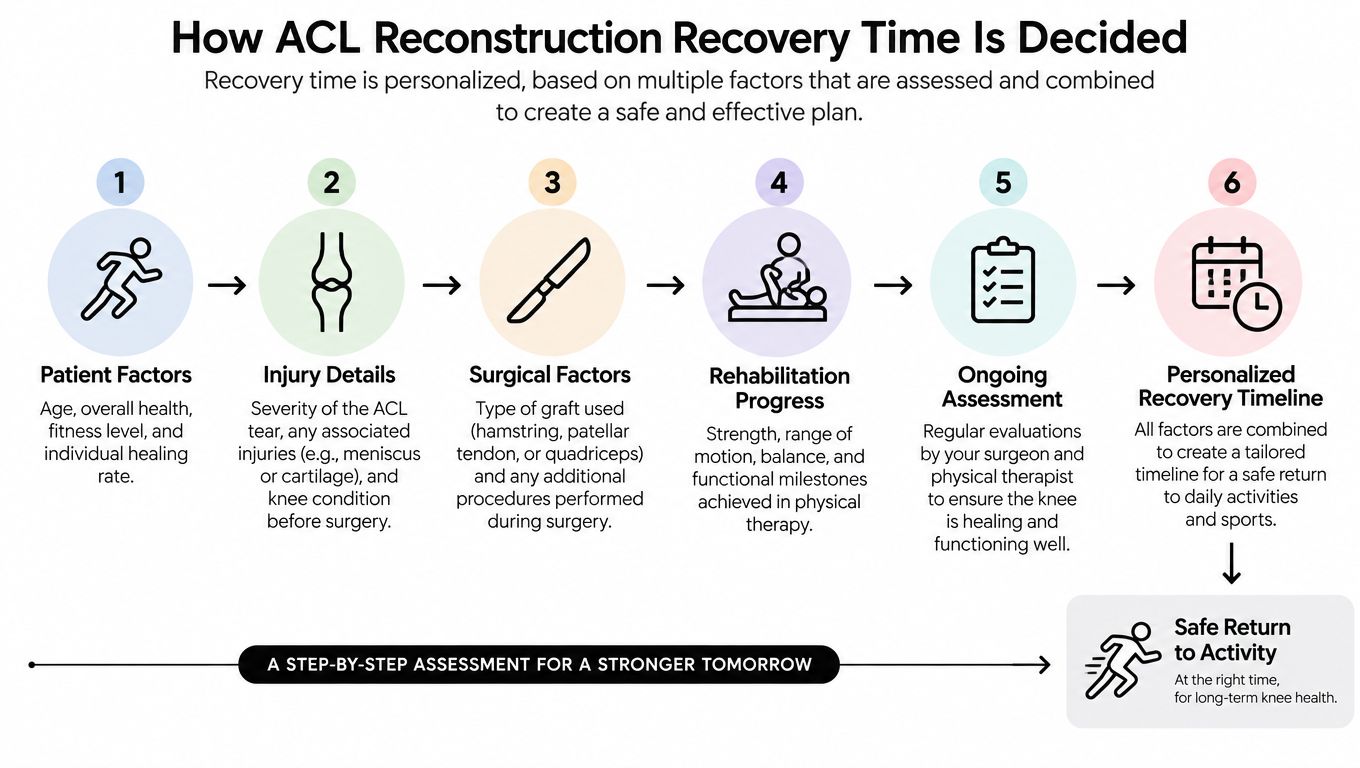
A knee can feel comfortable during daily activities while the graft, muscles, and movement patterns remain unready for pivoting sport. ACL recovery is therefore guided by staged milestones, not a target date. The Delaware–Oslo cohort found that delaying return to sport by each month up to 9 months reduced reinjury risk by approximately 51% (British Journal of Sports Medicine ACL research). Athletes who failed the return-to-sport criteria had reinjuries in 38.2% of cases, compared with 5.6% among those who passed.
The clearance questions that matter
A therapist and medical team assess whether you can:
- Match quadriceps strength: Objective testing should show the reconstructed leg approaching the uninjured side.
- Control sport-specific movement: Single-leg landing, deceleration, cutting, and reactive decisions should occur without unsafe compensation.
- Tolerate progressive exposure: Training load should build in stages, rather than shifting directly from controlled drills to competition.
- Trust the knee: Fear and hesitation can change mechanics, so psychological readiness belongs in the assessment.
Returning to a level-I pivoting sport before 9 months is associated with substantially greater risk. Contemporary observational data report a median return to sport of approximately 12 months after ACL reconstruction. These figures guide discussion, not a universal schedule. Additional procedures, instability, strength deficits, medical factors, and missed rehabilitation can all alter progression.
A structured ACL reconstruction recovery timeline helps organize these checkpoints. The calendar identifies when reassessment may be appropriate, while strength testing, movement quality, training tolerance, and confidence provide evidence of readiness. For recreational athletes, the same principle applies: return to the next demand only after the knee consistently handles the current one.
Factors That Speed Up or Slow Down Recovery
Two people can sustain similar injuries and still progress at different rates. Tissue damage, surgery, previous injury, age, general health, and the physical demands of the desired activity all shape the plan. Some factors can be improved; others require patience and medical judgment.
| Factor | How it can influence progress | Useful response |
|---|---|---|
| Injury severity | Greater structural damage usually requires more protection | Follow the medical restrictions before adding load |
| Previous injury | Weakness or altered movement can complicate rehabilitation | Address the entire kinetic chain, not only the painful site |
| Health conditions | Conditions affecting circulation, inflammation, or energy can slow recovery | Coordinate care with the appropriate clinician |
| Treatment consistency | Missed loading and mobility work can leave clear deficits | Make the home program practical and trackable |
| Sleep and nutrition | Poor recovery habits can reduce tolerance for rehabilitation | Establish regular sleep and adequate nourishment |
| Confidence | Fear can change movement and limit effort | Progress exposure gradually and discuss concerns openly |
The important comparison is between controllable factors and fixed biology. You can follow restrictions, attend therapy, complete prescribed exercises, fuel your body, and communicate when symptoms change. You can't force a graft, tendon, ligament, or bone to mature faster by ignoring warning signs.
If you're recovering from surgery, a general overview of strategies to recover faster after surgery can provide additional context. Any supplement, device, or accelerated protocol should be discussed with your surgical and rehabilitation team rather than added independently.
One more distinction prevents unrealistic expectations. Returning to some activity is not the same as returning to your previous sport, and returning to sport is not the same as performing at your former level. The rehabilitation target should match what you want to do.
Return to Participation, Sport, and Performance
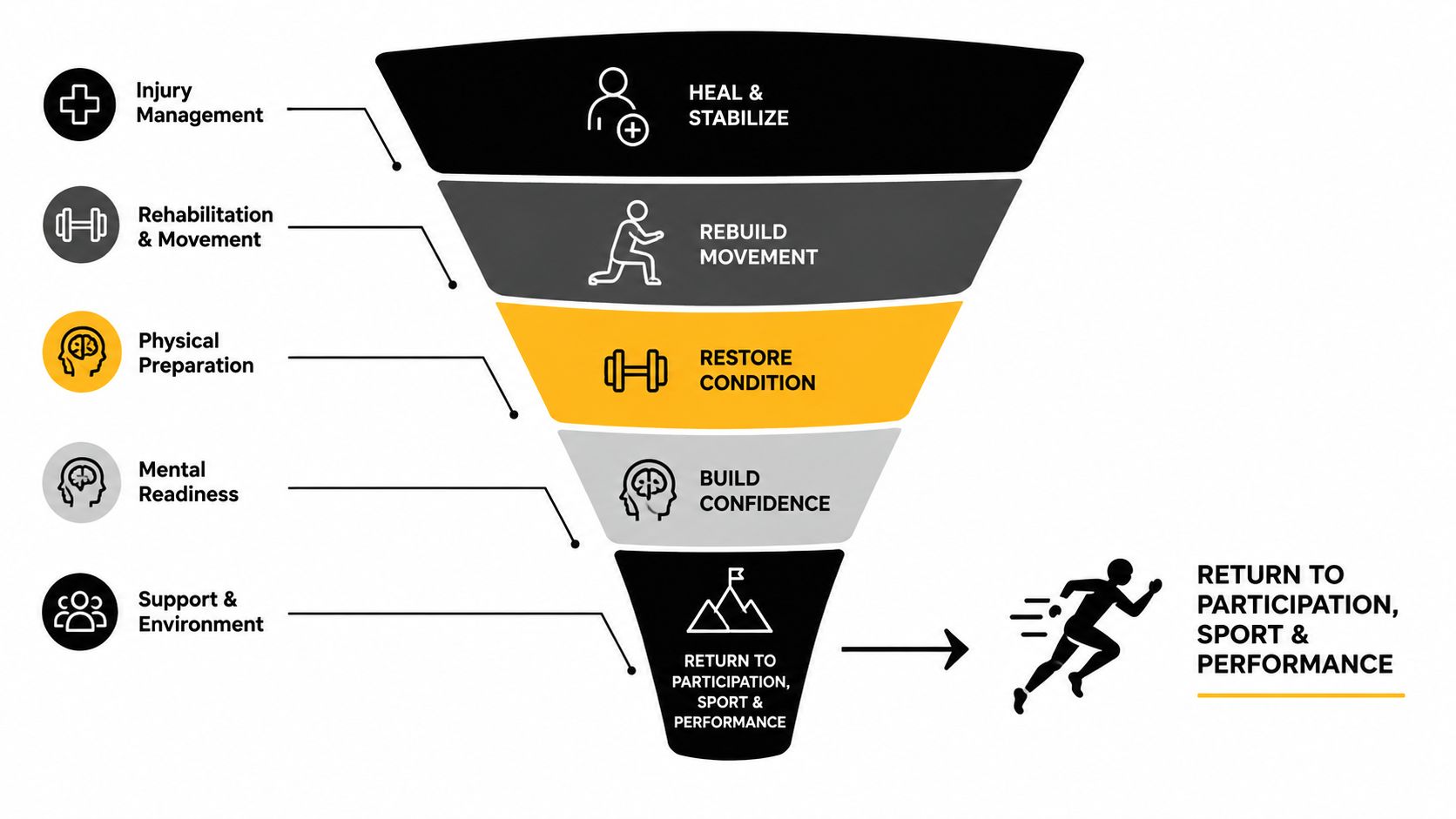
A runner may tolerate an easy jog but struggle when pace changes. A basketball player may jog and shoot freely, yet still be unprepared for contact, rapid direction changes, or repeated jumps. These examples show why recovery should progress through return to participation, return to sport, and return to preinjury performance, rather than follow a calendar alone.
Return to participation can involve modified exercise or practice. Return to sport means handling the sport's usual demands. Return to preinjury performance means competing at the level reached before injury. A nationwide study of athletes 1 to 3 years after ACL reconstruction reported that 62% returned to participation, 50% returned to sport, and 17% returned to preinjury performance (JOSPT Open consensus guidance). The difference between stages reflects conditioning, speed, confidence, and workload tolerance, not just pain.
Build the workload in stages
- Start with controlled drills, then add speed, volume, and decision-making.
- Increase one major training demand at a time, such as duration, intensity, contact, or cutting.
- Use partial practices before full sessions, with recovery time between harder exposures.
- Repeat a workload before advancing if symptoms rise later that day or the next morning.
- Add competition only after unrestricted training is tolerated, not just because a test feels comfortable.
Hamstring guidance supports individualized decisions based on symptoms, injury severity, sport demands, loading response, mobility, kinetic-chain function, pain-free sprinting, and unrestricted training (JOSPT guidance on individualized return decisions). Functional capacity and load tolerance often provide more useful guidance than elapsed time alone.
Physical Therapy Milestones and Red Flags to Watch
An ankle sprain progression typically moves through protected weight-bearing, calf strengthening, balance drills, and sport-specific agility. The same staged logic applies to other injuries. Early treatment focuses on controlling symptoms, protecting healing tissue, and restoring safe movement. Later milestones test strength, coordination, repeated loading, and the demands of the activity you want to resume.
A runner may need graded impact and pace changes. A tennis player may need lateral movement and reactive drills. A weightlifter may need controlled increases in range, resistance, bracing, and fatigue tolerance.
Progress should be earned by function: less pain is a starting point, not the final clearance test.
What to track between visits
- Swelling: Note whether activity causes visible or persistent joint swelling.
- Stability: Report giving way, buckling, or a feeling that the joint cannot be trusted.
- Movement: Watch for limping, protective stiffness, or a new compensation.
- Loading response: Record whether symptoms remain heightened later that day or the next morning.
- Performance: Track repetitions, distance, balance, or drill quality without chasing exhaustion.
A symptom-free test is only one checkpoint. The injured area also needs to tolerate the volume, speed, direction changes, and fatigue associated with your sport. Repeat a workload when symptoms rise later that day or the next morning, then progress after the response settles.
Harvard Health notes that grade I ankle injuries generally recover in 1 to 2 weeks, grade II partial tears in 3 to 6 weeks, and grade III ruptures commonly require 6 to 12 weeks or longer, especially when instability persists (Harvard Health ankle-sprain guidance). Range-of-motion work is typically introduced within 3 to 7 days as acute symptoms settle, followed by progressive weight-bearing, calf and peroneal strengthening, balance, and agility.
Persistent ankle symptoms beyond roughly 2 to 4 weeks warrant reassessment for an occult fracture, syndesmotic injury, or ongoing instability. Structured tracking can add useful objectivity through MedAmerica's functional outcome measurement approach. Seek prompt clinical guidance for worsening pain, repeated giving way, marked swelling, or failure to progress.
When to Seek Care at MedAmerica Rehab Center
Professional assessment makes sense when pain limits normal activity, swelling persists, the joint feels unstable, or you can't progress from basic movement to sport-specific loading. It's also valuable after surgery, when the safe sequence of protection, mobility, strengthening, and testing must align with the surgeon's restrictions.
Consider an active adult who twists an ankle playing pickleball. Walking improves, but lateral movement still produces apprehension and swelling later in the day. Returning because walking feels normal would skip the demands that caused the injury. A staged plan can instead restore motion, build calf and peroneal strength, challenge balance, and introduce controlled changes of direction before unrestricted play.
The same principle applies to a runner with a calf strain, a tennis player with shoulder pain, or an athlete returning after ACL reconstruction. The diagnosis matters, but so does the activity you want to resume. A therapist can identify whether the limiting factor is strength, mobility, coordination, pain sensitivity, conditioning, confidence, or an unresolved structural issue.
MedAmerica Rehab Center is a family-owned Deerfield Beach clinic operating since 1995. Its multidisciplinary team provides physical therapy, chiropractic care, acupuncture, and shockwave therapy, with individualized care for sports injuries, post-surgical rehabilitation, and chronic musculoskeletal conditions. Same-day appointments and insurance-friendly processes can make it easier to begin an evaluation when waiting may prolong activity limits.
The practical aim isn't to promise a faster calendar. It's to help you make steady, measurable progress while respecting tissue healing. With appropriate testing, clear communication, and gradual exposure to your sport's demands, returning to activity becomes a managed process instead of a guess.
If sports injury recovery time is limiting your work, exercise, or favorite activity, schedule an evaluation with MedAmerica Rehab Center in Deerfield Beach. The team can assess your movement, build a milestone-based rehabilitation plan, and guide you from symptom control toward safe return to the activities you value.
MedAmerica Rehab · Deerfield Beach
Talk to a clinician about your pain
Physical therapy, chiropractic, acupuncture and shockwave therapy under one roof, since 1995. Same-day appointments are available.
Mon–Thu 8:00 AM – 6:30 PM · Fri 8:00 AM – 3:00 PM