
Golfer’s Elbow Pain Relief: A Practical Guide
You finish a round of golf, loosen your grip, and expect the ache on the inside of your elbow to disappear overnight. Instead, the pain returns when you lift a mug, turn a door handle, or pick up a club. Rest may quiet it briefly, but the same gripping and wrist movements bring it back.
That pattern often points to golfer's elbow pain, not ordinary muscle soreness. Effective relief usually requires more than avoiding activity. You need to calm the irritated area, identify the movement that keeps overloading it, and gradually rebuild the forearm's ability to handle gripping, lifting, and rotation.
Recognizing Golfer's Elbow Pain Early
Golfer's elbow, medically called medial epicondylitis, affects the tendon attachment near the bony prominence on the inside of the elbow. The tendon connects with muscles that help flex the wrist, grip objects, and rotate the forearm. Golf can provoke it, but so can throwing, racquet sports, bowling, climbing, weightlifting, tool use, and other manual work. A clinical overview of medial epicondylitis describes the condition as relatively uncommon in the general population but more frequent among people exposed to forceful or repetitive wrist and forearm use.
The first useful question is not, “Does my elbow hurt?” Ask what the pain does during and after activity.
- Location: Golfer's elbow usually causes tenderness or aching on the inner elbow, sometimes spreading along the forearm.
- Load response: Wrist flexion, gripping, pulling, carrying, or twisting may reproduce the pain.
- Persistence: Ordinary post-activity soreness tends to settle as the muscles recover. Tendon-origin pain often lingers into the following day or returns with routine hand use.
- Function: A painful handshake, weak grip, uncomfortable coffee cup, or difficulty using a screwdriver matters more than the pain score alone.
The dominant arm is frequently involved because it often performs more gripping, club control, throwing, or tool work. The problem can begin after a clear increase in activity, but it may also develop gradually when the same movement is repeated without enough recovery or variation.
Practical rule: If inner-elbow pain repeatedly appears with the same task and affects the next day, treat it as a load-tolerance problem rather than ordinary soreness.
Complete rest isn't a complete solution because it may reduce symptoms without changing the capacity of the tendon or the movement pattern that irritated it. Inner-elbow pain can also resemble nerve irritation or other elbow problems. If the discomfort persists, spreads, or causes meaningful weakness, a clinical assessment can separate tendon pain from other causes and guide the right progression. For comparison, pain on the outside of the elbow may follow a different pattern, as explained in this guide to tennis elbow pain relief.
Immediate Self-Care for Flare-Up Relief
A flare-up often follows a familiar mistake: the elbow feels like ordinary muscle soreness, so you rest completely and wait. Rest can calm symptoms, but it does not correct the gripping, swinging, lifting, or tool-use pattern that overloaded the tendon. Use a short reset, then return to carefully graded activity.
- Reduce the aggravating load. Pause golf, heavy lifting, forceful gripping, heavy curls, and repetitive tool use while the elbow is highly reactive. Change the task rather than repeatedly testing the painful movement. Keep comfortable daily activity if symptoms remain stable during use and later that day.
- Apply cold for comfort. A wrapped cold pack may ease the unpleasant sensation during an active flare. Place a cloth between the pack and your skin, and remove it if the skin becomes numb or painful.
- Keep the joint moving gently. Bend and straighten the elbow through a comfortable range. Slowly rotate the palm up and down without forcing the end position. This preserves movement while the more provocative load is reduced.
- Use support selectively. A comfortable brace or elastic support may reduce unconscious gripping and make daily tasks easier. It should not cause numbness, tingling, swelling, or a trapped feeling in the arm.
- Review medication with a qualified professional. Medication may improve short-term comfort, but it does not restore tendon capacity. Ask a physician or pharmacist what fits your health history, other medicines, and stomach or kidney considerations.
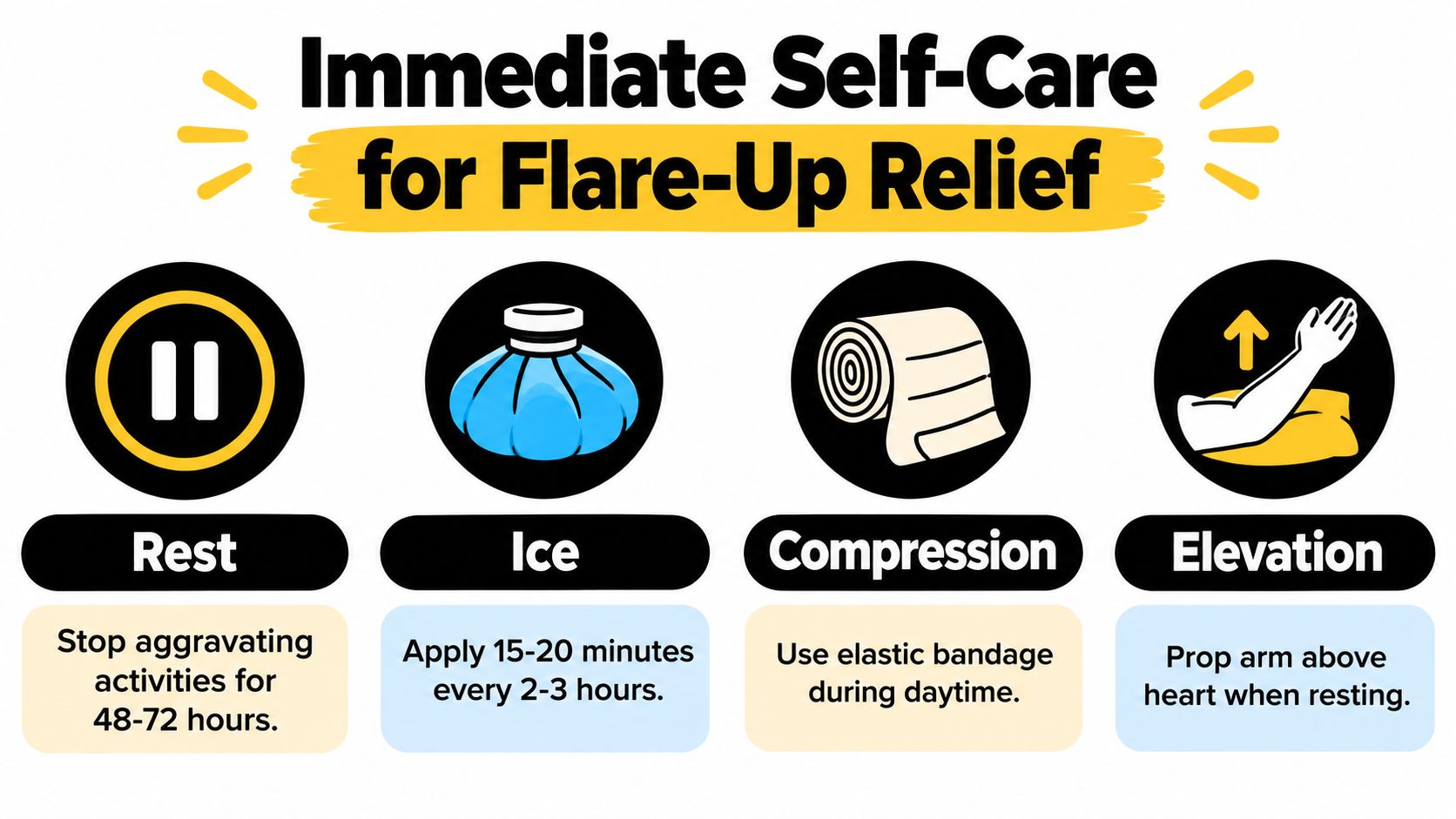
Relative rest means removing the painful dose of loading while retaining comfortable movement. If a task produces mild awareness that settles quickly, reduce its speed, force, duration, or grip size. If symptoms build during the task or remain worse the next day, the current dose is too high. That response guides the next adjustment better than complete inactivity.
For practical cold-therapy instructions, see MedAmerica's guide to using an ice pack in physical therapy. Cold is for symptom control. Tendon capacity returns through an appropriate loading progression, so resume strengthening once the flare is settling rather than immediately returning to the grip or swing that triggered it.
A broader clinical summary reports that more than 90% of patients improve without surgery when care includes relative rest, activity modification, stretching, progressive strengthening, and rehabilitation, as described in this evidence summary for medial epicondylitis. A staged conservative plan therefore gives the tendon time to settle while addressing the activity pattern that caused the flare.
Targeted Stretches and Strengthening Exercises
Stretching can make the forearm feel less restricted, but strengthening determines whether the arm can tolerate the task that provokes symptoms. Begin with movements that feel controlled and modest. The exercise should not produce a sharp increase in inner-elbow pain, and the arm shouldn't feel more irritated the next morning.

Start with comfortable mobility
Sit with the affected arm supported and the elbow gently straightened. Turn the palm upward, extend the wrist and fingers until you feel a mild stretch along the inner forearm, then hold without bouncing. Keep the shoulder relaxed and avoid forcing the elbow into a locked position.
Repeat the stretch several times during the day, especially after periods of gripping or computer work. A mild pulling sensation is acceptable. Sharp pain, tingling into the hand, or increasing soreness means the position is too strong or the diagnosis may need review.
Add controlled wrist loading
Once ordinary movement is more comfortable, support the forearm on a table with the palm facing upward. Use a light household object or a Cando resistance band to practice wrist flexion. Lift slowly, pause briefly, and lower even more deliberately. The lowering phase is particularly useful because it teaches the tendon to absorb load rather than produce force.
Start with a small resistance and a smooth range. Progress by changing only one factor at a time, such as resistance, repetitions, or the amount of wrist movement. If the next-day response is calm, continue. If pain is clearly higher the next day, reduce the resistance or volume before trying to advance again.
Build rotation and grip capacity
Forearm rotation matters for club control, lifting, and tool work. Hold a light object with the elbow bent comfortably and rotate the palm upward and downward in a slow, controlled manner. Keep the elbow close to the body so the forearm performs the work rather than the shoulder.
Grip work should begin below the level that reproduces your familiar pain. Squeeze a soft ball gently, release fully, and focus on an even grip rather than a maximum effort. Later, you can progress to firmer resistance, longer holds, or sport-specific gripping. Your target is improved tolerance, not exhaustion.
Use the following progression cues:
- Movement quality: The wrist stays aligned, and you don't compensate by hiking the shoulder or twisting the trunk.
- Pain behavior: Symptoms remain manageable during exercise and don't build after the session.
- Recovery response: The elbow is no worse the next day.
- Task tolerance: You can grip, lift, or rotate with more confidence before increasing resistance.
A physical therapist may also address the shoulder and upper arm when those areas contribute to poor control during swings or lifting. This video demonstrates a resistance-based approach to upper-limb exercise:
Don't jump from pain-free daily movement to full-speed golf, heavy pulling, or repeated practice swings. Tendons respond better to consistent, graded loading than to occasional intense workouts followed by another flare.
Clinical Therapies and Manual Treatment Options
A tendon that feels sore after golf or lifting is easy to treat like an ordinary muscle strain. Rest may calm the pain, yet symptoms often return when the same gripping or wrist-loading task resumes. Clinical care should identify the activity pattern that keeps irritating the tendon, then pair symptom control with a measured return to loading.
Professional rehabilitation is useful when you cannot identify the provoking task, pain affects work or sleep, or progress has stalled. A therapist can assess wrist and grip strength, elbow motion, shoulder control, nerve sensitivity, and the specific movement that reproduces symptoms. These findings help distinguish tendon pain from joint irritation, nerve involvement, or another condition that needs different care.
Manual treatment may include soft-tissue techniques around the forearm, joint mobilization, taping, or advice about a brace. These options can reduce guarding and make exercise or daily movement more comfortable. Their role is supportive. If treatment feels better on the table but gripping remains poorly tolerated, the functional problem still needs attention.
Where modalities fit
Shockwave therapy may be considered for a persistent epicondylitis problem when exercise and activity changes have not provided enough improvement. A clinical review comparing shockwave treatment with approaches such as control care, acupuncture, surgery-related procedures, corticosteroid injection, and cryoultrasound found possible benefits for pain and function, without consistent superiority across treatments. The findings are summarized in this clinical review of epicondylitis treatments.
The choice involves trade-offs. Corticosteroid injection can reduce pain quickly for some patients, but early relief does not demonstrate restored tendon strength or tolerance for gripping. Shockwave treatment can be another option for persistent symptoms, with its value judged by function, irritability, and progress rather than by pain relief alone. A clinician should explain the expected response, possible discomfort, cost, and how the treatment fits with rehabilitation.
Treatment should answer practical questions
Ask a clinician:
- Which task is exceeding my current capacity?
- What findings support tendon pain rather than nerve or joint involvement?
- Which treatment is intended to improve movement, and which is intended to reduce symptoms?
- How will exercise or work demands be progressed?
- What response over the following day means the load was too high?
- What measures will show readiness for golf, work, or lifting?
A useful plan connects each intervention to a functional goal. Manual therapy may make movement easier, while a modality may help settle symptoms. Graded rehabilitation and correction of the provoking activity build the capacity needed for lasting golfer's elbow pain relief.
Preventing Future Golfer's Elbow Flare-Ups
Prevention starts with managing the dose of gripping and wrist work. You don't need to avoid golf, lifting, or manual tasks forever. You need to stop asking an underprepared tendon to handle sudden changes in force, volume, speed, or recovery time.
Before golf or another grip-heavy activity, warm up with comfortable elbow bends, wrist movements, forearm rotation, and easy practice swings. Increase the effort gradually rather than beginning with the hardest swing or longest drive. During work or training, alternate demanding grip tasks with activities that use the hand and forearm differently.
Equipment and technique deserve attention. A club grip that feels too small or too large may encourage excessive squeezing, while a swing fault can shift more force into the wrist and forearm. A golf professional or therapist can assess grip pressure, wrist position, swing mechanics, and the way you carry or lift equipment. The right adjustment is personal, so copying another golfer's setup isn't always useful.
Use an early-warning rule:
- Mild awareness: Continue only if the sensation stays stable and settles after activity.
- Repeated discomfort: Reduce swing volume, grip force, or lifting resistance and review technique.
- Next-day aggravation: Treat that response as evidence that the previous load exceeded current capacity.
- Sharp or spreading symptoms: Stop the provoking task and arrange an assessment.
Strength maintenance should include wrist flexion, forearm rotation, grip control, and shoulder support. Keep the movements slow enough to notice compensation. A short, consistent routine is more useful than occasional high-effort sessions that leave the elbow irritated.
Return to the activity you want by rebuilding its demands in order: movement, light resistance, controlled practice, then full-speed performance.
Recovery time also matters. Avoid stacking several demanding grip sessions close together while the elbow is still adapting. When you return to golf, begin with shorter or easier practice and monitor the following day before adding more. That approach corrects the activity pattern rather than just waiting for pain to disappear.
When to Seek Professional Rehabilitation Care
Arrange an evaluation when inner-elbow pain continues despite a structured period of activity modification and gentle rehabilitation, or when it prevents ordinary tasks. You don't need to wait until the arm becomes unusable. Persistent pain with gripping, lifting, throwing, or turning objects deserves a clearer diagnosis and an individualized load plan.
Seek prompt medical attention if the pain follows a significant injury, if the elbow looks deformed, or if you develop marked swelling, unusual warmth, fever, or sudden loss of movement. Numbness or tingling into the ring and little fingers, progressive weakness, neck-related symptoms, or pain that doesn't behave like a movement-related tendon problem also warrants assessment. Those signs may indicate ulnar nerve irritation, cervical referral, instability, or another condition that requires a different approach.
A clinician will usually ask about the onset of symptoms, work and sport demands, previous injuries, and the movements that reproduce pain. The examination may include grip testing, resisted wrist movement, forearm rotation, elbow and neck screening, and functional tasks. Imaging isn't automatically the first step. It may become useful when the diagnosis is uncertain, progress stalls, or the examination suggests an associated injury.
Escalation should follow a documented conservative trial that may include activity modification, rehabilitation, bracing, and anti-inflammatory measures. If symptoms remain function-limiting, a clinician may discuss injection options or surgery after confirming the diagnosis and excluding other causes. Surgery is generally reserved for persistent or recurrent symptoms after approximately 4–6 months of substantial nonsurgical care, according to this systematic review of surgical treatment for refractory golfer's elbow. That review reported return-to-sport rates of 81–100%, return-to-work rates of 66.7–100%, and overall complications of about 3.1%. These figures describe reviewed surgical outcomes, not a guarantee for an individual patient.
One of the most common mistakes is loading the tendon aggressively while pain is still escalating. Another is assuming that early relief after a corticosteroid injection means the tendon has recovered. A safer benchmark is improving strength and task tolerance without a next-day flare, followed by a gradual return to throwing, gripping, lifting, or racquet activity.
MedAmerica Rehab Center offers individualized physical therapy, exercise-based rehabilitation, and clinical options such as shockwave therapy for patients working through golfer's elbow pain. Visit MedAmerica Rehab Center to arrange an evaluation and build a practical plan for returning to golf, work, or everyday gripping with greater confidence.
MedAmerica Rehab · Deerfield Beach
Talk to a clinician about your pain
Physical therapy, chiropractic, acupuncture and shockwave therapy under one roof, since 1995. Same-day appointments are available.
Mon–Thu 8:00 AM – 6:30 PM · Fri 8:00 AM – 3:00 PM