
Physical Therapy for Sprained Knee Recovery Guide
You step off a curb, feel your knee twist, and spend the next few days testing it with every staircase, walk, and turn. The pain may already be easing, yet the joint still feels swollen, weak, or unreliable. That uncertainty is where many recoveries go off course. People either protect the knee so completely that the quadriceps switch off, or they resume running and pivoting because walking feels comfortable.
Physical therapy for a sprained knee works best when recovery follows what the knee can do, not a calendar. Your therapist will look at swelling, range of motion, strength, balance, movement quality, confidence, and the demands of your work or sport. The evidence-based approach described in the clinical practice guideline for knee ligament sprains emphasizes those measurable factors rather than pain relief alone.
Protecting the Joint and Managing Acute Swelling
The first priority is to protect the injured tissue without turning the knee into a rigid, inactive joint. A sprain can involve different ligaments and grades of damage, so the right level of support depends on an examination. Severe instability, an inability to bear weight, significant bruising, or a locking sensation deserves medical assessment rather than a home exercise experiment.
For a milder injury, use pain-limited movement and reduce the activities that provoke swelling. Walk only as far as you can without a pronounced limp. Use a railing on stairs, step up with the stronger leg first, and step down with the injured leg first. Avoid carrying loads while the knee is unreliable. A brace may help with confidence or protection in a specific injury, but routine bracing isn't automatically necessary for every sprain.
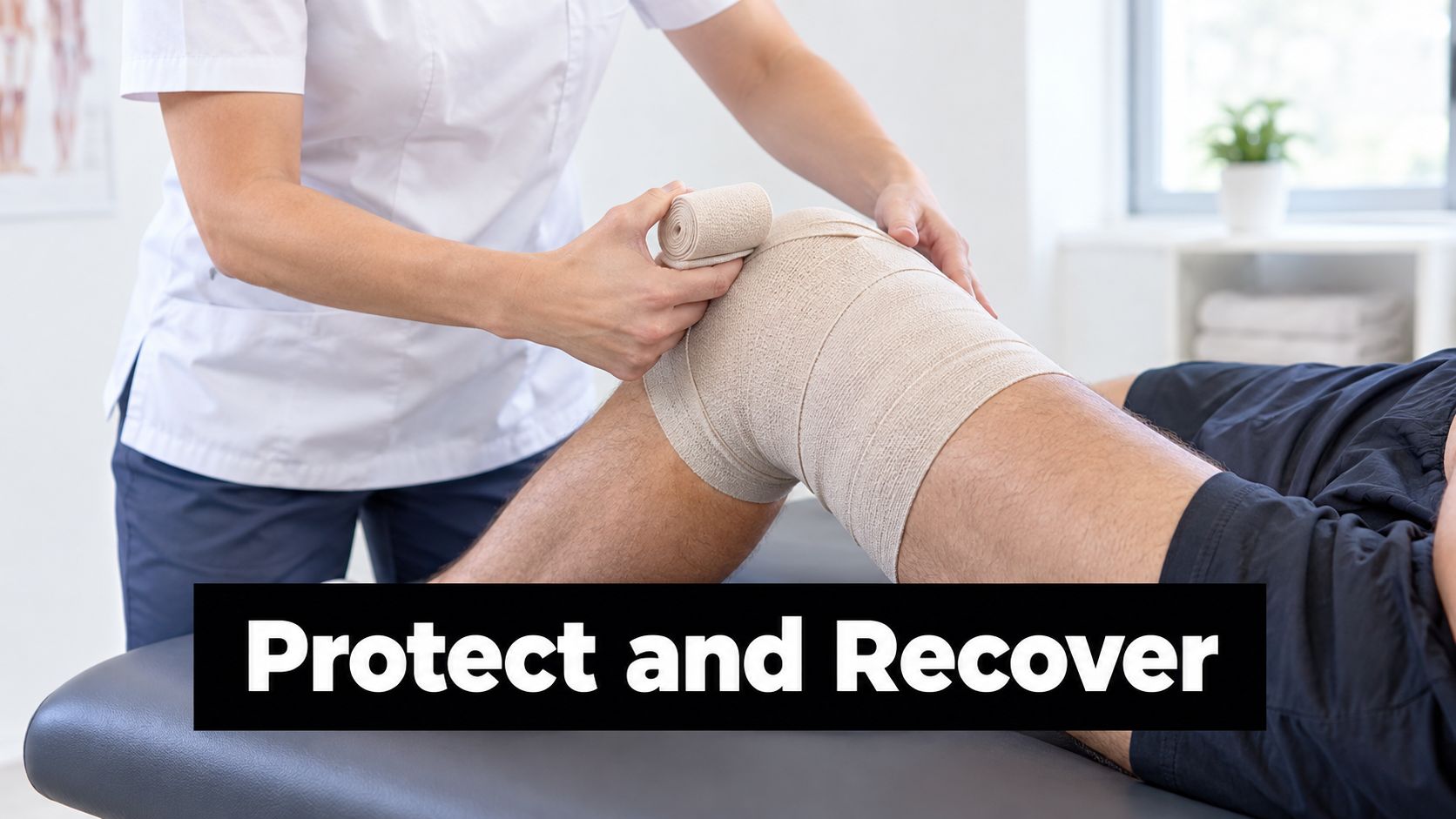
Practical ways to settle the joint
- Use cold therapy thoughtfully: Apply a cold pack for comfort when swelling or throbbing is limiting movement. Protect the skin and stop if numbness or irritation develops. A reusable knee cold therapy sleeve can make short periods of cooling easier to manage.
- Keep the leg up after activity: Support the lower leg so the knee sits above the level of the heart when practical. This won't repair a ligament, but it may reduce the sense of pressure after standing.
- Choose a comfortable sleep position: Back sleeping with a small support under the calf can reduce throbbing without forcing the knee into a severe bend. Side sleepers may place a pillow between the knees and avoid twisting the injured leg inward.
- Keep the ankle moving: Gentle ankle pumps encourage regular movement through the leg while the knee remains protected.
Complete bed rest often creates a second problem, quadriceps inhibition. The thigh muscle can become difficult to activate when the knee is swollen, which then makes walking and stair control harder. Short, frequent bouts of gentle motion are usually more useful than remaining still all day, provided symptoms stay controlled.
The 24-hour rule: An exercise response is acceptable when discomfort settles and the knee returns to its usual baseline by the next day. Escalating pain, increased effusion, worsening limp, or a new loss of motion means the load was too high.
Mild pain and swelling can persist for months even after the initial injury has healed. Gradual increases in activity are recommended as pain allows, while medical review is advised if there isn't significant improvement after one to two weeks, as outlined in Imperial College Healthcare's patient guidance on soft-tissue knee injuries.
Restoring Range of Motion and Early Strength
As swelling settles, a patient may still struggle with a stiff knee, a limp, or a quadriceps that will not fully engage. Early rehabilitation addresses those problems together. Restore comfortable motion first, then add resistance and weight bearing only when the knee remains calm during the following day.
Full extension deserves prompt attention because a knee that stays bent can alter walking and limit efficient quadriceps use. Flexion also matters, but forcing a deep bend through swelling often increases irritation. The first target is a smooth hinge with gradually improving motion compared with the opposite side.
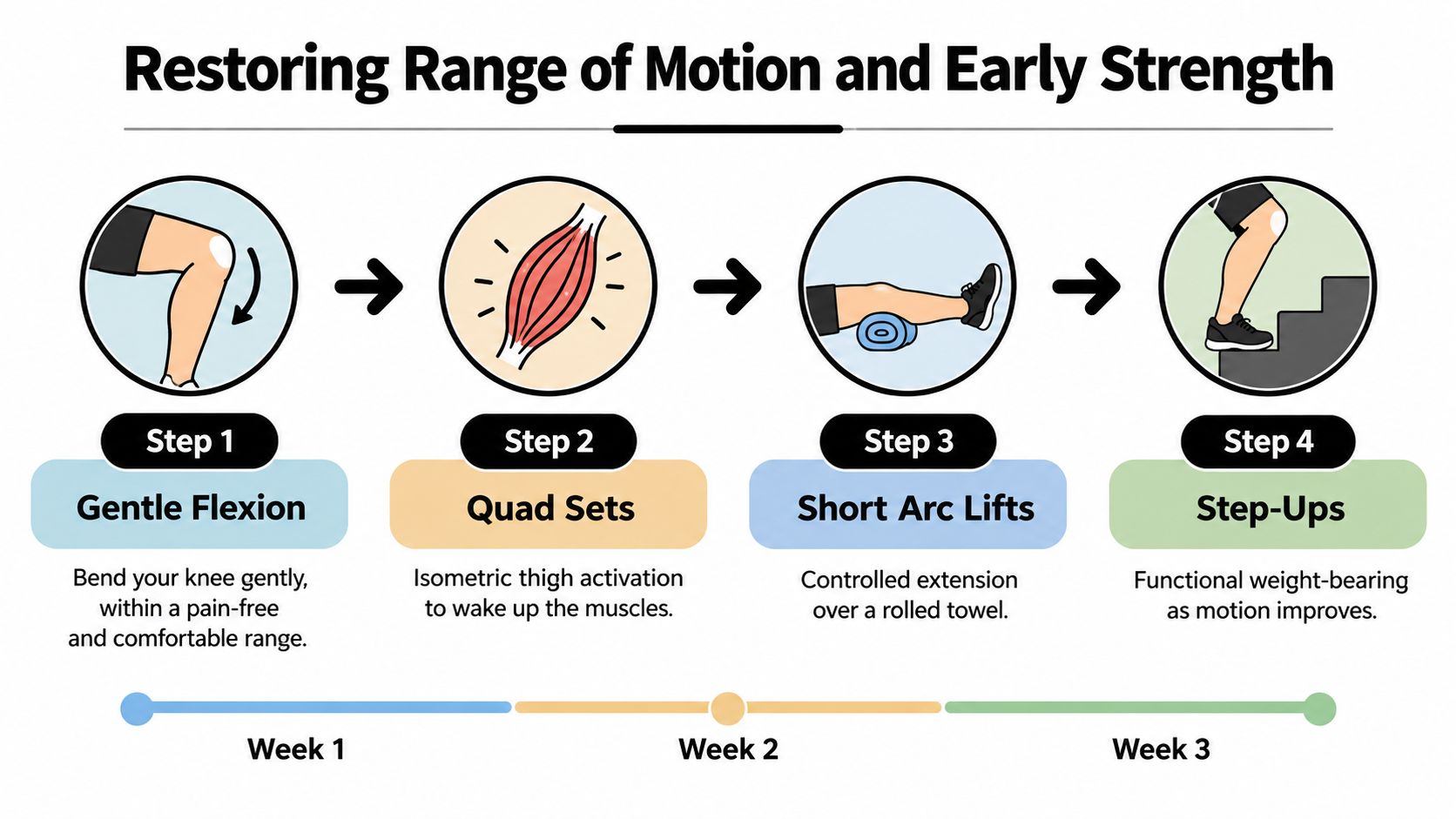
A controlled loading sequence
Begin with heel slides or another gentle flexion exercise, as detailed in our range of motion (ROM) exercises guide. Slide the heel toward your body until you feel a mild stretch, never sharp joint pain, then return slowly. More swelling later that day or the next morning means the range or repetitions should be reduced.
Quad sets provide the next foundation. With the leg supported, tighten the front of the thigh and gently press the knee toward the surface beneath it. Hold briefly, relax fully, and repeat with precise control. The goal is to restore communication between the nervous system and quadriceps, not to exhaust the muscle.
Short arc lifts can follow once you can activate the thigh without the knee dropping into a bent position. Place a rolled towel under the knee, straighten the leg over the towel, and lower it slowly. Attempt a straight-leg raise only when the knee stays fully straight throughout the lift. If it sags, return to quad sets and reassess movement quality.
When weight bearing is appropriate
Supported mini-squats and low step-ups keep the foot on the floor while the hip, knee, and ankle share the load. Introduce them after pain and swelling have settled and strength is approaching roughly 80% of the opposite limb, a practical benchmark described in the knee sprain rehabilitation decision tree.pdf).
Clinical guidance supports therapeutic exercise and neuromuscular re-education, with additional support for early mobilization, cryotherapy, supervised rehabilitation, and neuromuscular electrical stimulation, as summarized in this knee ligament sprain clinical practice guideline. Mild starting stiffness can be acceptable if it eases without renewed swelling. Stop and seek reassessment for sharp pain, giving way, recurrent effusion, or progressive loss of extension. The next milestone is function, not a calendar date.
Building Stability Through Balance and Functional Training
Strength in a straight-line exercise doesn't guarantee control during a sudden shift. Your knee must coordinate with the hip and ankle when you step onto uneven ground, change direction, descend stairs, or react to another player. That coordination depends on neuromuscular retraining, not just stronger muscles.
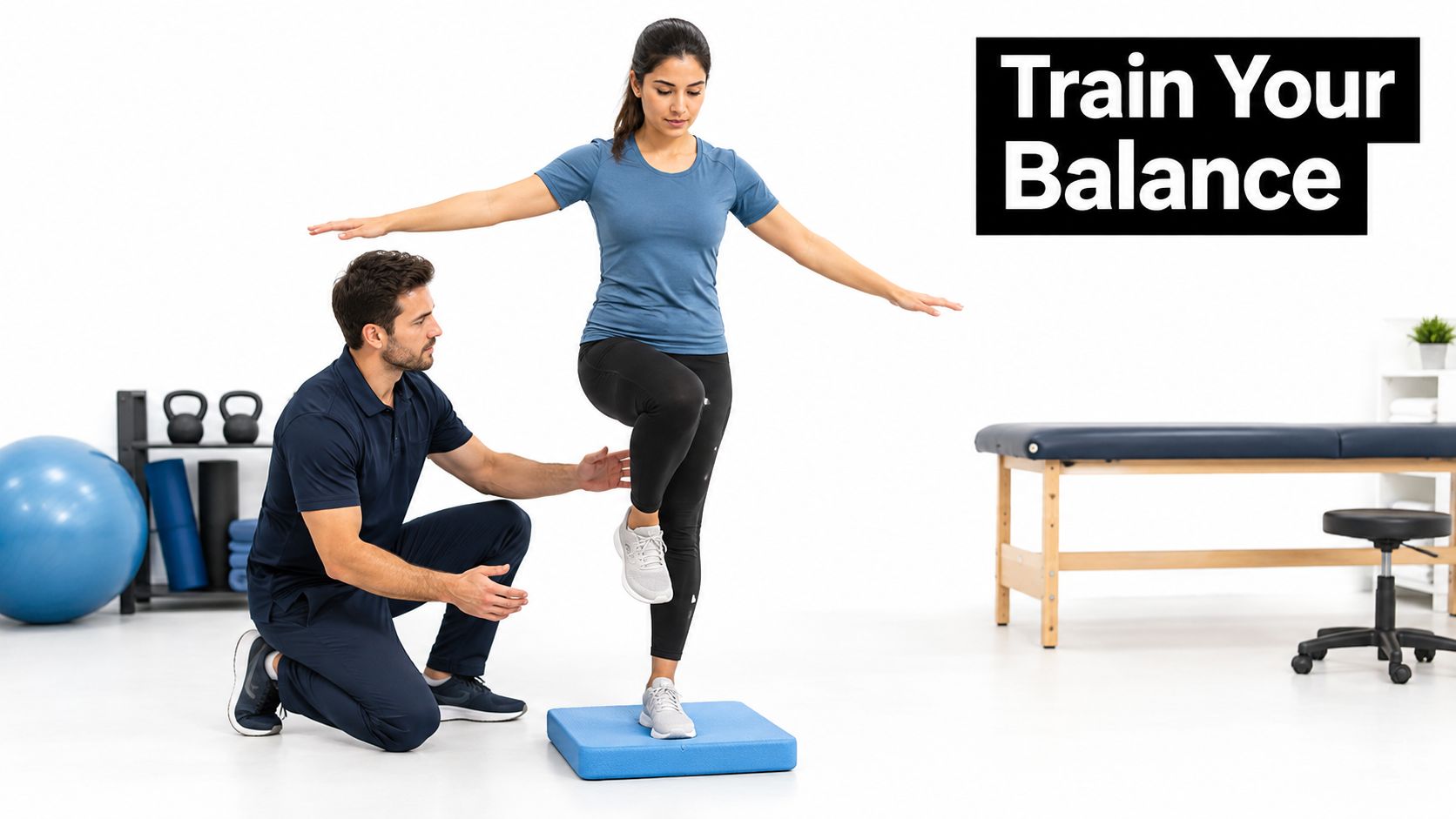
Single-leg balance is a useful starting point because it exposes whether the injured side can control the pelvis, thigh, and knee together. Stand near a stable support and balance on the affected leg while keeping the knee gently not locked. Watch for the knee drifting inward, the pelvis dropping, or the foot gripping and collapsing. Those details matter more than surviving a timed hold.
Progressing the challenge
Once stable on firm ground, change one demand at a time. You might turn the head, reach in different directions, stand on a compliant surface, or catch a light object. A therapist can add gentle perturbations, which teach the leg to respond to a small, unexpected shift without collapsing.
Closed-chain exercises also build practical control. Step-ups, controlled sit-to-stands, split squats, and lateral movements require the knee to accept and redirect force. Keep the knee aligned with the foot and control both the lifting and lowering phases. A shallow movement with good alignment is more valuable than a deeper movement that produces valgus, wobbling, or a painful rebound.
A knee that feels stable during quiet standing may still lack the timing needed for cutting, landing, or uneven surfaces.
The trunk contributes to that control. If the torso sways or the pelvis rotates, the knee often absorbs forces it can't manage efficiently. A carefully selected dominant on-pitch core routine can complement knee rehabilitation, especially for athletes who need to control their body while accelerating, decelerating, or changing direction. Choose movements that let you maintain alignment rather than adding fatigue that disrupts technique.
Why quality outranks difficulty
Progression should reflect the task you need to perform. A recreational walker may need confident stairs, curbs, and uneven paths. A warehouse worker may need repeated lifting, kneeling, and turning. A field athlete requires braking, lateral movement, and controlled landing. The same balance drill can be useful for all three, but the final challenge must resemble the actual demand.
Pain during a drill isn't the only signal. Swelling afterward, a change in gait, loss of extension, or repeated giving way indicates that the knee isn't tolerating the current level. Reduce the surface instability, shorten the duration, or return to bilateral loading before progressing again.
Objective Milestones for Returning to Sport and Work
You may walk comfortably, finish a work shift, and still lack the control needed to cut, land, kneel, or carry a load. Straight-line walking places predictable demands on the knee. Sport and physical work require faster force production, repeated loading, and precise coordination, so readiness should be judged by function rather than by pain level or a calendar date.
Return decisions should combine symptoms, swelling response, strength, task performance, and movement quality. The Cleveland Clinic overview of knee sprains explains why recovery varies with injury severity and the tissues involved. A date cannot show whether you can control a landing or tolerate a full workday.
A practical readiness screen
Begin with daily activities. Walk without a meaningful limp, manage stairs with control, and perform repeated sit-to-stands without swelling, buckling, or increasing pain. Then match testing to your job. A worker may need to squat, step down, kneel, turn, and carry. Test a shallow squat, controlled step-down, supported single-leg stance, and gradual direction changes only after basic tasks are consistent.
Running should precede cutting and rapid changes of direction. Start with walking, then straight-line jogging on a predictable surface. Increase speed and duration separately, and check the knee during the following day. Returning swelling, reduced extension, altered gait, or increasing soreness means the current workload exceeds the joint's capacity.
Strength testing compares the injured and uninjured sides. For higher-demand activity, a common target is approximately 90% limb symmetry for quadriceps and hamstrings, combined with a completed running progression and controlled movement before unrestricted sport. A clinician may use a handheld dynamometer, a 6-repetition maximum test, step-down observation, and single-leg hop tests selected for your injury. These benchmarks are consistent with the Cleveland Clinic overview of knee sprains and standard return-to-sport testing protocols.
| Functional Domain | Target Benchmark | Why It Matters |
|---|---|---|
| Symptoms | Sport- or work-specific activity is pain-free or well controlled | Pain can change mechanics and reduce confidence |
| Swelling | No reactive swelling after increased activity | Effusion can inhibit the quadriceps and restrict motion |
| Strength | Quadriceps and hamstrings reach approximately 90% symmetry | Comparable force production supports demanding tasks |
| Running | Running progression is completed without deterioration | Straight-line loading prepares the knee for higher demands |
| Movement quality | Step-downs, hops, landings, and direction changes remain controlled | Control limits unwanted knee motion under speed and force |
| Confidence | You trust the knee during the required task | Apprehension can change timing and create protective movement |
A failed test identifies a capacity that still needs work. Return to the last successful level, train that specific limitation, and retest after the knee tolerates the workload without a delayed reaction. Readiness is demonstrated by repeatable performance, not by just waiting for pain to disappear.
Sample Home Exercise Progressions for Each Phase
A home program should be simple enough to follow and flexible enough to reflect the knee's response. The exact exercise choice depends on the ligament involved, injury grade, associated damage, and your current movement. Use the following as a framework, not permission to push through instability or a growing effusion.
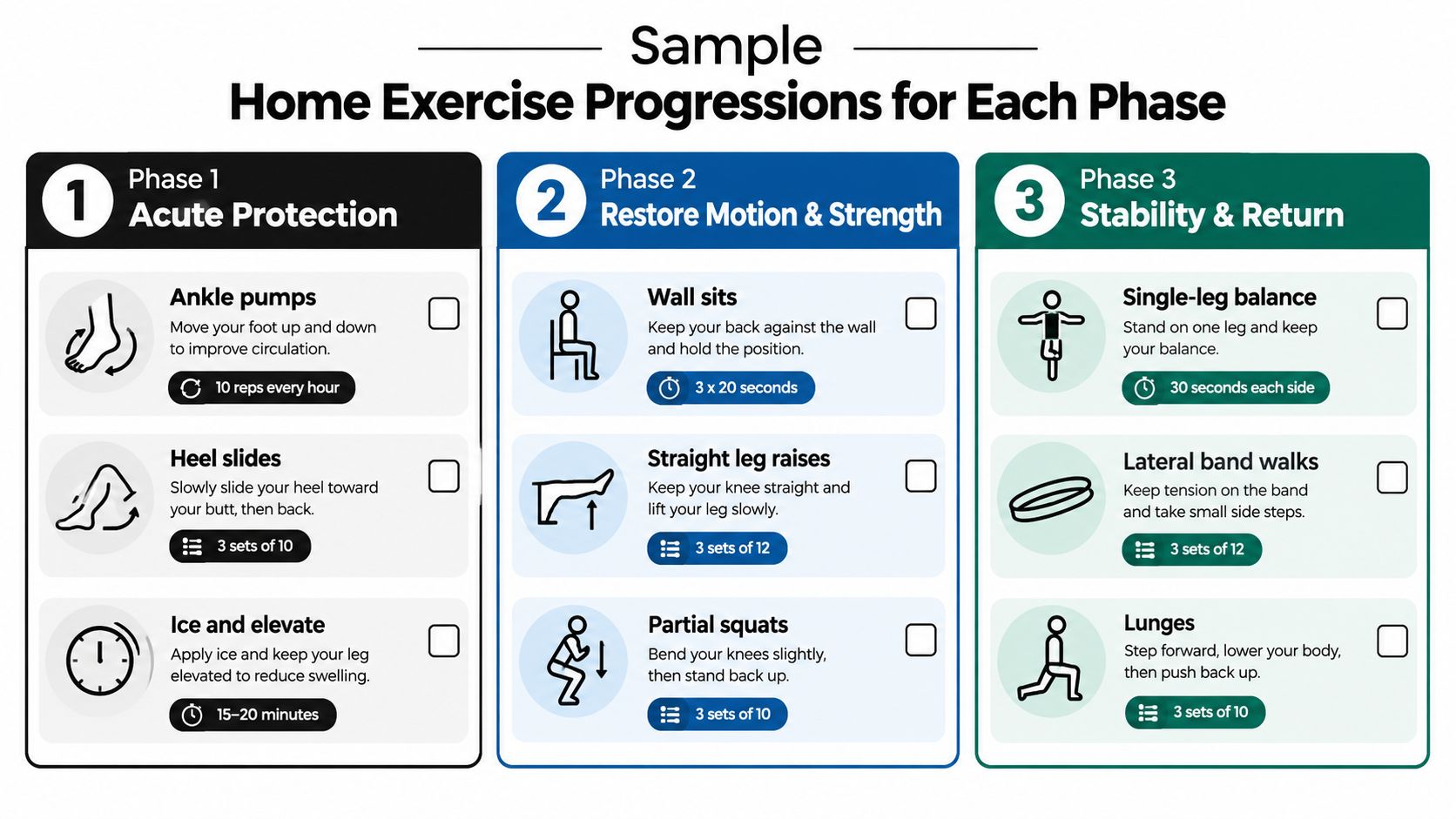
Phase one focuses on protection
During the acute phase, prioritize circulation, comfortable motion, and quadriceps activation.
- Ankle pumps: Move the ankle up and down regularly while resting, especially after periods of sitting.
- Heel slides: Perform gentle bends within a comfortable range. Don't force the knee into a deep position.
- Quad sets: Tighten the thigh while keeping the knee supported and still. If the muscle won't engage, shorten the contraction rather than holding your breath.
- Supported extension: Rest the heel on a low cushion so the knee can gradually straighten, but stop if this increases pain or produces a sharp stretch.
Use cold therapy and elevation for comfort after activity. The knee should feel no worse later that day or the next morning. If it does, reduce the range, repetitions, or frequency.
Phase two rebuilds motion and strength
When walking becomes smoother and swelling is controlled, add movements that load the leg without demanding fast reactions.
- Straight-leg raises: Keep the thigh tight and the knee straight throughout the lift. Lower slowly.
- Short arc lifts: Work over a rolled towel to strengthen controlled extension.
- Supported mini-squats: Hold a counter, sit the hips back slightly, and keep the knees aligned with the feet.
- Low step-ups: Use a low step and focus on a quiet, controlled landing. Start with the injured leg doing the work rather than pushing strongly from the trailing leg.
- Hamstring work: Add gentle standing curls or another clinician-approved variation when bending is comfortable.
Progress one variable at a time, such as range, repetitions, resistance, or balance demand. Don't increase all of them in the same session.
Phase three prepares you for real tasks
The final phase is not just a harder strength workout. It should resemble your work, recreation, or sport.
Practice single-leg balance, lateral band walks, controlled lunges, and step-downs. Then add brisk walking, straight-line jogging, and eventually low-level hops if the knee remains quiet afterward. A therapist may introduce landing mechanics, acceleration, deceleration, and change-of-direction drills as testing shows that the knee can manage them.
The best home program is the one that leaves you stronger and moving better, not the one that leaves the knee swollen for the next session.
When to Seek Professional Physical Therapy in Deerfield Beach
A mild sprain that is improving, allows steady walking, and gradually restores motion may respond to home care. Arrange an evaluation when the diagnosis is unclear or progress has stopped. Repeated giving way, mechanical catching, or swelling after modest activity can indicate more than a straightforward ligament strain.
Seek prompt medical assessment after a significant twisting injury if you cannot bear weight, fully straighten the knee, or trust it during basic movement. Fracture, meniscal injury, and a larger ligament injury should be screened rather than managed by guesswork. Grade III injuries, postoperative knees, and injuries involving additional tissue damage also require a supervised progression.
Signs your plan needs expert adjustment
Persistent joint fluid deserves reassessment. So does a quadriceps that remains hard to activate, a limp that does not improve, or an inability to move from basic strengthening into controlled weight bearing. A calendar does not determine readiness. The knee should earn progression by completing the task with acceptable control and without a worsening response afterward.
A physical therapist can identify problems that are difficult to judge accurately at home. A clinician may grade ligament laxity with tests such as the Lachman or pivot-shift test, then change the exercise plan based on the result.
- Motion: Compare knee extension and flexion with the uninjured side.
- Strength: Assess quadriceps and hamstring force instead of relying on a short walk.
- Stability: Examine ligament behavior and watch how the knee controls a single-leg position.
- Function: Recreate stairs, squatting, running, lifting, or work-specific demands.
- Response: Monitor swelling and symptoms after increased activity.
- Confidence: Address fear or hesitation that causes protective loading or altered movement.
The goal is a measurable return to daily life, work, or sport. If you cannot complete a required task with steady alignment, controlled force, and a quiet response later that day or the next morning, you are not ready for that level yet.
For adults in Deerfield Beach, MedAmerica Rehab Center provides individualized physical therapy for knee pain and injuries. Services may include mobility assessment, strengthening, balance work, walking and mobility training, and clinician-selected heat, cold, or electrical stimulation. The plan should reflect examination findings and the demands you need to resume, rather than a generic recovery date.
MedAmerica Rehab Center can assess knee movement, strength, balance, and work or sport requirements, then build a supervised plan around those findings. Visit MedAmerica Rehab Center to request an evaluation and work toward controlled, confident movement.
MedAmerica Rehab · Deerfield Beach
Talk to a clinician about your pain
Physical therapy, chiropractic, acupuncture and shockwave therapy under one roof, since 1995. Same-day appointments are available.
Mon–Thu 8:00 AM – 6:30 PM · Fri 8:00 AM – 3:00 PM