
Shoulder Injury Prevention Exercises That Actually Work
You feel it in ordinary moments first. You reach overhead for a suitcase, press a dumbbell you've lifted for years, or serve a few balls on the weekend and the shoulder doesn't feel sharp enough to call injured. It just feels off. A little pinchy, a little weak, a little less trustworthy.
That gray zone is where prevention matters most.
In clinic, I see plenty of people in Deerfield Beach who never had one dramatic injury. They had a stretch of busy workdays, inconsistent training, poor sleep, extra yard work, or a sudden return to golf, pickleball, swimming, or overhead lifting. The shoulder usually tolerates a lot until it doesn't. By the time pain is obvious, strength, control, and confidence have often been slipping for a while.
Good shoulder injury prevention exercises aren't random stretches pulled from social media. They work better as a repeatable system. You need a small group of movements you can do consistently, a dose you can recover from, and clear rules for when to back off and when to get checked.
Why Shoulder Prevention Matters Before Pain Starts
A healthy shoulder buys you options. It lets you train, work, sleep on your side, load luggage into an overhead bin, and reach into a high cabinet without negotiating with your own body first. Don't think about that until one reach changes the day.

Small symptoms usually arrive before big problems
The shoulder is built for motion, not brute stability. That's useful when you need to throw, swim, lift overhead, or reach behind you. It also means the joint depends heavily on good muscle timing and load tolerance.
That's why early warning signs often look minor:
- Overhead hesitation: You can still raise the arm, but you do it more carefully than before.
- End-of-day soreness: The shoulder feels more irritated after work, the gym, or practice than during it.
- Compensation: You shrug, arch your back, or turn your torso to avoid a direct overhead path.
- Uneven strength: Pressing, carrying, or pulling feels different side to side.
These aren't always injuries. They are often clues that your system needs maintenance.
Prevention works best as routine care
The strongest prevention data comes from sports settings, not from vague wellness advice. A 2021 systematic review and meta-analysis found that exercise interventions reduced shoulder injuries in sport by 27% overall, with a pooled relative risk of 0.73, and reported 25% risk reduction for both acute and overuse shoulder injuries. Shoulder-specific programs still showed a meaningful 20% reduction (British Journal of Sports Medicine abstract).
That matters for one practical reason. Structured exercise changes outcomes better than hoping your usual workouts cover shoulder health by accident.
Practical rule: Prevention should feel boring enough to repeat. If your plan is too long, too heavy, or too painful, most people abandon it before it helps.
Who benefits most from a prevention routine
Some groups tend to need this more than others:
- Overhead athletes: Throwing, serving, swimming, and repeated overhead skill work add up fast.
- Lifters: Bench, overhead press, dips, pull-ups, and high-volume upper body days can overload weak links.
- Desk workers: Long hours in one posture can make overhead mechanics less efficient when activity suddenly increases.
- Active adults returning after time off: The shoulder often dislikes abrupt spikes more than steady training.
If your shoulder already has persistent pain, catching, repeated instability, or night pain, a general prevention routine may not be enough. That's when an individual evaluation makes more sense than pushing through.
How Your Shoulder Stays Stable and What Puts It at Risk
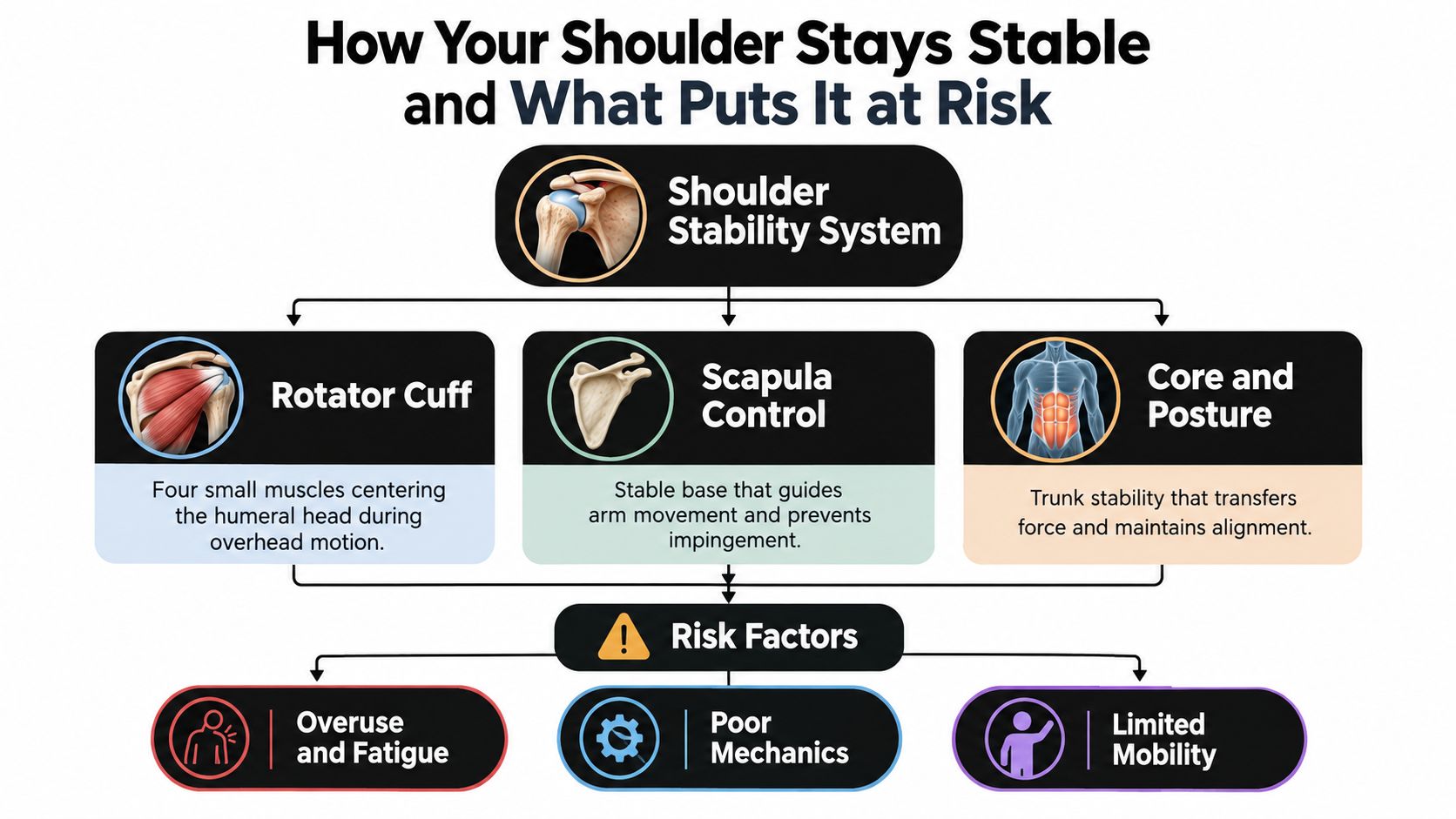
Shoulder stability isn't one muscle doing one job. It's a team effort between the rotator cuff, the scapula, and the trunk underneath them. If one part stops doing its share, the shoulder usually finds a workaround. The problem is that workarounds often irritate tissue over time.
The three parts that keep overhead motion clean
Think of shoulder stability in three layers.
First, the rotator cuff helps keep the ball of the upper arm centered while the arm moves. These muscles aren't just “rotators.” They guide the joint so bigger muscles can produce force without the shoulder drifting into poor positions.
Second, the scapula gives the arm a moving base. If the shoulder blade doesn't upwardly rotate, tilt, and glide well, overhead motion gets crowded and inefficient. Many people with a history of pinching symptoms need better scapular control, which is one reason resources on rehabilitation for shoulder impingement often emphasize more than stretching alone.
Third, the core and rib cage affect shoulder mechanics more than expected. If you arch through the low back every time the arms go up, you borrow motion from the spine instead of earning it at the shoulder.
What raises risk in real life
Most shoulder trouble I see doesn't come from one bad rep. It usually comes from one of these patterns:
- Volume jumps too fast: Weekend tournaments, vacation sports, spring yard work, or suddenly adding overhead press back into training.
- Fatigue changes mechanics: The first set looks clean. The last set turns into shrugging and lumbar extension.
- Mobility is limited in the wrong place: Tightness through the upper back or chest can force the shoulder into less efficient paths.
- Strength exists without control: Some people are strong in pressing and pulling but weak in slow, precise cuff and scapular work.
A shoulder can look strong in the gym and still lack the control it needs overhead.
A simple stability checklist
You don't need to self-diagnose. You do need to notice patterns.
Ask yourself:
- Can you raise both arms overhead without shrugging early?
- Can you keep your ribs down instead of flaring your chest up?
- Do both shoulders tolerate carrying, pushing, and reaching similarly?
- Does fatigue change your form quickly?
- Do symptoms show up after load rather than during it?
If several of those feel off, prevention should focus less on max strength and more on coordination, endurance, and repeatable mechanics.
Your Shoulder Injury Prevention Exercise Program With Exact Reps and Form
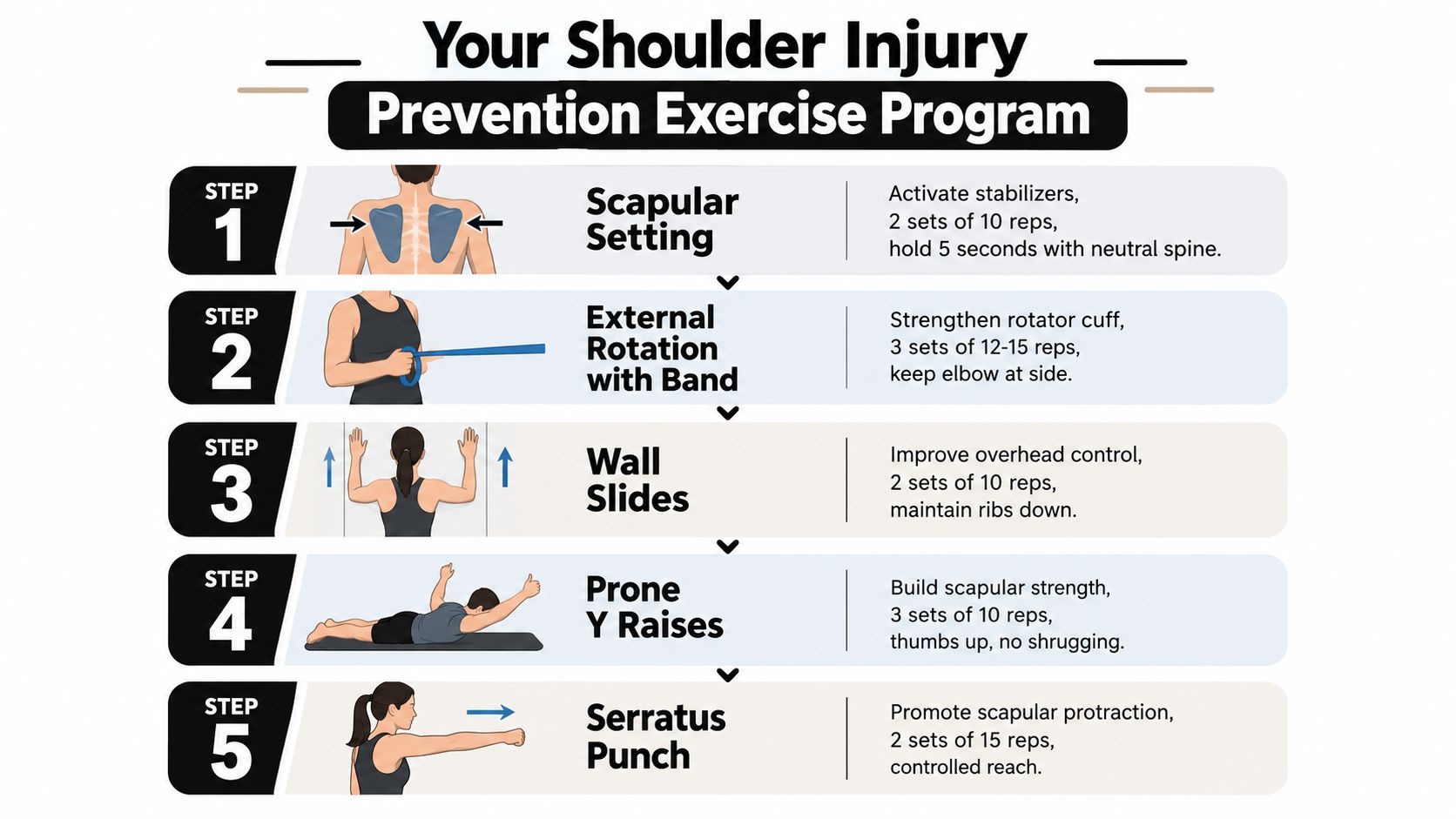
The most useful shoulder injury prevention exercises are the ones you'll repeat. I prefer a short sequence that covers scapular control, rotator cuff strength, upward rotation, and integrated stability. Done well, this works as a warm-up, a maintenance session, or a light add-on after training.
Exercise 1 scapular push-up
Purpose: Wake up serratus anterior and improve shoulder blade motion.
Setup: Start at a wall, bench, or floor depending on strength. Keep elbows straight and hands under shoulders.
How to do it:
- Let the chest sink slightly by allowing the shoulder blades to come together.
- Push the floor or wall away until the upper back rounds slightly.
- Don't bend the elbows. The motion comes from the shoulder blades.
- Keep the neck long and ribs stacked over pelvis.
Dose: 2 sets of 10 to 12 reps
Tempo: Slow out, brief pause, slow return.
Breathing: Exhale as you push away. Inhale as you return.
Rest: Short rest between sets.
You should feel: Muscular work around the side of the rib cage, not pinching on top of the shoulder.
Exercise 2 band external rotation
Purpose: Strengthen the rotator cuff, especially the muscles that help control the arm during overhead activity.
Before you try it, this movement pattern is demonstrated well here:
Setup: Anchor a light resistance band at elbow height. Place a small towel roll between your elbow and side.
How to do it:
- Stand tall with shoulder blades relaxed, not squeezed hard.
- Keep the elbow bent and pinned gently to the towel.
- Rotate the forearm away from the body without letting the shoulder tip forward.
- Return slowly.
Dose: 3 sets of 12 to 15 reps
Tempo: Two counts out, two to three counts back.
Breathing: Exhale during the rotation. Inhale on the return.
Rest: Brief rest, enough to keep form clean.
You should feel: Back of the shoulder working. If the upper trap takes over, lower the resistance.
Exercise 3 serratus wall slide
Purpose: Improve upward rotation and overhead control without heavy load.
Setup: Forearms on a wall, elbows bent. A light loop band around the wrists is optional but not required.
How to do it:
- Set your ribs down gently.
- Press forearms into the wall.
- Slide arms upward while keeping pressure into the wall.
- Reach slightly at the top without shrugging.
- Return with control.
Dose: 2 sets of 8 to 10 reps
Tempo: Smooth up and down.
Breathing: Exhale as the arms slide up. Inhale as they come down.
You should feel: Serratus and lower shoulder blade muscles, with mild effort overhead but no sharp pinch.
If your low back arches to get the arms higher, that rep doesn't count. Stop at the range you can own.
Exercise 4 prone Y and T raise
Purpose: Build mid-back and lower scapular endurance that supports cleaner overhead mechanics.
Setup: Lie face down on a bench or bed. Start with no weight or very light dumbbells. Thumbs point up for the Y. For the T, arms go out to the side.
How to do the Y:
- Gently draw the shoulder blades down and back.
- Lift the arms into a Y without cranking the neck upward.
- Pause briefly, then lower slowly.
How to do the T:
- Start in the same face-down position.
- Raise arms out to the side.
- Keep shoulders away from ears.
- Lower with control.
Dose: 2 sets of 8 to 10 reps each position
Tempo: Lift smoothly, pause, lower slower than you lifted.
Breathing: Exhale on the lift, inhale on the lowering phase.
You should feel: Mid-back fatigue before neck tension. If your neck tightens first, reduce range or load.
Exercise 5 suitcase carry or bottom-up carry
Purpose: Train the shoulder to stay organized while the rest of the body moves.
Setup: Start with a light dumbbell or kettlebell in one hand. Walk slowly with tall posture.
How to do it:
- Hold the weight without leaning.
- Keep the shoulder blade set gently, not rigid.
- Walk with short, controlled steps.
- Switch sides.
Dose: 2 to 3 rounds per side
Tempo: Slow walking pace.
Breathing: Quiet nasal breathing or steady exhale pattern. Don't brace so hard that you hold your breath.
You should feel: Trunk and shoulder working together. If you hike the shoulder or sway, lighten the load.
How to use the sequence
For most individuals, this sequence works well in this order:
- Start with scapular push-up
- Then band external rotation
- Then serratus wall slide
- Then prone Y and T
- Finish with carries
That order matters. It starts with activation and motor control, then layers in strength and integrated stability.
If you want more ideas to improve mobility naturally, pair this strength-focused routine with gentle thoracic and chest mobility work. Mobility helps most when it improves positions you can then control.
What works and what usually doesn't
A prevention plan usually works when it is:
- Light enough to repeat
- Specific enough to target cuff and scapular control
- Frequent enough to stay familiar
- Progressed gradually instead of aggressively
It usually fails when people:
- Jump straight to heavy overhead pressing
- Treat stretching alone as prevention
- Use painful reps as proof they worked hard
- Do the routine once in a while instead of building it into warm-ups
For readers who want exercise examples in the same lane, MedAmerica Rehab Center also has a guide on shoulder stability exercises that complements this warm-up-based approach.
Form Cues Progressions and Common Mistakes to Avoid
The biggest mistake in shoulder injury prevention exercises isn't choosing the wrong movement. It's doing a reasonable movement with poor control and calling it shoulder work. If the neck, low back, or upper traps take over every rep, the target area never gets the right training effect.
The form cues that clean up most reps
Use these cues across the whole program:
- Keep the neck long: If your shoulders creep toward your ears, reset before the next rep.
- Keep the ribs down: Overhead motion shouldn't come from a dramatic chest flare.
- Move slower on the way down: The lowering phase often exposes loss of control.
- Use less resistance than your ego wants: Prevention responds well to quality and repeatability.
A few tactile tricks help. Place a towel roll under the elbow during external rotation. Put one hand on your lower ribs during wall slides to catch arching. Film one set from the side if you're not sure whether your shrug is sneaking in.
Common errors compared with better choices
| Mistake | What it usually means | Better correction |
|---|---|---|
| Shrugging during raises or slides | Upper traps are dominating | Lower the arm range and think “shoulders away from ears” |
| Low back arch during overhead work | Borrowing motion from the spine | Exhale, soften ribs down, and reduce overhead range |
| Fast band reps | Momentum replaces cuff work | Slow the return and pause at end range |
| Heavy carries with leaning | Trunk can't organize the load | Drop weight and walk slower |
| Pinching at the top of motion | Range exceeds control | Stop short of that range and rebuild gradually |
Good form should feel controlled, not dramatic. The shoulder usually likes precision more than intensity.
Choose Your Level Without Losing Form
| Exercise | Easier Option | Standard Dose | Harder Progression | Move Up When |
|---|---|---|---|---|
| Scapular push-up | Wall version | 2 sets of 10 to 12 | Bench or floor version | You can keep elbows straight and avoid shrugging |
| Band external rotation | Lighter band, smaller range | 3 sets of 12 to 15 | Slower lowering phase | You feel the back of the shoulder without wrist or neck strain |
| Serratus wall slide | Shorter slide height | 2 sets of 8 to 10 | Add light band at wrists | You can keep ribs down through the full set |
| Prone Y and T | No weight | 2 sets of 8 to 10 each | Add very light dumbbells or longer pause | Neck stays relaxed and shoulder blades move cleanly |
| Carry | Light suitcase carry | 2 to 3 rounds per side | Bottom-up or longer carry | You can walk tall without leaning or hiking |
Progression should be earned, not rushed
For prevention, the best progression is often one of these:
- More control
- More range you can own
- More time under tension
- Only then, more load
Eccentric emphasis can be especially useful for cuff and scapular work. That means taking extra care on the lowering phase instead of chasing heavier resistance. If symptoms rise during or after the session, the load was too aggressive or the total volume didn't fit your current capacity.
How to Fit Prevention Into Your Weekly Routine and When to Get Help
They don't need another long workout. They need a routine that survives busy weeks. Shoulder injury prevention exercises work better when they live inside your week instead of waiting for the perfect day.
The dose that makes sense in real life
A major consensus statement recommends injury-prevention programs at least twice weekly, while the broader evidence is still described as low to moderate and no single prevention strategy has strong evidence across all shoulder injury types (JOSPT consensus statement).
In sport, a warm-up model has shown practical value. A cluster-randomized trial in 660 elite handball players found that using the OSTRC Shoulder Injury Prevention Programme during warm-up three times per week for seven months lowered average prevalence of shoulder problems from 23% in controls to 17% in the intervention group, with 28% lower risk of shoulder problems overall (PMC article reporting the trial).
For the general adult population, that doesn't mean the exact same routine guarantees the same result. It does support the larger point that prevention works best as a repeated warm-up habit, not a random rehab day.
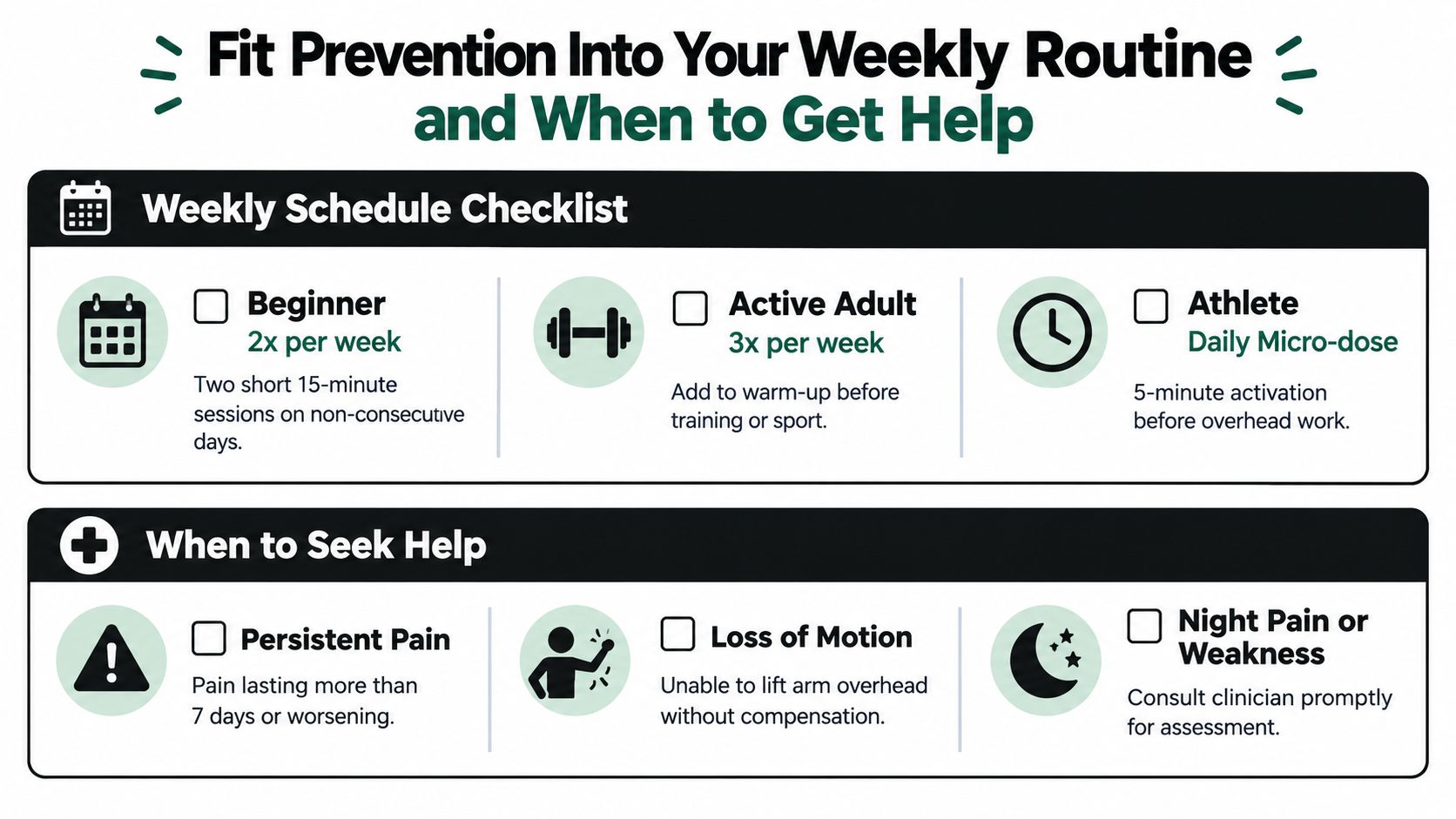
Simple weekly templates
Try the version that matches your life right now:
- Busy beginner: Do the full routine on two nonconsecutive days. Keep it short and leave a rep or two in reserve.
- Active adult: Add the first three exercises before upper body training, then do the full sequence on another day.
- Overhead athlete: Use a brief activation version before practice, then a fuller maintenance session later in the week.
A related research gap matters here. Evidence is still concentrated in overhead and team-sport populations, while broader claims for office workers, older adults, and post-injury adults remain less established. Pooled data suggest shoulder-specific programs that combine strength, stability or control, and sport-specific work may reduce injury rates by about 51% in handball and volleyball players, but certainty was rated very low and the benefit isn't yet well established for the general adult population (prevention strategies review PDF).
When to modify and when to get help
A prevention session shouldn't create a flare that lingers. Back off and reassess if you notice:
- Pain that builds across several sessions
- Night pain
- Noticeable weakness
- Loss of motion
- Clicking or instability that feels new or worsening
If those show up, prevention becomes treatment territory. That's a different conversation. A targeted exam can sort out whether you're dealing with load intolerance, impingement-related symptoms, cuff irritation, stiffness, or instability. If you need that next step, physical therapy for shoulder injury is the appropriate lane rather than just adding more band work.
Stay Consistent and Keep Your Shoulders Strong for the Long Term
The people who do best with shoulder injury prevention exercises usually follow three habits.
First, they keep the frequency steady. A modest routine done regularly beats an ambitious plan done occasionally. Second, they value clean reps over heavy reps. Prevention is where patience pays off. Third, they adjust early. If a movement starts to pinch, fatigue rises fast, or form slips, they regress before irritation piles up.
Use a simple four-week check-in. Notice whether overhead reaching feels smoother, whether one side still tires earlier, and whether your warm-up now prepares the shoulder instead of exposing it. Those are useful signs that your system is adapting.
Shoulder prevention has limits. It won't make you invincible, and it won't replace treatment when pain is established. But it does give you a practical way to build tolerance before symptoms start running the schedule. Keep it light, keep it frequent, and keep the quality high.
If your shoulder already feels unreliable, painful overhead, or slow to recover after activity, MedAmerica Rehab Center can assess what's driving it and build a progression that fits your work, sport, and current capacity. Their team in Deerfield Beach treats shoulder problems with hands-on care, targeted exercise, and clear return-to-activity planning. You can learn more or schedule a visit at MedAmerica Rehab Center.
MedAmerica Rehab · Deerfield Beach
Talk to a clinician about your pain
Physical therapy, chiropractic, acupuncture and shockwave therapy under one roof, since 1995. Same-day appointments are available.
Mon–Thu 8:00 AM – 6:30 PM · Fri 8:00 AM – 3:00 PM