
Carpal Tunnel Rehab After Surgery Explained
It's the morning after surgery. Your bandage is still on, your fingers feel puffy, and making breakfast takes more planning than you expected. You want to know when your hand will feel normal, and whether you should be resting it or moving it.
Carpal tunnel rehab after surgery isn't an automatic package of clinic visits or a single return-to-work date. The right plan matches protection, motion, and loading to your wound, your hand function, and the hardest task you need to do. Your surgeon's instructions take priority over any general recovery guide.
Recovery Timeline After Carpal Tunnel Release
Think in healing stages, not deadlines. A closed incision, comfortable movement, and a hand that tolerates activity are more useful progression checks than a date on the calendar.
Early on, protect the dressing and manage swelling. Keep it clean and dry, hold your hand above heart level during rest breaks, and move your shoulder, elbow, and fingers within the limits your surgeon allowed. Don't remove a dressing or prescribed support just to try an exercise.
Night tingling may ease before your grip feels reliable. A weak pinch or tenderness beside the incision, called pillar pain, doesn't automatically mean the release failed. What matters is whether your symptoms are gradually settling rather than becoming more intense.
Move forward when the hand is ready
Carpal tunnel rehab stages after release
| Window | Rehab focus | Usually allowed | Hold back if |
|---|---|---|---|
| Dressing on and incision healing | Wound protection and swelling control | Elevation, shoulder and elbow motion, surgeon-approved finger bends | Dressing gets wet, gripping pulls on the wound, or night pain increases |
| Wound closed and movement cleared | Motion and scar comfort | Tendon glides, gentle wrist bends, light scar massage after clearance | Forceful pinch, vibration, or an incision that reopens |
| Loading permitted | Grip, pinch, and endurance | Graded squeezing and longer daily tasks | Swelling or symptoms rise and stay elevated after practice |
| Preparing for normal duties | Task-specific conditioning | Longer tasks and full shifts after strength and symptoms hold | Assuming the first workday means recovery is finished |
Once the wound is closed and the surgical team has cleared stitches or skin glue, practice comfortable movement before resistance. Being able to type briefly doesn't mean your palm is ready for opening a tight jar, holding a vibrating tool, or pushing yourself out of a chair.
When loading is permitted, increase resistance and duration separately. For example, keep the same soft putty while you improve comfortable repetitions, rather than switching to firmer putty and extending the session together. That makes it easier to identify what caused a flare.
Build toward the actual task
Later rehabilitation should resemble the activities you're trying to recover. Carrying groceries requires sustained grip; fastening jewelry requires pinch and coordination; operating tools adds force, vibration, and sometimes unexpected movement.
The same principle applies to physical therapy after surgery: choose the next challenge according to healing and function, not just because the previous exercise became familiar.
Practical rule: Pick the row that matches today's wound and activity tolerance. Don't advance because someone else returned faster.
Who Needs Clinic Visits After Release
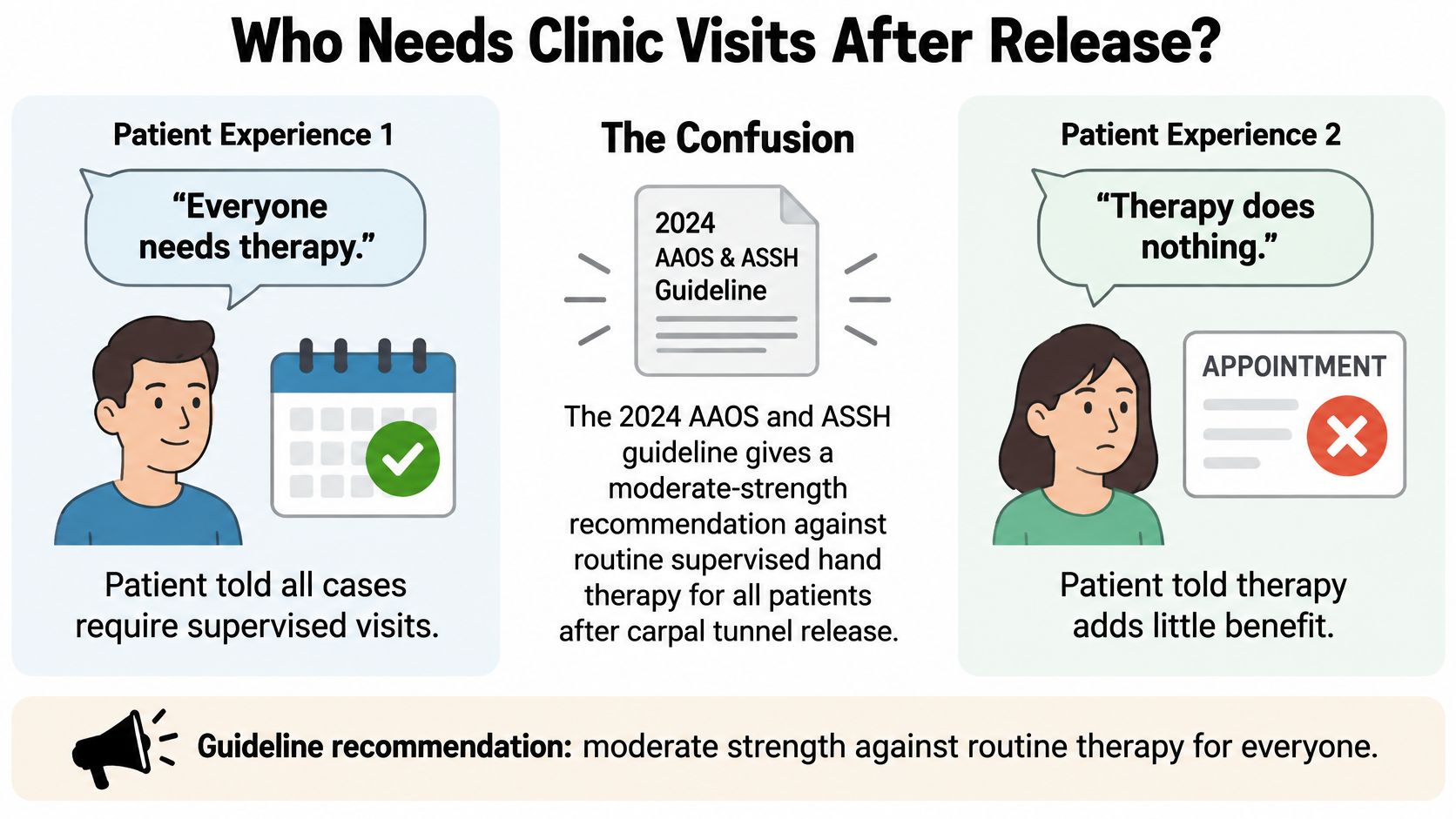
Routine supervised therapy isn't necessary for every patient. The 2024 AAOS/ASSH clinical practice guideline gives a moderate-strength recommendation against routinely prescribing supervised postoperative therapy, while also describing a high-quality study that found better motor dexterity at 1 month and faster return to work with therapy.
Those findings aren't contradictory. They distinguish an automatic referral for everyone from targeted care for someone whose hand isn't progressing.
The guideline also found no demonstrated routine benefit from postoperative immobilization. That supports protected movement when permitted, not removing a surgeon-prescribed splint or ignoring an individual restriction.
Compare the problem, not just the treatment
Home program or supervised hand therapy
| Situation | Better first plan | What the evidence supports |
|---|---|---|
| Uncomplicated release and steady gains | Surgeon-approved home program | No consistent added benefit from routine supervised therapy |
| Poor dexterity or a slow work return | Targeted supervised therapy | Selected patients may gain short-term functional benefits |
| Weakness, scar sensitivity, sensory change, or a heavy gripping job | Therapist-directed progression | Individual load, scar, and task practice rather than a fixed protocol |
| Extra proprioceptive hand drills | Optional add-on, not a default | Limited evidence doesn't establish a need for everyone |
A home program has real advantages: fewer appointments, less travel, and practice built into daily life. Its limitation is feedback. You may not know whether you're protecting the hand appropriately, avoiding movement unnecessarily, or adding more force than the incision can tolerate.
A therapist earns the visit by answering a specific question. Is poor pinch caused mainly by pain, weakness, or coordination? Does the scar restrict movement? Can you perform a work task accurately without compensating through your shoulder?
What a useful referral should accomplish
Think of the release as opening the tunnel, while the hand still has to manage traffic. Some people regain comfortable, coordinated use with simple home practice. Others need help choosing the right movement and load.
A targeted hand physical therapy assessment can clarify those decisions. The useful outcome isn't another list of exercises. It's a plan connected to the limitation that brought you in.
- Stay with the home plan when finger movement, swelling, and sleep are improving within your surgeon's limits.
- Request a focused referral when coordination is poor, ordinary touch remains difficult, or progress stalls.
- Ask what will be measured so you understand how the therapist will judge whether treatment is helping.
Don't buy into either extreme: everyone needs visits, or therapy never helps. Choose supervision because there's a problem to solve.
Hand and Wrist Exercises by Healing Stage
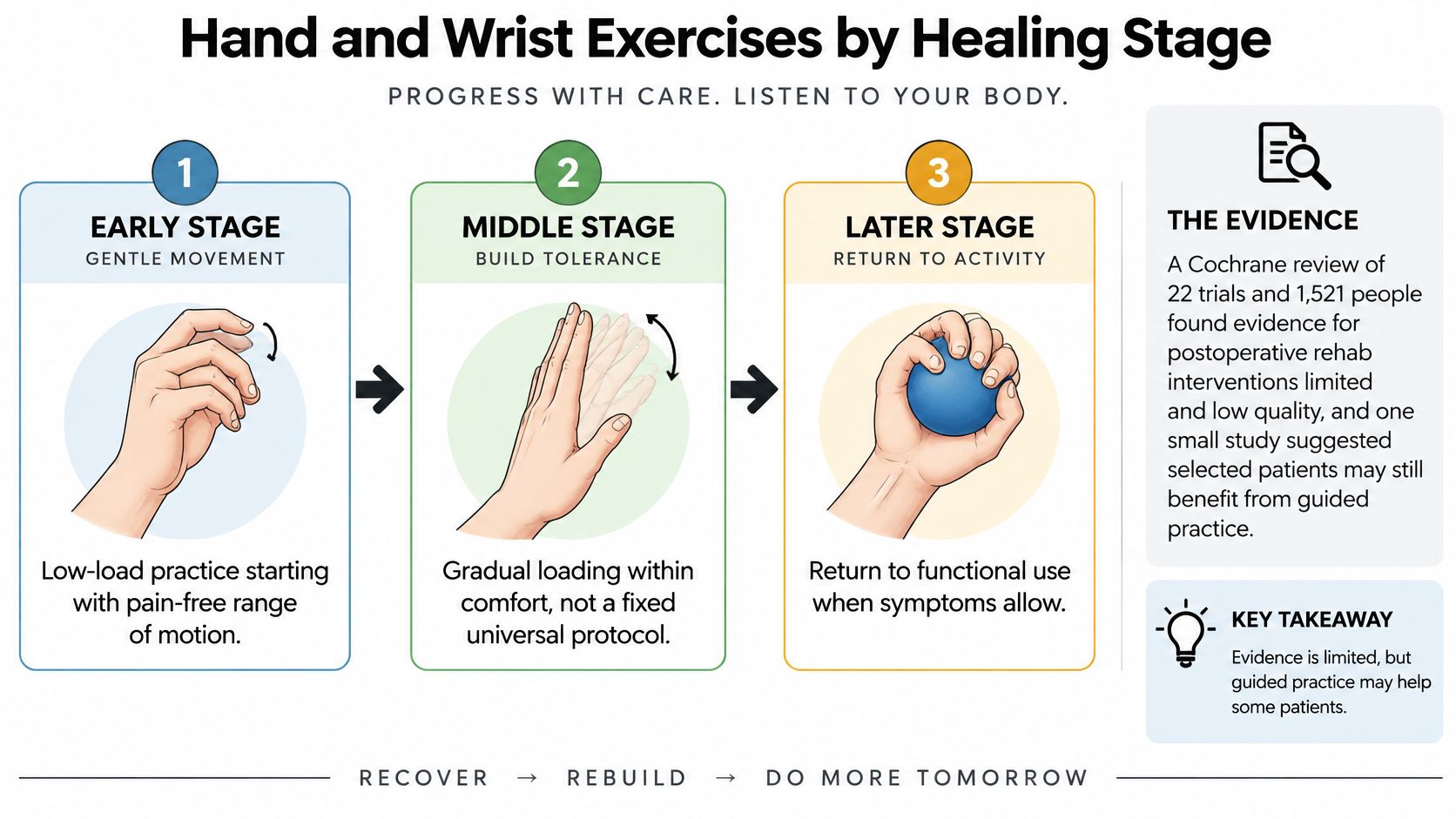
Exercises should be low-load practice, not a test of toughness. A Cochrane review of postoperative rehabilitation, encompassing 22 trials and 1,521 participants, found that the evidence was generally limited and low quality.
That limits how confidently anyone can prescribe a universal routine. Glides can help you practice movement, but they aren't a proven recipe that every recovering hand must follow.
Start with movement you can control
Use the following progression only after your surgical team approves the relevant movement. Ask for an individual repetition target rather than treating an online exercise dose as a prescription.
While the dressing is on, gently open and close the fingers. Move toward a loose fist without squeezing. Stop before a sharp pull at the incision, and don't force swollen fingertips into your palm.
After wound closure, practice a tendon-gliding sequence: straight hand, hook fist, full fist, then straight fist. In a hook fist, bend the finger joints while keeping the knuckles relatively straight; in a straight fist, bend the knuckles and middle joints without curling the fingertips tightly. Skip any position that creates sharp pain.
Support your forearm for wrist bends. Rest it on a table with your hand free to move, then bend the wrist gently forward and backward. Stay within a comfortable arc instead of pressing the wrist farther with your other hand.
Once the surgeon clears the scar, use clean fingertips to move the healed skin gently over the tissue underneath. This isn't deep digging. Stop if the skin opens, drains, or becomes increasingly irritated.
When loading is permitted, introduce a soft ball or soft therapy putty, then practice pinch and coordination with buttons, coins, or an unloaded tool handle. Stop before your grip becomes clumsy or you start substituting wrist movement for finger control.
Hand exercises by healing window
| Window | Exercise | Dose | Stop if |
|---|---|---|---|
| Dressing on, movement approved | Gentle fist and finger opening | Brief, easy sessions using the prescribed repetition target | Sharp pull at the incision |
| After wound closure | Tendon-gliding sequence | Slow practice without forcing the final position | Pain at the end of the range |
| Wrist motion cleared | Supported wrist flexion and extension | Short sets within a comfortable arc | Pain, swelling, or night symptoms stay elevated |
| Scar cleared by the surgeon | Clean-finger scar massage | Brief, gentle skin movement | Drainage or an opening wound |
| Loading permitted | Soft ball or putty, pinch, buttons, tool holds | Short sets with rest before fatigue affects control | The hand remains more swollen afterward |
Judge the response, not the effort
Nerve glides aren't the same as tendon glides, and they shouldn't feel like a strong nerve stretch. Have a clinician demonstrate the version appropriate for your symptoms rather than adding a forceful wrist-and-finger stretch yourself.
Early motion is like keeping traffic moving on a freeway. Forcing a numb, swollen hand is more like accelerating into a jam.
A useful exercise should leave you able to use the hand, not needing the rest of the day to recover from practice.
Check your hand after the session and again after rest. If it's puffier the next morning, reduce the challenge and discuss the response before progressing.
Return to Driving Work and Lifting
The return-to-work medians below come from a 2018 systematic review of 56 studies, which reported return times ranging from 4 to 168 days. These are planning figures, not clearance dates.
Return-to-work times after carpal tunnel release
| Duty or checkpoint | Reported timing | What the number does not mean |
|---|---|---|
| Non-manual work | Median 21 days away | Desk work can still flare with long typing |
| Modified duties | Median 23 days | Light duty is not full grip or vibration |
| Full duties | Median 30 days | Strength may lag behind pain relief |
| Manual work | Median 39 days away | Heavier jobs need a longer ramp |
| Any job, median of study medians | About 28 days | Study results ranged from 4 to 168 days |
| Work at 2 months | 41% working normally | 28% still reported limitations |
| Work at 6 months | 58% working normally | 26% still reported limitations |
The spread reflects surgical technique, job demands, employer policies, and differences in how investigators defined recovery. Returning for modified duties isn't equivalent to completing unrestricted work.
A 2020 prospective occupational-medicine study found that 161 of 178 employed patients with complete follow-up data, or 90%, returned to work, with a median return of 4 weeks. That's encouraging, but it doesn't promise an individual patient the same course.
Driving requires emergency control
A comfortable trip around the block isn't an adequate driving test. You need to grip and turn the wheel, operate controls, and respond suddenly without hesitation or a sharp pull through the palm.
Don't drive while medication makes you drowsy or while a dressing or support prevents reliable control. Discuss readiness with your surgical team and follow any applicable licensing or insurance requirements. A parked-car check can identify difficulty, but it doesn't establish that you're safe on the road.
A short task isn't a full shift
Lifting a bag once tests brief force. Carrying similar loads repeatedly adds endurance, fatigue, and the possibility of losing your grip.
For work planning, separate:
- Force needed to lift, push, pull, or pinch.
- Repetition required across the shift.
- Exposure to vibration, impact, or wet and dirty conditions.
- Recovery time available between tasks.
Begin with an approved, manageable load close to your body. Increase the challenge only when your grip remains secure and the hand settles afterward. Don't use a pain-free attempt as permission for unrestricted lifting.
Formal driving and work clearance belongs with the surgical team; the employer also needs to confirm that modified duties fit the restrictions.
What Rehab Looks Like for Different Jobs
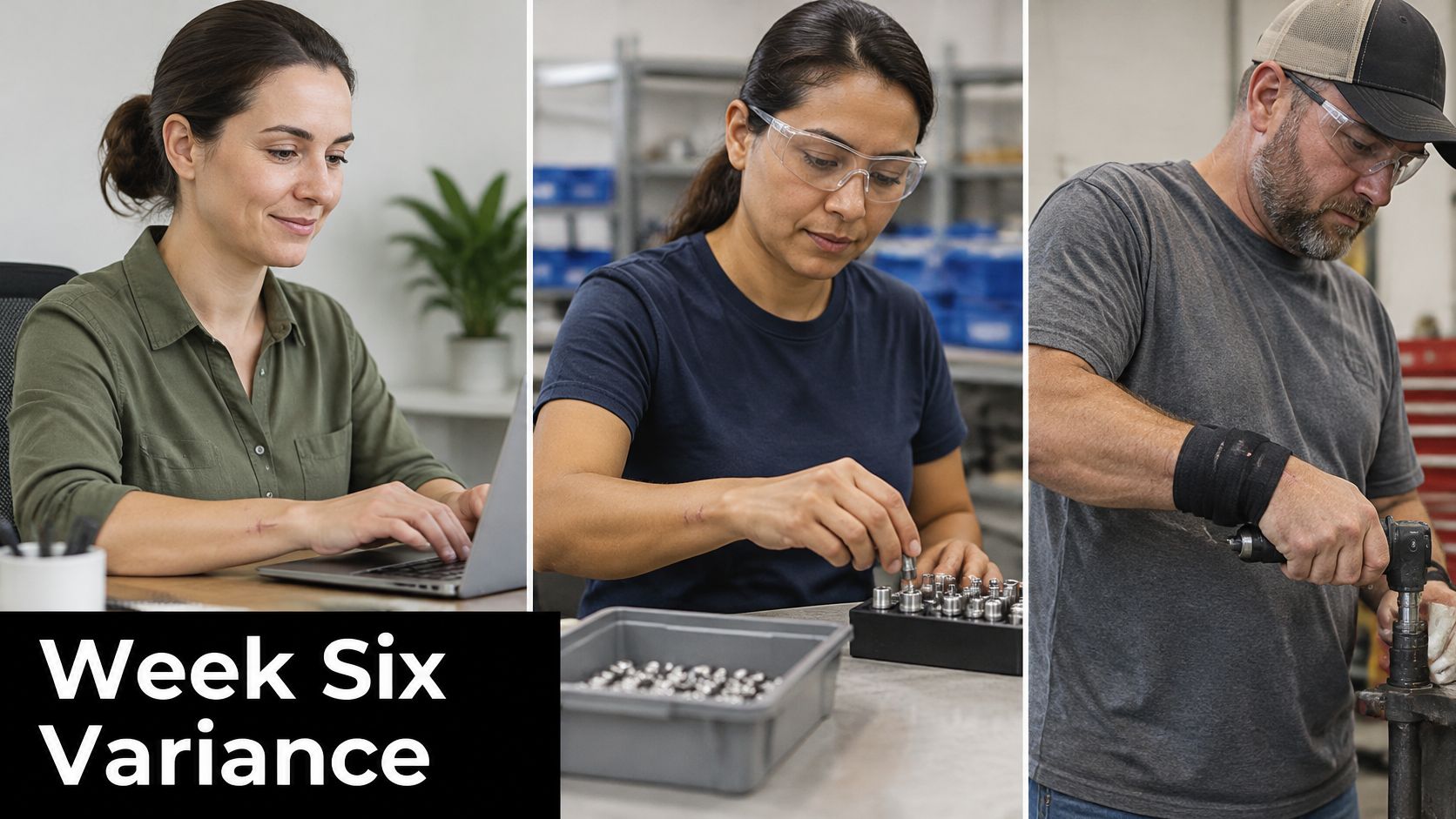
A billing clerk, grocery stocker, and delivery driver can have the same operation and need different rehabilitation decisions. Their job titles matter less than what their hands do.
A UK survey of hand surgeons and therapists reported median suggested returns of 7 days for desk work, 15 days for repetitive light manual work, and 30 days for heavy manual work. Those were professional recommendations, not observed recovery times or guarantees.
The clerk needs duration without palm pressure
Say the clerk has permission to resume keyboard work. They start with a brief typing block, keep the mouse close, and avoid pressing the incision into a hard wrist rest.
The useful check isn't whether they cleared the inbox. It's whether finger accuracy, palm comfort, and symptoms remain acceptable after repeated work blocks. A split keyboard may help positioning, but it won't compensate for working continuously through irritation.
The stocker needs a reliable repeated grip
The stocker's modified role might involve lighter packages at waist height instead of heavy cases lifted from the floor. A therapist can examine how the worker grasps the box, whether the wrist stays controlled, and whether the grip deteriorates with repetition.
Added drills aren't automatically better: the AAOS patient guidance on carpal tunnel syndrome summarizes moderate evidence that postoperative physical therapy provides no additional benefit routinely. For this worker, the reason for supervision would be a measurable task limitation, not the operation alone.
The driver needs control plus handling capacity
The delivery driver's job includes more than steering. Door handles, seat belts, packages, trolley handles, and loading tasks may be harder on the hand than sitting behind the wheel.
A parked vehicle allows a check of reach and control use before the surgical team considers road readiness. Package handling needs its own assessment; passing a steering check doesn't establish lifting capacity.
For each worker, reassess:
- Grip and pinch during that task.
- Sensation and dexterity needed for secure handling.
- Wound status and after-task pain before expanding duties.
Workplace changes described in repetitive strain injury guidance can help identify unnecessary repetition and awkward positioning. Which example matches the heaviest task in your day, rather than the easiest part of your job?
Symptoms That Need a Clinician Sooner
Pillar ache when you push through the palm can be part of healing. Bruise-like discoloration, morning stiffness, and a grip that feels weaker than the other side can also occur early on.
Those symptoms should gradually become easier to manage. A worsening pattern changes the plan, especially when it involves the wound, sensation, or circulation.
Don't exercise through warning signs
Contact your surgeon the same day for:
- Wound changes, including drainage, foul smell, spreading redness, or an opening incision.
- Possible infection, especially fever alongside increasing wound pain or redness.
- Suddenly severe pain, particularly when it's different from your usual soreness.
- New functional loss, such as unexpectedly dropping objects or losing finger control.
If your fingers become pale, blue, or cold, or you develop rapidly worsening pain or swelling, seek urgent medical assessment rather than waiting for a routine therapy appointment.
Returning numbness or night symptoms after clear improvement also deserves prompt surgical advice. Don't respond by tightening a brace, forcing nerve glides, or switching to firmer putty.
A slow stall also needs attention
Not every concern is dramatic. Swelling that stops settling with rest, a scar that won't tolerate light contact, or strength that fails to progress after loading was allowed all justify reassessment.
Exercise can address an appropriate movement or strength problem. It can't determine whether a wound complication or renewed nerve irritation needs medical treatment.
Thermo Recovery Wear's explanation of carpal tunnel vs tendonitis differences can help you describe whether symptoms feel more like tingling or movement-related tendon pain. It isn't a way to diagnose a postoperative complication yourself.
When you call: Describe when the change started, what you were doing beforehand, and whether sensation, finger color, or drainage changed.
Keep that note simple. Add whether the problem is constant, appears only during activity, or persists after stopping.
Contact the surgical team first when the wound or nerve is the concern. Once they've checked the problem, a rehabilitation clinician can adjust movement, scar care, or loading with a clearer understanding of what's safe.
Book a Post-Surgical Hand Check
Continue the home plan if you're improving within your surgeon's restrictions. Keep your surgical follow-up, and don't add appointments because you think every operation requires them.
Book a targeted evaluation if movement is stuck, scar sensitivity blocks ordinary use, or your grip can't meet the task you're cleared to attempt. A work-related or auto-injury case may also need documented functional progression rather than an informal guess about readiness.
Bring a clear question
Before the visit, write down:
- Your healing status, including whether the incision is closed and what the surgeon has permitted.
- Your hardest daily task, such as carrying a case, using pliers, or fastening clothing.
- Your symptom trend, including swelling, sleep, and scar comfort compared with your previous week.
Bring your operative instructions and any lifting, typing, or driving restrictions. A useful assessment should connect motion, scar mobility, sensation, and task performance to a manageable home plan, a clear activity limit, and a reassessment plan.
Know what the appointment decides
At MedAmerica Rehab Center in Deerfield Beach, we provide post-surgical rehabilitation and care for work and auto-injury cases. Our physical therapy and occupational therapy initial evaluations take place on the first visit and typically last 60–75 minutes. Wear comfortable clothing, such as gym clothes and shoes.
The therapist's assessment doesn't replace your surgeon's clearance for driving or unrestricted work. Its purpose is to identify what your hand can do now and what needs to improve next.
The choice isn't between doing nothing and committing to a fixed package of visits. It's between continuing a home plan that's working and getting a focused check when you need help progressing safely.
MedAmerica Rehab Center offers physical and occupational therapy to support post-surgical hand recovery, including rehabilitation after work and auto injuries. Visit MedAmerica Rehab Center to request a targeted hand evaluation, and bring your surgical instructions so we can connect your recovery plan to the tasks you need to regain.
MedAmerica Rehab · Deerfield Beach
Talk to a clinician about your pain
Physical therapy, chiropractic, acupuncture and shockwave therapy under one roof, since 1995. Same-day appointments are available.
Mon–Thu 8:00 AM – 6:30 PM · Fri 8:00 AM – 3:00 PM