
Return to Work After Workers Comp Injury
You're finally ready to go back, but the return-to-work note says only “cleared” or “light duty.” Your supervisor wants to know whether you can lift, climb, drive, stand, or work a full shift. Meanwhile, the claims adjuster is asking for a return date, even though nobody has matched your restrictions to the actual job.
That gap causes many avoidable problems after a workers' compensation injury. A safe return isn't a single appointment or a signature on a doctor's note. It's a working agreement among you, your treating clinician, your employer, and the claims adjuster, with each person relying on you to provide accurate information and report changes early.
Why Coming Back Feels So Hard
A warehouse worker may be medically improved but still unable to lift from floor level. A nurse may tolerate walking but not repeated patient transfers. An office employee may be cleared to sit but unable to remain at a computer without changing position. A generic “light duty” label answers none of those questions.
The worker is often left carrying messages between people who use different language. The clinician thinks in symptoms and functional limits. The supervisor thinks in tasks and staffing. The adjuster thinks in work status, documentation, and claim progression. If you don't help translate one side for the other, the plan can stall.
The friction points that matter
- Unclear restrictions: “Avoid strenuous activity” doesn't tell an employer whether you can lift, push, reach, bend, drive, or work overhead.
- Mismatched duties: A job labeled sedentary may still require a long commute, frequent filing, standing at a counter, or moving supplies.
- Delayed updates: A missed appointment, unsigned restriction form, or unanswered employer call can make everyone assume the case is waiting on someone else.
- Overly fast progression: Feeling better at home doesn't prove that you can repeat the same task across a work shift.
- No feedback loop: If symptoms worsen after a duty change, the plan needs adjustment, not silence.
Practical rule: Treat every work-status change as a handoff. Ask what the clinician needs to know, what the employer can provide, and what the adjuster needs documented.
The stakes rise as time away grows. NIOSH reports that the likelihood of returning to work drops dramatically as absence increases, and U.S. Department of Labor analysis found that prolonged absence became especially concentrated among claims with extensive lost time (NIOSH explains the relationship between time away and work recovery). The right response isn't rushing you into unsafe duties. It's keeping the case active through clear restrictions, suitable work, regular communication, and early escalation when the plan isn't working.
Getting Medical Clearance the Right Way
A useful clearance visit starts before you enter the examination room. Your clinician can only write practical restrictions when you explain what the job demands and what has changed since the last visit.
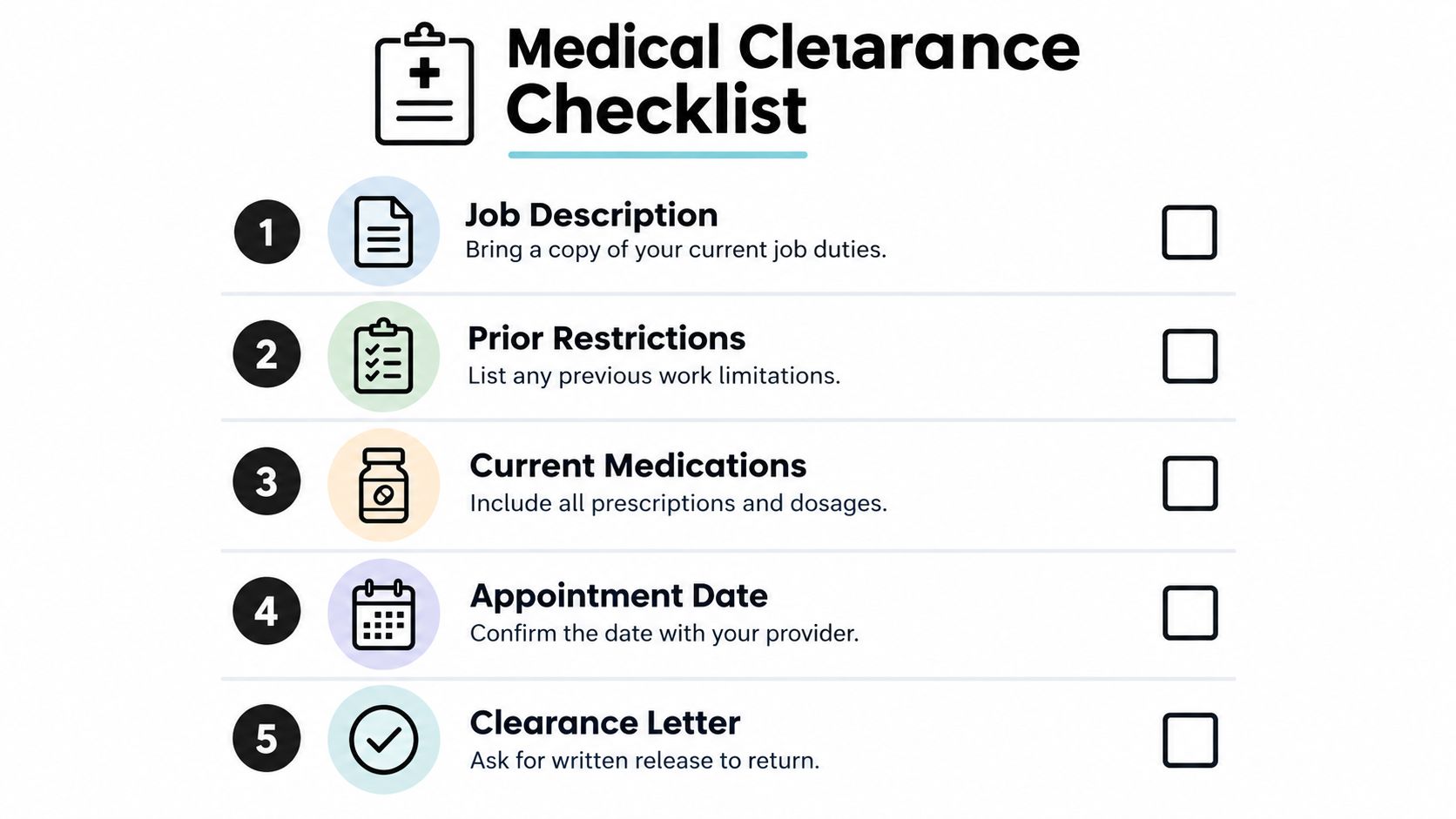
Bring these materials:
- Current job description: Include lifting, carrying, pushing, pulling, standing, walking, climbing, reaching, driving, keyboarding, patient handling, or other repeated tasks.
- Prior restrictions: Bring every restriction form, work-status note, and employer response you've received.
- Current medications: List prescriptions, over-the-counter medicines, dosages, and any side effects that affect alertness, balance, or concentration.
- A workday description: Explain the pace, shift length, breaks, equipment, commute, and tasks that trigger symptoms.
- Your symptom record: Note what you can do now, what causes a flare, how long recovery takes, and whether sleep or concentration is affected.
Ask the provider to write functional limits, not just a diagnosis or a label. “No lifting over a stated limit,” “alternate sitting and standing,” “avoid repetitive overhead reaching,” or “no operation of heavy equipment while taking a sedating medication” gives the employer something usable. The document should also identify whether you're off work, cleared for modified duty, or cleared for full duty, along with a review date.
Leave the appointment with a handoff plan
Before you leave, ask:
- Which essential tasks can I perform now?
- Which tasks are unsafe or outside my current capacity?
- How often should I change position or take a brief recovery break?
- What symptoms mean I should stop a task and contact the clinic?
- Who receives the completed work-status form, and when?
If the clinician doesn't know enough about your job to set limits, ask whether a functional capacity evaluation is appropriate. A functional capacity exam for workers' compensation cases can help compare demonstrated abilities with documented job demands, but it shouldn't be used as a substitute for a careful clinical history.
The Department of Labor's analysis of federal workers' compensation cases reported in 2010 found that, by the one-year point, 96% of traumatic-injury cases and 94% of occupational-illness cases had returned full-time to jobs paying pre-injury wages (the Department of Labor analysis describes these return-to-work outcomes). That finding doesn't mean every worker should return quickly. It shows why early, accurate clearance decisions matter. A vague note can delay appropriate work just as easily as an overly optimistic one can expose you to risk.
Designing a Graded Return That Actually Works
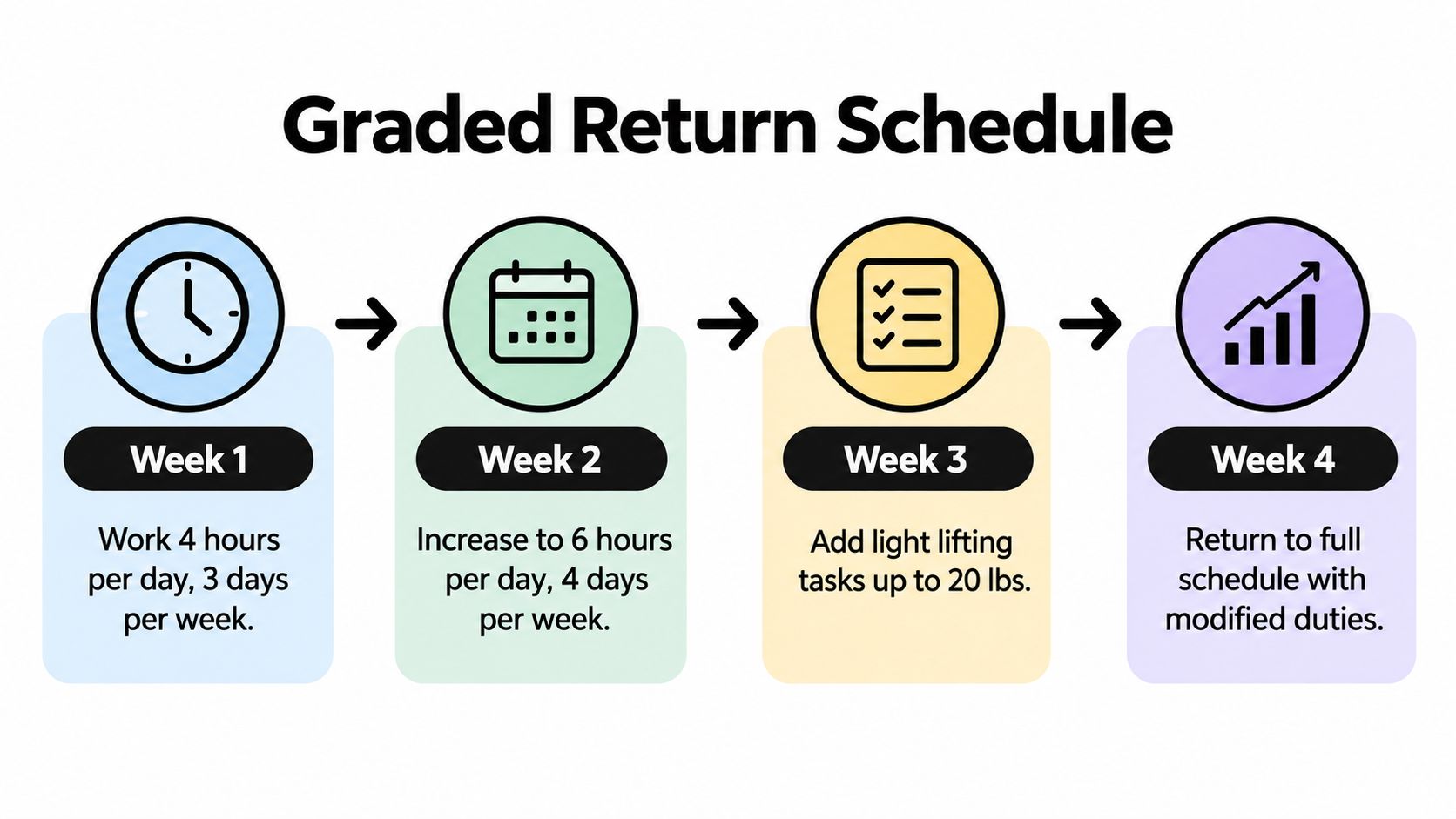
A graded return turns medical restrictions into a workday. The written plan should state which days you'll work, how long each shift lasts, what tasks are allowed, what tasks are excluded, and how progress will be judged.
Start with the job's highest-risk demands. For a warehouse employee, that may mean floor-to-waist lifting, carrying, pushing carts, and repeated bending. For an office employee, it may mean keyboarding, static sitting, commuting, or moving between departments. For a healthcare worker, it may mean patient transfers, prolonged standing, and urgent movement.
A practical plan might look like this:
- Warehouse: Begin with inventory scanning, labeling, and short walking routes. Exclude floor lifting, loaded carts, ladders, and repetitive bending until tolerance is demonstrated.
- Office: Use alternating sitting and standing, shorter computer blocks, limited filing, and a workstation arranged to reduce reaching. Keep essential administrative work rather than assigning meaningless tasks.
- Healthcare: Start with education, chart review, supervised rounding, or non-transfer duties. Delay patient lifting and emergency response tasks until the clinician confirms capacity.
These changes aren't special treatment. They're a way to preserve productive participation while the worker rebuilds tolerance. A work hardening therapy program can add controlled, job-specific practice when ordinary clinic exercises don't reproduce the demands of the workplace.
Progress by tolerance, not the calendar
A schedule should include progression criteria based on symptoms, task tolerance, functional capacity, and attendance. Don't increase hours because a calendar date arrived if the current workload causes a flare that lasts into the next day. Conversely, don't hold the worker at an easy level when they're consistently completing it without a concerning response.
Track:
- duties performed and duration
- lifting, reaching, standing, or sitting exposure
- pain or other symptoms during and after work
- breaks used and whether they were adequate
- attendance and any early departure
- problems reported by the worker or supervisor
Workers looking for jurisdiction-specific guidance may also benefit from northern Wisconsin injured worker return-to-work help, especially when job offers, restrictions, and claim decisions become difficult to interpret. Safe Work Australia's survey found that workers with a formal plan returned at a rate of 94.0%, compared with 81.7% among those without one, while only 61.8% had a plan in place (the survey analysis details the relationship between formal planning and work status). The important lesson is operational detail. A plan works when people can follow it, measure it, and revise it.
Talking to Your Employer and Adjuster
Your employer and adjuster don't need the same information. Your supervisor needs to know what you can safely do, what you can't do, and how the work will be organized. The adjuster needs current work status, appointment updates, restrictions, and evidence that the parties are acting on the plan. Neither needs your entire medical history.
Choose one employer contact, such as an HR representative, return-to-work coordinator, or designated supervisor. Send that person the current restriction form and ask for the proposed duties in writing. A single point of contact reduces conflicting instructions and gives you a clear place to report a problem.

Use plain language:
“My current restriction is no repetitive overhead reaching. Please confirm whether the proposed assignment includes that task and identify an alternative if it does.”
“I'm cleared for modified duty, but I need the schedule, tasks, lifting expectations, and break arrangement in writing before my first shift.”
“I completed the assigned work, but the symptoms increased afterward and affected my next shift. I'm reporting this now so the plan can be reviewed.”
Keep a simple communication log with the date, person contacted, topic, response, and next action. Save work-status forms, job offers, appointment notices, text messages, and emails in one folder. If a supervisor gives you a verbal instruction that conflicts with the written restrictions, don't argue on the work floor. Pause the task, refer to the restriction, and notify the designated contact.
Keep the adjuster informed without oversharing
A brief update is usually more useful than a long medical narrative. State the appointment date, current work status, restrictions, next review, and any obstacle preventing a safe return. If the employer hasn't provided suitable duties, say that directly and attach the written response if you have one.
Early involvement matters. Safe Work Australia's 2025 survey reported a return-to-work rate of 51.0% among workers who received employer assistance before a claim was lodged, compared with 27.2% when that early assistance was absent (the latest survey release reports these employer-assistance findings). The practical point is simple: don't wait for confusion to become a dispute. Put the question in writing while there's still time to solve it.
How Rehab Speeds Up a Safe Return
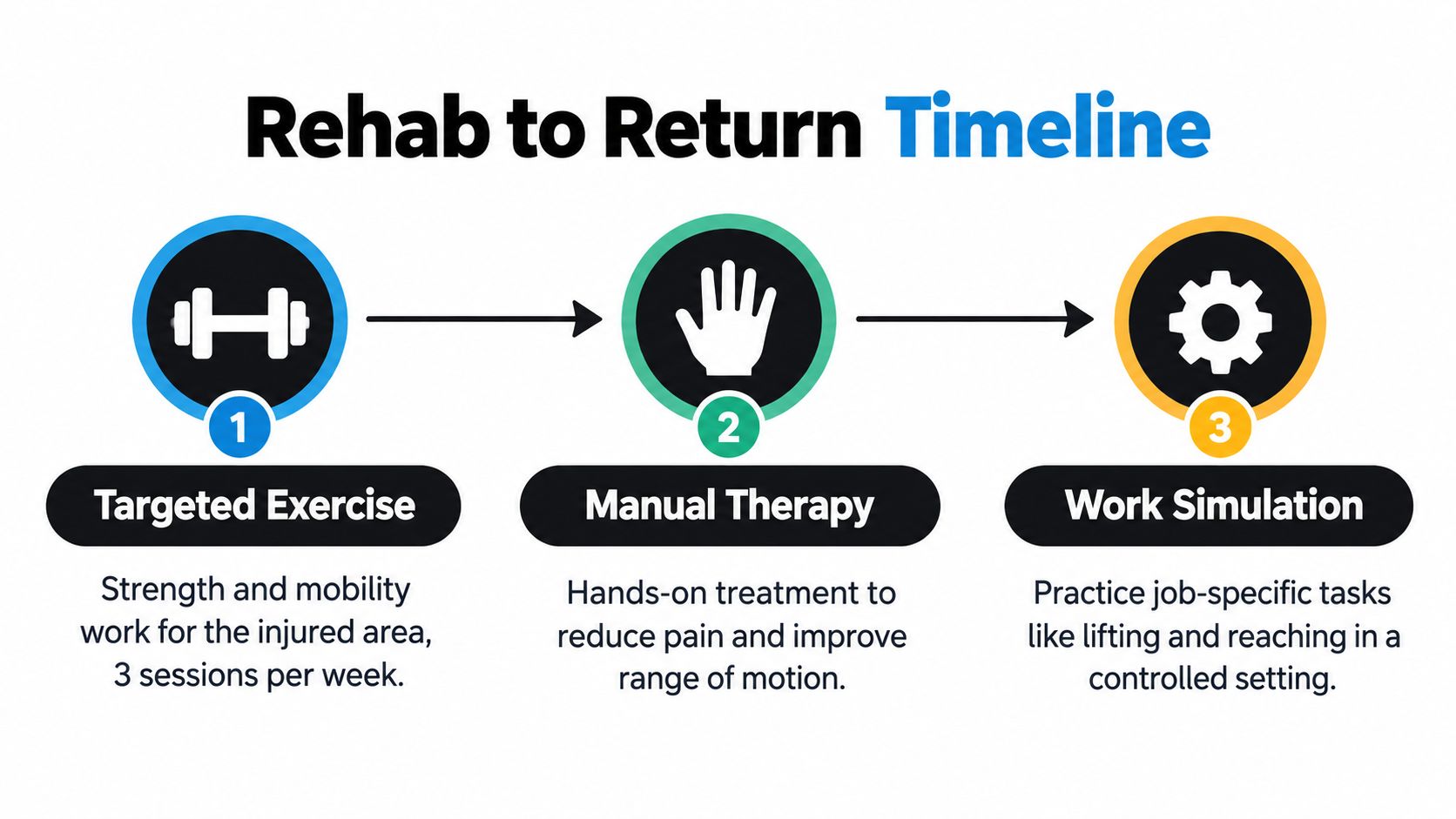
Rehabilitation should resemble the job more closely as you improve. A general exercise that reduces pain may be useful, but it doesn't answer whether you can lift a supply box, squat repeatedly, reach overhead, type through a shift, or stand on a hard surface.
A strong therapy plan links each clinical goal to a work demand:
| Work demand | Rehab focus | What to observe |
|---|---|---|
| Lifting from floor level | Hip and trunk control, graded lifting | Form, load tolerance, symptom response |
| Repeated reaching | Shoulder mobility and endurance | Repetition quality and recovery |
| Prolonged standing | Lower-limb strength and pacing | Posture, breaks, swelling, fatigue |
| Keyboarding | Position changes, hand endurance | Grip, wrist symptoms, concentration |
| Patient or equipment transfers | Body mechanics and coordinated movement | Safety, balance, assistance needs |
Physical therapy may address strength, mobility, balance, coordination, and symptom control. Occupational therapy can focus on task performance, work methods, cognitive demands, and environmental changes. Work simulation becomes valuable when the job involves repeated or complex activities that ordinary clinic exercises don't reproduce.
Ask therapy questions that change the plan
At each visit, ask the therapist to connect progress to your restrictions:
- Which job task are we preparing for today?
- What level of lifting, reaching, walking, or sitting did I tolerate?
- What should I report if symptoms rise after the session?
- What information should go to my treating clinician or employer?
- Do I need ergonomic changes, work simulation, or a formal capacity assessment?
A systematic review found moderate evidence that early employer contact, an accommodation offer, and communication between healthcare providers and the workplace can reduce work-disability duration and related compensation and healthcare costs (the systematic review examines coordinated return-to-work interventions). Therapy works better when the clinician knows what the employer can offer and the employer understands the functional limits.
For administrative support around clinic workflows, some practices explore chiropractic virtual assistant help, particularly when appointment coordination and documentation follow-up are consuming staff time. For injured workers in Deerfield Beach, workers' compensation physical therapy near you may be one treatment option when the plan requires task-specific rehabilitation and communication with the care team. Ask what the provider will measure, how progress will be reported, and how treatment connects to your actual job.
Handling Fear, Setbacks, and the Mental Load
Returning to work can feel unsafe even when the physical examination is improving. You may fear repeating the movement that caused the injury, worry coworkers think you're exaggerating, or feel pressure to prove you're ready by ignoring symptoms. Those reactions can change how you move, sleep, concentrate, and communicate.
A manageable adjustment usually improves with a clear schedule, predictable supervision, and gradual exposure to the difficult task. A warning sign is a pattern that interferes with the plan, such as worsening sleep, panic before shifts, intrusive memories, inability to concentrate, escalating irritability, or fear that causes you to avoid necessary activity. A pain flare can also be clinically important when it changes your function or lasts longer than expected.
A setback is information. Report what happened, identify the task or trigger, and let the team adjust the exposure instead of hiding the problem.
You don't have to disclose private details to your supervisor. You can say, “I'm having difficulty concentrating during this assignment and need to discuss a temporary change with my provider.” Ask the treating clinician whether the plan should include shorter shifts, more predictable tasks, additional breaks, reduced public contact, or a behavioral-health referral.
Safe Work Australia's 2025 survey found that workers with psychological injuries returned to work at a rate of 76.5%, compared with 90.2% for physical injuries, while the overall rate fell from 91.6% in 2021 to 88.9% in 2025 (the survey factsheet reports these psychological-injury and overall outcomes). Those figures reinforce a practical point: emotional symptoms deserve the same structured attention as lifting tolerance or range of motion.
If trauma symptoms, panic, or emotional distress are becoming difficult to manage, seek qualified behavioral-health care rather than waiting for the physical injury to settle. Information about expert PTSD care from Refresh Psychiatry may help you identify questions to raise with a licensed mental-health professional. Keep the employer conversation focused on functional needs, and keep clinical details between you and the appropriate providers.
Your Return-to-Work Checklist
Before the first shift, make sure you have a written work-status document and a written duty offer. Confirm the schedule, tasks, restrictions, break arrangement, supervisor, reporting process, and next medical review. Your clinician, employer, and adjuster should each know what has been agreed.
At every review, record:
- Work status: Off work, modified duty, or full duty.
- Actual exposure: Hours, lifting, standing, driving, reaching, typing, and other relevant tasks.
- Response: Symptoms during work, after work, overnight, and before the next shift.
- Function: What you completed safely and what you could not complete.
- Attendance: Missed shifts, early departures, or schedule changes.
- Next action: Continue, modify, progress, or escalate.
Bring these questions to your next provider visit:
- Which current task is limiting me most?
- What functional change would support the next progression?
- Are my restrictions specific enough for my supervisor?
- What symptoms mean I should stop and report the problem?
- Does the employer's proposed duty match my documented capacity?
A return plan needs adjustment when symptoms worsen, attendance becomes unstable, assigned duties conflict with restrictions, no suitable work is available, communication stops, or psychological symptoms interfere with concentration and safety. Sustainable return to work means maintaining the original or modified job for at least 3 months without relapse or renewed sickness absence, not merely completing a first shift. Track that sustained period with the same care you used to reach day one.
MedAmerica Rehab Center provides individualized physical therapy, chiropractic care, acupuncture, and other rehabilitation services for workers' compensation injuries, with treatment connected to mobility, task tolerance, and job demands. If you're planning a return to work after an injury in Deerfield Beach or nearby communities, visit MedAmerica Rehab Center to request an evaluation and discuss your next step.
MedAmerica Rehab · Deerfield Beach
Talk to a clinician about your pain
Physical therapy, chiropractic, acupuncture and shockwave therapy under one roof, since 1995. Same-day appointments are available.
Mon–Thu 8:00 AM – 6:30 PM · Fri 8:00 AM – 3:00 PM