

Workers Comp Physical Therapy Near Me: A Practical Guide
You've searched “workers comp physical therapy near me” because your back, neck, shoulder, or other work injury still hurts, and every phone call seems to create another question. Should you see a doctor first? Has your employer filed the claim? Will the insurer authorize treatment? Can you start PT before the paperwork is complete?
Those concerns are normal. As a clinic coordinator, I've seen injured workers lose days because the referral went to the wrong office, the claim number wasn't available, or nobody confirmed who was responsible for authorization. The practical answer isn't just choosing the closest clinic. It's moving four pieces in the right order: injury reporting, medical evaluation, PT referral, and authorization.
Timing matters. Guidance summarizing U.S. Bureau of Labor Statistics data indicates that about 70% of injured workers return within one week to one month, while roughly 30% return later than one month. That's one reason early evaluation and functional planning matter in workers comp rehabilitation. (Journal of Orthopaedic & Sports Physical Therapy guidance)
What to Do Right After a Work Injury
A warehouse associate slipped while stepping from a loading dock. She felt a pop in her lower back, finished what she could, and walked off shift unsure whether she should ice it at home, tell her supervisor, or find a doctor. Her immediate worries were familiar: missing pay, being blamed, locating the right provider, and discovering that treatment might not be covered.
The safest practical sequence starts with documentation, not guesswork. Report the injury to your supervisor as soon as possible, describe what happened in plain language, and keep a copy or record of the report. Then ask which physician or occupational health provider handles initial workers comp evaluations in your workplace and state.
Build your same-day checklist
- Report the incident. Record the date, approximate time, location, task, symptoms, and names of anyone who witnessed it.
- Ask for the claim contact. Get the employer's workers comp carrier, adjuster information, and claim number if one has been assigned.
- Attend the medical evaluation. The treating physician determines the diagnosis, work restrictions, and whether physical therapy is appropriate.
- Request the PT referral. The prescription should identify the condition being treated and any relevant restrictions.
- Call the clinic immediately. Ask whether the staff can verify the claim, review a pending referral, and schedule an evaluation while authorization is being processed.
Practical rule: A nearby clinic that can't confirm who handles your authorization may create more delay than a slightly farther clinic with a responsive workers comp coordinator.
Early action can reduce the chance that a manageable injury turns into a prolonged disability problem. If you're researching how location pages help people find nearby healthcare services, Digital Skyrocket's location page guide offers useful context about what local searchers need to know. The same principle applies to your search: look for clear information about workers comp intake, referral requirements, and appointment availability, not just a map listing.
How Workers Comp Referral and Authorization Work
A physician can write “start physical therapy” today, yet your first visit may still wait on claim approval. The referral, insurer review, and clinic intake each involve different people, and a missing detail at any stage can stop scheduling.
Follow the referral path
The initial treating physician is often selected or designated through the employer, insurer, or applicable state process. After examining you, that physician writes the PT referral and records the diagnosis, work restrictions, and reason for treatment.
The referral then goes to the insurer or claims administrator. The adjuster manages claim authorization. If assigned, a nurse case manager may coordinate communication among the physician, carrier, and clinic. The PT clinic's authorization coordinator checks benefits and network status, reviews the referral, submits required records, and asks the carrier whether treatment is approved.
Utilization review commonly takes three to ten business days, though timing depends on the state, payer, injury, and completeness of the submission. Some post-surgical cases receive faster handling, but that outcome is not automatic.
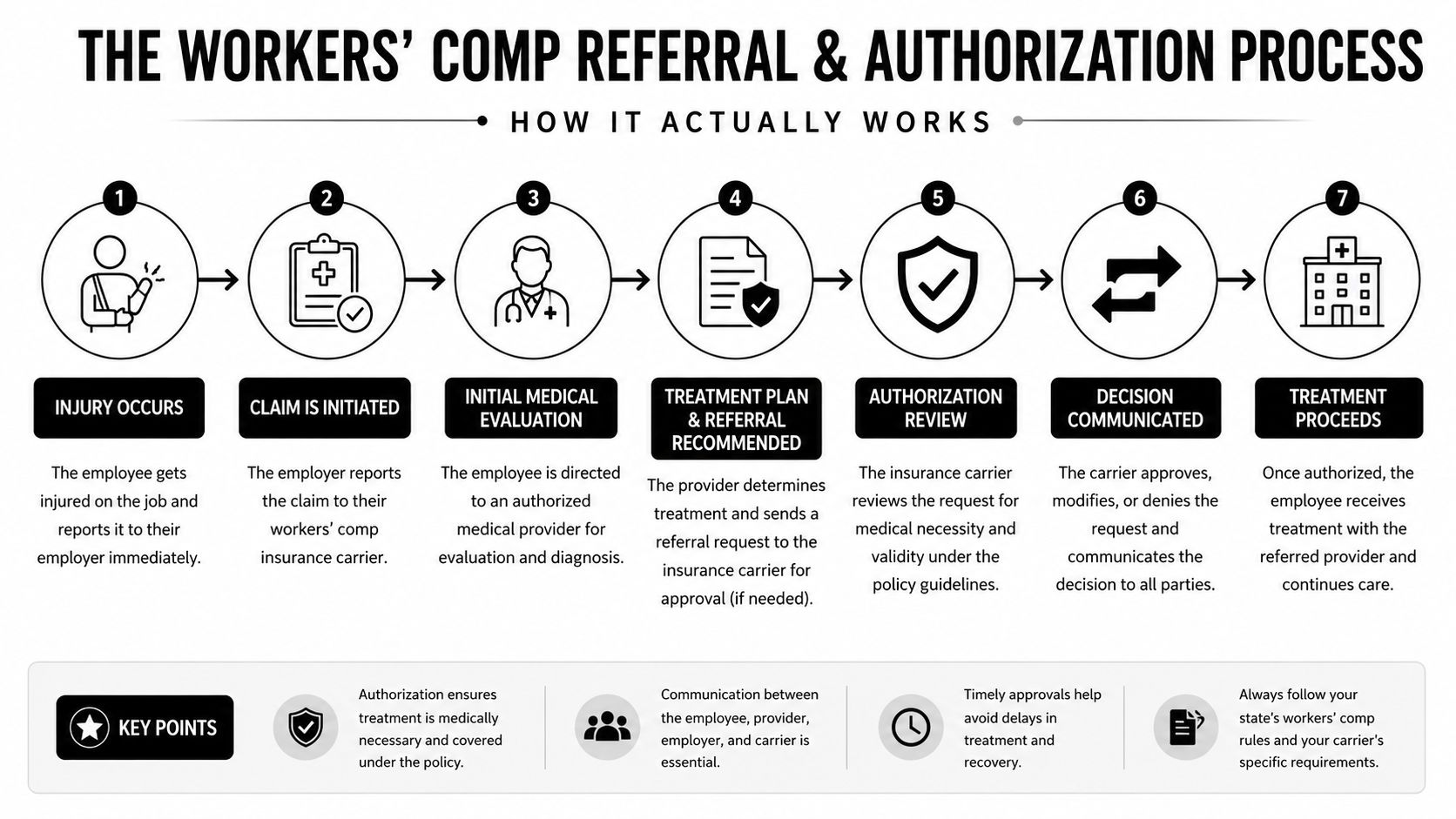
Find the delay before it grows
Check for an unsigned referral, missing physician progress notes, unclear work restrictions, or an incorrect claim number. The carrier may also request testing, such as a functional capacity evaluation. A denial can require an appeal, expedited review, or peer-to-peer discussion between the treating physician and reviewing clinician.
Referral rules vary by jurisdiction. One review reported that, as of 2023, 30 U.S. states required physician referral for work-related PT, while 17 explicitly allowed PT without one. It also reported average waits of 16 days for physician referral compared with about 5 days for physical therapy referral, with longer delays associated with worse claim outcomes. (Workers' compensation access and delay review)
A workers comp case insights platform can help organize how medical and legal records move through a claim. It does not replace your adjuster or treating physician, but it may clarify why different parties request different documents.
Call the PT clinic the same day the physician writes the referral. Ask the coordinator to pre-verify the claim, identify missing records, and confirm whether the clinic can hold an appointment while authorization is pending. For a plain-language explanation of broader claim timing, review how long workers comp can take.
Documents and Information to Bring to Your First Visit
A PT clinic can often begin intake with limited information, but complete records make the first appointment more useful and reduce billing confusion. Gather documents before you call, then send them through the clinic's secure method rather than carrying loose papers that may be misplaced.
Use this preparation list
- Claim number and adjuster contact: The claim number connects the visit to workers comp rather than your personal health insurance. Include the adjuster's phone number, email, and carrier name.
- Written PT prescription: This tells the therapist what diagnosis and treatment were authorized or requested.
- First report of injury: The incident description helps the therapist compare your current symptoms with the original mechanism of injury.
- Attending physician's progress notes: These show the diagnosis, restrictions, medical findings, and next review date.
- Imaging reports: Bring reports for X-rays, MRI scans, or other studies already completed. The therapist needs to know what has been evaluated and may not need to request duplicate imaging.
- Current medication list: Include prescriptions, over-the-counter medicines, and relevant supplements. Medication changes can affect exercise tolerance and symptom reporting.
- Employer light-duty or work-status form: If your physician has issued restrictions, bring the form so treatment goals match the tasks you're allowed to perform.
- Valid photo ID: The clinic uses it to verify your identity and complete registration.
If you don't have a claim number yet: Ask whether the clinic can schedule the evaluation using your employer's information, injury date, physician referral, and adjuster or claims contact. The clinic may need to confirm financial responsibility before treatment continues, but the missing number shouldn't stop you from asking about the earliest available intake.
Before leaving home, check off the following:
- Claim number or employer claim details
- Adjuster name and contact information
- PT prescription
- First report of injury
- Physician notes
- Imaging reports
- Medication list
- Work-status or light-duty form
- Photo ID
Call ahead if you're missing an item. A coordinator can tell you what's essential for scheduling and what can arrive later from the physician's office.
What Happens at Your First and Follow-Up PT Visits
Your first workers comp PT appointment is more than a pain check. The therapist needs to document how the injury affects movement, strength, endurance, and job duties. That baseline supports the treatment plan and gives the adjuster and physician measurable information for later decisions.
The first evaluation
After registration, you'll complete an intake describing the injury, symptoms, prior treatment, work tasks, and current restrictions. The therapist may ask what lifting, standing, reaching, walking, gripping, bending, or driving requires at your job.
The physical examination can include range-of-motion testing, strength assessment, posture and movement observation, balance, coordination, and functional tasks that are safe for your condition. The therapist then sets short-term goals tied to function, such as tolerating a work position, lifting within an approved limit, or completing repeated movements without a symptom increase.
Treatment may begin during the first visit with education, gentle therapeutic exercise, manual therapy, or a home program. The therapist should explain what to do between visits and what symptoms require a call to the clinic or physician.
Follow-up care and reporting
Follow-up visits usually build from the initial findings. You may perform progressive exercises, receive manual techniques, practice work-simulated movements, and repeat selected strength or mobility measures. Tell the therapist your pain pattern, work status, home-program compliance, and response after the previous appointment. Accurate reporting is more useful than trying to sound better or worse than you feel.
Progress notes are sent through the clinic's established process to the physician, adjuster, or case manager. Re-evaluations around weeks 4, 8, and 12 may become important authorization checkpoints, depending on the claim and payer. Those visits often require more detailed documentation because the team must decide whether goals are being met, modified, or replaced.
Return-to-work testing is different from a routine exercise session. If your employer needs objective information about safe job performance, ask whether a functional capacity evaluation for workers comp is appropriate.
Your work status can change during rehabilitation, but the treating physician generally issues formal restrictions or releases. For readers dealing with long-term disability questions, this explanation of PTD versus PPD in Georgia provides useful legal context, although workers comp rules differ by state.
Scheduling Options That Speed Up Your First Appointment
The fastest route depends on where your claim sits today. A clinic may be able to complete intake quickly, but it can't always treat without the required referral or authorization. Ask precise questions instead of saying only, “I need a workers comp appointment.”
Use this comparison to identify the appropriate pathway:
| Pathway | Typical Wait | Paperwork Required | Best For |
|---|---|---|---|
| Same-day intake | Same day when the clinic accepts a pending authorization | Physician referral or injury details, employer information, available claim contact | Recent injuries where the referral has been written but carrier processing is incomplete |
| Next-day evaluation | Next available business day, subject to verification | Referral, claim information, work restrictions, identification | Workers who need rapid baseline testing and can provide the core records |
| Standard scheduling | After written authorization arrives | Complete authorization, prescription, medical records, and work-status documentation | Claims with confirmed approval and no urgent surgical or job-restriction issue |
Use language that signals urgency
When calling the clinic, explain the practical trigger: “My physician wrote the PT referral today. Can you verify the claim and schedule the earliest evaluation?” If you have a surgical timeline, say so. If you're unable to perform a required job task, identify the task and the current restriction.
Call the adjuster with the same clarity. Ask whether the referral was received, whether utilization review is required, what documents are missing, and whether an expedited review is available. “Please expedite this” is less useful than “I have a physician-documented lifting restriction and need a PT evaluation to support modified duty.”
A pending authorization pathway can reduce idle time, but it may require more coordination and may carry financial uncertainty if the carrier later disputes responsibility. Standard scheduling reduces that uncertainty but can leave you waiting while symptoms and work problems continue.
Telehealth may be an option for selected services, but payer rules still control reimbursement. For example, Washington's 2025 fee schedule limits physical medicine telehealth to two hours per day per worker, showing why you should confirm virtual-care rules with the clinic and carrier before relying on remote visits. (Workers comp timing and utilization analysis)
Smart Questions to Ask Before You Book
More PT visits don't automatically produce a better recovery. The useful question is whether each visit advances a clinical milestone, supports a documented work goal, or provides information needed for the next authorization decision.
A large Australian workers comp study found that 82.0% of workers with accepted low-back-pain time-loss claims attended PT at least once, based on 23,619 of 28,819 workers and 596,432 attendances. Attendance was lower in Victoria, where the reported rate was 74.4%, illustrating that referral pathways, access, and policy influence whether injured workers receive treatment. (Australian workers compensation physical therapy study)
Ask these questions before confirming an appointment:
- Relevant experience: Does the clinic regularly treat your injury type, such as low-back strain, disc disease, shoulder injury, neck pain, or repetitive strain?
- Authorization handling: Will the clinic verify the claim and contact the adjuster if the referral is incomplete?
- Progress reporting: Who sends progress notes to the physician, nurse case manager, and adjuster?
- Delayed approval plan: Can the clinic schedule an evaluation while authorization is pending, and who explains the financial risk?
- Work coordination: How are light-duty restrictions, job descriptions, and return-to-work updates shared with the employer?
- Home program: Will you receive written or digital exercises, and how will the therapist adjust them if symptoms change?
- Missed visits: What notice is required, and could missed appointments affect communication with the carrier?
- Re-evaluation points: When will the therapist measure progress and request additional visits if needed?
- Stalled progress: Who contacts the treating physician if your symptoms stop improving?
Diagnosis-specific planning matters. In one clinical study of workers comp low-back cases, patients with mechanical low-back pain had significant disability reductions and functional improvements, with 90% returning to work in some capacity at discharge, while 45% of patients with disc disease did so. The study supports matching treatment to the injury pattern rather than applying one generic back program. (Clinical study of diagnosis-specific PT for workers comp low-back cases)
You can use this list of questions to ask a physical therapist as a starting point, then add questions about authorization and employer communication.
Key Takeaways and Quick Answers for Injured Workers
Workers comp PT moves more smoothly when you treat it as both a medical process and a documentation process. Report the injury, identify the treating physician, obtain the written referral, contact the PT clinic immediately, and keep the claim number and work-status documents together.
How long does approval take? Utilization review commonly takes three to ten business days, although the timing varies by carrier, state, diagnosis, and whether the submitted records are complete. Post-surgical cases may be handled faster in some circumstances. If a referral is delayed or denied, ask the adjuster and physician about expedited review or peer-to-peer communication.
What will PT cost me out of pocket? In an accepted workers comp claim, authorized treatment is generally handled through the claim rather than your personal health insurance. Don't assume every service is covered, though. Ask the clinic to verify the claim, confirm authorization, and explain what happens if the carrier disputes responsibility or limits visits.
When will I be released to work? The treating physician usually issues work restrictions or a release after reviewing your symptoms, examination findings, and functional progress. A therapist can provide measurements and job-specific observations, but the formal medical work-status decision belongs to the authorized treating provider under the applicable state process.
Can I attend PT while I'm still employed? Yes, treatment can often be coordinated around an active job, including modified duty. Tell the clinic your work hours and provide the employer's restrictions. The therapist can document functional tolerance, while the physician communicates the official restrictions to the employer and claims team.
What if my employer hasn't assigned a claim number? Give the clinic the employer name, injury date, supervisor or HR contact, treating physician information, and any incident documentation. The coordinator can tell you whether an evaluation can be scheduled while the carrier establishes the claim.
For low-back cases, PT has become a routine part of occupational rehabilitation in large compensation systems, but routine doesn't mean automatic. Your fastest next step is to call a clinic with the referral, employer information, adjuster details, and work restrictions in hand. Ask for same-day or next-day intake and have the coordinator identify any missing authorization before the request sits in a standard queue.
MedAmerica Rehab Center provides workers comp injury rehabilitation, including physical therapy, hands-on care, targeted exercise, and functional recovery planning in Deerfield Beach. Bring your claim information and referral when you contact MedAmerica Rehab Center, and ask the team about the earliest available evaluation and workers comp paperwork requirements.
MedAmerica Rehab · Deerfield Beach
Talk to a clinician about your pain
Physical therapy, chiropractic, acupuncture and shockwave therapy under one roof, since 1995. Same-day appointments are available.
Mon–Thu 8:00 AM – 6:30 PM · Fri 8:00 AM – 3:00 PM