

Carpal Tunnel Syndrome Physical Therapy Exercises
Waking up with numb fingers, shaking out a hand that has gone tingly after a long day at the keyboard, or dropping a coffee mug because your grip feels unreliable can make the whole day start with frustration. Carpal tunnel syndrome physical therapy exercises can help, but only when they're done with the right dose and the right safety rules, because the median nerve does not like aggressive stretching.
The safest home programs are usually the ones that look boring: gentle tendon glides, carefully dosed median-nerve sliders, and realistic symptom monitoring. If you're trying to sort out whether your pain is coming from the wrist or somewhere else, a practical overview like the Thermo Recovery Wear pain guide can help you compare patterns before you start adding more exercise.
Why Targeted Movement Calms Wrist Pain
A wrist that stays still all day often feels worse at night. The tissues around the carpal tunnel get stiff, the hand loses a little easy motion, and the median nerve has less room to move smoothly through the wrist.
Why rest alone can backfire
Targeted movement works because it restores glide without forcing strain. That matters in carpal tunnel syndrome, where the problem is compression and irritation, not a joint that needs to be cranked open. Controlled motion helps the hand keep moving while avoiding the kind of overload that makes symptoms flare.
Practical rule: If the exercise feels like a deep pull, it's usually too much for a nerve that's already irritated.
People often do better when they understand the difference between a calming motion and a stretch that keeps tugging after the hand is supposed to relax. That's why home programs work best when they're paired with education, pacing, and, when needed, a simple wrist splint or activity changes. A patient-focused resource such as pain neuroscience education can also help make sense of why symptoms can feel louder than the amount of tissue damage suggests.
Movement helps most when it respects the nerve's sensitivity. Push it too hard, and the hand may feel more numb, more wired, or more reactive later that night.
The Five Step Tendon Gliding Sequence
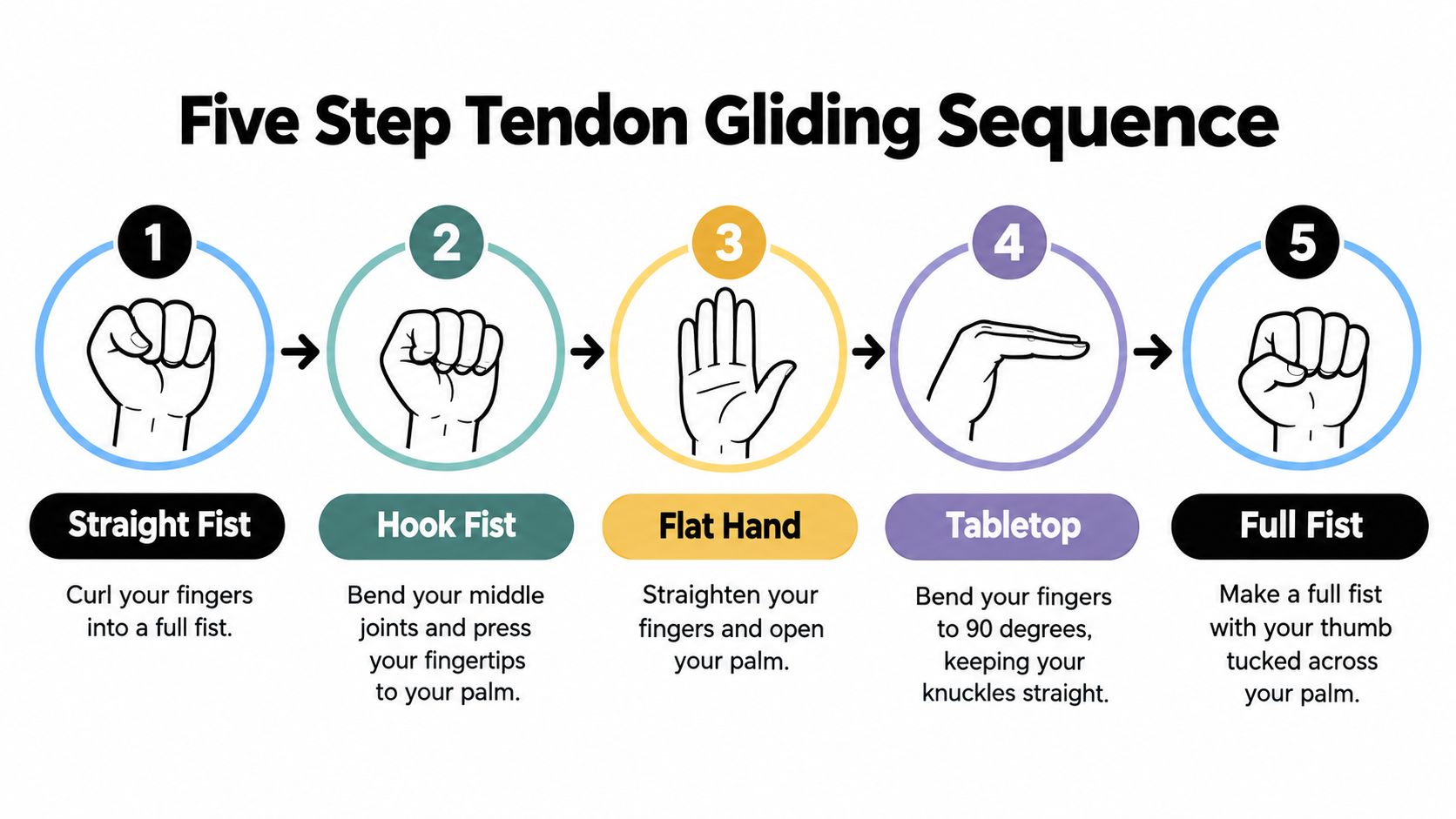
The tendon-gliding sequence used in orthopedic patient handouts is simple, but the details matter. Start with warmth if that helps your hand loosen, because the American Academy of Orthopaedic Surgeons includes heat for about 15 minutes before exercise and cold for up to 20 minutes afterward in its patient protocol (AAOS therapeutic exercise program).
How to move through the sequence
Begin with a relaxed hand. Make a fist with the thumb outside the fingers, then open the hand while keeping the thumb beside the index finger, extend the fingers and gently bend the wrist backward, keep the fingers and wrist extended while lifting the thumb, and finally return slowly to a relaxed hand. Hold each position for 3 to 7 seconds, move gently, and keep the sequence going for 3 to 4 weeks as tolerated (AAOS therapeutic exercise program).
The hand should look smooth, not forced. If the fingers shake, the wrist locks, or the thumb gets yanked back, the dose is too aggressive.
Keep the movement soft enough that the hand settles again as soon as the position changes.
How to keep it useful instead of irritating
A good tendon-glide session leaves the hand moving more easily, not more inflamed. The main mistake is forceful stretching, especially when someone tries to “push through” tingling or stiffness. That usually turns a mobility drill into an irritation drill.
For grip work later in recovery, some clinicians pair these drills with simple tools such as therapy putty. A practical example is the hand exercise putty resource, which can fit into a broader hand-conditioning plan when symptoms are calm.
Here, precision beats intensity. A few gentle passes done consistently are more useful than a hard session that leaves the fingers buzzing for the rest of the day.
Median Nerve Sliders for Better Mobility
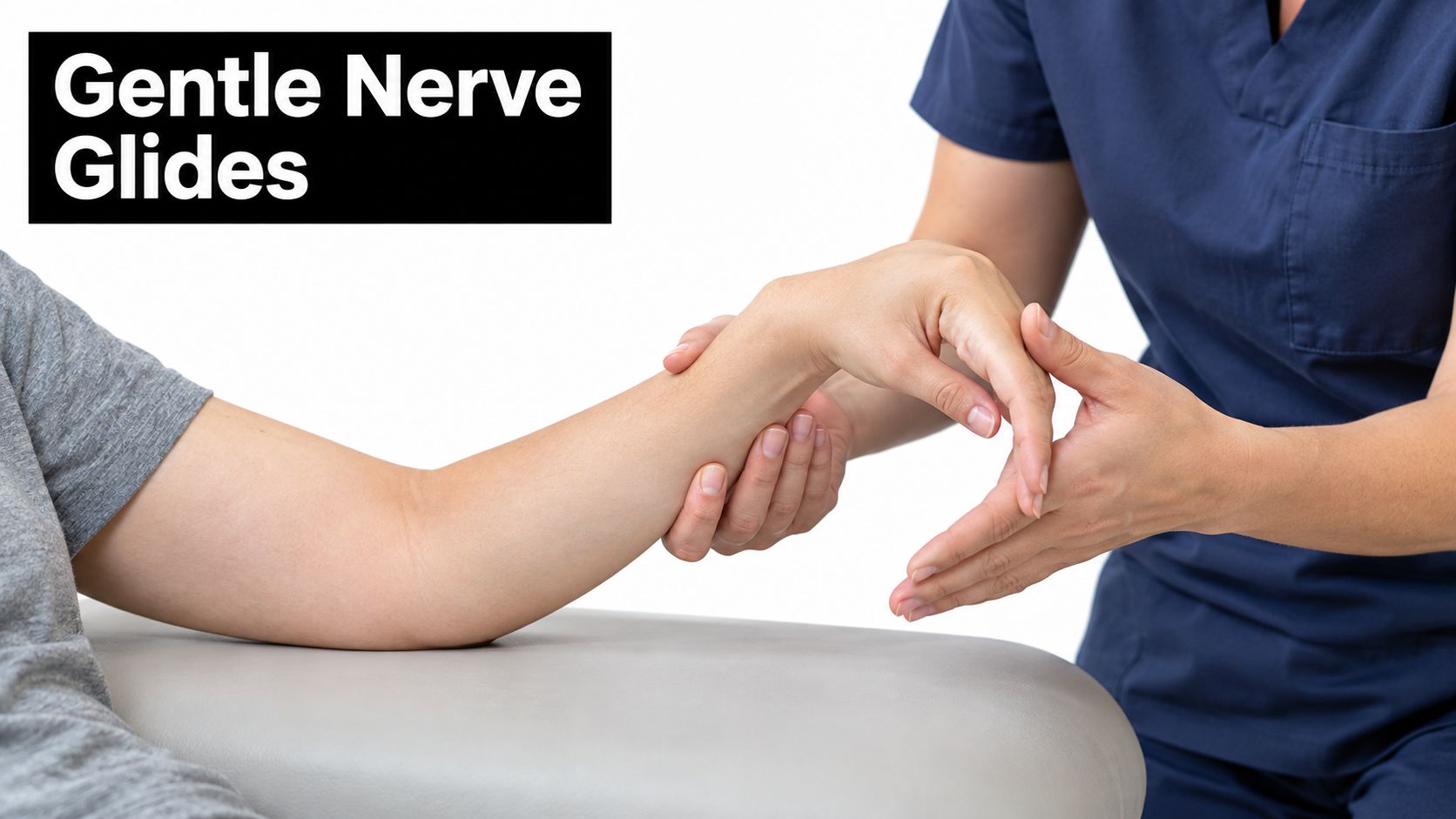
Median-nerve sliders are not deep stretches. They're coordinated movements that let the nerve travel without trapping it under tension for too long. That's why they work better as a sliding motion than as a long hold.
What a slider should feel like
Start with a posture that lets the shoulder, elbow, wrist, and fingers move in sequence. As the arm opens, the wrist and fingers change position to let one part of the nerve bed lengthen while another part shortens. The goal is smooth motion, not a hard pull in the palm or forearm.
If the hand starts tingling more as you move, shorten the range. If the sensation lingers after you stop, the nerve didn't like that dose.
The evidence base for nerve gliding is mixed but still useful when the movement is conservative and properly selected. A review in the Cochrane library found that exercise and mobilization approaches have been studied in 16 randomized trials with 741 participants, which supports using them as part of conservative care rather than as a miracle fix (Cochrane review).
How to keep nerve glides safe
Use fewer repetitions than you think you need. Stop right away if symptoms spike, especially if the hand feels more numb instead of less irritable. That rule matters because a nerve that's already compressed can react badly to repeated tension.
Stronger tingling is not proof that the glide is working.
For people who want structured, therapist-guided home care, some clinics also combine exercise coaching with splinting and behavior changes. MedAmerica Rehab Center is one option that provides that kind of carpal-tunnel-focused physical therapy approach.
Recognizing Safe Discomfort Versus Nerve Irritation
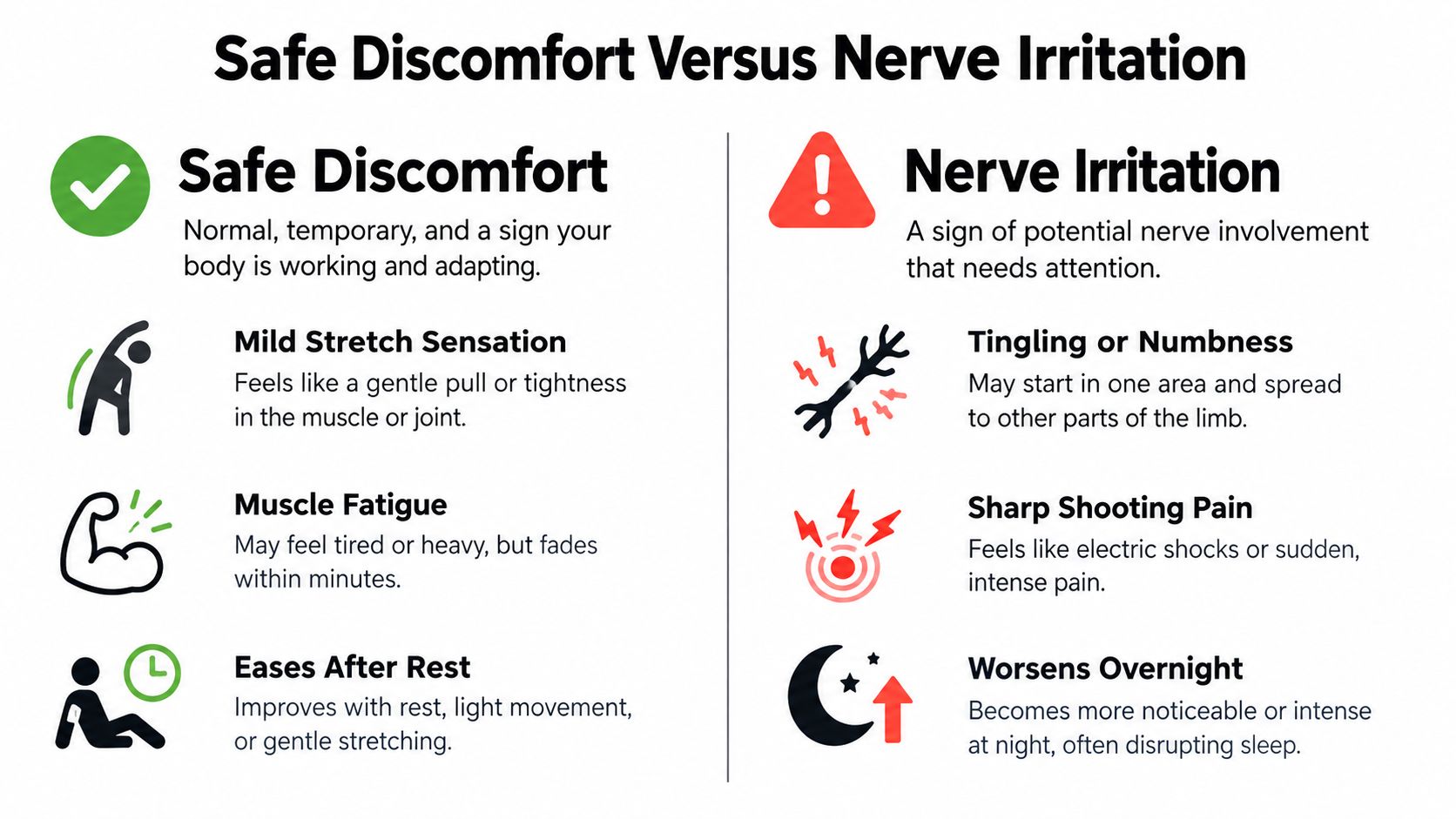
The most common mistake in home care is treating every sensation as progress. Muscle fatigue and nerve irritation do not feel the same, and your hand will usually tell you which one you're creating if you pay attention closely enough.
What you can usually tolerate
Safe exercise discomfort is mild. It feels like light effort, gentle stretch, or short-lived fatigue that settles down soon after you stop. It should not spread, worsen overnight, or leave the fingers feeling more unreliable than before.
What means stop now
Sharp pain, electrical zings, worsening numbness, or tingling that spreads beyond the median-nerve pattern are warning signs. So are increasing weakness, losing thumb opposition, or symptoms that stay high after exercise instead of settling. A useful comparison of wrist and neck-related symptoms is available in the carpal tunnel syndrome versus cervical radiculopathy guide, because not every hand symptom starts at the wrist.
The New York Workers' Compensation medical guideline notes that electrodiagnostic studies have sensitivity above 85% and specificity around 95%, and it also stresses that multiple findings have to be interpreted together rather than relying on a single test (NY WCB Carpal Tunnel MTG).
If your hand feels worse the next morning, the dose was probably too high. If symptoms are moving up the arm, the diagnosis may need to be reconsidered.
Setting Realistic Expectations for Home Recovery
Exercises help most when they're part of a broader plan. In carpal tunnel syndrome, that usually means tendon glides or nerve sliders plus a neutral wrist splint, better workstation habits, and a willingness to back off the motions that keep provoking the nerve.
A systematic review found that adding gliding exercises to conventional care improved symptom severity and functional status across four randomized controlled trials, but those trials used mixed treatment packages, so exercise alone wasn't isolated as the only reason for improvement (systematic review). In an 80-person trial of mild carpal tunnel syndrome, both gliding exercises and wrist splinting helped, but gliding did not add a statistically significant benefit over splinting alone (systematic review).
What that means at home
Don't measure success by one session. Measure it by how the hand behaves over a couple of weeks, especially at night and during the activities that usually trigger symptoms. If the hand calms down, the program is probably in the right range.
For people who want tech-assisted coaching, an adaptive AI workout coach can help keep a routine organized, but it still can't replace the judgment needed when symptoms are changing.
What not to expect
Exercises are not a guaranteed substitute for every other treatment. They're best viewed as one tool, and a good one, inside a structured plan. If symptoms keep returning every night, the hand stays weak, or work demands keep aggravating the wrist, the program needs adjustment.
Consistency matters more than intensity. The hand usually responds to careful repetition, not heroic effort.
When to Seek Professional Physical Therapy
Home care is a smart start, but it shouldn't become a way to delay evaluation when the nerve is clearly unhappy. Persistent thenar weakness, ongoing numbness, worsening symptoms, or a lack of progress after a few weeks of consistent home care all justify a clinic visit.
A licensed physical therapist can check the wrist, elbow, neck, posture, and movement pattern together instead of assuming every symptom comes from the same place. That matters because carpal tunnel syndrome can overlap with other problems, and the right exercise plan depends on which tissues are driving the symptoms.
MedAmerica Rehab Center in Deerfield Beach provides hands-on physical therapy, chiropractic care, acupuncture, and shockwave therapy, and it can build a more individualized plan when a home program isn't enough. For someone who needs a full screen, symptom-specific progression, and practical guidance on what to stop, what to keep, and what to change, that kind of evaluation is often the safest next step.
If your hand keeps waking you up, or the exercises are making symptoms linger instead of settle, don't keep guessing. Visit MedAmerica Rehab Center to ask about a carpal tunnel assessment and a home program that matches your symptoms, your work demands, and your recovery pace.
MedAmerica Rehab · Deerfield Beach
Talk to a clinician about your pain
Physical therapy, chiropractic, acupuncture and shockwave therapy under one roof, since 1995. Same-day appointments are available.
Mon–Thu 8:00 AM – 6:30 PM · Fri 8:00 AM – 3:00 PM