
Functional Capacity Exam Workers Comp: Preparation Guide
Your treating doctor or adjuster says you need a functional capacity exam workers comp evaluation, and your mind goes straight to the hard questions. Will this decide whether you can go back to work? Will someone think you’re exaggerating? What if you try too hard and flare your injury, or don’t do enough and get labeled uncooperative?
Those concerns are common. Injured workers in Deerfield Beach often arrive with the same mix of pain, uncertainty, and pressure from a claim that suddenly feels very technical.
A Functional Capacity Evaluation, or FCE, is not supposed to be a trap. It’s a structured way to measure what your body can safely do after a work injury. When it’s handled correctly, it protects you from being pushed into duties that exceed your current limits and gives everyone involved a clearer picture of what comes next.
Your Guide to the Functional Capacity Exam
There's a common assumption that a Functional Capacity Evaluation is a pass-or-fail event. It isn’t. The purpose is to create an objective snapshot of your present physical ability, especially when your case is approaching a return-to-work decision or a settlement discussion.
In workers' compensation, FCEs are especially important around Maximum Medical Improvement, or MMI. That’s the stage where treatment has brought you as far as it reasonably can, even if you still have pain, weakness, or lasting limitations. At that point, the system needs more than a general statement like “doing better” or “still hurts.” It needs function.
Research summarized by Enlyte’s overview of FCEs notes that FCEs are critical for return-to-work readiness after MMI. It also found that while meeting specific job demands in an FCE on its own didn’t predict future recovery, better overall performance on lifting and related tasks was associated with faster claim closure.
That matters because your exam isn’t just about a single lift or one painful motion. It’s about the full picture.
Practical rule: An FCE should measure your safe capacity, not your willingness to ignore pain.
A good evaluation answers questions such as:
- What can you safely lift or carry
- How long can you sit, stand, or walk before symptoms rise
- Whether your movement stays consistent during repeated tasks
- What restrictions may be needed for work
If you understand that purpose before exam day, the process gets less intimidating. You’re not showing that you’re “fine.” You’re showing what is true right now.
Why an FCE is Ordered in a Workers Comp Case
An FCE is usually ordered when the medical side of your claim and the job side of your claim need to be connected. Your records may show a diagnosis, treatment history, imaging, and progress notes. What they often don’t show clearly enough is whether you can safely perform the actual physical demands of work.

The usual point when this happens
The exam is commonly requested near or after MMI. By then, your doctor may believe your condition has stabilized. You may still need restrictions, home exercise, symptom management, or supportive care, but the question becomes more specific: what can you do in a work setting, and under what limits?
That’s why an FCE often appears late in treatment rather than at the beginning. It helps translate medical recovery into practical job capacity.
Who may request it
Several people in a workers' comp case may push for an FCE, and each has a different reason.
- Treating physician: The doctor may want objective physical data before assigning permanent restrictions.
- Insurance adjuster: The carrier may want clearer evidence about work ability, disability status, or next-step planning.
- Attorney: Legal counsel may want a detailed functional record that supports or challenges other opinions in the file.
- Employer or case manager: They may need to know whether modified duty is realistic.
If you’re already receiving care through a workers' compensation rehabilitation program, you’ve probably seen how many moving parts have to line up before a claim can move toward resolution. The FCE often becomes the common document everyone looks at when opinions differ.
The exam often matters most when subjective reports and job expectations are pulling in different directions.
What the system is trying to answer
A workers' comp claim isn’t only asking whether you’re injured. It’s asking whether you can return to your old job, whether modified duty fits your current limits, and whether permanent restrictions need to be documented.
That is why an FCE gets ordered. It bridges the gap between treatment and work.
In practice, it can clarify issues such as:
- Whether full-duty return is unsafe
- Whether temporary restrictions should continue
- Whether permanent restrictions are likely
- Whether vocational changes may be needed
Patients often feel uneasy because the exam can influence benefits. That concern is valid. But avoiding clarity rarely helps. What helps is making sure the evaluation reflects your true function, not fear, not guesswork, and not pressure from anyone else.
What to Expect During Your Evaluation
The easiest way to understand an FCE is to walk through a typical day. You check in, review your injury history, describe your current symptoms, and answer questions about your job. The therapist needs to know what your work requires, not just your job title.
From there, the day becomes very hands-on. According to this review of workers' comp FCE testing, an FCE typically lasts 4 to 8 hours and uses standardized tools such as isokinetic dynamometry, grip dynamometers, goniometry for range of motion, and material handling protocols based on NIOSH lifting equations.
How the session usually begins
Most evaluations start with baseline measures. The therapist may assess posture, range of motion, grip strength, balance, and general movement tolerance before moving into more demanding tasks.
You may be asked to demonstrate simple motions first:
- bending
- reaching
- turning
- squatting
- getting from sitting to standing
- walking at a comfortable pace
That opening matters. It establishes how you move before fatigue builds and gives context for the later testing.
The work simulation portion
This is the part most patients picture when they hear “functional capacity exam workers comp.” It can include lifting crates from floor to waist, waist to shoulder, or overhead. It may include carrying objects over a short distance, pushing or pulling resistance, climbing stairs, kneeling, crouching, gripping tools, or repeating arm motions.
Some tasks feel very general. Others are specific to your job.
A warehouse employee might stack boxes at different shelf heights. An office worker might do repetitive hand tasks and prolonged sitting. A delivery driver might be tested on carry tolerance, stair use, and pushing force.
| Test Category | What It Measures | Example Activities |
|---|---|---|
| Material handling | Safe lifting, carrying, pushing, pulling | Floor-to-waist lifts, carrying crates, pushing weighted equipment |
| Positional tolerance | How long you can stay in a posture | Sitting, standing, walking, kneeling, crouching |
| Range of motion | Joint mobility and movement limits | Reaching overhead, trunk bending, shoulder and neck motion |
| Strength and grip | Force production and hand use | Grip dynamometer testing, pinch tasks, resisted arm or leg effort |
| Endurance and repetition | Ability to sustain activity | Repeated lifts, repeated reaches, extended walking or task cycles |
| Fine motor or job-specific function | Work-relevant hand and coordination tasks | Typing, tool handling, sorting, gripping, manipulating small items |
What the therapist is watching besides strength
The evaluator isn’t just recording the heaviest thing you can lift once. They’re also watching for endurance, body mechanics, pain behavior, and consistency across the day.
That’s why the exam can feel longer than people expect. Your function at the beginning may not match your function later after repeated effort.
For patients who like to know the flow ahead of time, what to expect on your visit can help make the logistics feel less stressful. The less mental energy you spend worrying about the process, the easier it is to focus on honest performance.
Don’t treat the first task like the only task. Pace matters because the therapist is measuring sustainable function, not a single burst of effort.
What you should say during the exam
Speak up when symptoms change. Don’t go silent and try to “tough it out,” and don’t dramatize every movement. The most useful feedback is simple and specific.
Good examples include:
- “My low back pain increased when I lifted from the floor.”
- “I can do this motion, but after several repetitions my right shoulder feels weak.”
- “Standing is manageable at first, then my leg symptoms build.”
That kind of reporting helps the therapist connect your performance to your symptoms in a clinically useful way.
How FCE Results Impact Your Claim and Return to Work
After the testing, the raw data doesn’t just sit in a chart. It gets organized into a report that can influence major decisions in your case.
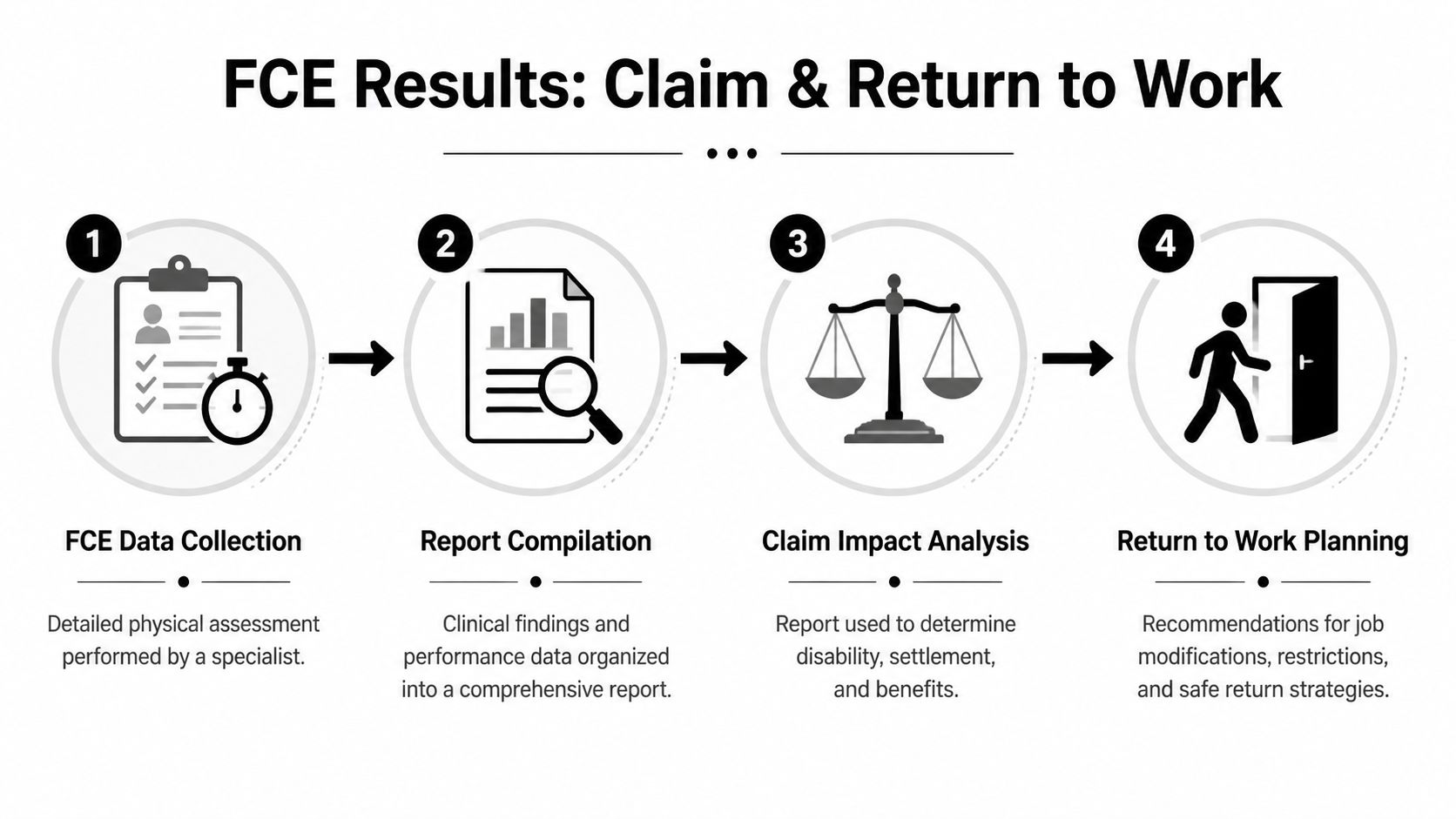
A well-written report usually describes your functional tolerances, notes any observed inconsistencies or safety concerns, and lists work restrictions in practical terms. It may say you can perform work in a given physical demand category, or that you need limitations on lifting, carrying, standing, reaching, or repetitive use of a body region.
Why the report carries weight
FCE reports are used as adjudicative evidence in approximately 70% of contested workers' comp claims, according to Renfro’s guide to FCEs and claim decisions. That same source notes that results are compared to job demands from databases like O*NET, and a mismatch can trigger modified duty or a Permanent Partial Disability rating based on the AMA Guides.
That’s why one report can influence several different parts of your claim at once.
How restrictions get translated into real outcomes
Here’s how the chain usually works:
Your performance is measured
Lifting tolerance, positional endurance, grip strength, range of motion, and task consistency are documented.Your job demands are reviewed
The evaluator or physician compares those findings to the physical demands of your position or a standard job profile.Restrictions are assigned
These can include limits such as no overhead lifting, reduced carrying, limited standing, or only occasional bending.Work status is decided
You may be cleared for full duty, modified duty, a different role, or continued restrictions.
What this means for benefits and settlement discussions
A restrictive report can support the argument that you aren’t ready for your old job, or that permanent limitations remain. A less restrictive report may be used to move you toward modified work.
That’s also why legal guidance matters when claim decisions start turning on FCE findings. If you want a plain-language legal overview of how this document may fit into a broader case strategy, this guide for San Jose workers' comp claims gives a helpful explanation of how FCE results interact with, but do not solely determine, settlement issues.
An FCE is strong evidence, but it isn’t the whole case. Doctors, records, job descriptions, and legal standards still matter.
What works and what doesn’t
What works is a report that ties test results to job function in concrete language. “Can occasionally lift from waist level,” “needs positional changes,” and “unable to sustain repetitive overhead work” are useful.
What doesn’t work is vague wording that leaves everyone arguing about interpretation. The stronger the clinical detail, the easier it is for the treating physician, employer, insurer, and attorney to respond appropriately.
Your Rights and How to Prepare for Your FCE
The biggest fear most injured workers have isn’t the lifting. It’s being told they didn’t give valid effort.

That fear is understandable. According to CDCIME’s discussion of FCE consistency concerns, 15% to 30% of FCEs are flagged for poor effort, and the same source notes that fear-avoidance behavior in chronic pain cases can be misread as inconsistency.
Many people find themselves in a difficult position. They think they have only two choices: push hard and risk reinjury, or protect themselves and risk being seen as uncooperative. In reality, the best strategy is neither. The best strategy is consistent, honest effort with clear symptom reporting.
What evaluators mean by consistency
Consistency doesn’t mean feeling the same on every task. Injured people don’t. It means your performance, pain reports, movement quality, and physical response make clinical sense together.
For example, if your grip varies wildly across simple repeated tests, or if your reported limits don’t match how you move during other tasks, the report may raise questions. On the other hand, if your symptoms increase in a predictable way as activity becomes more demanding, that pattern often reads as credible.
Preparation that helps
You can’t “game” a good FCE, and you shouldn’t try. But you can prepare in ways that make the results more accurate.
- Sleep the night before: Fatigue changes performance and makes pacing harder.
- Wear practical clothing: Choose clothes and shoes you can move in safely.
- Bring what you normally use: Glasses, braces, or other routine items help the exam reflect real function.
- Know your job demands: Think through what your work involves, including lifting height, carrying distance, stairs, pushing, pulling, and repetitive tasks.
- Review your symptom pattern: Be ready to describe what increases pain, numbness, weakness, or fatigue, and how quickly symptoms settle.
- Take your usual medications as directed unless told otherwise: Sudden changes can distort the picture.
If MMI is still a confusing term in your case, this explanation of what is MMI in workers comp can help you understand why FCEs often show up at this point rather than earlier.
Report what you feel when it happens. Don’t wait until the end of the day to mention that a task caused sharp pain or numbness.
What not to do on exam day
Some mistakes hurt patients more than they realize.
- Don’t act brave for the examiner. Working through unsafe pain to look tough can produce a report that overstates your capacity.
- Don’t underperform on purpose. Exaggeration is easier to detect than many people think, especially when multiple tasks point in different directions.
- Don’t use vague pain language only. “It hurts” is less helpful than “my neck pain increases when I look up repeatedly.”
- Don’t skip meals or hydration. Energy crashes can muddy the results.
A short visual explanation can also help if you’re more comfortable learning that way:
Your rights during the process
You still have the right to be treated respectfully. You also have the right to communicate symptoms, ask for clarification if instructions are unclear, and expect a professional, safety-focused evaluation.
If a task causes a clear symptom spike, say so immediately. If your injury involves chronic pain, nerve symptoms, or pain-related guarding, make that known in plain terms. The goal is not to prove how much you can endure. The goal is to show your safe, repeatable capacity.
The MedAmerica Rehab Approach in Deerfield Beach
For Deerfield Beach patients, the experience of an FCE is shaped by more than the testing itself. Environment matters. Familiar providers matter. Clear communication matters.
At a clinic level, the best FCE process doesn’t start on the day of the exam. It starts earlier, during rehab, when therapists identify movement limitations, build tolerance gradually, and help patients understand the difference between productive effort and unsafe overexertion. That preparation tends to reduce fear and make the final evaluation more representative.
What a supportive local process looks like
A strong clinic approach usually includes:
- Pre-FCE conditioning: Focused therapy to improve tolerance for lifting, positional changes, walking, reaching, and work-like movement patterns.
- Clear symptom coaching: Patients learn how to report pain, fatigue, and limitation accurately without minimizing or exaggerating.
- Coordination with the claim team: Physicians, adjusters, and attorneys need timely, understandable documentation.
- Follow-through after the report: Restrictions and recommendations should feed back into treatment or return-to-work planning.
For local patients already navigating back pain, neck injuries, shoulder problems, sciatica, or post-surgical recovery, access to physical therapy in Deerfield Beach can make the entire workers' comp process less fragmented. Instead of treating the FCE like an isolated event, the clinic can place it inside the larger recovery plan.
Local care works best when the therapist sees both sides of the case: your injury presentation and the work demands waiting on the other end.
That combination often gives patients more confidence going into the exam and more clarity after it.
Frequently Asked Questions About FCEs
Can I fail an FCE
Not in the way people usually mean it. An FCE is meant to document function, not assign a grade. But the results can still affect your claim in a major way. A New York workers' comp explanation of FCE outcomes notes that a favorable FCE for an insurer may place someone in a light or medium work category, which can stop total disability payments and push a return to modified duty. More restrictive findings can support a higher permanent partial disability award and settlement position.
What if I disagree with the results
Start by reviewing the report with your treating physician or attorney. Disagreements often come from incomplete job descriptions, symptom patterns that weren’t well explained, or conclusions that don’t match the rest of the medical record. The answer usually isn’t anger. It’s careful review.
Should I push through pain to show I’m motivated
No. You should give sincere effort, but not reckless effort. Pushing beyond safe limits can create a report that overstates your work ability and may aggravate your injury.
Can I say when a task increases symptoms
Yes. You should. Specific symptom reporting is part of the evaluation. Clear statements about pain, numbness, weakness, or fatigue help the therapist connect your physical output to your medical condition.
What if I’m anxious because chronic pain makes me move differently
Say that early and clearly. Chronic pain can change pacing, guarding, and movement confidence. If the evaluator understands that context, your behavior is less likely to be misread.
Do I need to prepare like it’s an athletic event
No. Come rested, fed, appropriately dressed, and ready to follow instructions. The goal is accuracy, not peak performance.
If you’ve been scheduled for a functional capacity exam workers comp evaluation and want a team that understands both the clinical and claim side of recovery, MedAmerica Rehab Center can help you move forward with clarity. Their Deerfield Beach team supports injured workers with hands-on rehabilitation, practical guidance, and a patient-centered approach that keeps the focus where it belongs: safe function, honest documentation, and a confident return to daily life.
MedAmerica Rehab · Deerfield Beach
Talk to a clinician about your pain
Physical therapy, chiropractic, acupuncture and shockwave therapy under one roof, since 1995. Same-day appointments are available.
Mon–Thu 8:00 AM – 6:30 PM · Fri 8:00 AM – 3:00 PM