

Your Best Rehabilitation Center Delray Beach FL
You're hurting, tired, and trying to make a smart decision fast. Maybe your surgeon told you to start therapy. Maybe your back pain has gotten to the point where getting out of bed feels like work. Maybe a parent was discharged from the hospital, and now you're staring at search results for “rehabilitation center delray beach fl” that mix hospitals, nursing homes, and clinics as if they're all the same thing.
They're not.
That confusion is one of the biggest reasons people delay the right care. They call a facility that doesn't fit their needs, assume rehab means a hospital stay, or keep waiting because the options seem too hard to sort through. If you live in or near Delray Beach, you need a simpler way to tell what kind of rehabilitation you need, what each setting does well, and what kind of recovery plan fits your life.
Finding Your Path to Recovery in Delray Beach
A common situation goes like this. Someone injures a shoulder, has a knee replacement, or develops sciatica that won't settle down. They search for a rehabilitation center delray beach fl and get a mix of results that includes acute rehab hospitals, skilled nursing facilities, and outpatient providers. The names sound similar, but the day-to-day care inside those places is very different.
That difference matters because the wrong setting creates friction right away. If you're mobile enough to live at home, don't need nursing supervision, and mainly need hands-on treatment plus a structured exercise plan, an inpatient facility usually isn't the right lane. On the other hand, if a loved one just left the hospital after a serious neurological event or major surgery and needs help around the clock, an outpatient clinic won't be enough.
I've seen people calm down once they realize rehab isn't one single thing. It's a spectrum of care. The right question isn't “Which rehab center is best?” The right question is “What level of rehab matches my actual condition, my safety needs, and my ability to function at home?”
For some patients, even getting to a clinic is the first barrier. When travel is the problem, mobile physical therapy options can make early treatment more realistic while strength, balance, or pain control improve.
The best rehab choice is the one that matches your current function, not the one with the most impressive name.
What usually brings people to rehab
Some of the most common reasons include:
- Post-surgical recovery after joint replacement, tendon repair, or spine procedures
- Neck and back pain that hasn't improved with rest alone
- Balance problems that make walking feel less safe
- Sports or overuse injuries that keep flaring up
- Hospital discharge needs where the person isn't ready to manage independently
If you're unsure where you fit, that uncertainty is normal. The next step is understanding what rehab is trying to accomplish.
Understanding the True Goal of Rehabilitation
Rehabilitation isn't just about reducing pain. Pain matters, of course, but pain by itself doesn't tell the whole story. The primary target is function. Can you walk safely, bend without guarding, climb stairs, get dressed, carry groceries, sleep better, return to work, or move without fearing the next flare-up?
A simple way to think about rehab is this. Your body is like a system that has lost coordination after injury, surgery, inflammation, or prolonged inactivity. Good rehab doesn't just quiet the alarm. It retunes the system so the parts work together again.
Rehab is active rebuilding
The most useful rehab plans usually involve several layers at once:
- Pain relief first, but not pain relief alone. Early treatment often aims to calm irritated tissues and reduce muscle guarding so you can move.
- Movement correction. Many problems keep returning because the body compensates. One joint stiffens, another overworks, and the same pattern repeats.
- Strength and endurance. Weak muscles don't stabilize well. Poor endurance also leads people to stop moving, which can make stiffness and deconditioning worse.
- Confidence with daily tasks. A patient may technically be healing but still avoid stairs, lifting, driving, or exercise because the body doesn't feel trustworthy yet.
That's why passive care by itself usually falls short. Heat, massage, or manual techniques can help, but they work best when paired with movement training that teaches the body what to do next.
Practical rule: If treatment relieves symptoms for a few hours but nothing about your walking, lifting, balance, or daily activity changes, the plan probably needs more active rehab.
Why a team approach often works better
Modern rehab is often strongest when more than one discipline can contribute. Physical therapy addresses strength, mobility, gait, balance, and movement quality. Chiropractic care may help with spinal and joint mechanics in the right patient. Acupuncture can be useful for pain modulation and muscle tension. A broader clinical setup can make it easier to adjust the plan without sending the patient all over town.
The main point is simple. Rehab should help you do more, not just hurt less.
The Different Types of Rehab Centers Near Delray Beach
The phrase rehabilitation center delray beach fl can lead you to three very different care settings. Knowing the difference saves time and prevents a lot of wrong turns.
Inpatient rehabilitation hospitals
An acute rehab hospital is for people with serious functional loss who need coordinated, intensive care. Pinecrest Rehabilitation Hospital describes an interdisciplinary, physiatrist-led model that includes physical, occupational, and speech-language therapy, plus hand therapy, neuropsychology, recreational therapy, rehabilitation nursing, nutrition, psychology, and case management through its rehabilitation hospital program. It's designed for patients who can tolerate at least three hours of therapy per day.
That level of care makes sense for conditions like stroke, spinal cord injury, major neurological illness, amputation, or complex orthopedic trauma. These patients often have problems that affect much more than one body part. They may need help with walking, swallowing, communication, cognition, self-care, and medication management at the same time.
If you can safely live at home and your main problem is back pain, joint stiffness, weakness after surgery, or a sports injury, this usually isn't your lane.
Skilled nursing facilities
A skilled nursing facility sits in a different spot on the spectrum. The focus is less on high-intensity therapy tolerance and more on medical oversight plus rehabilitation support after hospitalization.
Terrace of Delray Beach states that it provides 24-hour skilled nursing, post-acute care, and rehabilitation, with admissions accepted around the clock every day, along with a restorative program aimed at mobility, eating habits, and daily hygiene through its skilled nursing and restorative care services. That's often the right fit for older adults or medically complex patients who still need substantial help day to day.
This setting can be appropriate when someone isn't stable enough or strong enough for a more intensive rehab hospital, but also isn't ready to return home independently.
Outpatient rehabilitation clinics
Outpatient rehab is usually the right setting for people who can live at home, travel to appointments, and participate in a focused treatment plan several times per week or at a clinically appropriate pace. This includes many people with chronic back or neck pain, sciatica, arthritis-related limitations, post-surgical stiffness, shoulder and knee injuries, and balance concerns that don't require inpatient monitoring.
This is also the category many families overlook while searching. Local results often blur together very different services. As noted in this discussion of rehab search intent and care level confusion, many people looking for rehab may not need an inpatient facility at all. If you can live safely at home, outpatient care is often the more practical level of treatment.
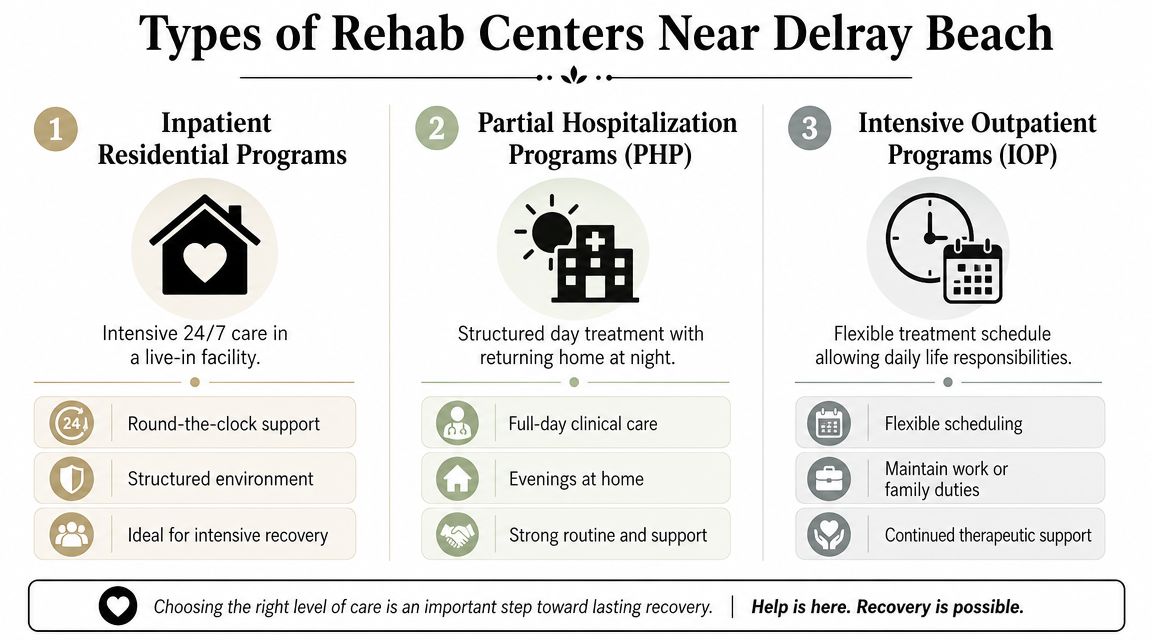
Which type of rehab do you need
| Care Setting | Best For | Intensity | Where You Live |
|---|---|---|---|
| Inpatient rehabilitation hospital | Severe stroke, major neurological injury, complex multi-system recovery | High, structured daily therapy | You stay in the facility |
| Skilled nursing facility | Post-hospital patients who need nursing care plus rehab support | Moderate, with medical oversight | You stay in the facility |
| Outpatient clinic | Pain, orthopedic recovery, mobility issues, balance training when home is safe | Targeted scheduled visits | You live at home |
If your biggest question is whether you're safe to recover at home, that decision comes before choosing a clinic.
Key Services in Modern Outpatient Rehabilitation
Once it's clear that outpatient care fits, the next question is what happens there. A good outpatient plan isn't a random list of modalities. Each service should solve a specific problem.
The Delray Beach rehabilitation market is active and well established. SNFdata lists Abbey Delray with 100 certified beds, 32,476 total patient days, and $40,198 thousand in gross patient revenue, and Abbey Delray South with 90 certified beds, 25,739 patient days, and $30,527 thousand in gross patient revenue on Florida skilled nursing facility statistics. That kind of volume reflects a mature local rehab ecosystem. It also means patients need to be selective about what type of therapy they're getting.
Physical therapy
Physical therapy is the core service for many orthopedic and mobility problems. It addresses painful movement, weakness, joint stiffness, balance deficits, gait changes, and poor mechanics.
A strong PT plan often includes manual therapy, guided exercise progression, flexibility work, neuromuscular re-education, and home exercises that are realistic enough to follow. For post-surgical patients, PT also helps protect healing tissue while restoring range of motion and strength at the right pace.
Pool-based exercise can be especially helpful for people who need lower-impact movement while regaining confidence. For some patients, physical therapy in a pool makes it easier to start walking, squatting, or moving through a fuller range without as much joint stress.
Chiropractic care and acupuncture
Chiropractic care can help when spinal or joint restriction is contributing to pain, reduced motion, or nerve irritation. It isn't a stand-alone answer for every condition, but in the right patient it can improve movement quality enough to make exercise and daily activity more comfortable.
Acupuncture is often used for pain, muscle tightness, and symptom management. Some patients who don't tolerate aggressive manual work early in recovery respond well to this approach as part of a broader plan.
Advanced modalities and integrated care
Modern outpatient clinics may also offer tools such as shockwave therapy, therapeutic exercise progression, soft tissue techniques, and balance training. The key is matching the tool to the problem.
A few examples:
- Sciatica or radiating leg symptoms may need a mix of spinal movement assessment, nerve mobility work, core stabilization, and activity modification.
- Shoulder pain often improves when therapists address both local tissue irritation and the way the shoulder blade moves.
- Arthritis-related stiffness usually responds better to steady mobility and strength work than to repeated rest.
One practical local option in this category is MedAmerica Rehab Center, an outpatient clinic in Deerfield Beach that offers physical therapy, chiropractic care, acupuncture, and shockwave therapy under one roof. For patients who don't need a hospital or skilled nursing setting, that kind of setup can simplify care coordination.
Choosing the Right Center A Practical Checklist
Once you know your level of care, the important work is narrowing down your options. This part shouldn't be guesswork. Use a checklist and treat the first phone call like a screening interview.
Some local facilities are large institutional settings. For example, West Delray Nursing & Rehab Center is listed by the Florida Agency for Health Care Administration as a 120-bed skilled nursing facility with 120 total capacity/community beds and 14 private rooms on its Florida Health Finder facility profile. Size isn't automatically good or bad, but it does change the patient experience.
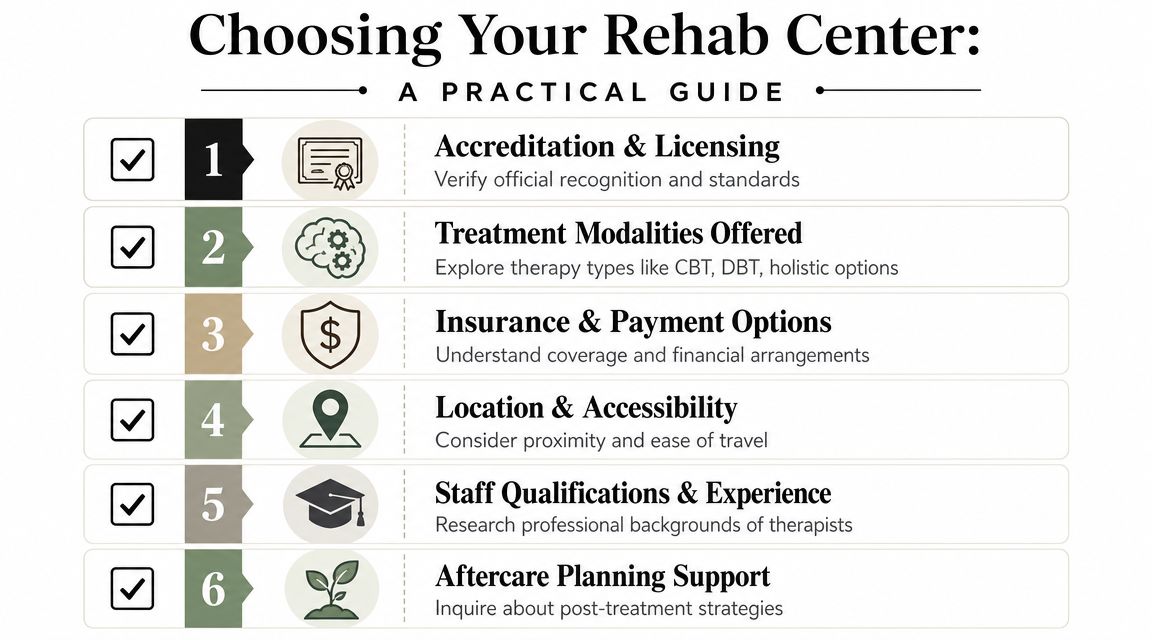
Questions worth asking before you schedule
- Who will evaluate me first? You want to know whether your initial visit is with a licensed clinician who can assess movement, pain triggers, safety, and goals in detail.
- How personalized is the plan? Be careful if every patient seems to get the same routine. Good rehab should reflect your surgery, diagnosis, age, strength, and daily demands.
- What happens between visits? The home plan matters. Recovery usually depends on what you do consistently outside the clinic.
- Does the setting match my tolerance? A person recovering from joint surgery may need a focused outpatient plan, while someone with major medical needs may need more support.
- Is the clinic easy to access? Long drives and difficult scheduling reduce follow-through.
Large facility versus smaller clinic
This trade-off matters more than people think.
A larger facility may offer broader on-site support, especially when nursing care or inpatient supervision is necessary. A smaller outpatient clinic may give you a more direct, hands-on experience and better continuity with the same treating team.
Neither model wins by default. The better choice depends on whether you need daily medical oversight or focused functional rehab while living at home.
Ask one blunt question: “Based on my current condition, do I need nursing care, intensive inpatient rehab, or a clinic where I come in and go home?” A good provider should answer clearly.
A short practical screening list
Before committing, check these basics:
- Licensing and credentials for the clinicians who will treat you
- Insurance clarity so there are no surprises after the first visit
- Treatment approach that includes active rehab, not only passive modalities
- Communication style that makes you feel heard and informed
- Reasonable scheduling so you can stick with the plan
If you want a useful companion resource while comparing providers, MedAmerica also has a practical guide on how to choose a physical therapist.
Preparing for Your First Rehabilitation Appointment
The first visit feels intimidating mainly because the process is often unfamiliar. Once you know the flow, it becomes much easier to start.
You'll usually begin with a phone call or online request. The front desk may ask why you're seeking care, whether you have a referral, and what insurance information you have available. If your pain is severe or your surgery was recent, say that clearly. It helps the clinic schedule appropriately.
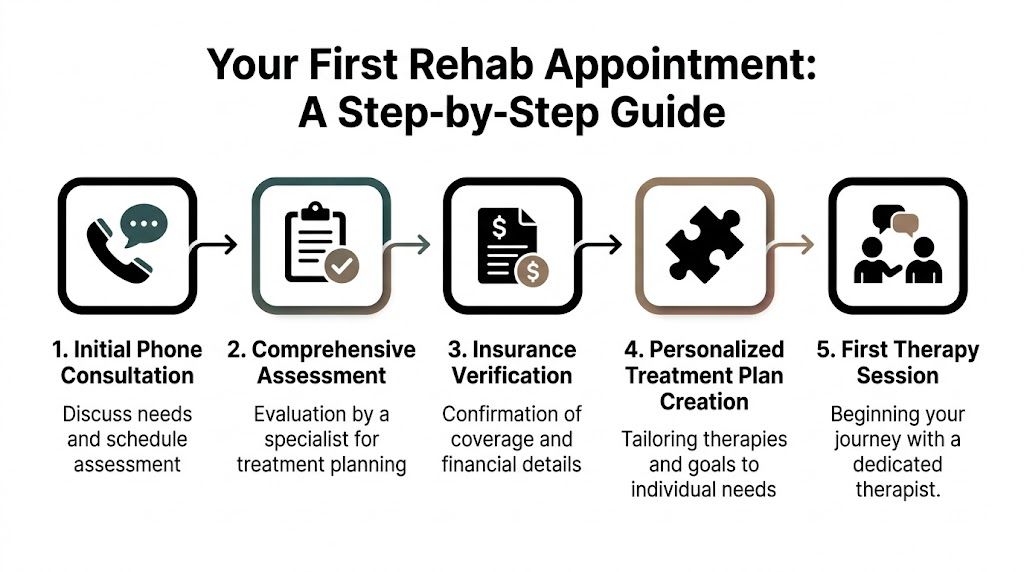
What to bring
Bring the items that make evaluation easier and safer:
- Photo ID and insurance card
- Referral or prescription, if your physician provided one
- Imaging reports or surgery paperwork if you have them
- A medication list
- Shoes and clothing you can move in
If your issue involves the knee, hip, back, or balance, don't wear something that makes walking tests or movement assessment harder.
What the therapist usually looks for
The first session is part conversation and part movement assessment. Expect questions about how the problem started, what makes it worse, what you can't do right now, and what a successful outcome would look like for you.
Then the clinician typically checks things like:
- Range of motion
- Strength
- Walking pattern
- Balance
- Tender areas or irritated tissues
- Movements that reproduce symptoms
- Movements that reduce symptoms
This part matters because the treatment plan should come from findings, not assumptions. Two people with “back pain” may need very different programs.
What a good first visit should leave you with
By the end of the appointment, you should have a working explanation of the problem, a starting treatment plan, and clear next steps. You should also know what to do at home before the next visit.
If you leave your evaluation unsure what the plan is, ask for it in plain language before you go.
A good first appointment doesn't need to solve everything immediately. It should make the problem feel more organized, more understandable, and more manageable.
Why MedAmerica is a Top Choice for Delray Beach Residents
Many people searching for rehabilitation center delray beach fl don't need a hospital bed or skilled nursing placement. They need focused outpatient care that helps them move better, hurt less, and return to normal life while continuing to live at home. That distinction often gets lost in local search results, but it's one of the most important parts of choosing the right care path.
For Delray Beach residents who fit that outpatient profile, MedAmerica Rehab Center makes sense because it aligns with what those patients usually need in real life. The clinic is family-owned, has served the community since 1995, and offers a multidisciplinary setup that includes physical therapy, chiropractic care, acupuncture, and advanced shockwave therapy. That combination is useful when recovery isn't one-dimensional.

Who tends to fit this model well
Outpatient multidisciplinary care is often a strong fit for:
- Adults with back or neck pain who need movement-based treatment, not inpatient monitoring
- Post-surgical patients who are safe at home but need guided progression
- People with sciatica, arthritis, or shoulder and knee pain who benefit from coordinated conservative care
- Older adults working on balance and fall prevention
- Auto accident and work injury patients who need structured rehab and a clear plan
The clinic also tries to reduce common barriers that stop people from getting started, including same-day appointments and insurance-friendly processes.
If first-visit nerves are part of what's holding you back, it can help to read a plain-language overview of what to expect in your first session. Even though that resource comes from counseling, the preparation mindset is useful for rehab too. Bring your questions, know your goals, and expect a conversation, not just a procedure.
Choosing rehab shouldn't feel like decoding a system built for insiders. Once you know the difference between inpatient rehab, skilled nursing, and outpatient care, the decision gets much clearer.
If you're looking for outpatient rehabilitation that's close to Delray Beach and focused on practical recovery, contact MedAmerica Rehab Center. The team can help you figure out whether outpatient care fits your needs, what your first visit will involve, and how to start a treatment plan that supports pain relief, mobility, and a safe return to daily activity.
MedAmerica Rehab · Deerfield Beach
Talk to a clinician about your pain
Physical therapy, chiropractic, acupuncture and shockwave therapy under one roof, since 1995. Same-day appointments are available.
Mon–Thu 8:00 AM – 6:30 PM · Fri 8:00 AM – 3:00 PM