
Hot Pack Physical Therapy: A Guide to Pain Relief
You wake up stiff, your back feels locked up, or your neck starts complaining before your first cup of coffee. Maybe you've tried a heating pad at home and thought, “This helps for a little while, but why doesn't it last?”
That's the right question.
In physical therapy, a hot pack usually isn't the whole treatment. It's the setup. Hot pack physical therapy works best when it prepares your body for the work that changes how you move, like stretching, joint mobilization, soft tissue treatment, and guided exercise. Used the right way, heat can make those next steps easier, more comfortable, and more productive.
How Heat Therapy Accelerates Healing
A stiff body behaves a lot like a cold car engine. It can still run, but everything feels tighter, rougher, and less efficient until it warms up.
That's the basic idea behind hot pack physical therapy. A hot pack doesn't need to reach deep internal structures to be useful. It mainly affects tissues within about 3 to 5 cm of the surface, and a typical 15 to 20 minute session is used to increase local circulation, relax muscle spasm, and improve flexibility without causing injury, as described in AAPM&R's overview of thermal modalities.

What heat changes in your body
Three things usually happen when a therapist applies heat correctly.
- Blood vessels open up more easily. That helps the treated area receive more blood flow, which supports tissue warming and can make the area feel less guarded.
- Soft tissue becomes more pliable. Muscles and other nearby tissues tend to move more easily once they're warmed.
- Pain feels less intense. Heat can calm the area enough that movement stops feeling so threatening.
Those effects matter because pain and stiffness often feed each other. You hurt, so you move less. Then you get stiffer, and movement hurts more. A hot pack can interrupt that cycle long enough for you to move better.
Why moist heat is common in clinics
Clinics often use moist heat, such as a hydrocollator pack, because it transfers heat efficiently. That's one reason patients often describe clinic heat as “deeper” or more soothing than the dry warmth from some home devices.
Practical rule: Heat should feel like a steady, comfortable warmth. It should never feel sharp, burning, or like you're counting the seconds until it's removed.
Heat can also do more than just feel good in the moment. A rehabilitation review describes hot packs as a core superficial heat modality often used with exercise, and it notes a distal radius fracture rehabilitation trial where a 3-week program combining hot packs with exercise produced greater improvements in pain, wrist range of motion, and Patient-Rated Wrist Evaluation scores than exercise alone, according to the Rehabilitation Reference Center clinical review on hot packs.
That's where the value lies. Heat gets the body ready so therapy can do more.
Is Hot Pack Therapy Right for Your Condition?
Hot packs are helpful for the right problem and the wrong choice for the wrong problem. That's where many people get mixed up.
If your issue is mostly stiffness, chronic soreness, muscle tightness, or achy joints, heat often makes sense. If your issue is fresh swelling, major irritation, or reduced sensation, you need to slow down and think safety first.
When heat often helps
Heat is usually most useful when tissues feel guarded and movement feels restricted.
A few common examples:
- Chronic low back pain when the area feels tight more than swollen
- Neck and shoulder tension from posture, stress, or repetitive work
- Osteoarthritis, especially when joints feel stiff before activity
- Muscle spasm after overuse or long periods of sitting
- General soft tissue pain such as strains and sprains that are no longer in the fresh, swollen stage
In these situations, the goal isn't to “cure” the condition with heat alone. The goal is to reduce resistance so you can move, stretch, and participate in therapy more comfortably.
When heat is the wrong call
Some situations are red lights.
Don't use heat over an area if you can't reliably feel temperature there.
That matters because clinical hydrocollator packs are typically stored at 70°C to 75°C (158°F to 167°F), so barriers and skin awareness are not optional. The risk is higher over areas with impaired sensation, including neuropathy, as explained in this overview of moist heat safety and application.
Avoid or get professional guidance before using heat if you have:
- A fresh injury with swelling
- An area that's red, hot, or actively inflamed
- Open skin or a wound
- Poor circulation
- Reduced sensation, such as neuropathy
- Difficulty communicating discomfort, which can make burn risk harder to detect
A quick self-check
Ask yourself two simple questions:
- Does this area feel stiff or swollen?
- Can I clearly feel heat and tell if it's getting too hot?
If the answer is “stiff” and “yes,” heat may be appropriate. If the answer is “swollen” or “not really,” don't guess. Get advice before using it.
Safe and Effective Hot Pack Application
Using heat well is less about fancy equipment and more about dosage, protection, and timing.
What a safe session looks like
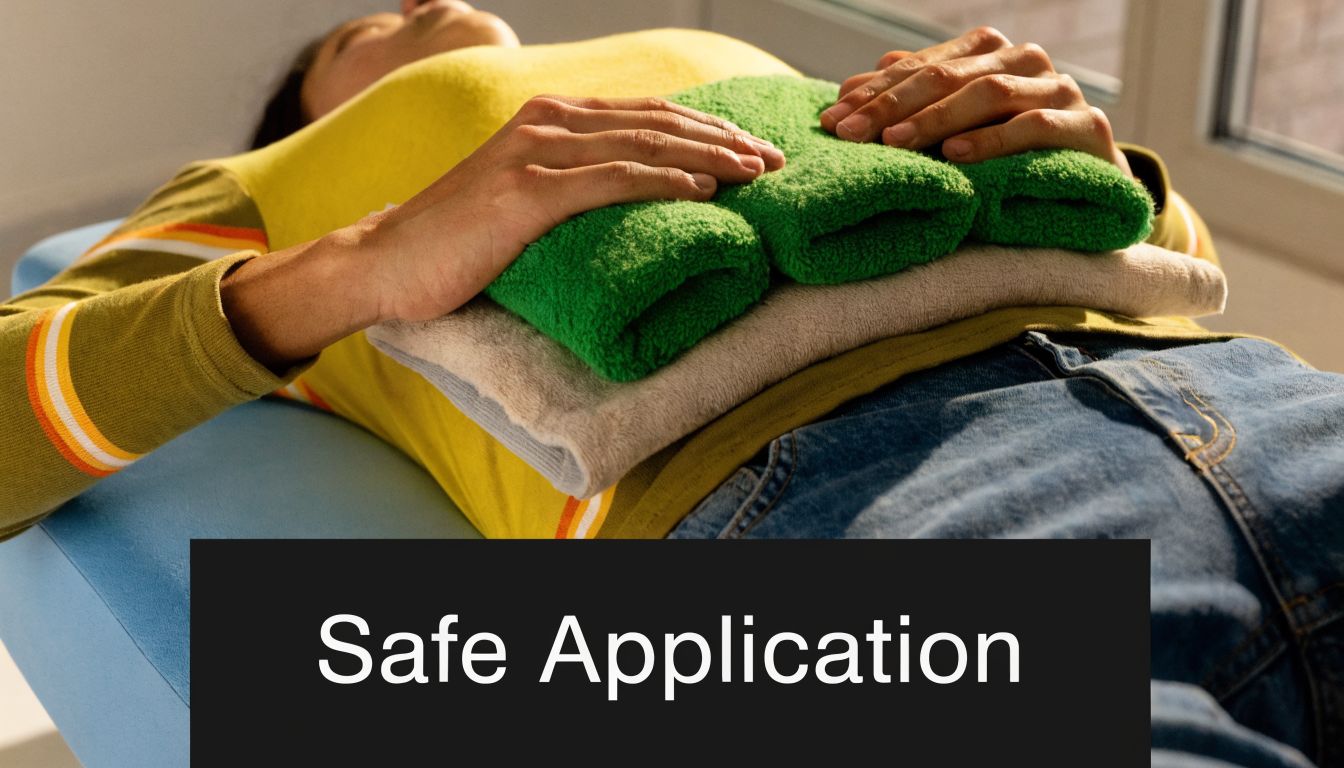
In the clinic, a therapist checks the skin, places a barrier between the pack and your body, positions you comfortably, and monitors your response. At home, you should follow the same logic.
A simple routine works well:
- Wrap the hot pack in layers of towel. You want protection between the pack and your skin.
- Place it on the target area while resting in a comfortable position.
- Keep the session within the usual treatment window.
- Check your skin after the session. Mild pinkness can happen. Intense redness or lingering irritation is a warning sign.
The timing matters. One clinical review noted that a 20-minute hot pack application reduced muscle stiffness more effectively than a 10-minute session, which supports staying within the common therapeutic window rather than stopping too early, as discussed in this clinical summary on applying heat therapy.
What it should feel like
The right sensation is gentle, deep warmth. You should feel relaxed, not challenged.
If you're using home heat as part of a care plan, this hot pack physical therapy overview from MedAmerica Rehab shows the kind of modality patients often receive in a supervised setting.
For a quick visual example, this short video shows a common setup and application style used with heat in rehab:
If the area feels hotter instead of better, remove the pack. Heat should make movement easier afterward, not leave the skin angry.
Choosing Between Heat Therapy and Cold Therapy
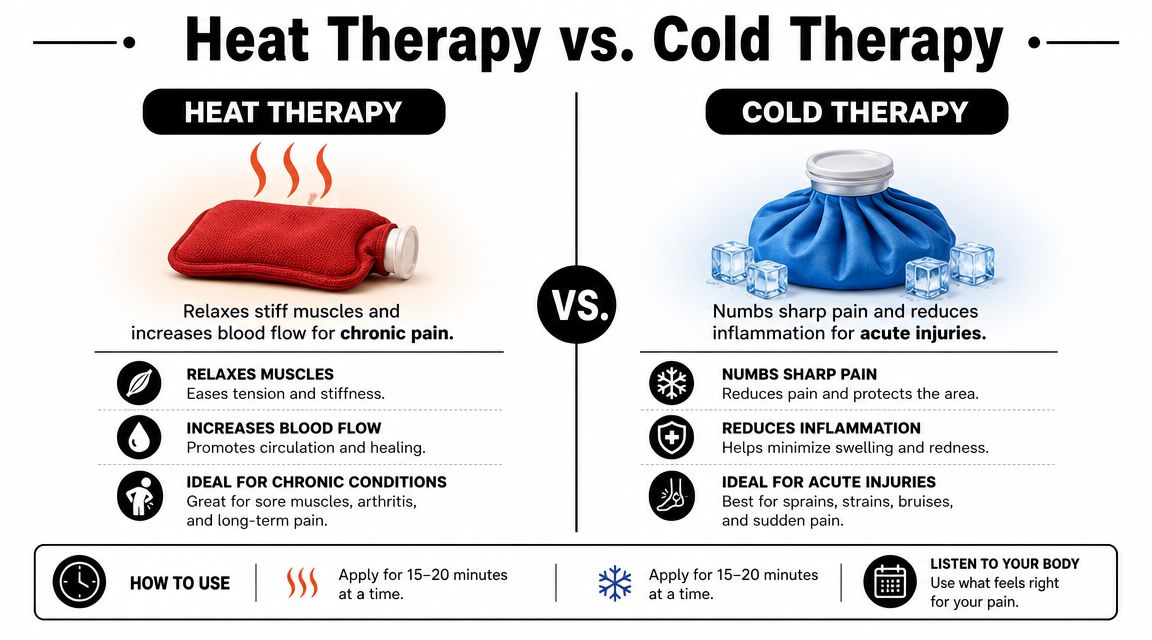
People mix these up all the time because both can help pain. The difference is the problem you're treating.
Heat is usually for stiffness. Ice is usually for fresh irritation and swelling.
Heat vs. Ice Which One to Use?
| Condition | Use Heat (Thermotherapy) | Use Ice (Cryotherapy) |
|---|---|---|
| Morning back stiffness | Yes | Usually no |
| Tight neck and shoulder muscles | Yes | Sometimes, if irritated after activity |
| Osteoarthritis stiffness | Yes | Sometimes for flare-related soreness |
| Fresh ankle sprain with swelling | No | Yes |
| New muscle strain that feels inflamed | No | Yes |
| Chronic muscle tension | Yes | Sometimes after activity if it flares |
| Post-exercise soreness with tightness | Often yes | Sometimes |
| Hot, swollen joint | No | Yes |
A practical way to decide
Use heat when the main complaint is that you feel tight, guarded, and hard to get moving.
Use ice when the area feels angry, swollen, or freshly injured. If you want a broader patient-friendly explanation of cold-based recovery options, this HempWell USA guide on CBD cold therapy gives useful context on how people think about cold applications in pain management.
If you're specifically dealing with a recent injury, an ice pack physical therapy overview can help clarify how cryotherapy is used differently from hot pack physical therapy in rehab settings.
Stiff and chronic usually points toward heat. Swollen and acute usually points toward ice.
Why Hot Packs Are Better with Professional Therapy
A hot pack by itself can calm symptoms. What it often can't do by itself is change the movement pattern, weakness, joint restriction, or tissue irritation that keeps the problem returning.
That's why heat works best as a preparatory tool.
Heat makes the next treatment step easier
When tissues are warmer, patients often tolerate movement better. A therapist can work on stretching, manual therapy, posture correction, or strengthening with less guarding from the body.
That matters because the goal of rehab isn't just temporary comfort. The goal is better function. Better walking. Better reaching. Better turning your head. Better tolerance for work, sleep, and daily life.

The research supports the combo approach
At this point, the unique role of heat becomes clear. A review of superficial heat therapy found that stronger functional gains often came when heat was combined with exercise rather than used alone. One trial reported that a heat wrap plus exercise group had 84% and 95% greater functional improvement by day 7 than groups using heat alone or exercise alone, according to the review on superficial heat and musculoskeletal pain.
That doesn't mean everyone needs the same treatment plan. It means heat often works best when it helps you do the actual work of rehab.
Why home heat may feel temporary
If heat helps for an hour and then your pain returns, that doesn't mean it failed. It may mean it did its job, but nothing followed it.
A therapist can use that temporary reduction in stiffness as an opening. That's the window for mobility work, hands-on treatment, gait training, targeted exercise, or retraining the way you load a painful area.
Start Your Path to Recovery in Deerfield Beach
If you live in Deerfield Beach or nearby and you're relying on home heat every day just to get through the morning, it may be time to look at the bigger picture.
Hot packs can be very useful for chronic stiffness, sore muscles, and achy joints. But their best role is often simple. They help you get ready to move better. Once that happens, stretching, strengthening, manual therapy, and activity-specific rehab have a better chance to work.
If you're trying to stay active while managing pain, it also helps to find adaptive workout plans that match your current ability instead of pushing through movements your body isn't ready for.
For patients who want a full evaluation of back pain, neck pain, arthritis, injury recovery, or post-surgical stiffness, physical therapy in Deerfield Beach can help determine when heat belongs in the plan and what should come next.
If pain, stiffness, or limited movement is getting in the way of your day, MedAmerica Rehab Center offers evaluation and treatment options that can help you move beyond temporary relief and build a plan for lasting recovery.
MedAmerica Rehab · Deerfield Beach
Talk to a clinician about your pain
Physical therapy, chiropractic, acupuncture and shockwave therapy under one roof, since 1995. Same-day appointments are available.
Mon–Thu 8:00 AM – 6:30 PM · Fri 8:00 AM – 3:00 PM