

Physical Therapy for Lower Back Pain Near Me: A Guide
You sat through another shift with a dull pull across your lower back, then opened a search for physical therapy for lower back pain near me and stalled. The pain is real. The calendar is worse. Work, a commute, and someone who needs a ride home all sit between you and a clinic. Two decisions come before any booking. First, does a warning sign mean a physician should see you before a therapist does? Second, can you get to the visits and do the work between them? A strong exercise plan fails when either answer is wrong.
If no warning sign is present, a local evaluation this week is the practical move. If one is present, medical care comes first, and therapy waits.
How Physical Therapy Treats Lower Back Pain
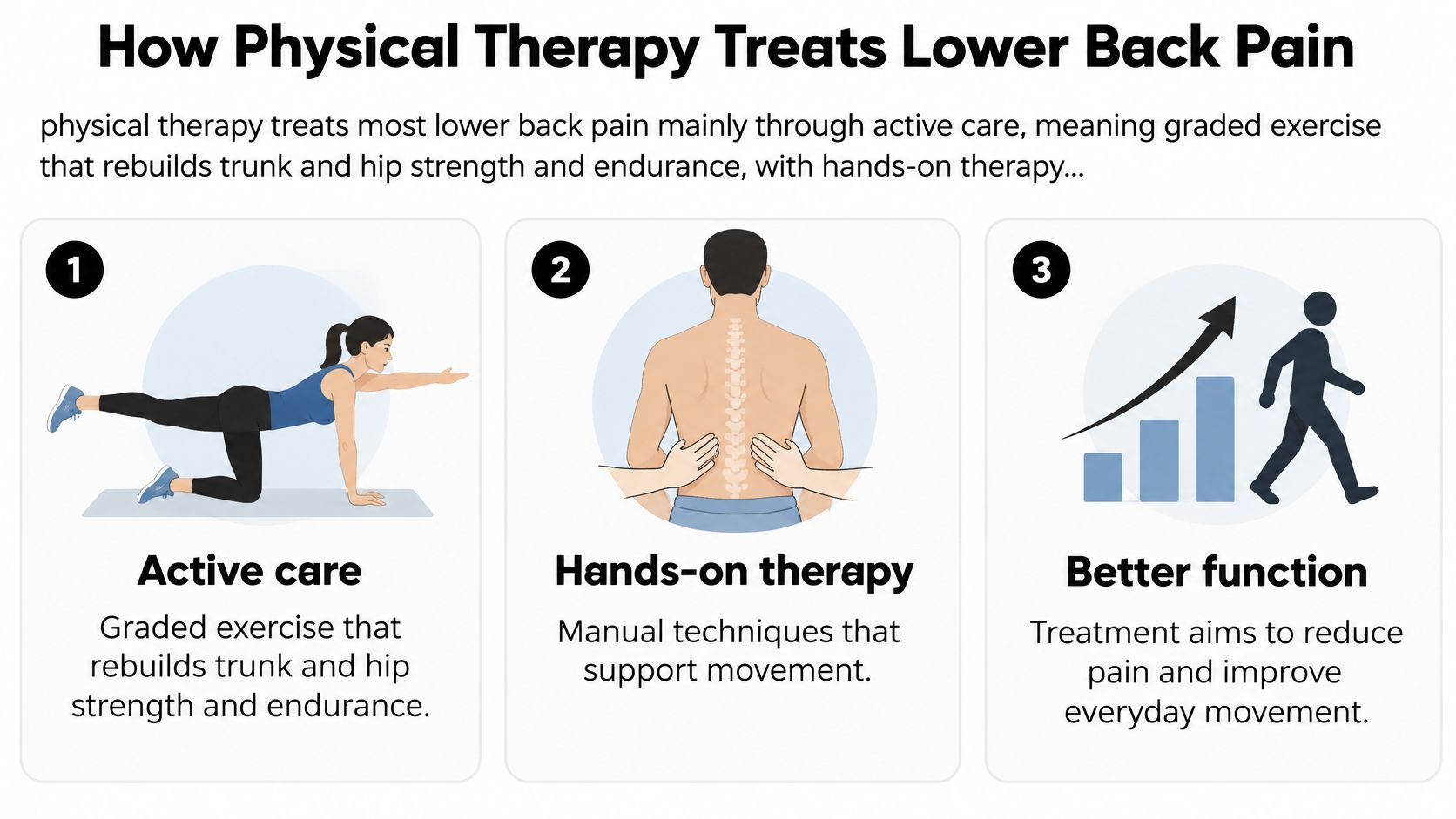
Physical therapy treats most lower back pain mainly through active care, meaning graded exercise that rebuilds trunk and hip strength and endurance, with hands-on therapy and passive tools as support. The World Health Organization fact sheet on low back pain reports that the Global Burden of Disease Study 2021 estimated 619 million people worldwide had low back pain in 2020, and that it remained the leading contributor to disability. Clinics see it every day, including desk workers and parents who never had a sports injury.
A sound plan follows four steps, and each one has a job.
- Restore tolerable walking and daily movement. Short walks you can repeat tomorrow beat a day on the couch. If ten minutes is the limit, that is the starting dose.
- Add graded trunk and hip strengthening. Bridges, supported hip hinges, and side-lying leg work come in once walking no longer spikes pain for hours.
- Increase load, repetitions, or duration as symptoms allow. Change one variable at a time so you can tell what helped.
- Rehearse lifting, bending, and the tasks your job or sport demands. The grocery bag and the car seat matter more than a perfect gym exercise you will never use.
What belongs in a session
Depending on the service and the findings, a visit can include manual therapy, strengthening exercises, hot or cold packs, electrical stimulation, stretching, and/or an adjustment. Hands-on work can quiet muscle guarding so you can move. Heat, ice, and stimulation may ease pain for a short window. Routine ultrasound, laser, or cryotherapy should never be the whole plan. Passive tools do not rebuild endurance.
Care is aimed at relieving pain, restoring mobility, and improving quality of life without surgery or unnecessary medication.
How your feet meet the floor changes the load on your back when you stand and walk. If your arches drop and your low back tightens by late afternoon, a clear look at arch support and lower back discomfort helps you judge inserts before you buy them.
| Component | What It Targets | Role in the Plan |
|---|---|---|
| Strengthening exercises | Trunk, core and hip endurance | Core of the program, progressed every few weeks |
| Manual therapy | Joint stiffness and muscle guarding | Used when clinically indicated, paired with exercise |
| Stretching | Tight hip flexors, hamstrings and lower back | Short sessions alongside strengthening |
| Hot or cold packs | Short-term pain and muscle tension | Support tool, not a standalone treatment |
| Electrical stimulation | Pain relief during activity | Optional adjunct, not a primary solution |
| Spinal adjustment | Spinal joint mobility | Included only when the service and findings call for it |
Practical rule: If the exercises never change, you do not have a plan. You have a handout.
Apply one test to any outline a clinic offers. Does it include active exercise that changes over time?
When to See a Doctor Before Starting Therapy
Severe pain makes people reach for a scan. That reflex is often the wrong first move. The Ontario Health patient guide on low back pain states that routine imaging is not recommended for acute low back pain without red flags, and that people are generally encouraged to remain active and modify daily activities rather than rest completely. Pain severity alone does not justify imaging. An early scan can show common age-related findings that do not explain your symptoms, and those pictures can send you toward worry or treatment you do not need.
Read the boundary before you book
| Symptom or Finding | What It Can Indicate | Action |
|---|---|---|
| Back pain with no warning signs | Common mechanical pain that often improves with activity | Book a physical therapy evaluation and stay active |
| Leg pain or tingling with steady strength | Possible nerve irritation | Physical therapy evaluation, with clinician review of the pathway |
| Worsening leg weakness or foot drop | Possible progressive nerve involvement | Prompt medical evaluation before routine therapy progression |
| Bowel or bladder changes | Possible serious spinal problem | Urgent medical care now |
| Numbness between the legs or groin | Possible serious nerve involvement | Urgent medical care now |
| Fever, unexplained weight loss or back pain with a history of cancer | Possible infection or malignancy | Medical assessment before therapy |
| Back pain after a major fall or crash | Possible fracture or significant injury | Emergency or urgent evaluation first |
Sciatica changes the route, not the standard. Leg pain with tingling and steady strength usually goes to a therapy evaluation. Weakness that is worsening, or a foot that slaps the ground, needs a physician promptly. Do not start a progressive exercise program while strength is dropping.
A therapist will screen for these signs at the first visit. Bowel or bladder changes, or numbness between the legs, should not wait for that appointment. Seek urgent care the same day.
While you sort the next step, our notes on what is good for back pain relief cover activity you can keep without pretending the pain is imaginary.
If any warning sign is present, the medical visit comes first. If none is present, book the therapy evaluation and ask which usual activities stay safe at home and at work.
Ordinary movement during recovery is not the same thing as damage. Ask what to change, then stay inside that line instead of stopping everything.
How to Choose a Physical Therapy Clinic in Deerfield Beach
Distance is the weakest reason to pick a clinic. A five-minute drive does not help if the visit is a hot pack and the same sheet given to every patient. Judge what happens in the room.
Credentials you can check
Therapists should hold active Florida licenses, and a doctor of physical therapy on staff is a useful sign of training depth. We are a Certified Outpatient Rehabilitation Facility, and all of our doctors and therapists are licensed and experienced. Confirm names in the state licensing lookup anyway. A line on a homepage is not a license.
Visit structure and the plan
Look for an individualized plan with stated goals, a progression, and a written or video home program. Ask whether a first opening exists the same day or the next day, and whether early or late slots exist for shift work. In Deerfield Beach, check drive time at rush hour and whether parking is simple. If your pain followed a crash or a job injury, ask whether the clinic treats auto-accident and workers' compensation cases. Physical therapy is offered for pain or mobility issues that result from sports injuries, auto accidents, or workers' comp issues.
Our guide on how to choose a physical therapist walks through questions worth asking on the phone, including how progress gets recorded.
| Criterion | What to Check | Red Flag |
|---|---|---|
| Licensing | Therapists hold active Florida licenses; a doctor of physical therapy is on staff | Staff names or licenses cannot be verified |
| Facility certification | Outpatient rehabilitation certification is current and visible | No verifiable certification |
| Evaluation length | An initial evaluation of about 60–75 minutes with measurements | A rushed check with no baseline scores |
| Follow-up length | Sessions long enough for hands-on work and exercise coaching | Five-minute check-ins with no coaching |
| Individualized plan | Goals, progression and a home program tailored to the patient | The same routine for every patient |
| Scheduling | Same-day or next-day evaluation, with early or late slots | Waits of several weeks for a first visit |
| Outcome tracking | Pain and disability scores repeated over time | No measurement recorded across visits |
| Insurance clarity | Network status and authorization confirmed before the first visit | Vague answers about coverage or costs |
A scorecard, not a vibe
Call two clinics and fill the table while you are on the phone. The clinic that cannot name a baseline measure, or that describes one routine for every back, is the one to leave. No single exercise style has proven better for everyone, so a copy-paste program is a clinical problem, not a convenience.
What to Prepare Before Your First Visit
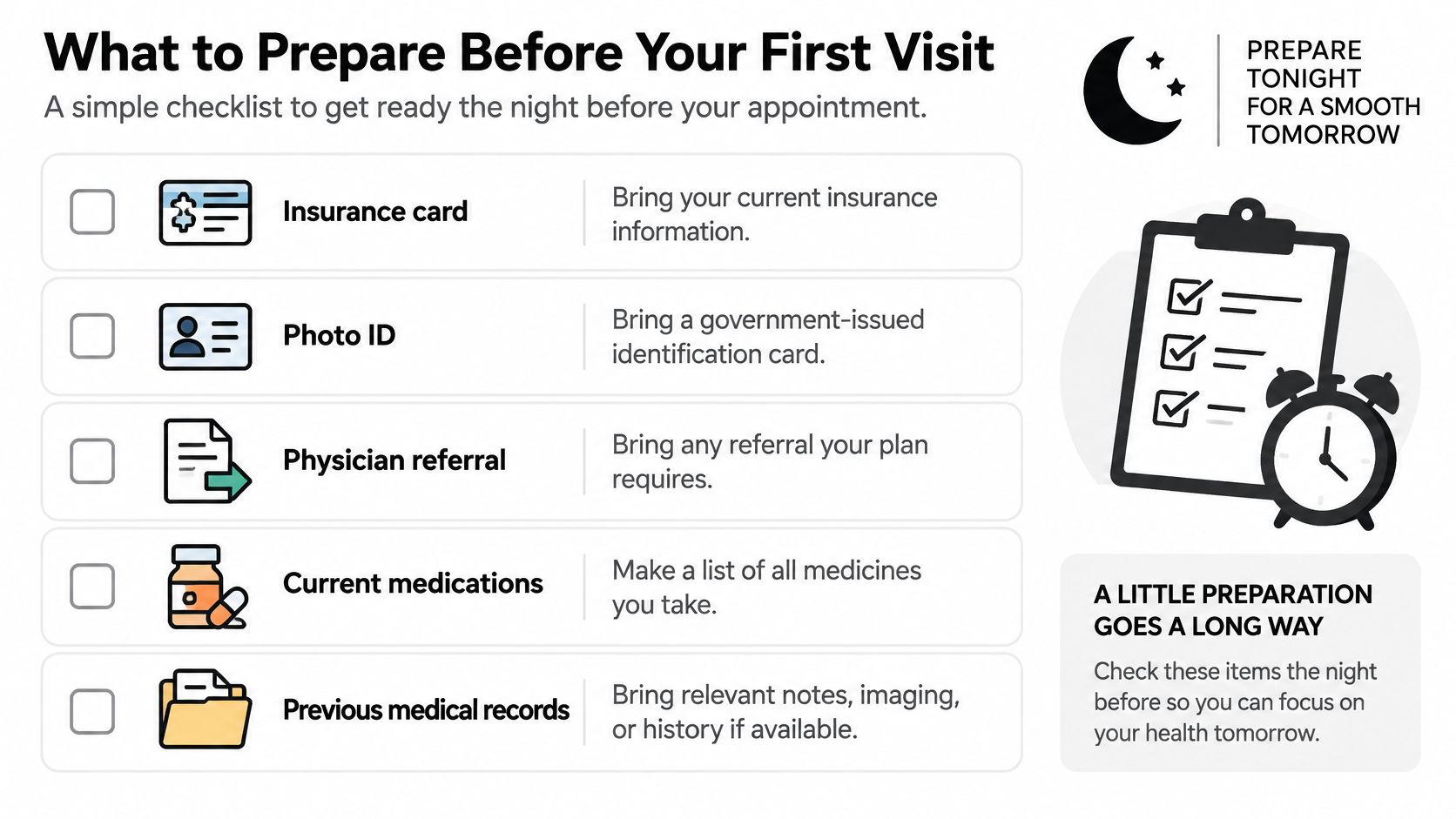
Do this the night before, not in the parking lot. Each item saves minutes the therapist would otherwise spend guessing.
Paperwork in one stack
- Insurance card: The front desk needs the current plan, not last year's card.
- Photo ID: Intake cannot start cleanly without it.
- Physician referral: Bring one if your plan requires it. Some plans do not.
- Medication list: Include dose and why you take it. Pain pills and blood pressure drugs both matter.
- Imaging summaries: Bring an MRI or X-ray report if you already have one. You do not need a new scan to attend.
The story the therapist will ask for
Write when the pain started and what set it off: a lift, a fall, a crash, or nothing you can name. Note what eases it, what makes it worse, and whether leg pain, numbness, or weakness is present. Add the day you live. Hours sitting or standing, weights you lift, time in the car, and care you give to children or parents all change the exercise dose.
Set one or two concrete goals, such as walking 20 minutes without stopping or sitting through a 45-minute meeting. Vague goals like "feel better" do not tell anyone when to progress you.
Bring three questions, and use our list of questions to ask a physical therapist if you want a longer set.
- Safe activity: Which usual tasks are fine this week?
- Work and home changes: What should you alter at the desk, in the car, or when you lift?
- Review point: After how many visits will scores and daily tasks be checked again?
Wear loose clothes that allow bending and lying down. Arrive about 15 minutes early so forms do not eat the evaluation.
What Happens at Your First Visit and Each Session After
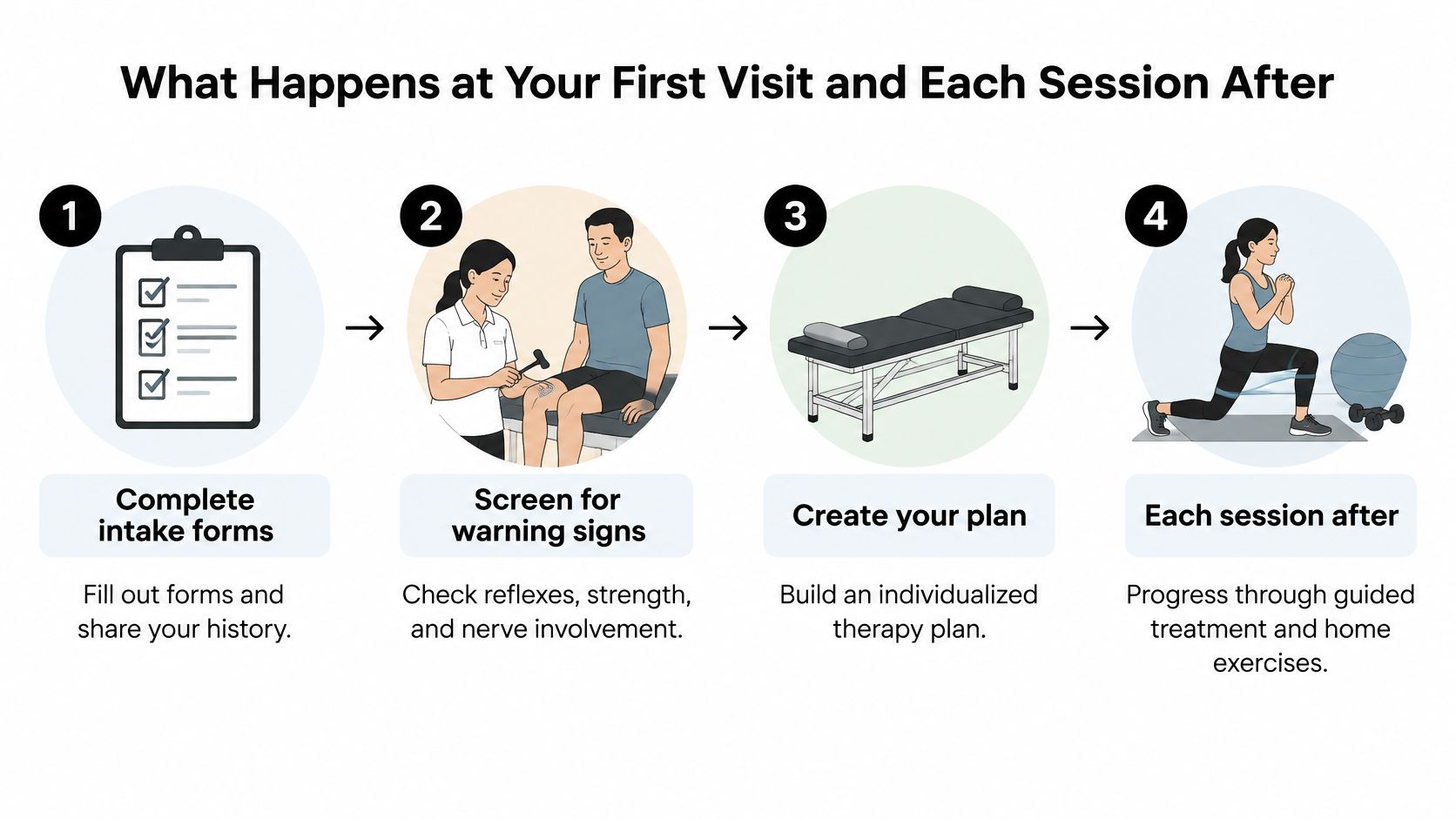
Say you book a Thursday afternoon after a week of desk pain and a pinch into one calf, with strength that still feels even. The visit runs in a set order, and you should be able to picture each step before you walk in. Initial evaluations typically last 60–75 minutes. Follow-up treatments are 60 minutes.
- Intake and history. You finish forms, then walk through onset, easing factors, work demands, and the goals you wrote down.
- Screening. Reflexes, strength, and sensation checks look for nerve involvement and for signs that do not belong in routine outpatient progression.
- Functional tests. Sit-to-stand, walking tolerance, and bending show what your day costs you.
- Baseline scores. A 0–10 pain scale and a disability index such as the Oswestry Disability Index give numbers you can repeat.
- Goals and a plan. You agree on what will change first, and what will wait.
- First treatment and a short home program. You leave with a few movements, not a twenty-item list.
What "better" looks like in weeks, not days
Exercise takes weeks. A Journal of Orthopaedic & Sports Physical Therapy summary of a Cochrane review found moderate-certainty evidence that exercise therapy for chronic low-back pain improved pain by approximately 15.2 points on a 0–100 scale and disability by about 7 points at roughly three months versus no treatment, usual care, or placebo. That analysis included 35 pain studies with 2,746 participants. Expect a slope, not a switch.
Track more than pain. Note walking distance, sleep, time you can sit, and one work or household task. If the pain number barely moves but you can carry laundry again, the plan is still doing its job. The point of the plan is to relieve pain, restore mobility, and improve daily function without surgery or medication you do not need.
Why the home piece is small on purpose
Adherence to home exercise programs varies widely from patient to patient and often falls short of what clinicians hope for. I would rather you finish four movements four days a week than own a perfect program you skip. The program should be short, written or on video, and changed when a flare, fear of moving, a ride problem, or too many steps gets in the way. Nobody should promise you a success rate.
Later sessions repeat the useful parts. You recheck a score, coach the exercise that stalled, add load only when the last dose was tolerable, and drop anything you are not doing.
Book Your Evaluation Within the Week
If no warning sign from the decision table is present, book the physical therapy evaluation within the week. Waiting for the ache to fade on its own usually means more rest, and guided activity is the better path. If a warning sign is present, book the medical visit first and do not start therapy until that clinician clears the next step.
Booking steps in order
- Ask for today or tomorrow. Request the cancellation list if the board is full.
- Confirm network status with the number on your insurance card, not from memory.
- Ask about a referral or prior authorization before you arrive, so the first visit is not cancelled at the desk.
- Ask about copay, deductible, and any annual visit limit. Write the answers down.
- After an auto accident, notify your own insurer and ask how personal injury protection applies before treatment starts.
- After a work injury, tell your employer promptly and ask whether you must use a panel of authorized providers.
- If you are uninsured, ask for the self-pay rate before the first visit.
The barrier that actually stops people
A plan you cannot attend does not work, no matter how evidence-based the exercises are. A 2025 U.S. military health-system review identifies limited appointment availability and opportunity costs, including time away from work, public transportation costs, and child-care needs, as barriers to starting or continuing physical therapy. Access also varies by location, socioeconomic status, disability, race or ethnicity, gender identity, and sexual orientation.
Match the fix to your constraint.
- Shift work: Ask for an early or late slot, and put the home program on the days you cannot come in.
- Transportation or child care: Budget those costs as part of treatment. If weekly visits are impossible, ask for fewer visits and a stronger home program.
- Older adults, workers' compensation, and post-crash care: Say so on the first call. The business treats sports injuries, car accident injuries, workers' comp injuries, pre- and post-surgical rehab, balance disorders, gait and mobility issues, and fall prevention. Exercise should match your preferences, beliefs, limits, and what you can do. One style is not best for every back.
Hours at a desk still matter between visits. If your chair dumps you into a slump by noon, a practical home office seating guide for comfort is a useful check before you blame every flare on the exercises.
MedAmerica Rehab Center in Deerfield Beach is one local clinic to hold against the scorecard: licensed clinicians, outpatient rehabilitation certification, and visits built around exercise plus hands-on care. The team includes Arielle Leavitt (COO), Dr. William Molesky (chiropractor and acupuncturist), Stanley Gusman (physical therapist), Heather Previll (doctor of physical therapy), Dorota Paspalis and Kristen Ebersberger (physical therapy assistants), and Krissy Carrera (office assistant).
Set a review after several visits. If pain scores, walking tolerance, and daily tasks have not moved, ask for a reassessment and a changed plan. More of the same sessions is not a strategy.
Today's action is small. Call one clinic, confirm insurance, and book the first open slot.
MedAmerica Rehab Center provides physical therapy for lower back pain and sciatica, with individualized exercise, manual therapy, and plans aimed at mobility without surgery or unnecessary medication. If you are in Deerfield Beach and ready to sort warning signs, scheduling, and a first evaluation, visit MedAmerica Rehab Center and book a time that fits your week.
MedAmerica Rehab · Deerfield Beach
Talk to a clinician about your pain
Physical therapy, chiropractic, acupuncture and shockwave therapy under one roof, since 1995. Same-day appointments are available.
Mon–Thu 8:00 AM – 6:30 PM · Fri 8:00 AM – 3:00 PM