

What Is Considered a Serious Injury in a Car Accident?
A serious injury is one that threatens life, damages a bone, brain, spinal cord or internal organ, or causes lasting loss of function, and it isn't defined by how much it hurts at the scene.
The familiar advice to judge an injury by how you feel immediately after a crash is unreliable. Walking away, seeing no blood, or having little pain doesn't tell you whether there's hidden damage. A safer approach is to consider what was injured, what you can no longer do, and whether your condition is changing.
Serious Means Lasting Harm, Not Just Pain
Pain deserves attention, but pain intensity alone doesn't establish severity. A painful bruise and an injury affecting a nerve can feel similar at first while requiring very different care. Likewise, an injury can need emergency treatment before anyone knows whether it will cause permanent harm.
The National Highway Traffic Safety Administration glossary describes severe injuries through conditions including skull fracture, internal injury, broken or distorted limbs, unconsciousness, severe lacerations, severe burns, or an injury preventing someone from leaving the crash scene without assistance. These are indicators of damage or impaired function, not a test of how much pain someone reports.
The different meanings of serious
When you're asking what is considered a serious injury in a car accident, distinguish these yardsticks:
- Medical severity: A clinician assesses damage, immediate danger, neurological changes, and effects on everyday function.
- Federal crash-reporting severity: Road-safety personnel use a reporting category to describe crashes consistently.
- Legal or insurance severity: Applicable law and policy terms govern whether particular benefits or damages are available.
Think of these as different measuring tools. A thermometer can't measure a person's height, and a crash-report label can't answer every medical or legal question.
Test function, not appearances
Consider a hypothetical driver who walks away from a rear-end collision and drives home. Later, she can't turn her neck safely and develops tingling in her fingers. Those changes call for medical assessment, even without bruising or an obvious wound.
She shouldn't assume it's only stiffness. Equally, she can't diagnose permanent nerve damage herself. Her clinician must examine strength, sensation, movement, and other findings before choosing appropriate tests.
For context on the more disabling end of the injury spectrum, Law Office of Bryan Fagan on injuries discusses catastrophic injuries. That terminology shouldn't replace an individual diagnosis or a local attorney's assessment.
Practical test: Ask whether you can function normally, whether hidden damage is possible, and whether limitations are continuing. You don't need to know the final prognosis before seeking care.
Injury Types That Count as Serious
| Injury type | Serious when | Key markers | Confirmed by |
|---|---|---|---|
| Skull fracture | There's a break in the skull | Head impact, scalp swelling, bruising behind an ear, clear drainage from the nose or ears | Medical examination and imaging such as CT |
| Long-bone or pelvic fracture | A major limb bone or the pelvis is broken, displaced, or distorted | Deformity, inability to bear weight, instability | X-ray or CT |
| Spinal cord injury | Injury affects spinal cord function | Weakness, numbness, loss of bladder or bowel control, paralysis | Neurological examination and MRI when indicated |
| Traumatic brain injury | Brain function is disrupted, especially with loss of consciousness or neurological deterioration | Confusion, repeated vomiting, slurred speech, unequal pupils | Clinical assessment, neurological examination, and CT when indicated |
| Internal injury | Bleeding or organ damage is suspected | Abdominal pain or swelling, fainting, unusual dizziness, rapid heartbeat | Examination, blood tests, ultrasound or CT |
| Severe laceration or burn | Tissue damage is deep, extensive, or threatens important structures | Uncontrolled bleeding, exposed deeper tissue, extensive or deep burns | Wound or burn assessment |
| Long-term loss of function | Persistent limitations prevent normal walking, driving, work, or self-care | Restricted movement, continuing weakness, activity intolerance | Functional testing and specialist assessment |
| Crash-scene immobility | Injury prevents leaving the scene without assistance | Inability to stand or walk unassisted | On-scene assessment, followed by medical evaluation |
The table is a reason to seek assessment, not a self-diagnosis checklist. A clinician doesn't need every marker in a row to suspect a significant injury. The most concerning finding should guide the urgency of care.
What the injury names mean
A skull fracture is damage to the protective casing around the brain. Someone may appear alert despite needing evaluation for associated bleeding or brain injury. With a major limb or pelvic fracture, clinicians also assess circulation, nearby nerves, and whether the bone is stable.
Spinal cord injury and a pinched nerve aren't interchangeable. Both may cause weakness or altered sensation, but their implications differ. A diagnosis of neck strain shouldn't end the evaluation if the person develops neurological changes.
Brain injury may affect thinking, alertness, memory, or balance without an external wound. MedAmerica's explanation of the vestibular system and concussion provides context for dizziness and balance problems, but those symptoms still need an individual assessment.
Internal injuries are concerning because the damaged tissue isn't visible. Severe wounds and burns require assessment of depth and affected structures, not just surface size. Finally, inability to function or leave the scene safely deserves attention even before clinicians identify the exact injured structure.
Where sprains and whiplash fit
Sprains affect ligaments; strains affect muscles or tendons. Whiplash describes the rapid neck movement associated with a crash, rather than a complete diagnosis of every injured tissue.
These injuries can be substantially disabling when symptoms persist, prevent safe driving or work, or accompany nerve-related findings. Arm numbness after an apparent neck strain, for example, requires assessment for a neurological problem rather than an automatic minor-injury label.
The World Health Organization road-traffic injury fact sheet estimates 20–50 million non-fatal injuries worldwide each year, with many injured people developing disability. That broader picture matters: serious harm includes impaired independence, not only injuries that immediately threaten life.
An injury name is a starting point. Its location, associated damage, and effect on normal activity determine what care is needed.
Emergency Signs and Delayed Symptoms
A red-flag symptom after a crash needs emergency assessment, not a routine rehabilitation appointment. Call emergency services if someone deteriorates, has concerning neurological symptoms, or may have a serious chest, spinal, or internal injury.
Don't wait for a visible wound. Brain swelling, bleeding, and neurological injury can occur without dramatic external signs.
Emergency warning checklist
- Brain and alertness changes: Loss of consciousness, worsening or persistent headache, repeated vomiting, seizure, increasing confusion, unusual drowsiness, inability to awaken, or slurred speech.
- Neurological changes: Weakness, numbness, unequal pupils, impaired coordination, or a substantial balance change.
- Possible spinal injury: New limb weakness, loss of bladder or bowel control, or inability to move normally after trauma.
- Chest or breathing problems: Difficulty breathing or significant chest pain.
- Possible internal bleeding: A swollen or hard abdomen, fainting, marked dizziness on standing, or a racing heartbeat, especially when symptoms are worsening.
Use this visual checklist to recognize concerning changes after a head impact.
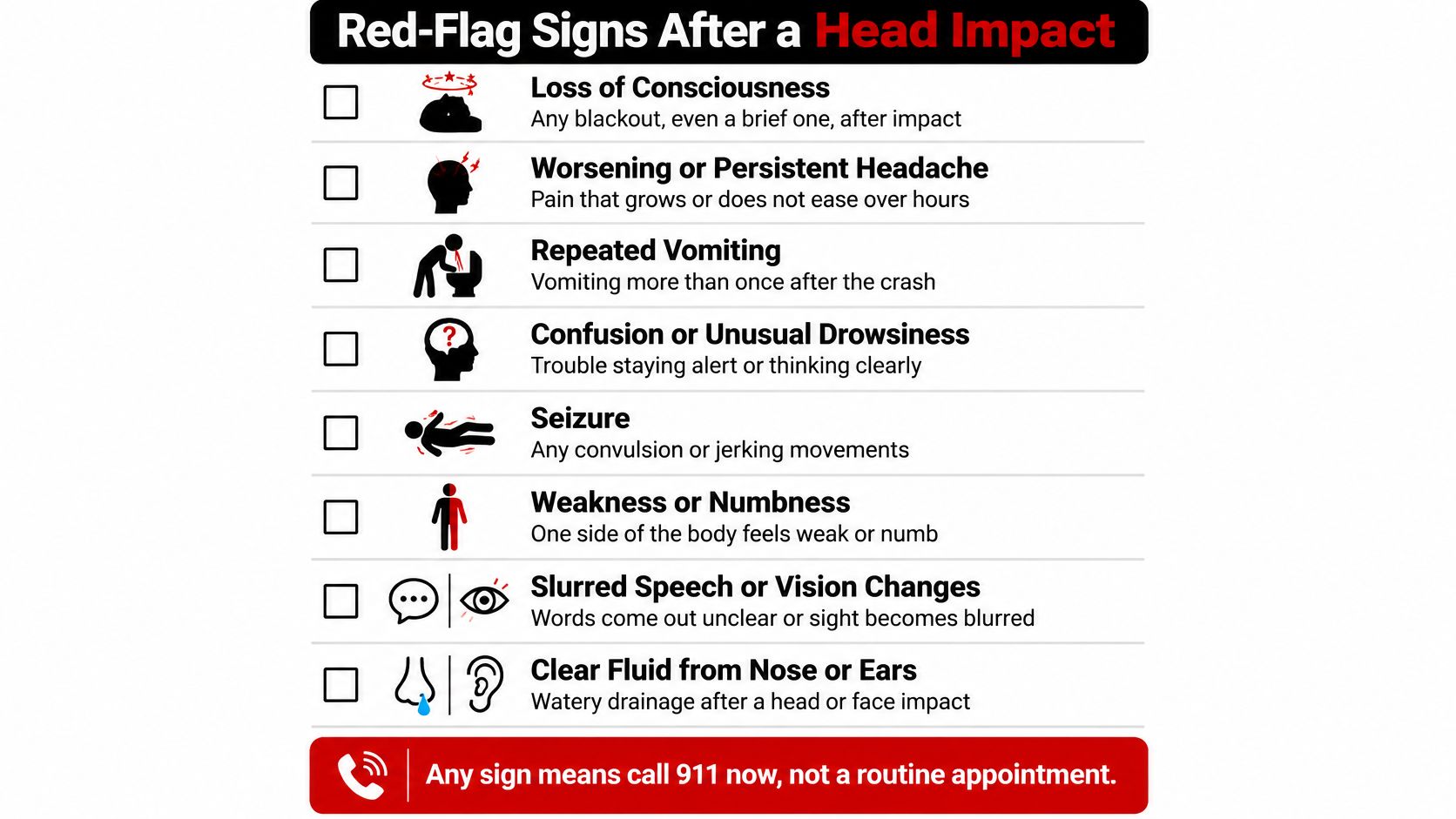
Clinicians assess more than whether someone can answer a question. According to MedlinePlus guidance on head injury, Glasgow Coma Scale scores of 13–15 generally indicate mild traumatic brain injury, 9–12 moderate injury, and 8 or below severe injury.
A clinician scores eye opening, verbal responses, and movement in context. You shouldn't calculate a reassuring score at home and use it to dismiss symptoms. Mild in this classification doesn't mean harmless or guarantee a quick recovery.
When symptoms emerge later
Symptoms can appear or become clearer after someone leaves the scene. A person may notice dizziness while walking, difficulty concentrating during work, or neck pain when trying to turn while driving.
The clinical discussion of delayed symptoms after a car accident emphasizes symptom progression and reduced function as reasons for reassessment. Early crash descriptions may not capture problems that emerge afterward.
Older adults, people taking blood thinners, and anyone with a head impact should be especially cautious about relying on an initially reassuring appearance. Tell the assessing clinician about medications and the mechanism of injury.
For a plain-language companion explanation, AskLegally discusses concussion symptoms that emerge days later. Use that information to prepare questions, not to decide that waiting is safe.
Delayed symptoms by time after the crash
These are monitoring stages, not deadlines for seeking treatment. Emergency symptoms override every row.
| Time after crash | Symptoms to watch | Action |
|---|---|---|
| First hours | Loss of consciousness, repeated vomiting, confusion, weakness or numbness | Emergency care now |
| Hours into the following days | Headache, dizziness, nausea, neck or back pain | Seek same-day assessment; use emergency care for red flags |
| Following days | Sleep disruption, persistent pain, reduced movement | Arrange prompt medical assessment; new neurological symptoms need urgent evaluation |
| Following weeks | Difficulty with daily tasks, memory or mood changes, pain limiting work or driving | Follow-up examination and a documented care plan |
| Continuing recovery | Symptoms that aren't improving or are getting worse | Reassessment and specialist referral when indicated |
A normal initial scan doesn't explain every symptom, and a low pain rating doesn't establish normal function. Worsening symptoms or new limitations justify another examination.
Don't drive yourself when emergency symptoms are present. Don't wait for physical therapy or chiropractic treatment to begin, and tell responders when the crash and any head impact occurred.
What to Do in the First 24 Hours After a Crash
Start with safety and medical assessment. Records and insurance communication matter, but they shouldn't delay needed treatment.
The following visual gives a practical overview of the immediate priorities.
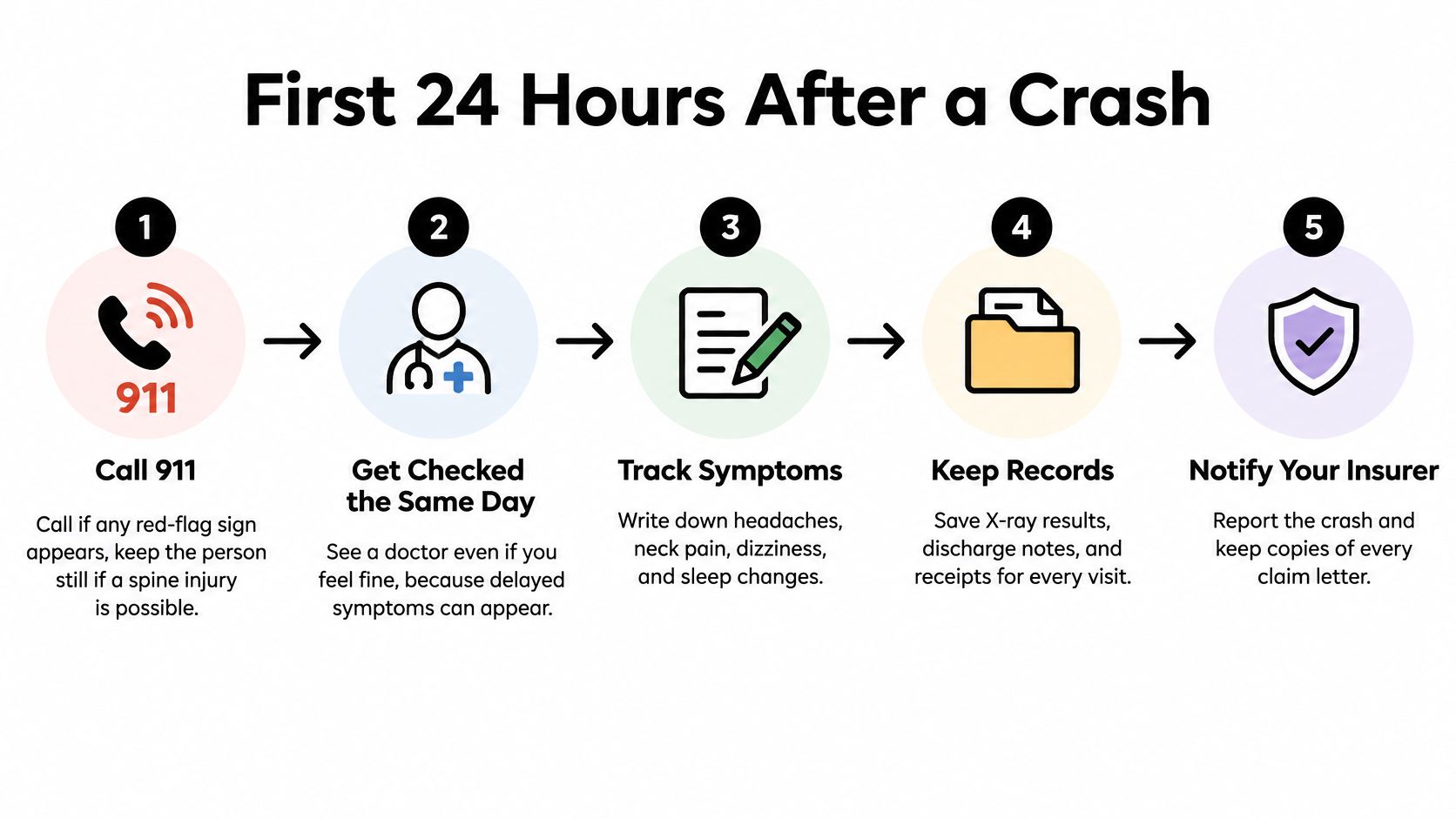
Follow an immediate action sequence
Get emergency help when indicated. If a spinal injury is possible, avoid unnecessary movement and follow the dispatcher's instructions. Move someone only when necessary to escape immediate danger or as directed by responders.
Arrange a medical assessment. Seek same-day guidance after a concerning impact, even if you're unsure whether you're injured. A clinician can determine whether an emergency department, urgent care, or another setting is appropriate.
Describe the whole event. Explain whether your head struck anything, whether you blacked out, where symptoms began, and what has changed. Mention blood thinners, previous injuries, and symptoms that seem unrelated, such as nausea or difficulty concentrating.
Collect your medical documents. Request discharge instructions, diagnoses, imaging reports, medication directions, and follow-up recommendations. Keep them together so another provider can understand what has already been assessed.
Start a symptom diary. Record symptom changes, sleep quality, medication effects, and activities you couldn't complete. Write concrete observations, such as being unable to check a blind spot, rather than only describing pain as bad.
Preserve crash information safely. Photograph visible injuries, vehicle damage, and the scene when doing so won't put you at risk. Save witness contact details and the police report information.
Notify your insurer factually. Describe what you know without guessing about fault, diagnosis, or recovery time. Ask about reporting obligations and consider legal advice before providing a recorded statement or signing a settlement release.
Follow the clinical plan. Keep appointments and report barriers such as transportation or cost. Once medically cleared, ask how rehabilitation will address the activities you're struggling to perform.
Make follow-up useful
Bring your symptom diary and medication list to the next appointment. Ask what changes should trigger urgent reassessment, what activities to avoid, and when you should return if improvement stalls.
The clinic's guide to steps after a car accident in Deerfield Beach offers additional local recovery context. Your own discharge instructions and treating clinician's advice take priority over a general checklist.
Record what changed: A dated note that you needed help dressing is more informative than an unsupported conclusion that your injury is permanent.
A clinically documented evaluation supports treatment decisions and creates a clearer foundation for any injury claim.
How a Serious Injury Changes Treatment and Rehab
Consider an illustrative scenario: an office manager is rear-ended at a red light. An emergency X-ray shows no fracture, but continuing neck symptoms later develop into arm numbness and difficulty driving. A clinician reassesses her and orders MRI, which identifies a disc injury affecting a nerve.
A collar may be used in selected cases, but wearing one doesn't establish the diagnosis or determine the rehabilitation plan.

Match treatment to the damaged structure
In this scenario, the clinician changes care because the examination and imaging identify a different problem, not merely because the patient reports more pain. The team checks strength and sensation, considers specialist input, and selects exercises that won't aggravate the neurological findings.
Other diagnoses lead to different paths:
- Fracture: Stabilization, protection from loading, and sometimes surgery before progressive strengthening.
- Brain injury: Symptom-guided activity, appropriate early rest, and a clinician-directed return to physical and cognitive demands.
- Spinal injury: Specialist assessment and neurological monitoring before routine manual treatment or exercise.
- Internal injury: Medical observation or surgical care when needed, with rehabilitation introduced only when safe.
- Persistent functional limitation: Measurable goals for tasks such as dressing, walking, lifting, and returning to work.
Emergency stabilization comes before rehabilitation. After clearance, physical therapy, balance and gait training, pain management, or selected adjunctive treatments such as acupuncture may form part of an individualized plan.
This video provides additional rehabilitation context.
Track abilities as well as symptoms
MedAmerica Rehab Center in Deerfield Beach is one option for auto accident rehabilitation, offering same-day appointments and individualized plans. Its explanation of physical therapy after a car accident outlines how supervised rehabilitation can fit into recovery.
Useful milestones include improved strength, greater neck movement, steadier walking, and tolerating work tasks without a symptom flare. Return to driving should reflect safe movement, attention, and medication effects, not just a desire to resume normal routines.
The office manager's progress would therefore be measured by more than pain relief. Her team would also assess whether she can grip reliably, turn safely, and complete her usual activities.
How Serious Injury Shapes Insurance and Injury Claims
A medically significant injury doesn't automatically satisfy an insurance policy or legal threshold. Conversely, being discharged from an emergency department doesn't settle whether an injury supports a claim.
The federal suspected-serious-injury reporting standard establishes a roadway-safety reporting classification. It doesn't decide an individual's entitlement to compensation or whether ongoing rehabilitation is medically necessary.
Compare the questions each system asks
A treating clinician asks what care you need. A crash-reporting official records a safety classification. An insurer or attorney examines coverage, causation, applicable law, and proof of losses.
State-specific lawsuit thresholds require checking the applicable statute and its interpretation. They shouldn't be inferred from a general medical definition.
| Jurisdiction model | Serious injury threshold | What it means for a claim |
|---|---|---|
| Florida no-fault | The applicable state-law threshold requires individual legal review | Ask which benefits and damages are available under the policy and governing law |
| New York no-fault | The applicable statutory definition must be checked against the medical evidence | A local attorney should assess requirements for non-economic damages |
| Michigan no-fault | The governing impairment standard requires state-specific legal analysis | Records should describe the injury and its effect on ordinary activities |
| At-fault or tort states | Applicable liability and damages rules require jurisdiction-specific review | Proof of injury, causation, fault, and losses remains important |
This comparison is a guide to the questions to ask, not a substitute for the state statutes. Don't assume that another person's settlement, even for a similarly named injury, predicts your result.
Build evidence around the actual limitations
An injury claim is easier to understand when the records connect the diagnosis to its consequences. A scan may identify damaged tissue, while a clinical note explains why that damage prevents lifting, prolonged sitting, or safe driving.
Useful documentation includes:
- Imaging reports: Preserve the written interpretation, not only a photograph of the scan.
- Specialist opinions: Ask providers to document the diagnosis, relevant findings, and their assessment of the relationship to the crash.
- Functional restrictions: Record specific limits on work, household duties, mobility, and self-care.
- Treatment history: Keep appointment records and explain interruptions rather than leaving an unexplained gap.
- Prior medical history: Disclose earlier symptoms fully and accurately so clinicians can distinguish a new injury from an aggravation.
- Financial records: Save bills, receipts, and documentation of missed work or necessary assistance.
Hospitalization isn't the sole measure of severity. An outpatient injury may substantially interfere with normal life, but that interference still needs careful medical documentation.
Don't ask a therapist to guarantee a settlement or an attorney to diagnose nerve damage. Each professional has a different role, and neither should promise an outcome before the facts are established. This is general information, not legal advice; a local attorney should review the law, deadlines, policy terms, and evidence for a specific claim.
MedAmerica Rehab Center offers individualized auto accident rehabilitation, including physical therapy and care focused on restoring movement and daily function. Once urgent injuries have been evaluated, visit MedAmerica Rehab Center to discuss your symptoms, current limitations, and an appropriate rehabilitation plan.
MedAmerica Rehab · Deerfield Beach
Talk to a clinician about your pain
Physical therapy, chiropractic, acupuncture and shockwave therapy under one roof, since 1995. Same-day appointments are available.
Mon–Thu 8:00 AM – 6:30 PM · Fri 8:00 AM – 3:00 PM