
Knee Injury Swelling Treatment: What to Do First
You're sitting on the couch with your leg up, knee tight under your jeans, wondering whether to ice it again, take something, or try to walk it off. You twisted it yesterday, or maybe this morning, and now bending hurts and the kneecap looks blurred. That uncertainty is normal. Good knee injury swelling treatment doesn't start with a universal rule. It starts with timing, how the knee behaves, and what medicines are safe for you.
How Swelling Timing Reveals the Injury
A knee that swells during a game calls for a different response from one that stiffens gradually over several days. Onset can guide your next step, but it cannot diagnose the injury by itself.
The 2018 American Family Physician clinical review on acute knee injury suggests that swelling within minutes to a few hours is commonly associated with a ligament injury, fracture within the joint, or kneecap dislocation. Swelling that develops over hours to days may be associated with a meniscal tear. The review also discusses using the Ottawa Knee Rule to help clinicians decide when an X-ray is needed.
Signs That Override a Home Plan
Get medical care promptly for a hot, red knee with fever, or if you cannot bear weight safely. A knee that locks and will not straighten, repeatedly gives way, or has severe or worsening pain also needs assessment. These symptoms matter regardless of when swelling began.
Swelling onset, likely causes and what to do now
| Swelling onset | Likely causes | What to do now |
|---|---|---|
| Within minutes to a few hours | Ligament injury, fracture within the joint, kneecap dislocation | Seek same-day medical evaluation. An X-ray may be needed. |
| Over hours to days | Meniscal tear, bruising, mild sprain | Protect the knee and monitor how it changes. Seek care if symptoms worsen or function remains limited. |
| Gradual, over days or weeks | Osteoarthritis flare, overuse, bursitis | Track changes and activity. Arrange a clinical assessment if swelling persists. |
| Hot and red, especially with fever | Possible infection or crystal arthritis | Get prompt medical care. Do not rely on home treatment. |
A pickleball player feels a pop, then notices swelling and warmth by the next morning. Because the swelling followed a pop and the knee is warm, he should seek same-day medical advice rather than wait several days. If fever or marked redness is also present, prompt care is especially important. Match the response to the concerning sign, not just the swelling's timing.
How to Treat Knee Swelling in the First 48 Hours
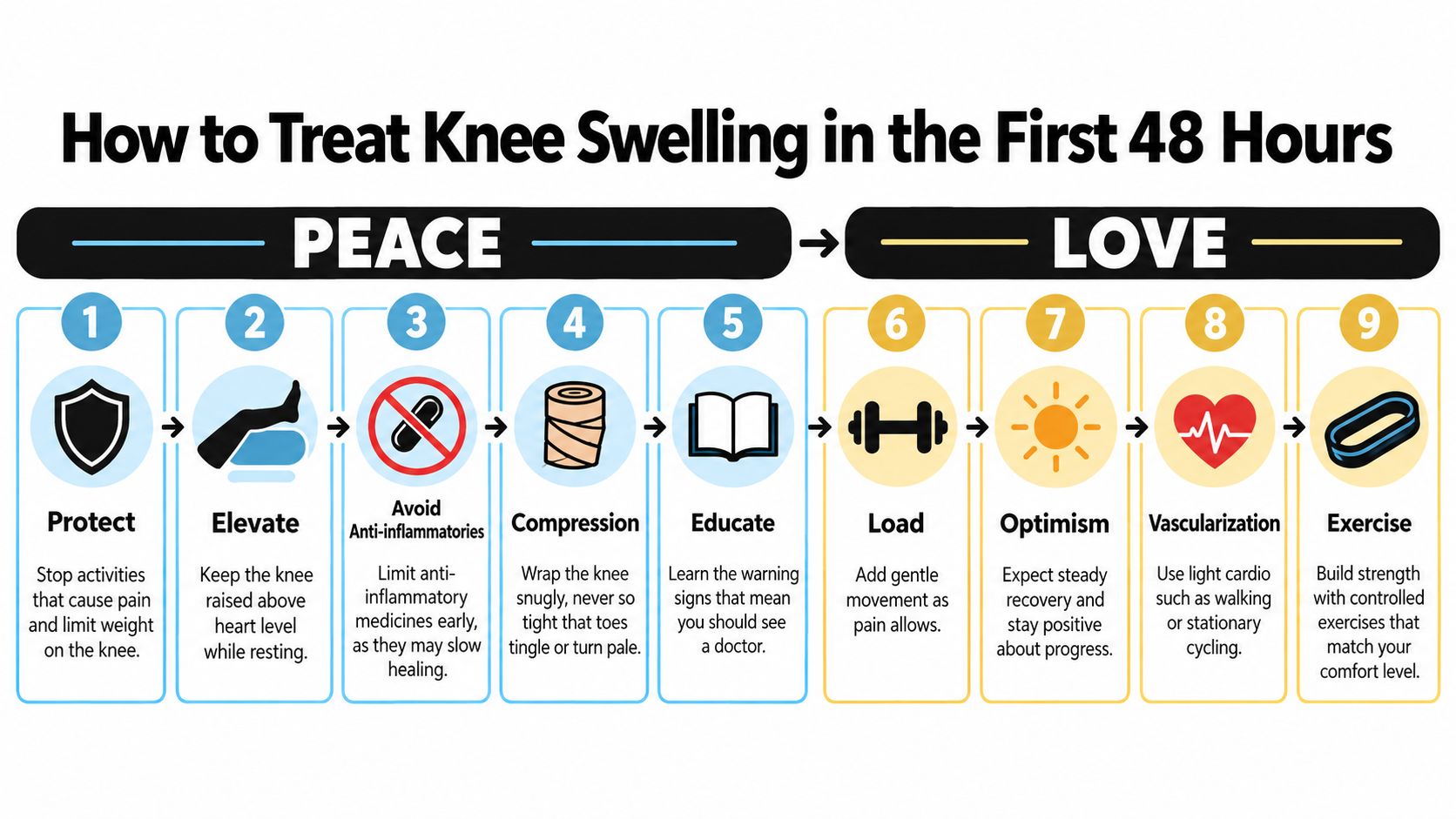
A knee can feel tighter with each step after a sprain or bruise. For an uncomplicated injury, protect it while keeping gentle movement in the plan. PEACE and LOVE is an emerging alternative to RICE, not a settled replacement. Clinicians still debate how much rest and ice help, so match your approach to when swelling began, how the knee responds, and your health history.
This visual shows the sequence from protection to guided exercise.
The First 48 Hours, Step by Step
Stop the trigger and protect the knee. Stop the activity that brought on the swelling and avoid painful loading. Use crutches, a cane, or a brace if weight-bearing hurts. The Massachusetts knee injury treatment guideline notes that support may be needed for approximately 3 days to 2 weeks when walking is difficult.
Wrap snugly, not tightly. Compression or a brace can limit extra fluid and give the joint support. Loosen it immediately if your toes tingle, go numb, or turn pale or blue. A tight wrap can affect circulation; it will not make swelling settle faster.
Raise the leg above heart level. Prop it on pillows for 15 to 20 minutes at a time, several times a day. Gentle ankle pumps are easy to add while the leg is raised.
Use cold for comfort, in short sessions. If a cold pack eases pain, wrap it in a towel and apply it for about 15 to 20 minutes at a time. Check your skin, and remove the pack if it turns white or feels numb. Do not leave it on for hours or fall asleep with it. For practical advice on using ice packs in physical therapy, follow safe placement and timing.
Move gently within your pain limit. Try short, easy bends and straightening several times through the day. Stop if movement sharply increases pain. Avoid strengthening, deep squats, and twisting during this early stage.
Check progress at 48 hours. Lightly mark the fullest point around the kneecap and compare its appearance and feel at the same time each day. Also note whether walking is easier and whether the knee bends a little further. Use the day-three check to decide whether it is settling, not as part of the first 48-hour treatment window.
Mistakes That Slow Things Down
Common missteps include wrapping too tightly, icing continuously, or staying completely still for a week. Ice and compression may ease symptoms, but neither guarantees recovery. A recreational runner who protects the knee, uses crutches briefly if needed, applies cold in short sessions, and keeps gentle motion going may notice swelling easing by day three.
Medication choices depend on your health history, so do not assume anti-inflammatory pills are right for you. By day three, an uncomplicated knee should feel calmer, not fuller, hotter, or harder to walk on. If it is worsening, arrange a clinical assessment.
When to Skip Ice and Anti-Inflammatory Pills
A cold pack may settle a painful knee, but it does not suit every person or every stage of an injury. The choice to ice, rest, or use an anti-inflammatory depends on when swelling began, whether cold brings relief, and your health history.
The PEACE approach advises against routine icing and anti-inflammatory drugs during early injury care. The PEACE and LOVE guidance emphasizes protection and optimal loading, meaning comfortable movement as tolerated rather than prolonged complete rest. This differs from classic RICE, which includes rest and ice. Mayo Clinic guidance on swollen knee diagnosis and treatment discusses icing to ease pain and swelling, and notes that ibuprofen or naproxen may help with pain and inflammation.
This short video explains how to weigh rest against movement.
A Practical Rule for Ice
Use ice for temporary pain relief if it feels helpful. Skip it if cold does not ease your symptoms, or if it causes increased pain, numbness, or a skin reaction. Stop when it no longer helps. Ice is optional symptom control, not a requirement for healing.
Keep movement within your pain limit, and let relief, not a fixed schedule, guide whether you continue icing.
You do not need to wait for swelling to disappear before trying gentle movement. Protect the knee while it is acutely painful, then keep comfortable range of motion and gradually increase activity as symptoms allow.
Who Should Ask Before Taking NSAIDs
Ibuprofen and naproxen can carry added risks for some people. Check with a pharmacist or clinician before using them if you have kidney disease, a history of stomach ulcers or bleeding, take a blood thinner or another medicine that affects clotting, or are an older adult with heart disease or another ongoing condition. In these situations, skipping NSAIDs until you get advice is safer than guessing.
Ask which dose is appropriate, how long to use it, and what symptoms mean you should stop. Acetaminophen may relieve pain without reducing inflammation. Follow the label, and check with a clinician or pharmacist if you are unsure whether it is suitable for you.
For example, an older adult taking a blood thinner who develops unexpected bruising after using ibuprofen should stop and seek medical advice. The pain may ease, but the medicine can add risk. Check your health history before choosing an anti-inflammatory.
What Clinicians Do When Swelling Will Not Settle
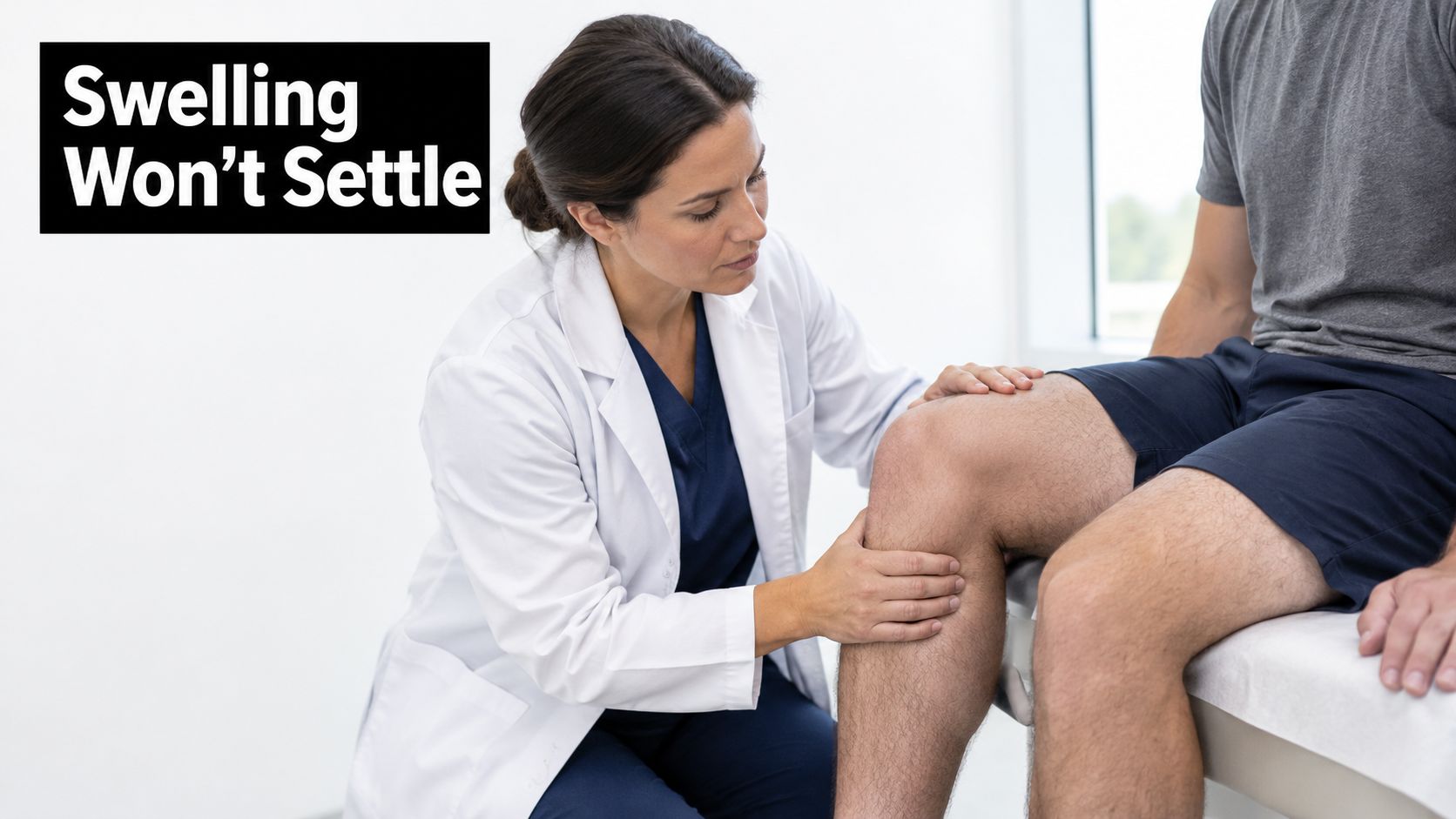
A knee that remains tight and hard to bend after home care needs an assessment, especially if swelling is large, pain persists after a few days, or fluid keeps returning. The next step is to identify the cause. Draining fluid can help with diagnosis and temporary relief, but it does not treat the underlying injury.
A clinician first examines the knee and decides whether a procedure is appropriate.
What Aspiration Can and Cannot Do
Joint aspiration uses a needle, sometimes guided by ultrasound, to remove fluid from the joint. This can reduce pressure and pain, and make the examination easier. If infection is suspected, the fluid can be sent for laboratory testing and culture.
Aspiration does not always succeed. In a study of ultrasound-guided knee aspiration, clinicians removed fluid in 47 of 61 knees, a 77% success rate. The other procedures were unsuccessful. Even when fluid is removed, it may build up again.
Aspiration is best used for diagnosis or short-term decompression, not as a lasting fix. Steroid injections generally wait until infection has been ruled out and are not routine treatment for every swollen knee. Imaging may help clarify the cause. This guide to when you need an MRI versus an X-ray explains how clinicians choose between those tests.
Clinical options for persistent knee swelling
| Option | When clinicians consider it | What it does | Main limit |
|---|---|---|---|
| Joint aspiration (needle drainage) | Large fluid buildup that limits movement or causes pain | Removes fluid, eases pain and can improve the examination | Fluid may return; the ultrasound-guided study reported a 77% success rate |
| Steroid injection | Inflammatory pain after infection is excluded | Reduces inflammation for a period | Avoid until infection is ruled out; not routine |
| Compression or hinged brace | Instability or pain when walking | Limits harmful motion and supports the joint | Needs correct fit and gradual weaning |
| Imaging (X-ray, ultrasound, MRI) | Cause unclear or home care not working | Shows fracture, tear or fluid pattern | Not every case needs an MRI |
| Specialist referral | Locking, recurrent swelling or suspected tear | Provides further assessment and treatment options | Waiting times vary by region |
A procedure should follow a clear examination and working diagnosis. Draining fluid without checking for the injury that caused it can miss a significant problem. Clinicians also need to consider infection or crystal disease, and a major twist or rapid bleeding into the joint may warrant imaging. Ask what the fluid is being tested for and what diagnosis supports any proposed injection.
Rehab Phases From Mobility to Full Loading
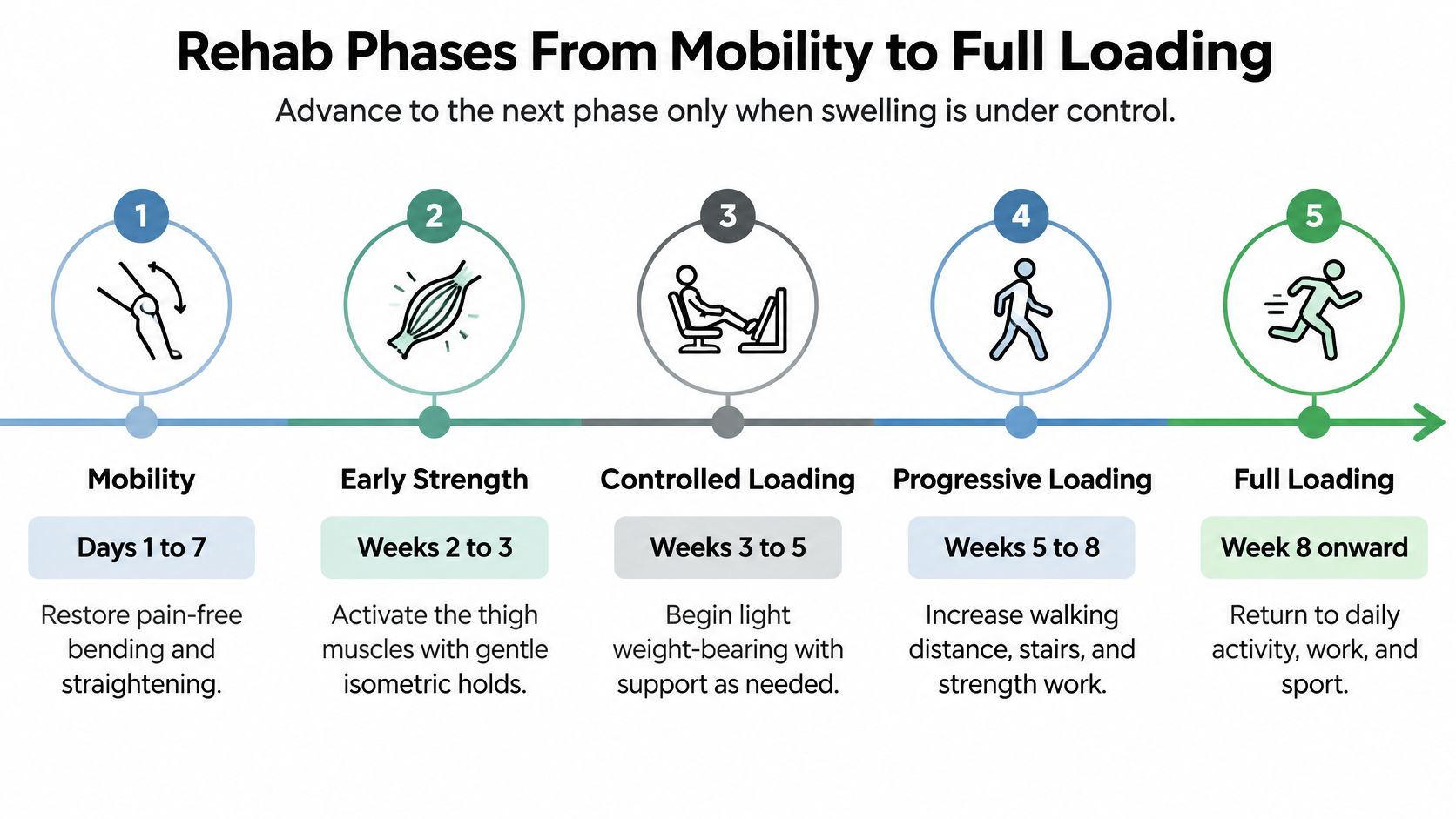
Rehabilitation moves from protection to loading, and swelling is the gate that decides when you advance. You don't earn the next phase by reaching a date. You earn it by showing the knee tolerated the last step without flaring.
Swelling gate: If the knee is noticeably more swollen the next morning after a session, step back one phase. Don't push through a fuller, tighter joint.
How the Sequence Builds
Early work restores motion first, especially full straightening. Then you reactivate the quadriceps, because that muscle shuts down quickly when a knee swells. After that comes strength, balance and coordination, then work or sport-specific loading.
Many uncomplicated injuries progress through range-of-motion work to quadriceps activation, strengthening, coordination, and functional loading over 1 to 6 weeks, with tapering visits through 12 weeks. Your exact schedule depends on the injury, so treat timelines as guides and pass tests as requirements.
This timeline shows the five phases and the goal that defines each one.
Knee rehab phases with goals and exercises
| Phase | Timeline | Goal and example exercises | Move on when |
|---|---|---|---|
| 1. Protect and calm | Days 1-3 | Control swelling; heel slides, ankle pumps, quad sets, walking with support | Walking with only a mild limp |
| 2. Restore motion | Days 4-14 | Regain full straightening and bending; low-seat stationary bike, supported heel slides, gentle hamstring stretch | Comfortable heel slides without swelling afterward |
| 3. Activate the quadriceps | Weeks 2-4 | Wake up the thigh muscle; quad sets with a towel, straight-leg raises, short-arc lifts | Straight-leg raise with no lag |
| 4. Build strength and balance | Weeks 4-8 | Strength and stability; step-ups, leg press, single-leg stance | Steady single-leg stance for about 30 seconds |
| 5. Return to function | Weeks 8-12 | Sport or work loading; lunges, hops, graded running | Pain-free activity with no next-day swelling |
Pass Tests in Real Life
Phase one ends when you can walk with only a mild limp, not when the knee looks perfect. Phase four asks more. A steady single-leg stance for about 30 seconds tells you balance and control are coming back, not just raw strength.
A 34-year-old recreational soccer player in Deerfield Beach learned the gate the hard way. He jumped to hopping drills in week three, woke with a fuller knee, and had to drop back to strength work for another week before hops were tolerated. That step back wasn't failure. It was the plan working.
If ligament injury is part of your picture, these knee ligament injury treatment exercises show how activation and strength work progress safely. Identify the phase you're in today, confirm its pass test, and only then advance.
Book a Visit When Swelling Ignores the Plan
You have followed the home plan, but the knee keeps filling or loses motion again after activity. That is a reason to book an assessment, especially when swelling persists, feels hot, looks red, or is getting larger. Knee swelling has several possible causes, so the next step depends on the injury timeline, your symptoms, and your medical history. The National Institutes of Health StatPearls review on knee swelling describes the range of conditions that can cause it.
When to Arrange an Assessment
Seek prompt medical care for new calf pain or swelling, or for a knee that becomes hot and red, particularly if you also have a fever. Swelling that appeared soon after a major twist also deserves timely evaluation. If the knee has not started improving after about a week of consistent home care, or repeatedly swells when you return to activity, arrange a visit rather than continuing the same plan.
A clinician can assess whether the problem is likely related to injury, bleeding, crystal arthritis, inflammatory disease, or another cause. The right treatment depends on that assessment. Rest may help a new injury settle, while prolonged rest can make stiffness and weakness harder to address once the acute symptoms ease. Ice and anti-inflammatory medication are not suitable for everyone, so discuss medication risks and activity changes in light of your health and the timing of the swelling.
What a Good First Visit Looks Like
Expect questions about how the injury happened, when swelling began, and what makes it better or worse. The clinician should check movement and strength, then explain what to do this week, what to avoid, and which changes call for earlier follow-up.
MedAmerica Rehab Center provides physical therapy, hands-on therapy, and targeted exercise plans for drug-free, non-surgical care. The clinic also treats sports injuries and auto accident or workers' compensation cases.
Bring the injury date, where swelling first appeared, and whether it came on quickly or built over time. List your medicines, including blood thinners, and bring dated photos if you have them. These details help the clinician understand how the knee has changed.
If symptoms are worsening or a new warning sign appears, seek prompt care. When the acute swelling has settled but motion or strength remains limited, book a rehab assessment and work at a level your knee can tolerate without a lasting flare.
Don't guess your way through recurring swelling or a knee that is not recovering as expected. At MedAmerica Rehab Center, request an assessment and a rehab plan for swelling, mobility, and quadriceps strength. Call or request a visit in Deerfield Beach, and bring your injury timeline and medicine list so the first session can focus on your situation.
MedAmerica Rehab · Deerfield Beach
Talk to a clinician about your pain
Physical therapy, chiropractic, acupuncture and shockwave therapy under one roof, since 1995. Same-day appointments are available.
Mon–Thu 8:00 AM – 6:30 PM · Fri 8:00 AM – 3:00 PM