
Acupuncture Pain After Treatment: Is It Normal
Mild needle-site soreness, a small bruise, tiredness, or a brief flare of your original pain can happen after acupuncture and is usually short-lived. Pain that worsens, spreads, or doesn't begin settling needs a call to the treating clinician, while chest pain, trouble breathing, fainting, or new weakness needs urgent assessment.
You might be reading this the morning after treatment, touching a tender spot on your back and wondering whether you should feel better already. Perhaps the needle sites barely bother you, but your familiar neck stiffness or leg pain feels louder than before.
Those are different situations. With acupuncture pain after treatment, the useful questions are where you hurt, whether the feeling resembles your original symptoms, and what you can comfortably do now.
Normal Soreness Versus Pain That Needs a Call
A small, tender spot where a needle went in is different from pain that keeps spreading or interferes with walking. Mild local discomfort doesn't automatically mean you've been injured, but the word normal shouldn't be used to dismiss symptoms that are getting worse.
Use the table to identify the closest match before trying home care. The timing descriptions are practical observations, not a guarantee about how your body must recover.
Post-acupuncture sensations and what to do
| Sensation | Typical timing | What it usually means | Action |
|---|---|---|---|
| Needle-site soreness or ache | Soon after treatment; should progressively ease | Expected local reaction when mild and confined to the point | Leave the site alone; stay ordinarily active as tolerated |
| Small bruise or pinpoint bleeding | May be noticed shortly after treatment; discoloration can outlast tenderness | Minor bleeding, with greater concern when taking blood thinners | Avoid repeated pressing; tell the clinician about blood thinners |
| Tiredness, drowsiness, or mild lightheadedness | Around the appointment or afterward | A recognized short reaction when mild and resolving | Sit or lie down; drink water; don't drive while woozy |
| Brief flare of the original pain | After the session, followed by settling rather than continued escalation | Symptom fluctuation, not proof of success or failure | Compare the familiar symptoms and daily function with your pre-treatment baseline |
| Spreading redness, fever, or marked swelling | Any time after treatment | Possible infection or significant bleeding | Seek prompt medical assessment |
| Chest pain, breathing trouble, fainting, new numbness or weakness | During treatment or afterward | A warning that shouldn't be treated as routine soreness | Seek urgent or emergency care |
What safety findings actually mean
A 2021 systematic review of prospective clinical studies estimated that 9.31% of patients completing an acupuncture series experienced at least one adverse event, with a 95% confidence interval of 5.10% to 14.62%; approximately 7.57% of individual treatments involved an adverse event. These measures describe different things: a patient's experience across a treatment series and events associated with individual appointments.
An adverse event isn't necessarily a serious injury. The term includes unwanted effects such as local pain, bleeding, bruising, and a temporary symptom flare. It's reasonable to ask about those effects without assuming that every tender point represents damage.
For your same-day decision, the important distinction is mild and settling versus unusual or escalating. A bruise that's no longer expanding and feels less tender is different from increasing swelling accompanied by worsening pain.
Don't use a reassuring statistic to override what's happening in front of you. Match the closest row and follow its action, using the more urgent response when symptoms overlap.
Why the Needled Area Can Ache
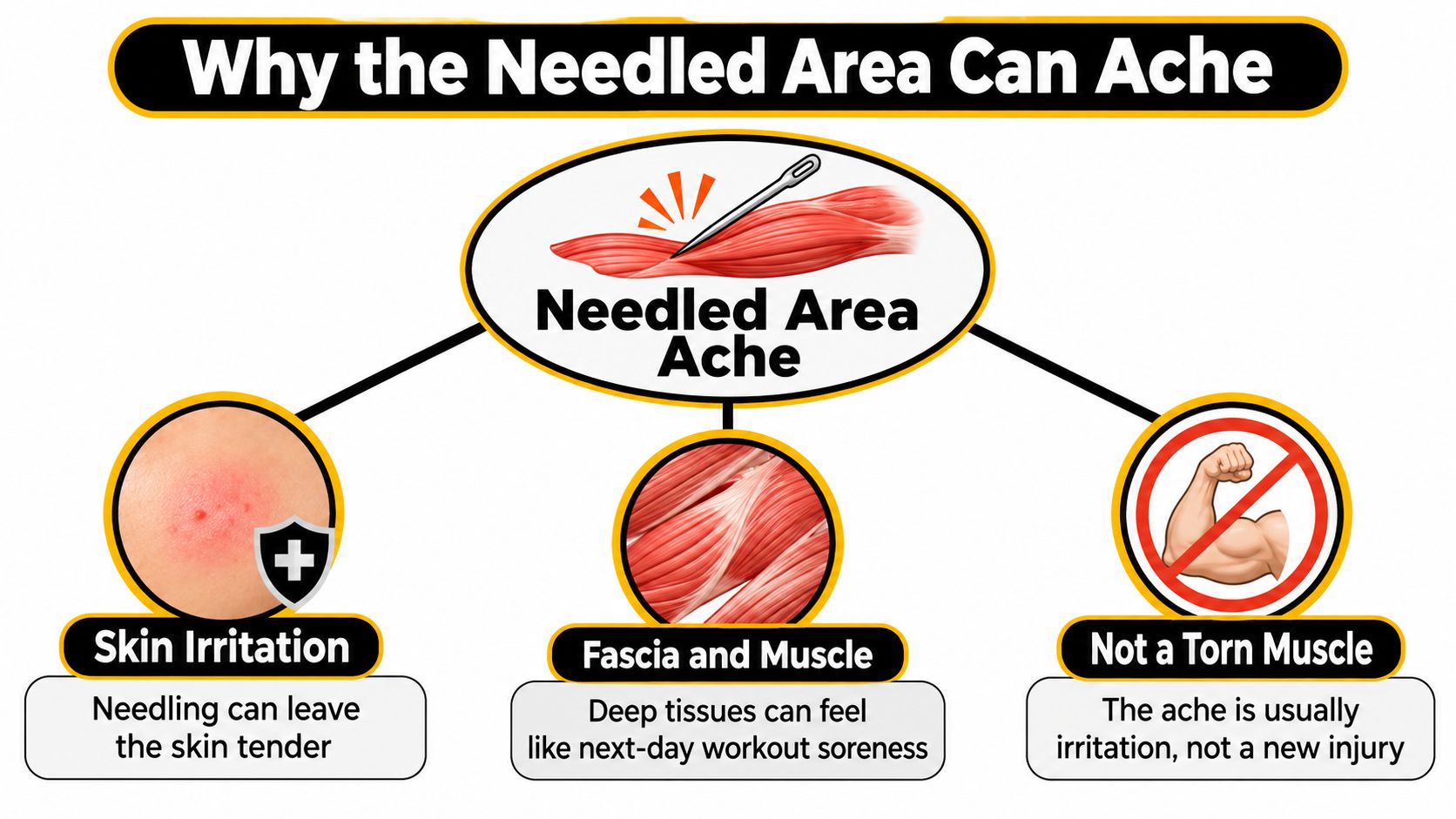
A needled muscle can feel a little like a muscle after an unfamiliar workout: tender, heavy, or bruised when you move. That comparison describes the sensation, not proof that acupuncture produces the same tissue changes as exercise.
Say you had treatment around a tight shoulder. Later, lifting your arm makes a small area ache, but the arm still works normally and there's no spreading pain. Local irritation is a more useful starting explanation than assuming a torn muscle.
Local irritation isn't the same as a new injury
A needle passes through skin and may stimulate deeper tissues, including fascia and muscle. That contact can leave focal tenderness, and a small amount of bleeding can produce a bruise.
During treatment, some people describe a dull, heavy, or pulling sensation. Tell the practitioner if it becomes sharp, burning, electric, or difficult to tolerate. You don't need to endure a painful sensation to make the appointment worthwhile.
If you've also heard about dry needling, don't assume the terms describe identical treatment plans. This explanation of dry needling in physical therapy can help you clarify which procedure you received and which aftercare instructions apply.
For jaw symptoms, Pain and Sleep Therapy Center's resource on trigger point treatment for jaw pain provides context for discussing muscle-focused care. Jaw tenderness still needs to be interpreted alongside your diagnosis rather than attributed automatically to a trigger point.
Keep the risk in proportion
A review of prospective acupuncture safety studies described a survey of approximately 34,000 treatments with no serious adverse events and 43 minor events; the reviewed prospective evidence also recorded two pneumothoraces in nearly a quarter of a million treatments.
A pneumothorax is a collapsed lung. It's uncommon, but the possibility explains why breathing symptoms after needling around the chest or upper back deserve immediate attention rather than reassurance over the phone.
Brief local soreness is much more likely than a major complication. That doesn't make new chest or breathing symptoms safe to watch at home.
Appropriate technique, informed consent, and communication during treatment remain important. Before you leave, make sure you know whom to contact if an unexpected symptom develops.
How Long Soreness Usually Lasts
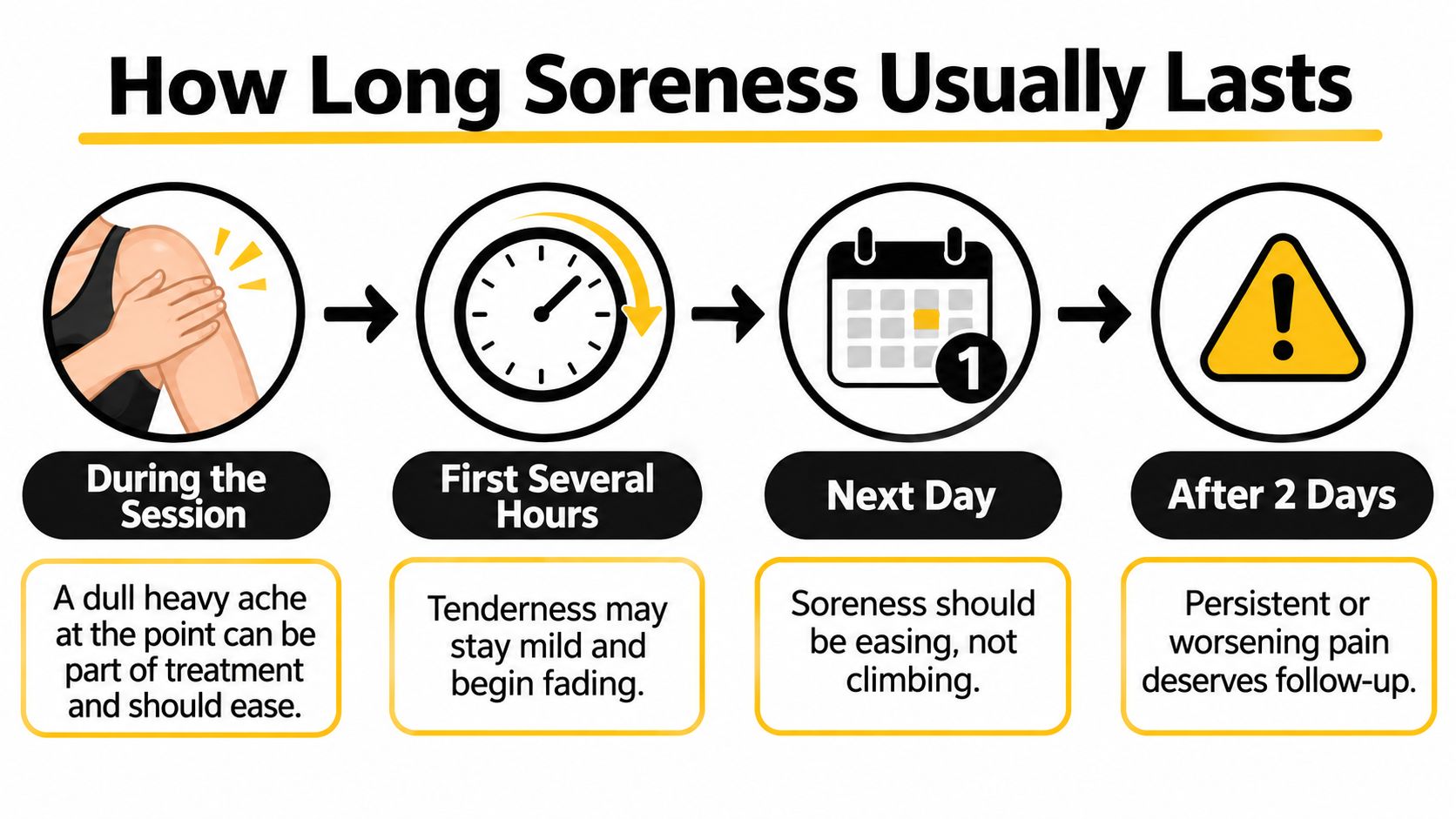
The most useful clock is whether you're improving, not a rigid deadline. Acupuncture safety studies often describe reactions as transient without establishing a reliable hour-by-hour recovery schedule.
A 2024 systematic review of chronic neck-pain acupuncture studies published in Medicine found an 8.5%–13.8% probability of adverse events, described as mild and transient. That supports a short-lived pattern, but it doesn't establish an exact deadline for every tender point.
Expected soreness timeline after acupuncture
| Phase | Timing | Expected | Concerning |
|---|---|---|---|
| During treatment | While needles are in place | A tolerable dull or heavy sensation that eases | Sharp pain that persists after removal |
| First hours | Soon after the appointment | Local tenderness; possible sleepiness or slight lightheadedness | Increasing dizziness or fainting |
| Evening | Later on the treatment day | A deeper point may feel bruise-like, even without visible discoloration | Expanding bruising or steadily climbing pain |
| Next morning | After the first night | Mild tenderness that's stable or beginning to ease | Sharper symptoms, new numbness, or weakness |
| Following days | As recovery continues | A clear downward trend in tenderness | No improvement, new spreading redness, or increasing swelling |
Don't read the table as permission to wait through warning signs. A new neurological symptom or breathing problem matters whenever it appears, not only after a particular amount of time has passed.
Compare the same activity
Checking tenderness with your thumb repeatedly won't tell you much. Instead, compare a familiar activity under similar conditions: getting out of bed, turning your head to reverse the car, or walking from your front door to the mailbox.
If the spot remains noticeable but those activities are easier, that's different from pain that's spreading while movement becomes harder. Neither a visible bruise nor the absence of one tells the whole story.
Your clinician may also need to account for a larger bruise, blood-thinner use, recent surgery, or the underlying condition being treated. Those details can change the advice even when the initial symptom sounds minor.
Practical rule: If you can't identify any improvement, or you're changing how you walk or sleep because symptoms are worsening, contact the treating clinician rather than waiting for a calendar cutoff.
Keep a brief log: appointment time, when soreness was worst, and whether walking, sleep, or lifting is easier or harder than before treatment. That gives the clinician something more useful than “it still hurts.”
Home Care for Ordinary Needle Site Pain
Home care is appropriate for mild, local soreness that's settling, not unexplained worsening pain. The aim is to keep the area comfortable while avoiding extra irritation.
A systematic review of acupuncture safety reported local needling pain in approximately 1.1%–2.9% of treatments, while slight bleeding or hematoma was reported in approximately 2.1%–6.1%. These minor reactions were generally transient and self-limiting.
Use a simple routine
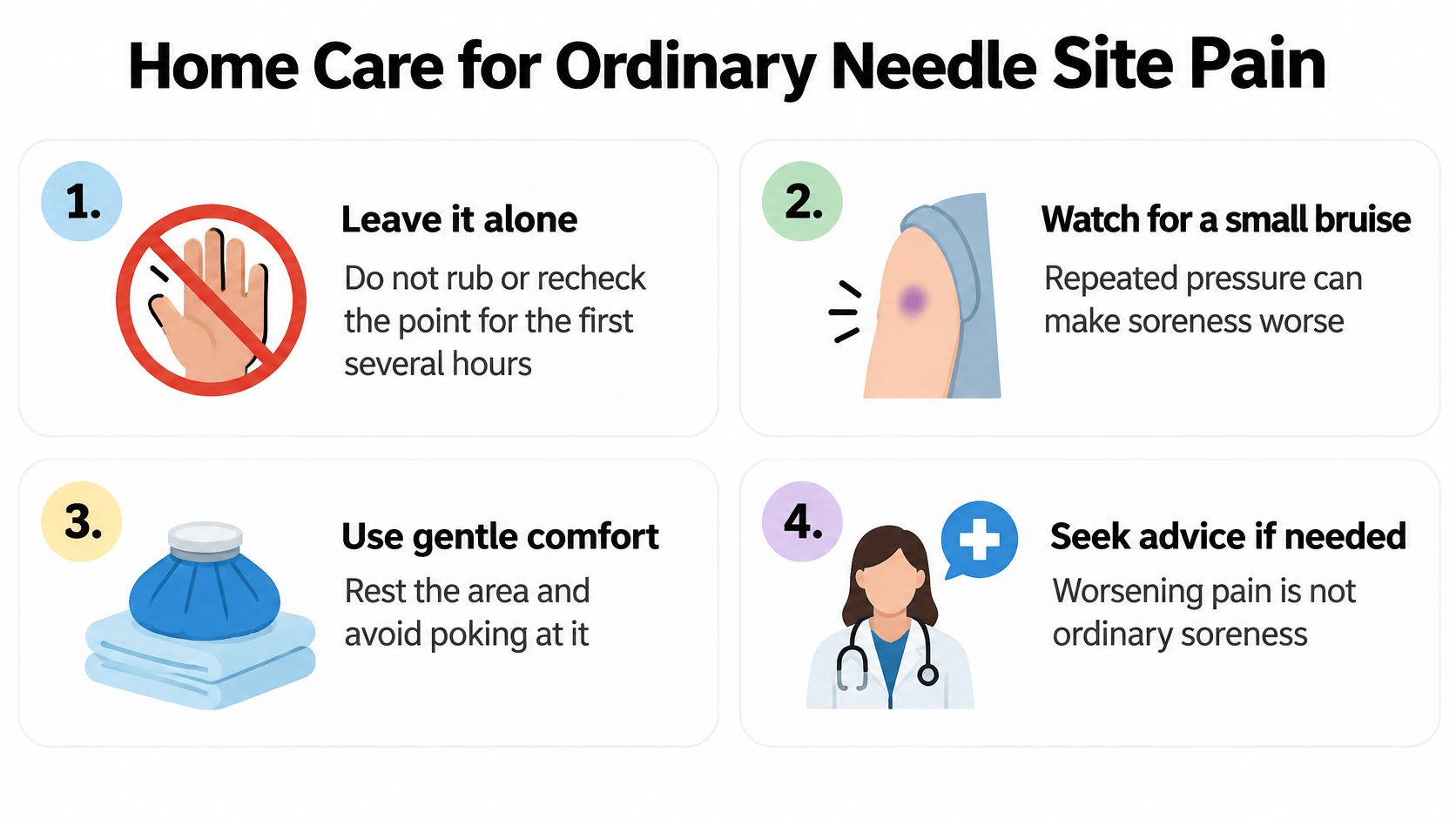
Leave the point alone. Don't keep rubbing, squeezing, or checking it with your thumb. Repeated pressure can make an already tender area more uncomfortable.
Address a small drop of blood gently. Hold a clean tissue or gauze against the spot until the bleeding stops, without repeatedly lifting it to check. Continued bleeding, especially with blood-thinner use, needs clinical advice.
Keep ordinary movement comfortable. A gentle walk or normal household movement is reasonable if it doesn't increase symptoms. Skip a strenuous workout or deep massage over a freshly tender or bruised area.
Choose comfort rather than aggressive treatment. A cool pack wrapped in cloth may soothe a visible bruise. Gentle warmth may feel better for a dull muscle ache, but avoid heat over an actively swelling area and don't place either pack directly against skin.
Respond to tiredness safely. Drink water normally and give yourself a quieter evening if you feel wiped out. Don't drive, climb ladders, or use equipment while lightheaded.
Check the direction of change. Notice whether movement and comfort are improving without repeatedly provoking the site. If symptoms escalate, stop experimenting with remedies and call.
Medication history changes the advice
Tell the treating clinician about anticoagulants, antiplatelet medicines, bleeding disorders, and easy bruising. Don't stop a prescribed blood thinner because you notice a bruise after acupuncture.
Likewise, don't automatically add an over-the-counter pain medicine or a new topical product. Your medication list, skin condition, and medical history may affect what's appropriate.
Avoid placing a hot or cold pack over skin with reduced sensation unless a clinician has advised you how to use it safely. You should be able to feel whether the temperature is uncomfortable and inspect the skin afterward.
For ordinary soreness, doing less to the point is often more sensible than adding another treatment. A quiet area that's improving doesn't need repeated massage, forceful stretching, or another needle session to make the tenderness disappear.
When the Original Pain Flares Instead
Needle-site pain usually has a location you can point to. A flare of the condition being treated feels more like the familiar problem: the same leg symptoms, neck stiffness, or joint pain, temporarily more noticeable.
The distinction isn't always clean. You can have both a tender needle point and a change in your original symptoms, so compare them separately.

A low-back spot and familiar calf pain
Say you're receiving treatment for sciatica. Afterward, there's a dull spot near a low-back needle site, while the familiar calf discomfort feels more noticeable that afternoon.
By the next morning, the calf symptoms have returned toward baseline and walking isn't harder. That pattern can fit local soreness alongside a brief symptom flare, rather than establishing that a new injury occurred.
The clue is what happened to the leg symptoms and walking, not whether your back was tender. For condition-specific context, the page on acupuncture for sciatica pain can help you prepare questions about your treatment goals.
Neck stiffness without a new symptom pattern
Someone treated for neck pain and headaches might wake feeling stiff, similar to having slept awkwardly. If gentle movement becomes easier and the discomfort remains familiar, that's different from a new headache pattern, arm weakness, or persistent numbness.
Don't force neck stretches to prove everything is fine. The useful clue is whether comfortable movement returns without creating new symptoms.
For arthritis, separate joint pain from tenderness in nearby skin and muscle. If you're considering additional products, Strong Strains Cannabis Dispensary's guide can help you compare cannabis creams for arthritic joints, but it shouldn't be used to diagnose a post-treatment flare or justify covering up worsening symptoms.
A minor label can hide a meaningful practical problem
Consider an older adult taking a blood thinner who develops a noticeable bruise and feels unsteady when standing. The bruise may be local, but the risk of falling makes the situation more consequential.
The same caution applies after an auto injury or orthopedic surgery. A change that interrupts prescribed walking or rehabilitation deserves discussion, even if the needle site itself looks unremarkable.
- Local soreness: Tenderness stays near the treated point and becomes less intrusive.
- Original-pain flare: Familiar symptoms temporarily intensify, then move back toward baseline.
- Reason for reassessment: Symptoms spread, daily ability declines, or pain continues escalating.
A temporary flare doesn't prove the underlying condition worsened. It also doesn't give anyone permission to dismiss a genuine loss of function.
Whether to Continue or Pause Treatment
Soreness isn't proof that acupuncture is working. It also isn't automatic proof that treatment failed.
A review comparing acupuncture with usual care for chronic low-back pain found significant immediate and intermediate pain reductions across eight randomized trials involving 1,123 participants, but adverse-event reporting was sparse. Reported adverse effects were generally mild, yet limited reporting means those findings can't guarantee an individual patient's response.
Checkpoints for the next acupuncture visit
| Checkpoint | Continue | Adjust or pause |
|---|---|---|
| Pain before each visit | Same or lower than the previous baseline | Baseline pain rises after each visit |
| Peak soreness afterward | Mild and local | Severe, spreading, or accompanied by new weakness |
| Time to settle | Clearly fading before the next planned treatment | Not settling, worsening, or requiring repeated self-treatment |
| Daily function | Walking, sleep, or lifting holds steady or improves | Function drops |
| Pattern across visits | Mild reactions alongside meaningful improvement | No meaningful benefit, or repeated bruising and dizziness |
The “adjust or pause” column isn't a single category of urgency. Repeated mild bruising needs a treatment discussion; new weakness needs medical assessment, not different needle placement.
Make the decision with a clear goal
Continue an agreed plan when the response is tolerable and you're moving toward a functional goal. That might mean walking more comfortably, sleeping with fewer interruptions, or managing prescribed exercises more easily.
Ask for reassessment when the treatment burden outweighs the benefit. The practitioner can consider whether points, treatment intensity, or appointment spacing should change, or whether another approach is more appropriate.
A treatment plan should earn its place through tolerable care and meaningful benefit, not through the assumption that pain must come before progress.
Acupuncture is an adjunct, not a replacement for diagnosis, exercise-based rehabilitation, or necessary medical evaluation. Guidelines don't uniformly recommend it for every pain condition, so the decision needs to fit your symptoms, preferences, and broader care plan.
You can use the information on acupuncture for pain relief to frame that conversation around your goals rather than expecting an identical response from every appointment.
For an older adult, a person taking blood thinners, or someone recovering from surgery, even a reaction described as minor may disrupt safety or rehabilitation. Don't wait for the pain score to become extreme before mentioning repeated dizziness, reduced confidence walking, or missed exercises.
Call the Clinic With These Details
Start with a clear description rather than asking only, “Is this normal?” A useful call sounds like this:
“I had acupuncture on this date, around these areas. The discomfort started afterward and was worst at this point. It's now improving, unchanged, or worsening, and this is what I'm having trouble doing.”
Then provide the details that help the clinician decide what happens next.
- Treatment location: Identify the needle sites and whether the pain stays there or travels elsewhere.
- Symptom change: Explain how this differs from your usual back, neck, sciatica, or arthritis pain.
- Visible changes: Mention an enlarging bruise, redness, warmth, drainage, or swelling.
- Medication list: Include blood thinners, nonprescription medicines, and supplements.
- Functional effect: Say whether you can walk, sleep, lift, or complete your rehabilitation exercises as before.
Choose the right route for help
For escalating pain or an expanding bruise, contact the treating clinician promptly. For chest pain, difficulty breathing, fainting, or new weakness, seek urgent or emergency assessment instead of waiting for a routine callback.
If you're in Deerfield Beach or a nearby community, our team can help arrange an aftercare discussion. At MedAmerica Rehab Center, we offer acupuncture for pain, headaches, and tension alongside physical therapy and chiropractic care.
Bring your symptom log and current medication list so the discussion reflects the whole response, not just how tender a point feels. Describe what's bothering you when requesting an appointment; we call back to confirm the time. Same-day appointments are available, but confirm current scheduling directly rather than assuming a particular opening.
If symptoms are mild and steadily improving, keep your notes for the next visit. You don't have to decide alone whether the next treatment should proceed unchanged.
MedAmerica Rehab Center offers acupuncture alongside physical therapy and chiropractic care for people managing pain and mobility problems. If soreness or a flare has left you unsure about your next appointment, visit MedAmerica Rehab Center to request a review, and bring your symptom timeline, medication list, and notes about what's become easier or harder.
MedAmerica Rehab · Deerfield Beach
Talk to a clinician about your pain
Physical therapy, chiropractic, acupuncture and shockwave therapy under one roof, since 1995. Same-day appointments are available.
Mon–Thu 8:00 AM – 6:30 PM · Fri 8:00 AM – 3:00 PM