
Shockwave Therapy Shoulder Pain: Who It Helps
You've rested your shoulder, stopped lifting heavy bags, and changed how you sleep. Yet reaching for a mug still hurts. Someone suggests shockwave therapy, and you want to know whether it could help or whether you'd be paying for another treatment that misses the problem.
The answer starts with your diagnosis, not the machine. Shockwave therapy has a stronger rationale for a rotator-cuff tendon containing a calcium deposit than for an equally painful tendon without one. Before booking treatment, find out which shoulder problem you have.
Which Shoulder Problems Shockwave Therapy Can Help
Calcific rotator-cuff tendinopathy means calcium has collected within a tendon that helps move and stabilize your shoulder. Noncalcific tendinopathy means the tendon is painful without that calcium deposit. The symptoms can overlap, but the treatment recommendations aren't interchangeable.
The 2025 rotator-cuff tendinopathy clinical-practice guideline says clinicians may consider shockwave therapy for calcific tendinopathy, reporting a small, statistically significant pain benefit versus control, SMD −0.32, with a 95% confidence interval of −0.55 to −0.09, while recommending against it for noncalcific tendinopathy. The same guideline indicates that high-energy treatment may outperform low-energy treatment.
That distinction should guide the conversation before anyone discusses a treatment package.
Shoulder diagnoses and whether shockwave therapy fits
| Shoulder problem | Shockwave fit | Evidence snapshot | Confirm first |
|---|---|---|---|
| Calcific rotator-cuff tendinopathy | May consider | Small pain benefit versus control; high energy may outperform low energy | Calcium deposit on ultrasound or radiograph |
| Noncalcific rotator-cuff tendinopathy | Guideline recommends against | Meaningful pain or disability benefit hasn't been demonstrated | Clinical examination; imaging if a tear is possible |
| Rotator-cuff tear | Not a calcium treatment | Don't assume results for calcific disease apply | Tear characteristics and whether surgical assessment is needed |
| Subacromial bursitis or impingement | Mixed, not automatic | Calcific results shouldn't be assumed to apply | Whether a deposit, tear, or irritated bursa is driving symptoms |
| Frozen shoulder | Not established | A different problem dominated by restricted movement | Active and passive motion pattern; diabetes history |
| Glenohumeral arthritis | Poor match for a calcium-targeting protocol | Joint-surface disease isn't the same as tendon calcification | Joint findings and activity limitations |
| Pain referred from the neck | Wrong target if the neck is the source | Treating the shoulder can miss the cause | Neck examination and arm-symptom pattern |
A rotator-cuff tear needs a plan that accounts for weakness, the injury history, and the tissue involved. Shockwaves shouldn't be presented as a way to repair a torn tendon.
With frozen shoulder, the clinician looks for substantial restriction when you move your arm and when someone else moves it for you. With arthritis, the joint itself needs assessment. Pain spreading from the neck, particularly with tingling or numbness, calls for a different examination again.
Confirm the target before choosing treatment
A physical examination comes first. Ultrasound or radiographs can help confirm calcium when imaging is clinically indicated, but a deposit on a scan still needs to fit your symptoms.
For pain described as impingement, rehabilitation for shoulder impingement can help you understand why movement, strength, and task demands deserve attention rather than assuming every painful reach needs shockwaves.
Practical rule: Match your diagnosis to a row before matching your shoulder to a treatment.
Even for calcific disease, suitability doesn't mean superiority over every alternative. Ask whether your main goal is less night pain, easier movement, or restored lifting capacity, because those aren't identical outcomes.
How Shock Waves Reach a Painful Shoulder
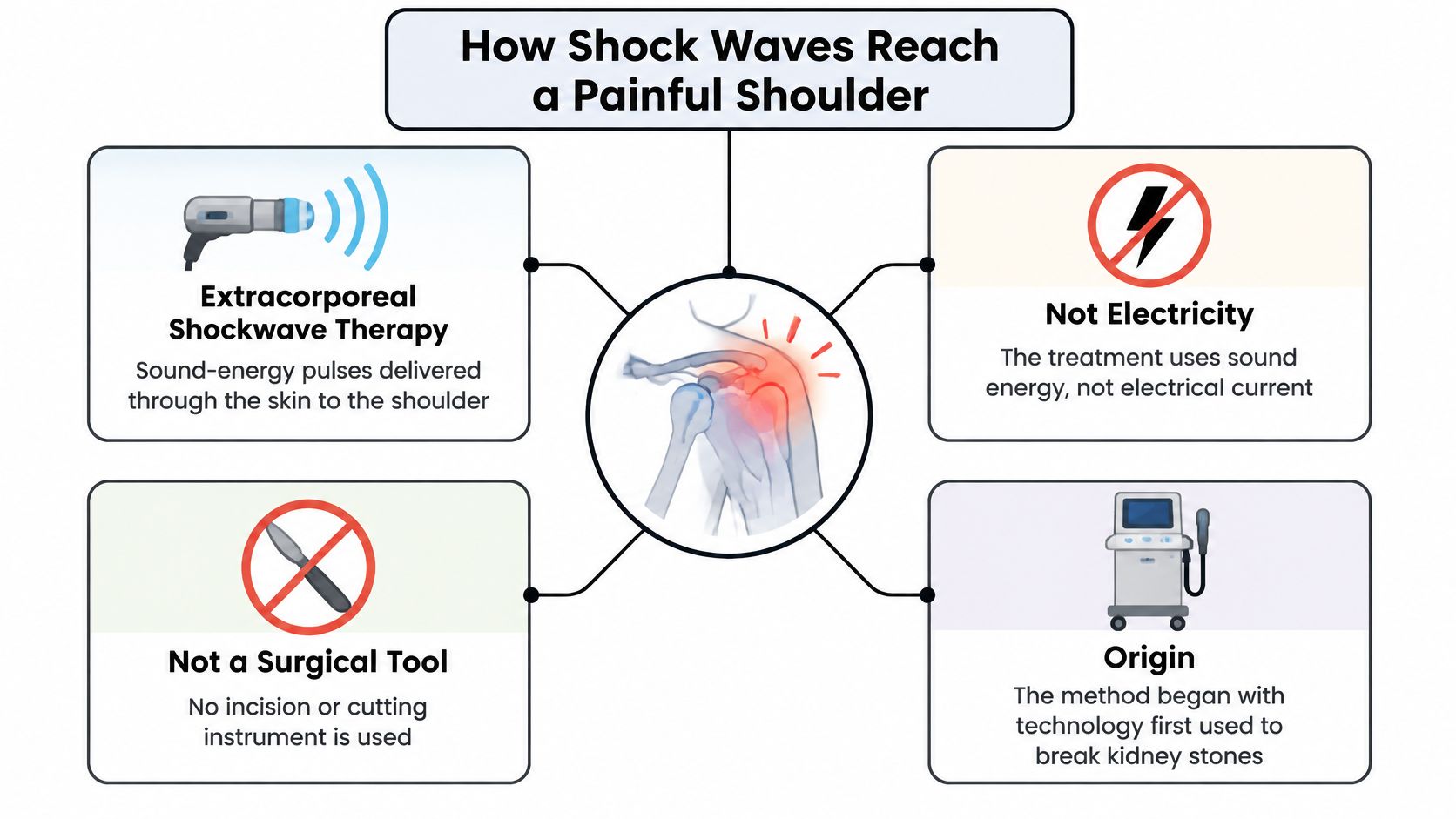
Extracorporeal shockwave therapy, usually shortened to ESWT, delivers acoustic energy through the skin. “Extracorporeal” means outside the body. The device doesn't deliver an electrical shock, and it doesn't cut into the shoulder.
The technology developed from acoustic-pulse treatment used for kidney stones. Clinicians later investigated whether tendon calcium could also respond, with early shoulder work focused on calcific disease rather than every cause of shoulder pain.
This diagram separates sound-energy treatment from electricity and surgery.
Focused and radial delivery
Say an ultrasound identifies a deposit within a rotator-cuff tendon. A clinician choosing focused shockwaves can direct the energy toward a more defined target. Radial pressure waves spread over a broader area from the skin surface.
Those labels matter. Different devices and settings don't necessarily deliver an equivalent treatment just because both appointments are called shockwave therapy.
- Focused treatment: Directs energy toward a selected tissue target.
- Radial treatment: Distributes pressure over a broader treatment area.
- Dose selection: Requires the clinician to match the device, target, and intensity rather than increase power until treatment hurts.
Why energy level matters
An OrthoEvidence review of calcific shoulder treatment describes a Gerdesmeyer-led comparison in which high-energy ESWT at 0.32 mJ/mm² produced better results than low-energy treatment at 0.08 mJ/mm², although low-energy treatment could also dissolve deposits.
Think of each pulse as a controlled mechanical stimulus, not a miniature surgical instrument. Tissue can respond through changes in cell activity, and a calcium deposit may fragment or undergo resorption, meaning the body gradually clears it.
That doesn't mean the clinician can promise to smash away every deposit. A plausible mechanism isn't a guaranteed clinical result, and a change on imaging isn't automatically the same as comfortable, useful movement.
What the Research Shows for Shoulder Pain
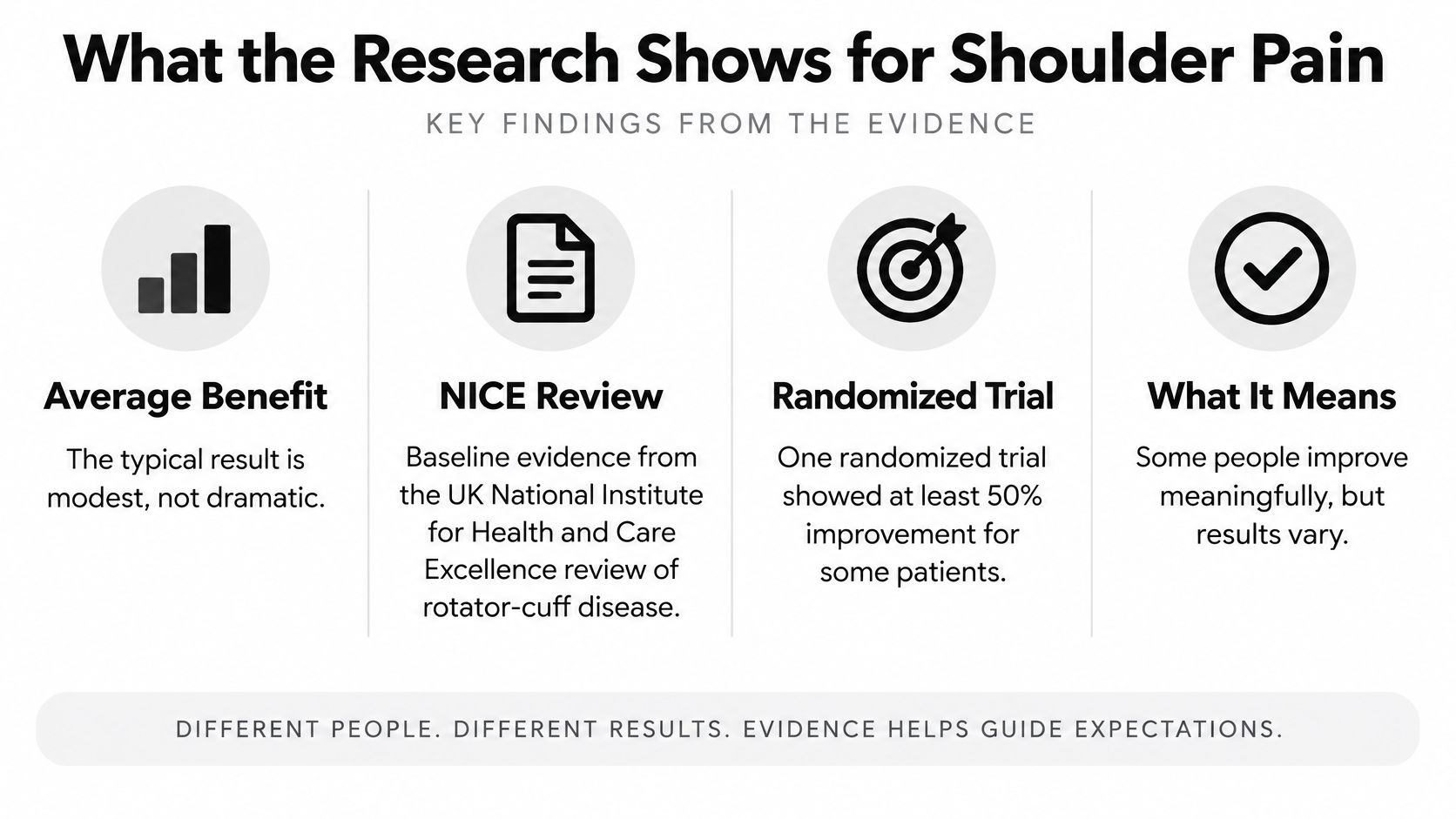
Average pain improvement has often been modest, even though individual patients may improve substantially. The important comparison isn't whether people felt better after treatment. It's whether they improved more than people receiving placebo treatment, and whether that difference mattered in daily life.
The NICE efficacy summary for rotator-cuff disease reports the trial results below, including an average pain advantage of 0.78 points across nine trials involving 608 participants, below the review's 1.5-point threshold for a clinically important difference.
Key shockwave trial findings
| Evidence | Shockwave result | Comparator | Effect and interval |
|---|---|---|---|
| At least 50% pain relief at three months, one randomized trial | 41% (14 of 34) | 38% (15 of 40) receiving placebo | Relative risk 1.10; 95% confidence interval 0.62 to 1.94 |
| Average pain, nine trials, 608 participants | 0.78 points better than placebo | Placebo | Reported benefit range 0.17 to 1.40 points; clinical threshold 1.5 points |
| Successful outcome, six trials, 287 participants | 39% (58 of 150) | 26% (35 of 137) receiving placebo | Relative risk 1.59; 95% confidence interval 0.87 to 2.91 |
| Calcific tendinopathy guidance | May be considered | Control treatments | Small pain benefit; treatment selection matters |
| Noncalcific tendinopathy guidance | Recommended against | Sham or other control treatments | Meaningful pain or disability benefit not established |
| Higher-energy versus lower-energy evidence | More favorable findings with higher energy | Lower-energy treatment or placebo | Findings differ by outcome and protocol |
| Complete calcium resorption | Can be more likely after treatment | No treatment or placebo | Deposit clearance doesn't establish equivalent functional recovery |
Understanding uncertainty
A relative risk of one means no difference between groups. When its confidence interval includes that value, the findings remain compatible with no true treatment advantage. That applies to the pain-relief and successful-outcome comparisons shown above.
The practical message is more nuanced than either “it works” or “it doesn't.” A trial can include responders while still failing to show a dependable advantage over placebo.
This visual summarizes why a clinic shouldn't promise a single success rate for every shoulder.
A quoted success rate is useful only when you know the diagnosis, treatment protocol, and definition of success.
A person who sleeps better but still can't lift a work bag may reasonably judge the result differently from someone whose main goal was relief at night.
A Typical Shockwave Treatment Course
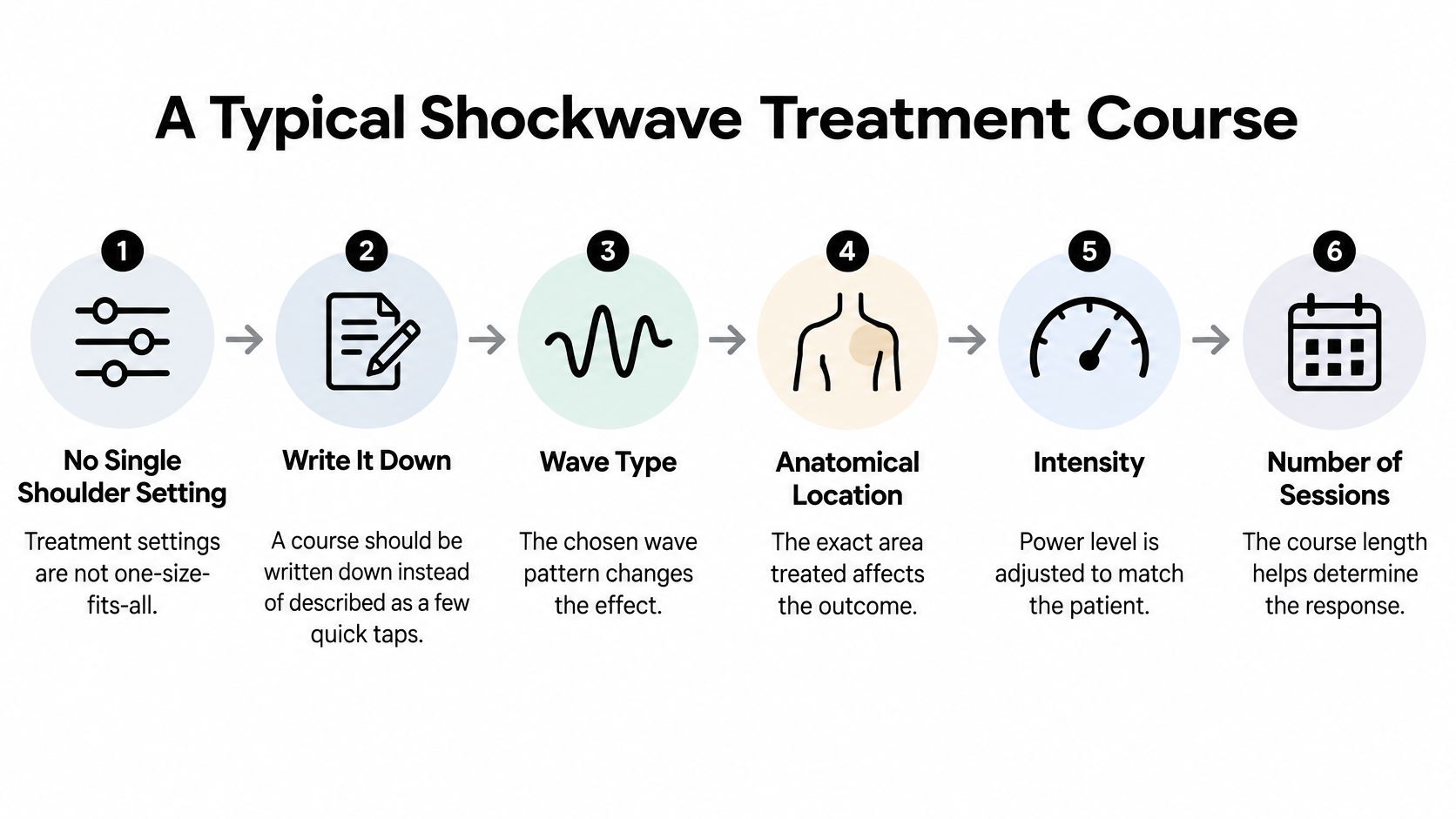
There isn't a single shoulder setting that suits everyone. A useful treatment plan names the tissue being treated, explains the dose, and states how the clinician will decide whether to continue, modify, or stop.
Before treatment begins, the clinician should establish a baseline. That means recording your pain pattern, shoulder motion, strength or task limitations, and a suitable disability questionnaire.
Dose variables to record in a shockwave course
| Dose variable | What to record | Why it matters |
|---|---|---|
| Wave type | Focused or radial | Changes how energy reaches the treatment area |
| Anatomical target | Named tendon, deposit, or other selected structure | Makes clear what the treatment is intended to address |
| Energy or pressure | Device setting and its unit | Allows the delivered intensity to be documented and adjusted |
| Pulse count | Number of pulses delivered to each target per session | Contributes to the total delivered dose |
| Session frequency | Visits per week and planned reassessment date | Documents spacing and the intended course |
| Concurrent exercise | Exercises, resistance, and progression criteria | Connects symptom management with recovery of useful capacity |
Don't settle for a description such as a few quick taps. You should understand why that target and protocol fit your diagnosis, and what would count as an inadequate response.
The treatment process should include assessment and reassessment, not just repeated device application.
A published protocol isn't a universal prescription
A randomized trial of hemiplegic shoulder pain enrolled 43 people and used three focused sessions once weekly plus five radial sessions twice weekly, compared with zero-energy treatment. Participants had stroke-related shoulder pain, so this isn't a default schedule for calcific rotator-cuff tendinopathy.
Both groups improved. Active treatment produced better pain and selected passive-motion results, but differences weren't significant for the Fugl-Meyer upper-extremity assessment or the Shoulder Pain and Disability Index, known as SPADI.
That distinction matters when reviewing your own progress. An arm that moves farther when a therapist assists it may still struggle with dressing, lifting, or reaching independently.
How to judge whether treatment is helping
Use several measures rather than asking only whether the shoulder feels less sore:
- Pain response: Track the same meaningful situations, such as getting dressed or sleeping.
- Active and passive movement: Compare what you can do yourself with what the joint allows when assisted.
- Disability and task performance: Repeat the questionnaire and test relevant activities.
- Deposit assessment: Consider follow-up imaging when it would change management.
If discomfort improves but overhead work remains impossible, that's a partial response. The clinician should reassess the limiting factor rather than treating pain reduction as a completed recovery.
Soreness Side Effects and Time to Feel Better
Non-invasive doesn't mean painless. During treatment, the pulses can feel like sharp tapping, pressure, or aching over a sensitive area. Tell the clinician how it feels so intensity can be adjusted appropriately.
A handheld applicator delivers treatment through the skin.
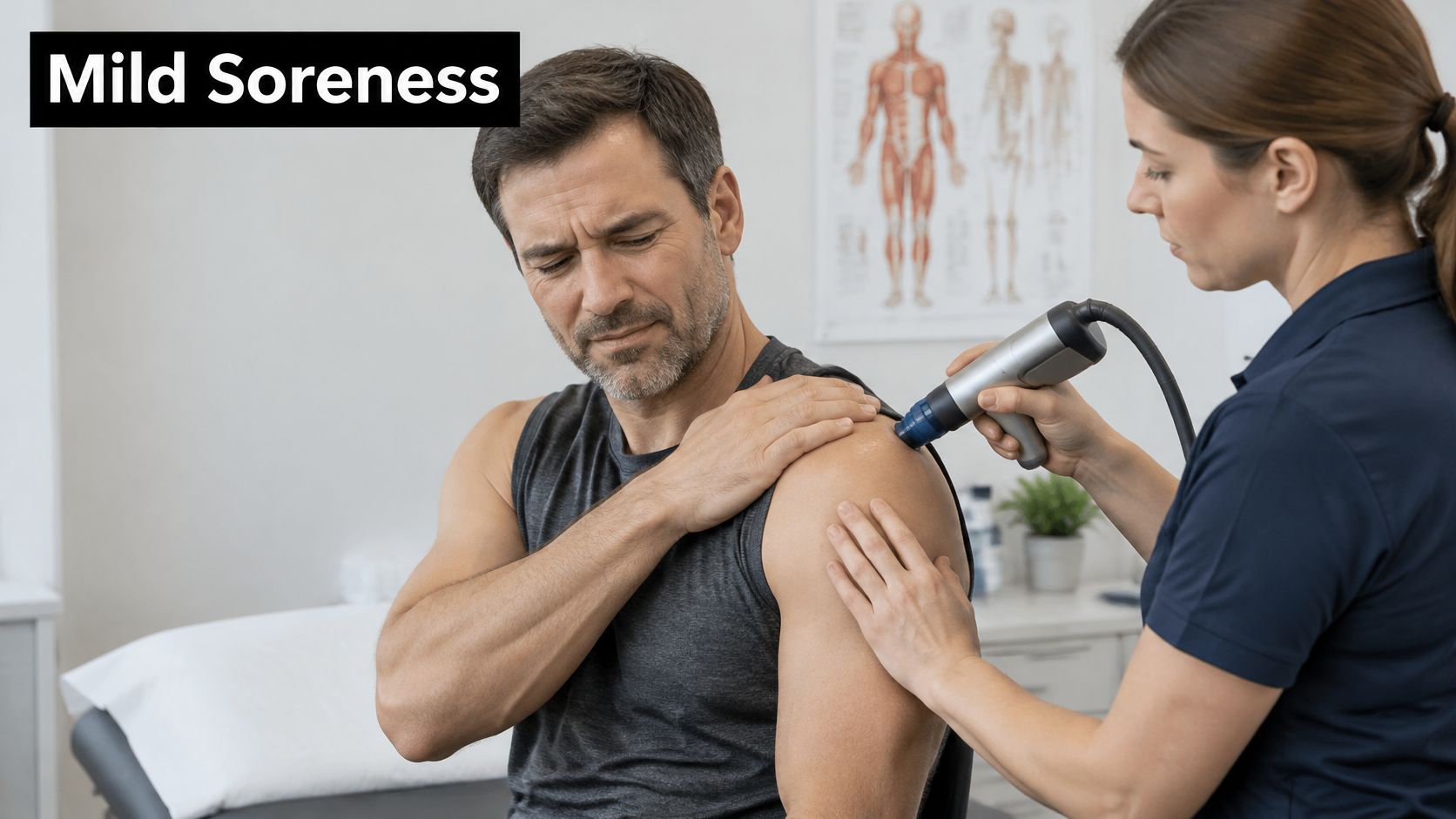
The NICE evidence overview for calcific shoulder tendinopathy found an adverse event within 12 months in 26% of shockwave recipients versus 7% in a comparator group, with reported events including pain, redness, bruising, bleeding, and increased shoulder pain. No serious adverse events were reported in the reviewed studies, but that doesn't make treatment risk-free.
Separate soreness from a worsening problem
Post-treatment tenderness can occur and isn't automatically evidence of failure. It also isn't proof that the treatment is working, so don't use soreness as a target or tolerate escalating pain to get a better result.
- Report promptly: Bleeding, a sudden loss of strength, or pain that keeps increasing instead of settling.
- Review suitability first: Tell the clinician about your health conditions and medicines before treatment.
- Get individualized instructions: Use the clinic's aftercare plan rather than assuming you should push through every symptom.
Our guide to shockwave therapy contraindications can help you prepare that safety discussion. An examination is still needed to decide whether treatment is appropriate for you.
Why recommendations differ
NICE found no major short-term safety concerns but judged efficacy evidence inadequate and recommended treatment only in research. Newer professional guidance permits it as an option for calcific tendinopathy, with a weak recommendation.
The unresolved question is who benefits, how much they benefit, and whether another option would serve them better.
Expect reassessment over weeks to months, not a verdict based on how you feel driving home. Agree on a review point before beginning, and don't let an open-ended course replace a decision about whether you're improving.
For an additional visual explanation of treatment, you can watch this video.
Before booking, obtain a written estimate covering the intended sessions and what insurance will cover. Don't assume the price of a rehabilitation visit automatically includes every treatment component.
Shockwave Therapy Beside Other Shoulder Options
Shockwave therapy is best viewed as a possible addition for a selected tendon problem, not a replacement for rehabilitation. Choosing between treatments means comparing their targets, burdens, and intended outcomes, rather than asking which sounds most advanced.
A systematic review of shockwave therapy for rotator-cuff tendinopathy supports a diagnosis-specific approach and highlights the difference between pain improvement and disability improvement. That distinction is useful when deciding whether an additional procedure is worthwhile.
Shoulder treatment paths compared
| Option | Best fit | What it does | What you still do |
|---|---|---|---|
| Shockwave therapy | Imaging-confirmed calcific tendinopathy in a suitable patient | Applies acoustic pulses to the selected target | Follow rehabilitation and reassess meaningful activities |
| Exercise-based physical therapy | Many rotator-cuff and mobility problems | Develops strength, motion, and load tolerance | Complete the home program between visits |
| Ultrasound-guided aspiration or lavage | A suitable calcium deposit contributing to symptoms | Uses imaging to guide washing or removal of calcium | Rehabilitate movement and capacity afterward |
| Corticosteroid injection | Selected cases of very irritable bursal pain | Can reduce inflammation and symptoms temporarily | Use symptom relief to resume appropriate activity |
| Platelet-rich plasma injection | Selected tendon cases after discussion of uncertainty | Injects a concentrate of the patient's platelets | Follow a staged rehabilitation plan |
| Surgery | Selected tears or persistent limitations despite suitable conservative care | May remove calcium or repair damaged tissue | Commit to postoperative rehabilitation |
An injection doesn't strengthen a shoulder by itself. Likewise, removing or reducing calcium doesn't automatically restore confidence with a heavy object overhead.
For an active-care starting point, physical therapy for shoulder injury explains the role of restoring movement and strength. The exercises should reflect what you need your arm to do, whether that's stocking shelves, swimming, or getting dressed.
Different patients need different decisions
A confirmed deposit with persistent night pain: If a well-performed exercise program hasn't provided adequate relief, discussing shockwave therapy or an ultrasound-guided procedure is reasonable. The discussion should include uncertainty, discomfort, cost, and the next step if treatment doesn't help.
Nonspecific pain during reaching: Without a confirmed calcium target, return to the examination. Review loading, shoulder-blade control, mobility, and aggravating work or exercise tasks rather than automatically adding a modality.
A tear with substantial weakness: Seek a tear-specific assessment. A surgical opinion may be appropriate, particularly after an injury or when weakness prevents essential activities, but not every tear requires surgery.
If you're comparing regenerative-treatment claims, Dream Body Clinic's a patient guide to regenerative shoulder care can help identify terminology you may encounter. Treat it as patient information, not proof that regenerative procedures have equivalent evidence or suitability.
Choose the option that matches the tissue problem. Then make sure the plan addresses the activity you want back, not merely the symptom that brought you through the door.
Book a Shoulder Evaluation at MedAmerica Rehab Center
If a clinician has confirmed a calcium deposit and an appropriate exercise trial hasn't settled your symptoms, a shockwave discussion may be reasonable. If your diagnosis is still only shoulder pain, book an evaluation rather than purchasing sessions before the cause is clear.
Prepare for a useful first visit
Bring information that helps connect your symptoms with your daily demands:
- Imaging reports: Gather previous radiograph or ultrasound findings, along with relevant specialist notes.
- Symptom pattern: Write down what hurts, when it worsens, and whether pain interrupts sleep.
- Activity goals: Identify what matters most, such as overhead work, a sport, or reaching into a cupboard.
- Previous treatment: Note which exercises or procedures you've tried and what changed.
At MedAmerica Rehab Center, physical therapy and occupational therapy initial evaluations take place on the first visit and typically last 60–75 minutes. That appointment provides time to assess the problem and discuss a suitable direction for care.
Leave with a decision you understand
Ask whether a calcium deposit explains your symptoms, how treatment will connect with progressive loading, and what measurements will determine progress. You should also understand what would prompt a change of plan.
The purpose of the evaluation isn't to justify a particular machine. It's to name the shoulder problem and choose care aimed at relieving pain, restoring mobility, and improving quality of life without surgery or unnecessary medication.
MedAmerica Rehab Center offers shoulder rehabilitation and shockwave therapy within individualized care. Visit MedAmerica Rehab Center to arrange a shoulder evaluation and find out whether shockwave therapy fits your diagnosis, goals, and rehabilitation needs.
MedAmerica Rehab · Deerfield Beach
Talk to a clinician about your pain
Physical therapy, chiropractic, acupuncture and shockwave therapy under one roof, since 1995. Same-day appointments are available.
Mon–Thu 8:00 AM – 6:30 PM · Fri 8:00 AM – 3:00 PM