

Oakleaf Family Chiropractic: Choosing Your Best Care
Your pain rarely gives you time to research calmly. After a car crash, a lifting injury, or weeks of waking up stiff, the question becomes immediate. Which clinic is most likely to reduce pain, restore normal movement, and keep this from turning into a recurring problem?
This is a common point of confusion for patients. Two clinics can sound similar online. Both may talk about chiropractic care, rehab, and personalized treatment. The difference that affects results is the care model underneath those terms.
Oakleaf Family Chiropractic is a well-known Jacksonville option with services that include adjustments, physical therapy, massage, dry needling, decompression, laser therapy, and treatment for common spine and injury complaints. For patients trying to sort out insurance questions before starting care, Happy Billing's chiropractic solutions can help clarify the billing side of a longer treatment plan.
The key question is whether your condition is best served by a primarily chiropractic model or by a multidisciplinary rehab model. That decision changes the exam, the treatment progression, the expected recovery time, and, in many cases, whether you get short-term symptom relief or more complete functional recovery.
For straightforward neck or back pain, a chiropractic-first clinic may be a reasonable fit. If pain is tied to weakness, poor movement patterns, post-surgical limitations, persistent whiplash, or an injury that affects how you walk, lift, reach, or sleep, a broader rehab model often gives a clearer path back to full activity.
Choosing Your Path to Pain Relief in South Florida
A common patient story goes like this. Your pain starts with something specific. A fender bender. A weekend pickleball match. A long month at a desk. At first, you hope it will calm down on its own. Then sleep gets harder, driving hurts, and even simple things like tying your shoes or lifting groceries start to feel unpredictable.
At that point, individuals often compare clinics by looking for familiar words. “Chiropractic.” “Physical therapy.” “Massage.” “Auto injury.” That's understandable, but it misses the clinical question that matters most. What kind of system is this clinic built to deliver?
Oakleaf Family Chiropractic is a known local option in Jacksonville, with documented operational history, a stable family-led structure, and a service menu that covers many common musculoskeletal complaints through conservative care. Another type of clinic you'll find in Florida is the integrated rehab center, where chiropractic is only one part of a larger recovery plan that may also include progressive exercise, movement retraining, and multi-provider coordination.
What patients often need to hear first: the right clinic for routine spinal pain isn't always the right clinic for post-surgical rehab, complex whiplash, or a shoulder injury that also changed how you move.
That doesn't mean one model is automatically better in every case. It means the best choice depends on what is driving your pain. If the main problem is joint restriction and you respond well to adjustments, a chiropractic-centered setting can be a strong fit. If the bigger issue is weakness, guarding, compensation, balance loss, or poor movement mechanics after injury, the clinic needs to do more than reduce pain for a day or two.
A quick decision frame
Before booking, ask yourself three things:
- What started this problem: A sudden injury, a surgery, repetitive strain, or long-term stiffness?
- What's limited right now: Pain only, or pain plus weakness, instability, numbness, limping, or loss of range?
- What outcome matters most: Relief this week, or getting back to lifting, running, work duties, or sport without repeated flare-ups?
Those answers usually point you toward the right care model faster than any marketing page does.
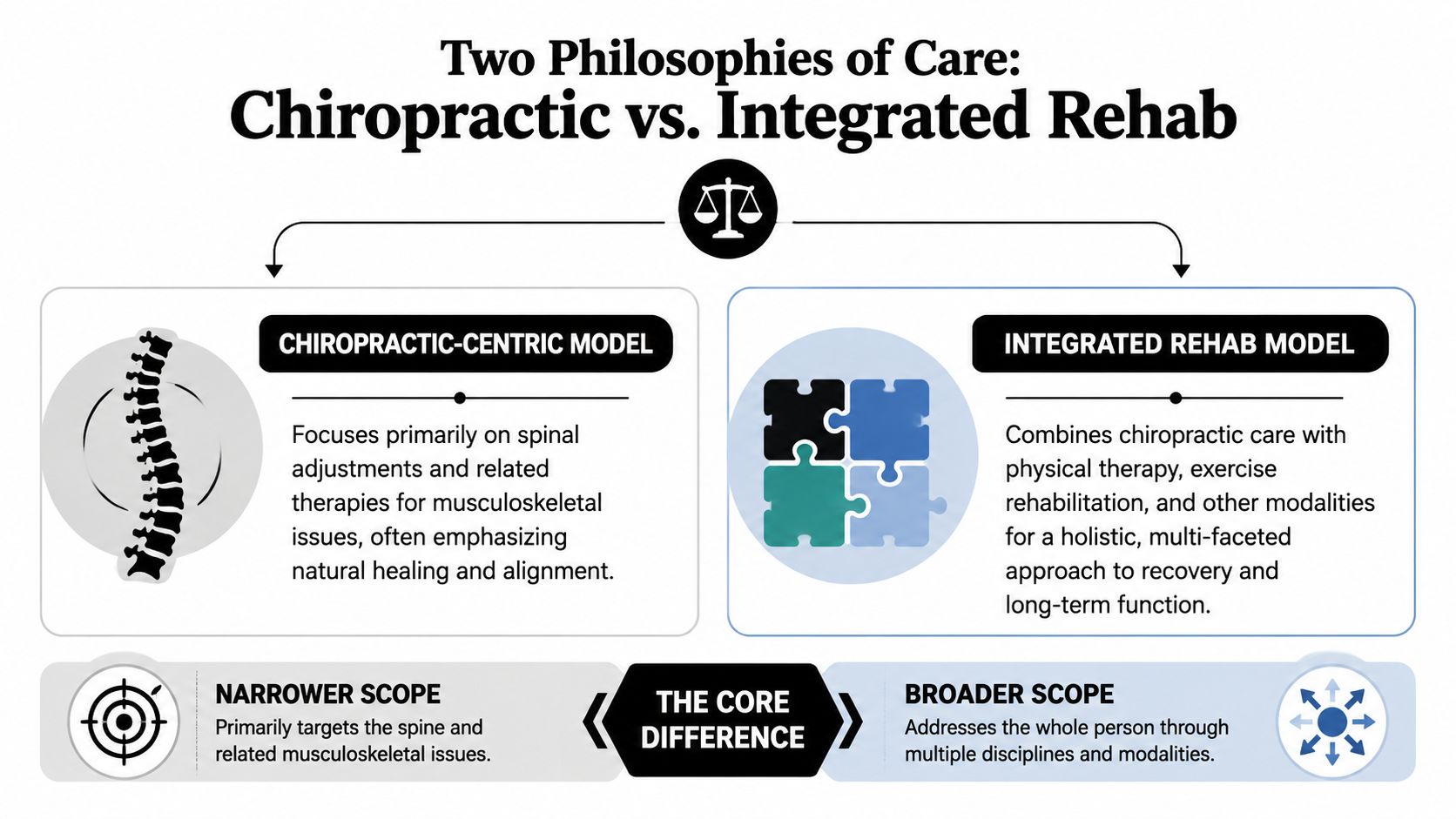
Two Philosophies of Care Chiropractic vs Integrated Rehab
Two patients can walk in with the same label, low back pain, and need very different care plans. One improves after restoring spinal motion and calming an irritated area. The other feels better for a day or two, then flares again because the underlying problem includes weakness, poor load tolerance, and movement compensation that was never corrected.
The chiropractic-centered model
A chiropractic-centered clinic usually starts with joint mechanics. The exam often focuses on spinal and extremity motion, segmental restriction, tissue irritation, posture, and whether an adjustment is likely to reduce pain and improve movement. As noted earlier, Oakleaf presents itself as a conservative clinic using adjustments, physiotherapy-style modalities, and exercise within that model.
This approach often fits patients whose main driver is mechanical pain, especially when they have responded well to adjustments before. Common examples include:
- Mechanical neck and back pain
- Recurrent spinal stiffness
- Headaches linked to neck tension
- Patients who know they respond well to adjustments
In the right case, that can work very well. If the main issue is restricted motion and local irritation, restoring mobility may shorten the painful phase and help normal activity return faster.
The integrated rehab model
An integrated rehab clinic usually asks a broader set of questions from the start. What movement changed? What tissues are overloaded? What is weak, guarded, unstable, or poorly coordinated? What has to improve so daily activity, work, or sport does not keep provoking the same symptoms?
That changes the treatment plan. Care may still include chiropractic treatment, but it is usually combined with progressive exercise, soft tissue treatment, mobility work, balance or motor-control training, and a step-by-step return to function. A helpful overview of the difference between a chiropractor and a physical therapist explains why those roles overlap in some areas but lead with different priorities.
The practical trade-off is straightforward. A chiropractic-centered plan may give faster symptom relief when joint restriction is the main problem. An integrated rehab plan often takes more work from the patient, but it is usually the stronger choice when pain is tied to deconditioning, compensation, post-injury weakness, or repeated flare-ups under load.
Why the philosophy matters
The clinic model shapes what happens after the first few visits. If treatment stops at pain reduction, some patients feel better quickly but do not build the strength or movement control needed to stay better. If treatment includes retraining and progression, recovery may feel slower at first, but long-term function is often the bigger target.
Therefore, asking “Do they offer my service?” is the wrong first question. Ask, “Is this clinic built to solve the reason my pain keeps coming back, and can it move me from symptom relief to durable recovery?”
A Side-by-Side Look at Services Offered
A patient with low back pain can look at two clinic websites, see chiropractic, physical therapy, and massage on both, and assume the care will feel the same. In practice, the bigger difference is what happens after pain settles down. One clinic may keep the focus on symptom relief. The other may use those same tools to move you into strength, control, and return-to-activity work.
That distinction shows up in the service mix.
Service Comparison
| Service | Oakleaf Family Chiropractic | MedAmerica Rehab Center |
|---|---|---|
| Chiropractic adjustments | Yes | Yes |
| Physical therapy | Yes | Yes |
| Massage therapy | Yes | Yes |
| Dry needling | Yes | Offered within integrated rehab settings |
| Laser therapy | Yes | May vary by clinic model |
| Decompression therapy | Yes | May vary by clinic model |
| Exercise rehabilitation | Yes, as part of care approach | Core component of integrated rehab |
| Post-surgical rehabilitation focus | Not a highlighted core emphasis in the provided Oakleaf materials | Common strength of integrated rehab centers |
| Multi-provider coordinated recovery plan | Present to some degree through multiple service lines | Central feature of integrated rehab model |
What Oakleaf appears to do well
Oakleaf Family Chiropractic presents a wider menu than many chiropractic-led offices. Its listed services include chiropractic adjustments, physical therapy, massage, dry needling, decompression therapy, and care for common pain complaints and accident-related injuries. That breadth gives patients more than one option when pain is not responding to a single treatment style.
The practical upside is simple. If your problem is fairly straightforward, such as acute neck pain, mechanical low back pain, or recurring stiffness that responds well to hands-on care, a clinic with several conservative tools can often manage that efficiently.
Why a long service list still does not answer the bigger question
A clinic can offer many modalities and still treat every visit the same way. That is the gap patients often miss.
The relevant comparison is not service count. It is treatment progression.
For example:
- An adjustment-centered plan may calm pain and improve motion early, which can be helpful in acute spinal flare-ups.
- A rehab-centered plan usually puts more attention on loading tolerance, movement quality, balance, gait, and joint mechanics once symptoms begin to settle.
- A coordinated multidisciplinary plan uses symptom-relief tools at the start, then reduces passive care as exercise and functional retraining take over.
That pattern usually affects recovery time and relapse risk more than the presence of dry needling or laser on a website.
Clinical reality: Dry needling, laser, massage, and decompression can all support recovery. None of them replace a clear diagnosis, a progression plan, or the right exercise dose for the tissue and function you are trying to restore.
How patients should read a services page
Patients with a simple pain episode can do well in either setting. Patients with repeat flare-ups, post-injury weakness, poor tolerance for bending or lifting, or a stalled recovery usually need more than access to multiple services. They need those services organized in the right order.
Ask these questions instead:
- Who is directing the plan: one provider, or a team working from the same goals?
- What is each service supposed to change: pain, mobility, strength, tissue tolerance, balance, or work and sport function?
- What happens after the first improvement: do visits progress toward independence, or do they keep repeating the same passive care model?
That is often where the difference between a chiropractic-centered clinic and a multidisciplinary rehab clinic becomes clear.
Which Clinic Handles Your Condition Best
You wake up with low back pain after yard work, but you can still get through the day. That patient often does well in a chiropractic clinic. A different patient comes in after a car crash, cannot turn the neck, has headaches, feels unsteady, and starts avoiding lifting or driving. That patient usually needs a broader rehab plan from day one.
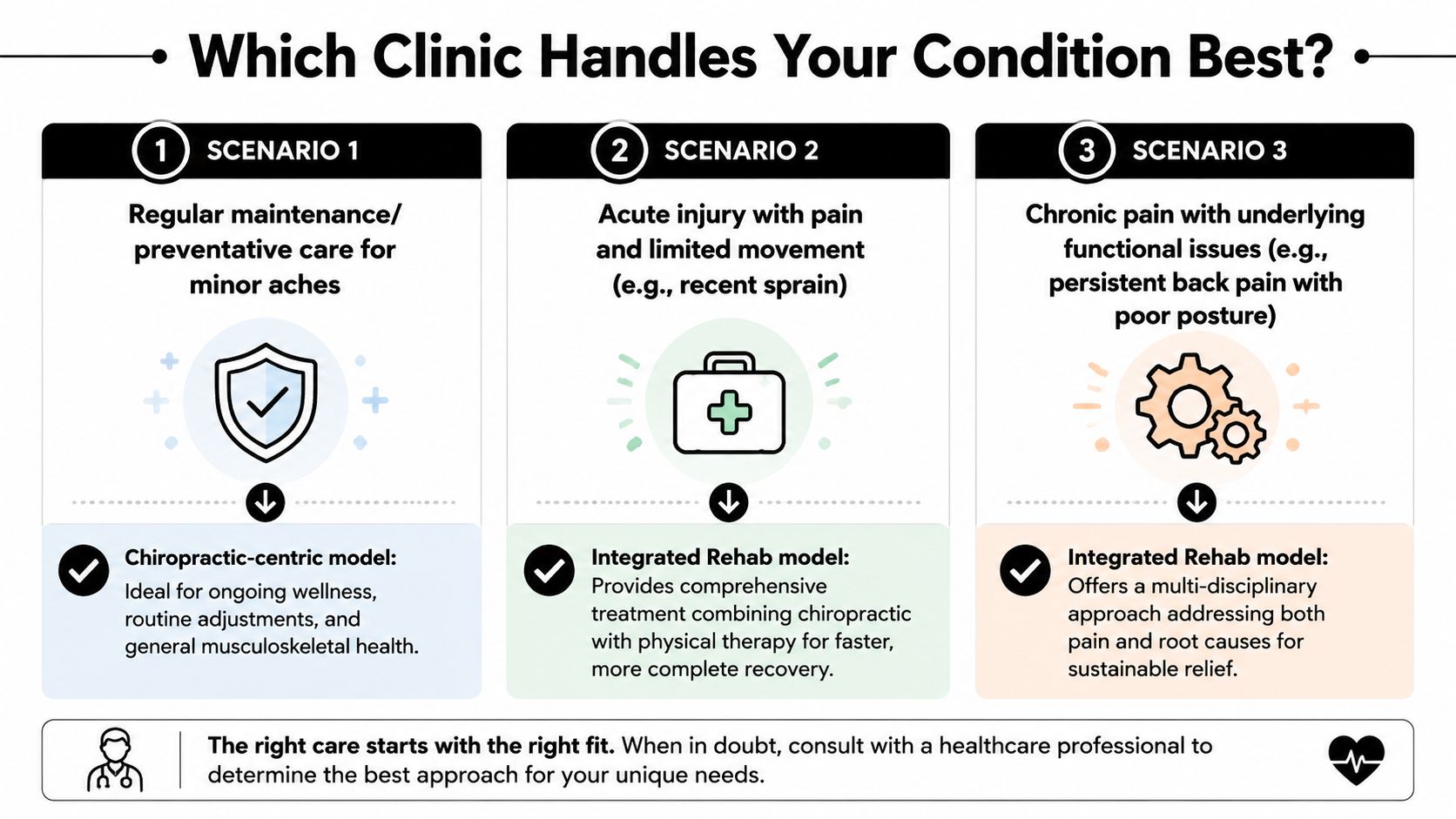
The practical question is not which clinic sounds better. The question is which model fits the actual job in front of it. In clinic, I look at two things first. How much has the condition changed your function, and how much retraining will it take to keep the problem from coming back?
When Oakleaf Family Chiropractic is a reasonable choice
Oakleaf fits best when the problem is mechanical, fairly contained, and likely to improve with conservative symptom-focused care in a stable outpatient setting.
That usually includes:
- Recurring spinal stiffness or maintenance visits: You have a pattern that responds well to adjustment-based care and you are not dealing with major weakness or lost function.
- Straightforward neck or back pain: Symptoms are present, but you are still walking, working, and moving reasonably well.
- Neck-driven headaches or tension complaints: Your symptoms seem linked to posture, joint irritation, or muscle tightness rather than signs that call for a more involved rehab progression.
- Mild strain injuries: You tweaked something at work, in the gym, or during weekend activity, but you do not have clear instability, major motion loss, or a sharp drop in strength.
Patients in that group often want relief, a focused exam, and a treatment plan that does not feel overly complicated. If that is you, reviewing what to expect at a first chiropractic visit can help you decide whether a chiropractic-first approach matches your comfort level.
When an integrated rehab clinic is usually the better clinical fit
A multidisciplinary rehab clinic becomes the stronger choice when pain is only one part of the problem. Recovery tends to take longer when the injury also affects strength, endurance, balance, work tolerance, or confidence with movement.
Here are the cases where I would usually steer a patient toward integrated rehab:
Auto accident injuries with more than one painful region
Whiplash cases often involve neck pain, headaches, upper back guarding, shoulder stiffness, and reduced tolerance for driving, sleeping, or working. Those patients usually need progression, not repeated symptom care alone.Post-surgical recovery
A knee, shoulder, or spine procedure requires staged loading, range-of-motion goals, strength rebuilding, and function testing. If those steps are missing, short-term pain relief can hide a slower recovery underneath.Chronic pain with clear deconditioning
If you now avoid stairs, lifting, exercise, bending, or long periods of sitting, the treatment plan has to rebuild capacity. Otherwise, the same flare pattern tends to keep returning.Return to sport or demanding work
Athletes and physical workers need more than a pain score drop. They need enough control, force production, and repeat tolerance to handle training or job demands without another setback.
The deciding factor is functional loss. The more your condition has changed the way you move and load your body, the more value you get from a team model with exercise progression, reassessment, and coordinated follow-through.
A simple way to choose
Choose a chiropractic-centered clinic if your problem is localized, your function is mostly intact, and you have done well before with conservative hands-on care.
Choose integrated rehab if your pain has spread into weakness, guarded movement, reduced activity tolerance, or repeated relapse.
That distinction affects recovery time. It also affects whether you finish care with less pain for a few weeks, or with a body that can handle normal life again.
Operational follow-through matters too. Clinics that are better at optimizing patient interaction workflows often make it easier for patients to stay on schedule, ask the right questions early, and avoid treatment drop-off during the part of care where progression matters most.
The Patient Journey From First Call to Final Visit
You call a clinic after a crash or a back flare, and the first question is simple. Can this place get me better, or am I signing up for visits without a clear endpoint?
That first phone call often tells you more than patients expect. A chiropractic-centered clinic may do a good job getting you scheduled quickly and explaining the first appointment. For a straightforward neck or back complaint, that can be enough to start care without much friction. If your case includes nerve symptoms, missed work, exercise intolerance, or an auto claim, the process needs more structure from day one because delays and vague planning can slow recovery.
Oakleaf gives patients some useful basics upfront, including location, hours, and common insurance categories. That helps with access. The bigger clinical question is what happens after the intake. Patients with uncomplicated pain often do well when the visit flow is simple and the treatment starts fast. Patients with more than pain need a clinic that explains the full care path, who is managing each phase, and what would trigger a change in plan.
Cost clarity matters for health reasons, not just financial reasons. The National Safety Council has reported that uncertainty around long-term costs can keep injured people from starting recommended care after motor vehicle accidents. In practice, I see the same pattern. People delay treatment, stiffness becomes guarded movement, guarded movement becomes deconditioning, and then the case is harder to turn around.
If you are comparing clinics, ask better questions on the first call:
- What does the exam measure besides pain level?
- Will you track strength, range of motion, walking tolerance, lifting tolerance, or work capacity?
- Who updates the plan if I improve slowly or stall out?
- What billing explanation can you give me before I commit to several weeks of care?
- If my case needs rehab progression, do you provide it in-house or refer it out?
Those answers separate a clinic that is set up for short-term symptom care from one that is built for recovery management.
A stronger first-to-final process has three parts. The exam identifies what pain has changed in your movement and function. The treatment plan states the goals, visit frequency, and what progress should look like by specific checkpoints. The discharge process confirms that you can handle normal life, work, or training without falling back into the same problem.
For patients, that structure reduces drop-off. For clinicians, it improves decision-making. For clinics trying to improve front-desk access, scheduling, and follow-up, tools for optimizing patient interaction workflows can support the operational side that patients notice immediately.
If you want a practical benchmark for intake and early visit flow, this guide on what to expect at a first chiropractic visit is a useful reference.
The trade-off is straightforward. A primarily chiropractic model can feel faster and simpler at the start. A multidisciplinary rehab model usually asks more questions early, but that extra structure often serves patients better when the goal is not just feeling better this week, but finishing care with clearer function and a lower chance of relapse.
Comparing Recovery Timelines and Long-Term Outcomes
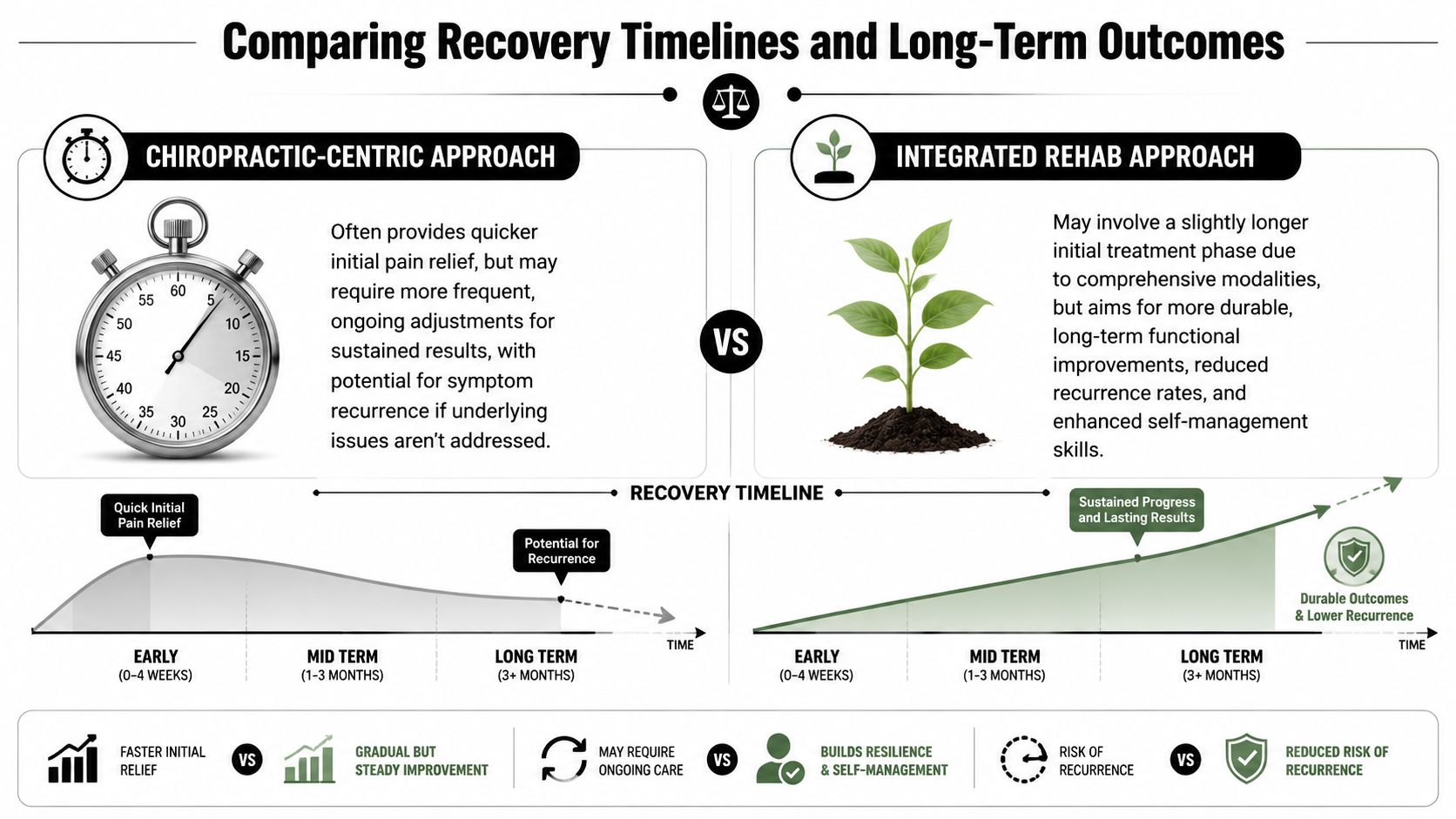
Two patients can leave a visit with the same pain score and still be on very different recovery paths. One is ready to build back to work, lifting, or sport. The other feels better for a day or two but still lacks the strength, control, or tissue tolerance to hold that gain.
Where chiropractic-centered care often helps most
For a recent flare-up of neck pain, low back pain, or stiffness that is mostly mechanical, a chiropractic-centered plan often helps sooner. Patients commonly notice easier motion, less guarding, and better sleep early in care. That matters, especially if the problem is straightforward and the main goal is to calm symptoms quickly.
Early relief is only one part of recovery.
If the underlying problem includes weakness after inactivity, reduced balance, poor movement mechanics, post-surgical loss of function, or repeated reinjury, a symptom-focused plan can fall short. In those cases, the patient often improves first on the table, then stalls when real-life demands return.
Where integrated rehab tends to hold up better over time
Integrated rehab usually takes longer at the front end because the plan has to answer more than one question. Can the joint move? Can the muscles support it? Can the patient tolerate load, repetition, and speed without the pain returning? That extra work often extends the first few visits, but it gives the clinician a better chance of shortening the total course for complex cases.
I see the difference most clearly in post-op patients and in people with recurring injuries. They do not just need pain reduced. They need progression. Mobility has to improve, then strength, then tolerance for daily tasks, then confidence under real demands.
That is why multidisciplinary care often leads to better long-term function. One part of the plan reduces pain and restores motion. Another rebuilds strength and control. The exercise side carries those gains into walking, lifting, reaching, stairs, sport, or work tasks.
If you want a practical example of how clinics track progress instead of relying on vague impressions, this overview of functional outcome measurement is worth reviewing.
What actually changes the timeline
Recovery speed depends less on how many services are listed on a website and more on whether the clinic can progress care at the right time.
A primarily chiropractic model often works well for:
- acute mechanical back or neck pain
- short-term mobility loss
- patients who have responded well to adjustments before
- simpler cases without surgery, trauma, or major strength loss
A multidisciplinary rehab model usually has the advantage for:
- post-surgical recovery
- sciatica that keeps returning
- sports injuries
- car accident cases with more than one painful area
- chronic pain that has changed gait, balance, or lifting tolerance
That distinction affects relapse rates in practice. A patient who feels 70 percent better but cannot hinge, squat, carry, rotate, or climb stairs without compensation is still at risk for another flare-up. A clinic that measures function, progresses loading, and discharges based on capability rather than short-term relief usually gives that patient a better shot at staying well.
Patient reviews can hint at this difference, although they are not outcome data. They tell you more about communication, scheduling, and follow-through than about clinical durability. If you are comparing clinics online, articles on getting Google reviews explain why review volume can grow faster than meaningful detail about results.
For South Florida patients deciding between these models, the trade-off is practical. If your condition is simple and your goal is fast symptom relief, chiropractic-centered care may be enough. If your condition affects how you move, work, train, or recover after surgery, integrated rehab usually gives you the better chance of a shorter total recovery and a lower chance of ending up back in treatment a few months later.
Final Recommendation Which Clinic Is Right for You
Most patients don't need more options. They need a clean decision.
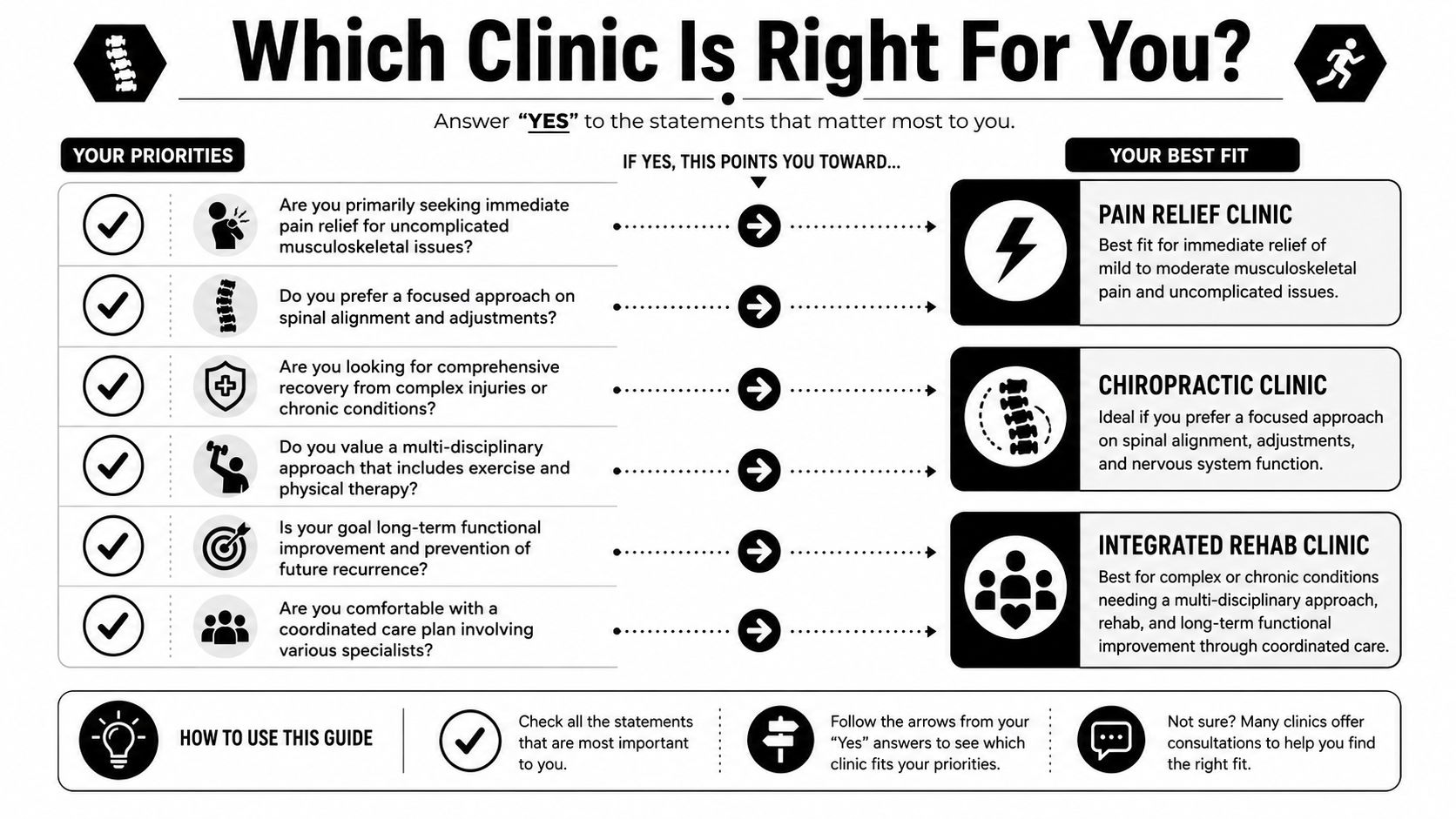
Choose Oakleaf Family Chiropractic if
Oakleaf Family Chiropractic is a good fit when your main need is focused conservative care for a common musculoskeletal complaint. If you want routine chiropractic maintenance, you've had success with spinal adjustments before, or your pain looks relatively straightforward, Oakleaf's established Jacksonville presence, family-led structure, and broad in-house service menu make it a reasonable choice.
This fit becomes stronger when:
- Your pain is mostly spinal and mechanical
- You aren't dealing with surgical recovery
- You want a clinic that combines adjustments with supportive modalities
- You value a familiar community practice model
Choose an integrated rehab clinic if
An integrated rehab clinic is usually the better choice when your problem is layered and the goal is more than feeling temporarily better. If you're recovering from surgery, a car accident, a sports injury, recurring sciatica, or chronic pain that has changed how you move, the broader model usually gives you a better chance at full function.
This is the better path when:
- You need structured exercise progression
- You have weakness, instability, balance loss, or functional limitation
- Your case involves multiple body regions
- You want long-term durability, not only short-term symptom change
The most practical way to decide
Here's the clearest summary.
If your primary need is adjustment-focused care for a straightforward problem, choose Oakleaf Family Chiropractic.
If your primary need is complete rehabilitation for a complex injury or recovery process, choose an integrated rehab clinic.
That distinction isn't marketing language. It's what determines whether your treatment plan matches the demands of your body. And when patients choose the right model early, they usually waste less time, spend less energy bouncing between partial solutions, and build a recovery that holds.
As a final step before booking anywhere, read recent patient feedback with a critical eye. Resources about getting Google reviews are useful because they show how reputation gets shaped and why patterns in patient comments matter more than a few glowing lines. Look for reviews that mention diagnosis clarity, communication, progression of care, and whether patients returned to real activities, not just whether the front desk was friendly.
If you want a clinic that combines physical therapy, chiropractic care, acupuncture, and advanced rehab for injury recovery, chronic pain, or post-surgical care, MedAmerica Rehab Center is worth contacting. Their team can help you understand what's driving your pain, what kind of plan fits your condition, and what recovery should realistically look like from the first visit forward.
MedAmerica Rehab · Deerfield Beach
Talk to a clinician about your pain
Physical therapy, chiropractic, acupuncture and shockwave therapy under one roof, since 1995. Same-day appointments are available.
Mon–Thu 8:00 AM – 6:30 PM · Fri 8:00 AM – 3:00 PM