

Neck Pain Sleeping: Best Positions, Pillows and Relief
What if the pillow you've been shopping for isn't the problem at all, and the position you fall asleep in matters less than whether your head stays level once you're asleep? Most advice on neck pain sleeping tells you to buy something new. A calmer starting point is to run a short, measured test at home, change one thing at a time, and know in advance what result means you should stop experimenting and see a clinician.
Why Your Neck Hurts After a Night's Sleep
Say you fall asleep reading on three stacked pillows. Your shoulders slide down, your head tips forward and slightly left, and you stay there for hours. You wake with a stiff left side, you can't turn comfortably to check your blind spot, and the ache doesn't ease until lunch.
That pattern is common because sleep holds one position for a long time. During the day, a tilted head bothers you and you shift. At night, you don't. Your muscles and the small joints in your neck stay loaded in that tilt or rotation, with no movement to relieve them, so they stiffen by morning and loosen once you're up and moving.
The Usual Culprits at the Bedside
- Stomach sleeping: Your head has to turn sideways to breathe, so it stays rotated for hours while the muscles on one side shorten and the other side stretches.
- A pillow that's too high or too flat: Too much height pushes your chin toward your chest or tips your ear toward your shoulder. Too little lets your head drop below the line of your spine.
- An arm under your head: It feels like extra support, but it lifts one side unevenly and often leaves the arm numb.
- Reading propped up: Several pillows behind your shoulders bend your neck forward before you've even fallen asleep.
None of these means you've damaged your neck. They mean sensitive tissues spent the night in a position they'd never tolerate while awake.
A neck that feels fine at bedtime, stiff on waking, and better after an hour of moving is usually telling you about position and load, not about a sudden injury.
Sleep position is still only one factor. Daytime posture, long screen sessions, an old injury, or arthritis can leave your neck less tolerant before you get into bed. If you're also noticing aching, stiffness, or pain that spreads into your shoulder during the day, it's worth understanding the symptoms of degenerative discs in the neck so you don't blame everything on your pillow.
What You Can Test Yourself
You don't need special equipment to start. First, figure out which position you sleep in, not the one you intend to. Note where you wake up, where your arms are, and whether your pillows have migrated.
Next, check whether your pillow keeps your head level with your trunk. Then run a short trial, one change at a time, and score your morning pain. By the end, you'll know whether a bedside fix helps, or whether your symptoms follow a pattern that needs an examination instead.
Best and Worst Sleeping Positions for Neck Pain
| Position | What the research shows | Neck-friendly setup | Main risk |
|---|---|---|---|
| Back (supine) | Lower odds of neck pain in a large observational study (OR 0.87) | Thin pillow or none under the head, small roll under the neck, pillow under the knees | Snoring or reflux can push the head up; lower back may need knee support |
| Side (side-lying) | Generally protective against spinal symptoms in a 2019 review; evidence limited | Pillow fills the gap from ear to mattress, head level with the spine, pillow between knees | Lower arm tucked under the head or a pillow that is too high pushes the neck into tilt |
| Stomach (prone) | Highest concern: the head stays rotated for hours; 8.5% of people with neck pain in one study reported prone sleeping | Avoid, or use a flat pillow only under the pelvis | Sustained neck rotation and a flattened lower back curve |
Read the middle column with care. These are associations, not proof of cause. In a large observational study of 6,969 participants, supine sleeping was associated with lower odds of neck pain, with an odds ratio of 0.87 and a 95% confidence interval of 0.76 to 0.99. Among participants with neck pain in that study, 55.3% reported supine sleeping, 8.5% prone sleeping, 38.4% left-side sleeping, and 50.9% right-side sleeping, and people could report more than one position.
That overlap matters. Many sleepers shift between positions over the night, so a single label doesn't capture how you rest. It also means switching positions won't automatically resolve pain.
How Strong Is the Evidence
A global epidemiological review in BMC Musculoskeletal Disorders reported an age-standardized neck-pain prevalence of 27.0 cases per 1,000 people in 2019, and it noted that a 2019 systematic review found only four eligible studies from 4,186 articles, with side-lying generally protective against spinal symptoms but clear limits in the evidence. Treat any claim that one position works for everyone with skepticism.
Sleep amount belongs in the same cautious frame. In the 6,969-person study, median sleep was 7.0 hours in both groups, yet sleeping at least 7 hours per day was associated with lower odds of neck pain. That's a reason to protect your sleep, not proof that an extra hour removes neck pain.
Three-night test rule: Keep one position, note your morning pain each day, and change only one variable at a time. If you change position, pillow, and mattress topper together, you'll never know what helped.
For back sleeping, keep the pillow thin and add a small roll under your neck, not under your head. For side sleeping, fill the ear-to-mattress gap and put a pillow between your knees so your hips don't drag your spine into a twist. If you can't yet give up stomach sleeping, skip the head pillow and place a flat pillow under your pelvis while you work on transitioning.
Pillow Height and Shape That Keep Your Neck Level
Height and shape do the work. Material labels don't. Your goal is simple, keep your head roughly level with your trunk, not tilted up, dropped down, or tipped sideways.
This is what level looks like in practice.

| Position | Target height | Setup | Fail check |
|---|---|---|---|
| Back (supine) | Low profile | Thin pillow or none under the head, small roll under the neck | Chin pushed toward the chest |
| Side | Fills the ear-to-mattress gap; more loft for wide shoulders or a soft mattress | Head level with the spine and a pillow between the knees | Neck tilted up or dropped toward the mattress |
| Stomach | Minimal or none under the head | Avoid, or a flat pillow only under the pelvis | Thick pillow that keeps the head rotated |
What a Pillow Can and Cannot Do
A systematic review and meta-analysis indexed on PubMed covered 9 high-quality clinical studies involving 555 adults with chronic neck pain and found pillow interventions significantly reduced overall neck pain, waking pain, and neck disability, while satisfaction improved. Sleep quality, however, did not improve significantly, so don't buy a pillow expecting it to fix your sleep as a whole.
Later evidence is humbling. A 2025 systematic review indexed on PubMed found only five eligible studies involving 239 people, with small, non-significant pain improvements and no memory-foam, latex, cervical, or contour pillow clearly outperforming the others. Score the height trial, not the material label. If you want product examples organized by sleeping position before you spend money, the sleep advice from Gorins Furniture & Mattress is a useful place to compare shapes against the height rules here.
The Towel Test Before You Buy
Fold towels to build height in small steps, or use a pillow with adjustable fill you can add or remove. Lie in your usual position and have someone check from behind or in front. On your side, your nose should line up with the center of your chest. On your back, your chin shouldn't be pressed toward your chest.
Watch this short demonstration of neutral positioning, then check your own setup against it.
Wide shoulders need more loft on your side, narrow shoulders need less, and a soft mattress lets your shoulder sink, which changes the gap. Once you pick a height, keep the same pillow for a two-to-four-week trial and score morning pain from 0 to 10 at the start and end. Don't judge on night one, and reverse any change that worsens arm tingling or headaches.
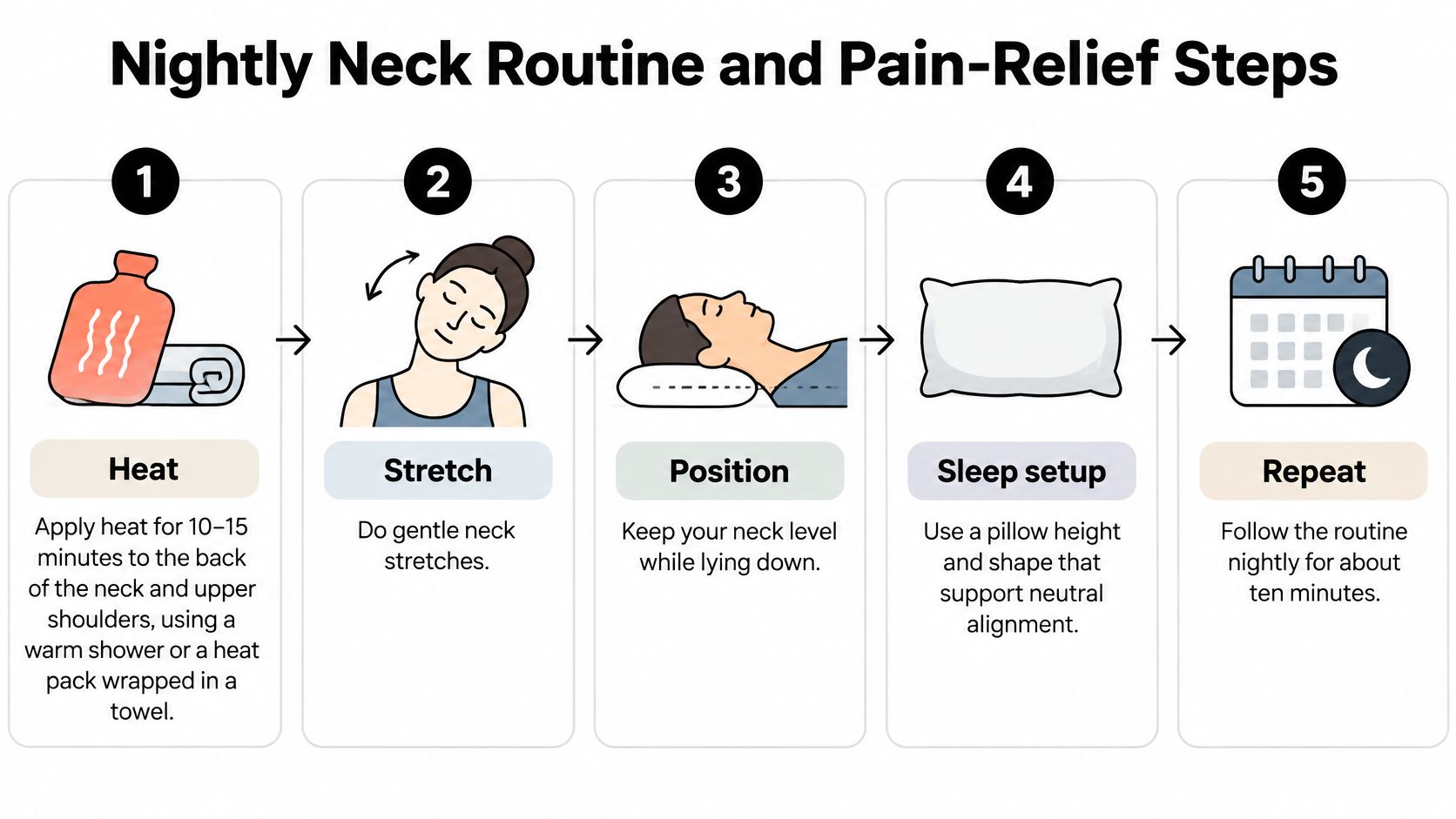
Nightly Neck Routine and Pain-Relief Steps
This routine takes about ten minutes. It won't rebuild your neck overnight, but it can lower the stiffness you carry into bed, which makes your position and pillow test cleaner. Move slowly and stay in a comfortable range.
The Ten-Minute Routine
- Heat first: Apply heat for 10 to 15 minutes to the back of your neck and upper shoulders, using a warm shower or a heat pack wrapped in a towel. Warm tissue stretches more easily and guards less.
- Chin tucks: Pull your chin straight back, as if making a double chin, without tipping your head up or down. Hold each for three seconds, repeat ten times. This wakes up the deep muscles that hold your head over your shoulders.
- Upper trapezius stretch: Reach one hand under the mattress edge to anchor your shoulder, then tilt your opposite ear toward the other shoulder. Hold 20 to 30 seconds per side. You should feel a pull along the side of your neck, not a pinch.
- Levator scapulae stretch: Turn your nose toward your armpit and let your head tilt down gently. Hold 20 to 30 seconds per side. This reaches the muscle that aches at the top corner of your shoulder blade.
- Slow rotations: Turn your head left and right three times each way, only as far as feels easy. You're reminding the joints how to move, not forcing range.
- Shoulder blade squeezes: Squeeze your shoulder blades together and slightly down for five seconds, repeat ten times. Your neck sits on your upper back, so a slumped base makes the neck work harder.
- Set the bed: Put your phone at eye level if you must look at it, use the pillow height you're testing, and don't read with your head propped on stacked pillows.
If you want guided form for these movements, work through these neck pain relief stretches alongside the routine until the positions feel familiar.
Stop any stretch that produces arm numbness, sharp pain, or dizziness. A stretch should feel like a pull that eases as you hold it, never like an electric or shooting sensation.
Pain Relief During a Flare
For a fresh flare, use ice for 15 minutes during the first 48 hours, then switch to heat afterward if heat feels better. Ice calms a newly irritated spot, heat relaxes guarded muscle, and many people do better with one than the other.
Over-the-counter anti-inflammatory medicine is an option only as the label directs, and only if it's safe for you given your other conditions and medicines. Don't use it to mask pain so you can push through stretches that hurt. If every morning still starts with a flare after several weeks of consistent routine, that's information, not failure, and it belongs in the decision below.
When Night Neck Pain Needs a Clinician
Start by separating two situations. One is a pillow and position problem you can test. The other is a pattern that needs examination before you buy anything else. A clinical cervical-spine imaging guideline from Louisiana Medicaid and Evolent lists night pain that prevents or disrupts sleep among findings that can prompt further assessment, especially when combined with other concerning symptoms.
That doesn't mean every bad night needs imaging. Ordinary mechanical irritation, poor positioning, or sensitive muscles can also wake you. Night pain alone isn't proof of serious disease, and sleeping wrong isn't a diagnosis. Use the pattern, not a single night.
| Symptom | What it may indicate | Action |
|---|---|---|
| Stiffness that eases within days after a position or pillow change | Mechanical irritation | Track for one to two weeks |
| Pain that repeatedly wakes you for several weeks | Persistent irritation or a problem that needs examination | Book a clinical evaluation |
| Numbness or tingling that spreads into the arm or hand | Possible nerve involvement | Prompt clinical assessment |
| New weakness, loss of grip, or dropping objects | Possible nerve compression | Prompt medical assessment |
| Unsteady walking or loss of coordination | Possible spinal cord involvement | Prompt medical assessment |
| Neck pain with fever, chills, or unexplained weight loss | Possible infection or systemic cause | Urgent medical evaluation |
| Neck stiffness with fever and severe headache | Possible serious infection | Emergency care now |
| Neck pain after a fall, collision, or significant trauma | Possible injury | Emergency or urgent evaluation |
Your Three-to-Five-Night Log
Before any appointment, log your position, pillow height, morning stiffness, night waking, and any arm or hand symptoms for three to five nights. Keep one position for three nights, change one pillow variable, score morning pain from 0 to 10, and do the routine five nights a week.
If pain and waking fall by four to six weeks, keep the setup. If they don't, bring the log with you. It turns a vague complaint into a pattern a clinician can act on, and it shows which self-care steps you've already ruled out.
What an Evaluation Adds
An examination checks your range of motion, strength, reflexes, and sensation, and it connects your night symptoms to your daytime posture and workload. That's how you learn whether you're dealing with muscle irritation, a joint problem, or nerve involvement, and it's why physical therapy for back and neck pain focuses on assessment before exercise selection.
At MedAmerica Rehab Center, we treat neck pain, back pain, sciatica, headaches, arthritis, knee pain, shoulder pain, and foot and ankle pain, and our care aims to relieve pain, restore mobility, and improve quality of life without surgery or unnecessary medication. That makes the clinic a sensible next step when your home test plateaus, not a replacement for emergency care when red flags appear.
If your log shows pain that keeps waking you, arm symptoms that aren't settling, or morning stiffness that hasn't budged after a fair pillow and position trial, that's the point where hands-on assessment beats another product. Visit MedAmerica Rehab Center to book an evaluation, bring your three-to-five-night log, and we'll build a plan around your actual sleep position, your pillow height, and how your neck moves during the day.
MedAmerica Rehab · Deerfield Beach
Talk to a clinician about your pain
Physical therapy, chiropractic, acupuncture and shockwave therapy under one roof, since 1995. Same-day appointments are available.
Mon–Thu 8:00 AM – 6:30 PM · Fri 8:00 AM – 3:00 PM