

How To Relieve Sciatica Pain Fast: 2026 Solutions
A sharp line of pain shoots from your low back into your buttock or leg. Sitting feels bad. Standing feels bad in a different way. You keep shifting, trying to find one position that doesn’t aggravate it, and nothing seems to last.
That’s usually when people search how to relieve sciatica pain fast.
The good news is that most sciatica improves without surgery. The bad news is that people often make it worse in the first few days by stretching too hard, using heat too early, or trying too many remedies at once. Fast relief usually comes from doing a few things in the right order, not from doing everything.
That Sudden, Shocking Pain What Is Sciatica Anyway
Sciatica is not a diagnosis by itself. It’s a symptom pattern. The sciatic nerve gets irritated or compressed, and you feel pain that travels along its path, usually from the low back or buttock down the leg.
A simple way to think about it is this. The sciatic nerve acts like an electrical wire. When something presses on it or inflames it, the signal changes. That can create burning, tingling, numbness, aching, or a sharp shooting pain.
What sciatica usually feels like
Some people feel most of the pain in the buttock. Others feel it in the calf or foot. You may notice:
- Radiating pain that travels down one leg
- Tingling or pins and needles in the thigh, calf, or foot
- Numbness in part of the leg
- Weakness when lifting the foot or pushing off to walk
- Pain with sitting that eases when you change position
The cause can vary. A disc in the low back may irritate the nerve. Tight tissue around the hip, including the piriformis area, can also contribute. Sometimes the pain starts after lifting, twisting, long hours sitting, a long drive, a fall, or an auto accident.
Sciatica is often less about “damage everywhere” and more about one irritated nerve that doesn’t tolerate compression, tension, or inflammation very well.
That distinction matters. If you treat it like a muscle strain and aggressively stretch everything, you can flare it up. If you treat it like a nerve that needs space, calm, and controlled movement, relief tends to come faster.
Immediate Actions for Fast Sciatica Pain Relief
When pain is fresh and intense, your job is to reduce irritation first. Don’t start by forcing mobility. Start by calming the area down.
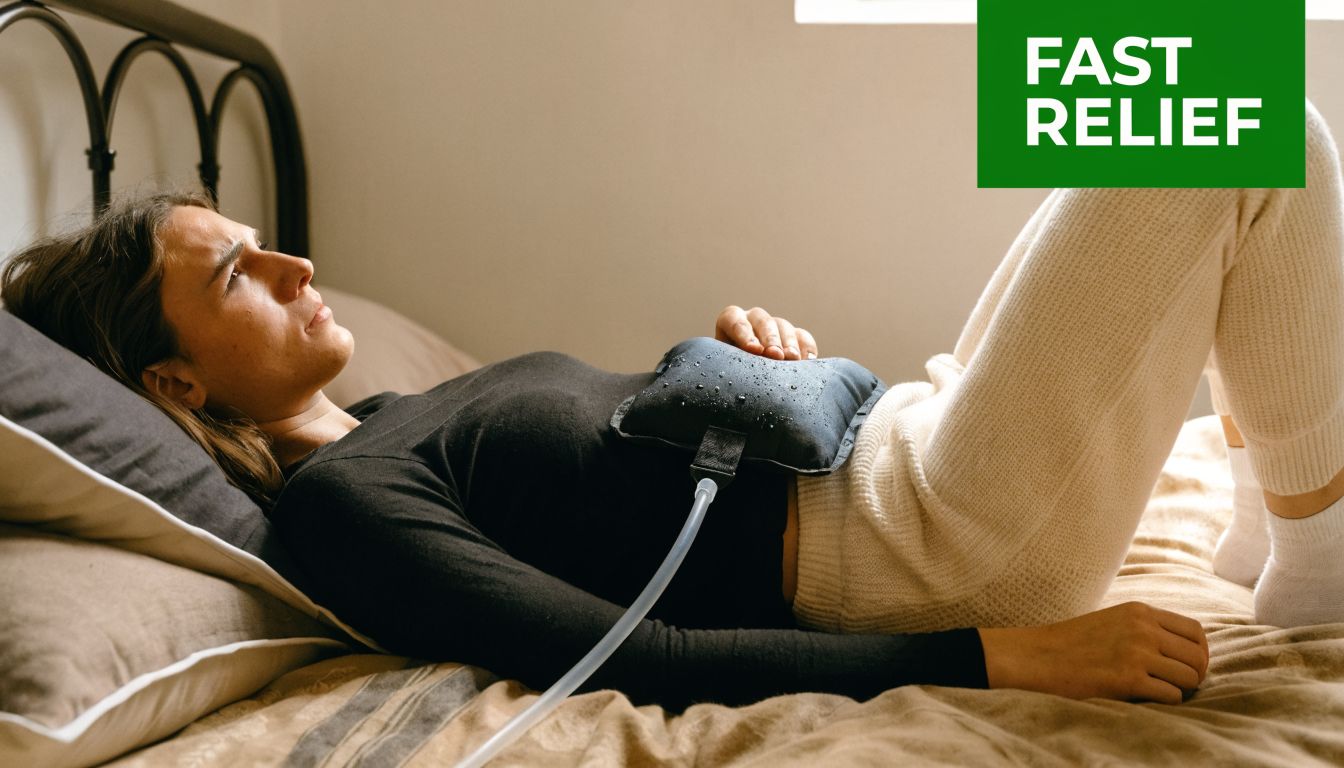
Find a position that unloads the nerve
The fastest relief often comes from changing pressure on the low back and pelvis. Try one of these positions and stay there long enough for symptoms to settle.
Lie on your back with your lower legs on a chair
Bend your hips and knees so both are supported at roughly right angles. This often reduces pull on the low back and lets tight muscles relax.Lie on your side with a pillow between your knees
This can help if back-lying feels too uncomfortable. Keep your top leg from dropping forward.Use short walking breaks instead of long sitting
If sitting spikes the leg pain, stand up and take a slow, easy walk around the room. Keep the stride short.
Use cold first, not heat
For early sciatica, cold is usually the better first tool. Harvard Health notes that about 90% of people with sciatica get better without surgery, most in just a few weeks, and recommends cold packs for 15 to 20 minutes at a time during the first 48 to 72 hours to reduce inflammation, followed by heat later if needed (Harvard Health sciatica home remedies and self-care).
Fast relief rule: Wrap the cold pack in cloth. Apply it for 15 to 20 minutes, then take a break before repeating. Cold too long can irritate the skin instead of helping the nerve.
Place the pack over the painful lower back or upper buttock area, not directly on bare skin. If your leg pain is the main symptom, you can still start at the low back and upper glute area because that’s often where the irritation begins.
If you want a more detailed guide on safe cold application, this overview of using an ice pack in physical therapy is a useful reference.
What to avoid in the first phase
People lose time here. They assume more effort means faster recovery. It usually doesn’t.
- Don’t start with heat right away if the pain feels fresh, sharp, or inflamed.
- Don’t do deep hamstring stretching into a pulling or electric sensation.
- Don’t stay in bed all day. Brief rest is helpful. Prolonged inactivity usually stiffens everything.
- Don’t test the pain over and over. Repeated bending, twisting, or toe-touching can keep the nerve irritated.
Make sleep and rest positions work for you
Night pain can keep sciatica going because poor sleep raises tension and lowers pain tolerance. If your mattress sags or leaves your pelvis twisted, symptoms often feel worse by morning. If you’re trying to sort out whether your bed is part of the problem, this guide on finding the best mattress for back pain relief can help you think through firmness, support, and sleeping position.
A practical first-day routine
If you want something simple to follow, use this sequence:
- Settle the pain position first for several minutes
- Apply cold as described above
- Stand up and take a brief easy walk
- Return to rest, but not for hours
- Repeat later, based on how your leg responds
If a position or activity makes the pain travel farther down the leg, back off. If it centralizes the pain closer to the back or buttock, that’s often a better sign.
Gentle Stretches and Movements to Soothe the Sciatic Nerve
Once the sharpest edge starts to settle, movement matters. The key word is gentle. You’re not trying to win a flexibility contest. You’re trying to reduce pressure, restore motion, and help the nerve move without getting angry.
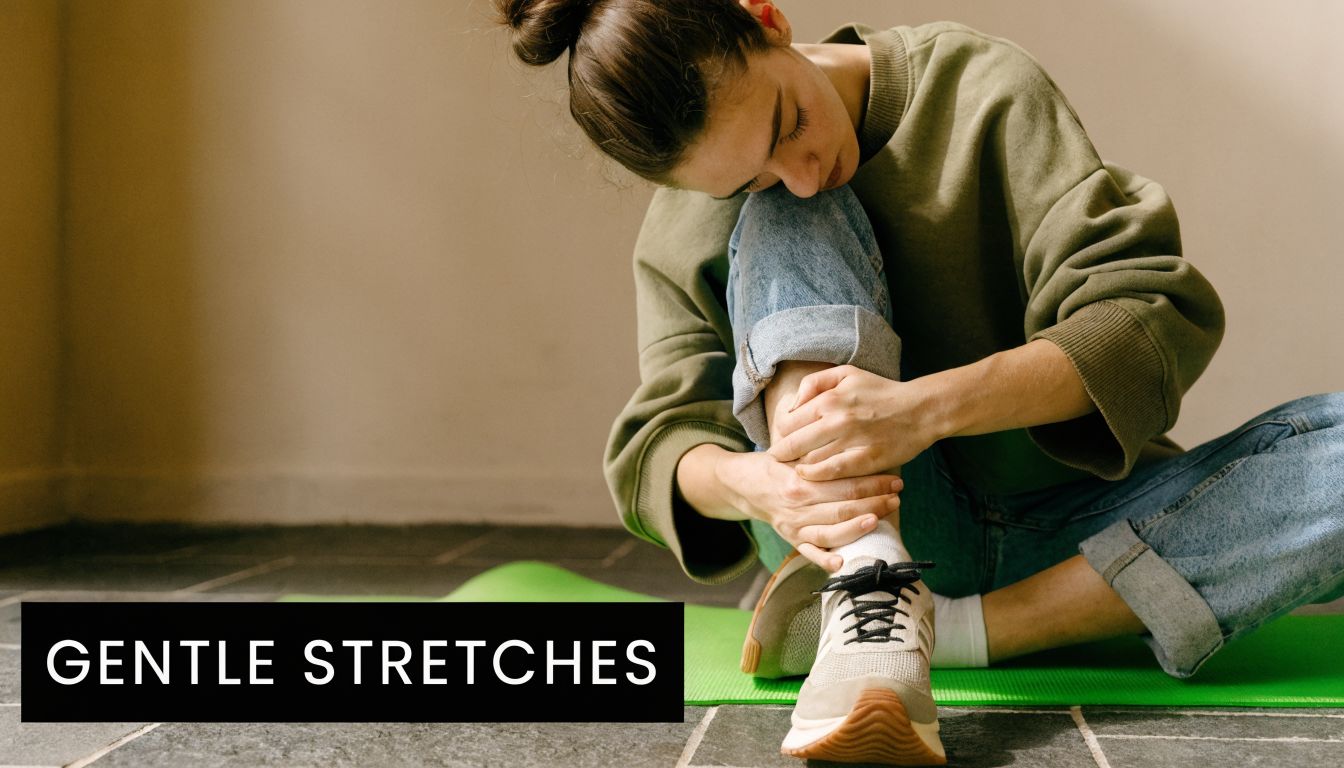
Start with the least provocative stretch
A good first stretch is the single knee-to-chest. It can create a little space in the low back and reduce tension without loading the leg aggressively.
How to do it:
- Lie on your back
- Bend one knee and gently bring it toward your chest
- Keep the other leg relaxed
- Hold for 30 seconds per leg
- Breathe normally and avoid jerking
If that feels fine, repeat on the other side. If bringing the knee up increases leg pain sharply, stop and try a smaller range.
Another option is a seated or lying piriformis stretch. This can help when the buttock feels tight and the nerve seems irritated as it passes through the glute area.
Try it this way:
- Lie on your back with both knees bent
- Cross the affected ankle over the opposite knee
- Gently draw the uncrossed leg toward you until you feel a mild buttock stretch
- Keep it mild. Sharp, electric, or spreading leg pain means you’ve gone too far
Use movement as medicine, not punishment
People often ask whether they should rest completely. Usually, no. Low-impact movement often helps the nerve tolerate daily activity better.
A few smart choices:
- Short slow walks around the house or outside on level ground
- Position changes every so often instead of long stretches of sitting
- Simple exercise consistency rather than occasional hard sessions
For ongoing home work, some people also benefit from self-massage or supported mobility tools. If you’re considering one, this guide to a PE foam roller can help you use it more thoughtfully around the hips and surrounding muscles. Avoid rolling directly over sharp nerve pain.
Nerve glides can help when basic stretches are tolerated
Nerve glides, sometimes called nerve flossing, are more specific than general stretching. The idea is to help the sciatic nerve slide within its surrounding tissues instead of getting tugged and compressed in one spot.
A clinical demonstration referenced in the verified material reports that nerve glides can provide relief in minutes for 70% to 80% of patients with mild to moderate sciatic irritation, and recommends 10 to 15 slow reps, 2 to 3 times daily rather than doing too much (sciatic nerve glide demonstration).
One simple version:
- Lie on your back with both legs extended.
- Lift the affected leg so the hip is bent comfortably.
- Slowly straighten the knee only as far as symptoms allow.
- As you move, alternate the ankle between toes up and toes relaxed.
- Keep the motion smooth, light, and controlled.
This is not a hard hold. It’s a glide. Think “move and release,” not “stretch and suffer.”
Here’s a visual walkthrough that can help you follow the movement pattern more easily:
A simple progression that works better than doing everything at once
Use this progression rather than jumping straight to advanced exercises:
| Stage | Best focus | What it should feel like |
|---|---|---|
| Early | Pain-relieving positions and very gentle mobility | Calming, not stretching hard |
| Settling phase | Knee-to-chest and piriformis stretch | Mild tension, no sharp pain |
| Next step | Nerve glides | Light motion, symptom easing |
| Daily return | Walking and normal movement | More confidence, less guarding |
Your body will usually tell you the right dose. Mild relief during or after exercise is a green light. More numbness, stronger leg pain, or a lingering flare means the dose was too high.
Common Home Treatment Mistakes That Worsen Sciatica
The biggest mistake I see is simple. People mix good treatments in a bad order.
Ice can help. Heat can help later. Stretching can help. Walking can help. But if you stack them too aggressively, especially early on, the nerve can get more irritated instead of less.
A verified reference states that a 2023 study in Pain Medicine found 42% of sciatica patients experienced worsened symptoms from improper home therapy combinations, often from over-stretching an inflamed nerve or alternating heat and ice too aggressively in the initial phase (discussion of home therapy combinations).
The most common mistakes
Too much stretching too soon
If the nerve is inflamed, deep stretching often acts like pulling on a sensitive cable. It may feel productive in the moment, then punish you later.Switching from ice to heat too fast
Early heat can feel soothing, but it isn’t always the right first choice in an irritated, acute flare.Chasing temporary relief with constant self-treatment
If you’re icing, stretching, rolling, twisting, and testing every hour, you may be keeping the area stirred up.Pushing into sharp pain because “no pain, no gain”
That rule does not apply well to nerve pain.
A safer sequence
If you want a practical home routine, keep it controlled:
- Unload the area with a comfortable position.
- Use cold in the early phase if symptoms are fresh and aggravated.
- Rest briefly, but don’t stay still too long.
- Try one gentle movement, not five.
- Recheck later, not every few minutes.
That sequence sounds almost too basic, but basic is often what works.
What “good discomfort” and “bad discomfort” look like
A mild stretch in the buttock or low back can be acceptable. A little stiffness that eases after walking can also be acceptable. Sharp pain, spreading numbness, or pain that runs farther down the leg after the exercise is not the kind of discomfort to ignore.
A flare-up often comes from enthusiasm, not laziness. People do too much because they want relief quickly.
If your symptoms are changing day to day, don’t keep adding more variables. Keep the routine steady long enough to learn what helps. Most setbacks happen because patients assume every “fast remedy” should be done on the same day, at full intensity.
Red Flags When to See a Doctor Immediately
Most sciatica is painful, frustrating, and scary. Most of it is not an emergency. A small group of symptoms is different. Those require immediate medical attention.

A verified source notes that urgent red flags include loss of bowel or bladder control, which can signal cauda equina syndrome, reported in 1% to 2% of cases, as well as significant leg weakness. These need immediate evaluation to reduce the risk of permanent nerve damage (urgent red flags for sciatica).
Go for urgent evaluation if you have these symptoms
- Loss of bowel or bladder control
- Numbness in the groin, inner thighs, or saddle area
- Marked leg weakness, especially if it’s getting worse
- Foot drop or trouble lifting the front of the foot
- Rapidly worsening numbness
- Severe pain after trauma that’s paired with neurologic change
These are not symptoms to watch for a few more days. They can indicate serious nerve compression.
Why these symptoms matter
Sciatica from routine irritation is one thing. Loss of bladder control or major weakness suggests the nerve structures may be under far more serious pressure. In that situation, waiting can raise the chance of lasting problems.
If your leg feels weaker, not just more painful, pay attention. Pain is miserable. Weakness changes the urgency.
When it’s not an emergency but still needs prompt care
You don’t have to wait for a crisis to get assessed. Reach out promptly if:
- Pain keeps returning every time you sit
- Walking is becoming more limited
- Home care isn’t clearly helping
- You’re recovering from an auto accident or work injury and the symptoms are interfering with function
That’s especially true if you’re starting to compensate in how you walk, stand, or sleep. The longer those patterns stick, the harder recovery can become.
Your Path to Lasting Relief at MedAmerica Rehab Center
A bad sciatica flare can settle enough to let you function, then return the moment you sit through work, drive across town, or sleep in the wrong position. That pattern usually means the nerve is still being irritated by something specific. Lasting relief comes from finding that driver and matching treatment to it.
That is the part many home plans miss. People often stack heat, stretching, massage guns, random online exercises, and long rest periods without knowing which one is helping and which one is keeping the nerve sensitive. A good rehab plan clears up that confusion early.
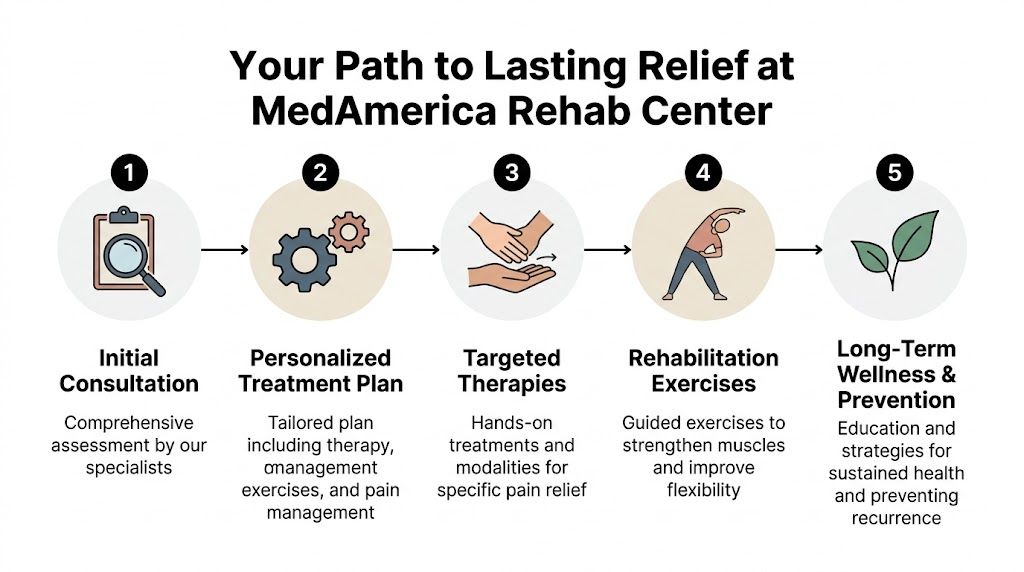
What a good first visit should accomplish
The first visit should answer practical questions you can use right away. What position reduces the leg pain? Which movement brings it on? Is the main issue disc irritation, joint stiffness, muscle guarding, loss of strength, or a combination?
A useful evaluation often includes:
- Symptom mapping to track where the pain, tingling, or numbness travels
- Movement testing during sitting, standing, bending, walking, and transitions
- Strength and sensation checks to see whether the nerve irritation is affecting function
- Response testing to identify which positions or exercises calm symptoms during the visit
I look for something else too. I want to know what you have already tried at home and how you combined it. That matters because the right tools used in the wrong order can still prolong a flare.
Why multidisciplinary care can work better than one isolated treatment
Sciatica is often more manageable when care is coordinated instead of pieced together. One person may need manual therapy to reduce guarding so they can tolerate exercise. Another may need activity modification, targeted strengthening, and a medical consult because pain control is the main barrier.
That is the trade-off. If treatment focuses only on pain relief, the symptoms may come back as soon as normal activity resumes. If treatment focuses only on exercise while the nerve is highly irritable, many people cannot do enough movement to make progress.
A clinic that offers physical therapy, chiropractic care, acupuncture, and medical referrals under one roof can adjust the plan faster. The goal is not to throw every service at the problem. The goal is to choose the fewest treatments that produce steady improvement.
What treatment often looks like in practice
A clear plan usually has a job for each part of treatment.
| Focus area | Why it’s used |
|---|---|
| Hands-on therapy | Helps reduce guarding and improve motion in painful areas |
| Targeted exercise | Builds support around the spine, hips, and core |
| Mobility work | Restores motion without aggressively pulling on an irritated nerve |
| Pain-relief treatments | Lowers symptoms enough to make walking, sleeping, and exercise easier |
| Return-to-activity coaching | Reduces repeat flares from sitting, lifting, driving, or work demands |
If you want a clearer picture of how evaluation, manual care, and exercise fit together, this guide on how physical therapy helps with back and neck pain explains the process in more detail.
Who benefits from getting help sooner
Some cases do better with early professional guidance instead of trial and error at home.
- Auto accident patients whose pain started after a collision
- Workers’ compensation patients whose job tasks keep triggering symptoms
- Adults with prior back pain or arthritis who flare quickly with generic routines
- Athletes and active adults who need a safe return to training
- Older adults whose walking, sleep, or balance is already being affected
MedAmerica Rehab Center is a family-owned clinic in Deerfield Beach that has provided physical therapy, chiropractic care, acupuncture, and shockwave therapy since 1995. That kind of setting can be useful when your symptoms change from week to week and the plan needs to change with them.
One detail people overlook at home
Sleep setup can keep progress moving or undo it night after night. If pain spikes every morning, your mattress and sleep position deserve attention. Finding a Mattress for Back Pain Relief is a practical resource if you are trying to sort out support, firmness, and positioning.
What patients often get wrong about professional care
A lot of people delay care because they assume treatment will jump straight to imaging, injections, or a rigid protocol. Good rehab usually starts with the least aggressive option that changes symptoms and improves function.
Another common mistake is waiting because the pain comes and goes. Intermittent sciatica still deserves attention if it is changing how you work, drive, train, or sleep. Repeated compensation patterns are often what turn a short flare into a recurring problem.
Frequently Asked Questions About Sciatica Recovery
How long does sciatica usually take to calm down?
Many cases improve with conservative care. Harvard Health notes that recovery without surgery typically occurs within a matter of weeks, not forever. The exact timeline depends on what’s irritating the nerve and whether daily habits keep provoking it.
Can my chair be making sciatica worse?
Yes. Long sitting is a common aggravator. If your chair tips your pelvis backward, keeps your hips compressed, or encourages slumping, the nerve may get more irritable over the course of the day. The fix is usually a mix of posture changes, standing breaks, and better support, not just buying a random cushion.
Is walking good or bad for sciatica?
Usually good, if it’s short, slow, and doesn’t ramp up leg pain. Walking often helps more than prolonged bed rest. If every step sends stronger pain down the leg, that’s a sign to scale back and get assessed.
Should I sleep on a firm mattress?
Not automatically. What matters most is whether your mattress keeps your spine supported without forcing you into a twisted position. If you’re sorting through options, this guide on Finding a Mattress for Back Pain Relief is a practical starting point for thinking about support and sleep position.
Once the pain improves, how do I keep it from coming back?
The short answer is consistency. Keep moving, avoid long static positions, build strength around the trunk and hips, and pay attention to what originally triggered the flare. The people who do best long term usually stop waiting for pain to come back before doing the basics that help.
If your sciatic pain isn’t settling, or you’re not sure whether you’re dealing with a routine flare or something that needs hands-on evaluation, contact MedAmerica Rehab Center. A thorough assessment can clarify what’s driving the pain, which movements are safe right now, and what kind of treatment makes sense for faster, steadier recovery.
MedAmerica Rehab · Deerfield Beach
Talk to a clinician about your pain
Physical therapy, chiropractic, acupuncture and shockwave therapy under one roof, since 1995. Same-day appointments are available.
Mon–Thu 8:00 AM – 6:30 PM · Fri 8:00 AM – 3:00 PM