

How to Recover from Sports Injury the Right Way
You leave a weekend game expecting ordinary soreness. Instead, your ankle has swollen inside your shoe, your knee feels unstable on stairs, or your shoulder hurts whenever you reach overhead. The first question is usually, “How many days until I can play again?” That's the wrong starting point.
Sports-injury recovery is governed by function, not the calendar. Pain, swelling, range of motion, strength, balance, movement quality, and sport-specific tolerance tell you whether the injured tissue is ready for the next demand. A staged return may take several days even after an uncomplicated concussion, because CDC guidance requires stepwise progress with each stage typically taking a minimum of 24 hours and beginning with only 5 to 10 minutes of light aerobic activity when symptoms allow (CDC return-to-sports guidance).
The practical question is therefore not just how to recover from sports injury, but how to build enough capacity to handle the movements, speed, force, and decisions your sport requires.
The First 72 Hours After a Sports Injury
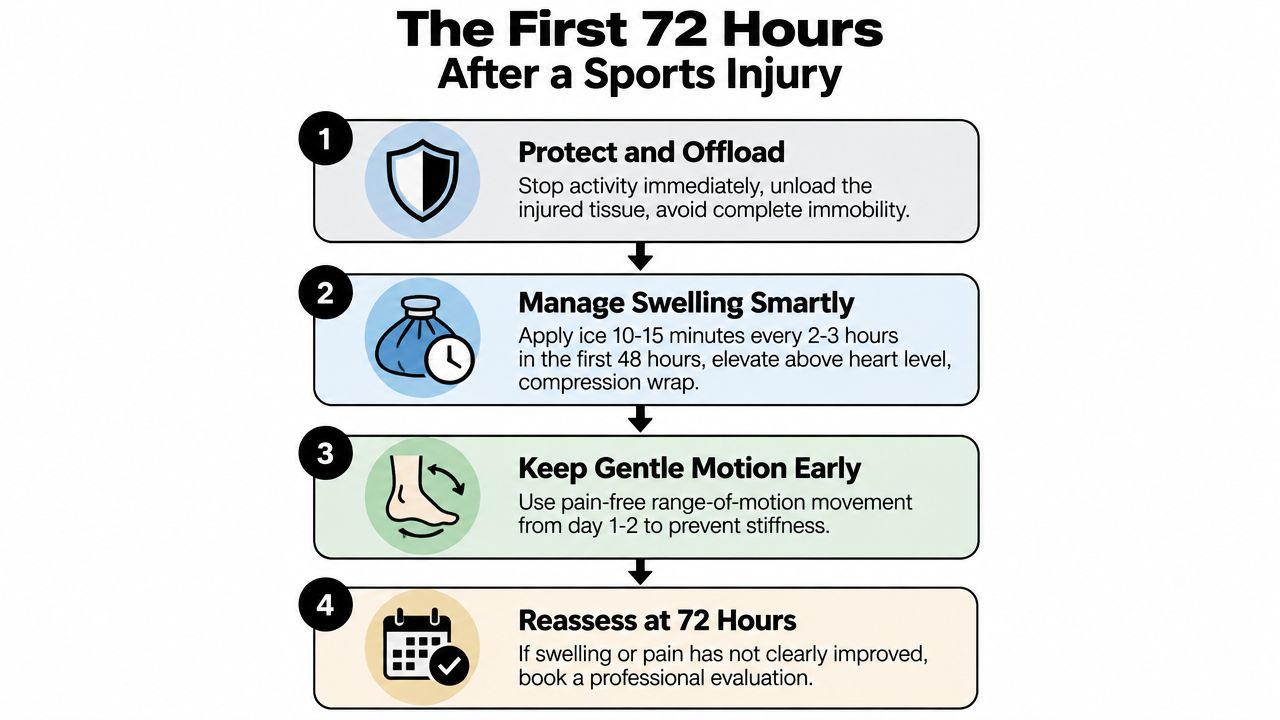
A recreational soccer player lands awkwardly after contesting a header. The ankle hurts immediately, swelling appears around the outside joint, and walking produces a limp. The athlete's first instinct is often to test it repeatedly, stretch aggressively, or search for a fixed recovery timeline. A better response treats the first 48 to 72 hours as an early triage window.
Protect the tissue without shutting the body down
Stop the activity that caused the pain. Protect the injured area from impact and excessive loading, but don't assume complete immobility is always helpful. For many soft-tissue injuries, the POLICE approach, protection, optimal loading, ice, compression, and elevation, is more useful than an automatic rest-only routine.
Use crutches, a brace, or another support if normal walking causes a sharp increase in pain or produces a pronounced limp. If gentle movement stays comfortable, maintain small, pain-free motions rather than forcing a stretch. An ankle may tolerate slow circles or supported dorsiflexion, while an irritated shoulder may tolerate a relaxed pendulum. The movement should reduce stiffness, not provoke a stronger pain response later.
Compression can help limit swelling when applied comfortably, and elevation is most useful when the injured limb is positioned above heart level. Ice may reduce pain for a short period, but it doesn't repair a torn ligament or replace an evaluation. Athletes who want a focused discussion of temperature-based care can review this sprained ankle heat or ice guide.
Know when home care isn't enough
Seek prompt medical assessment for inability to bear weight, visible deformity, numbness, tingling, loss of coordination, or rapidly expanding swelling. A joint that becomes markedly swollen soon after a twisting injury may require imaging or urgent evaluation, particularly when the athlete can't identify a comfortable position or movement.
Practical rule: If the injury changes how you walk, prevents normal use of the limb, or produces neurological symptoms, stop testing it yourself.
At MedAmerica Rehab Center, early care can include physical therapy triage, chiropractic assessment of nearby joint restrictions, and selected soft-tissue or shockwave modalities when clinically appropriate. Those services should support a clear baseline, not distract from determining whether the injury needs imaging or referral. The first useful outcome is a documented starting point for swelling, movement, strength, gait, and function.
Getting a Professional Evaluation That Actually Changes the Plan
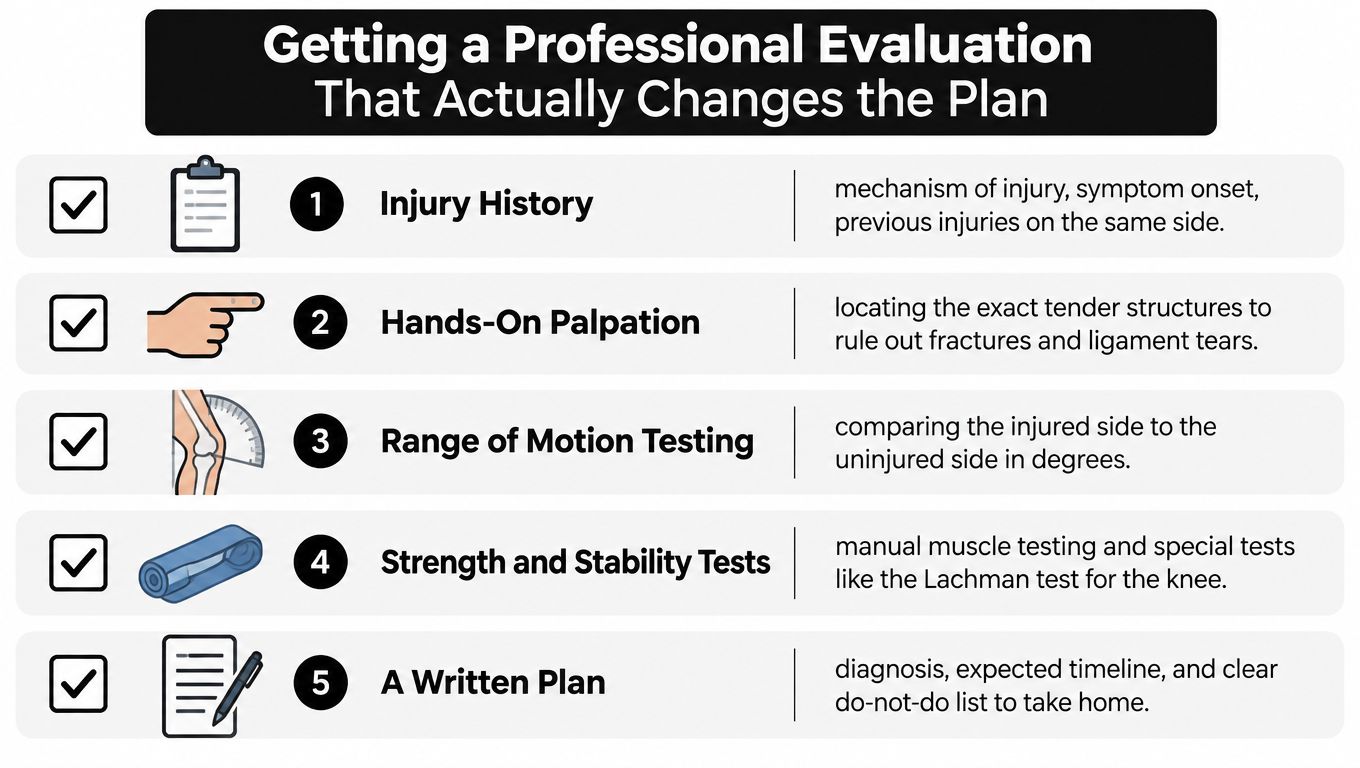
A professional evaluation should turn “my knee hurts” into a working problem list. The clinician needs to know what happened, what changed immediately, and which tasks now fail. A useful appointment isn't a quick massage followed by a generic exercise sheet.
Start with the mechanism
The injury mechanism narrows the possibilities. A planted foot with a twisting knee, a shoulder forced overhead, a direct blow to the thigh, and a sprint-related pull each place different tissues under stress. The evaluator should also ask about prior injuries on the same side, training changes, footwear, surface, and the exact moment symptoms began.
The hands-on portion should identify tender structures and assess swelling, joint mobility, and protective muscle guarding. Orthopedic special tests can help screen for ligament, tendon, meniscal, or joint involvement, but no single test should replace the full history and movement assessment.
Measure the side-to-side difference
Range of motion should be recorded and compared with the uninjured side. Strength testing may use manual resistance, a handheld dynamometer, or an isokinetic system where available. The clinician should also watch gait, a squat, a step-down, a single-leg stance, and any safe movement that resembles the athlete's sport.
Imaging is most valuable when its result changes management. X-rays can help evaluate suspected bone injury, ultrasound can help assess selected superficial tendons and soft tissues, and MRI can clarify deeper structural damage when the clinical findings justify it. Ordering every scan immediately can create noise, expense, and anxiety without improving the first treatment decision.
Leave with written boundaries
A useful plan states what the athlete can do, what must stop, which symptoms require reassessment, and what milestone permits progression. Physical therapy typically addresses mobility, strength, compensations, gait, balance, and sport-specific loading. Chiropractic care may be relevant when joint restriction or movement imbalance contributes to how force travels through the injured region. Manual therapy and shockwave treatment can complement active rehabilitation, but passive treatment shouldn't become the entire program.
For athletes comparing providers, this guide to choosing a physical therapist offers a practical standard: look for an evaluation that connects findings to measurable goals and sport demands. A diagnosis matters, but the plan matters more when it tells you how progress will be tested.
Phased Rehab From Pain Control to Sport-Specific Power
A strong rehabilitation plan advances when the athlete earns the next level of loading. A calendar can describe elapsed time, but it can't tell you whether swelling has settled, whether strength has returned, or whether the athlete can absorb force safely.
Phase 1 focuses on protection and activation
The first phase reduces pain and swelling while preserving available function. Depending on the injury, this may include comfortable range-of-motion work, breathing and relaxation strategies, protected walking, and low-intensity isometric contractions. A quadriceps set, gentle calf isometric, or pain-free shoulder setting exercise can maintain activation without demanding fast movement.
The progression cue is simple: symptoms should remain stable during the session and settle afterward. If swelling increases or pain becomes sharper later that day, the load was too high.
Phase 2 restores usable movement
The target is full, pain-free range of motion, not merely the ability to move farther than yesterday. Examples might include prone hip extensions, ankle dorsiflexion drills, controlled knee flexion, or shoulder pendulums followed by active-assisted elevation. A therapist may add soft-tissue techniques or controlled joint mobilization when stiffness limits normal mechanics.
Don't chase end-range discomfort. The body needs repeated, controlled exposure to the missing movement, followed by a check of how the joint responds.
Phase 3 rebuilds force production
Strength work begins with controlled resistance and progresses through slower tempo, greater range, and more demanding mechanical advantage. Bilateral exercises can introduce load, then unilateral work exposes the side-to-side difference. Split squats, step-downs, single-leg calf raises, rows, presses, and hip-hinge variations should match the injured region and the athlete's tolerance.
The progression cue is quality. The athlete should control alignment, avoid protective shifting, and complete the prescribed work without a delayed swelling response.
Phase 4 trains balance and reactive control
Many athletes under-train this phase because basic strength feels like recovery. Sport requires the nervous system to organize force when the surface, opponent, or direction changes. Single-leg balance, reaching tasks, perturbations, landing drills, and carefully introduced hopping teach the athlete to control the limb under uncertainty.
Phase 5 restores sport demands
The final phase uses running intervals, plyometrics, deceleration, cutting, throwing, contact preparation, or repeated efforts that mirror competition. The athlete must tolerate not only one good repetition, but the volume and fatigue pattern of the sport.
At MedAmerica Rehab Center, clinicians can sequence physical therapy, exercise progression, chiropractic input, and selected modalities around these changing demands. Athletes interested in nutrition alongside rehabilitation can also review this resource on how collagen helps ligaments, while keeping expectations realistic. Nutrition may support general tissue health, but it doesn't replace progressive loading or medical assessment.
| Phase | Primary Goal | Example Exercises | Progression Cue |
|---|---|---|---|
| 1 | Control symptoms and maintain activation | Isometrics, protected mobility, supported walking | Pain and swelling remain stable |
| 2 | Restore pain-free movement | Active mobility, pendulums, dorsiflexion drills, controlled mobilization | Range approaches the uninjured side |
| 3 | Rebuild strength | Split squats, tempo work, single-leg calf raises | Technique and side-to-side force improve |
| 4 | Restore balance and reaction | Single-leg stance, perturbations, hopping, landing drills | Control remains consistent under challenge |
| 5 | Rehearse competition demands | Running intervals, plyometrics, cutting, throwing, contact progressions | Full sport-specific load causes no symptom flare |
Return to Play on Measurable Criteria Not the Calendar
Pain reduction is encouraging, but it isn't a clearance test. An athlete can feel better because the irritated tissue is quieter while still lacking the strength, control, or confidence needed for sprinting, landing, changing direction, or contact.
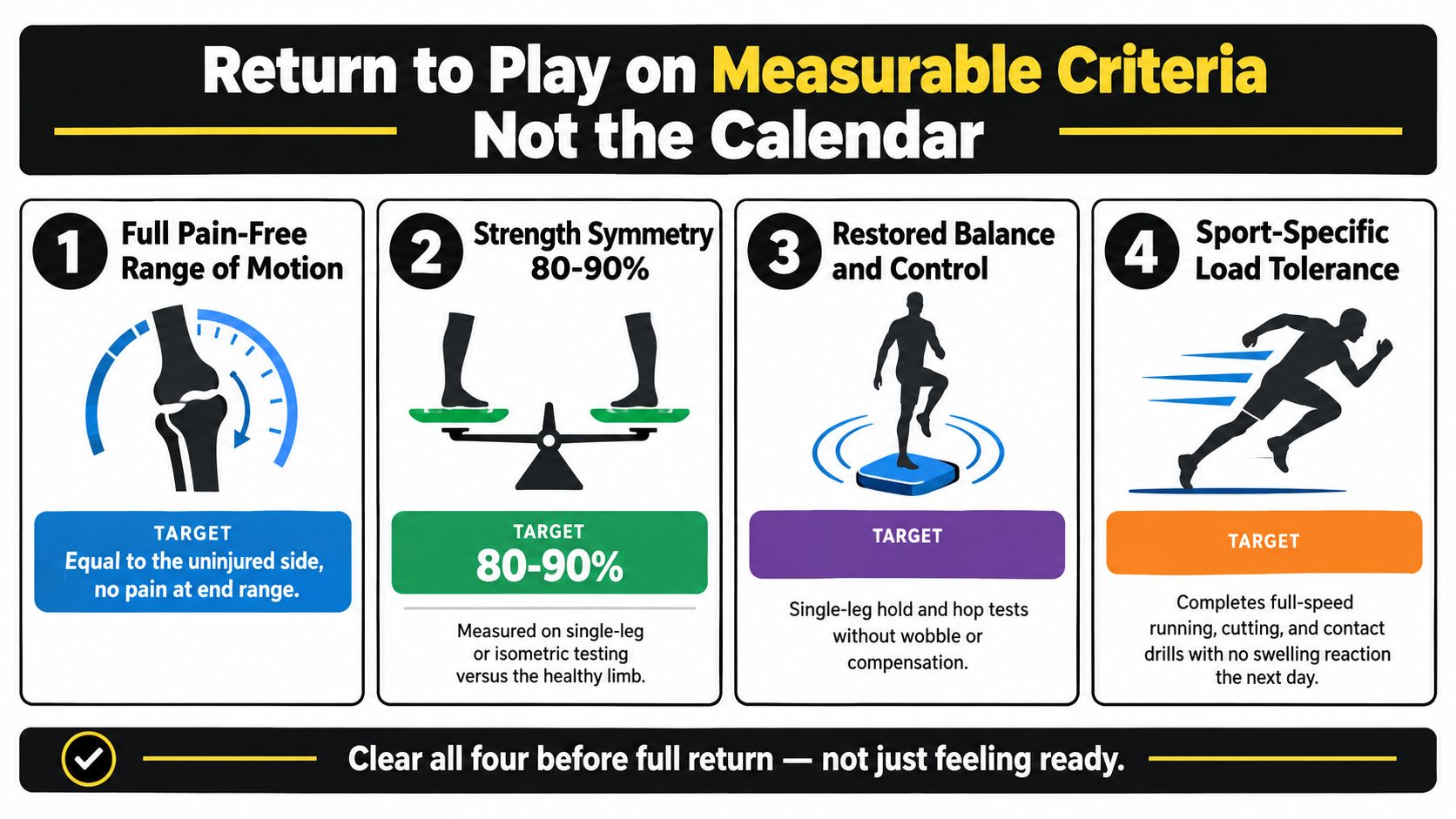
Four gates should guide the decision
Full pain-free range of motion. The injured side should match the uninjured side as closely as the injury and sport allow, with no painful restriction at end range.
Strength symmetry. Rehabilitation benchmarks commonly use approximately 80% to 90% strength symmetry compared with the opposite side, although the appropriate threshold depends on the injury, sport, test method, and stage of recovery (sports rehabilitation criteria review).
Balance and proprioception. Single-leg stance, reach testing, and hop tasks reveal whether the athlete can control the limb without wobble, trunk compensation, or protective landing.
Sport-specific load tolerance. The athlete should complete progressively faster running, cutting, jumping, throwing, or contact work without a meaningful swelling or pain reaction afterward or the next day.
The value of these gates is that they expose gaps hidden by ordinary walking. A shoulder may move well but lack repeated overhead endurance. A knee may pass a basic squat but fail a timed agility drill. A hamstring may feel comfortable during jogging yet struggle with high-speed exposure.
A criteria-based pathway also protects athletes from returning too early. In one acute sports-injury rehabilitation pathway, median progress reached pain-free status in 13 days, controlled sports training in 17 days, and full team training in 18 days, yet 8% experienced reinjury within 1 year, with most of those reinjuries occurring during the first 2 months after return (criteria-based rehabilitation study). The lesson isn't that those dates apply to everyone. It's that reaching a calendar milestone doesn't prove that tissue capacity has caught up.
A staged model is especially important after concussion. Athletes shouldn't return on the day of injury, and progression requires symptom resolution and normalized cognitive testing (consensus statement on sports rehabilitation). Confidence is the final checkpoint. Fear, hesitation, or avoidance during a familiar movement deserves attention, not dismissal.
Athletes can use this return-to-play guidance to frame the conversation with their clinician and bring sport-specific questions to the appointment.
Pre-Return Testing Checklist Athletes Can Trust
The final stretch should resemble a controlled rehearsal, not a sudden jump from therapy exercises to competition. A two-week checklist gives the athlete and therapist a shared way to identify weak links before full exposure.
Week one checks capacity
Start with objective testing while symptoms are quiet:
- Range of motion: Measure the injured and uninjured sides with a goniometer and record painful or restricted positions.
- Strength: Use a handheld dynamometer, isokinetic system, or a consistent clinic method to compare limbs.
- Balance: Complete Y-balance testing and single-leg control tasks without trunk lean or foot collapse.
- Hopping: Progress through single-leg distance, triple, crossover, and timed hop tasks when appropriate for the injury.
The test result matters, but so does the movement strategy. A distance achieved through a stiff landing or a large protective shift doesn't represent the same readiness as a quiet, controlled repetition.
Week two reproduces the sport
Build intensity through high-effort running intervals, deceleration, cuts, and progressive plyometrics. Field athletes may add controlled contact, ball work, stick handling, or reactive changes of direction. Court athletes should rehearse repeated jumps, lateral movement, and short recovery periods rather than only straight-line jogging.
Track the response after each session. No meaningful swelling, stable pain, and normal movement the following day are more useful than a promise that the athlete can return on a particular date.
Psychological readiness belongs on the checklist too. Rate confidence in the injured limb on a 0 to 10 scale, and treat a rating of 8 or higher as one useful readiness signal rather than a standalone clearance rule. The athlete should also complete three consecutive full practices without symptom flare before returning to unrestricted competition. These criteria come from the proposed clinical checklist, so the treating professional should adapt them to the injury and sport.
Staying Uninjured With Smart Prevention Habits
Prevention works best when it becomes part of normal training. The program doesn't need to compete with sport practice. It needs to prepare the joints and tissues for the exact forces they will face.
Warm up with movement, not a rushed stretch
Use a structured dynamic warm-up before every session. Include sport-specific mobility, activation for the hips and trunk, balance or landing preparation, and gradual increases in speed. Static stretching alone won't prepare an athlete for repeated sprinting, cutting, or jumping.
Strength maintenance should continue after symptoms disappear. Focus on the legs, hips, trunk, shoulders, or other areas that absorb the sport's repeated loads. The exercise choice should reflect the athlete's injury history, not a generic list copied from another sport.
Monitor the training load
Keep a simple log of training minutes, running volume, games, and unusually hard sessions. If the workload rises faster than the athlete can tolerate, soreness and movement changes often appear before a clear injury. A clinician can help adjust intensity, recovery days, and exercise selection without removing all activity.
Maintain mobility in areas that influence the injured region, including the ankles, hips, and thoracic spine when relevant. Add neuromuscular refreshers such as single-leg balance, landing mechanics, and eccentric strengthening throughout the week. These are maintenance tasks, not emergency repairs.
Sleep and recovery habits matter because tissues need time between demanding sessions. The prevention plan should also account for the athlete's work schedule, travel, age, surface, footwear, and competition calendar. For Deerfield Beach athletes, a clinic can turn those details into a sport-specific off-season plan rather than waiting for the next setback.
Your Recovery Roadmap and Next Step With MedAmerica Rehab Center
A practical recovery roadmap looks like this:
- Triage: Protect the injured area, manage swelling, maintain only comfortable movement, and identify red flags.
- Evaluation: Document the mechanism, tenderness, range of motion, strength, gait, balance, and movement quality.
- Rehabilitation: Progress from symptom control through mobility, strength, proprioception, and sport-specific power.
- Testing: Confirm functional benchmarks, sport-load tolerance, and psychological readiness.
- Prevention: Maintain strength, mobility, warm-up quality, load awareness, and recovery habits.
Each step has a milestone. You should know what has improved, what remains limited, and what test permits the next demand. That approach also helps prevent the compensation patterns that develop when athletes train around pain for too long.
MedAmerica Rehab Center offers coordinated physical therapy, chiropractic care, acupuncture, and shockwave therapy in a Deerfield Beach setting. The useful feature of a multidisciplinary plan is that active exercise, hands-on care, movement assessment, and symptom management can be organized around the same functional targets rather than handled as disconnected appointments. For simple foot-care ideas that may complement, but never replace, injury-specific rehabilitation, athletes can review this foot massage guide from Evermost LLC.
Bring any imaging reports, a list of your sport's demands, your recent training schedule, and the movements you currently can't perform. Ask for a written plan with clear restrictions, progression markers, and return-to-play tests. Booking an evaluation early won't guarantee a faster recovery, but it can prevent weeks of guessing and reduce the chance that pain relief hides an unfinished rehabilitation process.
MedAmerica Rehab Center provides individualized physical therapy, chiropractic care, acupuncture, and shockwave therapy to help athletes manage pain, restore movement, rebuild strength, and progress toward sport safely. Visit MedAmerica Rehab Center to request a same-day evaluation in Deerfield Beach and leave with a practical recovery roadmap built around measurable criteria.
MedAmerica Rehab · Deerfield Beach
Talk to a clinician about your pain
Physical therapy, chiropractic, acupuncture and shockwave therapy under one roof, since 1995. Same-day appointments are available.
Mon–Thu 8:00 AM – 6:30 PM · Fri 8:00 AM – 3:00 PM